现代汽车集团

Search documents
赛事招募|绿能智创 驱动未来2025第三届零碳技术专精特新创业大赛长三角预选赛上海站项目报名通道开启
势银能链· 2025-10-12 02:04
Core Viewpoint - The article emphasizes the acceleration of global energy transition driven by carbon neutrality goals, highlighting the emergence of zero-carbon technologies such as green hydrogen, fuel cells, and energy storage as key areas for innovation and investment [2][3]. Group 1: Event Background - The 2025 Zero Carbon Technology Entrepreneurship Competition aims to discover promising zero-carbon technology companies and promote the deep collaboration of technology, capital, and industry [2][3]. - The competition is initiated by Yield Capital, TrendBank, and other partners, focusing on the incubation and industrialization of innovative technologies [2][3]. Group 2: Innovation and Growth - The event seeks to provide a platform for technology innovators to showcase their work and accelerate the transition from laboratory to industrial application [3]. - It aims to connect industry partners with cutting-edge technologies to promote the large-scale application of zero-carbon solutions [3]. - Investment institutions are encouraged to identify high-growth projects and nurture future leaders in the green energy sector [3]. Group 3: Competition Structure - The competition includes various tracks focusing on different aspects of zero-carbon technology, such as green hydrogen, carbon capture, fuel cells, new energy storage, new hydrogen production methods, and smart energy [9][10][11][12][13][14]. - Each track addresses specific technological advancements and their potential impact on achieving carbon neutrality [9][10][11][12][13][14]. Group 4: Support for Participants - High-quality projects will receive support in financing, market branding, and incubation acceleration [15][16]. - Participants will have opportunities for one-on-one financing consultations, exposure to industry leaders, and potential media coverage [18][19]. Group 5: Upcoming Events - The competition will feature multiple preliminary rounds across different regions, including Shanghai and Beijing, leading to a final competition [21][22][25][27]. - The events are designed to enhance interaction among industry experts, market resources, and technology specialists [19].

韩、日、美、欧战略布局 “三国一区”竞逐AI赋能制造业新赛道
Zhong Guo Qi Che Bao Wang· 2025-10-11 01:58
Group 1 - The global manufacturing industry is undergoing a profound transformation driven by artificial intelligence (AI), with the automotive sector at the forefront of this shift [2][6] - South Korea plans to mass-produce humanoid robots by 2029 and AI-driven autonomous vehicles by 2030, aiming to become a global leader in manufacturing AI transformation [2][4] - Japan's government is focusing on practical applications of AI in manufacturing, with a basic plan to enhance AI development and usage across society [3][4] Group 2 - The United States is investing $33 million in four key areas of smart manufacturing, including supply chain technology and electric vehicle production, linking AI with clean energy transitions [3][4] - The European Union is launching the "AI Continental Action Plan" to balance policy and infrastructure, including a "super factory" with 100,000 AI chips to support manufacturing and transportation sectors [4][5] - Major economies are pushing for AI integration in manufacturing due to the urgent need for industry transformation and the competitive pressure from global technological advancements [4][5] Group 3 - AI is set to reshape the automotive industry by enhancing design, production, sales, and after-sales services, creating new value and changing human-vehicle interactions [6][7] - South Korea's plan for AI-driven autonomous vehicles aims to accelerate the commercialization of autonomous driving technology [7] - The integration of AI in the automotive sector will lead to a transition from traditional manufacturing to a smart mobility ecosystem, transforming vehicles into multifunctional smart terminals [7][8] Group 4 - Chinese automotive companies face unique opportunities and competitive pressures in the context of AI integration, requiring a shift in mindset to view data as a core asset [8][9] - The potential for cross-industry applications of AI technology in areas like robotics and drones presents new growth opportunities for suppliers [8][9] - Despite the potential for technology reuse, challenges remain in applying automotive AI technology to other sectors, particularly regarding safety and regulatory requirements [9]

中国机器人,在韩国需求量渐起
Huan Qiu Wang· 2025-10-10 07:34
Group 1: Industry Overview - The APEC meeting in late October will focus on the cooperation and competition in the robotics sector between China and South Korea, with Chinese companies preparing to mass-produce robots tailored for the South Korean market by the end of this year [1][9] - South Korea's Ministry of Trade, Industry and Energy has announced a plan to invest 1 trillion KRW (approximately 0.84 billion USD) by 2030 to enhance humanoid robot technology, aiming to achieve global leadership in emerging industries, including robotics [1][3] Group 2: Market Demand and Opportunities - There is a strong demand for robots in South Korea, with numerous inquiries from Korean enterprises and educational institutions, indicating a growing interest in Chinese robotic technology [2][5] - The cloud-based robot inspection solutions, such as the industrial-grade robot dog developed by Hangzhou Yundongchu Technology, are expected to save significant labor hours in inspections, showcasing the practical benefits of adopting Chinese robotic solutions [3][4] Group 3: Competitive Landscape - South Korean companies like Hyundai and Samsung are actively investing in robotics, with Hyundai acquiring an 80% stake in Boston Dynamics for 800 million USD and Samsung investing approximately 0.62 billion RMB in Rainbow Robotics [3][4] - Chinese robots are perceived as more cost-effective and have more practical deployment experience compared to South Korean counterparts, which face challenges in commercializing advanced humanoid robots [4][5] Group 4: Collaboration and Development - Chinese companies are open to collaboration with South Korean firms, focusing on integrating their technologies and platforms to enhance operational efficiency [7][8] - The trend of "second development" is prevalent, where foreign partners seek to customize and adapt Chinese robots for local needs, indicating a flexible approach from Chinese manufacturers [7][8] Group 5: Production and Supply Chain - The demand for Chinese robots in overseas markets is surging, leading to challenges in meeting production capacity, with some partners expressing concerns over long delivery times [8][9] - Plans are in place for mass production of robots tailored for the South Korean market by the end of this year, with potential future strategies including supplying key components for local assembly [9]

钱政宇:把握大势,中韩经贸合作拓展新领域
Huan Qiu Wang· 2025-10-09 23:42
Core Viewpoint - The China-South Korea economic and trade relationship is at a new historical juncture, facing risks and challenges due to the evolving international landscape, regional cooperation dynamics, and structural changes in their economic ties. However, the complementary nature of their industrial structures and the pragmatic diplomatic approach of the South Korean government provide a solid foundation for cooperation and potential growth in new areas [1][2]. Group 1: Economic Cooperation Framework - The formal implementation of the Regional Comprehensive Economic Partnership (RCEP) has injected strong institutional momentum into China-South Korea economic relations, significantly reducing regional transaction costs and enhancing supply chain resilience [1][2]. - Under the RCEP agreement, both countries will implement zero tariffs on 86% of each other's products, including key sectors like automotive parts and chemicals, opening new avenues for high-value industry cooperation [2]. - The RCEP's rules of origin accumulation mechanism is crucial for deepening the integration of the industrial chains between China and South Korea, allowing for easier access to tariff benefits [2]. Group 2: Digital and Green Economy - The digital and green economies are emerging as new growth points for China-South Korea economic cooperation, driven by both countries' internal demands for economic transformation and global sustainability agendas [3]. - In the digital technology sector, cooperation is expanding into areas such as e-commerce, artificial intelligence, cloud computing, and big data, with significant investments planned by both governments [3]. - In the green economy, both countries are actively pursuing carbon neutrality and have made substantial progress in renewable energy, electric vehicles, and hydrogen energy technologies [3]. Group 3: Local Cooperation and Mechanism Innovation - Local-level cooperation between China and South Korea is characterized by innovative practices such as city pairings and logistics integration, which have become vital for practical collaboration [4][5]. - The "Twin Cities and Twin Halls" model between Weihai and Incheon has successfully facilitated over 320 trade exchange activities, generating a trade volume of $1 billion [4]. - Platforms like the Changchun International Cooperation Demonstration Zone are expanding cooperation opportunities, enhancing logistics capabilities in Northeast Asia [5]. Group 4: Future Prospects - The ongoing release of RCEP benefits and the advancement of the third phase of the China-South Korea Free Trade Agreement negotiations are expected to foster continuous innovation in local cooperation, particularly in industrial chain collaboration and cross-border financial cooperation [5]. - The commitment to mutual respect and benefit will be essential for the sustained development of China-South Korea economic relations, contributing to regional economic stability and prosperity [5].
中国机器人在韩国需求量渐起,一中国机器人企业:每天都要接待韩国参观团体
Huan Qiu Shi Bao· 2025-10-09 23:06
Core Insights - The APEC informal meeting in South Korea at the end of October will focus on the competitive and cooperative landscape in the robotics sector between China and South Korea [1] - Chinese robotics companies are preparing to mass-produce robots tailored to the South Korean market by the end of this year [1] Group 1: Market Demand and Opportunities - There is a strong demand for robotics in South Korea, with numerous inquiries from Korean enterprises and educational institutions to Chinese companies [2] - The South Korean government is investing 1 trillion KRW (approximately 0.84 billion USD) by 2030 to enhance humanoid robot technology and support related R&D projects [1][3] - Chinese companies, such as Hangzhou Yundongchu Technology, are experiencing significant interest from South Korean clients, indicating a growing market for Chinese robotics products [2][3] Group 2: Competitive Landscape - South Korean companies like Hyundai and Samsung are actively investing in robotics, with Hyundai acquiring 80% of Boston Dynamics for 800 million USD and Samsung purchasing a stake in Rainbow Robotics [3] - Despite the advancements in South Korea, challenges remain in developing competitive bipedal humanoid robots, with most local products still in research and educational phases [4] Group 3: Product Development and Innovation - Hangzhou Yundongchu has developed industrial-grade robots for various applications, including power inspection and emergency response, with plans to export their products to Singapore and South Korea [3] - The company has introduced the X30 quadruped robot and the M20 wheeled robot, which are gaining traction in the South Korean market due to their competitive pricing and operational experience [4] Group 4: Collaboration and Integration - There is a need for strong partnerships between Chinese and South Korean companies to integrate technologies, such as connecting robots to control platforms for real-time monitoring [7] - Chinese robotics firms are generally more open to collaboration and customization, allowing for "second development" opportunities that cater to local market needs [8] Group 5: Production Capacity and Supply Chain - The rapid increase in demand for robotics has led to challenges in production capacity, with some partners expressing concerns over long delivery times [8] - Chinese companies are expanding their manufacturing capabilities, with plans to establish new factories to meet the growing demand in South Korea [8][9]
美国最大的CEO们正在敲响警钟
汽车商业评论· 2025-10-06 23:05
Core Viewpoint - The U.S. manufacturing sector, particularly the automotive industry, is facing a severe labor shortage, with a significant gap between demand and supply of skilled workers, which is exacerbated by recent immigration policies and a lack of investment in vocational training [3][5][19]. Labor Shortage in Key Industries - Jim Farley, CEO of Ford, highlighted the critical labor shortage in key sectors such as construction, manufacturing, and transportation, with 17.4% of the manufacturing industry reporting labor shortages [3][5]. - The manufacturing sector is projected to need 3.8 million jobs over the next decade, indicating a long-term challenge in workforce availability [3]. Automotive Industry Challenges - The automotive sector specifically requires approximately 795,000 technicians in the next five years, with a projected shortfall of nearly 971,000 positions by 2028 in various fields including automotive and diesel mechanics [5][8]. - Farley emphasized that the undervaluation of blue-collar workers has led to a significant decline in productivity and an acute labor shortage in critical economic areas [5][10]. Immigration Policy Impact - The recent increase in H-1B visa fees to $100,000 has created additional barriers for companies seeking to hire skilled foreign workers, further complicating the labor situation in the automotive industry [7][8]. - The approval rate for H-1B visa applications has dropped significantly, with only 20% of applicants expected to be approved in the 2025 fiscal year [7]. Training and Education Gaps - There is a pressing need for improved apprenticeship programs and vocational education to attract younger generations to blue-collar jobs, as many young workers are struggling to make ends meet [15][19]. - Farley noted that the traditional perception of blue-collar work is changing, with many young people questioning the necessity of a college degree in favor of skilled trades [13][14]. Economic and Technological Shifts - The shift towards electric vehicles (EVs) is creating new demands for skilled technicians, but the existing pay structures in the automotive repair industry are not aligned with the complexities of modern vehicle maintenance [25][26]. - The automotive industry must adapt to the evolving technological landscape, which requires a workforce skilled in both traditional and advanced manufacturing techniques [20][26]. Collaborative Solutions - Farley has initiated the "Essential Workforce Initiative" to collaborate with government and industry leaders to establish stable training channels for skilled labor [19]. - There is a call for a new visa system to facilitate the entry of skilled workers from countries like South Korea, which could help alleviate the labor shortage in the automotive sector [10][11].


应宜伦中环敲锣,港交所智能座舱第一股响了!
汽车商业评论· 2025-09-30 06:41
Core Viewpoint - The article discusses the successful IPO of Botai Car Networking Technology (Shanghai) Co., Ltd. and its strategic partnerships, particularly with Porsche, highlighting its growth potential in the smart automotive sector and the significance of its technological advancements and market positioning [4][5][19]. Group 1: IPO and Market Performance - Botai Car Networking launched its IPO on September 22, 2025, with a subscription rate of 529.79 times, and the final issue price was HKD 102.23 per share, raising approximately HKD 919 million [4]. - On its first trading day, Botai's stock surged by over 30%, reaching a midday price of HKD 142.8, giving it a market capitalization of HKD 21.4 billion (approximately RMB 19.6 billion) [5]. Group 2: Financial Growth - From 2022 to 2024, Botai's revenue doubled from RMB 1.218 billion to RMB 2.557 billion, achieving a compound annual growth rate of 44.9% [19]. - In the first five months of 2025, the company reported revenue of RMB 754 million, a year-on-year increase of 34.4%, with a gross margin recovery to 13.1% [19]. Group 3: Strategic Partnerships - Botai has established a robust partnership ecosystem, including deep collaborations with Huawei for domestic market positioning, Qualcomm for global market integration, and Horizon for future innovation [13][15][16]. - The partnership with Porsche is particularly significant, as it positions Botai as a key player in the luxury automotive sector, similar to how CATL gained prominence through its collaboration with BMW [5][19]. Group 4: Technological Advancements - Botai has pioneered several innovations in the automotive sector, including the first 3G vehicle networking system and a solid-state sound field intelligent system, with over 6,000 patent applications, 80% of which are invention patents [9][10]. - The company has developed an integrated model of "software + hardware + cloud services," focusing on smart cockpit solutions and networked services, differentiating itself from pure hardware manufacturers [9][10]. Group 5: Future Outlook - The company is positioned to expand into new fields such as embodied intelligence, leveraging its existing technology in perception and decision-making algorithms [14]. - With its strategic upgrades and the opening of overseas markets, Botai is expected to redefine its growth logic and explore significant upward potential in the future [20].

出海制造企业如何在新加坡选址布局?
第一财经· 2025-09-24 02:08
Core Insights - The article highlights Singapore's robust manufacturing ecosystem, showcasing how global giants like Hyundai Motor Group and Shimano are leveraging Singapore's industrial landscape for future factory developments [3][6]. - It emphasizes the strategic role of Singapore's land management and industrial space planning in supporting advanced manufacturing and attracting foreign enterprises [9][30]. Group 1: Manufacturing Ecosystem - Hyundai Motor Group has established its first global open innovation lab, focusing on electric vehicle business models and smart manufacturing technologies [3]. - Shimano is developing a smart factory in Singapore, incorporating modular layouts and real-time monitoring systems for future upgrades [3]. - Singapore's industrial ecosystem serves as a testing ground for manufacturing upgrades, providing a platform for Chinese manufacturing companies to connect with global markets [6][30]. Group 2: Land Management and Planning - Singapore's land ownership is state-controlled, with the Land Management Authority overseeing land sales and distribution to meet market demands [9]. - The Urban Redevelopment Authority is responsible for the "Master Plan," guiding land use and development for the next 10 to 15 years [9]. - The article outlines the flexible land use categories in Singapore, including B1, B2, and Business Parks, managed primarily by JTC Corporation [11][13]. Group 3: Support for Enterprises - The Singapore government provides clear categorization of land and space resources, facilitating efficient matching for enterprises based on their operational needs [17][30]. - Various government agencies, including the Economic Development Board, offer support for companies looking to establish operations in Singapore [30]. - The recent "2025 Master Plan" draft indicates a shift towards more diverse land use, allowing companies to adapt quickly to market conditions [30].

现代汽车发布中长期战略:2026年推出首款后驱豪华混合动力车
Huan Qiu Wang Zi Xun· 2025-09-23 07:42
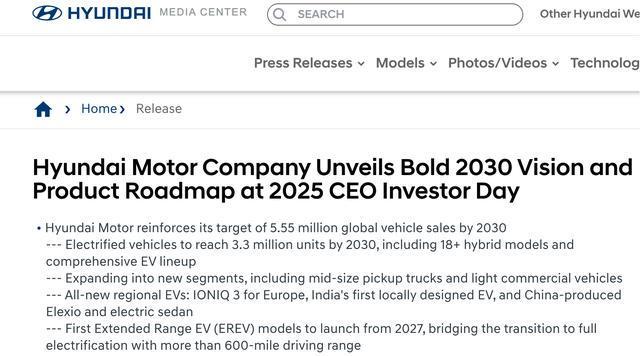
Core Insights - Hyundai Motor Group has announced a mid-to-long-term strategic plan focusing on accelerating electrification starting in 2026, with plans to launch new models across four powertrain types: HEV, EV, EREV, and FCVC [1][3] - The first luxury hybrid vehicle based on a rear-wheel drive architecture is set to debut in 2026, featuring the new TMED hybrid system aimed at enhancing performance and fuel efficiency [1] - By 2030, Hyundai aims to achieve global annual sales of 5.55 million vehicles, with eco-friendly models (including HEV, EV, EREV, and FCVC) making up 60% of this total, equating to 3.3 million units [1] Electrification Strategy - Hyundai plans to introduce a new generation of hybrid systems, starting with the 2025 model year for the new generation of the Palisade, which will include features like "Stay Mode" to improve the driving experience [1] - The company is committed to a comprehensive electrification strategy, with a significant focus on enhancing the driving experience through advanced electric functionalities [1] Software Development - In the software domain, Hyundai aims to complete the development of an SDV prototype by 2026, which will gradually be integrated into production models [3] - The new generation connected system "Pleos Connect" is expected to launch in the second quarter of 2025, supporting OTA updates and personalized services [3]
掘金服务消费(上)丨服务消费“新政”将为四大行业注入新动能
Sou Hu Cai Jing· 2025-09-23 01:37
Core Insights - The Ministry of Commerce and nine other departments issued a notice on September 2025 to expand service consumption, proposing five key measures aimed at enhancing service consumption across various sectors [2][13]. - The five measures are interconnected, creating a comprehensive mechanism that addresses both supply and demand sides, with the most benefited sectors being cultural tourism, leisure entertainment, sports health, medical care, and the integration of "digital + services" [3][4]. Measure Summaries - **Cultivating Service Consumption Promotion Platforms**: This serves as the foundational framework for service consumption, supporting the upgrade of various consumption platforms, both online and offline, to reduce transaction costs and enhance consumer experience [3][4]. - **Enriching High-Quality Service Supply**: This is the core engine aimed at solving the "what to consume" issue by increasing the availability of high-quality and diverse service products, thus stimulating consumer demand [3][4]. - **Stimulating Incremental Service Consumption**: This measure focuses on creating scenarios and demands to convert potential consumption capacity into actual behavior, injecting continuous customer and capital flow into the market [3][4]. - **Strengthening Financial Support**: This acts as the "blood" of the system, guiding financial resources towards the service consumption sector, enabling consumers to spend and businesses to innovate [3][4]. - **Improving Statistical Monitoring Systems**: This serves as the "brain" of the policy, ensuring that the entire system can adapt flexibly based on actual conditions, allowing for precise governance and continuous optimization [3][4]. Industry Opportunities - The transition from "material consumption" to "service consumption" is a significant historical trend, with industries such as cultural tourism, leisure entertainment, sports health, and medical care expected to benefit the most as GDP per capita exceeds $12,000 [5][6]. - New business models in cultural tourism and leisure, such as immersive experiences and night economy activities, are anticipated to see explosive growth due to policy encouragement [5][6]. - The aging population is driving demand for home care, community care, and high-end elderly care services, alongside health management and psychological counseling, indicating a vast market potential [6][5]. - The integration of "digital + services" is crucial for enhancing efficiency and creating new supply, with continuous innovation expected in online education, telemedicine, and digital cultural tourism [6][5]. Policy Implementation - The service consumption quality improvement initiative is a long-term quality revolution aimed at enhancing service quality and variety, ultimately rebuilding consumer confidence and stabilizing consumption [7][8]. - The combination of long-term quality improvement actions and short-term promotional activities is designed to stimulate consumption effectively [7][8]. - The successful implementation of these policies hinges on breaking down barriers, providing targeted support for various sectors, and ensuring a transparent and efficient policy execution process [9][10].