
零跑

Search documents
德国成为全球第二大电动汽车生产国
Guan Cha Zhe Wang· 2026-02-05 09:39
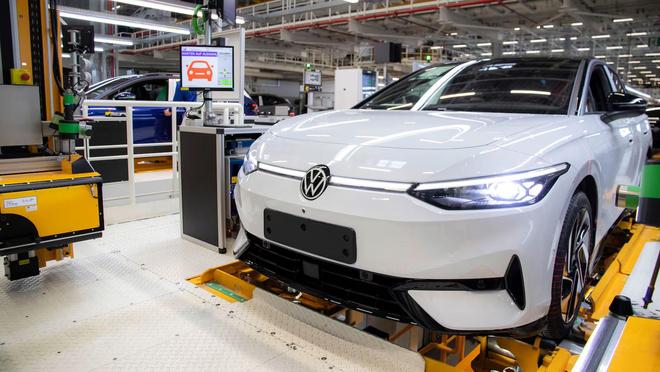
今年1月,德国政府表示,将向中低收入家庭提供最高7000美元(约4.8万元人民币)的补贴,用于购买 新的电动汽车,得益于重启电动车型购置补贴,德国汽车行业预测,到2026年德国电动汽车产量将再增 长6%,达到176万辆。 (文/观察者网 张家栋 编辑/高莘) 当地时间2月4日,德国汽车工业协会(VDA)发布数据显示,2025年德国电动汽车产量创历史新高。 大众汽车官网 数据显示,去年德国纯电动汽车产量增长15%,达到122万辆,而插电式混合动力汽车产量增长54%, 达到约45万辆。德国国内共生产167万辆电动化乘用车,比上年增长23%。VDA还称,这使得德国再次 成为全球第二大电动汽车生产地,超过了美国的104万辆,而位于榜首的中国则生产了1610万辆。 多家外媒在相关报道中表示,这一成绩意味着德国向电动出行的转型步伐显著加快,目前其电动汽车产 量约占汽车总产量的40%。 中东金融新闻网站MENAFN称,去年德国本土汽车制造商共生产415万辆汽车,延续了疫情爆发前持续 低迷的局面。不过,尽管德国整体制造业的业绩远低于2019年之前的水平,但其在电动化领域仍达到了 里程碑式的成就。 本文系观察者网独家稿件,未经 ...

零跑,可算有点工厂直销的样子了
3 6 Ke· 2026-02-05 09:37
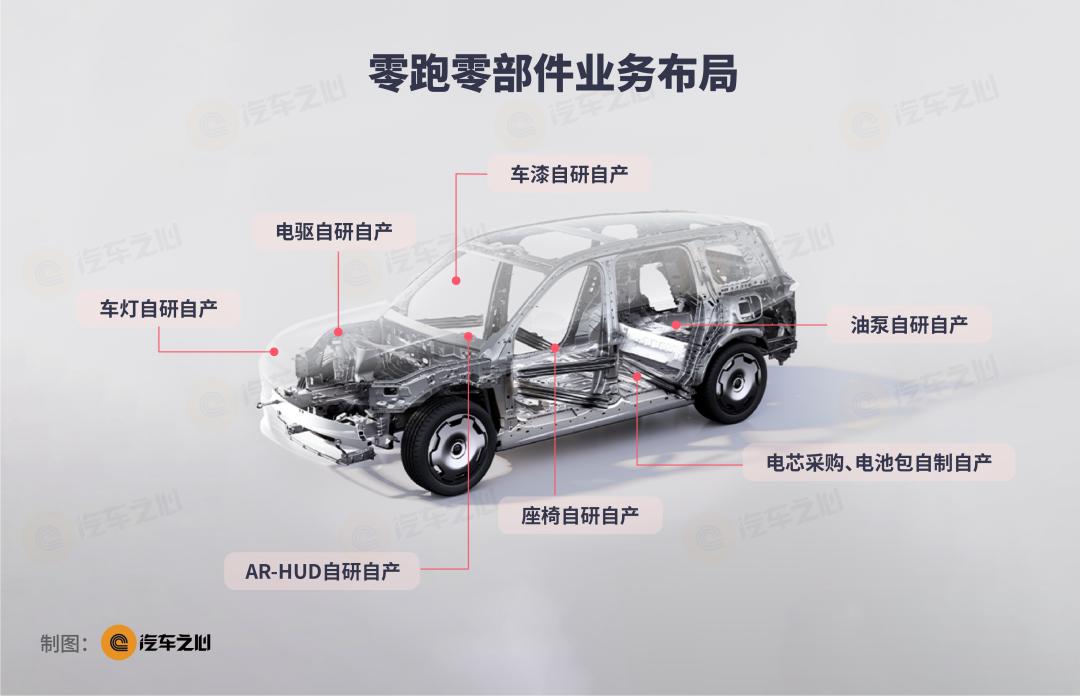
Core Viewpoint - The consensus among investors in the domestic automotive industry is that car manufacturers that cannot produce their own components are not considered good companies [1] Group 1: Supply Chain Management - In the current market competition, every car manufacturer needs to find a delicate balance between cost and profit [2] - Car manufacturers manage suppliers in three layers: direct purchase, cooperative development, and self-manufacturing of key components [3][7] - The first layer involves a direct buying-selling model where each manufacturer typically works with thousands of suppliers, undergoing multiple assessments of price, quality, and stability [5][6] - The second layer is a cooperative model where manufacturers deeply participate in technology development, as seen with Li Auto and its partnership with Aisin [8] - The third layer involves manufacturers self-developing and self-manufacturing key components, which allows them to extract profits from the supply chain [9] Group 2: Vertical Integration - Vertical integration is driven by necessity, with electric vehicle hardware costs divided into five parts: battery (40%), electric drive system (12%-13%), automotive electronics (13%-14%), body and chassis (14%-15%), and interior/exterior trim (17%) [10] - Only two players currently cover all R&D and manufacturing: Leap Motor and BYD [11] - Leap Motor focuses on rationalism in self-manufacturing components, while BYD emphasizes practical integration of its supply chain [12][18] - BYD has over 100 component factories and has built a vertically integrated supply chain from mining lithium to selling cars [18] - Leap Motor's self-manufactured components cover 70% of its vehicle costs, providing a competitive edge [9] Group 3: Profitability and Cost Management - Vertical integration allows manufacturers to eliminate middlemen, potentially leading to significant profit margins [21] - BYD's internal production of batteries is 20% cheaper than external sourcing, contributing to an increase in gross margin from 17.4% in 2021 to 22.3% in 2024 [21] - Leap Motor's gross margin turned positive for the first time after eight years, reaching 14.1% in the first half of 2025 [23] - Cost management strategies include achieving a production capacity utilization rate of over 70% and maximizing the commonality of components [27][28] Group 4: Supplier Dynamics - Car manufacturers are increasingly acting as suppliers, with BYD providing 15.6 GWh of batteries to new car manufacturers, earning an additional 1 billion yuan in net profit [33] - Leap Motor is also diversifying its revenue by supplying components to other manufacturers, projecting over 2 billion yuan in income from external supply by 2025 [39] - The competitive landscape requires manufacturers to either enhance internal component commonality or rely on external supply channels [31][32] Group 5: Future Outlook - The automotive industry is undergoing a reshuffle, with a focus on supply chain restructuring [40] - Leap Motor aims to achieve over 80% self-manufactured components, surpassing BYD's current 75% [52] - The goal is to increase production scale while reducing costs, leveraging the principle of economies of scale [54]

国联民生证券:1月车市新势力同比表现好于行业 智能化能力成竞争关键
智通财经网· 2026-02-05 06:20
Core Viewpoint - The automotive industry is experiencing a pivotal moment in smart technology, with autonomous driving capabilities becoming a key competitive factor for car manufacturers. The report anticipates a threefold turning point in technology, user acceptance, and business models for smart driving, favoring quality domestic car companies with advanced smart layouts and positive product and brand cycles [1]. Group 1: Market Performance - In January, the overall performance of the car market was subdued, with a total retail market size of approximately 1.8 million vehicles, a month-on-month decrease of 20.4% but a slight year-on-year increase. The retail sales of new energy vehicles are expected to reach 800,000 units, with a penetration rate of 44.4% [1]. - Five sample new force car companies (excluding Xiaomi and Aion) delivered a total of 130,772 vehicles in January, representing a year-on-year increase of 17.5% but a month-on-month decrease of 28.0%, outperforming the industry average [1]. Group 2: Company-Specific Performance - **Leap Motor**: In January, delivered 32,059 vehicles, a year-on-year increase of 27.4%. The strong performance is attributed to the competitive pricing of models C10 and B01. The company plans to launch its first flagship SUV D19 in April 2026 [2]. - **Xpeng**: Delivered 20,011 vehicles in January, a year-on-year decrease of 34.1% and a month-on-month decrease of 38.0%. The company plans to launch multiple new models in 2026, including the P7+ starting at 186,800 yuan [3]. - **NIO**: Delivered 27,182 vehicles in January, a year-on-year increase of 96.1%. The company is set to deliver its 60,000th ES8 on February 1, 2026, and has launched a new version of its NWM model [4]. - **Li Auto**: Delivered 27,668 vehicles in January. The company has expanded its retail and service network significantly, with 547 retail centers and 3,966 charging stations across the country [4]. - **Zeekr**: Delivered 23,852 vehicles in January, a year-on-year increase of 99.7%. The company plans to launch its second model, Zeekr 8X, in the first half of this year [4]. - **Xiaomi**: Delivered over 39,000 vehicles in January, with plans to launch the new generation SU7 in April 2026 [5][6]. Group 3: Technological Advancements - The era of intelligent driving is accelerating, with companies like Xpeng and those associated with Huawei continuously iterating and promoting smart driving technologies. The advancements are expected to lower the hardware barriers for smart driving, making it accessible in the mainstream market under 200,000 yuan, thus providing a competitive edge against joint venture brands [7].

新势力系列点评二十六:1月车市表现平淡,新势力同比表现好于行业
Guolian Minsheng Securities· 2026-02-05 00:25
Investment Rating - The report maintains a positive investment rating for the new energy vehicle sector, indicating a favorable outlook for the industry [7]. Core Insights - The performance of the new energy vehicle market in January 2026 was relatively flat, with a total retail market size of approximately 1.8 million vehicles, a month-on-month decrease of 20.4%, but a slight year-on-year increase. The penetration rate for new energy vehicles reached 44.4% [4]. - Five key new energy vehicle companies (excluding Xiaomi and Aion) delivered a total of 130,772 vehicles in January, representing a year-on-year increase of 17.5% but a month-on-month decrease of 28.0%, outperforming the industry average [4]. - The report anticipates a stabilization and recovery in automotive demand post-Chinese New Year, driven by the rollout of local government subsidies and the introduction of new models [4]. Summary by Relevant Sections Delivery Performance - Leap Motor delivered 32,059 vehicles in January, a year-on-year increase of 27.4% but a month-on-month decrease of 31.9%. The strong performance is attributed to the competitive pricing of models C10 and B01 [5]. - Ideal Auto reported 27,668 vehicles delivered, a year-on-year decrease of 7.5% and a month-on-month decrease of 37.5%. The company is focusing on enhancing user experience through software updates and expanding its service network [9]. - NIO delivered 27,182 vehicles, marking a significant year-on-year increase of 96.1% but a month-on-month decrease of 14.2%. The ES8 model was the top performer [6]. - Zeekr delivered 23,852 vehicles, with a year-on-year increase of 99.7% and a month-on-month decrease of 9.3% [10]. - Xpeng delivered 20,011 vehicles, reflecting a year-on-year decrease of 34.1% and a month-on-month decrease of 38.0% [6]. Market Trends - The report highlights the ongoing trend of intelligent driving technology adoption, with companies like Xpeng and Huawei leading the charge. The expectation is that advancements in intelligent driving will lower hardware costs and expand market access [12]. - The report suggests that the intelligent driving capabilities will become a key competitive factor for automakers, with a focus on companies that are leading in this area [12]. Investment Recommendations - The report recommends focusing on companies with strong intelligent driving capabilities and those that are well-positioned in the new energy vehicle supply chain. Specific companies highlighted include Geely, Xpeng, and BYD [12].



2026中国车企欧洲本土化动真格
Zhong Guo Qi Che Bao Wang· 2026-02-04 08:04
Group 1 - The EU is considering extending anti-subsidy tariffs on Chinese electric vehicles to include hybrid vehicles due to the rapid increase in sales of Chinese plug-in hybrids in Europe [3][4] - In October 2023, the EU initiated an anti-subsidy investigation into Chinese electric vehicles, claiming they distort the European market due to unreasonable subsidies [3][4] - The EU's investigation could lead to additional tariffs on Chinese electric vehicles, with rates potentially reaching up to 35.3% for certain manufacturers [3][4] Group 2 - Chinese car manufacturers are accelerating local production in Europe, with companies like Chery, Xpeng, and GAC already establishing assembly operations [2][6] - BYD plans to start trial production at its Hungarian passenger car factory in Q1 2026, with full production expected in Q2 2026 [2][8] - The overall sales of Chinese plug-in hybrids in Europe are projected to grow significantly, with a 645% increase expected in 2025, capturing a market share of 14% [4][5] Group 3 - The local production strategy of Chinese car manufacturers is characterized by a comprehensive approach, including supply chain, R&D, and service localization [6][9] - Xpeng is establishing a localized supply chain team in Europe and has opened a R&D center in Munich to better align with local market demands [9][10] - BYD has set up its European headquarters in Budapest, focusing on sales, after-sales, and local vehicle design, indicating a commitment to the European market [9][10] Group 4 - GAC aims to achieve an overseas sales target of 250,000 units by 2026, with Europe being a key market for its expansion [10][11] - NIO is establishing user experience centers in Norway and Germany to enhance brand perception and service offerings in Europe [11] - Xpeng leads the European market in customer satisfaction with an 81% rating, surpassing Tesla, while NIO ranks seventh among traditional luxury brands [11]

一月汽车销量解读 | 出口延续高增长
数说新能源· 2026-02-04 03:02
数说新能源 欢迎订购数说新能源2026年月度电池装机数据库和中国汽车上险数据库 联系方式:13220160736(同微信) 一、 1月份行业总体数据与特点 二、 主要主机厂2026年1月销量及动态分析 1、总量下滑,结构分化严重: 全行业:预计1月销量同比有明显下滑,幅度在两位数左右。 内销:显著下滑,是拖累全行业下行的主因。 出口:延续高增长,增速预计在30%-50%,表现强劲。 总结为"三好一差":出口好、燃油车好、新车型多的企业好;新能源车内销差。 2、内销下滑原因分析: 核心原因:补贴退坡。1月起,新能源汽车和燃油车的"以旧换新"补贴均下降,其中新能源汽车退坡更多,因此 内销下滑主要由新能源汽车引起。 成本压力:原材料(铜、铝、碳酸锂、存储芯片)成本显著上涨,对智能化程度较高的新能源汽车成本冲击尤其 大。 主流车企主动策略:在成本上涨背景下,行业并未大规模打"价格战",而是选择"保价保利润",这对行业是相对 利好的。 3、出口高增长原因分析: 延续了2024年下半年的高增长趋势(去年11、12月增速40-50%)。 背后核心原因是中国车企在海外市场和渠道的全面扩张。 4、其他结构性亮点: 燃油车表现较 ...

潘九堂:小米车主的真实用户体验和口碑传播,别人黑不动
Xin Lang Cai Jing· 2026-02-04 02:12
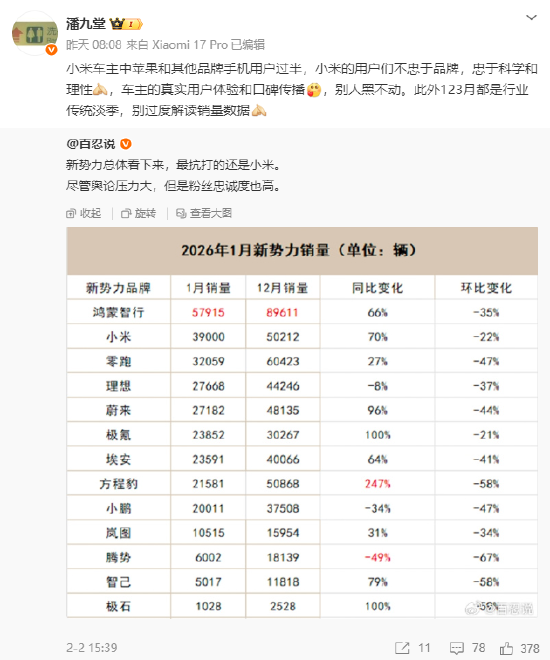
2月3日,小米产业投资部合伙人潘九堂转发了一份2026年1月新势力销量榜单并表示:"小米车主中苹果 和其他品牌手机用户过半,小米的用户们不忠于品牌,忠于科学和理性,车主的真实用户体验和口碑传 播,别人黑不动。此外,1、2、3月都是行业传统淡季,别过度解读销量数据"。 这份销量榜单显示,小米汽车1月销量为39000辆,12月销量为50212辆,环比下降22%。原博主表示, 新势力总体看下来,最抗打的还是小米,尽管舆论压力大,但是粉丝忠诚度也高。 | | | 2026年1月新势力销量(单位:辆) | | | | --- | --- | --- | --- | --- | | 新势力品牌 | 1月销量 | 12月销量 | 同比变化 | 环比变化 | | 鸿蒙智行 | 57915 | 89611 | 66% | -35% | | 小米 | 39000 | 50212 | 70% | -22% | | 零跑 | 32059 | 60423 | 27% | -47% | | 理想 | 27668 | 44246 | -8% | -37% | | 蔚来 | 27182 | 48135 | ઠેરિય | -44% | | ...
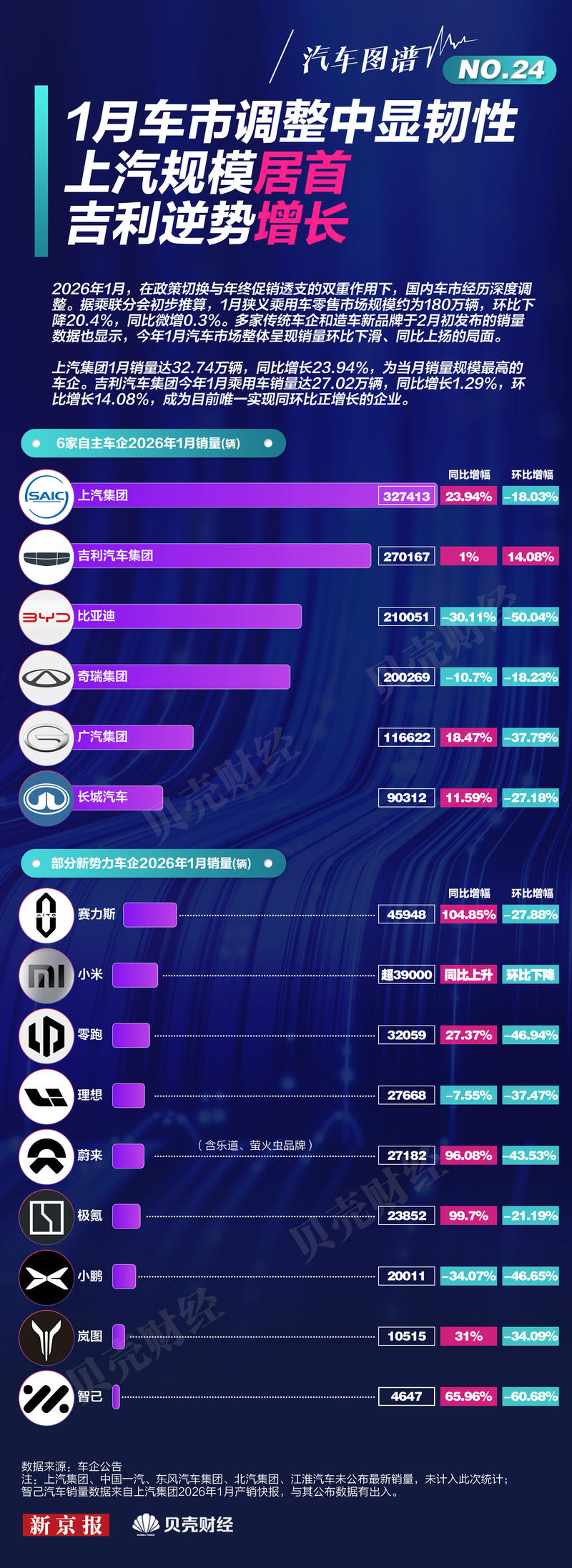
1月车市调整:上汽销量居首,吉利逆势增长
Xin Jing Bao· 2026-02-02 13:57
Core Insights - The domestic automotive market in January 2026 experienced a significant adjustment due to policy changes and year-end promotions, with a retail market size of approximately 1.8 million vehicles, reflecting a month-on-month decline of 20.4% but a slight year-on-year increase of 0.3% [1] Group 1: Traditional Automakers - SAIC Motor Corporation achieved sales of 327,400 vehicles in January, marking a year-on-year increase of 23.94%, making it the top-selling automaker for the month [1] - Geely Automobile Group reported sales of 270,200 vehicles, with a year-on-year growth of 1.29% and a month-on-month increase of 14.08%, being the only company to show positive growth in both metrics [1] - BYD's total sales reached approximately 210,000 vehicles, with domestic sales declining but overseas sales exceeding 100,000 vehicles, reflecting a year-on-year growth of 51.47% [1] - Chery Group's total sales across five brands exceeded 200,000 vehicles, showing a year-on-year decline of 10.7% [2] - GAC Group's sales were 116,600 vehicles, with a year-on-year increase of 18.47% [2] - Great Wall Motors sold over 90,300 vehicles, achieving a year-on-year growth of 11.59% [2] Group 2: New Energy and Emerging Automakers - Xiaomi Automobile delivered over 39,000 vehicles in January, surpassing Leap Motor for the first time [2] - Emerging automakers such as Seres, Zeekr, and NIO reported year-on-year sales growth of 104.85%, 99.7%, and 96.08% respectively, indicating strong performance in the high-growth segment [2] - The sales data for several new energy vehicle companies showed significant fluctuations, with some experiencing declines while others achieved substantial growth [4]




23亿的天价官司,暴露出车企自研电池的「致命隐患」
3 6 Ke· 2026-02-02 12:02
Core Viewpoint - The lawsuit involving a 2.3 billion yuan claim highlights significant quality disputes in the domestic power battery industry, emphasizing the need for automakers to learn from this incident [3][5][22]. Group 1: Lawsuit Details - A lawsuit was filed by Weirui, a subsidiary of Geely Group, against XINWANDA Power, claiming that the battery cells delivered from June 2021 to December 2023 had quality issues, leading to a demand for 2.3 billion yuan in compensation [3][5]. - The core component of the problematic battery pack in the Zeekr 001 WE86 version is the battery cell sourced from XINWANDA, while the pack and BMS were developed in-house by Weirui [4][5]. - XINWANDA argues that Weirui's aggressive charging strategy and "lock battery" operations altered the battery's usage conditions, which they claim are the real causes of the issues [5][6]. Group 2: Financial Implications - If Weirui wins the lawsuit, XINWANDA could face a loss equivalent to approximately two years of its net profit, which was reported as 1.068 billion yuan, 1.076 billion yuan, 1.468 billion yuan, and 386 million yuan for the years 2022 to Q1 2025 [5][6]. - The lawsuit not only poses a financial threat but also risks damaging XINWANDA's brand image, potentially affecting future customer acquisition [6]. Group 3: Industry Implications - The dispute underscores the risks associated with automakers developing their own battery packs while relying on external suppliers for battery cells, as seen with companies like Leap Motor, Li Auto, and Xiaomi [6][15]. - The case illustrates the complexities of determining responsibility for battery pack quality issues, particularly between battery cell manufacturers and BMS developers [7][17]. - The trend of automakers moving towards self-manufactured battery packs is likely to continue, despite the challenges highlighted by this lawsuit [22]. Group 4: Technical Considerations - The core debate in the lawsuit revolves around the responsibility for battery pack quality issues, specifically between the battery cells and the BMS [7][9]. - Variability in battery cell production, including differences in materials and manufacturing processes, can lead to performance discrepancies, complicating quality assurance [8][19]. - The BMS plays a critical role in managing battery performance, and its strategies can significantly impact the longevity and efficiency of the battery pack [10][11]. Group 5: Future Outlook - The ongoing legal proceedings may lead to a settlement, but the complexities of quality disputes in the battery industry will likely prompt more automakers to pursue self-manufactured battery solutions for better control over quality and costs [22].
23亿元天价官司,没有吓退车企自制电池包
3 6 Ke· 2026-02-02 09:19
Core Viewpoint - The lawsuit involving a 2.3 billion yuan claim against Xiwanda by Weirui highlights significant quality disputes in the domestic power battery industry, particularly concerning the battery cells supplied by Xiwanda to Weirui for the Zeekr 001 WE86 model, which experienced issues such as slow charging and abnormal battery degradation [1][2][3]. Summary by Sections Legal Dispute - Weirui claims that the quality issues with the battery cells supplied by Xiwanda led to costs for battery replacements and damage to the Zeekr brand image, thus seeking 2.3 billion yuan in compensation [2]. - Xiwanda argues that Weirui's aggressive charging strategy and "lock battery" operations altered the usage conditions of the batteries, which contributed to the problems [2]. Financial Impact - The potential loss of 2.3 billion yuan in compensation could equate to approximately two years of net profit for Xiwanda, which reported net profits of 1.068 billion, 1.076 billion, 1.468 billion, and 386 million yuan from 2022 to Q1 2025 [2]. - The lawsuit has negatively impacted Xiwanda's corporate image among end consumers, leading to a cautious stance from potential clients [2]. Industry Implications - The dispute underscores the risks associated with automakers developing their own battery packs and the complexities of determining responsibility for battery quality issues [3][4]. - The trend of automakers like Leap Motor, Li Auto, and Xiaomi to self-develop battery packs and BMS systems to reduce reliance on major battery suppliers is now facing scrutiny due to this legal case [3][13]. Technical Aspects - The core controversy revolves around the responsibility for battery pack quality issues, specifically between the battery cells and the Battery Management System (BMS) [4]. - Variability in battery cell quality between different production batches can lead to significant performance differences, complicating quality assurance [5][6]. - The design and control of battery cells, particularly in terms of manufacturing consistency, are critical to ensuring performance and longevity [5][6]. Future Trends - Despite the challenges highlighted by the lawsuit, the trend towards self-manufactured battery packs is expected to continue as automakers seek greater control over costs and product quality [19]. - The complexities of determining liability in battery quality disputes may lead to more collaborative approaches between automakers and battery manufacturers to mitigate risks [19].
