地平线

Search documents
车百会张永伟:中国成为全球增量供应链中心,电池装机份额接近70%
Zhong Guo Jing Ying Bao· 2025-11-22 12:28
Core Insights - The global automotive supply chain is becoming a critical battleground for future competition, with China increasingly playing a prominent role in this landscape [1][3] - Chinese automotive and component manufacturers are gaining traction in overseas markets, driven by a first-mover advantage in electrification and intelligence [1][3] - The focus of supply chain competition is shifting towards three key areas: batteries, chips, and software, which are deemed extremely important yet uncertain [3][8] Group 1: Supply Chain Dynamics - China has established itself as a center for the global incremental automotive supply chain, with battery installations accounting for nearly 70% of the global total [1][3] - By the end of the 14th Five-Year Plan, China's annual vehicle production is expected to reach 40 million, with domestic sales around 27-28 million and exports exceeding 12 million, representing approximately 45% of global production [1][3] - The concept of "含中率" (the proportion of Chinese components used) is anticipated to rise, regardless of the vehicle's production location [1] Group 2: Strategic Recommendations - Automakers should prioritize building a safe and stable supply chain system, moving away from the previous "just-in-time" inventory model [2] - The automotive industry must adapt to a new strategic requirement for supply chain stability, especially in light of recent global challenges [2][6] Group 3: Key Areas of Competition - The battery sector has shown significant growth, with a cumulative installation of 578.0 GWh in China from January to October this year, marking a 42.4% year-on-year increase [3][4] - The concentration of critical resources like lithium, cobalt, and nickel poses structural risks to the global battery supply chain [3][4] - The ongoing evolution of battery technology, including advancements in liquid and solid-state batteries, introduces further uncertainty [4] Group 4: Chip Supply Chain Concerns - The automotive industry has learned from the "chip shortage" crisis between 2020 and 2023, highlighting the fragility of the chip supply chain [5] - Recent events in the chip industry have renewed focus on the security of the automotive chip supply chain, prompting efforts to establish more autonomous supply chains [5][7] Group 5: Software and Ecosystem Development - Software, particularly operating systems, is becoming increasingly critical in automotive development and application, necessitating early self-sufficiency to avoid high switching costs in the future [8] - The shift from hardware-dominated supply chains to software-centric ecosystems is reshaping the industry landscape [8] Group 6: Globalization and Localization Strategies - Chinese companies face challenges related to trade restrictions and localization risks, necessitating a shift towards localized manufacturing in target markets [9] - The "dual factory" model, which involves establishing a "brain factory" in China and "hands factories" overseas, is being explored to address these challenges [9][10] Group 7: Agility and Responsiveness - Component manufacturers must enhance their responsiveness to customer demands, as the development cycles for vehicles are rapidly shortening [10] - Proximity to automakers is essential for component suppliers to ensure cost-effectiveness and supply chain security [10] - Continuous technological innovation and process iteration are crucial for component manufacturers to avoid obsolescence in a rapidly evolving market [10]
深蓝汽车L06搭载地平线芯片 余凯与邓承浩直播测试
Zhong Guo Jing Ying Bao· 2025-11-22 05:54
Core Insights - The launch of the Deep Blue L06 at the 2025 Guangzhou Auto Show marks a significant step in the integration of advanced intelligent driving technologies in mainstream vehicles [2][3] - The DEEPAL AD Max system, developed through collaboration between Horizon, Deep Blue, and Changan, utilizes advanced algorithms to provide comprehensive intelligent driving assistance [2] - The automotive industry is witnessing a shift towards the democratization of high-level intelligent driving technologies, with a goal to make these features accessible to ordinary consumers by 2025 [3] Company Developments - Deep Blue has introduced four models of the L06, priced between 132,900 and 154,900 yuan, all equipped with laser radar and advanced driving assistance systems [2] - Horizon's market share in China's autonomous driving computing solutions for domestic brands has reached 32.4% as of mid-2025, indicating strong growth and adoption of their technology [3] - Despite a revenue increase of 67.6% to 1.567 billion yuan in the first half of 2025, Horizon reported an expanded loss of 5.233 billion yuan, highlighting the challenges faced in achieving profitability [4] Industry Trends - The intelligent driving sector is rapidly evolving, with increasing competition and technological breakthroughs driving the adoption of these systems in non-premium vehicles [3] - The collaboration among multiple automotive manufacturers, including Changan, Chery, Volkswagen, and NIO, reflects a broader industry trend towards providing mature and efficient intelligent driving solutions [3] - The emphasis on user experience is becoming a key differentiator in the automotive market, as companies strive to enhance the practical application of intelligent driving technologies [3]

车百会理事长张永伟:八大趋势勾勒产业变革新图景 中国智能新能源汽车供应链迎全球机遇
Zhong Guo Qi Che Bao Wang· 2025-11-22 05:05
Core Insights - The global automotive industry is undergoing a transformation towards electrification, intelligence, and globalization, with Chinese supply chain companies evolving from "followers" to "leaders" on the global stage [1][3] Group 1: Trends in the Automotive Supply Chain - Trend 1: China's global position in the supply chain is rising, with the "Chinese content rate" becoming a key indicator of success. Chinese companies have a nearly 70% share in the global battery market and are transitioning from importing to exporting in the smart technology sector [4][5] - Trend 2: Batteries, chips, and software are identified as the three core competitive areas in the supply chain, with significant challenges in resource concentration and technological innovation. The need for domestic operating systems in vehicles is emphasized to avoid high switching costs in the future [5][6] - Trend 3: The globalization of the Chinese supply chain is evolving from "trade going out" to "local manufacturing," with the innovative "dual factory" model addressing localization challenges [6][7][8] Group 2: Cross-Industry Extensions and Supply Chain Security - Trend 4: The automotive supply chain is extending into new fields such as robotics and low-altitude economy, providing support for emerging industries while offering new opportunities for traditional automotive companies [9] - Trend 5: Supply chain security has become a strategic priority for automotive companies, shifting focus from lean production to building a stable supply chain system [11][12] - Trend 6: Component manufacturers are encouraged to adopt rapid response and technological iteration strategies to adapt to industry changes and reduce dependency on traditional production models [13][14] Group 3: Addressing Supply-Demand Imbalances - Trend 7: The primary contradiction in the supply chain is the supply-demand imbalance, with a call for platforms that facilitate connections between new technology companies and automotive manufacturers [15][16][17] - Trend 8: The future direction of the supply chain is guided by the "new four modernizations" of high-end, intelligent, green, and integrated development, aiming to enhance China's competitive position in the global automotive landscape [18]

平安证券(香港)港股晨报-20251121
Ping An Securities Hongkong· 2025-11-21 03:18
Market Overview - The Hong Kong stock market experienced fluctuations, with the Hang Seng Index closing at 23,831 points, down 145 points or 0.61% [1] - The market turnover decreased to 82.799 billion, with net inflows of 484 million from the Hong Kong Stock Connect [1] - The US stock market opened high but closed lower, with the Dow Jones down 0.84%, S&P 500 down 1.56%, and Nasdaq down 2.15% [2] Investment Opportunities - The report emphasizes the importance of selecting undervalued sectors and companies in the current market environment, particularly in the context of the Hong Kong stock market [3] - Key sectors to focus on include artificial intelligence, semiconductors, and industrial software, which are seen as new productivity drivers [3] - The report suggests that state-owned enterprises with lower valuations and higher dividends are also attractive investment options [3] Company Highlights - Baidu Group is highlighted for its AI strategy and recent stock performance, with a 2.4% increase despite market fluctuations [3][10] - The company reported a revenue of 32.713 billion yuan for Q2 2025, a year-on-year decrease of 3.59%, but a quarter-on-quarter increase of 0.80% [10] - Baidu's core revenue was 26.251 billion yuan, with a non-GAAP net profit of 4.792 billion yuan, reflecting a year-on-year decline of 34% [10] Sector Analysis - The report indicates that the real estate sector is stabilizing, with recent government measures aimed at promoting healthy market development [9] - The construction sector is expected to benefit from the Belt and Road Initiative, with recommendations to focus on leading state-owned enterprises like China Railway and China State Construction [9] - The report also notes the potential for growth in the upstream non-ferrous metals sector, benefiting from expectations of interest rate cuts by the Federal Reserve [3]
汽车有“魂”,AI如何重塑用车体验?
2 1 Shi Ji Jing Ji Bao Dao· 2025-11-21 00:30
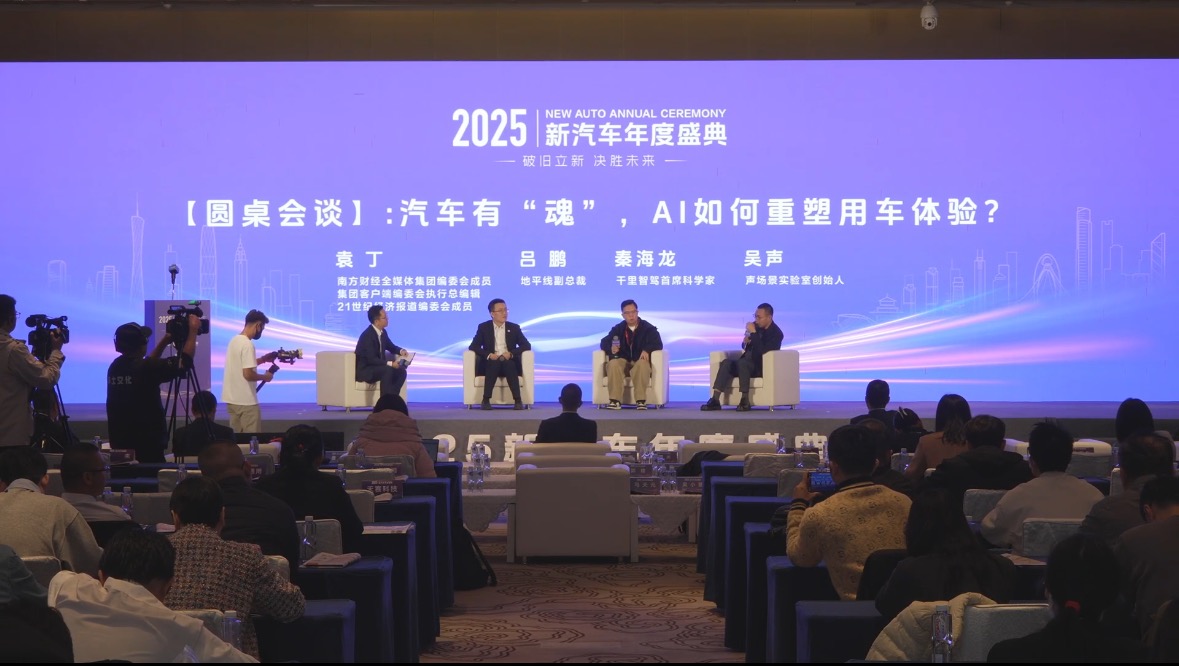
当人工智能的浪潮从虚拟世界涌向物理现实,汽车产业正站在这场变革的最前沿。自动驾驶领域技术路线纷繁复杂,"端到端"、"世界模型"、"VLA"等术语 层出不穷,业界对于何为"最优解"莫衷一是。 在由南方财经全媒体集团指导、21世纪经济报道主办的2025新汽车年度盛典上,南方财经全媒体集团编委会成员、集团客户端编委会执行总编辑、21世纪经 济报道编委会成员袁丁主持题为《汽车有"魂",AI如何重塑用车体验?》的圆桌论坛,邀请到地平线副总裁吕鹏、千里智驾首席科学家秦海龙和场景实验室 创始人吴声三位业界专家,旨在穿透技术路线的迷雾,深入探讨AI如何超越工具属性,为汽车注入可进化、可感知的"灵魂",从而彻底重塑人类的用车体 验。 场景实验室创始人吴声旗帜鲜明地指出,AI驾驶已超越"工具"范畴,正成为一种真实的生活方式,是通向AGI(通用人工智能)的最佳实践。 袁丁:当AI加速渗透物理世界,自动驾驶领域正处在充满分歧的路口。端到端、世界模型、VLA路线,哪条路线是自动驾驶的"最优解"?我们还要等待多久 才能迎来物理AI的曙光?吴声老师曾提出"AI场景革命元年"的概念,在汽车行业,AI场景应如何定义?目前是处于元年,还是已进入 ...
汽车行业正处于科技拐点 智驾竞争是一场“马拉松”
Mei Ri Jing Ji Xin Wen· 2025-11-20 12:38
Core Insights - The automotive industry in China is experiencing a robust growth trend, with production and sales reaching new highs in October 2025, driven by new energy vehicles and exports [1] - The upcoming policy changes regarding new energy vehicle purchase tax are expected to stimulate consumer demand, leading to a positive sales outlook for the fourth quarter [1] - The 2025 Guangzhou International Auto Show serves as a critical platform for companies to showcase new products and strategies, particularly in the context of the growing importance of intelligent driving technology [2][3] Industry Trends - The automotive market is witnessing a shift towards intelligent driving as a key competitive area, with rapid technological advancements and iterations [2][3] - Companies are increasingly focusing on integrating intelligent driving technology into mainstream markets, moving beyond high-end segments [3][4] - The Chinese automotive market is positioned to leverage its large consumer base, technological innovation, and supportive policies to foster a thriving intelligent vehicle market [2][3] Company Strategies - Companies emphasize the importance of a comprehensive approach that includes safety, quality, and design in their intelligent driving offerings, rather than relying solely on isolated technologies [4] - The integration of intelligent driving capabilities is seen as a necessary but not sufficient condition for establishing core competitiveness; companies must also enhance their overall systemic capabilities [4][5] - Firms like Li Auto are pursuing dual strategies of in-house development and open collaboration with partners to enhance their intelligent driving technologies and product offerings [6]
瑞银调研14家中国半导体公司:晶圆制造设备商们最乐观
智通财经网· 2025-11-20 09:01
Core Insights - UBS's recent survey indicates a significant demand divergence in the Chinese semiconductor industry by 2026, with strong growth expected in semiconductor equipment, AI infrastructure, and autonomous driving, while smartphone-related sectors face short-term pressures [1][3] Semiconductor Equipment Demand - The semiconductor equipment supply chain shows optimistic demand forecasts, with a projected year-on-year growth of 8%-10% for 2026, driven by capacity expansions from Yangtze Memory Technologies and ChangXin Memory [5][9] - Domestic storage chip clients are expected to place formal orders soon, indicating a robust demand outlook [3][5] Industry Challenges - IC companies without wafer fabs and mature process foundries may experience demand declines or specification downgrades due to rising storage costs in the smartphone sector [3][9] - The trend of wafer fab clients expanding their supplier base may pressure existing suppliers to lower prices, potentially impacting long-term gross margins [9] Key Company Developments - North Huachuang is confident in outperforming industry averages, with optimistic progress in CCP etching equipment, aiming to fully replace Applied Materials in metal deposition [7] - Huahai QK is expanding its product portfolio from CMP equipment to include grinding, polishing, ion implantation, and wafer inspection, anticipating growth in material removal equipment due to advanced packaging technologies [7] - Jingyi Automation has achieved a market share of 90%-100% for its core products in leading domestic wafer fabs, with increasing demand for ultra-low temperature cooling machines [7] Foundry Capacity and Technology - ChangXin Memory expects high capacity utilization rates through Q4 2025, with a slight seasonal decline in Q1 2026, while facing pricing pressures in the smartphone-related CIS and DDIC sectors [11] - Yuexin Semiconductor's 6-inch production line is operating at full capacity, while its 8-inch line is at 70%-80% utilization, focusing on power discrete devices [12] IC Product Expansion - Horizon Robotics is expanding from consumer electronics to high-growth sectors, with its high-end autonomous driving solutions being adopted by multiple OEMs [14] - Nanchip Technology is leveraging its consumer electronics foundation to expand into automotive, AI, and industrial sectors, aiming for a significant increase in domestic market share by 2030 [14] Backend Testing Growth - Backend testing is experiencing explosive growth driven by AI demand, with leading companies like Huafeng Testing and Visonic Testing seeing strong order growth and technological advancements [17] Display and Optical Modules - BOE expects slight growth in LCD panel shipments and area in 2025, with a strong performance in the Latin American market [19] - The domestic optical module market is projected to see significant growth, with an expected shipment of 15-16 million units in 2025, increasing to 20 million in 2026 [20][21]

洞见未来·大咖谈丨汽车行业正处科技拐点,智驾竞争是一场“马拉松”
Mei Ri Jing Ji Xin Wen· 2025-11-20 04:28
每经记者|裴健如 每经编辑|余婷婷 进入四季度以来,车企抢抓年底政策切换窗口期,生产供给保持较快节奏。企业新品继续密集上市、行业综合治理工作稳步推进,汽车市场延续良好发展态 势。 根据中汽协最新数据,2025年10月,我国汽车产销分别完成335.9万辆和332.2万辆,环比分别增长2.5%和3%,同比分别增长12.1%和8.8%,月度产销规模再 创新高。其中,新能源汽车和出口市场表现亮眼,成为驱动车市增长的重要引擎。 乘联分会秘书长崔东树预判,今年四季度,车市在政策引导和高增长基础上有望延续平稳增长势头。自明年起,新能源车购置税将由"免征"调整为"减半征 收",政策变化刺激消费者在年底前集中购车,叠加年末车企冲量,新能源与出口双轮驱动的格局进一步强化,智能网联技术升级和"反内卷"带来的市场秩 序改善也将支撑消费信心,预计四季度车市销量仍能实现小幅正增长。 随着智能汽车时代的到来,中国凭借庞大的消费市场、技术创新能力和政策支持,已经培育出一片蓬勃发展的智能汽车市场。从"技术引进"到"技术输出", 中国高阶智驾方案也在驱动全球出行变革,各企业都在探寻"中国答案"。 新的市场格局正在重塑,汽车行业风云激荡。国内车市 ...
前云鲸智能产品副总裁李阳离职创业 下一站投身具身智能
Xi Niu Cai Jing· 2025-11-19 09:17
Core Insights - Li Yang, the former Vice President of Products at Yunzheng Intelligent, has left the company to pursue entrepreneurship in the field of embodied intelligence, focusing on AI companion robots [2] - This departure marks a significant trend in the smart cleaning industry, with other notable executives also transitioning to the consumer robotics market [2] - Yunzheng Intelligent is currently in a critical phase as it approaches its IPO, having recently completed a $100 million financing round led by Tencent and the Beijing Robotics Industry Development Fund [2] Company Developments - Li Yang, who joined Yunzheng in 2021 from DJI, played a key role in product and technology development, leading the R&D of critical products [2] - His departure comes at a time when Yunzheng is initiating Pre-IPO financing, indicating a strategic shift within the company [2] Industry Trends - The global companion robot market has reached a size of $9.2 billion in 2023, with a projected compound annual growth rate (CAGR) of 25.68% over the next five years [2] - By 2029, the market size is expected to exceed 300 billion yuan, reflecting a growing interest and investment in the sector [2] - Li Yang's move to start a new venture in this booming market exemplifies the current trend of capital enthusiasm and talent mobility within the industry [2]


从智驾到 L4,汽车 AI 芯片战局松动
晚点LatePost· 2025-11-18 13:38
Core Viewpoint - The competition in the commercialization of intelligent driving is fierce, and the first-mover advantage may not be sustainable in the long run [1] Group 1: Market Dynamics - In February, BYD launched 21 intelligent driving models, marking a shift in its leadership's stance on autonomous driving, emphasizing the importance of AI in the second half of the market [2] - The intelligent driving technology is evolving from end-to-end solutions to VLA (Vision-Language-Action) models, driven by advancements in AI [2][4] - The Robotaxi market is becoming a focal point for competition among automakers, with projections indicating significant growth in China's Robotaxi market from approximately $54 million in 2025 to $47 billion by 2035, with a compound annual growth rate exceeding 96% [9] Group 2: Chip Technology and Competition - The AI chip market for automotive applications is experiencing shifts due to changes in technology routes and automakers' desire for supply chain autonomy, creating opportunities for latecomers [3][5] - Companies like Black Sesame Intelligence are developing competitive AI chips, such as the A2000, which is expected to enter mass production by the end of next year [3][8] - The demand for high-performance AI chips is increasing, with companies like NVIDIA and Huawei dominating the market, but the landscape is evolving as new players emerge [4][5] Group 3: Technical Evolution and Requirements - The transition from L2 to L3/L4 autonomous driving requires significant advancements in technology, including hardware redundancy and compliance with traffic regulations [10][11] - Automakers are investing heavily in AI to enhance the human-like capabilities of intelligent driving systems, with some companies adopting a dual redundancy approach in their systems [11][12] - The A2000 chip from Black Sesame Intelligence is designed to support various AI models efficiently, integrating multiple processing units to handle complex tasks [12][14] Group 4: Strategic Partnerships and Ecosystem - The success of AI chip companies hinges on their ability to provide comprehensive solutions beyond just hardware, necessitating collaboration with automakers and algorithm developers [17][18] - Black Sesame Intelligence is focusing on building an open platform and has established partnerships with various companies to enhance its ecosystem [18] - The competitive landscape is expected to intensify as high-performance, open AI chip platforms become increasingly sought after in the market [18]