华菱钢铁

Search documents
钢铁价格磨底蓄势,重申看多板块配置 | 投研报告
Zhong Guo Neng Yuan Wang· 2025-11-17 02:48
Core Viewpoint - The steel industry is experiencing fluctuations in production and demand, with a notable increase in capacity utilization rates, while prices and profits remain under pressure. The overall outlook suggests potential for recovery driven by government policies and market stabilization efforts. Supply Situation - As of November 14, the capacity utilization rate for blast furnaces in sample steel companies is 88.8%, an increase of 0.99 percentage points week-on-week [2][3] - The capacity utilization rate for electric furnaces is 53.2%, up by 2.31 percentage points week-on-week [2][3] - The production of five major steel products is 7.261 million tons, a decrease of 229,800 tons or 3.07% week-on-week [2][3] - Daily average pig iron production is 2.3688 million tons, an increase of 26,600 tons week-on-week and 28,200 tons year-on-year [2][5] Demand Situation - The consumption of five major steel products is 8.606 million tons, down by 63,300 tons or 0.73% week-on-week [2][3] - The transaction volume of construction steel by mainstream traders is 100,000 tons, an increase of 3,700 tons or 3.87% week-on-week [2][3] Inventory Situation - Social inventory of five major steel products is 10.614 million tons, a decrease of 136,100 tons or 1.27% week-on-week, but an increase of 306,100 tons year-on-year [3] - Factory inventory of five major steel products is 4.16 million tons, down by 126,100 tons or 2.94% week-on-week, with a year-on-year increase of 6.35% [3] Steel Prices & Profits - The comprehensive index for ordinary steel is 3,422.3 yuan/ton, an increase of 2.47 yuan/ton or 0.07% week-on-week, but down by 6.85% year-on-year [3] - The comprehensive index for special steel is 6,581.9 yuan/ton, a decrease of 10.59 yuan/ton or 0.16% week-on-week, and down by 3.37% year-on-year [3] - The profit for rebar from blast furnaces is -29 yuan/ton, an increase of 10.0 yuan/ton or 25.64% week-on-week [3] - The profit for construction steel from electric furnaces is -155 yuan/ton, an increase of 7.0 yuan/ton or 4.32% week-on-week [3] Raw Material Situation - The spot price index for Australian powder ore (62% Fe) at Rizhao Port is 786 yuan/ton, up by 10.0 yuan/ton or 1.29% week-on-week [4] - The price for main coking coal at Jingtang Port is 1,830 yuan/ton, an increase of 30.0 yuan/ton week-on-week [4] Market Outlook - The initiation of the 2025 Central Safety Production Assessment is expected to stabilize market confidence and positively impact steel prices [5] - The steel industry is anticipated to maintain a stable supply-demand balance, supported by government "stability growth" policies, with potential improvements in demand from real estate and infrastructure sectors [6] - The industry is expected to see structural investment opportunities, particularly in high-margin special steel companies and leading steel enterprises with strong cost control [6]
趋势研判!2025年中国钍矿行业发展现状、进出口情况、需求市场、重点企业及未来发展趋势分析:技术突破驱动产业升级,钍基熔盐堆引领核电新格局[图]
Chan Ye Xin Xi Wang· 2025-11-17 01:08
Core Insights - Thorium ore is emerging as a strategic energy resource due to its high energy density, safety, low waste, and cost-effective extraction when associated with rare earth elements [1][4][6] - China leads in both resources and technology, with proven industrial reserves of 287,000 tons, ranking second globally, and significant breakthroughs in thorium fuel technology [1][4][6] - The thorium mining industry in China is characterized by a "net import" trade pattern, with Nigeria being a key source of imports, and prices for thorium ore have shown a significant upward trend [1][6][8] Thorium Mining Industry Overview - Thorium ore consists of minerals containing thorium, which has significant economic value due to its properties and association with rare earth elements [2][3] - The core advantages of thorium include extremely high energy density, superior safety performance, and low extraction costs [3][4] Current Development Status of China's Thorium Mining Industry - China's thorium mining industry is transitioning from a niche resource to a strategic energy core, supported by abundant resources and technological advancements [4][6] - The Baiyun Obo mining area holds over 75% of China's thorium reserves, with significant potential for further exploration [4][6] Thorium Resource Distribution in China - China's thorium resources are managed under strict regulations, leading to a notable "net import" pattern despite domestic abundance [6][8] - The import volume of thorium ore has been increasing, with a notable 24.67% year-on-year growth in the first nine months of 2025 [6][8] Thorium Mining Industry Supply Chain - The thorium mining industry has established a complete supply chain from geological exploration to nuclear fuel manufacturing, with applications expanding beyond nuclear power [9][11] - The industry is characterized by collaboration across the supply chain, with upstream resources being integrated with rare earth mining processes [9][11] Competitive Landscape of China's Thorium Mining Industry - The industry exhibits a competitive structure with monopolies in resource extraction, concentrated technology, and collaborative applications [14][15] - Key players include Baogang Group, which controls over 75% of thorium resources, and leading companies in materials and equipment manufacturing [14][15] Future Development Trends of China's Thorium Mining Industry - The future of the thorium mining industry will focus on the continuous breakthrough and commercialization of thorium-based molten salt reactor technology [16][17] - There will be an emphasis on deep collaboration across the supply chain, driving technological upgrades and expanding applications in clean energy and industrial processes [16][17] - The diversification of applications will enhance the strategic value of thorium, contributing to energy security and reducing reliance on imported uranium [17]


加仓!险资前三季度股票余额增万亿 重仓了这些行业
Di Yi Cai Jing· 2025-11-16 21:26
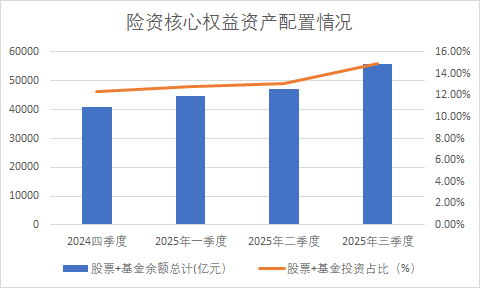
今年前三季度,险资投资的一大重点就是加仓股票。 第一财经记者根据金融监管总局最新发布的2025年三季度保险公司资金运用情况表(下称"资金运用情 况表")梳理,三季度末,保险资金运用余额达到37.46万亿元,其中股票的账面余额为3.62万亿元。这 一数字较去年末增加了1.19万亿元,增幅近五成;其中第三季度增加5524亿元。 如果加上证券投资基金,则截至三季度末险资配置的核心权益资产近5.6万亿元,较去年末增加近1.5万 亿元,其中第三季度单季增加值为8640亿元。 从Choice显示的险资三季度重仓股来看,银行股依然是险资的"心头好",不仅三季度末持仓市值占比超 一半,且第三季度险资增持股数也在所有重仓股中排名首位。在银行股外,据业内分析师统计,钢铁、 通信、食品饮料等行业在三季度获险资重点增持,而电力设备、有色金属、交通运输等则环比减持。 从去年末到今年三季度末,险资配置的股票余额一路上涨。资金运用情况表数据显示,今年三季度末险 资(指产险、寿险公司,下同)持有股票的账面余额为3.62万亿元,较去年末的2.43万亿元大幅增加了 1.19万亿元,涨幅高达49.14%,在资金运用余额中的占比也从去年末的7.30 ...
高低切&反内卷
2025-11-16 15:36
Summary of Conference Call Notes Industry Overview - The conference call discusses the "anti-involution" policy aimed at optimizing supply-demand structures and promoting inflation recovery, which has been strengthened since September 2025 [2][3][5] - The current market shows a clear high-low switching phenomenon, with cyclical industries such as coal, petrochemicals, and non-ferrous metals performing well [2][7] Key Points and Arguments Anti-Involution Policy - The anti-involution policy aims to clear supply first and stimulate demand later, optimizing the supply-demand structure to promote inflation recovery [3][6] - The policy has been increasingly enforced since September 2025, with a focus on regulating production behaviors and eliminating irrational competition [2][3][5] - Specific measures include supply-side constraints and governance of low-price competition in various sectors, including electronics and steel [5][6] Market Impact - The anti-involution policy is expected to have both short-term and long-term impacts on the equity market, with a positive catalyst effect on prices and performance over the next year [6] - The policy is anticipated to lead to a deeper adjustment of the capacity cycle over the next 3-5 years, similar to the supply-side structural reforms initiated in 2016 [6][8] Sector Performance - The cyclical industries benefiting from the anti-involution and inflation trading include non-ferrous metals, steel, coal, petrochemicals, and sectors like agriculture and logistics [2][11] - The photovoltaic industry is experiencing price increases due to capacity exits, while the wind power sector has seen an 18% increase in turbine prices [2][12] - In the lithium battery sector, the price of lithium hexafluorophosphate has doubled, and global energy storage demand is growing at over 50% [2][12] Steel Industry Insights - The steel industry is facing challenges with rising raw material prices but is expected to see a gradual recovery in steel prices and profits due to policy support [13][15][16] - Major companies like Baosteel and Hesteel are expected to benefit from the anti-involution policy, which supports advanced enterprises [3][14][16] Polyester and PTA Industry - The polyester and PTA industry is characterized by high concentration, with supply growth lagging behind demand growth, leading to a healthy supply-demand relationship [17][18] - The Ministry of Industry and Information Technology is taking measures to potentially reduce production or curb new capacity, benefiting integrated companies [18] Organic Silicon Industry - The organic silicon industry has not seen new capacity since 2025, with demand growing rapidly at 24% in the first half of the year [19][20] - A recent meeting led by state-owned enterprises aims to reduce capacity by 30%, which could improve profitability and market concentration [20] Livestock Industry - The livestock industry has faced challenges, with pig prices dropping to a four-year low, leading to a shift towards capacity reduction [21][22] - Major companies are actively reducing production in response to policy adjustments [21] Express Delivery Industry - The express delivery sector has implemented anti-involution measures, resulting in price increases across the industry [23][24] - Companies like YTO Express and Shentong Express have reported increased revenue per shipment, indicating successful price adjustments [24][25][26] Recommendations - The conference recommends focusing on cyclical industries that benefit from tight supply and inflation trading logic, particularly in sectors like electric cells, metals, chemicals, agriculture, and transportation [10][11] - Specific express delivery companies such as YTO Express, Shentong Express, Jitu Express, and ZTO Express are highlighted as having strong performance potential under the anti-involution policy [27]
加仓!险资前三季度股票余额增万亿,重仓了这些行业
第一财经· 2025-11-16 12:51
Core Viewpoint - The article highlights a significant increase in insurance capital investment in stocks during the first three quarters of the year, driven by favorable market conditions and regulatory support [3][4][5]. Group 1: Investment Trends - As of the end of Q3, the balance of insurance capital investment reached 37.46 trillion yuan, a year-to-date increase of 12.64% [4]. - The stock investment balance rose to 3.62 trillion yuan, an increase of 1.19 trillion yuan from the end of last year, marking a growth rate of 49.14% [5]. - Including securities investment funds, the total core equity assets reached 5.59 trillion yuan, up 1.49 trillion yuan, with a growth rate of 36.19% [5]. Group 2: Sector Preferences - Bank stocks remain the most favored by insurance capital, accounting for 51.92% of the total value of heavy holdings, which amounted to approximately 6.4 trillion yuan [9]. - Other sectors that saw significant increases in investment include steel, communication, and food and beverage, while sectors like electric equipment and non-ferrous metals experienced reductions [10][11]. Group 3: Market Dynamics - The increase in equity investment is attributed to several factors, including policy guidance, the need for better returns in a low-interest-rate environment, and a recovering capital market [7][12]. - The A-share market has shown a "slow bull" trend, with the CSI 300 index rising approximately 18% in the first three quarters, contributing to the profitability of insurance companies [7][12]. Group 4: Investment Strategy - Insurance capital adopts a "dividend stock + growth stock" strategy, focusing on high-dividend stocks for stable returns while also investing in high-growth sectors [11]. - Different preferences exist between life insurance and property insurance funds, with life insurance favoring low PB (price-to-book) and high-dividend blue-chip stocks, while property insurance leans towards higher PE (price-to-earnings) growth stocks [11].

加仓!险资前三季度股票余额增万亿,重仓了这些行业
Di Yi Cai Jing· 2025-11-16 11:05
Core Insights - Insurance capital has significantly increased its stock investments, with a notable rise in equity assets driven by favorable market conditions and regulatory support [1][3][6] Investment Trends - As of the end of Q3, the total balance of insurance capital investments reached 37.46 trillion yuan, marking a 12.64% increase from the beginning of the year [2] - The stock balance alone rose to 3.62 trillion yuan, an increase of 1.19 trillion yuan or 49.14% compared to the end of last year [3] - Including securities investment funds, the core equity assets reached approximately 5.59 trillion yuan, up 1.49 trillion yuan or 36.19% year-on-year [3] Sector Preferences - Bank stocks remain the most favored by insurance capital, accounting for 51.92% of the total value of heavy holdings, which amounted to nearly 640 billion yuan [8] - Other sectors that saw significant increases in investment include steel, communication, and food and beverage, while sectors like electric equipment and non-ferrous metals experienced reductions [1][8] Market Dynamics - The increase in equity investments is attributed to a strong stock market performance, with the CSI 300 index rising approximately 18% in the first three quarters [6][10] - Insurance companies reported that equity assets were a major contributor to significant growth in investment income, leading to record net profits for the third quarter [6][10] Investment Strategy - Insurance capital is adopting a "dividend stocks + growth stocks" strategy, focusing on high-dividend and stable profit companies while also seeking high-growth opportunities in emerging industries [9] - Different preferences exist between life insurance and property insurance funds, with life insurance favoring low PB (price-to-book) and high dividend stocks, while property insurance leans towards higher PE (price-to-earnings) growth stocks [9]
钢铁:从容不迫
GOLDEN SUN SECURITIES· 2025-11-16 06:41
Investment Rating - The report maintains a "Buy" rating for several steel companies, including Hualing Steel, Nanjing Steel, Baosteel, and New Steel [8][9][10]. Core Viewpoints - The steel sector has shown a strong performance this year, with a year-to-date increase of over 30%, ranking 7th among Shenwan's primary industries [2]. - The report highlights that the average daily pig iron production has increased to 236.9 thousand tons, while steel production has decreased [11]. - The total inventory of steel has decreased, with a week-on-week decline of 1.7%, indicating a tightening supply [23]. - Apparent steel consumption has shown a slight decline, with a week-on-week decrease of 0.7% [52]. - The report notes that iron ore prices have strengthened, influenced by reduced shipments from Australia and Brazil [49]. Summary by Sections Market Review - The CITIC Steel Index closed at 1,999.70 points, up 0.83%, outperforming the CSI 300 Index by 1.91 percentage points [1][94]. Supply Analysis - Daily pig iron production increased by 2.8 thousand tons, while steel production has decreased, particularly in rebar [11][17]. - The capacity utilization rate for 247 steel mills is reported at 88.8%, reflecting a slight increase [17]. Inventory Analysis - The total inventory of five major steel products decreased to 1,061.4 million tons, down 1.3% week-on-week [25]. - Steel mill inventories also saw a decline, with a 2.9% reduction [25]. Demand Analysis - Apparent consumption of five major steel products decreased by 0.7% week-on-week, with rebar demand dropping more significantly [40][52]. - The average weekly transaction volume for construction steel was 100 thousand tons, reflecting a 3.9% increase [41]. Price and Profitability - The report indicates a slight increase in steel prices, with the Myspic comprehensive steel price index rising to 121.2, up 0.1% week-on-week [75]. - Current costs for long-process rebar and hot-rolled coils are reported at 3,518 yuan/ton and 3,744 yuan/ton, respectively, with negative margins [75][76].


钢铁价格磨底蓄势,重申看多板块配置
Xinda Securities· 2025-11-16 06:03
Investment Rating - The report maintains a "Positive" investment rating for the steel industry, consistent with the previous rating [3]. Core Viewpoints - The steel sector is showing signs of recovery with a slight increase in prices and production, despite facing supply-demand imbalances and overall profit declines. The report suggests that the implementation of "stability growth" policies will support demand in real estate and infrastructure, leading to a potential marginal improvement in steel demand [4][6]. - The report highlights that the steel industry is expected to maintain a stable supply-demand situation, with a tightening supply due to policy expectations and increasing industry concentration. This is anticipated to create structural investment opportunities, particularly for high-margin special steel companies and leading enterprises with strong cost control [4][6]. Supply Situation - As of November 14, the capacity utilization rate for blast furnaces in sample steel companies is 88.8%, an increase of 0.99 percentage points week-on-week. Electric furnace utilization stands at 53.2%, up by 2.31 percentage points [26]. - The total production of five major steel products is 7.261 million tons, a week-on-week decrease of 229,800 tons, or 3.07% [26]. Demand Situation - The consumption of five major steel products is 8.606 million tons, reflecting a week-on-week decline of 63,300 tons, or 0.73% [34]. - The transaction volume of construction steel by mainstream traders is 100,000 tons, which is an increase of 370 tons, or 3.87% week-on-week [34]. Inventory Situation - Social inventory of five major steel products is 10.614 million tons, a week-on-week decrease of 136,100 tons, or 1.27%, but an increase of 30.61% year-on-year [42]. - Factory inventory of five major steel products is 4.160 million tons, down by 126,100 tons, or 2.94% week-on-week, and up by 6.35% year-on-year [42]. Price & Profit Situation - The comprehensive index for ordinary steel is 3,422.3 yuan/ton, with a week-on-week increase of 2.47 yuan/ton, but a year-on-year decrease of 6.85% [48]. - The profit for rebar produced in blast furnaces is -29 yuan/ton, an increase of 10 yuan/ton week-on-week, while the profit for electric arc furnace-produced construction steel is -155 yuan/ton, up by 7 yuan/ton week-on-week [54]. Raw Material Situation - The spot price index for Australian iron ore (62% Fe) is 786 yuan/ton, with a week-on-week increase of 10 yuan/ton [71]. - The price of primary metallurgical coke is 1,935 yuan/ton, reflecting a week-on-week increase of 55 yuan/ton [71]. Investment Recommendations - The report suggests focusing on regional leading enterprises with advanced equipment and environmental standards, such as Shandong Steel and Hualing Steel, as well as companies with excellent growth potential like Baosteel and Nanjing Steel [4].
钢铁周报20251116:西芒杜铁矿正式投产,新增产能逐步释放-20251116
Minsheng Securities· 2025-11-16 02:53
Investment Rating - The report maintains a "Buy" recommendation for several steel companies, including Hualing Steel, Baosteel, Nanjing Steel, and others, based on their projected earnings and valuations [3][4]. Core Insights - The Ximangdu Iron Mine has officially commenced production, with a total designed capacity of 120 million tons per year, expected to gradually ramp up over the next 2-3 years. This high-quality iron ore resource is anticipated to lower iron ore prices, alleviating pressure on steel mill profits [3][4]. - Steel prices have decreased, with notable declines in rebar and medium plates, while hot-rolled and cold-rolled prices remained stable [1][9]. - Steel production has decreased, with a total output of 8.34 million tons for major steel products, down by 223,600 tons week-on-week. Total social inventory also fell by 136,300 tons [2][6]. Summary by Sections Price Trends - As of November 14, 2025, the price of 20mm HRB400 rebar in Shanghai is 3,170 CNY/ton, down 30 CNY/ton from the previous week. Other steel products also saw price changes, with hot-rolled at 3,280 CNY/ton and cold-rolled at 3,770 CNY/ton remaining stable [1][9]. Production and Inventory - The total production of major steel products was 8.34 million tons, with rebar production specifically reduced to 2 million tons, a decrease of 85,400 tons week-on-week. Total social inventory decreased to 10.602 million tons [2][6]. Profitability - Steel margins have declined, with rebar, hot-rolled, and cold-rolled margins decreasing by 29 CNY/ton, 37 CNY/ton, and 39 CNY/ton respectively. Electric arc furnace steel margins also saw a slight decrease of 2 CNY/ton [1][3]. Investment Recommendations - The report recommends several companies based on their market positioning and expected performance, including Hualing Steel, Baosteel, Nanjing Steel, and others in various segments such as special steel and pipe materials [3][4].


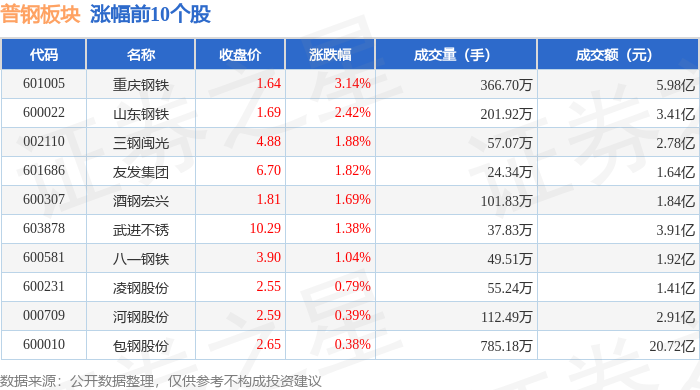
普钢板块11月14日跌0.35%,杭钢股份领跌,主力资金净流出1.87亿元
Zheng Xing Xing Ye Ri Bao· 2025-11-14 08:49
Market Overview - On November 14, the steel sector declined by 0.35% compared to the previous trading day, with Hangzhou Steel leading the decline [1] - The Shanghai Composite Index closed at 3990.49, down 0.97%, while the Shenzhen Component Index closed at 13216.03, down 1.93% [1] Individual Stock Performance - Chongqing Steel (601005) saw a closing price of 1.64, up 3.14% with a trading volume of 3.67 million shares and a transaction value of 598 million [1] - Shandong Steel (600022) closed at 69.1, up 2.42% with a trading volume of 2.02 million shares and a transaction value of 341 million [1] - Hangzhou Steel (600126) closed at 9.05, down 2.69% with a trading volume of 822,300 shares and a transaction value of 752 million [2] Capital Flow Analysis - The steel sector experienced a net outflow of 187 million from main funds, while retail investors saw a net inflow of 184 million [2] - Major stocks like Wujin Stainless Steel (603878) had a net outflow of 40.17 million from main funds, while retail investors had a net inflow of 41.04 million [3] - Huazhong Steel (000932) experienced a net inflow of 31.31 million from main funds but a net outflow of 23.20 million from retail investors [3]