
鸣鸣很忙

Search documents
鸣鸣很忙(01768) - 全球发售
2026-01-19 22:15
湖南鳴鳴很忙商業連鎖股份有限公司 BUSY MING GROUP CO., LTD. 股份代號 : 1768 (於中華人民共和國註冊成立的股份有限公司) 全球發售 聯席保薦人、聯席保薦人兼整體協調人、 聯席全球協調人、聯席賬簿管理人及聯席牽頭經辦人 整體協調人、聯席全球協調人、聯席賬簿管理人及聯席牽頭經辦人 重要提示 重要提示:閣下如對本招股章程的任何內容有任何疑問,應尋求獨立專業意見。 BUSY MING GROUP CO., LTD. 湖南鳴鳴很忙商業連鎖股份有限公司 (於中華人民共和國註冊成立的股份有限公司) 全球發售 | 全球發售項下的發售股份數目 | : | 14,101,100股H股(視乎發售量調整權及 | | --- | --- | --- | | 超額配股權獲行使與否而定) | | | | 香港發售股份數目 | : | 1,410,200股H股(可予重新分配) | | 國際發售股份數目 | : | 12,690,900股H股(可予重新分配及視乎 | | 發售量調整權及超額配股權獲行使與 | | | | 否而定) | | | | 最高發售價 | : | 每股H股236.60港元,另加1.0%經 ...
鸣鸣很忙(01768) - 全球发售
2026-01-19 22:09
香港交易及結算所有限公司、香港聯合交易所有限公司(「聯交所」)及香港中央結算有限公司 (「香港結算」)對本公告的內容概不負責,對其準確性或完整性亦不發表任何聲明,並明確表 示概不就因本公告全部或任何部分內容而產生或因倚賴該等內容而引致的任何損失承擔任何責 任。 除本公告另有界定者外,本公告所用詞彙與湖南鳴鳴很忙商業連鎖股份有限公司(「本公司」)於 2026年1月20日刊發的招股章程(「招股章程」)所界定者具有相同涵義。 本公告僅作說明用途,並不構成收購、購買或認購證券的邀請或要約。有意投資者於決定是否 投資發售股份前應細閱招股章程,以獲得下文所述有關本公司及全球發售的詳細資料。 本公告不會直接或間接於或向美國(包括美國的領土及屬地、美國任何州以及哥倫比亞特區)發 佈、刊發或派發。本公告並不構成亦不屬於在美國境內或於任何其他司法權區購買或認購證券 的任何要約或招攬的一部分。發售股份並無亦將不會根據《1933年美國證券法》(經不時修訂) (「美國證券法」)或美國任何州或其他司法權區的證券法登記,亦不得於美國境內提呈發售、出 售、質押或轉讓,惟根據美國證券法的登記規定獲豁免或毋須遵守有關規定的交易中進行者除 外。發 ...
鸣鸣很忙的启示:在「富饶的贫困」中,如何找到真需求?
36氪· 2026-01-19 13:47
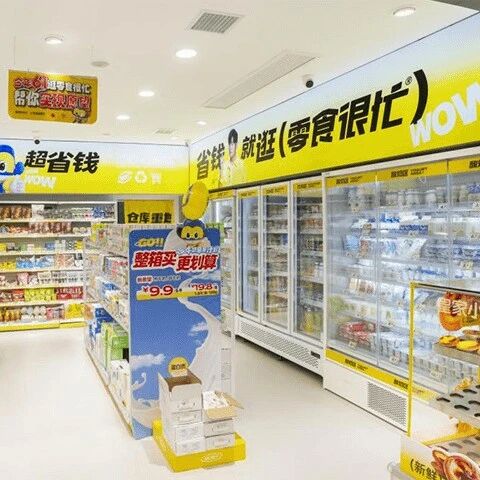
Core Viewpoint - The article highlights the significance of Mingming Hen Mang's upcoming listing on the Hong Kong Stock Exchange, marking a milestone for the bulk snack industry and establishing a new paradigm for its development [1][2]. Group 1: Industry Transformation - The bulk snack industry has historically been dominated by traditional thinking, leading to a misalignment between supply and consumer demand, characterized by a plethora of products that fail to meet true consumer desires [6][7]. - Traditional retail has been governed by "shelf thinking" and "traffic thinking," which limits the ability to cater to diverse consumer needs and preferences, especially among younger generations who seek new experiences and personalized offerings [8][10]. Group 2: Mingming Hen Mang's Strategy - Mingming Hen Mang has shifted from a "seller's mindset" to a "user's mindset," actively identifying and meeting consumer needs rather than merely responding to market demands [10]. - The company has introduced a flexible packaging strategy, with 38% of its SKUs available for bulk purchase, allowing consumers to buy as needed, thus breaking free from traditional large packaging constraints [11]. - 34% of Mingming Hen Mang's SKUs are customized products, reflecting a commitment to producing what consumers want rather than what is readily available [13]. Group 3: Market Validation and Consumer Engagement - The company employs a "small-scale trial and rapid iteration" market validation mechanism, testing new products in select stores before a nationwide rollout, which minimizes market risks and gathers authentic consumer feedback [16]. - Consumer feedback directly influences product adjustments, such as packaging improvements and flavor modifications, enhancing the overall user experience [17]. Group 4: Community and Future Expansion - With over 20,000 stores across 1,341 counties, Mingming Hen Mang aims to evolve beyond a snack retailer into a community-centric service provider, addressing various consumer needs [19][20]. - The "snack+" strategy seeks to explore new possibilities in community retail, drawing inspiration from global retail giants like Costco and Trader Joe's, focusing on consumer needs and breaking category boundaries [22][23]. - The company plans to expand its product offerings to include daily necessities, transforming stores into community convenience hubs, thereby enhancing customer loyalty and store efficiency [28][29].

鸣鸣很忙据报筹39亿港元 腾讯富达淡马锡为基石投资者
Ge Long Hui A P P· 2026-01-19 11:16
格隆汇1月19日|中国零食连锁零售商鸣鸣很忙(Busy Ming)本月初已通过港交所上市聆讯。彭博引述消 息人士表示,腾讯控股、富达国际、淡马锡控股计划投资鸣鸣很忙香港IPO。消息人士指出,上述3间 公司将作为基石投资者,而鸣鸣很忙最快于周二接受投资者认购,估计集资约5亿美元(约39亿港元)。 ...

零售新旧业态差异大 企业持续加码鲜食、自有品牌
Zhong Guo Jing Ying Bao· 2026-01-19 06:05
Core Insights - The retail industry in 2025 is experiencing significant changes, with emerging channels like Hema and Aldi growing rapidly while traditional retailers face ongoing challenges [1][3] Group 1: Emerging Channels - Hema's overall revenue growth exceeded 40% year-on-year in 2025, with the company entering 40 new cities and opening over 200 new stores [2] - Aldi has expanded its presence in China, opening over 80 stores since its initial launch in Shanghai in June 2019 [2] - The snack retail sector is also thriving, with Mingming Hen Mang achieving a revenue of 36.56 billion yuan, a year-on-year increase of 77.37% [2] Group 2: Traditional Retail Challenges - Traditional retailers like Zhongbai Group reported a revenue decline of 19.41% year-on-year, resulting in a loss of 325 million yuan in the first three quarters of 2025 [3] - Bain's report indicates a continued contraction in offline channels, with traditional hypermarkets and convenience stores losing market share in fast-moving consumer goods [3] - Despite the overall pressure, new channels such as warehouse membership stores, snack stores, and discount stores are expanding rapidly, with year-on-year growth rates of 40%, 51%, and 92% respectively [3] Group 3: Retail Transformation - Traditional retailers are attempting to reverse their fortunes through store and format adjustments, with Zhongbai Group closing 30 hypermarkets and incurring a closure loss of approximately 180 million yuan [3][6] - The shift towards fresh and ready-to-eat food offerings is evident, as traditional retailers adapt to consumer preferences for fresh products [7][8] - Retailers are increasingly focusing on private label products, with Yonghui Supermarket planning to develop 100 billion-level products over three years [9] Group 4: Consumer Preferences - Consumers are gravitating towards high-value and experiential retail formats, leading to a bifurcation in the market [7][9] - The success of membership stores like Sam's Club is attributed to their unique product selection and commitment to quality, although they face challenges in supply chain management [5][7] - The retail landscape is expected to evolve into a clear "M-shaped" differentiation, with one end focusing on efficiency and the other on experiential value [9]


中信建投:茅台披露市场化运营方案,伊利参与优然配售彰显信心
Ge Long Hui A P P· 2026-01-18 23:56
Group 1 - The core viewpoint of the article highlights the comprehensive reforms in Guizhou Moutai's market-oriented operation plan for 2026, focusing on product system, operational model, channel layout, and pricing mechanism [1] - The report indicates that the new store model is driving recovery in specific sectors, with Mingming very active in the Hong Kong stock market hearing [1] - Yili's shareholding ratio increased from 33.93% to 36.07% after participating in the YouRan placement, reflecting confidence at the industry bottom [1] Group 2 - In the consumer goods sector, three main themes are emphasized: the recovery expectations in the catering chain (focusing on new store models and customized supermarket offerings), high growth in health-oriented and functional products, and optimization of the cost cycle [1] - For Q1, attention is drawn to three key themes: first, snack and dairy products leading the market during the year-end rally, while liquor is expected to recover post-Spring Festival; second, the upcoming annual report forecast period may see leading companies in consumer goods exceed profit expectations; third, data from late January's Spring Festival stocking is expected to boost performance, combined with low valuations and sentiment recovery, amplifying the potential for Q1 performance surprises [1]



从双强视角看行业发展:量贩零食行业深度研究:从豆蔻时代,到万里繁花
Changjiang Securities· 2026-01-18 14:24
Investment Rating - The report maintains a "Positive" investment rating for the industry [11] Core Insights - The bulk snack industry has successfully captured current consumer trends through "extreme cost performance" and "efficient supply chains," leading to a stable "dual strong" market structure with significant scale effects for leading companies [4][6] - The market for leisure food and beverages is expected to approach 4 trillion yuan by 2025, with a compound annual growth rate (CAGR) of over single digits from 2025 to 2029 [6][30] - The two leading companies, Mingming and Wancheng, have established themselves as industry champions, with Mingming showing stronger profitability and Wancheng focusing on operational efficiency and turnover speed [4][7] Market Structure and Growth - The snack industry is transitioning from fragmented operations to brand and chain development, entering an innovative phase represented by bulk snack stores [19][21] - The leisure food and beverage market is projected to grow significantly, with the down-market segment expected to see a growth rate of 6.8% from 2024 to 2029, surpassing the high-line market's 4.1% [6][33] - The retail market for bulk snacks is expected to exceed 200 billion yuan by 2025, with significant contributions from lower-tier markets [36][38] Company Performance - As of mid-2025, both leading companies have over 15,000 stores, with Mingming's store count reaching 21,041 by November 2025, while Wancheng is enhancing its presence in lower-tier markets [7][54] - Mingming has approximately 180 million registered members, with a repurchase rate of about 77%, while Wancheng has over 150 million registered members and an average monthly purchase frequency of 2.9 times [54][55] - Profitability for both companies is improving, with Mingming's gross margin at 9.7% and Wancheng's at 11.7% for the first three quarters of 2025 [8][55] Future Outlook - The report suggests that the future growth of bulk snack companies will rely on scale effects and operational efficiency, with potential for category expansion and overseas market penetration [9][30] - The Southeast Asian snack and beverage market is projected to reach approximately 48.4 billion USD by 2025, presenting opportunities for Chinese snack companies to expand internationally [9][30]
到底是谁还在花钱?
创业家· 2026-01-16 10:16
Core Insights - Emerging markets are beginning to dominate consumer discourse, with cities like Changsha leading new consumption trends due to a combination of reasonable income and leisure time [4][8][20] - The shift in consumer behavior is characterized by a move from seeking external validation to pursuing self-value and emotional fulfillment, marking the beginning of China's fifth consumption era [22][24] Group 1: Consumption Trends - Cities like Changsha and Guiyang are becoming consumption leaders, with Changsha's comedy clubs and tea houses attracting significant foot traffic and demonstrating a willingness to spend on leisure [10][11][18] - The coffee culture in Guiyang has flourished, with over 3,000 coffee shops catering to a population of about 6 million, indicating a strong local demand for quality products [18] - Other cities like Yibin and Bengbu are also showing unique consumption patterns, such as high demand for fresh salmon and specialty cakes, reflecting a desire for quality and novelty in daily life [19][20] Group 2: Emotional and Health-Oriented Consumption - Emotional consumption is becoming a significant driver, with the market expected to grow from 2.31 trillion yuan in 2024 to 2.72 trillion yuan in 2025, and surpassing 4.5 trillion yuan by 2029 [24] - Health-conscious consumption is on the rise, with 71% of consumers actively researching product ingredients, leading to increased sales of health-oriented products [26][29] - The trend of "self-reward" is evident, with sales of flowers and desserts increasing, indicating a shift towards more diverse and emotionally fulfilling purchases [25] Group 3: Market Dynamics and Brand Strategies - The consumer base is shifting from first-tier cities to emerging markets, with retail growth in lower-tier cities outpacing that of major urban centers [35][38] - Brands like Domino's Pizza are successfully tapping into these markets by offering affordable and innovative products, achieving record sales in new locations [40] - Retailers like Hema are expanding into new cities, focusing on high-end products to meet the evolving demands of consumers in these regions [41][45] Group 4: Supply Chain Innovations - Hema has established a robust supply chain with multiple centers and direct sourcing bases, enabling efficient distribution of fresh products to emerging markets [45] - The company is transforming local specialties into urban bestsellers, demonstrating the potential for regional products to gain national traction [45][46] - This new retail model positions companies as essential infrastructure, connecting global supply chains with local consumer needs [46]
“死了么”App估值上亿,照见“孤独经济”万亿新蓝海
Sou Hu Cai Jing· 2026-01-14 14:50
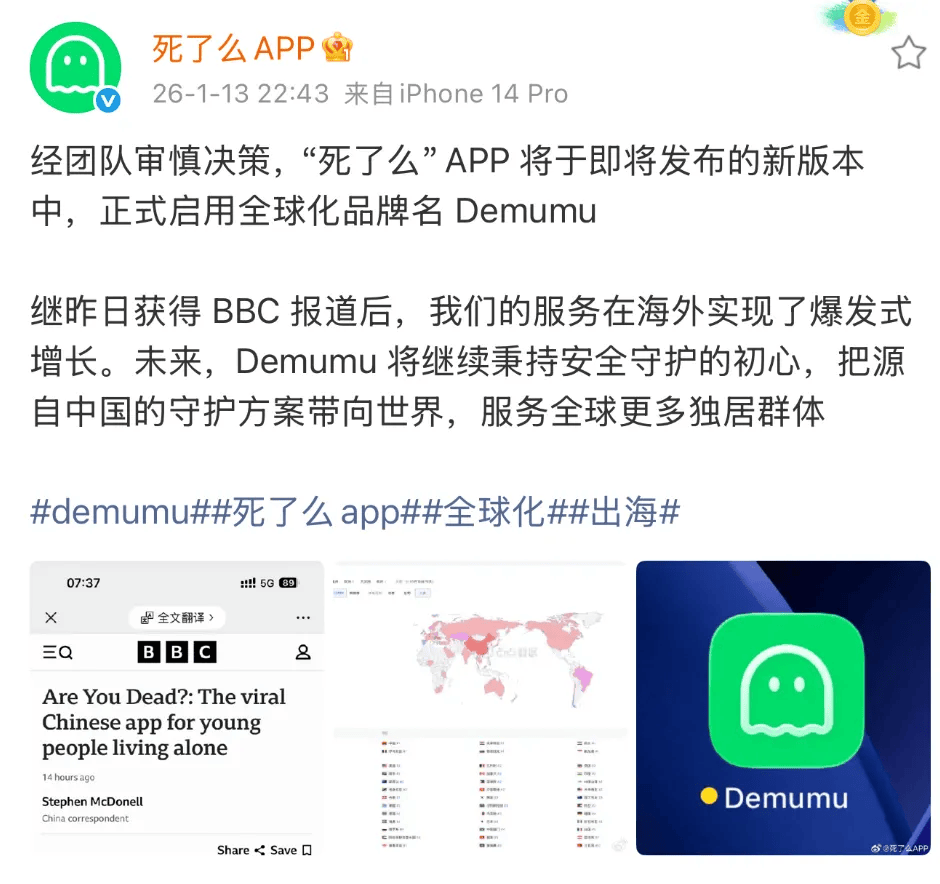
Group 1: App and Company Overview - The "Are You Dead?" app has gained significant popularity, with a rapid increase in downloads by 100 times since its launch, which had an initial investment of just over 1,000 yuan and was developed in less than a month [1] - The app's daily new user count has surged by 500-800 times compared to its initial phase, leading to a company valuation increase to approximately 100 million yuan from 10 million yuan within two days [1] - The app's founder plans to sell 10% of the company's equity for a financing amount in the tens of millions, despite the name "Are You Dead?" being criticized for its negative connotation, prompting a rebranding to "Demumu" for the upcoming version [1] Group 2: Societal Trends and Market Potential - The emergence of the "Are You Dead?" app reflects a growing trend in the "loneliness economy," which is a response to the increasing number of individuals living alone, particularly among urban youth [2][3] - By 2030, it is projected that the number of people living alone in China could reach 150-200 million, with the solo living rate exceeding 30%, driven by factors such as urban migration and changing marriage views [3] - The "loneliness economy" is expected to grow rapidly, with a focus on products that provide emotional value and cater to the needs of individuals living alone, indicating a significant market opportunity [3][5] Group 3: Emotional and Material Needs - The loneliness economy encompasses both emotional and material needs, with young individuals seeking emotional release and social interaction while feeling fatigued by interpersonal relationships [5][7] - The market for companionship services is expanding, with offerings ranging from online companionship to in-person activities, reflecting a growing demand for emotional fulfillment [7] - The rise of AI products and pets as alternatives for companionship is notable, with AI companionship market revenues projected to soar from $30 million to between $70 billion and $150 billion by 2030 [12][16] Group 4: Industry Developments and Consumer Behavior - Major companies are entering the AI companionship and pet markets, with significant investments and product launches aimed at meeting the emotional needs of consumers [15][16] - The pet industry is also experiencing rapid growth, with a projected market size of 312.6 billion yuan by 2025, driven by younger generations who view pets as family members [16][19] - The food and beverage industry is adapting to the needs of solo diners, with businesses like Haidilao innovating their offerings to cater to individual consumption patterns [20][22]
终于通过港交所上市聆讯!鸣鸣很忙去年门店数量已超2.1万家
Guan Cha Zhe Wang· 2026-01-14 10:44
Core Viewpoint - Mingming is the first company to pass the hearing for an IPO on the Hong Kong Stock Exchange after the New Year of 2026, indicating a significant milestone in its market entry strategy [1] Group 1: Company Growth and Market Position - By November 30, 2025, Mingming plans to have 21,041 stores, becoming the first company in the industry to exceed 20,000 stores, which has garnered market and capital recognition [1] - As of September 30, 2025, Mingming's GMV reached 66.1 billion yuan, a year-on-year increase of 74.5%, positioning it as the largest chain retailer in the leisure food and beverage sector in China [2] - The company has expanded its store network to cover all county-level cities in 28 provinces, with 59% of its stores located in county and town areas, entering 1,341 counties [2] Group 2: Financial Performance - For the first three quarters of 2025, Mingming reported a gross merchandise volume (GMV) of 66.1 billion yuan, with revenue of 46.372 billion yuan, reflecting a growth rate of 75.2% [2] - The adjusted net profit reached 1.81 billion yuan, showing a remarkable year-on-year increase of 240.8% [2] - The company's gross margin improved to approximately 9.73% in the first three quarters of 2025, up from 7.2% in the previous year, while the net profit margin increased to 3.4% from 1.8% [5] Group 3: Strategic Acquisitions and Brand Development - Mingming completed the acquisition of the "Zhao Yiming" snack brand in November 2023, contributing approximately 1.04 billion yuan to its total revenue, which is 10.2% of the annual total [4] - The integration of both brands has led to a consistent growth trend in revenue and gross profit, indicating effective management post-acquisition [5] - The company is focusing on expanding its own brand offerings, including "Red Label" (extreme low price) and "Gold Label" (quality and value), to enhance profit margins [5] Group 4: Future Outlook and Strategic Initiatives - The company aims to continue its rapid growth trajectory post-IPO by upgrading its store network, iterating products based on market demand, optimizing the supply chain, and enhancing digital management efficiency [6] - There is a focus on exploring potential investment and acquisition opportunities as part of its long-term growth strategy [6]
