三星

Search documents
民德电子(300656.SZ):功率半导体市场正步入新一轮上升周期
Ge Long Hui· 2026-02-09 13:27
Core Viewpoint - The power semiconductor market is entering a new growth cycle driven by increasing demand for high-voltage, high-efficiency, and high-reliability power devices due to the exponential rise in AI computing power and the expansion of data centers [1] Industry Trends - The demand for power management integrated circuits (PMIC) and power devices is experiencing exponential growth as AI data centers require significant power supply capabilities, which are becoming a core bottleneck for the large-scale implementation of AI technology [1] - The acceleration of power system construction, including photovoltaic energy storage and grid upgrades, along with the industrial automation upgrade, is driving the demand for key power devices in clean energy and industrial control sectors [1] Supply and Demand Dynamics - Major international manufacturers like TSMC and Samsung are focusing resources on advanced processes with higher returns, leading to a reduction in the supply and capacity of mature 6-inch and 8-inch processes, creating a structural imbalance in supply and demand for these mature processes [1] - Since the second half of 2025, most domestic power wafer production lines have been operating at high capacity utilization rates, indicating a strong demand in the market [1] - Infineon, a leading international power semiconductor company, announced a price increase for certain power devices effective April 1, 2026, reflecting a steady upward trend in both volume and price within the industry [1]

内存泡沫
3 6 Ke· 2026-02-09 11:50
几个月来,不少朋友都在纠结:到底要不要买一台笔记本电脑或手机囤着? 起初大家觉得。电子产品买新不买旧,没必要囤旧款。直到内存价格暴涨,新款产品降配保价,大家这才悟了:不是新款买不起,而是老款旗舰的大 内存版本更有性价比。 企业主也快吃不消了。1月6日,蔚来李斌也在媒体沟通会上公开表示,今年最大的成本压力是内存涨价。联想、惠普等OEM厂商也已经明确通知, 将上调笔记本等产品的价格。 从消费端的手机、笔记本电脑,到企业端的服务器、智能汽车,全产业链都被卷入成本飙升的漩涡。 起于2025年的这一波内存涨价潮,迎来了最高潮的部分:一箱内存条,能换上海一套房。 根据公开报道,256G DDR5服务器内存单价已突破4万元,部分高端型号高达49999元/根,一箱100根的总价接近500万元,相当于上海一套房。而 1637年郁金香泡沫的顶峰时期,一株优质郁金香球茎的标价高达5500至6000荷兰盾,能买下阿姆斯特丹河畔的一栋豪宅。 彼时彼刻,恰如此时此刻。 于是,关于内存泡沫的说法,在网上疯狂流传:内存价格之所以涨了四倍,是因为有人用根本不存在的钱,买下了大量尚未生产出来的内存,准备装 进同样尚未生产出来的GPU里,再放进尚 ...

苹果第一,小米第三!2025年全球手机出货数据出炉
Shen Zhen Shang Bao· 2026-02-09 11:10
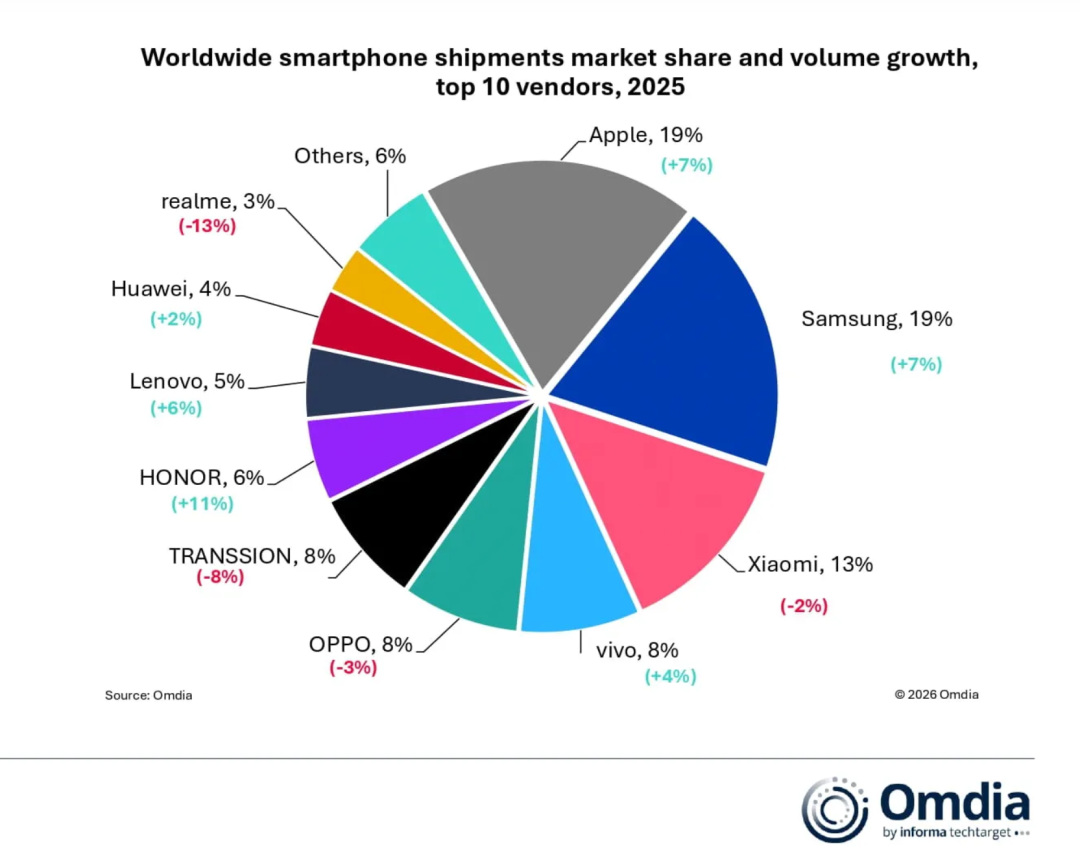
Group 1 - In 2025, Apple achieved a record annual shipment of 240.6 million iPhones, marking a 7% year-on-year increase, maintaining its position as the world's largest smartphone manufacturer for the third consecutive year [2] - Samsung rebounded in 2025 with a 7% year-on-year increase in shipments, following three years of decline, with a notable 16% increase in the fourth quarter driven by strong demand for flagship models and a recovery in the mass market [2] - Xiaomi retained its position among the top three manufacturers, but experienced a 2% decline in fourth-quarter shipments, while Vivo entered the fourth position for the first time with a 4% year-on-year increase in annual shipments [2] Group 2 - Honor achieved the highest global growth rate of 11% among the top ten manufacturers in 2025, leading in overseas shipment growth in the high-end and mid-high-end segments [3] - The global launch of the first "robot phone" HONOR ROBOT PHONE and the Honor Magic V6 foldable phone is scheduled for March 2026 at the Mobile World Congress in Barcelona [3] - Transsion, Lenovo, and Huawei reported annual shipment growth rates of 8%, 5%, and 4% respectively in 2025 [3]


华邦电子DRAM今年产能已售罄
Xin Lang Cai Jing· 2026-02-09 10:20
供应消息 华邦电子:今年一季度DRAM合约价延续大涨近50%的涨幅,今年产能已全数售罄,接下来高雄路竹厂 新增的DDR4、LPDDR4产能也已全数售罄。 注:全文732字 预计浏览1分钟。 HMB4:三星将于2月第三周正式向英伟达出货第四代高带宽记忆体(HBM4),成为全球首家向客户 交付量产版HBM4的业者。 项目技术 泽石科技葛店工业园:主体结构已完成100%,计划2026年建成投产运营。项目总投20亿元,一期投产 后计划实现年产SSD模组600万片;二期将聚焦闪存芯片封装测试环节,目标达成年产存储控制器芯片 600万片的产能规模。 企业动态 强一股份:发布公告,已签订了协议,计划投资不低于7.5亿元建设集成电路玻璃基板及器件的研发、 生产和销售项目。 长飞先进:宣布完成超10亿元A+轮股权融资。本轮融资由江城基金等机构参投,融资资金将主要用于 碳化硅功率半导体全产业链技术布局。 芯联集成:与浩思动力达成战略合作,未来5年内双方合作的技术产品预计覆盖约10款混动车型。 澜起科技:在港交所挂牌上市。其发行价为每股106.89港元(约合人民币94.86元),开盘价为每股 168.00港元(约合人民币149.0 ...


民德电子(300656) - 2026年2月9日投资者关系活动记录表
2026-02-09 10:12
编号:2026-01 证券代码:300656 证券简称:民德电子 深圳市民德电子科技股份有限公司投资者关系活动记录表 (1)纯晶圆代工的商业模式定位:纯晶圆代工模式在行业内属于相对稀缺资源, 功率半导体设计公司的痛点,在于找到可以保障其知识产权安全且能为其提供稳定、 可靠产能的晶圆代工厂;国内大部分功率半导体晶圆厂都是 IDM 模式或半 IDM 模式 (即一部分自主产品,一部分对外代工),很难做到对客户知识产权的充分保障和产 能稳定供应。因此,具备原创设计能力的芯片设计公司非常有意愿与广芯微建立代工 合作。 (2)较高端的工艺平台能力和一体化解决方案:广芯微电子的设备配置在国内 6 英寸功率半导体晶圆厂中具备较强的制造水平,已开发搭建的深沟槽刻蚀工艺、通孔 刻蚀+钨淀积工艺及高能注入机台工艺等核心工艺平台能力属业内较高端的平台,产品 线丰富,尤其在高压、特高压领域具有一定的优势;同时,广芯微和芯微泰克可以为 客户提供正面+背道(超薄、背面加工、重金属掺杂等)一体化的特色工艺全套解决方 案,可覆盖大多数功率半导体器件及功率集成电路产品,并利用自身丰富的经验,赋 能设计公司,减少开发周期。 4、广芯微电子产品下游 ...
古尔曼:iPhone 17e即将发布,带来四项新功能
Huan Qiu Wang Zi Xun· 2026-02-09 09:01
Core Viewpoint - Apple is set to release the iPhone 17e, which will feature at least four new functionalities, including enhancements to its hardware and connectivity options [1][3]. Group 1: New Features - The iPhone 17e will be equipped with the A19 chip, which was first introduced with the iPhone 17 [3]. - The new model will include the MagSafe magnetic connection feature, addressing a significant shortcoming of the current generation [3]. - It will also come with Apple's latest cellular modem, the C1X chip [3]. Group 2: Pricing and Market Strategy - The starting price for the iPhone 17e will remain the same as the iPhone 16e, set at $599 [3]. - Apple plans to aggressively market the iPhone 17e to emerging market users and businesses, potentially benefiting from reduced competition from Google and Samsung in this sector [3].

中国电子设备行业展望
Zhong Cheng Xin Guo Ji· 2026-02-09 08:22
Investment Rating - The investment outlook for the electronic equipment industry is rated as stable for the next 12 to 18 months [3][4][37]. Core Insights - The electronic equipment industry in China is expected to maintain a stable credit level in 2026, supported by favorable policies and AI computing power, despite challenges from international trade policy adjustments and rising core material prices [3][7]. - The industry is characterized by a strong operational resilience since 2025, with differentiated performance across sub-sectors, including stable growth in home appliances and computers, strong growth in communication equipment, and moderate recovery in smart consumer devices [18][19][23][27]. - The macroeconomic environment is projected to remain neutral, with ongoing uncertainties in global tariff policies impacting the industry [6][8]. Industry Fundamental Analysis - The electronic equipment industry is expected to face a mixed environment in 2026, with supportive policies like "old-for-new" programs boosting domestic demand while international trade tensions and material cost increases pose challenges [7][9]. - The "old-for-new" policy has significantly stimulated market demand, with over 129 million home appliances and 91 million digital products exchanged, generating sales exceeding 2.6 trillion yuan [9][10]. - The overall credit risk in the industry is manageable, with no bond defaults or extensions reported in 2025, indicating a stable credit quality outlook for 2026 [37][38]. Sub-sector Analysis Home Appliances - The home appliance sector is expected to see a moderate recovery driven by policy support and structural upgrades, despite facing pressures in specific product categories like televisions [19][21]. - The market dynamics show a concentration of competition among leading brands, with smaller players struggling to survive due to intense competition and pricing pressures [38][39]. Computer Equipment - The server segment is experiencing robust growth, particularly in AI servers, with a projected shipment of 486,000 units in 2025, reflecting a 15.4% year-on-year increase [23][24]. - The personal computer market is stable, with government and large enterprise demand driving growth, while consumer demand remains flat due to rising component prices [25][26]. Communication Equipment - The communication equipment sector is benefiting from strong demand for optical fibers and data center switches, with significant growth expected in 2026 [27][28]. - The market for optical fibers is projected to continue its upward trend, supported by increased procurement from major telecom operators and a growing need for high-end products [28][30]. Smart Consumer Devices - The smart consumer device market is facing challenges due to prolonged replacement cycles and rising costs, with expectations of a decline in overall shipment volumes in 2026 [32][36]. - The smartphone market is particularly affected, with a slight decrease in shipments anticipated due to market saturation and lack of innovation [32][33].
2026年是“别样”牛市!盘京庄涛最新小范围交流,乐观布局AI带来的产业机遇
Xin Lang Cai Jing· 2026-02-09 07:36
Group 1 - The core viewpoint is that 2026 is expected to be a bull market, characterized by significant trading volume, a surge in new account openings, and ample liquidity due to the low interest rate environment and the maturity of substantial deposits [6][10][39] - The number of new accounts opened in January 2026 reached approximately 5 million, indicating strong market entry from retail investors [7][46] - There is a substantial amount of liquidity in the market, with tens of trillions of three-year deposits maturing, which is expected to drive investment into the stock market [8][47] Group 2 - The market structure in 2026 is described as a "different" bull market, where traditional active management products are seeing little incremental capital, and many are facing significant redemptions [11][51] - The current market is experiencing extreme liquidity excess, with a one-sided market structure, where many actively managed funds have underperformed compared to quantitative products [12][52] - Historical parallels are drawn to early 2007, where a similar market structure existed, but the transition may not occur in the same manner this time [14][53] Group 3 - The investment thesis emphasizes that "no industry, no bull market," highlighting the importance of industry growth, particularly in AI, despite a weak macroeconomic backdrop [17][55] - There is a clear distinction made regarding the perception of AI investments, arguing against the notion that AI lacks revenue, as cloud demand itself constitutes income [19][58] - The capital investment in AI is framed as a survival decision for companies, rather than a straightforward profit calculation, emphasizing the urgency for firms to invest to avoid falling behind [22][62] Group 4 - The company stresses the need for a high level of understanding of fundamentals in the current market environment, where volatility can distort investment strategies [28][70] - Three strategies are proposed for navigating the market: focusing on fundamental analysis, maintaining a balanced portfolio that includes value stocks, and ensuring geographical diversification in investments [32][74] - The outlook for specific sectors, such as storage in the AI space, is highlighted as a key investment opportunity, with expectations for significant growth driven by domestic manufacturing capabilities [37][76]
2026成本战打响:原材料暴涨与政策退坡下的“生死局”
3 6 Ke· 2026-02-09 07:21
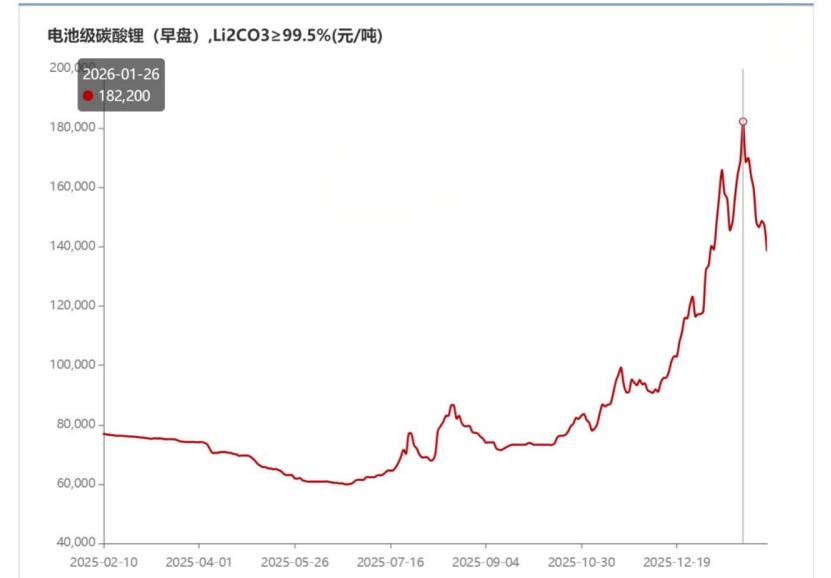
Core Viewpoint - The automotive industry is facing a dual challenge of rising costs and declining demand, with significant price increases in core raw materials and a competitive market environment impacting profitability [1][10]. Group 1: Cost Pressures - The automotive manufacturing sector is experiencing a collective price surge in key raw materials such as lithium, copper, aluminum, and tin, significantly affecting electric vehicle production [2][4]. - The price of battery-grade lithium carbonate has skyrocketed from 75,700 yuan per ton at the beginning of 2025 to 182,200 yuan per ton by January 26, 2026, marking an increase of over 150% [2]. - The cost of copper and aluminum has also risen sharply, with domestic electrolytic copper prices exceeding 100,000 yuan per ton and aluminum prices projected to reach 3,150 USD per ton in the first half of 2026 [4][5]. Group 2: Impact on Electric Vehicles - Electric vehicles, which require significantly more raw materials than traditional fuel vehicles, are particularly vulnerable to these cost increases, with the average vehicle requiring 200 kg of aluminum and 80 kg of copper [4][5]. - The cost of DRAM for automotive applications has surged by 180% in three months, with prices for DDR5 and DDR4 memory chips increasing dramatically due to competition with the AI sector [7][9]. Group 3: Market Dynamics and Policy Changes - The Chinese automotive market is currently experiencing a downturn in consumer confidence, exacerbated by the reduction of tax incentives for electric vehicles and changes to the "trade-in" subsidy policy [10][11]. - The sales profit margin for the automotive industry in China was only 4.1% in 2025, the lowest in five years, with some companies reporting margins as low as 1.8% [11][13]. Group 4: Strategic Responses - Many automotive companies are opting to absorb costs through financial schemes and temporary subsidies rather than raising prices, which could lead to a loss of market share in a highly competitive environment [11][13]. - Leading companies are seeking to strengthen ties with upstream suppliers and expand into overseas markets to mitigate domestic cost pressures [14].

马斯克:向中国学习
投资界· 2026-02-09 07:19
Core Viewpoint - Space is predicted to become the preferred location for AI infrastructure within 30 to 36 months, with annual AI computing power in space expected to exceed the cumulative total on Earth within five years [1][12][20]. Group 1: AI and Space Infrastructure - The total intelligence of AI may surpass human intelligence within five to six years, with human intelligence potentially constituting less than 1% of all intelligence [2][25]. - Companies entirely composed of AI and robots are expected to outperform any company with human involvement [2][31]. - The energy supply is a critical factor for building data centers in space, as energy production outside of China is stagnating while chip production is rapidly increasing [3][6]. Group 2: Energy and Cost Efficiency - Solar panels in space can generate power at five times the efficiency of those on Earth, eliminating the need for batteries, thus reducing costs significantly [4][9]. - The cost of solar panels is currently around $0.25 to $0.30 per watt in China, and costs could decrease by up to tenfold when deployed in space [9][23]. - The average electricity consumption in the U.S. is about 500 GW, and achieving 1 TW of power generation in space would require significant advancements in energy production [5][20]. Group 3: Challenges in Energy Production - Building power plants is complex, requiring extensive infrastructure and facing regulatory hurdles, which slows down the process [6][10]. - The demand for electricity for data centers is underestimated, with actual needs being much higher due to cooling and maintenance requirements [10][21]. - The U.S. is facing a bottleneck in energy production, which could hinder the launch of large-scale AI chip operations [21]. Group 4: Manufacturing and Supply Chain - The manufacturing of chips is constrained by existing foundries, which are unable to meet the growing demand for AI chips [19][18]. - There is a significant backlog in turbine orders, which complicates the establishment of new power generation facilities [11][12]. - SpaceX and Tesla aim to produce 100 GW of solar panels annually, controlling the entire supply chain from raw materials to finished products [8][34]. Group 5: Competitive Landscape - Without breakthrough innovations in the U.S., China is poised to dominate the AI and manufacturing sectors [2][37]. - China's energy production is projected to exceed that of the U.S. by three times, indicating its industrial capabilities [37]. - The U.S. faces challenges in maintaining a competitive edge due to lower birth rates and a declining workforce, making advancements in robotics and AI crucial [36][37].