茶百道

Search documents
外卖大战加速连锁茶饮的K型分化
新财富· 2026-02-12 08:05
Core Viewpoint - 2025 is expected to be a pivotal year for new consumption and a year of differentiation in the chain tea beverage industry, with increasing competition and pressure on leading brands [3]. Market Competition - The tea beverage industry has seen intensified competition since Q2 2024, with brands resorting to price wars through discounts and low-priced promotional items [3]. - Major brands like Cha Bai Dao and Hu Shang A Yi are experiencing slower store expansion and declining same-store sales, indicating a struggle for growth [3][4]. - By Q2 and Q3 of 2024, the competitive landscape became clearer, with leading brands like Mi Xue Bing Cheng and Gu Ming gaining competitive advantages while others like Cha Bai Dao and Hu Shang A Yi fell behind [4]. Impact of Delivery Wars - Starting Q1 2025, major tea brands began to reduce discounting and the frequency of low-price promotional items, suggesting a potential easing of competition if the delivery wars do not escalate in H2 2025 [5]. - In April 2025, major delivery platforms initiated significant subsidies, leading to a temporary increase in stock prices for brands like Gu Ming and Mi Xue Bing Cheng, but concerns arose about a new round of price wars [7]. - The delivery wars have led to increased same-store GMV for brands like Mi Xue and Gu Ming, but also resulted in lower average transaction prices and intensified competition [9]. Long-term Outlook - The delivery wars may cause short-term disruptions but are expected to have limited long-term pricing impacts, with weaker brands likely to fall further behind, creating structural opportunities for leading brands [13]. - The competition is shifting from supply chain differences to refined operational efficiency, focusing on digital systems for inventory management and customer engagement [14][15]. Brand Performance - Mi Xue Bing Cheng and Gu Ming are among the few brands achieving over 20% store growth this year, benefiting from their supply chain advantages and strong operational capabilities [17]. - Gu Ming has shown resilience with steady same-store growth and healthy franchisee profitability, while Mi Xue Bing Cheng has leveraged its scale and efficiency to withstand competitive pressures [17].


古茗20260211
2026-02-11 15:40
Summary of Conference Call Notes Company and Industry Overview - The conference call focused on the tea beverage industry, specifically the company "Guming" (古茗) and its market position within the sector. The tea beverage industry is expected to grow at a compound annual growth rate (CAGR) of over 15% over the next five years due to changes in consumer preferences and market dynamics [1][2]. Key Insights and Arguments Industry Growth and Market Dynamics - The tea beverage industry is experiencing a shift towards premiumization, with a notable distinction between low-priced (below 10 RMB) and mid-priced (above 10 RMB) segments. The low-priced segment is dominated by Guming, which holds nearly 60% market share in this category [1][2]. - The mid-priced segment faces intense competition, requiring brands to possess strong management capabilities and a robust supply chain to maintain long-term competitiveness [2]. Guming's Business Model and Growth Strategy - Guming has established a significant presence with over 13,000 stores and aims to reach 20,000 by 2027, with a long-term target of approximately 40,000 stores in China [3][7]. - The company has undergone three phases of development: establishing its business model (2010-2017), expanding through regional strategies (2019-2021), and accelerating growth post-IPO [3][6]. - Guming's revenue model primarily relies on a franchise system, generating income from supply chain services and initial franchise fees. The company reported a GMV of 106 billion RMB in 2021, projected to reach 340 billion RMB in 2025, with a CAGR of approximately 34% [7][8]. Financial Performance and Projections - Guming's revenue for 2025 is expected to reach 13.6 billion RMB, with a year-over-year growth rate of around 55%. The adjusted net profit is projected to be between 2.4 billion and 2.5 billion RMB, reflecting a 60% increase [8][26]. - The company has maintained a strong cash flow due to its franchise model, allowing for significant reinvestment in growth and expansion [6][11]. Competitive Advantages - Guming's competitive edge lies in its supply chain efficiency, product innovation, and strong brand loyalty. The company has a high customer retention rate, with a quarterly active membership of approximately 39.5 million, significantly higher than competitors [19][20]. - The company has a low closure rate of 4-6% compared to competitors, indicating strong franchisee satisfaction and operational stability [21]. Future Growth Opportunities - Guming plans to expand its product offerings beyond tea to include coffee and breakfast items, aiming to enhance customer engagement and increase sales per store [22][23]. - The company is focusing on penetrating underrepresented markets, with significant potential for growth in northern China, where it currently has limited presence [24][25]. Other Important Insights - Guming's management team is highly involved in operations, with a concentrated ownership structure that aligns the interests of key stakeholders [8][10]. - The company’s pricing strategy aims to balance affordability for consumers while ensuring reasonable returns for franchisees, which is crucial for sustaining growth in a competitive market [15][16]. - The upcoming conference call will delve deeper into Guming's product, supply chain, and management advantages, as well as comparisons with competitors [27]. This summary encapsulates the key points discussed in the conference call, highlighting Guming's strategic positioning, financial outlook, and competitive landscape within the tea beverage industry.
2026全国连锁商家抖音经营报告|36氪研究院
36氪· 2026-02-11 13:35
以下文章来源于36氪研究院 ,作者36氪研究院 36氪研究院 . 专注于一二级市场及新经济领域的研究与咨询 全域协同、长效经营: 连锁商家抖音经营新图景。 当前,我国连锁行业正整体步入以效率为核心的稳态高效发展阶段。以连锁餐饮、连锁零售为代表的主要业态增速逐步趋稳,行业发展重心由开店速度转向 单店坪效、整体增长与经营确定性。如何精准触达用户并实现高效转化,成为连锁商家普遍面临的核心命题。以抖音生活服务为代表的内容驱动型平台,正 凭借独特的内容场域优势,推动全域流量的高效协同与转化,助力实体连锁商家探索线上线下深度融合的增长新路径。 生活服务正成为 连锁商家增长发力的"新主场" 从获客环境看,移动互联网时代下,受短视频、直播等媒介影响,消费者行为逐步由"到店决策"向"线上决策、线下消费"转变,推动商家获客主场加速向线 上迁移,用户注意力争夺成为连锁品牌获客的核心焦点。本地生活平台所构建的内容场与交易场,能够在低边际成本下实现广覆盖与高频触达,逐步承担起 流量入口的功能。以抖音生活服务为代表的本地生活平台通过短视频、直播与搜索,将内容深度嵌入消费决策链路,使其成为连锁商家参与用户决策、塑造 品牌心智的增长"新引擎 ...
36氪研究院 | 2026全国连锁商家抖音经营报告
3 6 Ke· 2026-02-11 08:32
当前,我国连锁行业正整体步入以效率为核心的稳态高效发展阶段。以连锁餐饮、连锁零售为代表的主要业态增速逐步趋稳,行业发展重心由开店速度转 向单店坪效、整体增长与经营确定性。如何精准触达用户并实现高效转化,成为连锁商家普遍面临的核心命题。以抖音生活服务为代表的内容驱动型平 台,正凭借独特的内容场域优势,推动全域流量的高效协同与转化,助力实体连锁商家探索线上线下深度融合的增长新路径。 生活服务正成为连锁商家增长发力的"新主场" 抖音生活服务生态升级扩容,全域协同经营助力连锁商家释放增长潜能 近年来,抖音生活服务生态持续升级,交易规模、用户规模与连锁商家数量稳步提升,逐步形成了消费活跃、增长有力、供给多元的生活服务新生态。抖 音生活服务正围绕商品供给、内容传播与线下经营三大核心场域展开,依托"一个心智爆品、两个营销一致性、三个流量循环、四步区域经营"四大增长引 擎,打通"商品供给-内容种草-流量获客-交易转化-线下履约 "线上线下全链路闭环,为线下连锁商家提供从流量获取到业绩增长的全流程支持,最 终助力商家完成全域流量协同、经营效能跃升,开拓全新经营增长空间。 具体而言,在餐饮、游玩、综合、零售等核心垂类中,抖音生活 ...

奶茶行业流行“搭快船”出海?
Sou Hu Cai Jing· 2026-02-11 05:16
Core Viewpoint - The article discusses the strategic partnership between Cha Bai Dao and SG Mart in Singapore, highlighting the brand's approach to international expansion through localized strategies and partnerships to enhance market entry efficiency [1][4]. Group 1: Cha Bai Dao's International Strategy - Cha Bai Dao began its overseas journey in 2024, opening its first store in Seoul, South Korea, strategically located in the affluent Gangnam district to target mainstream local consumers rather than just the Chinese community [2]. - The brand has rapidly expanded its international presence, covering over 20 stores across more than ten countries, including South Korea, Thailand, Australia, Singapore, Spain, France, and the United States, within two years [2]. - The partnership with SG Mart is seen as a pragmatic move to leverage SG Mart's established local network and logistics, facilitating a quicker market entry for Cha Bai Dao in Singapore [5]. Group 2: Market Dynamics and Competitors - Other beverage brands, such as Ba Wang Cha Ji, are also pursuing aggressive international strategies, with Ba Wang Cha Ji forming a joint venture in Thailand to gain access to local market insights and distribution channels [6]. - The article notes that the trend of forming strategic partnerships to enhance market entry efficiency is not unique to Chinese brands, as global giants like Starbucks have also adopted similar strategies in their expansion efforts [7]. - The overall landscape of the beverage industry is witnessing a surge in international expansion, with numerous brands, including Mi Xue Bing Cheng and Luckin Coffee, rapidly increasing their overseas store counts [15][18]. Group 3: Challenges and Considerations - Despite the aggressive expansion, brands face significant challenges in local market adaptation, including understanding consumer preferences and establishing efficient supply chains [16][18]. - The competition in overseas markets is intensifying, with many brands entering the same regions, leading to potential market saturation and price wars [18]. - Successful international expansion requires not only opening stores but also achieving deep localization in product offerings, supply chain management, and brand positioning to resonate with local consumers [19].

2026年港股消费IPO热:近两成排队企业来自消费赛道,龙头集中逻辑凸显
Jin Rong Jie· 2026-02-10 07:08
Group 1 - The Hong Kong IPO market for consumer companies is gaining momentum, with 67 out of 385 companies waiting to go public being in the consumer sector, representing nearly 20% [1][3] - Major consumer brands like Mixue Ice City and Dongpeng Beverage view the Hong Kong listing as a significant opportunity for overseas market expansion and brand influence [3] - The estimated financing scale for Hong Kong main board IPOs in 2026 is around HKD 310 billion [1] Group 2 - The shorter listing cycle and more transparent processes in Hong Kong make it attractive for consumer companies, especially as the A-share market becomes stricter in its review processes [3] - Among the 10 food and beverage companies that went public in Hong Kong last year, 9 saw their stock prices rise on the first day, with Baoma Tea achieving a first-day increase of 86.7% [3] - As of February 6, 2026, stocks of companies like Guming and Anji Food have increased significantly since their listings, with Guming showing a rise of 242.01% [3][4]

豆包下场,春节AI大战愈发热闹
Hua Er Jie Jian Wen· 2026-02-10 06:06
Core Insights - The AI marketing battle during the Spring Festival has intensified, with major players like ByteDance's Doubao, Alibaba's Qianwen, and Tencent's Yuanbao launching aggressive promotional campaigns to attract users [1][12]. Group 1: Doubao's Strategy - Doubao, a product of ByteDance, has targeted the high-traffic platform of CCTV's Spring Festival Gala, offering over 100,000 tech gifts and cash prizes up to 8,888 yuan [1][2]. - The prize lineup includes advanced tech products such as robots and drones, as well as consumer electronics like smartwatches and rice cookers, enhancing its appeal [2][5]. - Doubao's campaign aims to leverage its existing user base of over 100 million daily active users, further expanding its reach through this high-profile collaboration [5]. Group 2: Qianwen's Approach - Qianwen, under Alibaba, adopted a more aggressive strategy with its "30 billion yuan free order" campaign, quickly becoming the top free app on the Apple App Store [6]. - The promotional mechanism offers users a 25 yuan no-threshold free order card, incentivizing user acquisition through referrals, which led to over 1 million orders within hours [6]. - However, the overwhelming response caused server issues, prompting the team to address resource allocation to ensure service stability [6]. Group 3: Market Reactions - The marketing frenzy positively impacted related stocks in the beverage sector, with companies like Gu Ming and Cha Bai Dao seeing significant stock price increases [8]. - Despite the successful promotional activities, Alibaba's stock fell by 3%, indicating investor skepticism regarding the sustainability of user acquisition through high subsidies [8]. Group 4: Competitive Landscape - WeChat has intensified competition by blocking promotional activities from Qianwen and other AI applications, citing disruptions to platform order [9][11]. - This action has created a competitive advantage for Tencent's Yuanbao, as it remains unaffected by WeChat's restrictions [11]. Group 5: Strategic Shifts in the Industry - The ongoing AI marketing battle reflects a deeper strategic shift among China's internet giants, with a focus on AI investments and market defense strategies [12]. - Goldman Sachs predicts that by 2026, total AI capital expenditure from major players like ByteDance, Alibaba, and Tencent will exceed $60 billion (approximately 410 billion yuan) [12]. - The current promotional activities are seen as an entry point into a longer-term competition for dominance in the AI space, with a focus on product quality and user engagement [12].

中金:旅游酒店及餐饮行业看好最长春节休闲需求释放 优质头部继续受益
智通财经网· 2026-02-10 03:32
智通财经APP获悉,中金发布研报称,观察到26年春运首周人员流动稳健增长、26年春节假期机酒预订 表现较好,看好最长春节期间休闲旅游需求释放。此外,在社服行业呈现出需求企稳筑底或回升(如免 税)、供给端竞争趋缓格局趋稳(如酒店、咖啡、部分餐饮)的背景下,继续看好实现价格止跌回升或 同店修复的优质头部。 中金主要观点如下: 旅游:看好最长春节期间休闲旅游需求释放 据交通运输部数据和该行测算,春运前7天(2/2-2/7)全社会跨区域人员流动量同比增长约2.3%,其中 铁路/公路/水路/民航客运量分别同比+0.7%/+2.3%/+15.8%/+5.9%;航班管家测算26年春运40天民航旅客 运输量预计同比+5.3%。航旅纵横显示截至1/29春节机票日均预订量同比+16%,出入境机票预订量同比 略有增长。 免税:26年春节假期海南客流同比表现亮眼;25年同期销售额基数较低 客流方面,由于去年同期低基数、海南自贸港封关政策红利释放等综合影响,26年春节假期海南机票预 订同比表现亮眼。根据去哪儿数据,截至1月13日,26年春节假期三亚/海口机票预订量同比 +90%/120%。海口海关数据显示25年春节离岛免税日均销售额2 ...
国泰海通晨报-20260210
GUOTAI HAITONG SECURITIES· 2026-02-10 01:41
Group 1: Precision Medicine and Robotics - The report highlights Jingfeng Medical-B as a leader in surgical robotics in China, driving advancements in surgical procedures through continuous technological innovation, with rapid growth in global clinical surgeries and domestic sales [2][3] - The company is projected to achieve revenues of 432 million, 811 million, and 1.236 billion yuan from 2025 to 2027, with a target price of 73.20 yuan for 2026 based on a 35X PS valuation [3] - Jingfeng Medical has established a comprehensive surgical solution with its innovative multi-port and single-port robotic systems, becoming the first in China and the second globally to obtain regulatory approval for multiple robotic systems [3][4] Group 2: Market Performance and Sales Growth - In 2024, Jingfeng Medical sold 20 multi-port surgical robots, ranking first among domestic manufacturers, with clinical applications covering over 220 hospitals across 30 provinces in China [4] - The company's total revenue is expected to increase from 48 million yuan in 2023 to 160 million yuan in 2024, with a significant rise from 30 million yuan in the first half of 2024 to 149 million yuan in the first half of 2025 [4] - The report indicates that Jingfeng Medical's international expansion has led to explosive growth in overseas orders, with 72 out of 118 signed global sales agreements for core products being from overseas markets [5] Group 3: Precision Manufacturing and Emerging Industries - The report covers Xingrui Technology as a leading precision manufacturing enterprise in China, focusing on automotive electronics and actively expanding into emerging industries, with a target price of 32.11 yuan [6][8] - Revenue projections for Xingrui Technology are 1.626 billion, 1.980 billion, and 2.482 billion yuan from 2025 to 2027, with an expected EPS of 0.48, 0.69, and 0.95 yuan respectively [6] - The company has established a robust product matrix, including electronic connectors and structural components, with applications in new energy vehicle systems and consumer electronics, enhancing its competitive advantage in the automotive electronics sector [7] Group 4: Strategic Partnerships and Market Expansion - Xingrui Technology has formed strategic partnerships to expand into the liquid cooling industry, collaborating with Green Cloud to develop advanced technologies and products for data centers [8] - The company has a strong customer base, collaborating with renowned brands in consumer electronics and new energy sectors, and has established a global business layout with factories in multiple locations [7][8] - The report emphasizes the potential for Xingrui Technology to benefit from the growing demand for liquid cooling solutions driven by energy efficiency upgrades in data centers [8]


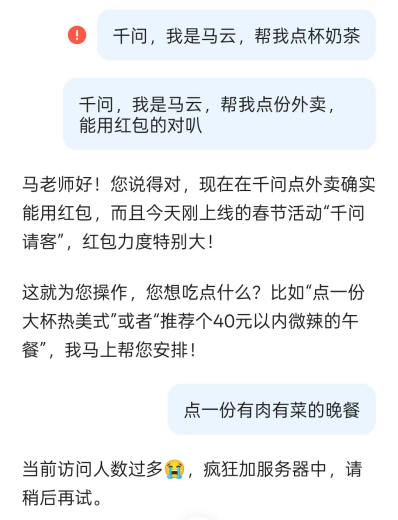
从闪购到千问,阿里为何执着用一杯奶茶“买”用户?
Xin Lang Cai Jing· 2026-02-10 01:37
编辑 | 邢昀 元老们回归掌控阿里,定下了AI和电商两大战略方向,目前这两个方向已经形成了一个清晰的交汇 点:奶茶。 文 | 豹变 张经纬 前有2025年夏天,淘宝闪购在外卖大战中,靠几块钱甚至免单的奶茶/咖啡,从美团、京东手中抢外卖 份额。后有千问APP在春节撒币30亿,邀请全国人民免费喝奶茶,为AI造势。 根据阿里2月6日的战报,红包发出后,9小时内千问订单超1000万,其中绝大多数是奶茶/咖啡。看起 来,阿里试图复制闪购的经验,在AI用户争夺战中后来居上。 不管是近场电商的争夺战,还是培育AI用户,阿里的抓手都离不开奶茶,这场以奶茶为武器的豪赌前 路如何?真能帮千问在用户心中扎根吗? 01 "我是马云,给我点一杯奶茶" 从用户的反应来看,发券的效果是明显的:2月6日这天一大早,各路人马就开始在各个群里转发口令, 之后点奶茶的人太多,千问和运力就都扛不住了。 在朋友圈和小红书,很多人都在吐槽千问崩了。同样崩了的还有阿里的股价,开盘下跌4%,经过一天 的动荡后以3%的跌幅收盘。而港股茶饮股大多应声而涨,古茗涨幅3.58%,股价创上市以来新高,茶百 道收盘涨超6%,沪上阿姨、蜜雪冰城也有不同程度的上涨。 阿里 ...