
春秋航空

Search documents
中印引领亚太航空客运增长,但航司运一位旅客只赚23块
Di Yi Cai Jing· 2025-12-10 13:25
Core Insights - The profitability of the airline industry is significantly lower compared to tech companies like Apple, with airlines earning an average net profit of only $7.90 per passenger, which is less than the profit from selling an iPhone case [1][5] - The International Air Transport Association (IATA) forecasts that global airlines will achieve a record net profit of $41 billion by 2026, although profitability varies greatly by region [1][2] Profitability Disparities - Airlines in the Asia-Pacific region are expected to see a net profit of $6.6 billion in 2026, an increase from $6.2 billion in 2025, but they earn only $3.20 per passenger, the lowest among all regions [2][4] - In contrast, Middle Eastern airlines are projected to earn $28.60 per passenger, highlighting the competitive and challenging environment for Asia-Pacific airlines [4][5] Operational Challenges - The global airline industry faces significant operational challenges, including a backlog of over 17,000 aircraft orders, which is equivalent to 60% of the current fleet [6][7] - Supply chain bottlenecks are driving up costs, with an estimated additional cost of over $11 billion expected by 2025 due to delays in aircraft deliveries and increased maintenance costs [7][8] Sustainable Aviation Fuel (SAF) Issues - The production of Sustainable Aviation Fuel (SAF) is growing but remains costly, with prices up to five times higher than traditional jet fuel [9][10] - IATA has revised its SAF production forecasts downward, indicating that current production levels are insufficient to meet future targets set by airlines for carbon reduction [10][11]


交通运输行业2026年投资策略:聚焦反内卷受益板块及高确定性个股
Dongxing Securities· 2025-12-10 12:28
Investment Summary - The transportation industry has shown a significant underperformance compared to the broader market, ranking among the lowest in terms of growth within the Shenwan primary industry indices as of December 8, 2025 [15][16] - The implementation of anti-involution policies has positively impacted the fundamentals of certain segments within the transportation sector, particularly benefiting the aviation and express delivery sectors [26][30] 2026 Outlook - The focus for 2026 remains on sectors benefiting from anti-involution policies and high-certainty stocks, with a long-term impact expected from these policies on stock price movements [5][34] - Key sectors to watch include aviation, express delivery, and regional shipping, while high-dividend and low-debt companies are expected to attract more investor interest in weaker cyclical areas [5][34] Express Delivery Sector - The express delivery industry has seen a recovery in profitability driven by rising single-package prices, with major companies like YTO Express and Shentong Express showing significant improvements [6][35] - The trend of price competition has been curtailed, leading to a decrease in package volume growth as companies focus on maintaining service quality and profitability [6][38] - The competitive strategies among companies have diverged, with YTO and Shentong performing strongly, while Yunda has struggled with profitability and market share [42][53] Aviation Sector - The aviation sector has experienced a notable improvement in performance since Q2 2025, with major airlines reporting increased profitability compared to the previous year [63][64] - The focus for 2026 will be on the transition from high passenger load factors to higher ticket prices, supported by controlled supply and strong demand [69][87] - Major airlines are expected to maintain cautious procurement strategies, with a projected fleet growth of around 5% in 2026 [69][80] Highway Sector - The highway sector has faced significant adjustments in stock prices, leading to a more rational market approach towards high-dividend investments [8][4.1] - Following substantial adjustments, the attractiveness of highway stocks has improved, with a focus on companies with high dividend ratios and low debt levels [8][4.3]






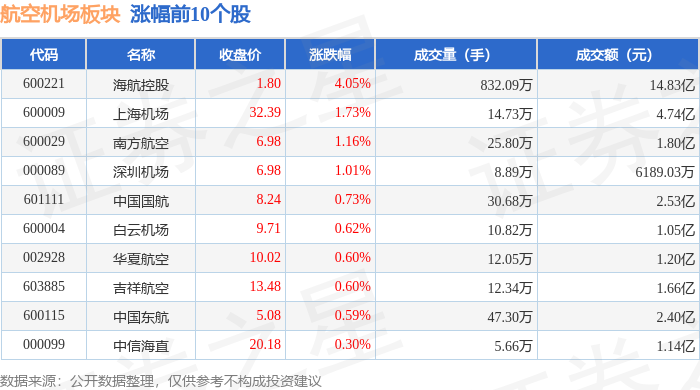
航空机场板块12月10日涨1.14%,海航控股领涨,主力资金净流出369.65万元
Zheng Xing Xing Ye Ri Bao· 2025-12-10 09:09
Core Insights - The aviation and airport sector saw a rise of 1.14% on December 10, with HNA Holding leading the gains [1] - The Shanghai Composite Index closed at 3900.5, down 0.23%, while the Shenzhen Component Index closed at 13316.42, up 0.29% [1] Stock Performance - HNA Holding (600221) closed at 1.80, up 4.05% with a trading volume of 8.32 million shares [1] - Shanghai Airport (600009) closed at 32.39, up 1.73% with a trading volume of 147,300 shares [1] - Southern Airlines (600029) closed at 6.98, up 1.16% with a trading volume of 258,000 shares [1] - Shenzhen Airport (000089) closed at 6.98, up 1.01% with a trading volume of 88,900 shares [1] - China National Aviation (601111) closed at 8.24, up 0.73% with a trading volume of 306,800 shares [1] - Baiyun Airport (600004) closed at 9.71, up 0.62% with a trading volume of 108,200 shares [1] - Huaxia Airlines (002928) closed at 10.02, up 0.60% with a trading volume of 120,500 shares [1] - Juneyao Airlines (603885) closed at 13.48, up 0.60% with a trading volume of 123,400 shares [1] - China Eastern Airlines (600115) closed at 5.08, up 0.59% with a trading volume of 473,000 shares [1] - CITIC Offshore Helicopter (000099) closed at 20.18, up 0.30% with a trading volume of 56,600 shares [1] Capital Flow - The aviation and airport sector experienced a net outflow of 3.6965 million yuan from institutional investors, while retail investors saw a net inflow of 8.92532 million yuan [2] - The overall capital flow indicates a mixed sentiment among different investor types within the sector [2] Individual Stock Capital Flow - HNA Holding saw a net inflow of 14.2 million yuan from institutional investors, but a significant outflow of 85.3144 million yuan from retail investors [3] - China Eastern Airlines had a net inflow of 23.1458 million yuan from institutional investors, with retail investors also experiencing a net outflow [3] - China National Aviation had a net inflow of 9.8210 million yuan from institutional investors, while retail investors had a net inflow of 660.88 million yuan [3] - Baiyun Airport had a net inflow of 3.9543 million yuan from institutional investors, but retail investors faced a net outflow [3] - Huaxia Airlines had a net inflow of 3.0489 million yuan from institutional investors, with retail investors showing a slight net inflow [3]






航空:步步为营,峰回路转
Ge Long Hui· 2025-12-10 01:41
Core Viewpoint - The aviation industry is expected to experience a significant supply-demand reversal in 2026, transitioning into a state of supply shortage after years of low supply growth and gradually absorbing excess capacity [1][2]. Supply - The effective supply remains tight due to insufficient capacity and engine disruptions, with an expected ASK growth rate of 2.7% in 2026. Boeing and Airbus are recovering capacity slowly, currently at about 70% of pre-pandemic levels, and global supply chain issues persist [2][4]. - Aircraft delivery delays are anticipated to continue into 2026, with Boeing and Airbus's production rates for key models (B737MAX and A320NEO) only reaching approximately 70% of their peak levels [4][5]. - Engine issues are expected to further reduce the number of available aircraft, with an increase in grounded planes due to technical and quality problems with major engine models [7][10]. Demand - Demand remains resilient, with an expected growth rate of about 5% in 2026, constrained by supply limitations. The return of business travelers is expected to support this growth [2][24]. - The domestic aviation demand growth rate is projected to outpace that of rail, indicating strong resilience and some irreplaceable aspects of air travel [29][31]. - The average travel distance for domestic flights has increased, reducing the competitive edge of high-speed rail against aviation [29][31]. Ticket Prices - Ticket prices are expected to rise moderately in 2026, approaching 2019 levels, with seasonal variations where off-peak price increases may exceed those during peak seasons [2][49]. - The industry is likely to see a shift in focus towards improving off-peak performance, with potential for greater price increases during these periods due to tighter supply [49][53]. Capacity Utilization - The passenger load factor is projected to reach 87% in 2026, an increase from 85% in 2025, driven by tighter supply conditions [38][44]. - The high load factors in 2025 were partially due to pricing strategies aimed at increasing volume, while the anticipated high load factors in 2026 will be a result of supply constraints [38][44]. Potential vs. Actual Demand - While potential demand is expected to grow at a rate exceeding 5%, actual demand growth is constrained to about 5% due to supply limitations [39][48]. - The elasticity of actual demand relative to GDP growth is expected to decrease in 2026, indicating unmet potential demand and a clear supply-demand imbalance in the aviation market [39][44].

中金2026年展望 | 航空:步步为营,峰回路转
中金点睛· 2025-12-09 23:46
Core Viewpoint - The aviation industry is expected to experience a significant supply-demand reversal in 2026, transitioning into a state of supply shortage, with an anticipated passenger load factor reaching 87% [2][40][44] Supply - The effective supply will remain tight in 2026, with an expected ASK growth rate of 2.7%. Boeing and Airbus are recovering production capacity slowly, currently at about 70% of pre-pandemic levels, and global supply chain issues, particularly with engine quality, persist [4][18] - The delivery volume from COMAC is expected to decline significantly in 2025 due to global supply chain disruptions and geopolitical tensions, limiting the short-term impact of domestic aircraft on industry capacity [7][20] - Engine issues are affecting the availability of aircraft, with an increase in grounded planes expected in 2026 due to technical and quality problems with mainstream engines [9][11] Demand - Demand remains resilient, with an expected growth rate of about 5% in 2026, constrained by supply limitations. The return of business travelers is expected to support this growth [22][36] - The domestic aviation demand growth rate is still higher than that of rail, indicating strong resilience and some irreplaceable demand for air travel [25][30] Ticket Prices - Ticket prices are projected to increase moderately in 2026, approaching 2019 levels, with seasonal fluctuations expected. The price increase in the off-peak season may exceed that of the peak season due to tighter supply [45][48]

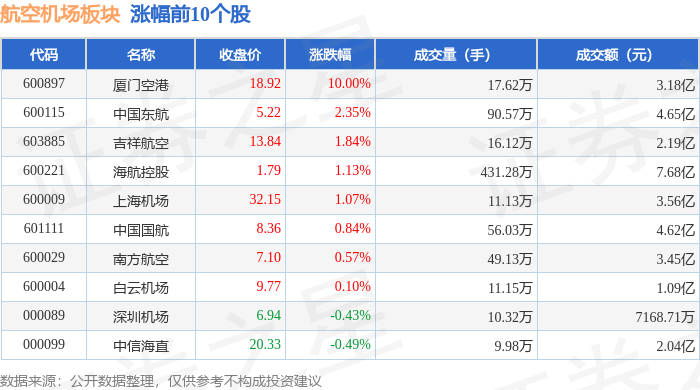
航空机场板块12月8日涨0.91%,厦门空港领涨,主力资金净流出118.47万元
Zheng Xing Xing Ye Ri Bao· 2025-12-08 09:09
Market Performance - The aviation and airport sector increased by 0.91% on December 8, with Xiamen Airport leading the gains [1] - The Shanghai Composite Index closed at 3924.08, up 0.54%, while the Shenzhen Component Index closed at 13329.99, up 1.39% [1] Stock Performance - Xiamen Airport (600897) saw a significant rise of 10.00%, closing at 18.92 with a trading volume of 176,200 shares and a transaction value of 318 million yuan [1] - China Eastern Airlines (600115) increased by 2.35%, closing at 5.22 with a transaction value of 465 million yuan [1] - Other notable performers include: - 吉祥航空 (603885) up 1.84% to 13.84 [1] - 海航控股 (600221) up 1.13% to 1.79 [1] - 上海机场 (600009) up 1.07% to 32.15 [1] Capital Flow - The aviation and airport sector experienced a net outflow of 1.1847 million yuan from institutional investors, while retail investors saw a net outflow of 113 million yuan [2] - Conversely, speculative funds recorded a net inflow of 11.4 million yuan [2] Individual Stock Capital Flow - Xiamen Airport (600897) had a net inflow of 75.8533 million yuan from institutional investors, but a net outflow of 41.6046 million yuan from retail investors [3] - Shanghai Airport (600009) saw a net inflow of 12.4068 million yuan from institutional investors, with a net outflow of 19.0737 million yuan from retail investors [3] - China Eastern Airlines (600115) experienced a net outflow of 5.7540 million yuan from institutional investors, while speculative funds had a net inflow of 37.2950 million yuan [3]




交通运输行业周报:原油运价高位下跌,前11月全国快递业务量首次突破1800亿件-20251208
Bank of China Securities· 2025-12-08 01:32
Investment Rating - The report rates the transportation industry as "Outperform" [2] Core Views - Crude oil freight rates have declined from high levels, with mixed changes in ocean freight rates. The China Import Crude Oil Composite Index (CTFI) was reported at 2321.90 points on December 4, down 7.9% from November 27. The VLCC market has seen transactions at major loading ports, with shipowners trying to maintain price levels despite a cooling market [3][14] - China Eastern Airlines has launched the world's longest one-way flight route from Shanghai to Buenos Aires, reducing travel time by over 4 hours. Additionally, a ton-class eVTOL was included in urban firefighting drills for the first time [3][16] - In November, China's express delivery volume exceeded 180 billion items for the first time, marking a new record. The first full schedule China-Europe freight train departed from Shijiazhuang [3][24] Summary by Sections Industry Hot Events - Crude oil freight rates have decreased, with the Middle East route showing a 9.76% drop. The Shanghai port's export rates to Europe and the US have also seen declines of 0.3%, 5.0%, and 4.7% respectively [14][15] - The launch of the longest flight route by China Eastern Airlines connects Shanghai to Buenos Aires, significantly shortening travel time [16][17] - The express delivery volume in China reached a record high of 180 billion items in November, reflecting strong economic vitality [24][26] High-Frequency Data Tracking - The Baltic Air Freight Price Index has increased month-on-month but decreased year-on-year. The Shanghai outbound air freight price index was reported at 5721.00 points, up 2.4% year-on-year [28] - Domestic freight flight numbers decreased by 2.03% year-on-year in November, while international flights increased by 14.88% [30] - The SCFI index for container shipping was reported at 1397.63 points, down 0.39% week-on-week and down 38.06% year-on-year [37] Investment Recommendations - Focus on the equipment and manufacturing export chain, recommending companies like COSCO Shipping, China Merchants Energy Shipping, and Huamao Logistics [5] - Attention to the transportation demand increase driven by hydropower station construction in the Yarlung Tsangpo River downstream [5] - Investment opportunities in low-altitude economy trends, recommending CITIC Offshore Helicopter [5] - Opportunities in the highway and railway sectors, recommending Gansu Expressway, Beijing-Shanghai High-Speed Railway, and others [5] - Investment opportunities in the cruise and ferry sectors, recommending Bohai Ferry and Haixia Shares [5] - E-commerce and express delivery investment opportunities, recommending SF Express, Jitu Express, and Yunda [5] - Opportunities in the aviation sector, recommending Air China, China Southern Airlines, and others [5]


周期半月谈 - 聚焦资源品与行业自律
2025-12-08 00:41
Summary of Key Points from Conference Call Records Industry Overview - The focus is on the non-ferrous metals industry, particularly copper, aluminum, and the construction materials sector, as well as the gold market and its outlook [1][2][4][5][6][9]. Non-Ferrous Metals - **Copper Market**: Short-term price surge due to U.S. tariff expectations leading to an expanded price gap between LME and COMEX. The U.S. market pricing is deviating from fundamentals. By 2026, the U.S. siphoning effect may create tight inventory risks in non-U.S. regions, but a return to fundamental pricing could occur if LME experiences warehouse congestion or tariff expectations decrease, leading to potential oversupply risks [1][5]. - **Aluminum Market**: Prices are expected to follow copper trends, with global supply affected by electricity shortages. Domestic production has peaked, and high overseas energy costs, along with investment cycle constraints, will likely lead to a decline in supply growth from 2025 to 2030. A bull market is needed to strengthen price incentives, with occasional events also pushing prices up [1][5]. Gold Market - The outlook for the gold market remains optimistic, driven by central bank purchases, ETF investments, and potential gold tokenization. Gold prices are expected to rise significantly by 2026, with current stock valuations between 10 to 13 times earnings being attractive [1][4]. Construction Materials - The construction materials sector is experiencing supply contraction under profit pressure. Recommendations include focusing on consumer building materials and leading fiberglass companies. Differentiation in product offerings is allowing some companies to achieve excess profits, with leading float glass companies expected to balance supply through self-initiated repairs, aiding profit recovery [1][6][7][8]. Fiberglass Industry - Demand for fiberglass is projected to grow in the high single digits, with approximately 400,000 tons of new domestic supply expected next year, while about 100,000 tons of overseas capacity will exit annually. High-end products remain scarce, and leading companies like China National Building Material and China Jushi are recommended [3][9]. Cement Industry - The cement industry is controlling supply through production limits and peak-shifting measures. By the end of 2025, a net reduction of over 50 million tons of capacity is anticipated, with a potential overall capacity reduction of over 10% in 2026 if monitoring and enforcement measures are effective. The industry is expected to see a moderate recovery in profit margins [11]. Phosphate and Potash Markets - Phosphate demand is significantly driven by the growth in energy storage, with total demand for power and storage batteries expected to reach 450 to 500 GWh by 2026, translating to a demand for 4.3 to 5 million tons of phosphate rock. The potash market is also expected to see stable growth, with limited new supply and high import dependence from China, leading to favorable price expectations [22][24]. Chemical Industry - The chemical industry is currently at a cyclical low but is expected to enter an upward phase starting late 2025. Industry self-discipline measures are enhancing price elasticity, with recent price increases observed in various chemical products [25][26][27]. Investment Opportunities - Recommended investment opportunities include potassium and phosphorus fertilizers, which are supported by strong fundamentals and global agricultural and renewable energy growth. Related fine chemicals like refined phosphoric acid and yellow phosphorus also show significant investment potential due to their wide applications [28].


周期论剑电话会议 顺周期跨年行情推荐
2025-12-08 00:41
Summary of Conference Call Notes Industry Overview - **Monetary Policy and Market Sentiment**: Anticipation of a potential easing of monetary policy in early 2026, with the Financial Regulatory Bureau lowering risk factors for insurance companies' equity investments, which may enhance market risk appetite. The period from December to February is seen as a window for policy, liquidity, and fundamentals to resonate positively [3][6] - **A-Share Earnings Growth**: Expected growth of approximately 10.6% in non-financial A-share earnings for 2026, indicating a shift away from reliance on traditional cyclical industries [6] Sector-Specific Insights Aviation Sector - **Optimistic Outlook**: The aviation sector is expected to significantly reduce losses in Q4 2025 and turn profitable for the year. Demand growth in 2026 is projected to drive ticket prices and profitability upward. Companies recommended for investment include Air China, Juneyao Airlines, China Eastern Airlines, China Southern Airlines, and Spring Airlines [7] Oil and Shipping Sector - **Record Profits Expected**: Anticipation of record profits in the oil shipping sector for Q4 and the entire year, driven by increased production in the Middle East and South America, and a reduction in Indian imports of Russian oil. Recommended companies include COSCO Shipping Energy, China Merchants Energy Shipping, China Merchants South Oil, and China Ship Leasing [8] Chemical Sector - **Current Position and Recommendations**: The chemical sector is at a bottoming phase, with some products beginning to recover. Companies with cost advantages and new capacity that can enhance performance are recommended, such as the coal chemical leader Hualu Hengsheng. Investment opportunities are also noted in lithium iron phosphate electrolyte, n-butanol, and new alcohols due to price increases [9][10] Industrial Metals - **Upward Trend**: The industrial metals sector is experiencing a resonant upward trend, with copper, aluminum, and tin being highlighted as key investment areas. Factors include increased supply disruptions for copper and high domestic capacity utilization for aluminum [4][27] Coal Market - **Price Dynamics**: Recent rapid decline in port coal prices, with a drop of 27 yuan per ton, attributed to winter demand dynamics. Current coal prices are around 830 yuan per ton, with expectations of stabilization around this level [20][21] New Materials - **High-Growth Opportunities**: In the new materials sector, high-growth products such as lubricating oil additives and high-frequency, high-speed resins are highlighted. Companies like Ruifeng New Materials and Shengquan Group are noted for their potential [15] Investment Recommendations - **Focus Areas**: Continued emphasis on technology growth, large financials, and cyclical assets. The technology sector is seen as a medium-term growth driver, while large financials are expected to benefit from seasonal effects and insurance sector dynamics [5][28] - **Dividend Stocks**: High dividend assets are expected to outperform in the cross-year period, with companies like China State Construction, Sichuan Road and Bridge, and China Minmetals International highlighted for their attractive dividend yields [28][17] Conclusion - **Overall Market Sentiment**: The outlook for 2026 is optimistic, with expectations of policy support and economic recovery. Key sectors such as aviation, oil shipping, chemicals, and industrial metals are poised for growth, while investment strategies should focus on high-quality dividend stocks and sectors benefiting from structural changes in the economy [3][6][29]

铜、白银新高,周期怎么看?
2025-12-08 00:41
Summary of Key Points from Conference Call Records Industry Overview Aviation Industry - The adjustment of the China-Japan route impacts airlines and ticket prices, with the route accounting for 3% of the total market share. The removal of flights has led to a shift in capacity to domestic flights, causing ticket prices to stabilize or slightly decline from previous growth of 2-3% [2] - Airlines have extended the free ticket refund period for the China-Japan route until March 31, 2026, resulting in short-term disruptions but overall limited impact due to the small number of flights removed [2] - The recommendation for airline stocks includes China Southern Airlines, China Eastern Airlines, and Air China, followed by Huaxia Airlines, Juneyao Airlines, and Spring Airlines [2] Retail and Duty-Free Market - The Shanghai Airport duty-free store bidding process has sparked discussions, with potential new operators being introduced as existing shareholders oppose the bid. This could lead to increased revenue for Shanghai Airport [4] - The bidding process may benefit Shanghai Airport regardless of the outcome, as the expected revenue from the bidding exceeds investment returns [4] Shipping and Bulk Freight - The Baltic Dry Index (BDI) reached a two-year high of 2,854 points, driven by the upcoming production of the West Manganese Mine and concentrated shipments from Australian mines [5] - The outlook for the bulk shipping market remains positive, with recommendations for stocks such as Haitong Development, Pacific Shipping, and China Merchants Energy [5] Express Delivery Industry - Jitu's volume growth in Southeast Asia reached 78% during the Double Eleven shopping festival, with new market growth at 83%, indicating strong performance [6] - The express delivery sector is experiencing a shift, with leading companies increasing market share while lower-tier companies see declines. Zhongtong has returned to double-digit growth in October and November, making it an attractive investment opportunity [7] Commodity Market Insights Metal Market - The commodity cycle since 2020 is not yet halfway through, with expectations for a bull market in 2026 driven by a weakening dollar and supply chain disruptions [8] - The investment strategy for 2026 focuses on energy metals, nickel, cobalt, gold, copper, aluminum, and strategic metals, influenced by energy revolutions and geopolitical tensions [11] - Specific insights include: - Nickel and cobalt prices are expected to remain high due to quota systems and unexpected demand for energy storage [8] - Copper's supply issues are critical, with both financial and commodity attributes driving its value [8] - Aluminum is anticipated to break out of a three-year range due to low inventory and increased demand from industrial and energy sectors [8] Coal Market - The coal market is currently under pressure, with prices for Shanxi coal dropping by 27 yuan, and overall coal inventory rising but still below last year's levels [13][14] - Electricity consumption has decreased year-on-year, but there is a seasonal uptick in demand [15] - The national coal market conference indicated a balanced supply-demand outlook for 2026, with a focus on long-term contracts and import controls to stabilize prices [16] Future Projections - The overall sentiment for the metal sector in 2026 is optimistic, emphasizing the importance of energy revolutions and geopolitical factors for long-term investment opportunities [9]