
阿里

Search documents
端侧硬件场景丰富,产业链有望迎高增机遇
Orient Securities· 2025-09-22 11:03
Investment Rating - The industry investment rating is "Positive (Maintain)" [5] Core Viewpoints - The smart terminal market is expected to flourish, driven by the recovery in iPhone sales and the entry of large model manufacturers like Open AI, which will accelerate innovation in smart terminal categories and forms [3][8] - The iPhone 17 series has shown strong sales performance, with a fourfold increase in trade-in sales compared to the previous year, indicating a positive outlook for the supply chain [8] - Open AI's entry into AI hardware terminals is expected to enrich the product ecosystem, benefiting existing supply chain companies like Luxshare Precision and GoerTek [8] Summary by Sections Investment Suggestions and Targets - The report recommends buying shares of several companies in the AI supply chain, including Luxshare Precision (002475), Lens Technology (300433), and GoerTek (002241) among others [3] Industry Dynamics - The report highlights the potential for rapid growth in the AI hardware terminal market, with Open AI planning to launch its first device by late 2026 or early 2027, which will include various innovative products [8] - The report notes that the iPhone 17 series has prompted Apple to increase production capacity, reflecting strong market demand and potential for supply chain growth [8] - Meta's recent launch of multiple AI & AR glasses indicates a growing market for AR technology, suggesting a shift from accessory to independent smart terminal status for wearable devices [8]





新力量New Force总第4864期
First Shanghai Securities· 2025-09-22 08:47
Group 1: Company Overview - NetDragon's revenue for the first half of 2025 was RMB 2.38 billion, a year-on-year decline of 28%[5] - The gross profit was RMB 1.7 billion, down 24.7% year-on-year, but the gross margin improved by 2.9 percentage points to 69.5%[5] - The company has a net cash position of approximately RMB 2.3 billion and holds 12,000 Ethereum as digital asset reserves[5] Group 2: Business Segments - The gaming and other businesses generated RMB 1.74 billion in revenue, a decrease of 18% year-on-year, but only a 4% decline compared to the second half of 2024, indicating stabilization[6] - The education segment, Mynd.ai, reported revenue of RMB 640 million, impacted by tightened customer budgets, with ongoing cost optimization efforts[7] Group 3: Financial Projections - The target price for NetDragon is set at HKD 20.24, representing a 71% upside from the last closing price[8] - The adjusted EPS for 2025 is projected at HKD 1.004, a decrease of 25% from previous estimates, while 2026 EPS is expected to be HKD 1.175, down 22%[2] Group 4: Market Strategy - The company plans to return at least HKD 600 million to shareholders through dividends and share buybacks over the next year[5] - New game titles and expansion into overseas markets are expected to drive future growth, with several products in the pipeline for release[6]

瑞声科技涨超9%,港股通科技ETF基金(159101)强势吸金,近2日日均流入超1亿
Mei Ri Jing Ji Xin Wen· 2025-09-22 05:37
Group 1 - The Hang Seng Index fell by 0.99%, the Hang Seng Tech Index dropped by 1.18%, and the Hang Seng China Enterprises Index decreased by 1.3% on September 22, with a half-day trading volume of HKD 164.784 billion [1] - The Hong Kong Stock Connect Technology ETF (159101) experienced a flat performance, while component stocks like AAC Technologies surged over 9%, Sunny Optical Technology rose over 6%, and SMIC and WuXi Biologics increased by over 3% [1] - There has been a continuous net inflow into the Hong Kong Stock Connect Technology ETF for five consecutive trading days, with the last two days seeing a net inflow exceeding HKD 100 million [1] Group 2 - The recent interest rate cut does not signify the end of rate reductions, as the dot plot indicates two more expected cuts by 2025, which will continue to support the Hong Kong stock market and tech sector [2] - The internal drivers for the Hong Kong tech sector remain strong, with reduced competition in industries like food delivery and automotive, and a renewed focus on AI as a core narrative [2] - Recent interim reports from Hong Kong tech companies show that cloud business revenues exceeded market expectations, reinforcing the growth logic driven by AI, alongside strong future capital expenditure plans [2] Group 3 - The Hong Kong Stock Connect Technology ETF (159101) covers major internet giants like Tencent and Alibaba, as well as emerging players like Li Auto and BeiGene, providing a comprehensive investment tool for Chinese tech leaders [3] - The top five holdings account for 57% of the ETF's weight, while the top ten holdings make up 77%, indicating a concentrated yet broad exposure to key sectors including software, hardware, new consumption, innovative pharmaceuticals, and new energy vehicles [3]
国产AI训练芯片逐步对标国际巨头,科创芯片ETF(588200)早盘冲高涨近1%
Sou Hu Cai Jing· 2025-09-22 02:17
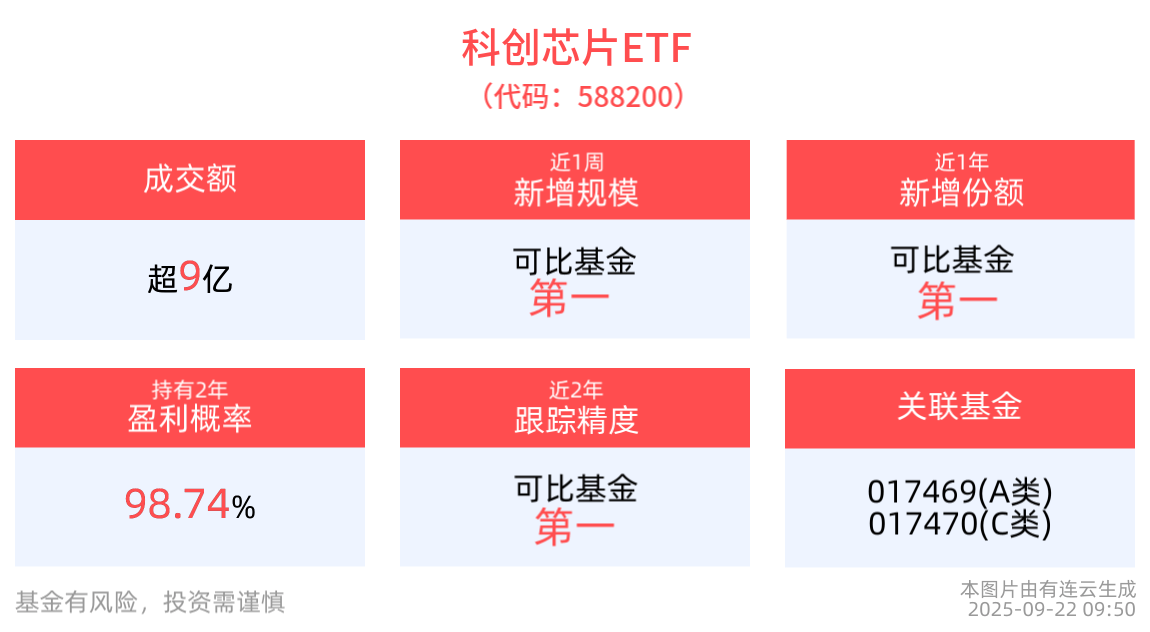
Group 1: ETF Performance - The Sci-Tech Chip ETF had a turnover rate of 2.91% and a transaction volume of 9.66 billion yuan on September 19 [3] - Over the past month, the average daily transaction volume of the Sci-Tech Chip ETF reached 43.93 billion yuan, ranking first among comparable funds [3] - In the past week, the Sci-Tech Chip ETF's scale increased by 7.71 billion yuan, also ranking first among comparable funds [3] - The ETF's share increased by 7.305 billion shares over the past year, marking significant growth and ranking first among comparable funds [3] - As of September 19, the net value of the Sci-Tech Chip ETF has risen by 106.79% over the past two years, placing it in the top 0.90% among 2,321 index equity funds [3] - The highest monthly return since inception was 35.07%, with the longest consecutive monthly increase being 4 months and a maximum increase of 36.01% [3] Group 2: Key Stocks in the Index - The top ten weighted stocks in the Sci-Tech Chip Index include Cambricon, Haiguang Information, SMIC, and others, collectively accounting for 62.02% of the index [3] Group 3: Industry Developments - On September 16, Tencent Cloud announced full adaptation to mainstream domestic chips, enhancing its AI computing power strategy [4] - Alibaba's self-developed PPU chip was unveiled, showing performance metrics close to Nvidia's H20 and superior to A800, indicating the rise of domestic AI chips [4] - Huawei revealed a detailed three-year roadmap for its Ascend chips at the Huawei Connect conference, aiming to compete with international giants [4] - The AI wave has significantly increased demand for computing power, boosting the value of servers, AI chips, optical chips, memory, and PCBs [4] - Broadcom's AI revenue grew by 63% year-on-year in Q3 2025, with expectations for further acceleration in Q4 [4] - Global semiconductor equipment shipments reached 33.07 billion dollars in Q2 2025, a 24% year-on-year increase, driven by advanced logic processes and increased shipments in Asia [4]

港股收盘 | 恒指平收 博彩、有色股表现亮眼 劲方医药-B首挂股价翻倍
Zhi Tong Cai Jing· 2025-09-19 08:51
Market Overview - The Hong Kong stock market showed mixed performance today, with the Hang Seng Index closing flat at 26,545.1 points and a total turnover of HKD 3,768.12 million. The Hang Seng China Enterprises Index rose by 0.17% to 9,472.35 points, while the Hang Seng Tech Index increased by 0.37% to 6,294.42 points. For the week, the Hang Seng Index gained 0.59%, the China Enterprises Index rose by 1.15%, and the Tech Index saw a 5.09% increase [1]. Blue Chip Performance - Sands China (01928) led the blue-chip stocks, rising by 6.19% to HKD 21.6, contributing 4.77 points to the Hang Seng Index. The upcoming National Day and Mid-Autumn Festival holidays have driven demand for gaming stocks, with strong expectations for the Golden Week based on nearly full hotel bookings [2][4]. - Other notable blue-chip performers included China Hongqiao (01378) up 4.67% to HKD 26.46, Galaxy Entertainment (00027) up 4.22% to HKD 42.46, while Hansoh Pharmaceutical (03692) fell by 2.62% to HKD 35, dragging the index down by 1.74 points [2]. Sector Highlights Gaming Sector - The gaming sector saw significant gains, with Melco International Development (00200) up 6.6%, Sands China (01928) up 6.19%, and Wynn Macau (01128) up 6.02%. Macau's gross gaming revenue (GGR) for August reached MOP 22.16 billion, marking a new monthly high, with a year-on-year increase of 12.2% [3][4]. Gold Sector - Gold stocks rebounded, with Shandong Gold (01787) rising by 6.13% to HKD 35.68, Lingbao Gold (03330) up 3.98% to HKD 16.46, and Zijin Mining (02899) up 2.76% to HKD 29.08. The price of spot gold has stabilized above USD 3,650 following the Federal Reserve's interest rate cuts [4]. Coal Sector - Coal stocks performed well, with Yanzhou Coal Mining (01171) up 6.51% to HKD 10.63, and China Shenhua Energy (01088) up 1.42% to HKD 38.46. Recent investigations into overproduction in Inner Mongolia are expected to curb excess supply [5][6]. Robotics Sector - The robotics sector showed mixed results, with Sanhua Intelligent Control (02050) down 6.21% while DCH Holdings (00179) rose by 5.78%. Recent rumors regarding Tesla's robot orders were denied by Elon Musk, but the Chinese government is pushing for the application of humanoid robots in various industries [7]. Notable Stock Movements - Jinfang Pharmaceutical-B (02595) debuted with a remarkable increase of 106.47% to HKD 42.1. The company focuses on developing new treatment solutions for tumors and autoimmune diseases [8]. - Hongteng Precision (06088) surged by 21.44% to HKD 5.89, benefiting from Nvidia's investment in Intel for AI infrastructure [9]. - Cloudfin Financial (00376) rose by 10.55% to HKD 6.39 after appointing a former Ant Group executive to lead its Web3 development [10]. - Weimob Group (02013) increased by 10% to HKD 2.86 following a significant share placement [11]. - Ganfeng Lithium (01772) saw a rise of 9.51% to HKD 37.3, with the company announcing full production capacity for its energy storage cells [12]. - Changfei Optical Fiber (06869) reached a new high, increasing by 8.55% to HKD 61.6, driven by interest in hollow core fiber technology [13][14].
东软载波(300183.SZ):公司没有在PPU上与阿里合作
Ge Long Hui· 2025-09-19 08:28
Core Viewpoint - Dongsoft Zhaibo (300183.SZ) has clarified that the company is not collaborating with Alibaba on the PPU project [1] Company Summary - Dongsoft Zhaibo has made a statement on the investor interaction platform regarding its non-participation in a partnership with Alibaba related to PPU [1]

恒生科技的“补涨逻辑”并未结束?
Mei Ri Jing Ji Xin Wen· 2025-09-19 05:41
Group 1 - The Hong Kong stock market indices collectively declined on September 19, with mixed performance in tech stocks and active trading in gold and non-ferrous metal sectors [1] - The Hong Kong Stock Connect Auto ETF (159323) rose nearly 1.5%, with leading stocks including Ganfeng Lithium (002460), Tianqi Lithium (002466), Tianneng Power, and Xpeng Motors [1] - The Hang Seng Tech Index ETF (513180) experienced fluctuations and narrowing gains, with stocks like NIO, Hua Hong Semiconductor, JD Group, and Xpeng Motors performing well, while Horizon Robotics, NetEase, and Kuaishou lagged [1] Group 2 - A report from Guotou Securities highlighted a historical alternating relationship between the ChiNext Index and the Hang Seng Tech Index, indicating that when the ChiNext Index outperforms by 20 percentage points, the Hang Seng Tech Index often experiences a relative rebound [1] - As of September 18, the rolling 60-day return difference between the ChiNext Index and the Hang Seng Tech Index was 29.09%, close to historical extremes observed in 2021, suggesting that the rebound logic for the Hang Seng Tech Index may still be in play [1] - With Alibaba and Baidu competing in self-developed chips and AI driving bullish sentiment, the Hang Seng Tech Index is expected to break upward again [2] - Anticipation of a Federal Reserve interest rate cut and continued inflow of southbound funds may lead to a reconstruction of valuations for the Hang Seng Tech Index, supported by both domestic and foreign capital [2] - Investors without a Hong Kong Stock Connect account may consider the Hang Seng Tech Index ETF (513180) for exposure to core Chinese AI assets [2]
华为昇腾进一步引领国产算力加速
China Post Securities· 2025-09-19 01:58
Industry Investment Rating - The investment rating for the computer industry is "Outperform the Market" and is maintained [1] Core Viewpoints - The report highlights the significant advancements in domestic chip capabilities, particularly through Huawei's release of the Ascend chip roadmap, which aims to double computing power annually to meet the growing demands of AI [4][5] - The report indicates that the self-sufficiency rate of domestic computing chips in China is expected to reach 82% by 2027, driven by policy guidance and performance improvements [7] - The report suggests focusing on the computing power supply chain, including various companies across different segments such as Huawei, Alibaba, and Baidu, which are leading the charge in domestic chip development [9] Summary by Relevant Sections Industry Basic Situation - The closing index for the computer industry is 5648.76, with a 52-week high of 5841.52 and a low of 2855.49 [1] Recent Developments - Huawei plans to launch several new Ascend chip products between 2026 and 2028, enhancing AI computing capabilities [4][5] - Alibaba's AI computing card has been showcased as outperforming NVIDIA's A800 in several hardware parameters [6] - Baidu's Kunlun chip has secured significant orders, indicating strong market demand for domestic AI computing solutions [6] Investment Recommendations - The report recommends monitoring various supply chains related to computing power, including companies like Huawei, Alibaba, and others across different technology segments [9]
腾讯阿里市值双涨 殊途同归还是渐行渐远
Bei Jing Shang Bao· 2025-09-18 17:04
Core Viewpoint - Tencent and Alibaba have shown a V-shaped recovery in their stock prices, indicating the attractiveness of Chinese tech companies in the capital market, despite not maintaining a growth trend recently [1][3]. Group 1: Market Capitalization and Stock Performance - As of September 17, Tencent's market capitalization was 6.06 trillion HKD, while Alibaba's was 3.08 trillion HKD. By September 18, Tencent's market cap decreased to 5.88 trillion HKD and Alibaba's to 3.02 trillion HKD [1]. - Tencent's stock price has rebounded 290% from 170.17 HKD on October 31, 2022, to 664.5 HKD on September 18, 2025 [3]. - Alibaba's stock price increased from over 80 HKD to nearly 170 HKD since 2025 [3]. Group 2: Market Environment and Investment Sentiment - The market environment for tech stocks has improved, driven by breakthroughs in domestic models like DeepSeek, leading to a 37% average increase in valuations for Chinese AI-related companies over the past year [3][4]. - Tencent announced a share buyback plan totaling 112 billion HKD for 2024, signaling confidence in its stock [4]. - Goldman Sachs has increased its target price for Tencent to 701 HKD and for Alibaba from 158 HKD to 174 HKD, reflecting growing investor confidence [5]. Group 3: Strategic Focus and Business Models - Tencent has built a robust moat through "precise investment and ecological synergy," while Alibaba is balancing "technology research and business expansion" [1][7]. - Tencent's diversified ecosystem, including gaming, fintech, and advertising, provides stronger risk resistance compared to Alibaba's reliance on e-commerce [7][8]. - Both companies are leveraging the AI wave, with Tencent optimizing existing businesses and Alibaba investing in future technologies [8]. Group 4: Financial Performance - In Q2 2025, Alibaba reported revenue of 247.65 billion CNY, a 2% year-on-year increase, while Tencent's revenue was 184.5 billion CNY, reflecting a 15% year-on-year growth [8]. - Tencent's non-IFRS operating profit grew by 18%, while Alibaba's net profit decreased by 18% [8].

腾讯阿里市值双双冲高,殊途同归还是渐行渐远
Bei Jing Shang Bao· 2025-09-18 12:59
Core Insights - Tencent and Alibaba have market capitalizations of HKD 5.88 trillion and HKD 3.02 trillion respectively as of September 18, 2023, indicating a V-shaped recovery in the Chinese tech sector despite recent fluctuations [1] - Tencent's stock price is approaching its historical high of HKD 730, while Alibaba's price remains significantly lower than its peak of over HKD 300 five years ago, reflecting differing strategic focuses and operational efficiencies [1] - The market environment in 2025 is conducive for tech stock rebounds, driven by advancements in AI technologies and corporate share buybacks [4][5] Market Performance - Tencent's stock has rebounded 290% from HKD 170.17 on October 31, 2022, to HKD 664.5 on September 18, 2025, while Alibaba's stock has increased from around HKD 80 to nearly HKD 170 during the same period [4] - Analysts have expressed increased confidence in Tencent's future, with Goldman Sachs rating it as a "buy" and setting a target price of HKD 701, while raising Alibaba's target price from HKD 158 to HKD 174 [5] Strategic Focus - Tencent is building a robust ecosystem through "precise investment and ecological synergy," while Alibaba is balancing "technology research and business expansion" [1] - Both companies are leveraging the AI wave that began in late 2022, with Tencent maintaining a leading position in its core business areas, while Alibaba faces increased competition in e-commerce and food delivery [7][8] Financial Performance - In Q2 2025, Tencent reported revenue of HKD 184.5 billion, a 15% year-on-year increase, and a non-IFRS operating profit of HKD 69.25 billion, up 18% [8] - Alibaba's Q2 2025 revenue was HKD 247.65 billion, a 2% year-on-year increase, with a 10% increase when excluding disposed businesses, but a net profit decline of 18% [8] Future Outlook - The core business areas of Tencent and Alibaba show limited overlap, with potential competition primarily in the AI sector [9] - Both companies are pursuing international market opportunities, with Alibaba focusing on global cloud services and Tencent expanding its overseas gaming and cloud computing businesses [9]
