中宠股份

Search documents
2025年三季度新消费财报:IP、宠物、颜值经济分化,增长逻辑深度重构
Zheng Quan Shi Bao· 2025-11-03 12:17
Core Insights - The performance of the new consumption sector shows significant divergence, with companies like Pop Mart achieving impressive growth, while the capital market reacts with valuation adjustments [1] - The pet economy continues to attract capital attention, with companies like Zhongchong and Guai Bao Pet reporting steady growth, yet facing valuation declines [1] - The beauty economy, represented by companies like Aimeike and Huaxi Biological, is experiencing notable declines in performance [1] IP Economy Performance - Pop Mart reported a substantial revenue increase of 245%-250% year-on-year for Q3 2025, continuing its high growth trend from the first half of the year [2] - In the Chinese market, revenue grew by 185%-190%, with online channels surging by 300%-305% and offline channels by 130%-135% [2] - Overseas revenue skyrocketed by 365%-370%, with the Americas showing an extraordinary growth of 1265%-1270% [2] - Light Media also saw significant growth, with Q3 revenue reaching 3.616 billion yuan, a 150.81% increase, and net profit soaring by 406.78% [2][3] Pet Economy Trends - Zhongchong reported Q3 revenue of 3.860 billion yuan, up 21.05%, and net profit of 333 million yuan, up 18.21% [4] - Guai Bao Pet achieved Q3 revenue of 4.737 billion yuan, a 29.03% increase, with net profit growing by 9.05% [4] - Despite high market demand, the pet economy faces challenges from homogenization and increased competition [5] Beauty Economy Challenges - Aimeike's Q3 revenue fell by 21.49% to 1.865 billion yuan, with net profit down 31.05% [6] - Huaxi Biological reported a revenue decline of 18.36% to 3.163 billion yuan, with net profit decreasing by 30.29% [6] - Beitaini's revenue dropped by 13.78% to 3.464 billion yuan, with net profit down 34.45% [6] - The medical beauty industry is undergoing a strategic transformation, with a focus on high-end markets and new materials gaining attention [6][7]




2025年三季度新消费财报:IP、宠物、颜值经济分化,增长逻辑深度重构
证券时报· 2025-11-03 12:11
Core Viewpoint - The performance of the new consumption sector shows significant divergence, with companies like Pop Mart achieving impressive growth, while the capital market does not seem to respond positively, leading to a stark contrast between "performance growth and valuation adjustment" [1] Group 1: IP Economy Performance - Pop Mart's Q3 2025 financial report shows a substantial revenue increase of 245%-250% year-on-year, continuing its high growth trend from the first half of the year [3] - In the Chinese market, Q3 revenue grew by 185%-190%, with online channels surging by 300%-305% and offline channels increasing by 130%-135% [3] - The overseas market saw even more remarkable growth, with overall revenue up by 365%-370%, and the Americas market skyrocketing by 1265%-1270% [3] - Light Media, a leading company in the IP economy, reported a 150.81% increase in revenue to 3.616 billion yuan and a 406.78% rise in net profit to 2.336 billion yuan for the first three quarters [4] - Despite these impressive results, companies like Pop Mart and Light Media experienced notable stock price adjustments, indicating that the market is more focused on sustainable growth potential and the ability to localize operations in overseas markets [4] Group 2: Pet Economy Growth - The pet economy has been a favored sector in the capital market, with companies like Zhongchong Co. and Guai Bao Pet seeing stock price increases until recently, when performance growth began to slow [6] - Zhongchong Co. reported a revenue of 3.860 billion yuan for the first three quarters, a year-on-year increase of 21.05%, and a net profit of 333 million yuan, up 18.21% [7] - Guai Bao Pet achieved a revenue of 4.737 billion yuan, a 29.03% increase, and a net profit of 513 million yuan, up 9.05% [8] - The pet market in China is still in its early stages compared to developed countries, with significant opportunities for growth as consumer demand diversifies [8][9] Group 3: Beauty Economy Decline - Companies in the beauty economy, such as Aimeike, Huaxi Biological, and Beitaini, are facing dual challenges of declining performance and valuation adjustments [10] - Aimeike's Q3 report shows a revenue of 1.865 billion yuan, down 21.49%, and a net profit of 1.093 billion yuan, down 31.05% [12] - Huaxi Biological reported a total revenue of 3.163 billion yuan, a decrease of 18.36%, and a net profit of 252 million yuan, down 30.29% [13] - Beitaini's revenue for the first three quarters was 3.464 billion yuan, down 13.78%, with a net profit of 272 million yuan, down 34.45% [14] - The medical beauty industry is experiencing a strategic transformation, with a focus on high-end markets and product innovation, which may provide growth opportunities in the future [15]


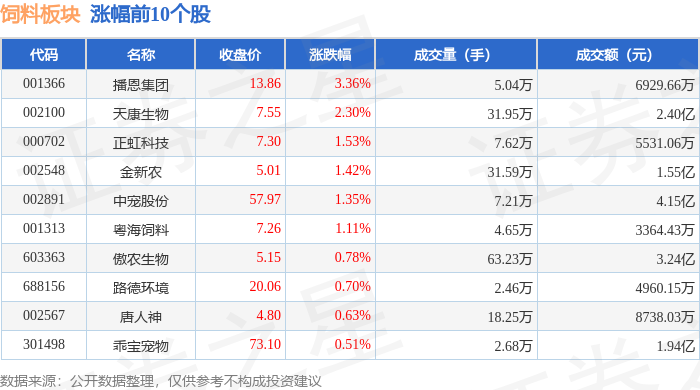
饲料板块11月3日涨0.49%,播恩集团领涨,主力资金净流出2822.46万元
Zheng Xing Xing Ye Ri Bao· 2025-11-03 08:40
Market Overview - The feed sector increased by 0.49% on November 3, with Boen Group leading the gains [1] - The Shanghai Composite Index closed at 3976.52, up 0.55%, while the Shenzhen Component Index closed at 13404.06, up 0.19% [1] Individual Stock Performance - Boen Group (001366) closed at 13.86, up 3.36% with a trading volume of 50,400 shares and a transaction value of 69.30 million [1] - Tiankang Biological (002100) closed at 7.55, up 2.30% with a trading volume of 319,500 shares and a transaction value of 240 million [1] - Zhenghong Technology (000702) closed at 7.30, up 1.53% with a trading volume of 76,200 shares and a transaction value of 55.31 million [1] - Jin Xin Nong (002548) closed at 5.01, up 1.42% with a trading volume of 315,900 shares and a transaction value of 155 million [1] - Zhongchong Co., Ltd. (002891) closed at 57.97, up 1.35% with a trading volume of 72,100 shares and a transaction value of 415 million [1] Capital Flow Analysis - The feed sector experienced a net outflow of 28.22 million from institutional investors, while retail investors saw a net inflow of 12.66 million [2] - The main capital inflow and outflow for selected stocks include: - Tiankang Biological: Net inflow of 16.15 million from main capital, but net outflow of 4.79 million from speculative capital [3] - Zhongchong Co., Ltd.: Net inflow of 11.32 million from main capital, with a significant net inflow of 22.82 million from speculative capital [3] - Dabeinong (002385): Net inflow of 3.82 million from main capital, but a net outflow of 20.27 million from speculative capital [3]


宠物行业全景图:产业链价值重构与国产替代浪潮
2025-11-03 02:36
Summary of the Pet Industry Conference Call Industry Overview - The global pet industry is projected to exceed $200 billion in 2024, with an estimated growth to $270 billion by 2029, reflecting a compound annual growth rate (CAGR) of 5.5% [2] - The United States leads the global pet economy, expected to account for 47% of the pet food and snacks market and 52% of the pet services market by 2025 [1][2] - The European pet market is also significant, with 2023 pet food value reaching €22.93 billion, a 9% year-on-year increase [4] Key Market Insights - In the U.S., total pet industry spending is projected to reach $151.9 billion in 2024, with pet food and snacks accounting for $65.8 billion (43% of total spending) [4] - China's pet market is rapidly growing, with a projected market size exceeding ¥300 billion in 2024, a 7.5% year-on-year increase [5] - In China, the pet food market is the largest segment, making up 52.8% of total spending, followed by the medical market at 28% [5] Consumer Trends - Chinese consumers are increasingly focused on nutritional balance and ingredient transparency, with 35% of cat owners and 33% of dog owners preferring domestic brands [9] - The demand for pet health products is rising, with the pet health supplement market growing at a rate of 32% [3] Emerging Segments - The global pet wearable market is expected to grow from $3.3 billion in 2023 to $17.1 billion by 2033, with a CAGR of 18% [11] - The pet cleaning products market is seeing significant growth, particularly in functional products like deodorants and disinfectants, with sales of plant-based cat litter increasing by 307% [10] Medical and Grooming Services - The pet medical service market in China is valued at approximately ¥84 billion, with a growing demand for veterinary services due to an increasing number of aging pets [15] - The pet grooming industry in China reached ¥42 billion in 2023, with a projected growth to over ¥62 billion in 2025 [16] Challenges and Opportunities - Despite the late start, China's pet industry shows high growth potential driven by demographic changes and evolving consumer needs [18] - Investment opportunities exist in domestic brand development, niche product innovation, and the integration of insurance services within the pet care ecosystem [18]
宠物行业专家交流
2025-11-03 02:35
Summary of Pet Industry Conference Call Industry Overview - The pet industry is experiencing significant growth, particularly in the brands under Jiajia Pet, such as Blue and Crazy Dog, which have seen annual growth rates of 200%-300% since the end of 2022 [1][2] - In the first nine months of 2025, Crazy Dog's sales reached approximately 1.5 billion yuan, while Blue's sales were between 1.2 to 1.4 billion yuan, achieving about 80% of their annual targets [1][2] - The overall expected growth rate for the year is around 70%, indicating strong momentum in the market [1] Key Points on Jiajia Pet - Jiajia Pet achieved profitability for the first time in 2023, following significant investments and platform development supported by Unicharm, which invested 1 billion yuan [1][4] - The company aims for revenue targets of 4 billion yuan by 2026 and 10 billion yuan by 2032, prioritizing revenue growth over profit in a competitive market [1][5] - Marketing expenditures are expected to exceed budgets to meet these ambitious revenue goals, despite high competition and costs [1][5] Competitive Landscape - Mid-tier pet brands, such as Gao Ye Jia, are facing increased marketing costs and pressure from platform investments, leading to a strategic focus on specific platforms rather than broad market expansion [1][6] - Brands that fail to meet new revenue targets may face significant pressure on both revenue and profits, potentially leading to acquisitions or market exit [1][7] - Poor management, including supply chain issues and ineffective reforms, are significant challenges for brands like Afei and Bati [1][8] Market Dynamics - New imported pet food brands struggle to establish themselves in the Chinese market due to a lack of differentiation and brand recognition, while domestic brands are favored for their quality and cost-effectiveness [2][9] - Jiajia Pet's online sales account for approximately 70% of total sales, with offline sales at about 30%, reflecting a strong focus on online channels [2][10] - Leading companies like Guai Bao are reducing the number of distribution clients to concentrate resources on flagship and large specialty stores, enhancing growth speed and simplifying management [2][11] Future Trends - The pet industry is expected to continue its online dominance, although niche markets in offline sales remain viable for smaller brands [2][14] - Successful main products rely on strong supply chain management, R&D capabilities, and effective channel marketing [2][17] - The core barriers to success for leading brands include maintaining high-quality standards and adapting to consumer needs while managing marketing and operational challenges [2][18] Challenges for Domestic Brands - Domestic pet brands face challenges in brand operation and market competition, with many struggling to enhance brand influence despite acquisitions and expansions [2][20] - The differences in pet ownership concepts between domestic and international markets may evolve as consumers become more quality-conscious [2][22] Conclusion - The pet industry is poised for continued growth, driven by strong brand performance and strategic marketing efforts. However, challenges remain for mid-tier brands and new entrants, necessitating effective management and resource allocation to thrive in a competitive landscape.
国内头部宠企“弯道超车”进行时
Bei Jing Shang Bao· 2025-11-02 16:01
Core Insights - The performance of listed companies in the domestic pet industry shows significant divergence amid intensifying competition and rising costs, with the rise of self-owned brands and global production layout driving growth [1] - The overall industry remains in a growth phase, particularly benefiting from domestic consumption upgrades and the "national brand substitution" trend, with leading companies maintaining double-digit growth [1] Revenue Performance - Leading companies such as Guibao Pet and Zhongchong Co. reported revenues of 4.737 billion and 3.86 billion respectively in the first three quarters of this year, reflecting year-on-year growth of 29.03% and 21.05% [1] - Yuanfei Pet achieved a revenue of 1.281 billion, marking a significant year-on-year growth of 37.66% [1] - In contrast, Petty Co. and Yiyi Co. faced revenue pressures, with Petty Co. experiencing a year-on-year decline of 17.68% due to reduced overseas orders and domestic agency business adjustments, while Yiyi Co. saw a slight decline of 0.72% but managed to improve profits through cost control and product structure optimization [1] Strategic Focus on Domestic Market - Companies are emphasizing the enhancement of the domestic market as a core strategic highlight and future growth engine, increasing marketing investments, enriching brand matrices, and deepening channel construction to capture domestic consumer mindshare [2] - Yiyi Co. plans to acquire the "Gao Ye Jia" cat food and cat litter brand to quickly gain mature domestic brand operation capabilities and market share [2] - Petty Co. intends to continue investing in its domestic self-owned brand business, particularly in staple food products, and plans to introduce high-end staple food products from its New Zealand factory to the Chinese market [2] Global Production Layout - Leading pet companies are accelerating their global production layout, particularly shifting capacity to Southeast Asia to build a more resilient and efficient global supply chain [3] - Yuanfei Pet has established a dual-core production capacity structure of "domestic + Southeast Asia," with its Cambodia factory nearing full production and the Bangladesh base under construction [3] - Petty Co. plans to expand its Southeast Asia factory capacity, expecting to increase pet snack production by approximately 5,000 tons over the next two years [3] - The current global production layout is driven more by considerations of supply chain security, cost optimization, and resource integration rather than merely proximity to customers or obtaining custom orders [3]
农林牧渔行业2025年第44周周报:2025年三季报收官,农业板块总结和展望-20251102
Tianfeng Securities· 2025-11-02 14:46
Investment Rating - Industry Rating: Outperform the market (maintained rating) [11] Core Views - The agricultural sector is experiencing a mixed performance with significant opportunities in various sub-sectors, particularly in pig farming, cattle, pets, poultry, and planting industries. The report emphasizes the importance of focusing on leading companies with strong profitability and market positioning [3][4][5][6][8][26]. Summary by Relevant Sections 1. Pig Farming Sector - The decline in pig prices has led to a divergence in profitability among companies, highlighting the need to focus on expected differences in the pig farming sector. The average selling price of pigs in Q3 2025 was between 13-14 CNY/kg, down from 14-15 CNY/kg in H1 2025 [3][15]. - Key companies to watch include leading players like Muyuan Foods and Wens Foodstuff, with valuations at historical low levels [3][16]. 2. Cattle Sector - The raw milk price is stabilizing, while the beef cattle sector may be entering a super cycle. The average price for beef cattle in Q3 2025 was 25.88 CNY/kg, up 2.34% from the previous quarter [4][17]. - Companies with mother cow resources or those adopting a "milk-meat linkage" model are expected to have stronger profitability [4][18]. 3. Pet Sector - The pet economy is thriving, with domestic brands rapidly rising. Major pet food companies reported revenues of 4.737 billion CNY for Guibao Pet and 3.860 billion CNY for Zhongchong Co., with growth rates of 29% and 21% respectively [5][19]. - Recommended companies include Guibao Pet, Zhongchong Co., and Petty Co. [5][20]. 4. Poultry Sector - The white chicken segment is under pressure, with a focus on the need for improved breeding practices. The average price for white chicken was reported to be 3.5 CNY/kg, with a slight increase [6][21]. - The yellow chicken market is expected to see price recovery due to seasonal demand, with companies like Lihua and Wens showing improved performance [6][23]. 5. Planting Sector - The seed industry is anticipated to recover, with a focus on the commercialization of genetically modified corn. Leading companies in the seed sector include Longping High-Tech and Dabeinong [8][26]. - The report emphasizes the importance of agricultural technology and innovation in enhancing competitiveness [8][27]. 6. Feed and Animal Health Sectors - The feed sector has shown revenue and profit growth among leading companies, with Haida Group reporting a revenue increase of 13.24% [8][28]. - The animal health sector is facing challenges due to competition, but there are opportunities for innovation in vaccine development [8][32].


生猪养殖持续亏损,产能去化或加速
CAITONG SECURITIES· 2025-11-02 13:13
Core Insights - The report maintains a positive outlook on the agricultural sector, particularly in pig farming, despite ongoing losses in the industry [1][3] - The report highlights a potential acceleration in capacity reduction due to supply pressures and policy guidance [6][19] Group 1: Pig Farming - The number of breeding sows decreased by 0.20% month-on-month in September, with a total of 40.35 million sows reported [20][21] - Pig prices have been on the rise, with the average price for market pigs reaching 12.22 CNY/kg on October 30, reflecting a week-on-week increase of 7.10% [29][30] - The profitability of pig farming remains negative, with losses of 89.33 CNY per head for self-bred pigs and 179.72 CNY per head for purchased piglets as of October 31 [35][37] Group 2: Poultry Farming - The average price for white feather broilers increased to 7.09 CNY/kg on October 31, marking a week-on-week rise of 3.05% [39][42] - The report notes a significant increase in the number of breeding stock, with a 143.18% month-on-month rise in the number of grandparent stock updated in October [39][40] Group 3: Animal Health - The demand for animal health products is expected to rebound, driven by a recovery in breeding cycles and an increase in livestock numbers [48] - The report mentions that several companies are actively developing new products, which may enhance growth prospects for the sector [48] Group 4: Seed Industry - The average prices for wheat, soybean meal, and corn have increased, with wheat and soybean meal rising by 0.9% and 1.3% respectively as of October 31 [52][53] - The report emphasizes the importance of food security and the promotion of biotechnology in the seed industry [52][56] Group 5: Pet Industry - Pet food exports amounted to 823 million CNY in September, showing a year-on-year decline of 6.8% [57][60] - Domestic sales of pet food have continued to grow, with a combined growth rate of 3% across major e-commerce platforms in September [60]


25W43周观点:直补趋势化,AI赋能商家降本增效,即时零售贡献新增量-20251102
Huafu Securities· 2025-11-02 11:49
Investment Rating - The report maintains a rating of "Outperform the Market" for the home appliance sector [7]. Core Insights - The Double Eleven shopping festival has seen an earlier start and extended duration this year, with major platforms like Kuaishou, JD, and Douyin initiating pre-sales as early as October 7, 2025 [14][16]. - Direct subsidy trends have become prominent, simplifying promotional strategies and focusing on direct price reductions across platforms [14][16]. - AI tools are increasingly empowering marketing operations, helping merchants reduce costs and improve conversion rates through precise customer targeting and efficient ad spending [3][16]. - The instant retail market is expected to contribute significantly to this year's Double Eleven sales, with platforms like Taobao and JD enhancing their local life services and promotional strategies [4][20]. Market Performance Data - The home appliance sector experienced a weekly increase of 1.2%, with specific segments showing varied performance: white goods up 1.6%, black goods down 0.3%, small appliances up 1.1%, and kitchen appliances up 2.7% [26]. - Key brands in the home appliance sector have shown significant sales growth, particularly in 3C digital and AI innovation products, with order volumes for major categories increasing over 70% year-on-year [20][21]. Segment Tracking - The report highlights the performance of various segments within the home appliance industry, noting that brands like Haier and Midea have faced challenges in sales, particularly in offline channels [37][40][41]. - The small appliance segment has shown resilience, with brands like Joyoung and Supor reporting positive sales growth in specific product categories [40]. - Kitchen appliances have also seen varied performance, with brands like Boss and Huadi experiencing significant fluctuations in sales figures [41].
宠物三季报:自有品牌与全球化布局成增长双引擎
Bei Jing Shang Bao· 2025-11-02 10:07
Core Insights - The domestic pet industry is experiencing significant performance differentiation among listed companies as they report their Q3 2025 results, driven by the rise of private brands and global capacity layout amidst increasing competition and cost pressures [1][4] Revenue Performance - Guibao Pet (301498) and Zhongchong Co. (002891) lead the industry with Q3 revenues of 4.737 billion and 3.86 billion respectively, showing year-on-year growth of 29.03% and 21.05% [3] - Yuanfei Pet (001222) reported a revenue of 1.281 billion, with a notable growth rate of 37.66% [3] - In contrast, Petty Co. (300673) faced a revenue decline of 17.68% due to reduced overseas orders and domestic agency business adjustments, while Yiyi Co. (001206) saw a slight revenue decrease of 0.72% but managed to improve profits through cost control and product structure optimization [3] Profitability Challenges - Despite revenue growth, many companies are facing pressure on profit margins, with Guibao Pet's net profit down 16.6% and Zhongchong Co.'s net profit decreasing by 6.64% in Q3 [5] - Petty Co. experienced a nearly 40% drop in net profit, highlighting the broader trend of increasing costs outpacing revenue growth [5][6] Strategic Focus on Domestic Market - Companies are prioritizing the domestic market as a core strategic focus, increasing marketing investments, expanding brand portfolios, and enhancing channel development to capture consumer attention [7] - Yiyi Co. plans to acquire the "Gao Ye Jia" cat food and litter brand to quickly gain mature domestic brand operation capabilities and market share [7] Growth of Private Brands - The rapid growth of private brands is driving performance increases for pet companies, with Guibao Pet's high-end sub-brand "Fuleijiate" achieving over 100% year-on-year growth in online sales [9] - Zhongchong Co.'s domestic private brand growth is around 35%-40%, with its staple food business growing by 85.79% [9][10] Global Capacity Layout - Leading pet companies are accelerating their global capacity layout, particularly in Southeast Asia, to create a more resilient and efficient global supply chain [11] - Yuanfei Pet has established a dual-core capacity structure in "domestic + Southeast Asia," with its Cambodian factory nearing full production [11] - Petty Co. plans to expand its Southeast Asia factory capacity by approximately 5,000 tons over the next two years [11]