招商蛇口

Search documents
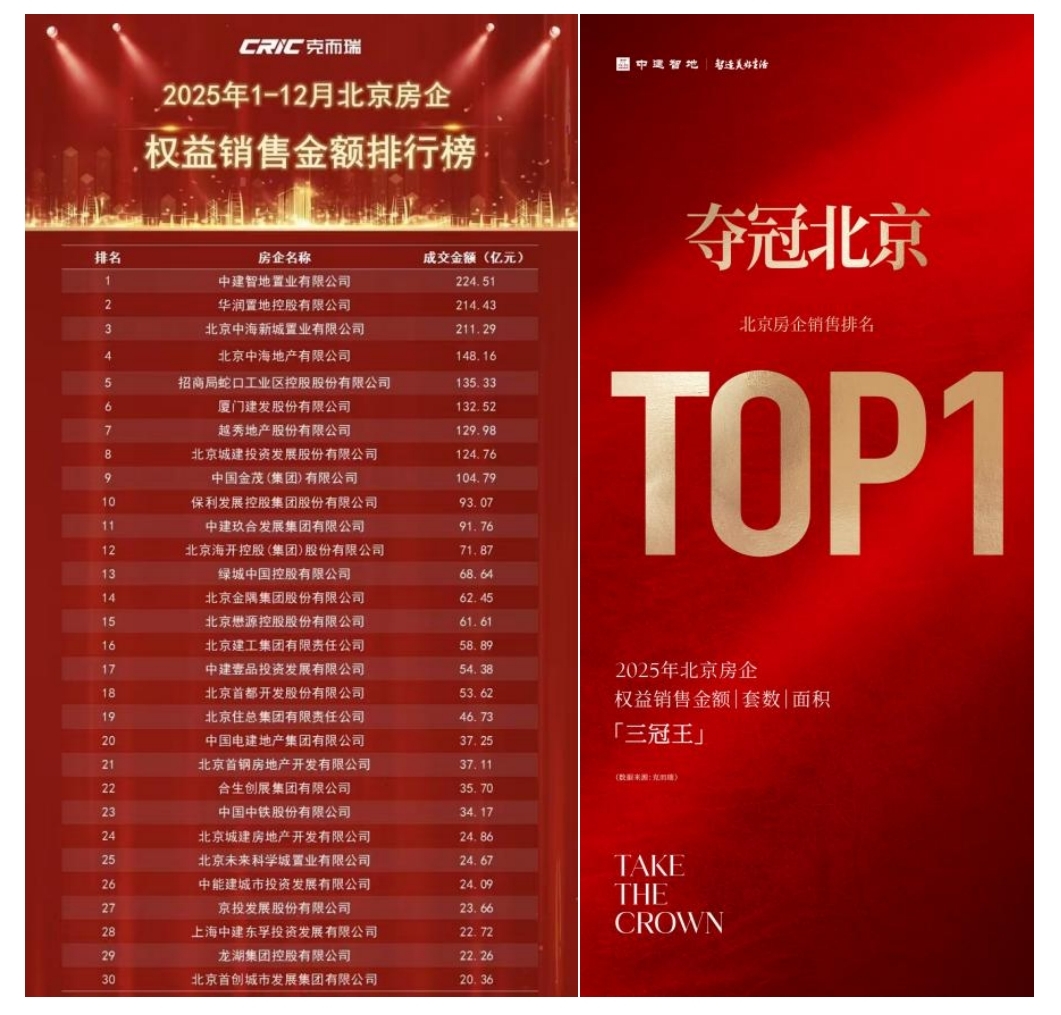
“新王”加冕!中建智地荣膺2025北京权益销售“三冠王”
3 6 Ke· 2026-01-08 04:17
Core Insights - The 2025 sales ranking of real estate companies in Beijing reveals that China State Construction's subsidiary, Zhongjian Zhidi, achieved the top position in sales amount, transaction units, and area, earning the title of "Triple Crown" winner [1][2]. Sales Performance - Zhongjian Zhidi recorded a sales amount of 22.451 billion yuan, with 5,847 units sold and an area of 442,800 square meters [2]. - The second and third positions were held by China Resources Land with 21.443 billion yuan and China Overseas Property with 21.129 billion yuan, respectively [2]. Market Strategy - Zhongjian Zhidi has focused on key areas in Beijing such as Chaoyang, Changping, and Fangshan, leading to significant sales in multiple projects [3]. - The Beijing Chenyuan project achieved over 10 billion yuan in sales within eight months, while the newly launched Zijing Chenyuan generated 5.65 billion yuan on its first day of sales [3]. Product Development - The company's success is attributed to its "Good House" construction system and the integration of cultural living concepts [4]. - Zhongjian Zhidi has established a dedicated research base for the "Good House" initiative and upgraded its core IPs, Chenyuan and Guoxianfu [4][6]. Land Acquisition - In 2025, Zhongjian Zhidi actively participated in the land market, acquiring four key plots in Beijing with a total investment exceeding 20 billion yuan, expected to be launched in 2026 [7]. - The company plans to continue developing high-end product lines based on its successful projects [7][8]. Future Outlook - Zhongjian Zhidi aims to maintain its market position through product strength and operational capabilities amid industry transformations and market changes [9].

原华侨城董事长段先念被带走?文旅地产模式终结?
Sou Hu Cai Jing· 2026-01-08 01:18
Core Viewpoint - The recent rumors surrounding the detention of Duan Xiannian have sparked significant reactions within the industry, highlighting the vulnerabilities of the Chinese cultural tourism real estate model [1] Group 1: Historical Context - During Duan Xiannian's leadership at Overseas Chinese Town A, the "culture + tourism + urbanization" and "cultural tourism + real estate" models were seen as golden formulas, with theme parks serving as traffic engines and real estate as cash machines [3] - The rapid expansion and prioritization of scale in the industry were initially successful, with examples like Happy Valley and Window of the World becoming industry benchmarks [3] Group 2: Structural Issues - The existing model relies heavily on asset expansion and future expectations rather than actual operating cash flow, leading to vulnerabilities when the real estate cycle reverses [4] - The Shenzhen Securities Regulatory Bureau and Shenzhen Stock Exchange have pointed out issues such as asset impairment and insufficient provisions, indicating structural risks in the cultural tourism projects [4] Group 3: Industry Challenges - The current environment, marked by the pandemic and deep adjustments in the real estate sector, has exposed the weaknesses of the model, resulting in significant losses for Overseas Chinese Town A in 2024 and consecutive deficits over three years [5] - Other state-owned enterprises are also facing similar challenges, indicating a broader issue within the integrated cultural tourism real estate model [5] Group 4: Future Considerations - The incident involving Duan Xiannian marks the beginning of a critical phase for Overseas Chinese Town, raising questions about asset revaluation, financial resilience, and the potential transformation of cultural tourism into a core business rather than a real estate appendage [6] - The industry must shift focus from scale to genuine customer flow, stay duration, consumption, and cash flow, with theme parks needing to evolve into sustainable content platforms [6] - The current situation compels the industry to confront the reality that cultural tourism is not merely a financial tool but requires patience, professionalism, and a long-term perspective [6]


2025年,我观察到企业组织的四个变化
3 6 Ke· 2026-01-08 01:08
Core Insights - In 2025, Chinese companies are undergoing a collective adjustment in organizational logic, moving away from "performative diligence" towards efficiency and human-centered management [1][11] Group 1: Efficiency Revolution - Leading companies are initiating an efficiency revolution, focusing on eliminating the illusion of productivity that busywork creates [2][6] - Midea serves as a benchmark for this movement, implementing measures to simplify work processes, resulting in a reduction of average working hours from 10.1 to 7.6 hours and a 20% increase in productivity [2][6] - DJI and Miniso are also adopting similar practices, such as enforcing strict work hours and minimizing unnecessary meetings to enhance effective work periods [3][4][5] Group 2: Organizational Restructuring in Real Estate - The real estate sector is experiencing a shift towards "organizational precision," with companies like Poly and China Jinmao restructuring to reduce management layers and bring decision-making closer to the frontline [7] - This restructuring involves merging or eliminating regional companies and compressing middle management, allowing younger and more qualified managers to take on direct responsibilities [7] Group 3: AI Talent Acquisition and Organizational Reconfiguration - In contrast to the real estate sector's downsizing, tech companies are focusing on talent acquisition and organizational restructuring to enhance their AI capabilities [8][9] - Tencent's restructuring of its technology engineering division exemplifies this shift, moving from a business-driven to a technology-driven approach, and planning to hire 28,000 new positions over three years, with a significant focus on AI roles [8][9] Group 4: Emphasis on Human-Centric Management - Amidst the push for efficiency, some companies are recognizing the importance of human-centric management, as seen in delivery platforms providing social security for riders [10] - The case of Pang Donglai highlights the growing trend of prioritizing employee well-being and creating a collaborative environment, which is becoming a management philosophy for many private enterprises [10] Group 5: Collective Organizational Adjustment - The year 2025 marks a significant change in organizational logic, with companies adjusting their value measurement standards, decision-making proximity, technology collaboration, and individual relationships [11]


新房成交环比高增,韶关对农村转移人口购房给予契税补贴:房地产行业周报(2025年第53周)-20260107
Huachuang Securities· 2026-01-07 10:15
证 券 研 究 报 告 房地产行业周报(2025 年第 53 周) 新房成交环比高增,韶关对农村转移人口购 推荐(维持) 房给予契税补贴 行业研究 房地产 2026 年 01 月 07 日 华创证券研究所 证券分析师:单戈 邮箱:shange@hcyjs.com 执业编号:S0360522110001 证券分析师:许常捷 邮箱:xuchangjie@hcyjs.com 执业编号:S0360525030002 证券分析师:杨航 邮箱:yanghang@hcyjs.com 执业编号:S0360525090001 相关研究报告 《商业地产行业跟踪报告:行业分化,强者恒强》 2025-12-31 《房地产行业周报(2025 年第 52 周):北京出台 楼市新政,新房周成交环比上涨》 2025-12-31 《房地产行业重大事项点评:北京楼市再宽松》 2025-12-26 证监会审核华创证券投资咨询业务资格批文号:证监许可(2009)1210 号 板块行情:第 53 周(12 月 29 日-12 月 31 日)申万一级行业指数中,房地产 指数下跌 0.7%,在 31 个一级行业板块中排名第 19。 政策要闻:地方层面:1 ...
“丁祖昱评楼市2026年度发布会”高清PPT全公开!
克而瑞地产研究· 2026-01-07 09:31
"丁祖昱评楼市2026年度发布会"高清PPT全公开! 原创 编辑部 丁祖昱评楼市 2026年1月7日 17:13 上海 核心观点: 诚如"长期主义——丁祖昱评楼市2026年度发布会"的结语,"把握确定性,奔赴新征程"。"长期主义"不是坚持什么长期不变,而是判断什么 是"确定的"。 十年坚守 生生不息 长期主义 一转眼,"丁祖昱评楼市年度发布会"已经举办了十届。 1、中国房地产仍是中国经济的支柱产业。 2、好房子是中国房地产未来十年,二十年,最该关注的政策。 3、行业规模回到了2010年以前,但压力已基本释放完。 4、整体市场仍"L"型运行,还在止跌回稳的过程中。 5、 二手房成交占比越来越多 ,二手房是整体市场活跃度晴雨表 。 6、 企业规模增长时代已经结束 。 7、民企信心开始修复。 8、2026年行业底部确认,需要四个确定性。 9、一线城市重新划分:上海、北京、杭州、成都、广州5个一线城市。 10、现房销售将倒逼企业开发模式转变。 在房地产市场供求关系已经改变的当下,未来不再是速度与规模的狂欢,而是价值与时间的重构。 2026年,房地产行业一定会出现新的转机。 以下我们将为您呈现最全、最新的"长期主义—— ...

2025年度中国房地产企业品牌传播力
克而瑞地产研究· 2026-01-07 09:31
Core Viewpoint - In 2025, the Chinese real estate industry is entering a new phase of value competition amid deep adjustments, shifting its core competitiveness from scale and speed to product quality, operational service, and sustainable professional capabilities. Brand communication has transformed into a multi-dimensional value output focused on "hardcore product strength," "warm community strength," and "entrusted professionalism" [1]. Group 1: Brand Development - The year 2025 marks a significant transformation in the industry, with the "Good House" standard becoming a key driver for brand development and product quality, as it is integrated into government work reports and residential regulations [8]. - Many companies are releasing updated "Good House" standards, with Green City China updating its standards to include 270 core guidelines, while Jianfa Real Estate has introduced a four-dimensional framework for its "Good House" system [9]. - The launch of innovative community projects under the "Good House" framework, such as Darwin Camp and zero-carbon community projects, has garnered high attention and engagement [10]. Group 2: Community Brand - The real estate industry is evolving from "space construction" to "relationship cultivation," focusing on community warmth, neighborly relations, and growth experiences [16]. - Leading companies are creating community ecosystems that foster recognition, participation, and continuity, with community operations becoming a key aspect of post-delivery services [21]. - Initiatives like the "Children-Friendly" program by China Railway Real Estate and various health and wellness activities by companies like China Railway and Fuyue Property highlight the industry's focus on enhancing living experiences for residents [17][18]. Group 3: Construction Brand - In 2025, brand communication in real estate construction is characterized by a focus on "stronger companies, technology-driven, and value deepening," with an emphasis on comprehensive strength and differentiated value [22]. - The integration of AI technology in construction processes, such as the AI cooling station control system developed by Longfor, showcases the industry's commitment to innovation and efficiency [22]. - The establishment of industry standards, such as the "Comprehensive Capability Evaluation Standard for Construction Enterprises," enhances brand credibility and positions companies as authoritative figures in the market [23]. Group 4: Future Outlook - The brand communication landscape in the real estate sector is becoming increasingly structured, with product brands focusing on the "Good House" concept, community brands emphasizing human connections, and construction brands building on professionalism and technological capabilities [26]. - Future brand strategies will likely integrate product innovation, community engagement, and digital capabilities, allowing companies to create perceivable and trustworthy brand assets that provide a competitive edge in the evolving market [26].

连续五天融资净买入,资金持续力看一点
Sou Hu Cai Jing· 2026-01-07 04:09
Group 1 - The core viewpoint emphasizes that merely observing financing net purchases is insufficient; the true determinant of a stock's ability to withstand volatility lies in the "real attitude" of institutional investors behind the scenes [1][3] - Many investors focus on superficial data like "financing net purchases" and "increased trading volume," believing that following the crowd is a safe strategy, but this can lead to misleading outcomes [3][5] - The analysis of institutional inventory reveals that during previous price rebounds, institutional participation remained active, indicating that they were not selling but rather consolidating positions; however, a lack of institutional inventory during a price drop signals potential trouble ahead [5][7] Group 2 - Investors often fall into the trap of only looking at price movements without understanding the underlying buying and selling dynamics, which can obscure the true intentions of institutional players [7][8] - Quantitative data analysis is crucial as it helps investors discern whether institutional funds are actively participating in trades, which can provide insights into market sentiment and potential price movements [7][8] - The market is not about guessing but rather about analyzing data to reveal the true situation; understanding institutional actions can prevent premature selling or holding onto losing positions [8][9]
原华侨城董事长段先念,退休3年多被调查
3 6 Ke· 2026-01-07 02:55
近日,土楼研究所的消息说,段先念被带走了。 段先念的名字,很多90后不知道。但20年前,算得上如雷贯耳。 段先念是做曲江文旅成名的。后来还形成了所谓的"曲江模式"——这个模式跟段先念的名字是连在一起 的。就是将"文化+旅游+城市"整合起来进行运营,实现区域土地大幅增值。现在西安的网红打卡点大 唐芙蓉园、大唐不夜城,都是段先念主导建设的。段先念也从曲江新区管委会主任升到了西安市副市 长。 2014年3月,段先念跨省调到华侨城集团当总经理的时候,人们多少有点意外。这个跨度有点大。 但仔细一想,也不意外。那时,段先念已经58岁了,这个年龄在政界要晋升恐怕比较难。而华侨城是央 企,也是正厅级,再干五六年没问题。更重要的是,段先念以文旅成名,华侨城则是响当当的"文旅央 企"。从这个角度上说,国资委是知人善任。 2017年,任克雷退休,段先念接任董事长。由此华侨城迎来大刀阔斧的动作。用地产界的话说就是,大 举扩张。 如果没记错的话,华侨城那时有两个重要的投资方向,一个是云南,一个是段先念起家的西安。动辄千 亿级别。当然,意向项目没有都落地。话说回来,如果都落地了,华侨城今天的窟窿要更大。举个例 子,华侨城那几年跟云南城投 ...
2025信用月报之十二:基金费率新规落地,信用债怎么配-20260107
HUAXI Securities· 2026-01-07 02:34
Report Summary 1. Report Industry Investment Rating The provided content does not mention the industry investment rating. 2. Core Viewpoints of the Report - In January 2026, the credit - bond market may gradually recover with the implementation of the new fund sales fee regulations, but the pattern of strong supply and weak demand may restrict its performance. It is recommended to focus on varieties within 3 years, with a leveraged strategy to increase returns, and also pay attention to the potential demand for 5 - year varieties driven by amortized bond funds [1][2][3]. - After the implementation of the new regulations, the second - tier and perpetual bonds of large banks may experience a recovery. Since the second half of 2025, these bonds have significantly over - declined compared to general credit bonds, but the new regulations' formal release may ease market concerns and promote their recovery [4][5]. 3. Summary According to Relevant Catalogs 3.1 Short - term Bonds as a Shield, 4 - 5 - year Large Bank Second - tier and Perpetual Bonds as a Spear - **January Credit - Bond Supply - Demand Situation and Investment Focus**: In December 2025, due to factors such as changes in the expectation of broad money, concerns about ultra - long bond supply, and new fund sales regulations, the long - end interest rate was weak, and the credit - bond market showed a "short - strong, long - weak, high - rating dominant" structural market. In January 2026, the credit - bond market may recover, but the supply - demand pattern will be strong supply and weak demand. It is recommended to focus on varieties within 3 years, with short - duration sinking for urban investment bonds, and also pay attention to 4.5 - 5.5 - year public non - perpetual bonds [1][2][3]. - **Recovery of Second - tier and Perpetual Bonds**: Since the second half of 2025, the medium - and long - term second - tier and perpetual bonds of large banks have significantly over - declined compared to general credit bonds. After the formal release of the new regulations on December 31, 2025, market concerns may ease, and these bonds may experience a recovery. Currently, the 4 - 5 - year large - bank second - tier and perpetual bonds have higher holding - period yields than general credit bonds, with the 4 - year variety being more cost - effective [4][5]. 3.2 Urban Investment Bonds: Net Financing Increased Year - on - Year, and Long - Duration Transaction Activity Declined - **December Issuance and Net Financing**: In December 2025, the net financing of urban investment bonds was positive and increased year - on - year. The issuance of short - duration bonds increased, and the weighted average issuance interest rate increased across the board, with a larger increase for medium - and long - duration bonds. The performance was divided, with the yields of medium - and high - grade bonds within 5Y and low - grade bonds within 3Y generally declining, and the spreads of 1Y short - duration and 5Y low - grade bonds widening significantly [41]. - **Provincial - Level Performance**: The net financing performance of each province in December was divided, with half of the provinces having negative net financing. The yields of public urban investment bonds in each province generally increased, with Liaoning and Yunnan performing worse [45][50]. - **Transaction Activity**: In December, the buying sentiment of urban investment bonds was still weak, with the overall TKN ratio and low - valuation ratio slightly decreasing. The long - duration transaction activity declined, and the AA(2) transaction ratio decreased, while the AA + ratio increased [53]. 3.3 Industrial Bonds: Supply Increased Significantly, and the Short - Duration Issuance Ratio Increased Significantly - **December Issuance and Net Financing**: In December 2025, the issuance and net financing of industrial bonds increased significantly year - on - year. The issuance of short - duration bonds increased significantly, and the issuance interest rate increased across the board, with a larger increase for 3 - 5 - year bonds. The spreads generally widened, with long - duration varieties performing worse [56][57][59]. - **Industry - Level Yield Performance**: The yields of public bonds in various industries generally decreased slightly. Among industries with over 50 billion yuan in outstanding public bonds, the public utilities and transportation industries performed well with a 2bp yield decline, while the real estate industry's yield increased significantly by 10bp [62]. 3.4 Bank Second - tier and Perpetual Bonds: Supply Increased, and Medium - and Long - Duration Yields Mostly Increased - **December Supply and Net Financing**: In December 2025, the supply of bank second - tier and perpetual bonds increased significantly, with the increase mainly coming from second - tier capital bonds. The issuance and net financing both increased significantly year - on - year [65]. - **Yield and Spread Performance**: The yields of bank second - tier and perpetual bonds were divided, with medium - and long - term second - tier capital bonds performing worse. The spreads generally widened, except for the 5Y AAA - and 2Y AA - perpetual bonds. Compared with medium - and short - term notes, AA and above second - tier and perpetual bonds performed weakly [69]. - **Transaction Activity**: The number of transactions of bank second - tier and perpetual bonds increased month - on - month, but the trading sentiment was still weak. The TKN ratios of second - tier capital bonds and perpetual bonds were 62% and 56% respectively, and the low - valuation ratios increased by 8pct and 3pct respectively. The transactions of state - owned banks and joint - stock banks were mainly concentrated in 3 - 5 - year medium - and long - duration varieties, while the trading sentiment of city commercial banks was weak, and the transactions showed a trend of extending duration [74].
上海新年“第一拍”两宗地底价成交,2025年卖地揽金2453亿
Xin Lang Cai Jing· 2026-01-07 00:47
Core Viewpoint - The Shanghai land market continues its trend of "one auction per month" into 2026, with a focus on multiple small batch releases, as evidenced by the successful auction of two residential plots in January 2026, which were sold at their starting prices [1][8]. Group 1: Auction Details - The first land auction of 2026 in Shanghai took place on January 6, featuring two residential plots in Pudong and Minhang, with a total starting price of approximately 4.57 billion yuan [1]. - Both plots were successfully sold at their base prices, with Yuexiu Property acquiring one for 2.56 billion yuan and Zhijiang Group for 2.01 billion yuan [1][6]. - The Pudong plot is notable as it is the first residential land released in the Senlan area since the introduction of the "good housing" policy, covering an area of approximately 2.69 hectares with a floor area ratio of 2.5 [5][6]. Group 2: Market Trends and Predictions - According to Zhang Wenjing from the China Index Academy, the current market is in a traditional off-peak season, leading to reduced enthusiasm among developers for land acquisition [1]. - It is anticipated that the pace of land acquisition will remain stable in the short term, with the release of quality plots in core areas expected to boost market participation [1]. - The auction results indicate a trend where major state-owned enterprises like China Resources, Poly, and China Merchants did not participate, highlighting a shift in market dynamics [4][5]. Group 3: Historical Context and Future Outlook - The 2025 Shanghai land market was characterized by high competition and record-breaking land prices, with a total land sale revenue of approximately 245.3 billion yuan [9][12]. - The year 2025 saw significant land price increases, with several plots achieving premium rates above 40%, and the highest premium reaching 46% [10]. - The trend of increasing participation from private enterprises in the land market is noted, with local firms like Dahua Group actively acquiring plots [12][13].