欣旺达

Search documents
中银国际:供需格局有望重塑 固态电池加速落地
Zhi Tong Cai Jing· 2026-01-12 02:33
Core Viewpoint - The report from Zhongyin International indicates that global sales of new energy vehicles (NEVs) are expected to maintain high growth, potentially reaching a historical high by 2026, driven by strong demand and technological advancements in the industry [1][2]. Group 1: New Energy Vehicle Market - Global demand for new energy vehicles is projected to continue growing, with sales expected to reach approximately 26 million units in 2026, representing a year-on-year increase of about 15% [2]. - The market is experiencing steady growth, with increasing penetration rates and expanding market space, supported by the introduction of new models and advancements in smart and connected technologies [2]. Group 2: Battery Industry Outlook - The demand for power batteries is expected to grow significantly, with domestic installed capacity projected to maintain a high growth rate in 2026 [3]. - The market share of lithium iron phosphate batteries is anticipated to continue rising, while the costs of lithium battery raw materials have increased since October 2025, posing challenges for battery manufacturers in cost management [3]. Group 3: Material Sector Dynamics - The consensus on "anti-involution" in the midstream materials sector suggests that high demand coupled with cautious capacity expansion may lead to a supply-demand mismatch, particularly in the lithium hexafluorophosphate segment, which is expected to see price recovery [4]. - Companies in the tight supply segments, such as lithium iron phosphate cathodes, separators, anodes, and copper foils, are recommended for investment due to their potential for profit recovery [4]. Group 4: Solid-State Battery Development - The industrialization of solid-state batteries is accelerating, entering a phase of pilot testing and small-scale vehicle validation, which is expected to benefit equipment manufacturers and high-value material segments [5]. - Companies that can achieve stable supply, have mature processes, and clear cost reduction paths are recommended for investment, especially those that have collaborated early with industry leaders [5]. Group 5: Investment Recommendations - The new energy vehicle supply chain is expected to maintain high growth, with battery cell segments showing strong resilience in profitability [6]. - Investment focus is suggested on leading companies in tight supply segments and those involved in solid-state battery technology, including firms like CATL, EVE Energy, and others listed in the report [6].



绿金周报0112|小米雷军:特斯拉确实强 但并非不可战胜 AI驱动全球核电需求增长
Xin Lang Cai Jing· 2026-01-12 02:30
Group 1: Solid-State Battery Innovation - Donut Lab introduced the world's first mass-producible solid-state battery, achieving an energy density of 400Wh/kg and a fast charging time of 10 minutes [1] - The Verge electric motorcycle, equipped with this battery, is set for user delivery this year, although the technology faces scrutiny over data verification and aggressive production expansion [1] Group 2: Industry Regulation and Collaboration - The Ministry of Industry and Information Technology (MIIT) held a meeting with multiple agencies to address issues in the power and energy storage battery industry, focusing on capacity control, price stabilization, and patent protection [1][2] - The meeting included 16 companies, primarily leaders in the power and energy storage battery sectors, indicating a collaborative effort to regulate industry competition [2] Group 3: Market Developments in Energy Storage - Shenzhen-based Yuanxin Energy submitted a listing application to the Hong Kong Stock Exchange and completed a 200 million RMB equity financing round, with a post-financing valuation of approximately 2 billion RMB [3] Group 4: Nuclear Power and AI Influence - AI is driving a significant increase in global nuclear power demand, with over 63% of surveyed investors considering AI-related consumption a structural change in electricity demand [4] Group 5: Advancements in Solar Technology - Research teams from Xiamen University and Xi'an Jiaotong University developed a new method to enhance the stability of perovskite solar cells, addressing critical defects that affect performance [5][6] Group 6: Future Energy Initiatives - Beijing Economic-Technological Development Area plans to establish a "Future Energy Town" focusing on new energy storage, clean energy, low-carbon transition, and fusion energy [7] Group 7: Electric Vehicle Market Adjustments - General Motors announced a $6 billion impairment charge to terminate certain electric vehicle investments, influenced by market demand fluctuations and policy changes [8] - Geely Holding Group projected a total sales volume of 4.116 million vehicles in 2025, with a 26% year-on-year increase, driven by a 58% growth in new energy vehicle sales [8] Group 8: Carbon Capture and Utilization Standards - China Huaneng Group released three national standards in the CCUS field, covering the entire process from carbon capture to geological storage, marking a significant advancement in carbon asset development [10] Group 9: Circular Economy Initiatives - Greeenme's project for recycling end-of-life vehicles received a carbon reduction certification, marking a significant achievement in carbon asset development [12] - The "Love Recycling" initiative reported a recycling volume of 945,000 tons in 2025, reflecting a 40% increase from the previous year [13]
A股震荡走高,商业航天持续活跃,恒科指涨1%,智谱涨近20%,金属再度爆发,沪银飙升超11%
Hua Er Jie Jian Wen· 2026-01-12 02:19
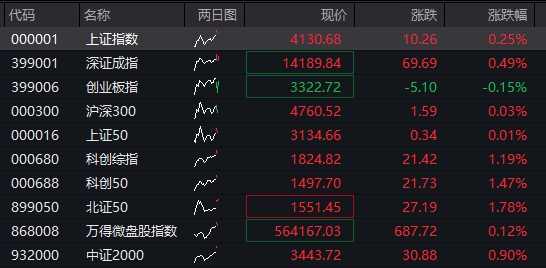
Market Overview - A-shares experienced a volatile rise, with the Shanghai Composite Index up 0.25% and the Shenzhen Component Index up 0.49%, while the ChiNext Index fell 0.15% [1][2] - Hong Kong stocks also saw gains, with the Hang Seng Index up 0.24% and the Hang Seng Tech Index up 0.91% [3][12] - The bond market showed an upward trend, with government bond futures rising across the board [3][4] Sector Performance - The commercial aerospace sector remained active, and AI applications continued to strengthen, with notable gains in tech stocks [1][10] - The battery sector faced declines, with companies like Defu Technology dropping over 10% [9][10] - The metal futures market saw significant increases, particularly in silver, which surged over 11%, and other metals like platinum and palladium also rose [1][15] Notable Stocks - "Global Large Model First Stock" Zhihui surged nearly 20% in early trading [6][12] - AI programming concept stocks experienced a rally, with companies like Zhuoyi Information hitting the daily limit up [8][10] Commodity Market - Domestic commodity futures showed widespread gains, with silver up 11.5%, lithium carbonate up 9%, and platinum up 5% [4][5] - Other commodities like nickel, copper, and aluminum also saw increases, while some commodities like glass and fuel experienced declines [5][15]

FINE2026火热招展中!六大主题展集结:智能终端+轻量化与可持续+先进电池+半导体+热管理+科技创新成果
DT新材料· 2026-01-11 23:28
Core Viewpoint - The 2026 Future Industries New Materials Expo (FINE 2026) aims to lead global innovation in new materials, serving as a pivotal platform for showcasing advancements in high-tech industries and facilitating collaboration and procurement in the sector [2][3]. Group 1: Event Overview - FINE 2026 will take place from June 10-12, 2026, at the Shanghai New International Expo Center, featuring a 50,000 square meter exhibition area and over 300 strategic and cutting-edge technology reports [3][13]. - The expo will focus on key industries such as artificial intelligence, aerospace, smart vehicles, and renewable energy, addressing five common needs in future industries: advanced semiconductors, advanced batteries, lightweight materials, low-carbon sustainability, and thermal management [3][11]. Group 2: Participation and Audience - The previous events, including the 9th International Carbon Materials Expo and the 6th Thermal Management Expo, attracted over 35,000 professional visitors from 27 countries, showcasing the growing interest and participation in the new materials sector [8][36]. - FINE 2026 is expected to draw over 100,000 professional attendees, including representatives from major companies like BYD, Huawei, and Tesla, as well as over 5,000 industry investors [36][11]. Group 3: Exhibition Highlights - The expo will feature six specialized thematic exhibition areas, including advanced semiconductors, advanced batteries, thermal management, lightweight materials, new materials technology innovation, and future smart terminals, with an anticipated participation of over 800 exhibitors and 200 research institutions [13][36]. - FINE 2026 will host more than 30 forums and 300 expert presentations, focusing on trends in technology, investment strategies, and advanced manufacturing techniques related to new materials [22][24]. Group 4: Organizer and Support - The event is organized by DT New Materials, a well-known consulting brand in the new materials industry, which has established a vast network of over 200,000 contacts across various sectors [11][53]. - The expo is supported by multiple associations and institutions, including the China Productivity Promotion Center Association and various new materials industry associations, enhancing its credibility and outreach [5][6].
2025年95%QDII正收益 广发中证香港创新药ETF涨67%
Zhong Guo Jing Ji Wang· 2026-01-11 23:11
Group 1 - In 2025, out of 650 comparable QDII funds, 619 funds saw an increase in net value, representing 95.2% of the total, while 31 funds experienced a decline [1] - The top-performing fund, Huatai Fuhong Hong Kong Advantage Selection Mixed (QDII) A/C, achieved a remarkable growth of 114.19% and 113.83% respectively [1] - The fund's investment strategy focuses on innovative pharmaceuticals with global competitiveness and high-barrier equipment and consumables [1] Group 2 - The current fund manager of Huatai Fuhong is Zhang Wei, who has extensive experience in the pharmaceutical sector [2] - Six other QDII funds recorded growth exceeding 80%, with four of them managed by E Fund Management, all surpassing 85% growth [2] - The top holdings of these funds include major companies like TSMC, NVIDIA, Google, and Alibaba [2] Group 3 - There are 26 QDII funds with monthly growth rates between 60% and 80%, with the largest being GF Zhongzheng Hong Kong Innovative Medicine ETF (QDII), which had a growth of 66.65% [3] - The Fuguo Blue Chip Selected Stock (QDII) in USD also showed significant growth of 67.99% [4] Group 4 - The bottom-performing QDII funds in 2025 were primarily those focused on oil and gas products, with 10 funds declining over 10% [5] - E Fund Management had four products leading the decline, with losses ranging from 11.64% to 13.59% [5]
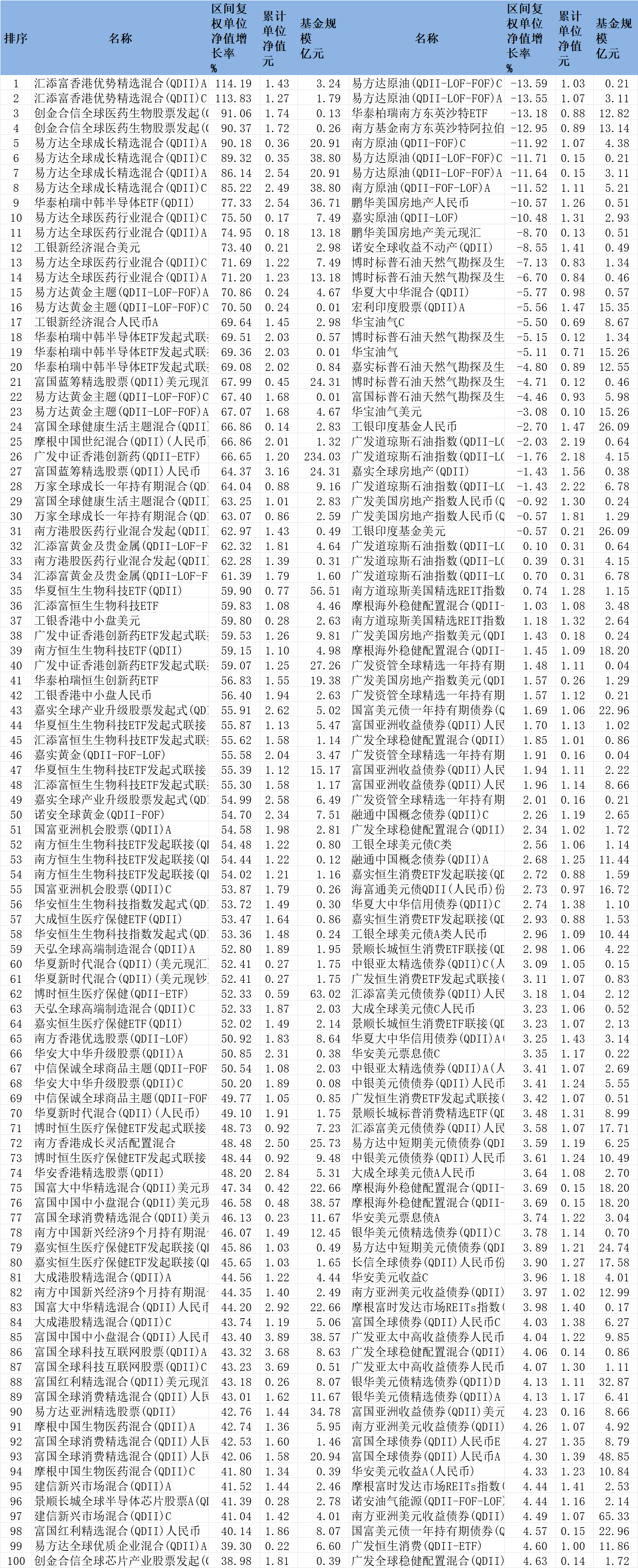
比23亿更严重:欣旺达或让数万海外车主陷入安全隐患
Tai Mei Ti A P P· 2026-01-11 12:03
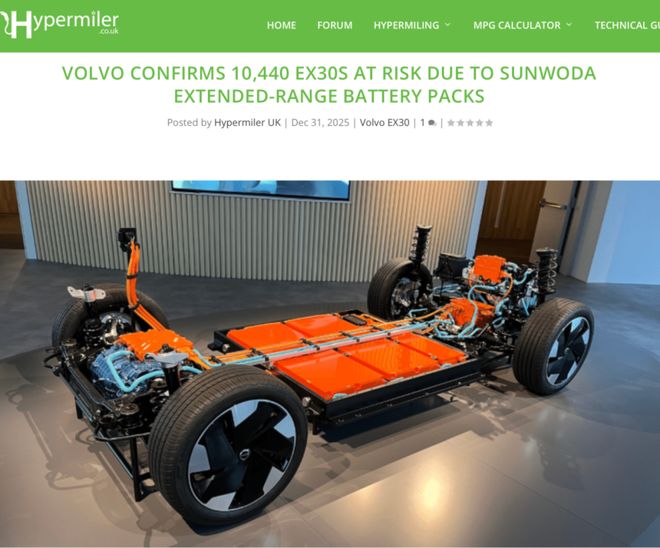
Core Viewpoint - Volvo Cars, known for its commitment to safety, is facing unprecedented challenges in the electric vehicle era due to safety concerns related to its EX30 model's battery supplied by Sunwoda [1][4][11]. Group 1: Battery Safety Issues - A total of 10,440 EX30 vehicles in the UK are affected by potential safety issues related to high-voltage batteries from Sunwoda, marking a significant acknowledgment of the problem [12]. - Among 33,777 EX30 vehicles produced with Sunwoda batteries, approximately 0.02% have reported overheating issues [4]. - A fire incident involving an EX30 in Brazil raised alarms, leading Volvo to issue warnings to owners to limit charging to 70% to mitigate fire risks [7][11]. Group 2: Recall and Legal Actions - Volvo is preparing for a large-scale recall, with the South African National Consumer Commission already issuing a recall notice for 372 EX30 vehicles due to potential battery defects [7][14]. - Geely Holding, Volvo's parent company, has filed a lawsuit against Sunwoda for 2.314 billion RMB, citing quality issues with batteries supplied between June 2021 and December 2023 [14][17]. Group 3: Consumer Trust and Market Impact - The battery safety crisis has raised significant concerns among consumers, with many questioning the reliability of electric vehicle batteries and the overall quality control in the industry [23][29]. - Volvo's temporary measure of limiting charging to 70% has led to dissatisfaction among owners, as it significantly reduces the vehicle's usable range [12][13]. - The incident has broader implications for the electric vehicle industry, potentially leading to increased scrutiny and a shift towards prioritizing safety and quality over cost [29].
【转|太平洋机械-26年度策略】科技创新,周期崛起
远峰电子· 2026-01-11 11:53
Investment Highlights - The mechanical industry experienced a growth rate of 41.69% in 2025, outperforming the Shanghai and Shenzhen 300 index, which rose by 17.66%, ranking 6th among 31 primary industries [3] - The top three sub-sectors in terms of growth were engineering machinery components (93.20%), lithium battery specialized equipment (92.49%), and metal products (80.47%), while the rail transit equipment sector saw a decline of 3.80% [3] Fund Holdings Analysis - As of Q3 2025, the total market value of mechanical equipment holdings by various fund types was 69.8 billion yuan, accounting for 3.39% of the total market value of A-shares, indicating a low allocation of 1.09 percentage points compared to the industry’s 4.47% share [5] Performance Overview - The mechanical equipment industry achieved a total operating revenue of 1.533 trillion yuan in the first three quarters of 2025, reflecting a year-on-year growth of 7.46%, while the net profit attributable to the parent company reached 110.19 billion yuan, up 16.86% [8] Engineering Machinery Sector - Domestic demand for engineering machinery is recovering, driven by factors such as water conservancy projects and machinery replacement, with excavator sales in 2024 showing a year-on-year increase of 18.59% [9] - The central economic work conference emphasizes the importance of domestic demand, which is expected to benefit the engineering machinery sector through policy support and a renewal cycle [12][17] - Exports of excavators showed a positive trend, with a cumulative sales volume of 104,000 units in the first eleven months of 2025, marking a year-on-year increase of 14.85% [19] Robotics Sector - The humanoid robot sector is seeing continuous product iteration and performance upgrades, with several companies planning to achieve mass production by 2026 [24][35] - Capital investment in humanoid robotics has surged, with over 32.8 billion yuan raised in the first three quarters of 2025, indicating increased market interest [27] - Government policies are actively supporting the development of the humanoid robot industry, aiming to establish a competitive industrial ecosystem by 2027 [33][34] AI and Equipment Demand - The AI industry is experiencing high demand, with major tech companies significantly increasing capital expenditures for AI infrastructure, projected to exceed 350 billion USD in 2025 [38] - The construction of AI data centers is driving up electricity demand, benefiting the gas turbine market, which is expected to see a rise in sales from 38,917 MW in 2020 to 70,838 MW in 2025 [39] Industrial Equipment Trends - The industrial robot market is on an upward trajectory, with a cumulative production of approximately 673,800 units in the first eleven months of 2025, reflecting a year-on-year growth of 29.20% [52] - Forklift sales are also increasing, with domestic sales reaching 843,000 units, up 14.27% year-on-year, and exports growing by 13.96% [56] - The machine tool sector is seeing steady production growth, with a cumulative output of 783,000 units in the first eleven months of 2025, up 12.70% year-on-year [58] Lithium Battery Equipment - The demand for dynamic storage batteries is on the rise, with global shipments expected to grow significantly, supported by increased capital expenditures from leading battery manufacturers [60] - The solid-state battery sector is also advancing, with several companies planning to achieve mass production by 2027, indicating a positive outlook for equipment suppliers [64] Photovoltaic Equipment - The photovoltaic industry is shifting towards technology upgrades, with new production lines focusing on n-type battery cells, which are expected to dominate the market [67] 3C Equipment - The consumer electronics sector is entering an innovation cycle, with the foldable smartphone market projected to see explosive growth in 2026, benefiting upstream equipment demand [68]

能源金属涨价引爆千亿市场,头部企业加码锂电回收布局
Huan Qiu Wang· 2026-01-11 02:40
Core Viewpoint - The lithium battery recycling industry is undergoing a value reassessment driven by high energy metal prices, increased demand for energy storage, and supportive policies, leading to the formation of a green circular market exceeding 100 billion yuan by 2025 [1][6]. Industry Overview - The prices of key metals such as lithium, cobalt, and nickel are expected to remain high due to global mineral development cycles and a second surge in downstream energy storage demand [1]. - The industry is transitioning from extensive development to a more refined, standardized, and globalized phase, with a market size projected to exceed 100 billion yuan [1]. Company Performance - Companies like Greeenme and Tianqi have reported significant improvements in profitability due to increased retirement volumes and rising metal prices, with Greeenme's battery recycling volume reaching 36,000 tons, a 59% year-on-year increase [2]. - Tianqi's lithium battery recycling segment has turned profitable, aided by the lifting of black powder import restrictions and rising metal prices [2]. Strategic Initiatives - Leading companies are adopting a "capacity + capital" dual-drive strategy to capture market opportunities, with Greeenme planning to invest 400 million yuan to acquire shares in Henan Recycling Group and pursue a Hong Kong listing [4]. - Tianqi has established a processing capacity of 100,000 tons of used lithium batteries, with another 100,000 tons under construction, indicating a strong commitment to expanding its recycling capabilities [4]. Technological Advancements - Greeenme has achieved a lithium recovery rate exceeding 96.5% through its nine global recycling bases and has established partnerships with over 1,000 automotive and battery manufacturers [5]. - The industry is focusing on technological iteration and collaboration across the supply chain, with non-compliant small operations exiting the market, leading to a concentration of market share among companies with technological and environmental advantages [5]. Market Outlook - The lithium battery recycling industry is expected to experience accelerated growth over the next 3 to 5 years, with an annual growth rate projected to exceed 50%, potentially surpassing 100 billion yuan by 2030 [5][6]. - The industry's growth is not only driven by short-term fluctuations in energy metal prices but also by the necessity of closing the loop in the new energy industry chain, ensuring resource security and alleviating mining pressures [6].


2025年中国储能BMS行业产业链、SWOT、市场规模、产值、竞争格局及发展趋势研判:行业技术成熟度和标准化程度显著提升,带动储能BMS规模扩张[图]
Chan Ye Xin Xi Wang· 2026-01-11 01:03
Core Insights - The energy storage Battery Management System (BMS) is a critical component for safety in energy storage systems, transitioning the industry from "passive protection" to "active safety" [1][3] - The market for new energy storage systems in China is expected to grow significantly, with the BMS market projected to reach 3.448 billion yuan in 2024 and 2.475 billion yuan in 2025, despite a decline in overall value due to price reductions [1][3] Industry Definition and Classification - Energy storage BMS is the core control component of energy storage systems, responsible for real-time data collection, state diagnosis, and safety protection [2] - BMS can be classified based on enterprise type, application field, and technology architecture [2] Current Industry Status - The global energy storage BMS market is expected to reach 6.252 billion yuan in 2024, with the Asia-Pacific region accounting for 62.01% of the market share [3] - In China, the BMS market is projected to grow from 275 million yuan in 2020 to 3.448 billion yuan in 2024, with a potential decline to 2.475 billion yuan in 2025 due to pricing pressures [3] Industry Value Chain - The energy storage BMS industry value chain includes upstream suppliers of key materials and components, midstream hardware production and software development, and downstream system integrators [4] SWOT Analysis - The energy storage BMS industry is supported by national policies aimed at promoting new energy storage, positioning it as a core component of the new power system [5] Competitive Landscape - The domestic energy storage BMS market features three main types of participants: self-developed BMS by battery companies, system integrators with self-development capabilities, and third-party specialized manufacturers [6][7] - Leading self-developed BMS companies include CATL, BYD, and Guoxuan High-Tech, which leverage their technology to enhance product competitiveness [6] - Comprehensive manufacturers like Sungrow and Haibo Innovation develop BMS products tailored to their systems [7] - Specialized third-party BMS manufacturers focus on technological differentiation and cost optimization [7] Development Trends - The energy storage market in China is expected to maintain rapid growth, driven by the dual carbon goals and the construction of new power systems [8] - The maturity and standardization of BMS technology are anticipated to improve, leading to further industry expansion [9] - Future trends indicate a shift towards integration, intelligence, openness, and scalability in the BMS industry [9]





二线电池厂,活在巨头阴影下
投中网· 2026-01-10 07:07
Core Viewpoint - A significant lawsuit involving a claim of 2.314 billion yuan against Aoxin Wanda by Geely's subsidiary has exposed the financial struggles of second-tier battery manufacturers in the competitive electric vehicle market [6][7]. Group 1: Lawsuit and Financial Impact - Aoxin Wanda's subsidiary, Aoxin Wanda Power, is being sued for 2.314 billion yuan due to alleged quality issues with battery cells supplied to Geely's Zeekr models, leading to a large-scale battery replacement [6][7]. - This lawsuit represents the total net profit of Aoxin Wanda over the past two years, causing its stock price to drop over 10% and erasing more than 6 billion yuan in market value [7]. - The lawsuit highlights the ongoing quality complaints from customers since the second half of 2022, and Aoxin Wanda's previous legal action against Geely for unpaid debts [7][10]. Group 2: Industry Challenges - The financial difficulties faced by Aoxin Wanda are indicative of broader issues within the second-tier battery manufacturing sector, where companies like Aoxin Wanda and EVE Energy are struggling to maintain profitability amid fierce competition from industry leaders like CATL and BYD [8][9]. - Despite Aoxin Wanda's annual revenue exceeding 50 billion yuan, its power battery division has accumulated losses of over 3.4 billion yuan in the past two years, indicating a reliance on consumer battery profits to sustain its operations [10][11]. Group 3: Financial Performance of Competitors - In the first three quarters of 2025, EVE Energy reported revenue of 45 billion yuan with a net profit of 2.82 billion yuan, while Aoxin Wanda's revenue was 43.53 billion yuan with a net profit of 1.41 billion yuan [11]. - Other second-tier players like Guoxuan High-Tech and Zhongxin Innovation also show similar trends of revenue growth without corresponding profit increases, indicating a systemic issue in the industry [12]. Group 4: Cost Pressures and Market Dynamics - The cost pressures faced by second-tier manufacturers stem from their inability to secure stable pricing for raw materials, leading to reduced profit margins [14][15]. - The production capacity utilization rates for second-tier manufacturers are significantly lower than those of leading firms, resulting in higher unit costs and further financial strain [15][16]. Group 5: Customer Relationships and Market Position - Second-tier battery manufacturers often rely heavily on a few major clients, which can lead to a loss of bargaining power and increased vulnerability to market fluctuations [22][24]. - The trend of automakers adopting a dual-supplier strategy, favoring leading manufacturers like CATL while using second-tier suppliers as backup, further complicates the market position of these companies [24][25]. Group 6: Future Outlook and Survival Strategies - The future of second-tier battery manufacturers may hinge on their ability to innovate and differentiate themselves in niche markets or technologies, as the competitive landscape continues to favor larger players [37][38]. - Strategies such as international expansion and forming strategic partnerships may provide pathways for survival, but these approaches come with their own risks and challenges [37][38].