
宇通客车

Search documents
L3 级自动驾驶获批上路,我国智能网联汽车迈向量产应用新阶段
Changjiang Securities· 2025-12-19 15:37
行业研究丨点评报告丨软件与服务 [Table_Title] L3 级自动驾驶获批上路,我国智能网联汽车迈 向"量产应用"新阶段 报告要点 [Table_Summary] 12 月 15 日,根据有关规定,工业和信息化部于第 401 批公告附条件许可了两款 L3 级自动驾 驶(有条件自动驾驶)车型产品。此次首批 L3 级车型获得准入许可,意味着我国智能网联汽车 迈入量产应用新阶段。随着试点工作的逐步推进,智能网联汽车产品准入管理和法规标准体系 有望持续完善,进而加速自动驾驶技术的规模化、商业化应用,进而惠及全产业链。建议关注: 1)智能驾驶算法提供商;2)智能驾驶相关硬件提供商;3)Robotaxi 运营平台。 分析师及联系人 [Table_Author] 丨证券研究报告丨 宗建树 陈耀文 SAC:S0490520030004 SAC:S0490525070002 SFC:BUX668 请阅读最后评级说明和重要声明 %% %% %% %% research.95579.com 1 软件与服务 cjzqdt11111 [Table_Title L3 级自动驾驶获批上路,我国智能网联汽车迈 2] 向"量产应用"新阶 ...
全国商用车国内保险特征—2025年11月
Xin Lang Cai Jing· 2025-12-19 12:49
Core Insights - The domestic commercial vehicle market is experiencing a strong growth trend, particularly in the new energy commercial vehicle segment, driven by policy support and increasing demand for vehicle upgrades [1][2][10]. Commercial Vehicle Market Analysis - In November 2025, domestic commercial vehicle sales reached 260,000 units, a year-on-year increase of 4% and a month-on-month increase of 4% [5]. - From January to November 2025, total commercial vehicle sales amounted to 2.81 million units, representing a 9% year-on-year growth [5]. - The new energy commercial vehicle sales for the same period reached 770,000 units, showing a significant year-on-year increase of 54% [8]. New Energy Commercial Vehicle Performance - The penetration rate of new energy commercial vehicles has risen sharply, reaching 27% from January to November 2025, up 7 percentage points year-on-year [12]. - By November 2025, the penetration rate for new energy commercial vehicles reached 36%, an increase of 11 percentage points compared to the same month last year [12][10]. Market Trends and Dynamics - The market for new energy commercial vehicles is characterized by a strong upward trend from March to November 2025, with November sales peaking at 92,000 units, a 45% year-on-year increase [10][8]. - The overall commercial vehicle market has shown a recovery from previous lows, with 2025 marking a significant improvement compared to the previous years [5][4]. Competitive Landscape - Major players in the commercial vehicle sector include Beiqi Foton, SAIC-GM-Wuling, Dongfeng Motor, and China National Heavy Duty Truck Group, with Foton and Wuling leading in light truck and bus markets respectively [14]. - The new energy segment is seeing increased competition, particularly among companies like Geely and Chery, which are gaining traction in the new energy light truck market [20].




L3级自动驾驶商业化进程加速 小米汽车获路测牌照
Xin Lang Cai Jing· 2025-12-19 12:48
Core Insights - The Ministry of Industry and Information Technology has issued the first batch of L3 conditional autonomous driving vehicle permits, with Xiaomi Auto being the latest company to obtain an L3 road testing license in Beijing [1][14] - The report indicates that by September 2025, 23 companies, including Xiaomi, have accumulated over 60.27 million kilometers of operation with 750 autonomous passenger vehicles [1][14] - The L3 autonomous driving permit process follows a structured pathway, and companies are categorized into those with official "entry permits" and those with "road licenses" for internal testing [1][14] Company Developments - Changan Automobile's "Deep Blue SL03" has received L3 permit for operation in specific congested areas in Chongqing [2][15] - BAIC Blue Valley's "ARCFOX Alpha S" has been granted L3 permit for operation on specific highways in Beijing [2][15] - BYD was the first to obtain an L3 road testing license in July 2023 and has begun large-scale road validation [3][16] - Seres (Wenjie) has obtained L3 testing permits primarily in Chongqing and Shenzhen for its Wenjie M9 model [4][17] - SAIC Group has received two L3 road permits, making it one of the companies with the most licenses [4][17] - NIO has been selected for the first batch of L3/L4 autonomous driving permits and road testing trials [5][17] - GAC Group has made progress in L3 autonomous driving technology [6][18] - JAC Motors has obtained L3 road testing permits [7][19] - Foton Motor has completed the development and acceptance of L3 autonomous driving prototypes [8][20] - Yutong Bus is the first in the bus industry to enter the L3 autonomous driving pilot program [9][21] - FAW Jiefang's high-level autonomous driving truck J7 L3 has completed road testing [10][22] Industry Trends - The transition to L3 autonomous driving represents a significant technological milestone, shifting driving control and accident liability from the driver to the system itself [10][22] - Multiple institutions emphasize the hardware upgrade logic due to the increased safety and reliability requirements associated with L3 [11][23] - The regulatory framework for L3 permits indicates a closed loop in product safety, network security, and accident liability, alleviating long-standing compliance concerns for automakers [12][23] - The commercialization of L3 is expected to drive the mass application of intelligent chassis technologies, including active suspension, electronic brake-by-wire (EMB), and steer-by-wire (SBW) systems [12][23][24] - Specific components benefiting from this trend include active suspension systems from companies like Baolong Technology and Top Group, EMB systems from Bertel and Asia Pacific Holdings, and SBW systems from companies like Nexperia [12][24]




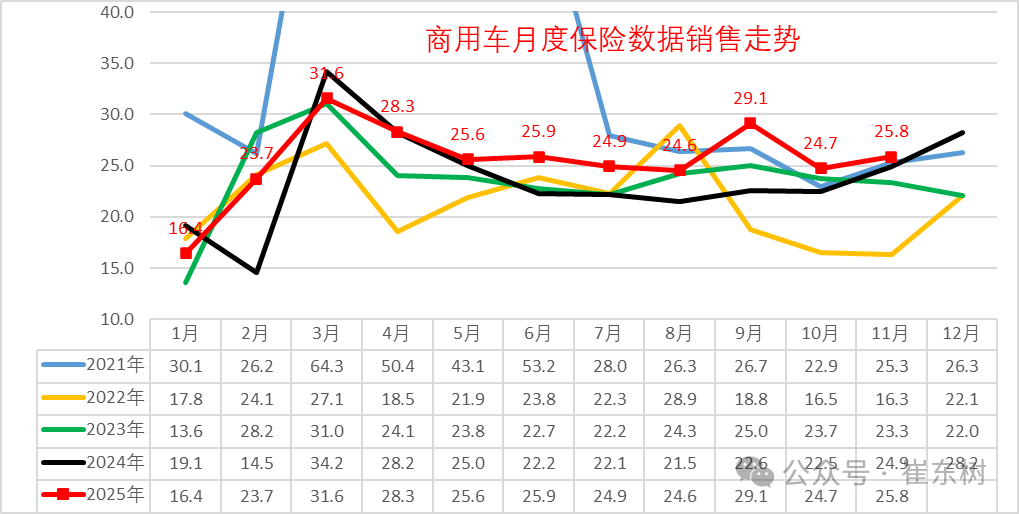
崔东树:2025年国内商用车交强险数据强势增长 11月商用车国内销量同比增4%
智通财经网· 2025-12-19 11:49
Core Insights - The commercial vehicle market in China is experiencing significant growth, particularly in the new energy vehicle (NEV) segment, driven by policy support and increasing demand for vehicle upgrades [1][2][12] - In November 2025, the domestic sales of commercial vehicles reached 260,000 units, marking a 4% year-on-year and month-on-month increase, while total sales from January to November 2025 reached 2.81 million units, a 9% increase compared to the previous year [1][6] - The penetration rate of new energy commercial vehicles has risen sharply, reaching 36% in November 2025, up 11 percentage points from the same month last year [2][12] Commercial Vehicle Market Analysis - The commercial vehicle market has shown a strong upward trend from February to November 2025, with sales driven by the growth of new energy vehicles [4][10] - The sales data indicates a recovery from previous years' lows, with 2025 expected to see stable performance compared to 2024, which had a total of 2.85 million units sold [5][6] - The market dynamics are shifting, with traditional fuel vehicles requiring effective policy support to compete with the rapidly growing new energy segment [2][12] New Energy Vehicle Performance - The cumulative sales of new energy commercial vehicles from January to November 2025 reached 770,000 units, reflecting a 54% year-on-year increase [1][8] - The penetration rate of new energy vehicles in the commercial sector has increased significantly, from 3% in 2019-2021 to 27% in the first eleven months of 2025 [2][12] - In November 2025, new energy commercial vehicle sales reached 92,000 units, a 45% increase year-on-year and a 15% increase month-on-month [1][8] Market Structure and Competition - The market for commercial vehicles is characterized by stable structures in truck and bus segments, with significant growth in the new energy penetration rates for both [14][21] - Key players in the light truck market include Beiqi Foton, SAIC-GM-Wuling, and China National Heavy Duty Truck Group, with Foton and Wuling leading in sales [15][21] - The heavy-duty truck segment is dominated by companies like FAW Jiefang and China National Heavy Duty Truck Group, which have shown strong performance in the new energy sector [17][18] Regional Market Dynamics - The eastern and southern regions of China, particularly the Huabei and Huadong areas, show strong demand for light and heavy commercial vehicles, with increasing penetration of new energy vehicles [18][22] - The market for light commercial vehicles is particularly robust in economically developed regions, with significant sales growth in the southern and eastern parts of the country [19][23]


中国车出海在俄遇阻:当地重建汽车工业 产品可靠性遭质疑
Tai Mei Ti A P P· 2025-12-19 10:37
Group 1: China’s Automotive Export Growth - In 2023, China's automotive export volume reached 5.22 million units, a year-on-year increase of 57.4%, surpassing Japan to become the world's largest automotive exporter [1] - For 2024, a 19% annual growth is expected, solidifying China's position as the top automotive exporter, with projections of total exports between 6.8 to 7 million units [1] Group 2: Decline in Exports to Russia - In 2025, despite overall growth, China's automotive exports to Russia are experiencing a significant decline, with a 50% year-on-year drop in the first four months [2] - By the first three quarters of 2023, exports to Russia decreased to 357,700 units, marking a 58% decline [2] - Russia has fallen to the third-largest market for Chinese automotive exports, with Mexico and the UAE now leading [2] Group 3: Russian Automotive Industry Policies - Following the Ukraine conflict, Russia aims to rebuild its automotive industry by limiting imports and increasing costs for foreign vehicles [3][4] - New policies include raising the scrappage tax for imported vehicles, with fees for 1L-2L engines increasing from 300,600 rubles to 556,000 rubles [3] - Import tariffs for vehicles will rise to between 20% and 38% starting January 1, 2025, increasing costs for Chinese imports [4] Group 4: Challenges for Chinese Brands in Russia - Chinese automotive brands face challenges in Russia due to a lack of after-sales service and product reliability, impacting their market share [6][7] - Despite a peak market share of 60% in 2024, this has dropped to below 40% in the first three quarters of 2023 [6] - Reliability issues have been highlighted, with tests showing that some Chinese models suffer from corrosion and durability problems in Russia's harsh climate [7][8] Group 5: Local Production and Market Adaptation - Chinese companies are adapting by increasing local assembly, with Great Wall Motors achieving a localization rate of about 65% [6] - New brands like Tenet have seen rapid growth in sales after local production began [6] - However, the overall market for automobiles in Russia remains weak, with low consumer demand and high interest rates affecting sales [5]
东莞证券财富通每周策略-20251219
Dongguan Securities· 2025-12-19 10:34
Market Overview - The market experienced a rebound this week, with the Shanghai Composite Index slightly rising by 0.03%, while the Shenzhen Component Index and ChiNext Index both fell by 0.89% and 2.26% respectively. The market initially declined due to weak domestic economic data and expectations of interest rate hikes by the Bank of Japan, but later stabilized and briefly surpassed 3900 points before retreating [1][3][14]. Economic Data Analysis - Economic data for November showed a general slowdown, indicating weak internal growth momentum. The industrial value added for November grew by 4.8% year-on-year, down 0.9 percentage points from the previous value. Fixed asset investment from January to November decreased by 2.6% year-on-year, with manufacturing investment growing by only 1.9% [10][11]. - Retail sales for November increased by only 1.3% year-on-year, a decline of 1.6 percentage points from the previous value, primarily affected by weak commodity retail performance [10][11]. Financial Indicators - The total social financing in November was 2.49 trillion yuan, an increase of 160 billion yuan year-on-year, but new RMB loans amounted to only 390 billion yuan, a decrease of 190 billion yuan year-on-year, marking the fifth consecutive month of decline [11][12]. - The M2 money supply grew by 8% year-on-year, while the M1 money supply increased by 4.9%, indicating a decrease in the liquidity of funds and weak demand for real financing [12]. Policy Outlook - The report anticipates that expanding domestic demand and promoting consumption will be key focuses of future policies, especially in light of the ongoing economic transition and external uncertainties. The necessity and possibility of "timely strengthening" monetary policy have increased, with expectations for further easing measures such as reserve requirement ratio cuts and interest rate reductions [10][12][14]. Investment Recommendations - The report suggests focusing on sectors such as finance, non-ferrous metals, food and beverage, machinery, and TMT (Technology, Media, and Telecommunications) for potential investment opportunities [15].
解放超徐工夺冠!三一破3000辆 重汽大涨279%!11月新能源牵引车增194% | 头条
第一商用车网· 2025-12-19 09:12
Core Viewpoint - The domestic new energy heavy truck market has experienced significant growth, with November 2025 sales reaching 28,000 units, a year-on-year increase of 178%, marking a record high for monthly sales [1][4][30]. Sales Performance - In November 2025, new energy heavy truck sales totaled 28,000 units, a month-on-month increase of 39% and a year-on-year increase of 178% [4][10]. - New energy tractor sales reached 22,200 units in November, with a month-on-month growth of 43% and a year-on-year growth of 194%, indicating a continued upward trend [4][10]. - The penetration rate of new energy tractors in the overall tractor market reached 47.26% in November, up from 36.40% the previous month, representing a significant increase [10][18]. Market Share and Trends - New energy tractors accounted for 79.50% of the new energy heavy truck market in November, an increase from 77.34% the previous month [6][10]. - From January to November 2025, new energy tractors achieved a cumulative sales figure of 141,800 units, reflecting a year-on-year growth of 221% [22][24]. - The top three companies in the new energy tractor market—FAW Jiefang, Xugong, and SANY—each sold over 18,000 units, with market shares of 16.75%, 16.21%, and 13.32%, respectively [26][28]. Competitive Landscape - In November 2025, FAW Jiefang led the monthly sales with 3,987 units, followed by Xugong and SANY with 3,730 and 3,014 units, respectively [20][18]. - A total of 30 companies participated in the new energy tractor market by November 2025, indicating a competitive environment with multiple players [22][30]. Regional Distribution - New energy tractors have been registered in all 31 provincial-level administrative regions in China, with Shanghai, Guangdong, and Shanxi accounting for over 40% of the market share [14][12]. Conclusion - The new energy tractor market has shown robust growth, with average monthly year-on-year growth rates reaching 242% from January to November 2025, indicating a sustained upward trajectory [30].



东吴证券2026年汽车行业策略:坚定“破旧立新”
Zhi Tong Cai Jing· 2025-12-19 09:04
Core Viewpoint - The automotive industry is at a new crossroads, with the end of the electric vehicle (EV) boom and the rise of smart technology. Commercial vehicles and two-wheelers are seen as promising investment areas. The company suggests two strategies: finding cyclical alpha varieties and embracing the next industrial trends of smart technology and robotics/AIDC [1] Automotive Sector Forecast for 2026 - Passenger vehicle sector: The industry will be impacted by a 5% new energy vehicle purchase tax, with an overall domestic demand expectation of 3.5%. Total domestic sales are projected at 22 million units (down 3.5% year-on-year), with new energy domestic sales at 13.2 million units (up 6.4% year-on-year). Total external sales are expected to be 6.41 million units (up 12.0% year-on-year), with new energy external sales at 3.52 million units (up 43.9% year-on-year) [1] - Heavy truck sector: Under neutral predictions, wholesale sales are expected to reach 1.16 million units (up 1.5% year-on-year), with domestic sales at 770,000 units (down 5.5% year-on-year) and external sales at 390,000 to 400,000 units (up 18.8% year-on-year) [1] - Bus sector: Continued resonance in domestic and external demand is expected, with export growth likely to maintain over 30%, and new energy export growth anticipated to be even faster. Domestic sales are projected at 81,000 units (up 3% year-on-year), with exports at 76,400 units (up 30% year-on-year) [1] - Motorcycle sector: Total industry sales are expected to reach 19.38 million units (up 14% year-on-year), with large-displacement motorcycles at 1.26 million units (up 31% year-on-year). Domestic sales are projected at 3.99 million units (down 9% year-on-year), while external sales are expected to be 15.39 million units (up 21% year-on-year) [1] Investment Opportunities - Passenger vehicle sector: Preferred stocks include Yutong Bus (600066) and attention to King Long Motor (600686) [2] - Motorcycle sector: Top picks are Chunfeng Power (603129) and Longxin General (603766) [2] - Heavy truck sector: Preferred stocks include China National Heavy Duty Truck Group (000951) H and Weichai Power (000338) [2] - Passenger car sector: Top choice is BYD (002594), with Jianghuai Automobile (600418) as a preferred option [2] - Parts sector: Preferred stocks include Fuyao Glass (600660), Xingyu Co., Ltd. (601799), and Minth Group (002743) [2] Growth Opportunities - L4RoboX investment opportunities: Focus on the L4RoboX industry chain, with B-end software targets preferred over C-end hardware. Top picks include XPeng Motors and Horizon Robotics in H-shares, and Qianli Technology and Desay SV in A-shares [3] - Robotics/AIDC investment opportunities: The overseas Optimus V3 is expected to be finalized in 2026, with rapid capital progress in domestic robotics. Preferred stocks in the robotics and liquid cooling sectors include Top Group (601689) and Junsheng Electronics (600699) [3]

汽车行业双周报(2025、12、5-2025、12、18):工信部近日正式向两款车型发放L3级自动驾驶准入许可-20251219
Dongguan Securities· 2025-12-19 09:03
Investment Rating - The report maintains an "Overweight" rating for the automotive industry, indicating an expectation that the industry index will outperform the market index by more than 10% over the next six months [2][45]. Core Insights - The Ministry of Industry and Information Technology has officially granted L3 autonomous driving permits for two vehicle models, marking a significant transition from testing to commercial operation in China's autonomous driving sector. This shift also indicates a legal transition of responsibility from drivers to systems, enhancing regulatory frameworks around product safety and accountability [3][5][41]. - The automotive sector has shown mixed performance, with the automotive index declining by 0.17% over the past two weeks, underperforming the CSI 300 index by 0.31 percentage points. However, the sector has increased by 17.49% year-to-date, outperforming the CSI 300 index by 1.78 percentage points [10][15]. - In November, China's automotive production reached 3.532 million units, a year-on-year increase of 2.8%, while sales were 3.429 million units, up 3.4% year-on-year. Exports surged by 48.6% year-on-year to 728,000 units [19][20]. Summary by Sections Automotive Industry Trends and Valuation Review - As of December 18, 2025, the automotive sector has experienced a year-to-date increase of 17.49%, ranking 12th among 31 industries. The sector's performance has been relatively stable despite recent declines [10][15]. Industry Data Tracking - In November, automotive production and sales showed positive growth, with production increasing by 2.8% year-on-year and sales by 3.4%. Exports saw a significant rise of 48.6% year-on-year [19][20]. Industry News - The Ministry of Commerce announced ongoing negotiations between China and Europe regarding electric vehicles, aiming to resolve differences and create a stable market environment [27]. - Guangzhou has initiated a second round of automotive consumption promotion with a supplementary fund of 300 million yuan to stimulate car purchases [29]. - Chongqing is advancing "AI+" smart connected vehicles, focusing on enhancing research and manufacturing in intelligent driving and vehicle-grade chips [30]. Corporate News - Yutong Bus is actively following up on L3 autonomous driving developments, while CATL and Lantu have signed a ten-year cooperation agreement focusing on battery technology and integrated chassis [35][36]. - Xpeng Motors has received an L3 autonomous driving road testing license in Guangzhou, marking a step forward in practical applications of autonomous technology [39]. Investment Recommendations - The report suggests focusing on companies that are expanding their overseas markets and enhancing their technological capabilities, such as BYD, Seres, and Yutong Bus. These companies are expected to benefit from the increasing penetration of intelligent driving configurations and the transition to L3 autonomous driving [41][42].




2026年汽车行业总投资策略:坚定“破旧立新”
Soochow Securities· 2025-12-19 08:14
Core Conclusions - The 2026 automotive industry investment strategy emphasizes "breaking old and establishing new," suggesting that the industry is at a crossroads similar to 2011 and 2018, with the end of the electric vehicle (EV) boom and the rise of smart technology [2][3] - The report predicts a total domestic demand of 22 million vehicles in 2026, a decrease of 3.5% year-on-year, with new energy vehicle (NEV) sales expected to reach 13.2 million, an increase of 6.4% [2][10] - The commercial vehicle sector is expected to see a wholesale volume of 1.16 million units in 2026, with a slight increase of 1.5% year-on-year, while the bus sector is projected to maintain strong export growth [2][19] Passenger Vehicle Sector - The passenger vehicle sector is projected to experience a total sales volume of 22 million units in 2026, with NEV sales expected to reach 13.2 million units, reflecting a year-on-year growth of 6.4% [2][10] - The report highlights the impact of a 5% purchase tax on NEVs starting January 1, 2026, which is expected to support domestic demand [10] - Key investment opportunities include BYD and Jianghuai Automobile in the passenger vehicle sector [2][3] Commercial Vehicle Sector - The heavy truck segment is forecasted to have a wholesale volume of 1.16 million units in 2026, with domestic sales expected to decline by 5.5% to 770,000 units, while exports are projected to grow by 18.8% [2][15] - The bus sector is expected to see a total domestic sales volume of 81,000 units, with exports anticipated to grow by over 30% [2][19] Motorcycle Sector - The motorcycle industry is expected to achieve total sales of 19.38 million units in 2026, representing a year-on-year increase of 14%, with large-displacement motorcycles projected to grow by 31% [2][22] - Domestic sales of large-displacement motorcycles are expected to reach 430,000 units, while exports are projected to grow significantly [22] Investment Opportunities - The report identifies key investment opportunities across various segments, including Yutong Bus and King Long in the bus sector, and Spring Power and Longxin General in the motorcycle sector [2][3] - The focus on L4 RoboX investment opportunities highlights the importance of software over hardware in the autonomous driving sector, with recommended stocks including XPeng Motors and Horizon Robotics [2][3] Growth Trends - The report anticipates a continued focus on smart technology and robotics, with significant growth expected in the L4 RoboX industry and AIDC (Automated Identification and Data Capture) sectors [2][3] - The penetration rate of smart driving technology in new energy vehicles is expected to reach 40% by 2026, with a notable shift in chip supplier market shares [13][14]
