理想汽车

Search documents
老黄苏妈投了同一家世界模型公司
3 6 Ke· 2026-02-12 09:52
Core Insights - Runway, an AI video company, has shifted its focus to world models and has secured significant investment from Nvidia and AMD, indicating strong industry confidence in its new direction [1][2][12]. Company Overview - Runway was founded in 2018 by three art students and has undergone two major transformations, leading to a current valuation of $5.3 billion with only 140 employees [1][4]. - The company initially focused on video editing tools, gaining traction with its "green screen" feature, which led to early funding rounds totaling $200 million [6][8]. Recent Developments - Runway completed its Series E funding round, raising $315 million (approximately 2.17 billion RMB) to develop the next generation of world models [2][4]. - The latest funding round was led by General Atlantic, with participation from Nvidia and AMD, reflecting a strong belief in Runway's potential [2][12]. Valuation Growth - Following the recent funding, Runway's post-money valuation nearly doubled to $5.3 billion (approximately 36.58 billion RMB) [4][12]. - The company has seen a steady increase in valuation through its strategic pivots, particularly its entry into generative AI following the launch of ChatGPT [6][8]. Product Evolution - Runway's product evolution includes the introduction of the Gen-1 and Gen-2 models, with Gen-2 being the first commercially viable text-to-video model [8][10]. - The company has recently launched the GWM-1 (General World Models-1), which allows for interactive control and real-time image generation, marking a significant advancement in its technology [10][12]. Industry Context - The world model technology is gaining traction across various sectors, including autonomous driving, with companies like Tesla and Waymo developing their own models [13][17][22]. - Nvidia's investments in Runway and other companies utilizing world models highlight the growing importance of this technology in the AI landscape [12][22].



中汽协:17家车企中多数账期已低于60天,少数趁机“勒索”供应商
Jing Ji Guan Cha Wang· 2026-02-12 09:20
Core Insights - The China Automotive Industry Association (CAAM) released a report indicating that most of the 17 key automotive enterprises have reduced their payment terms to within 60 days, with an average payment term of approximately 54 days, which is a reduction of about 10 days compared to the previous year [2] - The revised "Regulations on Payment for Small and Medium-sized Enterprises" will take effect in June 2025, mandating large enterprises to pay small and medium-sized enterprises within 60 days of delivery [2] - The report highlights that the average accounts payable turnover days for domestic listed automotive companies in 2024 is 182 days, significantly higher than that of German (40.5 days) and American (60.5 days) automotive companies, causing financial strain on upstream enterprises [2] Group 1 - The CAAM's survey shows that all key automotive enterprises are prioritizing the implementation of payment term commitments, with many forming special task forces and establishing long-term mechanisms for commitment fulfillment [3] - The survey indicates that 15 out of 17 key automotive enterprises use cash or bank acceptance bills for payments, with 5 companies having a cash payment ratio exceeding 50% and 2 companies exceeding 70% [3] - 14 out of the 17 key enterprises are implementing additional preferential policies for small and medium-sized enterprises, ensuring that the payment process from delivery to payment does not exceed 60 days [3] Group 2 - There are still issues in the payment processes of some automotive enterprises, such as discrepancies in the starting point for payment terms, which can lead to extended payment periods despite nominally adhering to the 60-day term [4] - The CAAM emphasizes the need for continuous efforts to address these issues, as the management of the payment process is not sufficiently standardized [4]

美团、百度、腾讯、京东、阿里,集体下跌
第一财经· 2026-02-12 08:31
Market Overview - The Hang Seng Index fell by 0.86% to 27,032.54, while the Hang Seng Tech Index dropped by 1.65% to 5,408.98 [1][2] - Significant declines were observed in tech stocks, with NetEase, Lenovo Group, and Meituan each dropping over 4%, and Ctrip Group nearly 4% [2][3] - The overall performance of the Hang Seng Biotech Index decreased by 1.47% to 15,816.64, and the Hang Seng China Enterprises Index fell by 1.00% to 9,175.18 [2] Notable Stock Movements - Major declines in tech stocks included: - Kingdee International: -4.98% to 11.070 - Lenovo Group: -4.56% to 9.000 - Meituan: -4.50% to 84.850 - NetEase: -4.10% to 187.000 - Ctrip Group: -3.90% to 428.800 [3] - Conversely, SenseTime saw a significant increase of over 6% [2] Semiconductor Sector Performance - The semiconductor sector experienced substantial gains, with notable increases including: - Zhaoyi Innovation: +20.95% to 358.000 - Tianyu Semiconductor: +10.54% to 54.650 - Biran Technology: +9.70% to 36.860 - Lanke Technology: +5.56% to 182.300 [4] GEO Concept Stocks - The GEO concept stocks rose sharply, with notable performers including: - Zhiyu: +28.68% to 402.000 - MINIMAX: +14.62% to 588.000 [5][6]

友车科技股价异动涨近4%,业务转型与AI布局受关注
Jing Ji Guan Cha Wang· 2026-02-12 08:24
Core Viewpoint - The stock price of Che Technology (688479) experienced significant movement on February 12, 2026, closing at 24.82 yuan, up 3.94%, with a trading volume of 1.25 billion yuan and a turnover rate of 8.15% [1] Group 1: Stock Price Movement - The stock has seen a cumulative increase of 31.81% year-to-date, with an 11.00% rise over the last five trading days [1] - On February 12, there was a net inflow of 30.17 thousand yuan from major funds, with large orders amounting to 98.10 thousand yuan, indicating heightened trading activity [2] Group 2: Business and Technical Development - Despite a 24.42% year-on-year decline in revenue reported for Q3 2025, the company is actively expanding its customer base in the new energy sector (e.g., Li Auto, Avita) and in Southeast Asia and Europe, with overseas revenue increasing by nearly 70% [3] - The establishment of an AI Innovation Strategic Division and the launch of an enterprise-level AI platform have positioned the company as a potential player in the integrated vehicle-road-cloud sector [3] Group 3: Sector Performance - On February 12, the domestic software sector rose by 0.61%, with increased attention on technology-related themes [4] - The company had previously reached its daily limit on January 14 due to developments in AI technology, and there is ongoing market discussion regarding its long-term strategy in the intelligent transportation data service sector [4]

盈利曙光普照,造车新势力们集体“上岸”了?
证券时报· 2026-02-12 08:10
Core Viewpoint - The new forces in China's automotive industry have collectively entered a phase of profitability, marking a significant transition from reliance on external funding to self-sustaining growth [3][4][12]. Group 1: Profitability Milestones - NIO has forecasted a quarterly profit of 700 million to 1.2 billion yuan for Q4 2025, marking its first quarterly profit [9]. - XPeng Motors has reported a total revenue exceeding 20 billion yuan for Q3 2025, with a gross margin surpassing 20% and a significant reduction in net losses [9]. - The collective profitability of these new forces, including NIO, XPeng, and Li Auto, signifies the arrival of a new era in the automotive sector [9][12]. Group 2: Factors Driving Profitability - Key drivers behind this collective profitability include cost reduction through technological innovation and optimization of product structures [9][10]. - Vertical integration and supply chain control have been crucial, with companies like Leap Motor covering approximately 70% of their vehicle costs through self-produced components [10]. - The scale effect is seen as a foundation for profitability, with XPeng's delivery volume increasing by 126% year-on-year in 2025 [10]. Group 3: Changing Competitive Landscape - The shift from "blood transfusion" to "blood production" indicates a change in competitive logic, focusing on internal operational quality and sustainable profitability [12]. - The competition is evolving from a product-centric approach to a system capability comparison, emphasizing comprehensive assessments of product definition, cost control, and brand management [12]. - Major players are building competitive moats through distinct strategies: NIO focuses on high-end electric vehicles and battery swapping, while XPeng emphasizes smart driving and range extension [12]. Group 4: Future Challenges and Strategies - Despite achieving quarterly profitability, the sustainability of this "blood production" capability remains a challenge, with potential supply chain pressures and rising costs expected in 2026 [15]. - The rapid iteration of new automotive products poses risks, as companies may rush to market without fully validating their offerings, leading to increased costs and reduced profits [15]. - The industry anticipates a more cautious approach to growth, with a focus on high-margin markets and efficient operational models [16].



陕西:政策补贴,让新春消费“马力全开”
Shan Xi Ri Bao· 2026-02-12 07:49
该销售中心销售经理蒲昱介绍,消费者报废符合条件的旧车并购买新能源乘用车,可享受新车销售价格 12%的补贴,补贴金额最高2万元;置换符合条件的旧车并购买新能源乘用车,可享受新车销售价格8%的补 贴,补贴金额最高1.5万元。"国家补贴的是真金白银,再叠加企业优惠,对消费者的吸引力非常大,特别是 新能源车,成为许多家庭换购的首选。近期到店客流量和订单量都明显攀升。"蒲昱说。 今年,陕西启动提质增效实施2026年消费品以旧换新工作,聚焦绿色低碳、智能升级,对补贴范围、标 准、条件等进行精准优化,推动消费提质扩容。 汽车市场迎消费热潮 2月1日下午,理想汽车西安浐灞销售中心展厅内人气爆棚,前来咨询、试驾的顾客络绎不绝,年轻群体 成为消费主力。 家住西安市雁塔区的市民王诣新谈及换车初衷,难掩喜悦:"我今年要订婚,本来就有换车计划,赶 上'新国补'政策落地,就前来体验一下。"王诣新告诉记者,家里有一辆旧车,按照汽车置换更新政策,换新 车预计能节省2万多元。"补贴太给力了。"王诣新的感慨,道出了众多消费者的心声,也彰显出"新国补"精准 切中民生需求,有效激发了市场活力。 陕西日报记者 李畅文/图 2026年,新一轮汽车、家电 ...

汽车和汽车零部件行业周报20260208:地补出台+需求见底,建议关注汽车板块-20260212
Guolian Minsheng Securities· 2026-02-12 07:06
Investment Rating - The report maintains a "Buy" rating for the automotive sector [3] Core Insights - The automotive sector is expected to stabilize and recover due to the introduction of local subsidies for vehicle replacement and the upcoming launch of new models after the Spring Festival [2][12] - The report highlights potential investment opportunities in various segments, including passenger vehicles, automotive parts, and motorcycles, with specific company recommendations [2][19][34] Summary by Sections 1. Passenger Vehicles - The introduction of the 2026 vehicle replacement subsidy is anticipated to stimulate domestic demand, with subsidies based on vehicle price [14][15] - January sales data shows mixed results, with BYD's sales down 30% year-on-year, while Geely's sales increased by 1% [13][18] - Recommended companies include Geely, Xpeng, and BYD, with a focus on the left side of the demand bottom [2][19] 2. Automotive Parts - The report emphasizes the growth potential in the automotive parts sector, particularly in smart driving and new energy vehicles [19][23] - Recommended companies include Bertel, Horizon Robotics, and Top Group, focusing on the H and T chains [2][19] 3. Motorcycles - The motorcycle market is experiencing growth, particularly in the mid-to-large displacement segment, with recommendations for Chuanfeng Power and Longxin General [31][34] - Sales data indicates a strong performance in the 500cc+ category, with a significant year-on-year increase [32] 4. Commercial Vehicles - The heavy truck market is expected to recover due to the continuation of the vehicle replacement subsidy policy, with recommendations for Weichai Power and China National Heavy Duty Truck [35][36] - The report notes a 26% year-on-year increase in heavy truck sales for 2025 [35] 5. Tires - The tire industry is projected to benefit from ongoing globalization and demand, with recommendations for Sailun Tire and Senqilin [37][39] - The report highlights a high operating rate for PCR tires and a gradual recovery in TBR demand [39]
乘联分会:1月全国乘用车市场零售154.4万辆 新能源车渗透率为38.6%
智通财经网· 2026-02-12 06:41
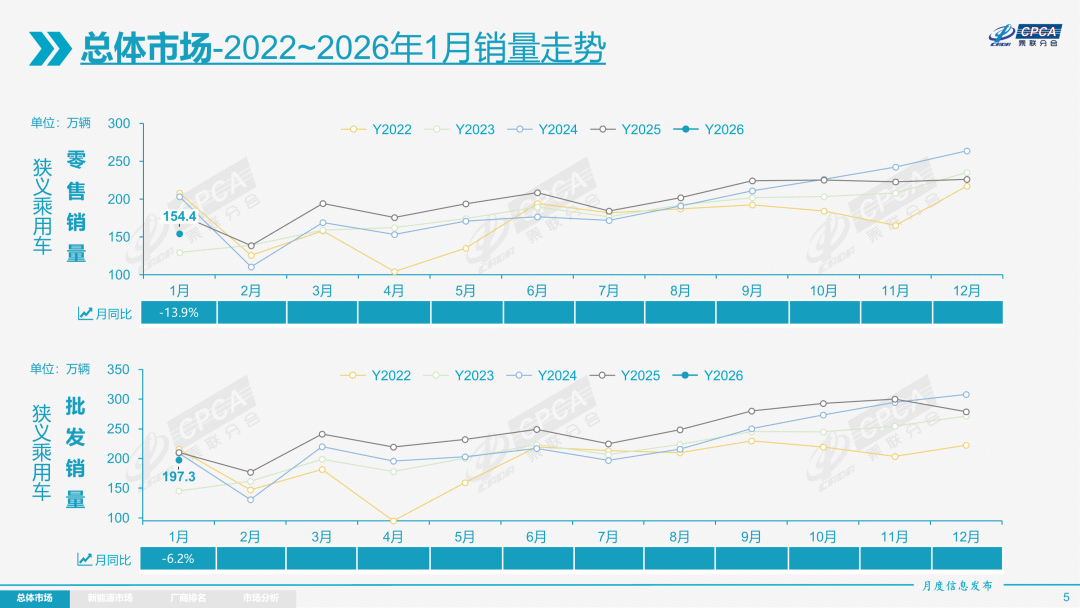
Core Insights - The overall retail sales of passenger cars in January decreased by 13.9% year-on-year, with a total of 1.544 million units sold. The retail sales of new energy vehicles (NEVs) reached 596,000 units, representing a penetration rate of 38.6%, down 3 percentage points from the previous year [1][11]. Retail Market Overview - In January, the retail sales of self-owned fuel passenger cars were 250,000 units, up 17% year-on-year, while self-owned NEVs sold 226,000 units, marking a significant increase of 115%. NEVs accounted for 47.5% of self-owned exports, indicating growing international influence [2]. - The retail sales of self-owned brands totaled 890,000 units, down 18% year-on-year, with a domestic market share of 57.5%, a decrease of 3.5 percentage points [2]. - Mainstream joint venture brands sold 470,000 units, down 4% year-on-year, with German brands increasing their market share to 19.8%, up 1.4 percentage points [2]. Production and Wholesale Analysis - In January, the production of passenger cars was 2.003 million units, down 4.4% year-on-year. The wholesale volume was 1.973 million units, a decrease of 6.2% year-on-year [4]. - The wholesale of self-owned brands was 1.326 million units, down 8%, while luxury car wholesale increased by 4% to 228,000 units [4]. - The overall wholesale landscape is changing, with some mid-tier companies showing strong performance, such as SAIC-GM-Wuling and NIO [4]. New Energy Vehicle Insights - The production of NEVs reached 938,000 units, a slight decrease of 0.6% year-on-year, while wholesale sales were 864,000 units, down 3.3% [5][6]. - NEV retail sales were 596,000 units, down 20% year-on-year, with conventional fuel vehicles selling 948,000 units, down 10% [7]. - NEV exports reached 286,000 units, a remarkable increase of 103.6%, accounting for 49.6% of total passenger car exports [11][12]. Market Trends and Future Outlook - The new energy vehicle market is expected to face challenges in February due to the impact of the Spring Festival, which may lead to lower sales volumes [16]. - The transition from merely selling cars to exporting entire industrial chains is anticipated, indicating a shift towards quality growth in the automotive export sector [17].



拓普集团丨2025年收入稳健增长 “车+机器人+AI”协同【国联民生汽车 崔琰团队】
汽车琰究· 2026-02-12 06:17
Core Viewpoint - The company expects steady revenue growth in 2025, with projected revenue between 28.75 billion to 30.35 billion yuan, representing a year-on-year increase of 8.1% to 14.1%, while net profit attributable to shareholders is expected to decline by 3.4% to 13.4% [3] Group 1: Revenue Growth and Profitability - The median revenue for 2025 is projected at 29.55 billion yuan, reflecting an 11.1% year-on-year growth, with Q4 revenue expected to be between 7.82 billion to 9.42 billion yuan, indicating a year-on-year increase of 7.9% to 30.0% [4] - The decline in net profit is attributed to raw material price fluctuations and intensified market competition, leading to a decrease in gross margin, compounded by the complexities of the international situation [4] - The company is enhancing operational efficiency through large-scale procurement, smart manufacturing, and lean management, which helps to dilute R&D and operational costs [4] Group 2: Strategic Partnerships and Product Development - The company is strategically aligned with Tesla and emerging car manufacturers, aiming to penetrate the global supply chain, and has established stable partnerships with both international and domestic innovative car companies [5] - The company has developed eight product lines under the Tier 0.5 model, enhancing the value of single vehicle components, with a total value of approximately 30,000 yuan per vehicle [5] Group 3: Robotics and AI Applications - The company is actively expanding into robotics and AI applications, with a focus on products such as robotic actuators, sensors, and thermal management systems, and has secured orders worth 1.5 billion yuan as of June 30, 2025 [6] - Planned investments include 5 billion yuan for a robotics electric drive system production base and up to 300 million USD for a production base in Thailand, with expected completion by the end of 2025 [6] Group 4: Financial Projections - Revenue projections for 2025 to 2027 are 29.55 billion, 35.88 billion, and 42.84 billion yuan respectively, with net profits of 2.76 billion, 3.4 billion, and 4.26 billion yuan [7] - The expected EPS for 2025, 2026, and 2027 are 1.59, 1.96, and 2.45 yuan, with corresponding PE ratios of 45, 37, and 29 [8]


i6i8MEGA分别交付16883/1013/414|理想26年1月记录
理想TOP2· 2026-02-12 05:14
Core Insights - The article discusses the delivery performance of Li Auto in January 2026, highlighting a total delivery of 27,668 vehicles, with 9,358 being range-extended and 18,310 being pure electric [1][2] - It mentions a significant organizational restructuring within Li Auto, transitioning from a Huawei IPD model to a Toyota CE model [1] - The article also notes the introduction of two product lines within Li Auto, with specific leadership assigned to each line [3] Delivery Performance - In January 2026, Li Auto delivered a total of 27,668 vehicles, which includes 9,358 range-extended vehicles and 18,310 pure electric vehicles [1][2] - The delivery numbers for previous months show fluctuations, with December 2025 having the highest at 44,246 vehicles, and a notable decrease in January 2026 [2] Organizational Changes - Li Auto is restructuring its product lines into two main categories: one focusing on MEGA, L9, L8, and L7, and the other on the i series and L6 [3] - Leadership changes include汤靖 overseeing the first product line and 李昕旸 managing the second [3] Market Position and Strategy - The article indicates that Li Auto is focusing on enhancing user experience over the initial purchase experience, as stated by the company's founder [3] - There is a mention of Li Auto's strategic goal for 2028, emphasizing the importance of AI and agent technology in their future plans [4] Industry Context - The article references a broader industry context where Li Auto is seen as a leader in self-developed materials and applications within the automotive sector [4] - It also highlights the competitive landscape, noting that the performance of other brands in the market, such as AITO, has been better in the 300,000+ market segment compared to Li Auto [3][5]