
海富通基金

Search documents
石油石化ETF上涨;1月14只ETF扩容逾百亿丨ETF晚报
2 1 Shi Ji Jing Ji Bao Dao· 2026-02-04 12:00
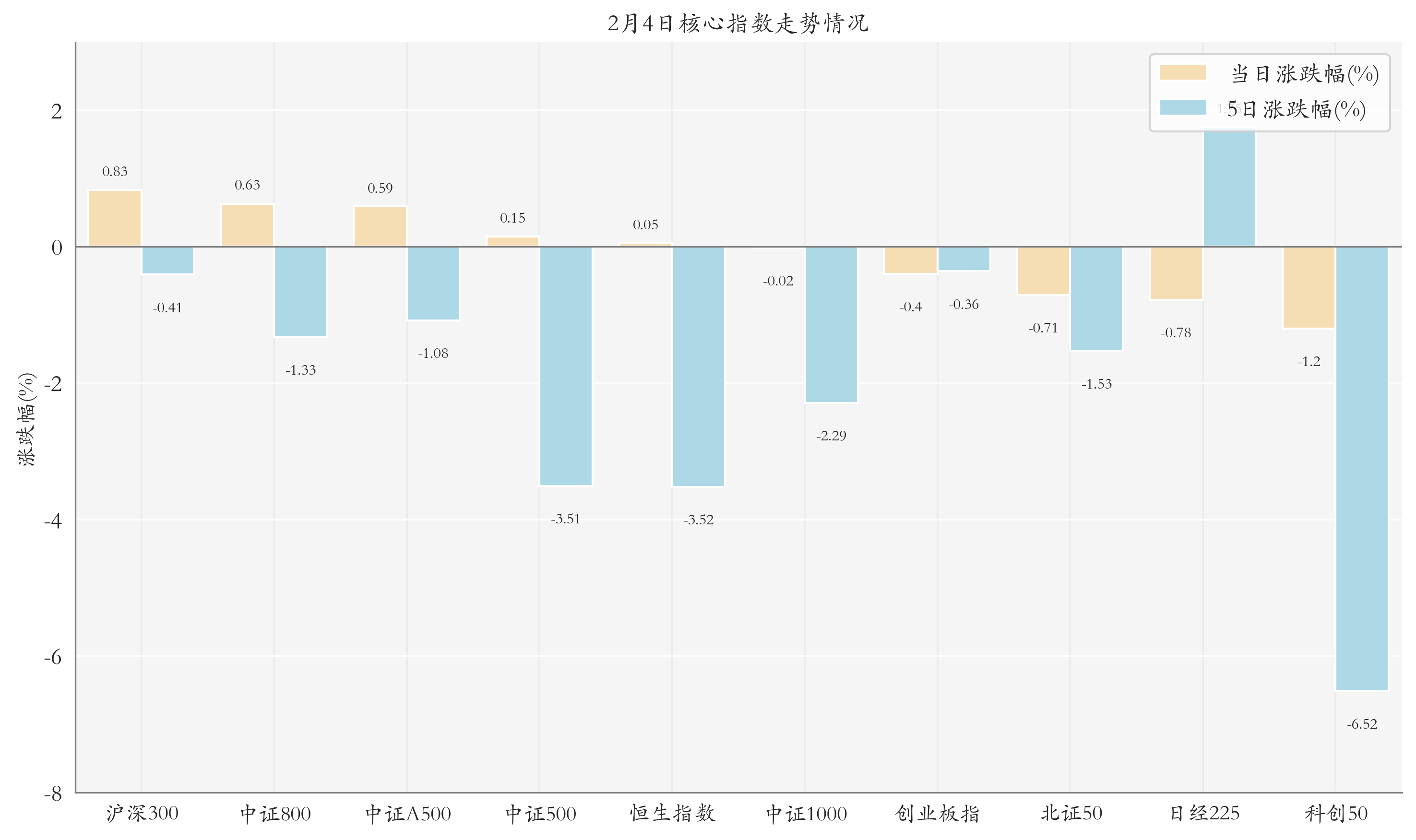
ETF Industry News - The Shanghai Composite Index has returned to 4100 points, with multiple ETFs in the oil and petrochemical sector experiencing significant gains, including the Energy ETF Guangfa (159945.SZ) up by 5.99% and the Energy ETF (159930.SZ) up by 5.33% [1] - On February 3, the A-share market saw a reversal with a net inflow of nearly 10 billion yuan into stock ETFs, marking one of the few days of net inflow since January. Major ETFs tracking the CSI 500, CSI 300, and STAR 50 indices saw significant inflows, while thematic ETFs in sectors like non-ferrous metals and photovoltaics experienced net outflows [2] - As of January 31, 2026, 14 ETFs have expanded by over 10 billion yuan, with a notable shift towards industry-themed ETFs and commodity ETFs, indicating a consensus among investors on sectors supported by industrial policies and positive fundamentals [3] Market Overview - On February 4, the A-share market showed mixed performance, with the Shanghai Composite Index rising by 0.85% to close at 4102.2 points, while the ChiNext Index fell by 0.4%. The top performers among major indices included the CSI 300 and CSI 800 [4] - In terms of sector performance, coal, building materials, and real estate sectors led the gains with daily increases of 7.58%, 3.48%, and 2.97% respectively, while media, communication, and computer sectors lagged behind [7] ETF Market Performance - The average daily return for commodity ETFs was the highest at 3.70%, while stock-themed index ETFs had the lowest average return at -0.08% [10] - The top-performing ETFs included the Coal ETF (515220.SH) with a return of 9.07%, followed by the Energy ETF Guangfa (159945.SZ) and the Energy ETF (159930.SZ) with returns of 5.99% and 5.33% respectively [13] - The top three ETFs by trading volume were the A500 ETF Southern (159352.SZ) with a trading volume of 7.732 billion yuan, the CSI 500 ETF (159338.SZ) with 6.968 billion yuan, and the A500 ETF Fund (512050.SH) with 14.236 billion yuan [16]

国内债券ETF发展现状与产品结构解析:从规模高增到结构分化
Hua Yuan Zheng Quan· 2026-02-04 10:58
Report Industry Investment Rating No industry investment rating was provided in the report. Core Viewpoints of the Report - In 2025, the domestic bond ETF market experienced rapid growth, with the scale increasing from 174 billion yuan at the end of 2024 to 829 billion yuan at the end of 2025. The product structure showed differentiation, with credit - bond ETFs becoming the main growth driver. [1] - The participation of bond ETFs continued to expand, but the scale barriers of leading fund companies were relatively stable. The market was mainly dominated by institutional investors. [1][2] - The performance of interest - rate bond ETFs was related to duration, and there was significant differentiation. Credit - bond ETFs such as science - innovation bond ETFs and benchmark market - making credit - bond ETFs showed stable performance. Convertible bond ETFs also achieved high - speed growth. [2] - The domestic bond ETF market may further concentrate on leading institutions in single categories. Future product innovation may focus on diversified expansion to meet the differentiated needs of investors. [2] Summary by Relevant Catalogs 1. Domestic Bond ETF Market Overview 1.1 Bond ETF Development Process - The development of domestic bond ETFs has gone through three stages: the start - up stage from 2013 - 2018, the slow - growth stage from 2019 - 2021, and the rapid - growth stage from 2021 to the present. As of December 31, 2025, the scale reached 829 billion yuan. [6] 1.2 Bond ETF Scale Growth in 2025 - In 2025, the bond ETF market grew rapidly. By the end of 2025, there were 53 listed bond ETFs, with a total scale of 829 billion yuan, a 377% increase compared to the end of 2024. The scale expansion showed an accelerating trend. [9] - Among the 53 bond ETF products, 37 had a scale of over 10 billion yuan, accounting for about 70%, indicating rapid market development in 2025. [14] 1.3 Bond ETF Benchmark Index - As of the end of 2025, the domestic bond ETF benchmark index had formed a system covering all categories such as interest - rate bonds, credit bonds, and convertible bonds, with a total of 25 indices compiled by index institutions such as China Securities Index and China Bond Index. [17] - Different types of ETFs correspond to different target indices, which can meet the diversified needs of investors from stable allocation to thematic investment. [18] 1.4 Bond ETF Product Classification System - Domestic bond ETFs can be divided into interest - rate bond ETFs, credit - bond ETFs, and convertible bond ETFs. Interest - rate bond ETFs are the basic products, credit - bond ETFs were the main growth driver in 2025, and there are currently 2 convertible bond ETFs. [21][22] 1.5 Bond ETF Managers - As of the end of 2025, 28 fund companies managed a total of 53 bond ETFs. The scale of leading fund managers showed a long - term stagnation followed by rapid growth. [23] - The market pattern showed significant leading effects and high concentration. Haitong Fund ranked first, followed by Boshi Fund and Fuguo Fund. Both leading institutions and new entrants promoted the expansion of the industry. [28][31] 2. Bond ETF Product Line and Recent Trends 2.1 Structural Differentiation of Bond ETF Scale Growth in 2025 - In terms of scale and quantity, interest - rate bond, credit - bond, and convertible bond ETFs showed significant differentiation in 2025, reflecting the different demand for products with different risk - return characteristics. [33] - Products with a duration of 0 - 3 years and 3 - 7 years accounted for a relatively large proportion, with the proportion increasing by 12.33 percentage points compared to the end of 2024. [38] - The launch of science - innovation bond ETFs and benchmark market - making credit - bond ETFs was the highlight of the market in 2025. The total scale of science - innovation bond ETFs exceeded 35.53 billion yuan, contributing nearly 54% of the annual market scale increment. [41] 2.2 Interest - Rate Bond ETFs - The scale of interest - rate bond ETFs expanded steadily. As of the end of December 2025, the asset - net - value scale was 152.8 billion yuan, accounting for 18.4% of the overall bond ETF market. Policy support promoted the inflow of funds. [45][51] - The product system was improving and achieved full - duration coverage, but there was still room for innovation in some niche categories. [52] - The competition pattern was relatively stable, with leading institutions taking the lead. Competition focused on duration coverage, tracking - error control, and liquidity maintenance. [54] 2.3 Credit - Bond ETFs - Before 2025, there were only 3 credit - bond ETFs. In 2025, it was a big year for credit - bond ETF issuance, with the launch of benchmark market - making credit - bond ETFs and science - innovation bond ETFs. [57] - **Benchmark Market - Making Credit - Bond ETFs**: In January 2025, 8 benchmark market - making credit - bond ETFs were listed. Their scale showed a trend of rapid expansion in the first half of the year and high - level oscillation in the second half. The underlying assets were concentrated in medium - and short - duration, high - rating bonds, mainly including general public - offering corporate bonds and science - innovation bonds. [58][59][62] - **Science - Innovation Bond ETFs**: In 2025, science - innovation bond ETFs grew rapidly, with a total scale of 35.53 billion yuan at the end of the year, accounting for over 40% of the overall bond ETF scale. They were driven by policies and had a three - pillar tracking - index system, with products concentrated in leading fund companies. [70][73][76] - **Other Credit - Bond ETFs**: There were only 3 other credit - bond ETFs, focusing on short - term financing, urban investment bonds, and high - grade corporate bonds. [79] 2.4 Convertible Bond ETFs - In a low - interest - rate environment, convertible bond ETFs became an important allocation target. As of the end of 2025, there were only 2 convertible bond ETFs. The market had achieved leap - forward growth in recent years, and although the scale decreased in 2025, it remained at a high level. [81][82] 3. Bond ETF Product Holder Structure - Bond ETFs were mainly held by institutional investors, and the investor structure of treasury - bond ETFs was relatively balanced. As of June 2025, institutional investors held 92% of the asset - net - value scale, and individual investors held 8%. [84] - In terms of concentration, the concentration of policy - financial bond ETFs was the highest, and that of convertible bond ETFs was the lowest. The top three institutional investors in terms of holding scale were other institutions, securities firms, and securities investment funds. [88][89] 4. Bond ETF Performance - As of the end of 2025, the performance of interest - rate bond ETFs showed significant differentiation, with long - duration products having larger declines and short - duration products achieving positive returns. Most products had a tracking - deviation mean of less than 0.1. [92] - The performance of credit - bond ETFs also showed differentiation. Some science - innovation bond ETFs and benchmark market - making credit - bond ETFs performed well, and the annualized returns of some early - established credit - bond ETFs were higher. [95][97] - The recovery - unit - net - value trends of Haitong Shanghai - Stock - Exchange Investment - Grade Convertible Bond ETF and Boshi Convertible Bond ETF were highly synchronized, with 2025 returns of 13.1% and 18.0% respectively, and annualized returns since establishment of 4.5% and 5.5% respectively. [98] 5. Future Development of Bond ETFs - The domestic bond ETF market showed a trend of concentration among leading institutions, and there were problems such as product homogenization and lack of richness, which were difficult to meet the differentiated needs of investors. [102] - Referring to the US bond ETF market, the domestic bond ETF market could enrich the product matrix from multiple dimensions, including expanding product - gradient coverage, developing Smart Beta and actively managed bond ETFs, adding cross - border and cross - market bond ETFs if QDII quotas were sufficient, and adding over - the - counter connection funds. [103][104][107]
周大生:接受海富通基金等投资者调研
Mei Ri Jing Ji Xin Wen· 2026-02-04 10:50
Group 1 - The company Zhou Dasheng announced that it will accept investor research from Hai Futong Fund and other investors on February 4, 2026, with representatives Zhou Xiaoda and Rong Huan participating in the reception and answering investor questions [1] Group 2 - The article discusses Kevin Warsh's new policy concept, which involves a dual approach of monetary easing and tightening, aiming to control inflation with the help of AI, while rejecting the role of being a major buyer of U.S. Treasury bonds [1]
立春启新|2025年度Wind最佳路演榜单正式发布
Wind万得· 2026-02-03 22:45
Core Insights - The article discusses the release of the 2025 Wind Best Roadshow Rankings, emphasizing the importance of roadshows in the capital market for information exchange and strategic discussions despite a changing market environment [1][3]. Group 1: Roadshow Rankings Overview - The rankings are based on actual operational data from the Wind 3C conference platform for 2025, focusing on key indicators to objectively reflect market attention and the actual impact of roadshows [3]. - The rankings are divided into two main sections: institutional and individual, comprising 11 sub-lists that cover key market participants such as securities firms, public funds, futures, and listed companies [3]. Group 2: Institutional Performance - Certain institutions have shown outstanding performance in research output frequency, roadshow quality, and market participation in 2025, establishing a stable communication mechanism for investment judgments [5]. Group 3: Roadshow Participation Metrics - The metrics for evaluating roadshows include browsing volume, participant scale, and the ongoing impact of meetings [8]. Group 4: Roadshow Content Quality - The quality of roadshow content ultimately depends on the presenters, who provide valuable research perspectives through continuous and clear output of viewpoints on macro environments, industry trends, and asset allocation strategies [19]. Group 5: Roadshow Participation Statistics - The Wind 3C conference platform supported various types of meetings in 2025, including analyst roadshows, strategy meetings, industry summits, and performance briefings, serving thousands of financial institutions globally [47]. - The total number of meetings held reached a scale of tens of thousands, with participant numbers exceeding ten million, showcasing the platform's capability to efficiently deliver valuable insights [48]. Group 6: Future Outlook - The rankings serve not only as a retrospective of the past year's roadshow achievements but also as a reference for the future, guiding growth and promoting rational development in the capital market [50].

今年首月公募“打新”获配超12亿元
Xin Lang Cai Jing· 2026-02-02 23:02
本报记者 方凌晨 公募排排网统计数据显示,今年1月份,公募机构共参与了5只新股的网下配售,获配金额超12亿元。在 业内人士看来,公募机构参与"打新",主要出于收益增厚、优化组合配置、战略布局等多方面考量。未 来公募"打新"热情有望延续,综合实力强劲的公募机构有望主导"打新"市场。 新股各具行业代表性 上述数据显示,1月份公募机构参与新股网下配售合计获配6022.33万股,获配金额达12.50亿元。 深圳市融智私募证券投资基金管理有限公司FOF(基金中的基金)基金经理李春瑜对《证券日报》记者 分析,一方面,新股网下配售具有风险相对较低、收益兑现较快的特点,能够有效增厚基金收益,尤其 在市场震荡期间,"打新"收益可以成为基金重要的收益稳定器;另一方面,"打新"也是公募机构布局高 成长赛道的重要方式,通过参与新股配售,公募机构可以提前锁定优质资产,与现有权益组合形成互 补,进一步优化配置结构。 具体来看,公募机构参与网下配售的5只新股分别是恒运昌、振石股份、北芯生命、至信股份和世盟股 份,从申万行业分类来看,这些新股各具行业代表性,分别隶属于半导体、玻璃玻纤、医疗器械、汽车 零部件和物流五大行业。 在南开大学金融学 ...
可转债周报(2026.1.26-2026.2.1):小盘风格承压之下,转债估值仍有支撑-20260202
Dong Fang Jin Cheng· 2026-02-02 07:53
1. Report Industry Investment Rating - There is no information provided regarding the report industry investment rating in the given content. 2. Core Viewpoints of the Report - Last week, the equity market style switched, with the small - cap style continuing to weaken. The convertible bond market adjusted with reduced volume, showing anti - decline properties, and the Wind Convertible Bond Weighted Index outperformed the Wind Convertible Bond Underlying Stock Weighted Index by 0.43 pcts. Convertible bond ETFs had a net subscription of 2.545 billion yuan, supporting the convertible bond valuation. [2] - In the short term, convertible bonds are expected to follow the underlying stocks in volatile consolidation, maintaining a structural market with rapid rotation. Large - cap and dividend convertible bonds are expected to continue to dominate. However, during the wide - range volatility period, convertible bonds have an asymmetric advantage. After the performance announcements, the risk - aversion sentiment in small - and micro - cap stocks will gradually ease, and the regulatory attitude will warm up. Before the Spring Festival, a new round of favorable and policy - game market is expected to start, with the market style switching back to small - cap dominance, which will drive the convertible bond market. [2] 3. Summary by Relevant Catalogs Policy Tracking - On January 27, the State Council issued the "Regulations for the Implementation of the Drug Administration Law of the People's Republic of China", which will come into force on May 15, 2026. It supports the development of new industrial formats, promotes the implementation of pharmaceutical innovation results, and improves various aspects of drug management. [3] - On January 29, the State Council issued the "Guidelines on Performance Comparison Benchmarks for Publicly Offered Securities Investment Funds", proposing 12 policy measures and identifying key service consumption areas such as transportation and household services, and strengthening support for cultivating new growth points in service consumption. [2][3] Secondary Market - **Equity Market**: Last week, major equity market indices closed down. The Shanghai Composite Index, Shenzhen Component Index, and ChiNext Index fell 0.44%, 1.62%, and 0.09% respectively. Overseas, the Fed's hawkish nomination and the sharp adjustment in the precious metal market affected the global capital market. Domestically, although the profits of industrial enterprises above designated size increased in 2025, the January PMI index declined, and the market risk preference decreased. The small - and micro - cap stocks weakened, and the large - cap dividend stocks strengthened. [6] - **Convertible Bond Market**: Major convertible bond market indices followed the decline. The CSI Convertible Bond Index, Shanghai Convertible Bond Index, and Shenzhen Convertible Bond Index fell 2.61%, 2.56%, and 2.61% respectively, with an average daily trading volume of 9.0209 billion yuan, a marginal decrease of 308.6 million yuan from the previous week. Convertible bond ETFs showed differentiation, with a net subscription of 2.545 billion yuan in total, supporting the valuation. [7] - **Structural Analysis**: The large - cap style in the convertible bond market was dominant due to its anti - decline property. The median prices of convertible bonds and their underlying stocks were still at a high level, the conversion value quantile decreased, and the median valuation level increased slightly. The trading activity of underlying stocks decreased, while that of convertible bonds increased. [9] - **Industry Analysis**: All industries' convertible bonds fell. Construction materials, agriculture, forestry, animal husbandry, and fishery, food and beverage, and public utilities had relatively small average declines, while national defense and military industry and computer industries had larger average declines. The valuation of convertible bonds in different industries was differentiated. [10] - **Individual Bond Analysis**: Most convertible bonds rose. Baichuan Convertible Bond 2 led the rise with an increase of over 12%, while high - position convertible bonds such as Xinzhi Convertible Bond and Hangyu Convertible Bond had significant declines. [13] - **Price and Valuation**: The arithmetic average and median of convertible bond prices decreased. The arithmetic average of the conversion premium rate increased, and the median decreased. The arithmetic average and median of the pure - bond premium rate decreased. [24] Primary Market - **Issuance and Listing**: No new convertible bonds were issued last week. Lianrui Convertible Bond and Naipu Convertible Bond 02 were listed, and several convertible bonds were redeemed early and delisted. As of last Friday, the convertible bond market's outstanding scale was 55.2588 billion yuan, a decrease of 4.596 billion yuan from the beginning of the year and 3.682 billion yuan from the previous week. [30] - **Conversion**: Ten convertible bonds had a conversion ratio of over 5%, one more than the previous week. Some bonds had announced early redemption or were about to trigger the strong - redemption condition. [33] - **Approval Progress**: Star Semiconductor's convertible bond issuance was approved by the exchange. One convertible bond passed the review of the Issuance Examination Committee, with a total scale of 1.5 billion yuan. As of last Friday, eight convertible bonds were approved by the CSRC to be issued, with a total scale of 6.164 billion yuan. [34] - **Clause Tracking**: One convertible bond announced a downward revision of the conversion price, and two announced early redemption. Some bonds announced not to revise the conversion price downward or were about to trigger the downward - revision condition, and many bonds were expected to trigger the early - redemption condition. [35]
ETF策略指数跟踪周报-20260202
HWABAO SECURITIES· 2026-02-02 07:43
1. Report Industry Investment Rating - Not provided in the content 2. Core Viewpoints - The report presents several ETF strategy indices constructed by Huabao Research and tracks their performance and positions on a weekly basis, aiming to help investors convert quantitative models or subjective views into practical investment strategies [11] 3. Summary by Relevant Catalog 3.1 ETF Strategy Index Tracking - **Overall Performance**: The table shows the performance of various ETF strategy indices last week. The Huabao Research Quantitative Windmill ETF Strategy Index had the highest weekly excess return of 2.56%, while the Huabao Research SmartBeta Enhanced ETF Strategy Index had the lowest weekly excess return of -2.76% [12] 3.1.1 Huabao Research Size Rotation ETF Strategy Index - **Strategy**: It uses multi - dimensional technical indicator factors and a machine - learning model to predict the return difference between the Shenwan Large - Cap Index and the Shenwan Small - Cap Index. It outputs weekly signals to predict the strength of the indices in the next week and determines positions accordingly to obtain excess returns [13] - **Performance**: As of 2026/1/30, the excess return since 2024 was 29.34%, the excess return in the past month was 5.89%, and the excess return in the past week was - 1.86%. The index's positions include 50% in the CSI 500ETF and 50% in the CSI 1000ETF [13][17] 3.1.2 Huabao Research SmartBeta Enhanced ETF Strategy Index - **Strategy**: It uses price - volume indicators to time self - built Barra factors and maps timing signals to ETFs based on their exposure to 9 major Barra factors to achieve market - outperforming returns. The selected ETFs cover mainstream broad - based index ETFs and some style and strategy ETFs [17] - **Performance**: As of 2026/1/30, the excess return since 2024 was 20.15%, the excess return in the past month was - 2.11%, and the excess return in the past week was - 2.76%. The index's positions are mainly in several science - innovation and growth - style ETFs [17] 3.1.3 Huabao Research Quantitative Windmill ETF Strategy Index - **Strategy**: It starts from a multi - factor perspective, including the grasp of medium - to - long - term fundamentals, tracking of short - term market trends, and analysis of the behavior of various market participants. It uses valuation and crowding signals to indicate industry risks and multi - dimensionally digs out potential sectors to obtain excess returns [20] - **Performance**: As of 2026/1/30, the excess return since 2024 was 51.39%, the excess return in the past month was 6.51%, and the excess return in the past week was 2.56%. The index's positions are mainly in commodity - related and financial - related ETFs [20][25] 3.1.4 Huabao Research Quantitative Balance ETF Strategy Index - **Strategy**: It adopts a multi - factor system, including economic fundamentals, liquidity, technical analysis, and investor behavior factors, to construct a quantitative timing system for trend analysis of the equity market. It also builds a prediction model for market large - and small - cap styles to adjust the equity market position distribution and obtain excess returns through comprehensive timing and rotation [24] - **Performance**: As of 2026/1/30, the excess return since 2024 was - 10.24%, the excess return in the past month was 0.48%, and the excess return in the past week was - 0.36%. The index's positions include bonds and equity - based ETFs [24][27] 3.1.5 Huabao Research Hot - Spot Tracking ETF Strategy Index - **Strategy**: It uses strategies such as market sentiment analysis, tracking of major industry events, investor sentiment and professional opinions, policy and regulatory changes, and historical analysis to track and dig out hot - spot index target products in a timely manner, constructing an ETF portfolio that can capture market hot spots and providing short - term market trend references for investors [27] - **Performance**: As of 2026/1/30, the excess return in the past month was 6.21%, and the excess return in the past week was 3.21%. The index's positions are mainly in commodity, Hong - Kong - stock, and short - term financing ETFs [27][30] 3.1.6 Huabao Research Bond ETF Duration Strategy Index - **Strategy**: It uses bond market liquidity and price - volume indicators to screen effective timing factors and predicts bond yields through machine - learning methods. When the expected yield is below a certain threshold, it reduces the long - duration positions in the bond investment portfolio to improve long - term returns and drawdown control [30] - **Performance**: As of 2026/1/30, the excess return in the past month was 0.40%, and the excess return in the past week was 0.14%. The index's positions are mainly in bond - related ETFs [30][33]
500亿以上ETF梯队新洗牌,非货ETF单月缩水超5000亿,谁被洗出,谁成新贵?
Xin Lang Cai Jing· 2026-02-02 03:33
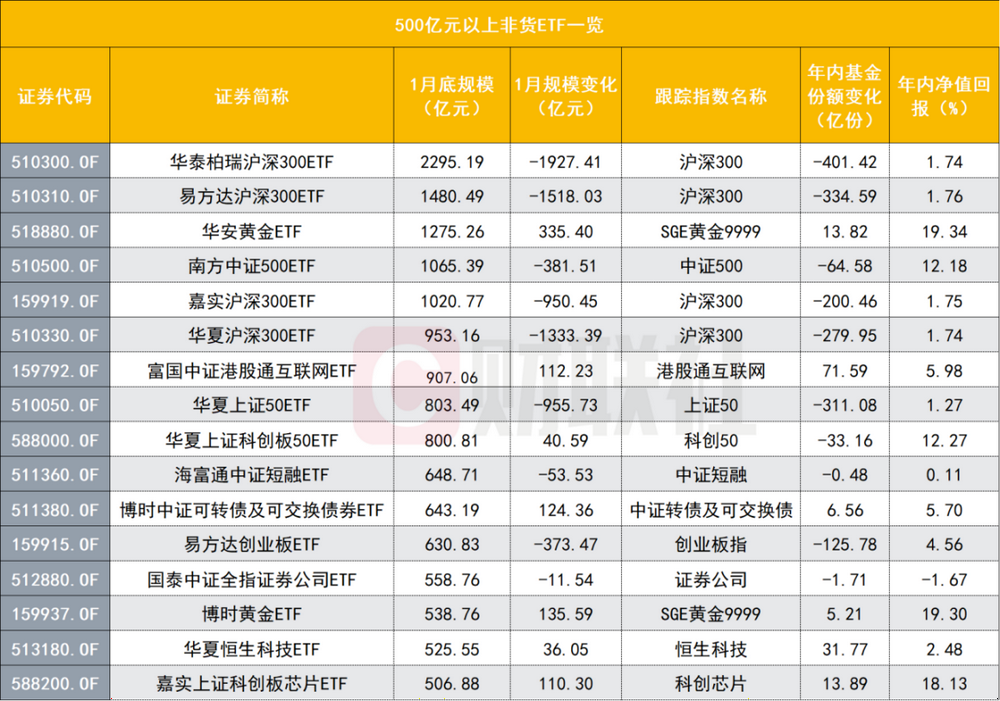
Core Insights - The non-cash ETF market experienced a significant contraction, with a reduction of over 500 billion yuan in January 2026, primarily driven by a decline in equity ETFs [1][6][7] - Despite the overall shrinkage, thematic ETFs, particularly those focused on gold and technology sectors, saw substantial inflows, with several new products entering the 500 billion yuan tier [2][4][5] ETF Market Overview - The total scale of non-cash ETFs as of the end of January was 5.31 trillion yuan, reflecting a decrease of 536.76 billion yuan from the previous month [7] - Broad-based ETFs saw a reduction of 909.96 billion yuan, bringing their total scale below 1.66 trillion yuan [7] - The three ETFs linked to the CSI 300, CSI 1000, and SSE 50 indices experienced the largest declines, with the CSI 300 ETF alone shrinking by 574.30 billion yuan [7][8] Thematic ETF Performance - The gold-themed ETFs collectively grew by 820.73 billion yuan in January, reaching a total scale of 3.01 trillion yuan [9][10] - Notable new entrants to the 500 billion yuan category included the Bosera Gold ETF, Huaxia Hang Seng Technology ETF, and Harvest SSE Sci-Tech Chip ETF, all of which showed strong performance in terms of net value returns [2][4][5] - The Bosera Gold ETF reported a net value return of nearly 20% in January, contributing to its growth of 135.59 billion yuan [3][4] Fund Management Insights - As of the end of January, Huaxia Fund led the market with four non-cash ETFs exceeding 500 billion yuan, while Bosera and Harvest Funds each had two [5] - The number of ETFs in the 1 billion yuan category decreased from seven to five, indicating a consolidation in the market [4][5] Redemption Trends - Significant redemptions were observed in the EasyOne SSE Sci-Tech 50 ETF and Southern CSI 1000 ETF, which saw net redemptions of 226.92 billion and 149.40 billion units, respectively, marking the largest monthly redemptions since their inception [4][8]
两市ETF两融余额减少28.96亿元丨ETF融资融券日报
2 1 Shi Ji Jing Ji Bao Dao· 2026-02-02 02:49
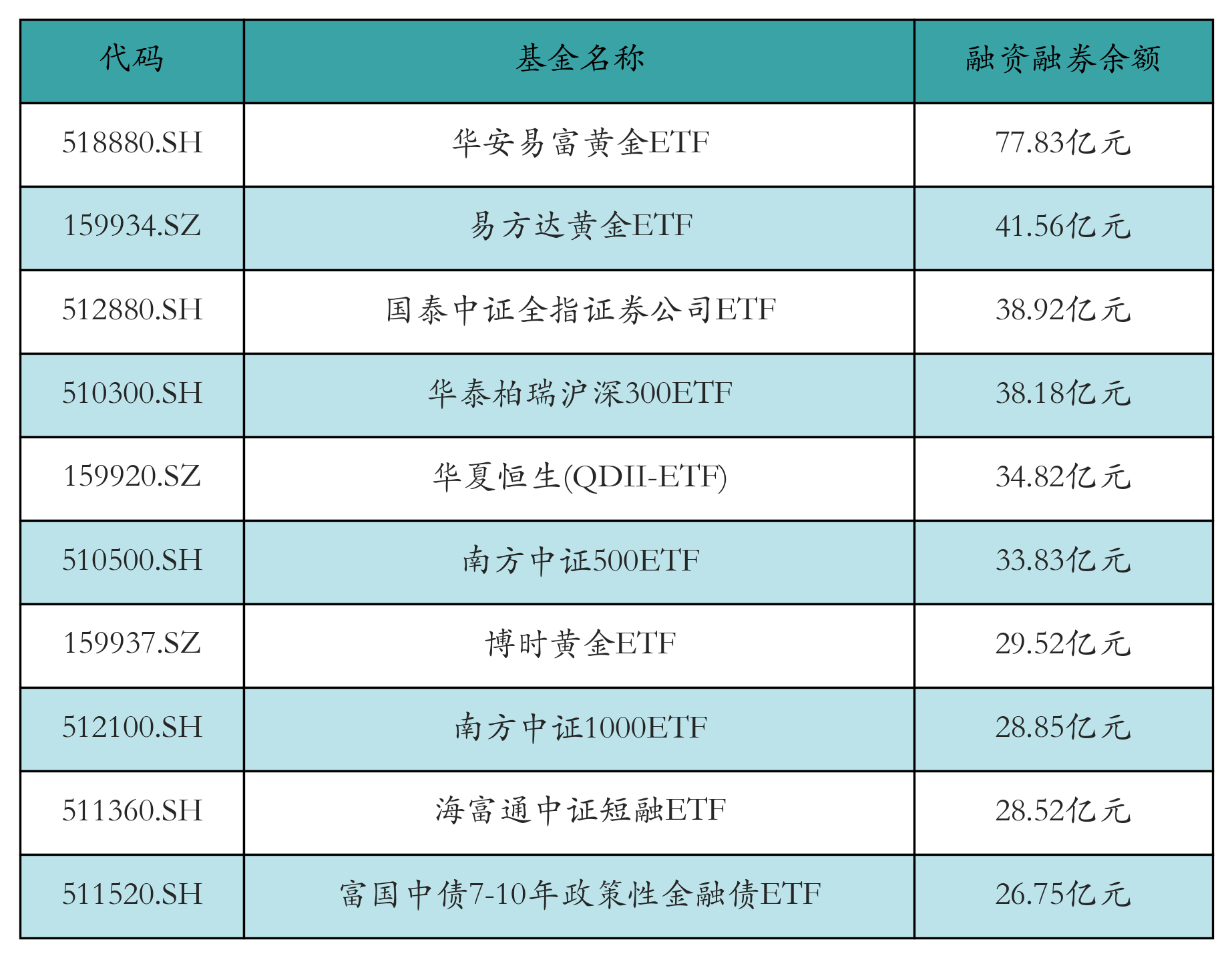
Market Overview - As of January 30, the total ETF margin balance in the two markets is 120.251 billion yuan, a decrease of 2.896 billion yuan from the previous trading day [1] - The financing balance is 112.88 billion yuan, down by 2.768 billion yuan, while the securities lending balance is 7.371 billion yuan, a decrease of 129 million yuan [1] - In the Shanghai market, the ETF margin balance is 84.19 billion yuan, a reduction of 1.917 billion yuan, with a financing balance of 77.757 billion yuan, down by 1.8 billion yuan [1] - The Shenzhen market's ETF margin balance is 36.061 billion yuan, decreasing by 979 million yuan, with a financing balance of 35.122 billion yuan, down by 967 million yuan [1] ETF Margin Financing Balances - The top three ETFs by margin balance on January 30 are: 1. Huaan Yifu Gold ETF (7.783 billion yuan) 2. E Fund Gold ETF (4.156 billion yuan) 3. Guotai CSI All-Share Securities Company ETF (3.892 billion yuan) [2] ETF Financing Buy Amounts - The top three ETFs by financing buy amounts on January 30 are: 1. Hai Futong CSI Short Bond ETF (4.538 billion yuan) 2. Bosera CSI Convertible Bonds and Exchangeable Bonds ETF (2.375 billion yuan) 3. Huaan Yifu Gold ETF (1.598 billion yuan) [4] ETF Financing Net Buy Amounts - The top three ETFs by financing net buy amounts on January 30 are: 1. E Fund CSI Hong Kong Securities Investment Theme ETF (84.1736 million yuan) 2. Huaxia Hang Seng Internet Technology Industry (QDII-ETF) (48.62 million yuan) 3. Fuguo Shanghai Composite Index ETF (42.3782 million yuan) [5] ETF Securities Lending Sell Amounts - The top three ETFs by securities lending sell amounts on January 30 are: 1. Southern CSI 1000 ETF (74.7985 million yuan) 2. Huatai-PB Shanghai and Shenzhen 300 ETF (18.0902 million yuan) 3. Southern CSI 500 ETF (11.3948 million yuan) [6]
25Q4基金转债持仓分析:固收+继续扩张,增配科技化工
GOLDEN SUN SECURITIES· 2026-02-01 06:40
证券研究报告 | 固定收益 gszqdatemark 2026 01 31 年 月 日 固定收益点评 固收+继续扩张,增配科技化工——25Q4 基金转债持仓分析 2025Q4 公募基金持有转债规模占转债总市值的 57.74%,环比下降 4.08pcts,仓位小幅下降 0.05pcts。截止 2025Q4,转债市场存量余额 5338.90 亿元,环比 25Q3 增加 4.30%。权益势强背景下,固收+配置需 求仍在,转债存量规模略有增加,但机构持有转债比重略有下降。2025Q4 公募基金持有转债市值 3082.51 亿元,占转债总市值的 57.74%,较三季 度减少 4.08pcts;公募基金持有转债仓位为 0.76%,环比下降 0.05pcts。 二级债基、一级债基加仓转债。从结构上看,持有转债较多的基金类型为 债券型基金中的二级债基( 36.41%)、可转债基金 36.29%)和债券型基 金中的一级债基 21.90%)、偏债混合型基金( 3.30%)、灵活配置型基金 2.10%)。受基金产品定位与市场策略分化影响,环比 25Q3,二级债基 转债市值增加 39.63 亿元 3.72%,表示转债持有比重增加 3 ...