瑞幸

Search documents
星巴克中国卖了!出售最多60%股权、剑指2万家门店
Guo Ji Jin Rong Bao· 2025-11-04 08:54
星巴克中国股权买家尘埃落定,这是星巴克入华26年来里程碑式的变动。 博裕资本成立于2011年,近年先后投资蜜雪冰城、海天味业(603288)、华润饮料等头部消费品牌,今 年5月还以百亿级资金入主北京SKP。 "博裕在本地市场的经验与专长,将有力加速星巴克在中国市场,特别是中小城市及新兴区域的拓 展。"星巴克咖啡公司董事长兼首席执行官倪睿安(Brian Niccol)这样表示。 此次股权调整,亦折射出星巴克中国应对本土竞争的战略考量。作为星巴克在全球的第二大市场,中国 市场近年面临瑞幸、库迪等本土咖啡品牌,以及新茶饮品牌的双重挤压,近两年星巴克营收和门店规模 已被瑞幸超越,客单价、销量等重要经营指标持续波动。 为扭转局面,星巴克今年加快自我变革,以降价加码非咖业务、加快门店区域下沉,并增加营销活动。 11月4日,星巴克咖啡(SBUX)正式宣布与博裕投资达成战略合作,将成立一家合资企业运营中国市 场的零售业务。此举标志着这家国际咖啡巨头在华开启"本土资本+品牌授权"的全新运营模式。 新合资公司总部将设立在上海,愿景是未来将星巴克中国门店规模拓展至20000家,目前星巴克在中国 市场门店总数为8011家。该交易需监 ...

星巴克下沉千县开店超8000家,平价咖啡迎来新机遇
Shang Hai Zheng Quan Bao· 2025-11-01 00:39
Core Insights - Starbucks China reported significantly better-than-expected financial results for Q4 and the full year of FY2025, with a revenue of $831.6 million for Q4, a 6% year-on-year increase, and a total revenue of $3.105 billion for FY2025, up 5% year-on-year [1][2] - The competition in the domestic coffee market has intensified, with a shift from coffee being a "social attribute" to a "daily attribute," creating new opportunities for affordable coffee brands [1][4] Starbucks' Performance - Starbucks has successfully expanded into lower-tier markets, opening 8,011 stores in 1,091 county-level cities by the end of FY2025 [1] - The company has implemented significant price reductions on popular products, marking its largest price adjustment in 26 years in China, which has contributed to its strong performance amid a broader industry downturn [2] Luckin Coffee's Growth - Luckin Coffee, under the Moutai Group, has rapidly expanded its presence in first-tier markets, with over 1,000 stores and a total exceeding 9,000 stores nationwide, aiming for a target of 10,000 stores [2][3] - The introduction of new products, such as the "Lucky Latte Season" series, has driven significant sales, with the "Coconut Latte" alone generating over $300 million in sales and exceeding 30 million cups sold this year [3] Market Trends - The coffee consumption landscape is shifting, with younger consumers increasingly favoring affordable yet quality options, indicating a potential mainstream trend for budget coffee brands [4] - The competition is evolving from incremental growth to a focus on existing market share, with brands needing to emphasize cost control, supply chain management, and brand development to succeed [4]

古茗(01364.HK)深度研究:大众现制饮品龙头 冷链快反筑造护城河
Ge Long Hui· 2025-10-25 22:37
Core Viewpoint - The company, Guming, is experiencing significant growth in the Chinese ready-to-drink tea market, with a market share of approximately 9.1%, making it the second-largest player after Mixue Ice City and the leading brand in the 10-20 yuan price segment [1] Group 1: Market Position and Performance - As of the end of H1 2025, Guming operates 11,179 stores across over 200 cities, with 81% of its stores located in second-tier and lower cities [1] - The company is projected to achieve revenue of 8.791 billion yuan in 2024, representing a 14.5% increase, with a corresponding GMV of 22.4 billion yuan, up 16.57% [1] - Guming's revenue is primarily derived from the sale of raw materials and equipment to franchise stores, accounting for 80% of total revenue [1] Group 2: Competitive Landscape - The ready-to-drink beverage market in China is characterized by a rising per capita consumption potential, with low-tier markets being the main source of growth [1] - In the milk tea segment, the chain rate is expected to reach 49% in 2024, with supply chain capabilities becoming a critical competitive factor due to product homogeneity and low replication barriers [1] - The coffee segment faces less intense competition compared to milk tea, with leading brands leveraging scale advantages to combat rising coffee bean costs and price wars [1] Group 3: Store Performance and Expansion Strategy - Guming's single-store model shows resilience, with an average monthly GMV of 197,000 yuan, despite a 4% decline, and approximately 40% of sales coming from third-party platforms [2] - The company maintains a focus on store quality and franchisee health, with a strategy of expanding in existing stronghold provinces while also entering neighboring regions [2] - The new franchise policy for 2025 emphasizes the importance of franchisee management and lowers the entry threshold to 230,000 yuan to encourage expansion [2] Group 4: Logistics and Supply Chain - Guming leads the industry in cold chain and warehousing logistics, ensuring fresher products compared to competitors, with most fresh ingredients transported to stores within 1-3 days [3] - The company owns 362 transportation vehicles, with 75% of its stores located within a 150-kilometer radius of its warehouses, allowing for efficient cold chain service [3] Group 5: Financial Projections - Revenue forecasts for Guming are set at 11.98 billion yuan, 15.18 billion yuan, and 18.34 billion yuan for 2025-2027, with growth rates of 36%, 27%, and 21% respectively [3] - The projected net profit for the parent company is 2.6 billion yuan for 2025, remaining stable at 2.6 billion yuan in 2026, and increasing to 3.2 billion yuan in 2027 [3] - The adjusted net profit is expected to be 2.12 billion yuan, 2.71 billion yuan, and 3.29 billion yuan for the same period, with corresponding growth rates of 37%, 28%, and 21% [3]
白酒搭奶茶,能撬动4000亿年轻人酒饮市场吗?
Mei Ri Jing Ji Xin Wen· 2025-09-23 12:07
Group 1 - The core idea of the article is the collaboration between Luzhou Laojiao and Cha Baidao, marking a return of their product "Drunken Steps on the Road" after five years, which combines milk tea and liquor for the first time [1] - The product's re-launch was met with significant consumer interest, achieving nearly 120,000 cups sold on the first day, indicating strong demand among young consumers [1] - The liquor industry is increasingly seeking to engage younger audiences through innovative collaborations, as seen with Moutai's partnership with Luckin Coffee and various promotional events by Luzhou Laojiao [1] Group 2 - Current consumer preferences are shifting towards experiences and consumption scenarios rather than just products, highlighting the importance of emotional engagement in marketing strategies [1] - Industry experts suggest that such cross-industry collaborations may not lead to frequent repurchases, but serve to make liquor brands more approachable and relevant to younger consumers [1] - The trend of periodic collaborations is viewed as a more realistic approach for liquor brands to connect with new generations, rather than relying on constant engagement [1]

开源晨会-20250922
KAIYUAN SECURITIES· 2025-09-22 14:59
Macro Economic Overview - The "14th Five-Year Plan" emphasizes the use of more proactive fiscal policies to support employment and foreign trade, and to improve people's livelihoods [3][4] - Recent policies focus on industrial internet applications and the development of new energy sectors, indicating a shift towards digitalization and innovation [3][4] Fixed Income Market - As of August 2025, the total bond custody amount reached 174.54 trillion yuan, with a net increase of 15,060.06 million yuan, indicating a slight decrease in growth compared to previous months [9][10] - The leverage ratio in the bond market slightly increased to 106.88%, reflecting a cautious optimism in the market [13][14] Pharmaceutical Industry - The pharmaceutical sector is entering a new growth phase driven by innovation and optimization of centralized procurement, with major companies like Heng Rui Pharmaceutical and China Biologic Products showing robust revenue growth [17][18] - The recent adjustments in the national medical insurance directory are expected to benefit innovative drugs, leading to potential rapid growth for companies involved [18][19] Non-Bank Financial Sector - The performance of non-bank financial companies is primarily driven by property and equity investments, with significant contributions from the property insurance sector [21][22] - The net profit growth of listed insurance companies improved in the first half of 2025, largely due to the profitability of property insurance [21][24] Agricultural Sector - The price of white feather chicken increased due to supply disruptions and rising demand, with the average selling price reaching 7.17 yuan/kg in August 2025 [30][31] - The egg market faces pressure from high production capacity, limiting the potential for price increases despite some upward movement in prices [32][33] Machinery Industry - The valuation of global robotics companies is being redefined, with Figure's recent funding round valuing the company at 39 billion USD, indicating a bullish outlook for the robotics sector [37][38] - Key components in robotics are expected to see significant valuation increases, with potential PE ratios reaching 200 times as the industry matures [38][39] Consumer Services Sector - The upcoming National Day holiday is expected to boost travel bookings, with a steady increase in pre-booking trends observed [42][45] - The tea and coffee sector continues to show strong performance, with leading brands expanding their market presence despite some overall industry slowdowns [43][45] Real Estate and Construction - China Overseas Property is experiencing growth in both scale and profitability, with projected net profits increasing from 16.1 billion yuan in 2025 to 19.6 billion yuan by 2027 [47][48] - The company is focusing on high-quality expansion and has seen a significant increase in managed area and new contract signings [49][50] Electronics Industry - The domestic high-power server power supply market is growing, with companies like Oulu Tong positioned as leaders in this space, benefiting from the rise of AI applications [51][52] - The demand for higher power server supplies is expected to increase, with new products in development to meet the needs of advanced AI servers [53]





瑞幸距重新上市有多远
华尔街见闻· 2025-09-13 10:08
Core Viewpoint - Luckin Coffee has made significant strides in its financial performance and is speculated to be on the verge of a potential relisting on the Nasdaq, despite facing challenges from past financial misconduct and intense market competition [3][19][23]. Financial Performance - In the first half of 2025, Luckin Coffee reported revenues of 212.24 billion yuan and a net profit of 17.89 billion yuan, marking year-on-year growth of 44.57% and 17.89% respectively [3]. - For Q2 2025, the company achieved a net revenue of 123.59 billion yuan, a 47.1% increase year-on-year, and a GAAP operating profit of 17 billion yuan, up 61.8% [6]. - Monthly active customer numbers reached 91.7 million, a 31.6% increase, with total cumulative customers surpassing 380 million [7]. Market Position and Competition - Luckin Coffee operates over 26,200 stores, outpacing competitors like Kudi, Starbucks, and Lucky Coffee combined [10]. - The company faces significant competition from Kudi and Lucky Coffee, which are aggressively expanding their market presence [5][50]. - Despite its current success, Luckin Coffee's pricing strategy remains a challenge, as it struggles to move beyond a 9.9 yuan price point amidst fierce competition [50]. Challenges to Relisting - The path to relisting on Nasdaq involves overcoming hurdles related to restoring market trust and hiring a reputable auditing firm, particularly given its history of financial fraud [4][25][32]. - The company has been exploring the possibility of privatization followed by a listing in Hong Kong as an alternative route to relisting [40][41]. - Luckin's current market valuation stands at approximately 10.339 billion USD, which complicates potential privatization efforts due to high costs and shareholder equity dilution [43]. Strategic Considerations - The involvement of major shareholders like Dazhong Capital adds complexity to the decision-making process regarding relisting and potential exit strategies [46]. - The competitive landscape in the coffee market is dynamic, with new entrants and aggressive pricing strategies from rivals, necessitating continuous adaptation from Luckin [48][58]. - The company is also focusing on international expansion, with 89 stores globally, although this segment is still in the investment phase and not yet profitable [64].

蚂蚁的第三次跃迁
虎嗅APP· 2025-09-12 10:28
Core Viewpoint - The article discusses the rapid growth and innovation of Alipay's "Tap to Pay" feature, which has reached over 200 million users in a short period, indicating a significant shift in payment interaction and user experience in the mobile payment landscape [3][29]. Group 1: User Growth and Market Impact - Alipay's "Tap to Pay" feature achieved over 200 million users in less than 400 days, significantly faster than previous milestones [3][29]. - This feature has created a new entry point for users, spreading across over 400 cities and involving more than 5,000 brands and millions of businesses [4][5]. - The growth of "Tap to Pay" is particularly notable in a time when overall internet user growth is slowing down, marking it as a unique achievement [6][29]. Group 2: Innovation in Payment Interaction - "Tap to Pay" represents a new form of interaction in mobile payments, akin to the intuitive multi-touch interface of the iPhone, which lowered the psychological barrier for users [13][45]. - The feature is designed to be instinctive, requiring minimal cognitive load from users, thus facilitating a more natural payment process [33][45]. - The introduction of "Tap to Pay" is seen as a strategic move by Ant Group to innovate beyond traditional payment methods, focusing on enhancing user experience through intuitive interactions [17][31]. Group 3: Technological Development and Collaboration - Ant Group has collaborated with major smartphone manufacturers to optimize the "Tap to Pay" experience, ensuring compatibility and performance across devices [25][26]. - The development of the first generation of "Tap to Pay" devices involved extensive testing and collaboration with suppliers to achieve the desired quality and user experience [23][24]. - The revival of NFC technology in the market has been significantly influenced by the introduction of "Tap to Pay," leading to a broader ecosystem of related industries [26][29]. Group 4: Marketing and User Engagement - Ant Group's marketing strategy aims for widespread adoption, targeting local markets to ensure that "Tap to Pay" is accessible and familiar to users [28][29]. - The feature has been integrated into various applications and scenarios, enhancing its utility and encouraging user engagement [40][42]. - The success of "Tap to Pay" has led to increased stock prices for associated companies, indicating market recognition of its value [43]. Group 5: Future Directions and AI Integration - Ant Group is exploring further innovations in payment interactions, including "Look to Pay" and "Say to Pay," which aim to simplify the payment process even more [47][52]. - The integration of AI into payment systems is seen as a key future direction, with the goal of creating seamless and intuitive user experiences [46][55]. - The company's focus on reducing transaction costs and enhancing user experience positions it for significant growth in the evolving digital payment landscape [66][71].

超1300亿!“星巴克祖师爷”被卖了
Xin Lang Cai Jing· 2025-09-07 16:44
Core Insights - The global coffee market is undergoing significant changes, highlighted by the acquisition of JDE Peet's, the parent company of Peet's Coffee, by Keurig Dr Pepper (KDP) for €15.7 billion (approximately ¥130 billion) [2][4] - The acquisition is part of a broader strategy by JAB Holdings to consolidate its coffee business assets and enhance global market presence [4][14] - The coffee industry is facing challenges, particularly for premium brands like Peet's Coffee, which struggle to balance high-end positioning with market adaptability [5][15] Company Overview - KDP has a strong foothold in the North American beverage market, with a market share of 8.3% in 2024, ranking second in carbonated beverage sales [2] - JDE Peet's operates over 50 brands, including Peet's Coffee and Douwe Egberts, with coffee being a core revenue driver [2][4] - Peet's Coffee has a rich history, founded in 1966 by Alfred Peet, and is known for its high-quality coffee and innovative brewing techniques [5][6] Financial Performance - JDE Peet's reported a 7.9% increase in global sales to €8.837 billion (approximately ¥736 billion) for FY 2024, with adjusted operating profit rising by 52.4% [11][12] - Peet's Coffee has shown strong performance in the Chinese market, with a 23.8% increase in adjusted EBITDA [11] - Despite strong performance, the expansion of Peet's Coffee in China has slowed, with new store openings dropping from 98 in 2023 to 51 in 2024 [11][19] Market Dynamics - The coffee market is experiencing a shift from growth to competition for existing customers, with lower-priced brands like Luckin Coffee and Kudi attracting consumers through aggressive promotions [5][15] - Premium coffee brands face high operational costs due to their focus on prime locations and quality service, making it difficult to compete with lower-cost alternatives [15][16] - The demand for personalized coffee experiences is increasing, challenging traditional brands to innovate and adapt to changing consumer preferences [18][22] Strategic Responses - Peet's Coffee is launching a more affordable sub-brand, Ora Coffee, to target price-sensitive consumers, with prices ranging from ¥15 to ¥25 [22] - KDP's acquisition of JDE Peet's is seen as a strategic move to enhance its global coffee capabilities and address its previous market limitations [13][14] - The coffee giants are adjusting their strategies to maintain brand integrity while meeting diverse consumer demands across different markets [22]

迷你 Labubu 二手市场价格回落;雀巢中国与瑞幸共同研发新品;缺席“外卖大战”的霸王茶姬业绩受挫丨品牌周报
36氪未来消费· 2025-09-07 07:26
Group 1: Nestlé Leadership Change - Nestlé's former CEO Laurent Freixe was dismissed due to a violation of the company's code of conduct related to a romantic relationship with a subordinate [3] - Philipp Navratil, who has over 20 years of experience at Nestlé, has been appointed as the new CEO, effective immediately [3] - Navratil previously led Nestlé's coffee business, which generates nearly 200 billion yuan in sales and accounts for over 22% of the company's total revenue [3] Group 2: Challenges in Greater China - Nestlé's Greater China region reported a 6.5% decline in profits, amounting to a loss of 1.5 billion yuan, and a 1.8% drop in sales for the first half of 2025 [4] - The company's growth strategy in this region is shifting from channel-driven distribution to consumer demand-driven sales, while also reducing inventory [4] - The coffee business in China is a focal point, with ongoing collaboration with Luckin Coffee to enhance product development [4] Group 3: Bubble Mart's Mini Labubu Price Drop - The resale price of the Mini Labubu toy has decreased by 10% to 30% within a week of its launch, with the most popular "L" version dropping nearly 30% [7] - The rapid price decline is attributed to oversupply and consumer dissatisfaction with product quality [7][8] - Bubble Mart's production capacity has increased significantly, with plush product output exceeding ten times that of the previous year [8] Group 4: Bawang Tea's Performance - Bawang Tea reported a 23% decline in monthly GMV, the only negative growth among six listed tea brands [9] - The company is facing challenges from intensified price wars on delivery platforms, impacting customer retention [10] - Despite a strong expansion with 2042 new stores, the rapid growth has led to internal competition, diluting sales performance [10] Group 5: MaxMara's Pricing Strategy - MaxMara maintains prices in China that are over twice those in Europe, leading to consumer backlash and a thriving gray market [11] - The brand's pricing strategy aims to create a high-end image, but risks could arise from regulatory changes and increased competition [11][12] - Chinese consumers are increasingly price-sensitive, seeking value and transparency, which could challenge MaxMara's pricing model [12][13] Group 6: H&M's Expansion in China - H&M has opened two new stores in Shenzhen, including its largest flagship store in Southern China [19] - The brand is adapting to the Chinese market by enhancing its product offerings and entering new e-commerce platforms [20] - H&M's strategy focuses on maintaining affordability while transitioning towards a more fashionable and quality-oriented brand image [21] Group 7: Kweichow Moutai's Stock Performance - Kweichow Moutai regained its position as the highest-priced stock in A-shares, closing at 1476.1 yuan per share [23] - The stock's fluctuation was influenced by a brief surge in the price of another company, which was later corrected [23] Group 8: Elliott's Investment in PepsiCo - Elliott Investment Management has acquired a stake worth $4 billion in PepsiCo, becoming one of its largest investors [24] - The firm has proposed five major reform initiatives aimed at optimizing the beverage business and enhancing accountability [25] Group 9: GAP's Entry into Beauty Market - GAP announced its entry into the beauty market, testing products in 150 Old Navy stores [26] - The initiative aims to expand its product range and attract a broader customer base [26]

重磅!纳斯达克新规严打“杀猪盘”,中企赴美上市难度暴增
Sou Hu Cai Jing· 2025-09-05 10:56
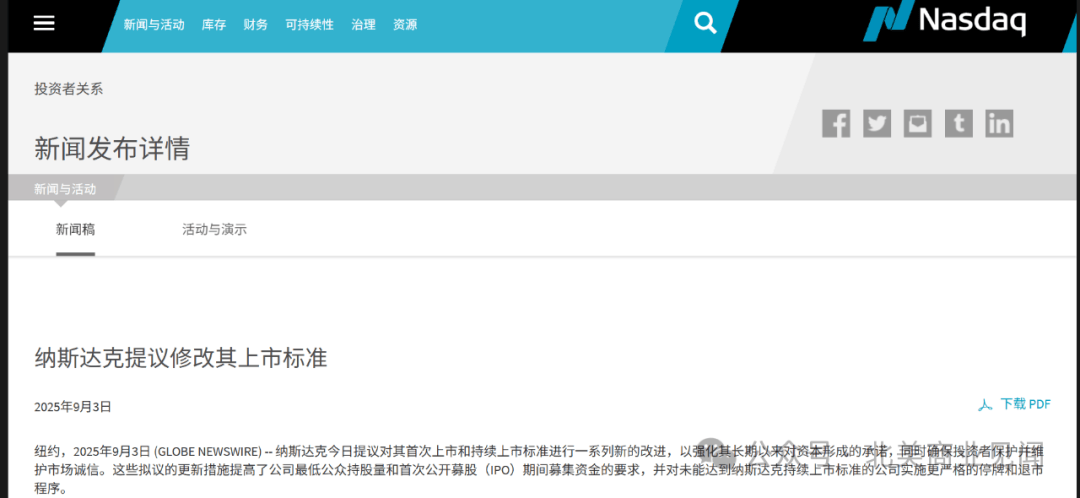
Core Viewpoint - Nasdaq's proposed changes to its listing standards may make it more difficult for Chinese companies to go public in the U.S. stock market, particularly on the Nasdaq exchange [1][5]. Group 1: Proposed Changes to Listing Standards - Nasdaq plans to implement stricter listing standards, including a minimum public float market value of $15 million for companies listing based on net income, up from the current threshold of $5 million [3]. - Companies with a market value below $5 million and listing deficiencies will face accelerated suspension and delisting processes [3]. - New companies primarily operating in China will be required to raise a minimum of $25 million in their IPOs [3]. Group 2: Regulatory Context and Market Impact - The changes are a response to recent volatility in smaller companies listed on U.S. exchanges, particularly those linked to "pump and dump" schemes, with examples of extreme price fluctuations in companies like Regencell Bioscience Holdings Ltd. and Pheton Holdings Ltd. [5][6]. - Nasdaq has been tightening its scrutiny of small IPOs from mainland China and Hong Kong since June 2022 to prevent significant price swings following a few trades [6]. - Over 280 Chinese companies are listed on major U.S. exchanges, with a total market capitalization of $1.1 trillion, indicating the scale of the market affected by these changes [6]. Group 3: Implications for Chinese Companies - The new standards could significantly impact Chinese companies, as the increased public float requirement and the specific fundraising threshold may exclude many small and medium-sized enterprises from Nasdaq [8]. - The average IPO financing amount for Chinese companies in 2024 is projected to be $5 million, down from over $300 million in 2021, highlighting a trend of reduced capital raising capabilities [8]. Group 4: Potential Strategies for Chinese Companies - Chinese companies may consider multi-market listings (A+H+N or H+N models) to mitigate risks associated with stricter U.S. regulations while maintaining their presence in the U.S. market [9]. - SPAC mergers could provide an alternative route for companies to go public without adhering to traditional IPO requirements, allowing for more flexible fundraising [10]. - Expanding Pre-IPO funding rounds could help companies accumulate sufficient capital before listing, although this may complicate their capital structure [10].