
淘宝

Search documents
李善友教授重磅新课|为竞争建模:拆解价值网,重构创新维度
混沌学园· 2025-07-24 08:04
Core Insights - A significant statistic reveals that 63% of companies fail due to being trapped in mainstream value networks, while those choosing edge value networks have a success rate of 37% [1][5][9] - The competition among companies is not merely about products or technologies, but rather a battle between value networks [1][8] Group 1: Course Overview - The course titled "Modeling Competition: Deconstructing Value Networks and Reconstructing Innovation Dimensions" will be led by Professor Li Shanyou, focusing on a methodology developed over 10 years of research [2][30] - The course aims to provide actionable competitive modeling methodologies for decision-makers and entrepreneurs facing growth challenges [2][5] Group 2: Key Values of the Course - The course addresses the growth dilemma, emphasizing that 63% of companies fail due to their choice of value networks, rather than technological or managerial shortcomings [5][6] - It challenges the conventional understanding of competition, asserting that the real competition occurs between value networks rather than individual companies [8][9] Group 3: Value Network Competition Theory - The course will explore the concept of disruptive innovation, highlighting that disruption arises from the combination of new technologies and new markets [10][21] - It will provide insights into how companies can transition from being disrupted to actively disrupting their competitors by understanding their value network positioning [10][21] Group 4: Course Content and Methodology - The course will utilize the "One Thinking, Three Stages of Innovation" framework to help participants build competitive models and identify breakthrough points [14][15] - Participants will learn to identify key market entry points in edge markets through the lens of disruptive innovation [17][18] Group 5: Target Audience - The course is designed for various stakeholders, including corporate decision-makers, entrepreneurs, innovation managers, and those seeking cognitive upgrades [27][30] - It aims to equip participants with tools to diagnose their company's value network and develop strategies for competitive advantage [28][30]


突发!“零元购”全面下线!
中国基金报· 2025-07-23 07:09
Core Viewpoint - The Shanghai market supervision department has taken action against platforms like Ele.me, requiring them to implement three key rectifications to ensure fair competition and consumer protection in the food delivery industry [4][5]. Group 1: Regulatory Actions - The Shanghai market supervision department has conducted talks with Ele.me and other platforms, mandating the complete removal of "zero yuan purchase" promotional activities [4][5]. - Platforms are required to significantly reduce the scope of free meal marketing and establish a special task force to enhance activity monitoring, price control, and rider rights protection [4][5]. - Continuous enforcement of regulations is emphasized to ensure compliance and promote a healthy and sustainable development of the food service industry [4][5]. Group 2: Industry Competition - The recent "food delivery war" has prompted regulatory bodies to intervene after platforms engaged in aggressive discounting strategies, including free offers and substantial coupon distributions [8]. - Major platforms like Meituan reported a surge in daily order volumes, with Meituan exceeding 1.5 billion orders and Taobao Flash Sale reaching over 80 million orders [8]. - Industry leaders are calling for a return to rational competition, with Meituan's CEO highlighting the need for fair practices to avoid detrimental outcomes for all parties involved [8]. Group 3: New Initiatives Post-Regulation - Following the regulatory actions, Meituan has launched the "Ten Thousand Brands" initiative to support 10,000 well-known restaurant brands with tailored services [10]. - JD.com has introduced a "Dish Partner" recruitment plan, investing 1 billion yuan to find partners for 1,000 signature dishes, aiming to enhance quality and supply chain efficiency [10]. - Taobao Flash Sale has denied rumors regarding operational strategies, asserting that their business practices adhere to normal commercial regulations [10].


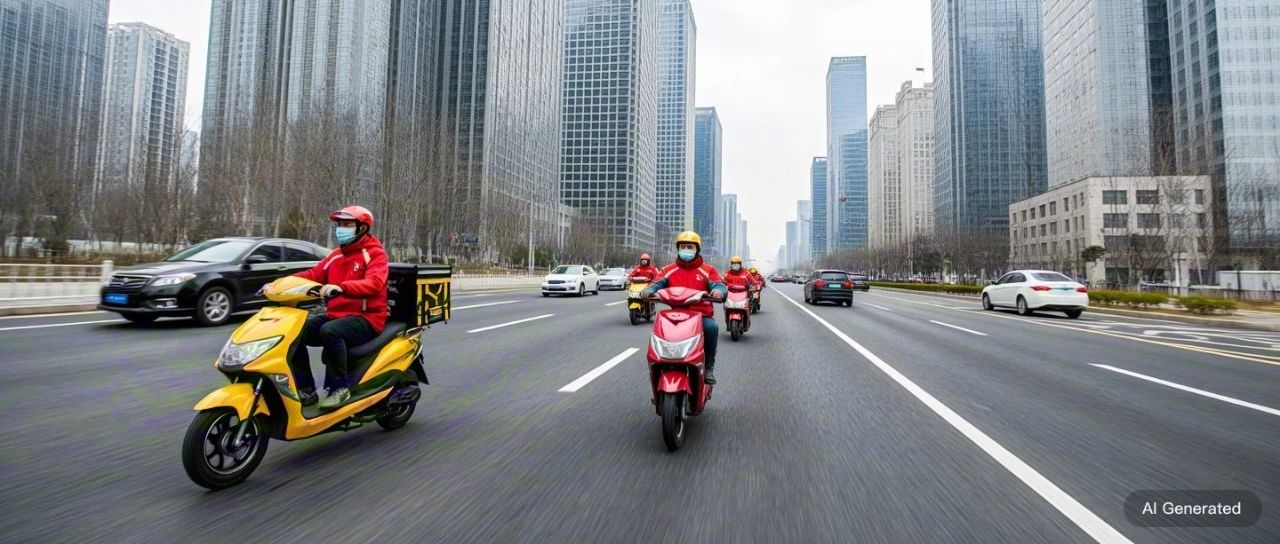
“外卖大战”硝烟未止:平台补贴仍继续,茶饮单量回归正常,有骑手称收入腰斩
Sou Hu Cai Jing· 2025-07-23 01:51
Group 1 - The core viewpoint of the articles indicates that while extreme discounts like "0 yuan purchase" have disappeared, the price war among food delivery platforms is not over, with significant discounts still being offered by platforms like Taobao, JD, and Meituan [1][2] - Industry experts predict that the price war will continue for at least 1-2 months due to new platforms entering the market, creating a competitive environment that will not resolve quickly [1][2] - The external pressure from regulatory bodies has led to a tightening of subsidies, but substantial discounts remain prevalent, indicating ongoing competition among major e-commerce platforms for market share in instant retail [2][6] Group 2 - During the height of the subsidy war, delivery riders experienced a surge in income, with reports of daily earnings exceeding 500 yuan, and some even reaching over 1,000 yuan [3][4] - As the subsidy war winds down, rider incomes have begun to decline, with many reporting daily earnings dropping to around 300-500 yuan [4] - The competitive landscape has shifted, with businesses now facing multiple layers of competition, including from other merchants on the same platform and across different platforms, leading to thinner profit margins [9] Group 3 - The reliance on subsidies has created a challenging environment for small and medium-sized businesses, as they struggle to compete with larger chains benefiting from significant funding [6][7] - The long-term sustainability of the benefits gained from the subsidy wars is questioned, as the price distortions created may not be recoverable once subsidies are removed [8] - Experts emphasize the need for businesses to balance profit margins with customer base growth, suggesting that selectively withdrawing from low-margin activities could be a viable strategy [5][9]
2025年(上)中国电子商务用户体验与投诉数据报告-网经社
Sou Hu Cai Jing· 2025-07-22 14:07
Core Insights - The report reveals significant consumer complaints in the e-commerce sector, highlighting issues such as refund disputes, product quality, and after-sales service [8][9][10]. Overall Data - The top complaint types include refund issues (17.59%), product quality (7.08%), and after-sales service (5.32%) [10]. - Complaints are concentrated in Guangdong Province (21.84%) and Zhejiang Province (9.11%) [13]. - The gender distribution of complaints shows a predominance of male users at 77.05% compared to 22.95% for female users [16]. - Most complaints involve amounts ranging from 0 to 50,000 (42.58%) and 0 to 100 (14.96%) [20]. Rating Data and Typical Cases Digital Retail - The top platforms for complaints include Pinduoduo and Douyin E-commerce, with issues such as delayed shipments and counterfeit products [28][31]. - The report lists 16 platforms recommended for ordering, including Tuhu Car Maintenance and Vipshop, while 11 platforms, including Xiaohongshu, are advised against [23][24]. Digital Life - The top complaint platforms in this category are Meituan and Qunar, with issues related to inadequate after-sales support and false advertising [53]. - The report identifies 7 platforms recommended for ordering, including Luban Home and BOSS Zhipin, while 3 platforms, including Feizhu, are advised against [53][54]. Cross-Border E-commerce - The top complaint platforms include AliExpress and Shiji, with complaints about product issues and after-sales service [2]. - The report emphasizes the need for improved service and regulatory oversight to enhance consumer experience in the e-commerce industry [2].

美宜佳门店突破40000店;京东启动新业务“生鲜折扣店”
Sou Hu Cai Jing· 2025-07-21 16:56
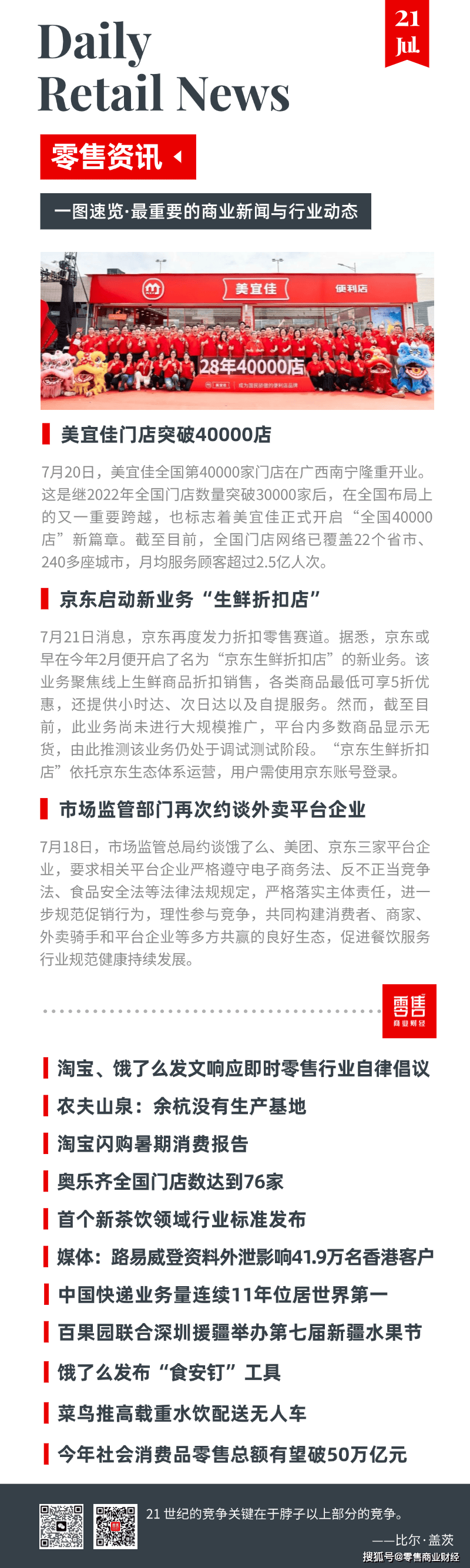
Group 1: Company Developments - Meiyijia has opened its 40,000th store in Nanning, Guangxi, marking a significant milestone in its national expansion, with coverage in 22 provinces and over 240 cities, serving more than 250 million customers monthly [6] - ALDI has expanded its presence in China, reaching a total of 76 stores nationwide, with new openings in Wuxi and Suzhou [14] - JD.com has launched a new business called "JD Fresh Discount Store," focusing on online discounts for fresh products, although it is still in the testing phase with limited product availability [8] Group 2: Market Trends and Consumer Behavior - Taobao Flash Sale reported a significant increase in night-time orders, with a more than 100% month-on-month growth in 127 cities since July, particularly in central and western regions [10] - The Chinese express delivery industry continues to lead globally, with an average of over 500 million packages collected daily, reflecting efficient resource allocation [15] - The retail sales of consumer goods in China are expected to exceed 50 trillion yuan this year, maintaining the country's position as the second-largest consumer market globally [22] Group 3: Regulatory and Industry Standards - The State Administration for Market Regulation has held discussions with major food delivery platforms, emphasizing compliance with e-commerce laws and promoting fair competition [9] - The first industry standard for fresh tea beverages has been officially released, which will take effect in January 2026, setting quality requirements for ingredients and packaging [14] - A new digital tool called "Food Safety Nail" has been launched by Ele.me to enhance food safety monitoring across the supply chain [18]


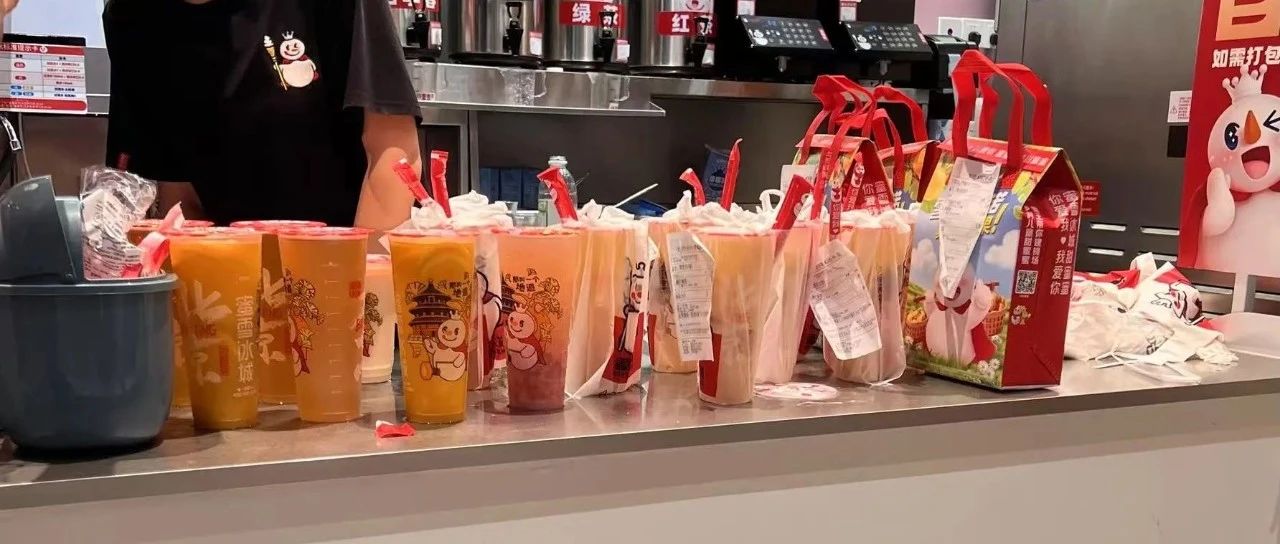
免费奶茶因无人取被扔掉、部分商家抱怨被平台裹挟,餐饮协会急喊 “停”!
第一财经· 2025-07-21 14:35
Core Viewpoint - The ongoing food delivery war has intensified competition among platforms, leading to significant consumer engagement through promotions, but also raising concerns about market practices and sustainability [1][2][4]. Group 1: Market Dynamics - The food delivery market has shifted from a stagnant to a growing market due to aggressive subsidies, with platforms like Meituan, Ele.me, and JD.com actively participating in this competition [1][2]. - The recent opening of JD.com's first self-operated delivery store indicates a new phase in the delivery competition, potentially altering market dynamics further [1]. - Regulatory bodies have urged platforms to adhere to existing laws and promote healthy competition, highlighting the need for a balanced ecosystem among consumers, merchants, delivery personnel, and platforms [1][4]. Group 2: Merchant Perspectives - Merchants have seen a 20% to 30% increase in delivery orders during the recent promotional period, but they express concerns about the long-term impact on in-store dining experiences [2][3]. - The intense competition has led some merchants to compromise on food quality to maintain lower delivery prices, which could harm their reputation and customer trust in the long run [3][4]. - Merchants are also facing operational challenges as they allocate resources to manage delivery orders, potentially detracting from in-store service quality [3][4]. Group 3: Industry Concerns - Industry associations have raised alarms about the negative effects of the subsidy wars, calling for an end to irrational price competition that could lead to systemic damage in the restaurant sector [4][5]. - The ongoing promotional activities, despite regulatory warnings, reflect a "subsidy inertia" where platforms continue to offer discounts to retain users, risking a potential drop in order volumes if subsidies are suddenly withdrawn [5][6]. - Analysts predict that while extreme subsidies may taper off, competition will evolve towards efficiency and service quality, leading to a healthier profit model in the long term [5][6].
2025年零售品牌100强-Brand Finance
Sou Hu Cai Jing· 2025-07-21 05:17
Overall Summary - The Brand Finance report reveals that the total brand value of the world's top 100 retail brands has reached USD 1.3 trillion, with a 9% increase year-on-year, highlighting the dominance of US brands and the strong performance of Chinese e-commerce brands [16][26][29]. Group 1: Brand Performance - Amazon retains its position as the world's most valuable retail brand for the tenth consecutive year, with a brand value of USD 356.4 billion, reflecting a 15% growth [16][35][42]. - Walmart ranks second with a brand value of USD 137.2 billion, marking a 42% increase, driven by private-label expansion and a rebranding effort aimed at younger consumers [16][36]. - Kmart is noted as the fastest-growing brand, with a 79% increase in brand value to USD 2.2 billion, attributed to its successful private label strategy [16][53]. Group 2: Regional Insights - The United States leads with 36 brands contributing 68% of the total brand value, amounting to USD 856.1 billion [29][30]. - China, despite a 14% decline in overall brand value, remains the third-highest contributor with USD 66.7 billion [27][29]. - Germany ranks second in brand value contribution at USD 83.4 billion, with strong performances from discount retailers like Lidl and Aldi [27][29]. Group 3: Brand Strength and Leadership - ICA from Sweden is recognized as the strongest retail brand globally, with a Brand Strength Index (BSI) score of 93.2 [2][65]. - The Brand Guardianship Index ranks Philip Daniele of AutoZone as the top retail brand CEO, reflecting strong leadership in brand management [80][89]. - E-commerce brands are increasingly prominent, with four of the top ten strongest retail brands originating from this sector, including JD.com and Meituan from China [71][72]. Group 4: Sustainability Trends - Sustainability is becoming a critical factor in consumer choice, with 4.9% of consideration driven by sustainability practices in retail [93]. - Brands are focusing on energy efficiency, waste reduction, and ethical sourcing to meet growing consumer demand for transparency and responsible practices [93].


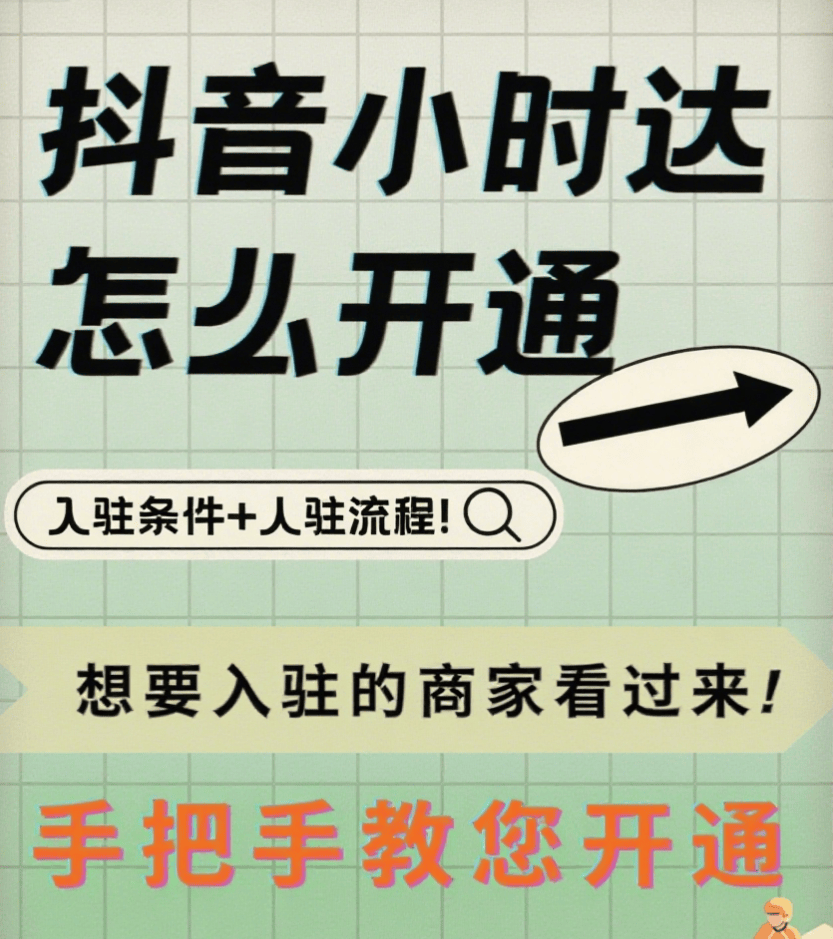
抖音小时达入驻全流程,2025年开店费用及教程超详细
Sou Hu Cai Jing· 2025-07-21 04:07
Core Insights - Douyin Xiaoshida is an instant retail service by Douyin, focusing on "delivery within approximately 1 hour after ordering" to meet users' immediate shopping needs [1] - The service was piloted in Shenzhen in August 2022 and expanded to major cities like Beijing, Shanghai, Guangzhou, and Shenzhen in 2023, with plans to open full access to all e-commerce influencers by March 2025 [1] - The service covers a radius of 5-10 kilometers from the user, offering categories such as fresh produce, food, daily necessities, 3C accessories, flowers, beauty products, and over-the-counter drugs [1] Service Model - Merchant Model: Merchants must provide business licenses and relevant operating qualifications, set up their stores, list products, and manage orders and delivery [2] - Influencer Sales: Influencers with complete e-commerce permissions can automatically activate their accounts and promote products through short videos, images, and live streams [2] - Delivery relies on third-party teams, with a system that matches nearby delivery personnel, typically achieving delivery within 1 hour, although delays may occur during peak times or adverse weather [2] Onboarding Process - Preparation: Required documents include business licenses, legal representative ID, store logo, and product photos [5] - Store Creation: Merchants create a store on the platform and fill in necessary information [5] - Submission and Review: Submitted information is reviewed, typically taking 3-5 business days for results [5] - Information Completion: After approval, merchants can further refine store details [5] - Product Upload: Merchants upload product information, including names, prices, descriptions, and inventory [5] - Shipping Fee Setting: Merchants set shipping fees based on actual conditions [5] - Product Launch: After completing the previous steps, products are published on the platform [5] - Marketing Operations: Merchants can then engage in marketing to attract more users [5]
“网络身份证”已正式启用|南财合规周报(第199期)
2 1 Shi Ji Jing Ji Bao Dao· 2025-07-21 00:36
AI Developments - The National Intellectual Property Administration of China is exploring the application of AI in patent examination, aiming to assist examiners in understanding inventions and conducting technical analyses more efficiently [2] - The implementation of AI in patent examination will serve as an auxiliary tool, and AI-generated reasoning cannot be used directly as examination opinions [2] Regulatory Dynamics - The State Administration for Market Regulation of China has summoned Ele.me, Meituan, and JD.com to ensure compliance with e-commerce laws and promote healthy competition in the food delivery industry [3] - The platforms are urged to adhere to laws such as the E-commerce Law and the Anti-Unfair Competition Law, and to rationalize promotional activities to foster a win-win ecosystem for consumers, merchants, and delivery personnel [3] - JD.com, Meituan, and Taobao have responded to recent competitive practices, with Taobao planning to inject 50 billion yuan into consumer and merchant subsidies over the next 12 months [3] Online Identity Management - The "Network Identity Card" was officially launched on July 15, allowing users to verify their identity in online transactions, significantly reducing the risk of personal information leakage [4] - Users can apply for and use the identity card through the National Network Identity Authentication App, with specific guidelines for minors regarding application [4] Overseas Developments - NVIDIA has announced the resumption of sales of its H20 AI chips to China, following U.S. approval, and plans to launch a new GPU compatible with the Chinese market [5][6] - NVIDIA's CEO emphasized the benefits of AI for global business and society during discussions with government and industry officials in Beijing [6] Corporate Investments - Meta Platforms, led by Mark Zuckerberg, plans to invest up to hundreds of billions of dollars in building multiple large-scale AI data centers to advance "superintelligence" [7] - The first AI data center, "Prometheus," is expected to be operational by 2026, with another project, "Hyperion," expanding to a computing power of 5 gigawatts [7] Investigations - The French Competition Authority has initiated an investigation into Meta's online advertising practices, following allegations of market dominance abuse by the advertising platform Adloox [8] - The investigation will assess whether Meta's actions have impacted advertising verification services and related markets [8] New AI Products - Elon Musk has launched the AI chatbot Grok, featuring a "companion" function with characters like a gothic girl and a cartoon panda, available to SuperGrok subscribers for $30 per month [9] - The AI characters have sparked controversy due to their inappropriate comments, raising concerns about content moderation [9]

市场监管总局要求外卖平台“理性参与竞争”,此前美团多次呼吁拒绝非理性“内卷”
Zhong Guo Jin Rong Xin Xi Wang· 2025-07-19 03:20
Core Viewpoint - The Chinese market regulatory authority has urged major platforms like Ele.me, Meituan, and JD.com to adhere strictly to e-commerce laws and promote rational competition to foster a healthy ecosystem in the food delivery industry [1][2]. Group 1: Regulatory Actions - On July 18, the State Administration for Market Regulation held discussions with Ele.me, Meituan, and JD.com, emphasizing compliance with laws such as the E-commerce Law and the Food Safety Law [1]. - The regulatory body called for these platforms to take responsibility and regulate promotional activities to ensure a win-win situation for consumers, merchants, delivery riders, and platform companies [1]. Group 2: Industry Responses - Meituan's CEO Wang Xing has publicly stated the company's opposition to "involution" in the industry, highlighting that unhealthy competition is unsustainable and detrimental to both platforms and merchants [1]. - Meituan has initiated various measures to combat "involution," including the introduction of a fatigue prevention mechanism for delivery riders and the launch of pension insurance subsidies [2]. Group 3: Market Dynamics - Since April, major players like JD.com and Ele.me have engaged in aggressive subsidy campaigns, with an estimated total of 80 billion yuan in subsidies flooding the food delivery market, leading to peak daily orders of 250 million [2]. - The People's Daily has commented that the ongoing "food delivery war" is essentially a disguised price war, reflecting a struggle for market share in instant retail and e-commerce [2].
