东鹏饮料

Search documents
保龄宝(002286.SZ):公司主要客户有伊利、可口可乐等国内外知名厂商
Ge Long Hui· 2026-01-20 01:04
Core Viewpoint - The company, Baolingbao (002286.SZ), has a diverse client base including well-known domestic and international brands, and is expanding its product offerings in the health and nutrition sector, particularly with the approval of its lactulose raw material drug for future domestic sales [1] Group 1: Client Base - The company’s main clients include prominent brands such as Yili, Coca-Cola, Yuanqi Forest, Abbott, Feihe Dairy, Junlebao, Holley, Dongpeng Beverage, and Mixue [1] Group 2: Product Development - The core products of the company include prebiotics, dietary fibers, and sugar-reducing sweeteners, with detailed business and industry development information available in the company's 2025 semi-annual report [1] Group 3: Regulatory Approvals - In October 2025, the company obtained a production license for lactulose raw material from the Shandong Provincial Drug Administration, pending further registration with the National Medical Products Administration for domestic sales [1] - Currently, the lactulose raw material is only exported to select overseas markets, but future approvals in major countries are expected to enhance sales revenue and operational performance [1]

中原证券晨会聚焦-20260120
Zhongyuan Securities· 2026-01-20 00:40
Key Insights - The report highlights that China's GDP for 2025 is projected to reach 1401879 billion yuan, reflecting a growth of 5.0% compared to the previous year, indicating a successful completion of the "14th Five-Year Plan" [5][8] - The semiconductor industry showed strong performance in December 2025, with a 5.11% increase in the domestic semiconductor sector, outperforming the broader market [19] - The electric power and utilities sector maintained a "stronger than market" investment rating, with a focus on stable, high-dividend companies in the sector [36][38] Domestic Market Performance - The Shanghai Composite Index closed at 4114.00, with a slight increase of 0.29%, while the Shenzhen Component Index rose by 0.09% to 14294.05 [3] - The average P/E ratios for the Shanghai Composite and ChiNext indices are 16.80 and 53.52, respectively, indicating a favorable environment for medium to long-term investments [9][10] Industry Analysis - The aerospace and electric grid sectors led the A-share market with slight gains, while the internet services and software development sectors faced challenges [6][9] - The battery and semiconductor sectors are highlighted as key areas for investment, with significant growth potential driven by technological advancements and market demand [11][12] Economic Indicators - The report notes a trend of increased capital inflow into the equity market, with a notable rise in margin trading balances, suggesting a positive outlook for market continuation [10][11] - The CPI showed a slight increase in December 2025, indicating marginal improvements in domestic demand [10][11] Sector-Specific Insights - The new energy vehicle sector saw sales of 171.0 million units in December 2025, a year-on-year increase of 7.14%, supported by favorable policies [15] - The chemical industry experienced a slowdown in price declines, with specific focus on agricultural chemicals and polyester filament [17] - The gaming industry is projected to continue its steady growth, with animation films leading box office revenues [27][30]

市值缩水近四成 华润饮料换帅破局
Guo Ji Jin Rong Bao· 2026-01-19 16:04
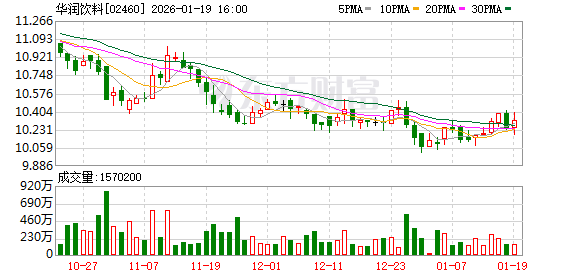
Core Viewpoint - The leadership change at China Resources Beverage, with Gao Li taking over as chairman, comes at a critical time as the company faces performance pressures and intensified industry competition [2][3]. Group 1: Leadership Change - Gao Li, a veteran of the China Resources Group, has been appointed as the new chairman, succeeding Zhang Weitong, who stepped down due to work adjustments [2]. - Gao Li has a strong financial background, having served as the financial director of China Resources Beverage from 2012 to 2020 and as the general manager of the finance department of China Resources Group since January 2025 [2]. Group 2: Performance Challenges - China Resources Beverage's revenue growth has stagnated, with a reported revenue of 13.52 billion yuan in the year of its IPO, reflecting only a 0.05% increase, while profit growth of 23.12% was primarily due to cost control [4]. - In the first half of 2025, the company experienced a decline in both revenue and profit, with revenue dropping to 6.206 billion yuan, a year-on-year decrease of 18.52%, and net profit falling to 808 million yuan, down 28.63% [4]. Group 3: Market Competition - The bottled water market has seen significant changes, with competitors like Wahaha and Nongfu Spring impacting China Resources Beverage's sales, particularly in the small-sized bottled water segment [5]. - In the first half of 2025, Nongfu Spring's bottled water revenue grew by 10.7% to 9.443 billion yuan, while China Resources Beverage's revenue in the same segment fell by 23.1% to 5.251 billion yuan [6]. Group 4: Strategic Initiatives - To diversify its revenue streams, China Resources Beverage has been actively launching new products in tea, juice, and sports drinks, introducing 14 new SKUs in the first half of the previous year [7]. - Despite these efforts, non-water beverage revenue only accounted for approximately 15.4% of total revenue, indicating that the second growth curve has not yet materialized [7]. Group 5: Market Position and Valuation - China Resources Beverage's revenue has remained stagnant around 13.5 billion yuan in 2023 and 2024, with expectations that its total revenue for 2025 will likely be surpassed by competitors like Dongpeng Beverage and Yuanqi Forest [7]. - As of January 19, 2026, the company's stock price had dropped to 10.32 HKD, a decline of 29% from its one-year high and over 38% from its IPO closing price, resulting in a market capitalization of 24.749 billion HKD, down 36.8% from its IPO value [8].

市值缩水近四成,华润饮料换帅破局
Guo Ji Jin Rong Bao· 2026-01-19 16:02
Core Viewpoint - The leadership change at China Resources Beverage comes at a critical time as the company faces declining performance and increased competition in the beverage industry [1][3]. Group 1: Leadership Change - Zhang Weitong has stepped down as Chairman of China Resources Beverage due to work adjustments, with Gao Li taking over for a three-year term [1]. - Gao Li has a strong financial background and has previously held key positions within the China Resources Group, including serving as the CFO of China Resources Beverage from 2012 to 2020 [1]. Group 2: Performance Challenges - In 2024, China Resources Beverage's revenue growth stagnated, with total revenue at 13.521 billion yuan, reflecting a mere 0.05% increase, while net profit grew by 23.12% mainly due to cost control [3]. - By the first half of 2025, the company experienced a decline in both revenue and profit, with operating income at 6.206 billion yuan, down 18.52% year-on-year, and net profit at 0.805 billion yuan, down 28.63% [3]. - The core packaged water business, which accounts for nearly 90% of revenue, has seen significant declines, particularly in the sales of its flagship product, Yibao [3][5]. Group 3: Market Competition - The competitive landscape in the packaged drinking water market has shifted, with Wahaha regaining market presence and Nongfu Spring launching a low-priced product that negatively impacted Yibao's sales [3]. - In the first half of 2025, Nongfu Spring's revenue from packaged drinking water reached 9.443 billion yuan, a 10.7% increase, while China Resources Beverage's water segment revenue fell to 5.251 billion yuan, a 23.1% decline [5]. Group 4: Growth Strategy - China Resources Beverage has been criticized for its reliance on a single product line and has attempted to diversify by launching new products in tea, juice, and sports drinks [6]. - In the first half of 2025, non-water beverage revenue was 0.955 billion yuan, a 21.3% increase, but still only accounted for about 15.4% of total revenue, indicating that a second growth curve has not yet materialized [6]. Group 5: Market Position and Valuation - Competitors like Dongpeng Beverage and Yuanqi Forest are expected to surpass China Resources Beverage in revenue, with Dongpeng projected to exceed 20 billion yuan and Yuanqi Forest anticipating a 26% growth [8]. - China Resources Beverage's stock price has declined significantly, with a closing price of 10.32 HKD on January 19, 2026, down 29% from its peak and over 38% from its IPO price, leading to a market capitalization decrease of 36.8% from its initial value [8].
2026年食品饮料行业投资策略报告:筑底修复为主线,结构分化藏良机-20260119
Wanlian Securities· 2026-01-19 11:02
Group 1 - The core viewpoint of the report indicates that the food and beverage industry experienced a downturn in performance and stock prices in 2025, with revenue growth slowing and net profit declining for the first time [2][16][23] - The food and beverage sector's revenue for the first three quarters of 2025 was 831.395 billion yuan, a year-on-year increase of only 0.14%, while net profit decreased by 4.57%, ranking 20th and 21st among 31 industries respectively [16][20] - The stock prices of the food and beverage sector fell by 4.72% from January to November 2025, placing it at the bottom of the performance rankings among the 31 industries [23][27] Group 2 - In the liquor industry, the report notes that channel destocking and low valuations combined with high dividend yields provide support for stock prices, despite a challenging environment due to policy impacts [3][36] - The report predicts that the white liquor industry will enter a "volume-price double kill" phase, characterized by intensified competition and market consolidation [3][36] - The report highlights that the beer sector is expected to see marginal improvements in 2026 due to cost advantages and a recovery in on-premise consumption [4][36] Group 3 - The dairy sector is experiencing a recovery in demand, with low-temperature and deep-processed dairy products showing positive growth, while the overall profitability of dairy companies varies significantly [4][9] - The condiment industry is evolving towards customization driven by the rise of chain restaurants and strong retail channels, with a focus on companies that can meet tailored demands [4][9] - The frozen food sector is expected to return to positive growth as price wars ease, with companies like Anji actively exploring new sales channels [4][9] Group 4 - The soft drink market is primarily driven by functional beverages, which are seen as a high-growth segment, while the overall market growth is expected to rely on structural upgrades [4][9] - The snack industry is facing challenges with "revenue without profit," and companies with health-oriented products and strong channel advantages are recommended for attention [4][9]






一周港股IPO:袁记食品、比格餐饮等26家递表;牧原股份等3家通过聆讯
Cai Jing Wang· 2026-01-19 10:35
Group 1: Market Activity - A total of 26 companies submitted applications to the Hong Kong Stock Exchange last week, marking a recent high in submissions [2] - Among the 26 companies, 3 passed the hearing, and 1 company is currently in the process of an IPO [10][12] Group 2: Industry Highlights - The semiconductor and computing sectors are particularly active, with companies like Weizhao Semiconductor and Placo Electronics submitting applications [2] - Weizhao Semiconductor reported a revenue of 615 million yuan and a profit of 40.25 million yuan for the first nine months of 2025 [2] - Placo Electronics achieved a revenue of 751 million yuan and a profit of 76.11 million yuan for the same period [2] Group 3: Robotics Sector - Several robotics companies, including Yifei Intelligent and Estun, are also pursuing listings [3] - Estun is ranked first in the industrial robotics sector by revenue, with a market share of 1.7% globally [3] - TuoStar is recognized as a leader in the domestic industrial robotics market, with a revenue of 1.688 billion yuan and a net profit of 47 million yuan for the first nine months of 2025 [3] Group 4: Biopharmaceutical Sector - Multiple biopharmaceutical companies are applying for listings, including Zeling Bio and Exegenesis Bio Inc. [4][5] - Zeling Bio reported a loss of 1.19 million yuan for the first nine months of 2025, while Exegenesis Bio has not yet received regulatory approval for its products [5][6] - Shanghai Shengsheng achieved a revenue of 538 million yuan and a net profit of 11.3 million yuan for the same period [4] Group 5: Food and Beverage Sector - The food and beverage sector is seeing significant activity, with companies like Yuanji Food and Qian Dama submitting applications [7] - Yuanji Food reported an adjusted net profit of 192 million yuan for the first nine months of 2025, a 31% increase year-on-year [7] - Qian Dama achieved a GMV of 14.8 billion yuan in 2024, maintaining its position as the top player in the community fresh product retail chain industry [7] Group 6: New Listings - Four new stocks were listed last week, with all experiencing price increases on their first trading day [13] - The stock of Howie Group, a global leader in CMOS image sensors, rose by 16.22% on its debut [13] - Zhaoyi Innovation, a storage chip leader, saw its stock price increase by 38.27% on its first day of trading [13]


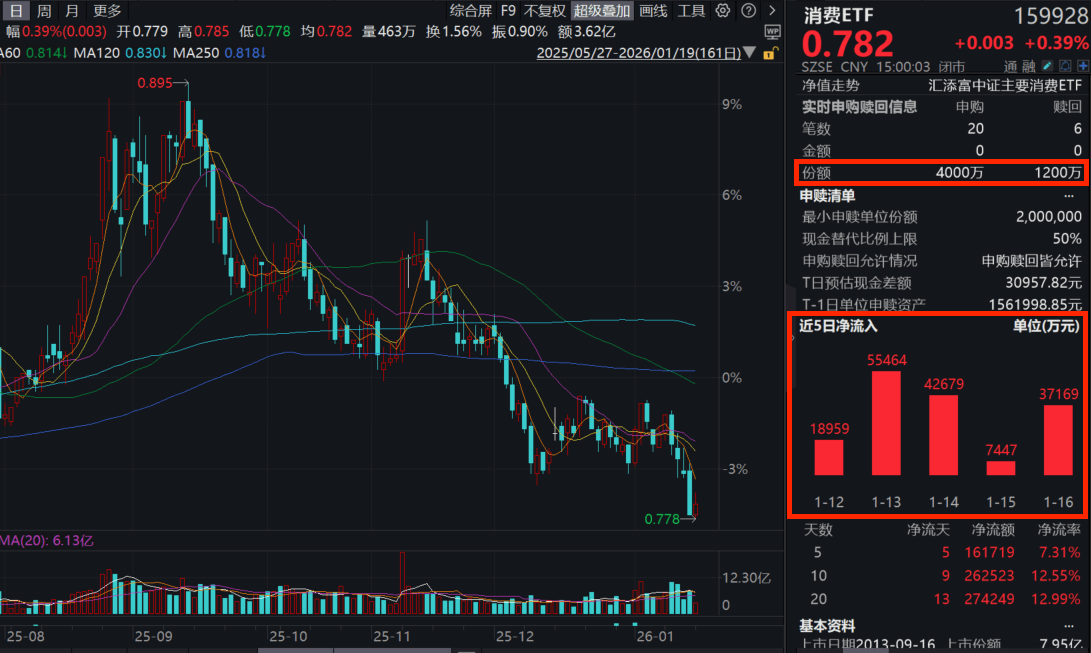
2025年社零同比增长3.7%!消费ETF(159928)收涨0.39%结束四连阴,近5日净流入超16亿元!政策加码下消费动能将持续释放!
Sou Hu Cai Jing· 2026-01-19 09:33
Group 1: Market Performance - A-shares experienced a slight increase with the consumer sector performing well, as evidenced by the leading consumer ETF (159928) rising by 0.39% and achieving a trading volume exceeding 360 million yuan [1] - The consumer ETF has seen a net subscription of 28 million units today, accumulating over 1.6 billion yuan in the past five days [1] Group 2: Economic Data - The National Bureau of Statistics reported that China's GDP for the year reached 14,018.79 billion yuan, reflecting a 5% growth year-on-year at constant prices [3] - In December 2025, the retail sales of consumer goods grew by 0.9% year-on-year, a decrease of 0.4 percentage points compared to November [3] - The per capita disposable income for residents in 2025 was 43,377 yuan, marking a nominal increase of 5% year-on-year, with a real growth of 5% after adjusting for price factors [3] Group 3: Consumer Trends and Policies - The focus on enhancing service consumption is evident, with a CAGR of approximately 9.6% in per capita service consumption from 2020 to 2024, expected to reach 46.1% of total consumption by 2024 [7] - The government aims to boost domestic demand and has outlined key tasks for 2026, emphasizing the importance of "domestic demand as the main driver" [3][7] - Policies are expected to support sectors such as elderly care, cultural tourism, and sports, with a focus on new consumption scenarios and enhancing service quality [4][8] Group 4: Investment Opportunities - The consumer ETF (159928) is noted for its resilience across economic cycles, with a TTM price-to-earnings ratio of 18.91, which is lower than 99% of the historical data over the past decade [4][9] - The top ten holdings in the consumer ETF account for over 68.55% of its weight, with significant representation from leading liquor brands and agricultural companies [9][10] - The Hong Kong Stock Connect Consumer 50 ETF (159268) is highlighted as an efficient investment vehicle for the consumer sector, particularly appealing to the younger generation [10]

食品饮料行业跟踪报告:茅台重塑价格体系,推进市场化改革
Shanghai Aijian Securities· 2026-01-19 09:04
Investment Rating - The industry investment rating is "Outperform the Market" [1] Core Insights - The report highlights that the liquor industry is entering a phase of rapid performance clearing, with demand expected to show weak recovery as policy pressures ease. The industry is currently at a low valuation, and pessimistic expectations are fully priced in. The leading liquor companies are stabilizing prices and increasing dividends, making them attractive for investment [3] - The report emphasizes the strategic price adjustments by Kweichow Moutai, which aims to stabilize its distribution channels and ensure reasonable profit margins for distributors. This adjustment reflects a market-oriented pricing mechanism and is expected to enhance the stability of the distribution system during the industry adjustment period [4] - The report also notes that Eastroc Beverage's performance for 2025 is in line with expectations, with significant revenue growth projected. The company is transitioning from a regional to a national brand, showcasing its platform capabilities and growth potential [4] Summary by Sections Liquor Industry - The liquor industry is experiencing a phase of performance clearing, with demand expected to recover weakly due to easing policy pressures. The industry is at a low valuation, and leading companies are stabilizing prices and increasing dividends, making them attractive for investment [3] - Kweichow Moutai has adjusted the contract prices for several products to align with market prices, ensuring reasonable profit margins for distributors and stabilizing the distribution system [4] Consumer Goods - The consumer goods sector is focusing on high-growth areas, with some segments still benefiting from new products and channels. Companies like Wancheng Group and Eastroc Beverage are highlighted for their growth potential and market positioning [3]
饮料乳品板块1月19日跌0.18%,欢乐家领跌,主力资金净流出4859.23万元
Zheng Xing Xing Ye Ri Bao· 2026-01-19 08:52
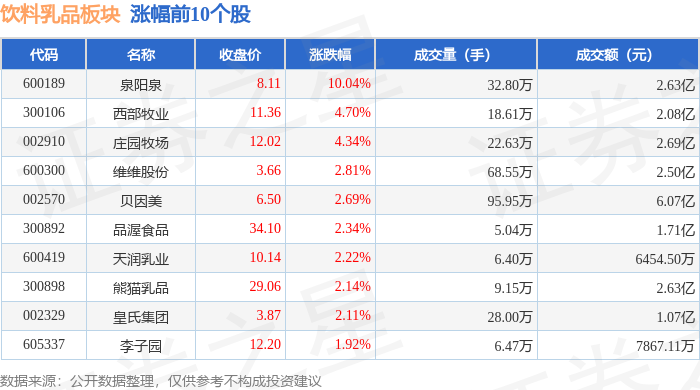
Core Insights - The beverage and dairy sector experienced a slight decline of 0.18% on January 19, with Huanlejia leading the drop [1] - The Shanghai Composite Index closed at 4114.0, up 0.29%, while the Shenzhen Component Index closed at 14294.05, up 0.09% [1] Sector Performance - The beverage and dairy sector saw mixed performances among individual stocks, with notable gainers including: - Quanyunquan (681009) with a closing price of 8.11, up 10.04% and a trading volume of 328,000 shares [1] - Xibumuy (300106) at 11.36, up 4.70% with 186,100 shares traded [1] - Zhuangyuanmucang (002910) at 12.02, up 4.34% with 226,300 shares traded [1] - Conversely, Huanlejia (300997) led the decline with a closing price of 26.12, down 5.09% and a trading volume of 225,400 shares [2] Capital Flow - The beverage and dairy sector experienced a net outflow of 48.59 million yuan from institutional investors, while retail investors saw a net inflow of 68.04 million yuan [2] - The capital flow for individual stocks showed: - Quanyunquan had a net inflow of 72.37 million yuan from institutional investors, but a net outflow from retail investors [3] - Yiyuan Beverage (600887) had a net inflow of 8.73 million yuan from institutional investors, with a slight net outflow from retail investors [3]

饮料市场加速分化 接班潮涌能否讲出新故事?
Zhong Guo Jing Ying Bao· 2026-01-19 08:41
Core Insights - The beverage industry is shifting from merely quenching thirst to emphasizing health attributes, with this trend expected to be more pronounced by 2025 [1] - Reports indicate that low-sugar and no-sugar options will become standard in the beverage market by 2025, reflecting a clear trend towards health-conscious consumption [1] - The industry is experiencing a bifurcation, with some companies capitalizing on market trends for growth while others face declining performance [1] Industry Performance - In November 2025, China's beverage production reached 10.46 million tons, a year-on-year increase of 0.4%, with a cumulative production of 165.61 million tons from January to November, reflecting a 3.3% growth [2] - Eastroc Beverage reported impressive performance with a revenue of 16.844 billion yuan in the first three quarters of 2025, a 34.13% increase year-on-year, while Nongfu Spring achieved a revenue of 25.622 billion yuan, up 15.6% [2] - Conversely, traditional giants like Master Kong faced challenges, with a revenue decline of 2.7% in the first half of 2025 [2] Segment Analysis - Sales of tea beverages fell by 6.3% to 10.67 billion yuan, fruit juice sales dropped by 13.0% to 2.956 billion yuan, and packaged water sales decreased by 6.0% to 2.377 billion yuan [3] - Carbonated and other beverages saw a growth of 6.3%, reaching 10.256 billion yuan [3] - The plant-based protein drink segment struggled, with leading brands like Yangyuan and Chengde Lulux experiencing revenue declines of 7.64% and 9.42%, respectively [3] Competitive Landscape - Companies are adjusting to revenue declines, with some experiencing double-digit drops; for instance, China Resources Beverage's revenue fell by 18.5% to 6.206 billion yuan [4] - The competitive landscape is marked by price wars, particularly in the packaged water segment, leading to significant revenue drops for brands like "Yibao" [4] - Analysts suggest that the success of Nongfu Spring's tea segment indicates a shift from basic hydration to quality tea beverages, while traditional companies must innovate to escape the price war trap [4] Emerging Trends - The rise of functional beverages is evident, with products tailored for specific scenarios, such as sports and fitness, gaining traction [7] - Brands are focusing on packaging innovations and marketing strategies that align with health and fitness trends, such as electrolyte water and convenient single-use formats [7][8] - The health and wellness segment is seeing explosive growth, with numerous new brands entering the market, particularly in traditional Chinese health drinks [6] Leadership Transition - The beverage industry is witnessing a generational shift, with new leaders taking over established companies, such as Wei Hongcheng at Master Kong and Xu Yangyang at Dali Foods [9][10] - These new leaders bring fresh perspectives and experiences, which may help navigate the challenges of a saturated market [11] - However, not all transitions are smooth, as seen in the ongoing succession issues at Wahaha, highlighting the complexities of generational change in the industry [11]