
方大特钢

Search documents
钢铁行业今日涨2.59%,主力资金净流入4.19亿元
Zheng Quan Shi Bao Wang· 2025-07-29 08:54
沪指7月29日上涨0.33%,申万所属行业中,今日上涨的有16个,涨幅居前的行业为通信、钢铁,涨幅 分别为3.29%、2.59%。钢铁行业位居今日涨幅榜第二。跌幅居前的行业为农林牧渔、银行,跌幅分别 为1.36%、1.19%。 资金面上看,两市主力资金全天净流出356.37亿元,今日有4个行业主力资金净流入,医药生物行业主 力资金净流入规模居首,该行业今日上涨2.06%,全天净流入资金29.96亿元,其次是钢铁行业,日涨幅 为2.59%,净流入资金为4.19亿元。 | 代码 | 简称 | 今日涨跌幅(%) | 今日换手率(%) | 主力资金流量(万元) | | --- | --- | --- | --- | --- | | 600010 | 包钢股份 | 5.16 | 7.57 | 18129.61 | | 600581 | 八一钢铁 | 10.00 | 9.49 | 10621.67 | | 301160 | 翔楼新材 | 8.91 | 10.65 | 7217.90 | | 600507 | 方大特钢 | 3.85 | 3.15 | 4987.12 | | 000898 | 鞍钢股份 | 3.96 | 0 ...



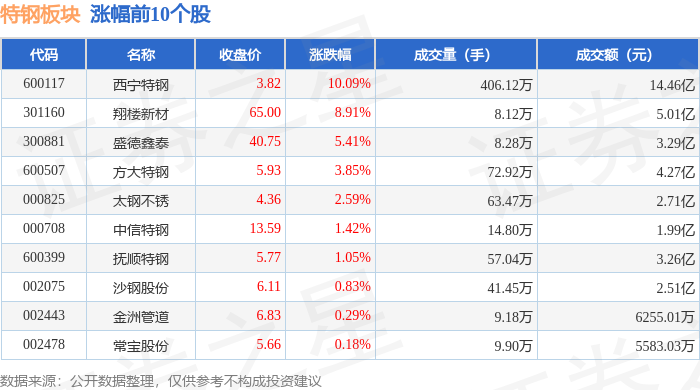
特钢板块7月29日涨1.9%,西宁特钢领涨,主力资金净流出4401.56万元
Zheng Xing Xing Ye Ri Bao· 2025-07-29 08:33
Market Performance - The special steel sector increased by 1.9% on July 29, with Xining Special Steel leading the gains [1] - The Shanghai Composite Index closed at 3609.71, up 0.33%, while the Shenzhen Component Index closed at 11289.41, up 0.64% [1] Individual Stock Performance - Xining Special Steel (600117) closed at 3.82, up 10.09% with a trading volume of 4.0612 million shares and a turnover of 1.446 billion yuan [1] - Xianglou New Material (301160) closed at 65.00, up 8.91% with a trading volume of 81,200 shares and a turnover of 501 million yuan [1] - Shengde Zhengtai (300881) closed at 40.75, up 5.41% with a trading volume of 82,800 shares and a turnover of 329 million yuan [1] - Fangda Special Steel (600507) closed at 5.93, up 3.85% with a trading volume of 1.7292 million shares and a turnover of 427 million yuan [1] - Other notable performances include Taigang Stainless Steel (000825) up 2.59% and CITIC Special Steel (000708) up 1.42% [1] Capital Flow Analysis - The special steel sector experienced a net outflow of 44.0156 million yuan from main funds, while retail funds saw a net inflow of 131 million yuan [2] - The individual stock capital flow indicates that Xianglou New Material had a main fund net inflow of 72.1603 million yuan, while Fangda Special Steel had a net inflow of 62.5260 million yuan [3] - Conversely, stocks like Jiu Li Special Materials (002318) and Fushun Special Steel (600399) experienced significant net outflows from main funds [3]


重视周期大宗的牛市机会
2025-07-29 02:10
Summary of Conference Call Industry Overview - The conference call primarily discusses the outlook for the Chinese capital market, focusing on various sectors including financials, technology, and commodities, particularly in the context of economic challenges and policy reforms. Key Points and Arguments Market Outlook - The Shanghai Composite Index is expected to reach a high of approximately 3,800 to 4,000 points by the end of the year, with the Hang Seng Index and Hang Seng Tech Index also anticipated to hit new yearly highs [2][20]. - Despite some market volatility expected in August, it is viewed as a final opportunity to increase positions in the market for the year [2][20]. Economic Conditions - The prevailing sentiment is that the economic downturn is widely recognized, but it is not expected to lead to significant market corrections as seen in previous years [3][4]. - The current market conditions are compared to Japan's past economic stagnation, noting that while China's economy has not reached that level, asset prices have already adjusted significantly [6][10]. Investment Strategy - The focus remains on sectors such as financials, technology, and certain cyclical commodities, with an emphasis on the importance of long-term investment logic [20][21]. - The decline in risk-free interest rates is highlighted as a critical factor that will drive market growth and attract new capital into the stock market by 2025 [9][20]. Sector-Specific Insights - **Financial Sector**: Strong recommendations for investing in financial stocks, particularly brokerages, as they are expected to benefit from the market's upward trajectory [16][20]. - **Technology Sector**: Continued optimism for growth in technology stocks, especially in AI and related fields, as demand is expected to rise significantly [25][26]. - **Cyclical Commodities**: The cyclical commodities sector is viewed as undervalued, with potential for price increases as economic conditions improve [17][19]. Policy Implications - Recent economic policies are seen as timely and appropriate, aimed at enhancing investor returns, which is a shift from previous years [8][20]. - The importance of structural reforms in the capital market is emphasized, as they are expected to improve the overall investment climate and attract more capital [12][20]. Risks and Considerations - The potential for a disconnect between commodity prices and stock prices is noted, with the latter expected to rise even if commodity prices do not follow suit [19][20]. - The need for investors to focus on companies with clear long-term growth narratives is stressed, as those without such narratives may struggle to attract investment [20][21]. Additional Important Content - The discussion includes insights into specific sectors such as the rare earth materials and chemicals industries, with recommendations for companies that are well-positioned to benefit from current market dynamics [22][29][35]. - The impact of upcoming expirations of high-yield deposits and financial products is anticipated to influence market liquidity and investment behavior [14][20]. This summary encapsulates the key insights and recommendations from the conference call, providing a comprehensive overview of the current market outlook and strategic investment considerations.
研判2025!中国液氨储罐行业分类、发展背景、市场规模、竞争格局及前景展望:下游应用领域广泛,带动液氨储罐产业蓬勃发展[图]
Chan Ye Xin Xi Wang· 2025-07-29 01:24
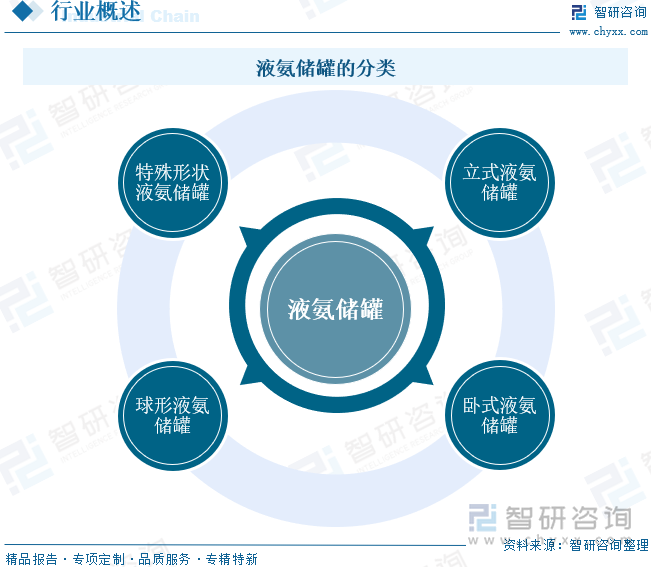
Industry Overview - The liquid ammonia storage tank is a specialized equipment for storing and transporting liquid ammonia, with a history dating back to the late 19th century. Its development has been driven by advancements in chemical industry and increasing demand in agriculture, medicine, and food sectors [1][4][14] - The market size of China's liquid ammonia storage tank industry is projected to reach approximately 7.788 billion yuan in 2024, representing a year-on-year growth of 10.12% [1][14] - The first phase of the world's largest green hydrogen ammonia project, with an initial capacity of 320,000 tons, was officially put into operation on July 8, 2025. This project includes a milestone liquid ammonia storage tank project that is the first large-scale low-temperature tank for storing green ammonia globally [1][14] Industry Development Background - The demand for liquid ammonia has been increasing, with production expected to grow from 45.51 million tons in 2018 to 62.10 million tons in 2024, reflecting a compound annual growth rate of 5.32% [7] - The growth in liquid ammonia production has spurred the demand for specialized storage equipment, leading to rapid technological advancements in liquid ammonia storage tanks [7] Industry Chain - The upstream of the liquid ammonia storage tank industry includes raw materials and equipment, such as special steel, low-temperature alloys, insulation materials, sealing materials, and welding materials. The core equipment includes compressors, refrigeration units, and safety valves [10] - The midstream involves the production and manufacturing of liquid ammonia storage tanks, while the downstream applications span across chemical, construction, aerospace, biomedical, and environmental sectors [10] Industry Trends - The trend towards larger liquid ammonia storage tanks is driven by increasing production capacity and import/export demands. The industry is moving towards 50,000-ton capacity tanks to reduce land use and operational costs [22] - The integration of smart technologies, such as IoT sensors and AI monitoring systems, is enhancing safety and efficiency in the liquid ammonia storage tank sector [23] - The green transformation of liquid ammonia storage tanks is essential, focusing on low-energy, corrosion-resistant materials and the adoption of BOG recovery systems to minimize carbon emissions [24] Key Companies - Major companies in the liquid ammonia storage tank market include CIMC Enric, Blue Science and Technology, and various domestic manufacturers that dominate the mid to low-end market, while international brands focus on high-end large storage tanks [15][18][20]


湖口高新技术产业园:千亿园区锚定“智造绿心”
Zhong Guo Hua Gong Bao· 2025-07-28 05:51
Core Insights - The Jiangxi Jiujiang Lakeside High-tech Industrial Park (Lakeside Park) has officially entered the trillion-yuan park category in 2024, achieving accounts receivable of 101.778 billion yuan, a year-on-year increase of 8.34% [1] Group 1: Industrial Development - Lakeside Park, established in 2003, has evolved from the Jinsha Bay Industrial Park and is recognized as a national fine chemical industrialization base and a provincial circular economy demonstration park [2] - The park has developed a new industrial structure characterized by lithium battery new energy as the leading industry, with fine chemicals, steel and non-ferrous metals, and digital economy as the main industries, forming a "1+3+N" industrial pattern [2] - Lakeside Park has attracted nearly 30 major projects with investments exceeding 2 billion yuan, including 15 Fortune 500 and listed companies, contributing to significant industrial growth [2] Group 2: Enterprise Support and Services - The park has established the "Huiqi Tong" platform to enhance service efficiency for enterprises, helping 14 companies secure nearly 50 million yuan in development funds in the first half of the year [3] - Lakeside Park collaborates with financial departments to facilitate loan procedures for eligible enterprises and conducts recruitment events to support employment [3] Group 3: Digital Transformation and Risk Management - Lakeside Park is implementing a digital transformation model through the "Park + Industrial Internet Platform," which includes a safety risk intelligent control platform [4] - The platform enhances safety risk management capabilities by 50% and emergency response efficiency by 50%, with 35 key enterprises already integrated into the system [4] Group 4: Green Transformation and Environmental Protection - Lakeside Park is a core engine for industrial growth in the region and is committed to ecological protection along the Yangtze River, focusing on ecological transformation, clean production, and green development [5] - The park has completed significant environmental projects, including wastewater treatment upgrades and pollution control measures, with 23 chemical enterprises achieving environmental upgrades [5][6] - In 2024, the average PM2.5 concentration in Lakeside City is reported at 26.7 micrograms per cubic meter, with an air quality good day ratio of 94.8% [6]
反内卷下,钢铁股的弹性几何?
Changjiang Securities· 2025-07-27 15:20
Investment Rating - The investment rating for the steel industry is Neutral, maintained [8] Core Insights - The current round of supply-side optimization in the steel industry emphasizes the "supporting the strong and eliminating the weak" approach, indicating that underperforming capacities should be limited while leading companies are expected to strengthen [2][6] - The market sentiment has significantly improved with the deepening of the "anti-involution" policy, leading to a positive signal of "volume and price linkage" in the steel market [4] - The report highlights that the execution of the "anti-involution" policy may be smoother compared to previous years due to the absence of large-scale stimulus measures, suggesting a gradual improvement in the industry's long-term trends despite short-term fluctuations [2][6] Summary by Sections Supply and Demand Dynamics - The apparent consumption of the five major steel products decreased by 1.03% year-on-year and 0.36% month-on-month, while the average daily transaction volume of construction steel increased by 2.10 thousand tons per day compared to the previous week [4] - The average daily pig iron output of sample steel companies decreased to 2.4223 million tons, a decline of 0.21 thousand tons per day [4] - Total steel inventory decreased by 0.14% month-on-month and 24.22% year-on-year, with long product inventory down by 27.40% year-on-year and plate inventory down by 17.74% year-on-year [4] Price and Profitability - Shanghai rebar prices rose to 3,450 RMB/ton, an increase of 180 RMB/ton, while hot-rolled prices reached 3,520 RMB/ton, up 160 RMB/ton [5] - The estimated profit for rebar is 238 RMB/ton, with a lagging cost profit of 495 RMB/ton [5] - The report suggests that with the support of the "anti-involution" policy and strong determination to curb deflation risks, steel prices may show an upward trend that is easier to rise than to fall [4] Elasticity and Valuation - The report calculates the elasticity of steel stocks based on the assumption that the average net profit per ton of listed steel companies could rise to 200/300/400 RMB/ton, compared to 56 RMB/ton in Q1 2025 [6] - Companies such as Hualing Steel, Nanjing Steel, Baosteel, and CITIC Special Steel are identified as having significant elasticity [6] - The report emphasizes that if the valuation of steel stocks returns to historical averages, it could indicate strong investment opportunities, particularly for companies with low price-to-book (PB) ratios [6][32] Investment Opportunities - The report identifies four main investment lines: 1. Companies benefiting from the release of new capacities in iron ore and coke, such as Nanjing Steel and Hualing Steel [32] 2. Steel stocks with low PB ratios that may experience significant performance and valuation recovery, such as New Steel and Fangda Special Steel [32] 3. Mergers and acquisitions under the state-owned enterprise reform theme, which could enhance asset quality and subsequent valuation recovery [33] 4. High-quality processing leaders and resource leaders, particularly in specialized fields, are also highlighted as worthy of attention [33]


继续关注反内卷政策下的钢铁板块配置机会
Xinda Securities· 2025-07-27 11:22
Investment Rating - The steel industry is rated as "Positive" [2] Core Viewpoints - The steel sector has shown a strong performance with a weekly increase of 7.55%, outperforming the broader market [10] - The report highlights the impact of government policies aimed at reducing "involution" in the industry, which is expected to improve the profitability of steel companies [3] - Despite facing supply-demand challenges, the overall demand for steel is anticipated to stabilize or slightly increase due to supportive policies in real estate and infrastructure [3] Summary by Sections 1. Market Performance - The steel sector's performance this week was strong, with specific segments like special steel and long products seeing increases of 8.04% and 9.04% respectively [10] - The average daily pig iron production was 2.4223 million tons, showing a slight week-on-week decrease but a year-on-year increase of 2.58 million tons [3][25] 2. Supply Data - As of July 25, the capacity utilization rate for blast furnaces was 90.8%, a decrease of 0.08 percentage points week-on-week [25] - The total production of five major steel products was 7.55 million tons, reflecting a week-on-week decrease of 0.16% [25] 3. Demand Data - The consumption of five major steel products was 8.681 million tons, with a week-on-week decrease of 0.23% [31] - The transaction volume of construction steel by mainstream traders increased by 22.38% week-on-week, reaching 115,000 tons [36] 4. Inventory Data - Social inventory of five major steel products increased to 9.271 million tons, a week-on-week rise of 0.54% [44] - Factory inventory decreased to 4.094 million tons, reflecting a week-on-week decline of 1.48% [43] 5. Price Data - The comprehensive index for ordinary steel increased to 3,606.2 yuan/ton, a week-on-week rise of 4.16% [50] - The comprehensive index for special steel reached 6,625.5 yuan/ton, with a week-on-week increase of 0.76% [50] 6. Profitability - The profit per ton for rebar was 282 yuan, an increase of 64.91% week-on-week [59] - The average profit margin for 247 steel enterprises was 63.64%, reflecting a week-on-week increase of 3.5 percentage points [59] 7. Investment Recommendations - The report suggests focusing on regional leaders with advanced equipment and strong environmental standards, as well as companies benefiting from the new energy cycle [3]
蓄力新高5:反内卷的期货映射方向
CAITONG SECURITIES· 2025-07-27 07:44
Group 1 - The report highlights a significant trend in the futures market driven by "anti-involution" strategies, with leading sectors such as polysilicon and coking coal showing substantial price increases due to production cuts and environmental regulations [4][11]. - The report indicates that there is still potential for over 15% price appreciation in leading stocks related to polysilicon, coking coal, glass, and coke, as the price trends in commodities remain upward [4][11]. - The report emphasizes the importance of monitoring the Producer Price Index (PPI), which is expected to bottom out and recover, suggesting that stock market performance is closely tied to PPI movements [5][12]. Group 2 - The report outlines a "dumbbell trading" strategy observed in fund holdings, where there is an increase in allocations to TMT sectors like telecommunications and media, while reducing exposure to consumer goods and manufacturing sectors [6][15]. - The report notes that the second quarter saw a consensus among both northbound and domestic funds to increase allocations in dividend-paying sectors and cyclical industries, while reducing exposure to consumer and manufacturing sectors [16]. - The report discusses the historical performance of PPI cycles, indicating that during PPI upturns, cyclical sectors such as coal, non-ferrous metals, and basic chemicals tend to perform strongly [5][13].
黑色产业链价格波动加大
GOLDEN SUN SECURITIES· 2025-07-27 06:56
Investment Rating - The report maintains a "Buy" rating for several steel companies, indicating a positive outlook for the sector [5][8]. Core Insights - The black industrial chain has experienced significant price fluctuations, with the CITIC Steel Index rising by 7.55% during the week, outperforming the CSI 300 Index by 5.86 percentage points [1][85]. - The report highlights a rebound in steel prices due to a reversal in inventory cycles, driven by strong domestic and external demand in the first half of the year, although uncertainties remain due to tariff frictions [2][6]. - The report anticipates that the implementation of "anti-involution" policies will accelerate the recovery of industry profitability, with a focus on reducing production capacity [2][6]. Supply Analysis - Daily molten iron production has decreased slightly to 242.2 thousand tons, with a marginal decline in long-process production [11][14]. - The capacity utilization rate for domestic blast furnaces is reported at 90.8%, a slight decrease of 0.1 percentage points week-on-week [14][20]. Inventory Analysis - Total steel inventory has slightly decreased by 0.1 percentage points, with social inventory increasing while steel mill inventory has significantly declined [20][22]. - The social inventory of five major steel products stands at 9.271 million tons, up 0.5% week-on-week but down 27.4% year-on-year [22][27]. Demand Analysis - Apparent consumption of five major steel products has shown a slight decline of 0.2% week-on-week, indicating resilient demand despite the overall weakness [36][46]. - Weekly average transaction volume for construction steel has increased by 22.4% compared to the previous week, reaching 115 thousand tons [36][37]. Raw Material Analysis - Iron ore prices have strengthened, with the Platts 62% Fe iron ore price index rising to $102.6 per ton, a week-on-week increase of 2.4% [45][54]. - The report notes a decrease in Australian iron ore shipments by 10.5% week-on-week, while Brazilian shipments increased by 17.4% [54][68]. Price and Profit Analysis - The report indicates a significant improvement in immediate gross margins for steel products, with the Myspic comprehensive steel price index rising by 4.2% week-on-week [66][67]. - Current prices for rebar in Beijing and Shanghai have increased by 7.7% and 5.5% respectively, reflecting a positive trend in the market [67][70]. Key Stocks - The report recommends several stocks for investment, including: - Xinxing Ductile Iron Pipes (Buy) - Nanjing Steel (Buy) - Hualing Steel (Buy) - Baosteel (Buy) - Jiuli Special Materials (Buy) - New Steel (Increase Holding) [8][89].

“反内卷”行情后续如何参与?
2025-07-23 14:35
Summary of Conference Call Records Industry Overview - The conference call discusses the "anti-involution" trend in various traditional industries including coal, oil, petrochemicals, steel, and construction materials, with a focus on the implications for investment strategies in these sectors [1][2][4]. Key Points and Arguments 1. **Current Market Sentiment**: - Public funds are underweight in traditional sectors like coal and steel, while electricity equipment has seen a decrease in overweight positions. The "anti-involution" sectors have clean chips and potential for recovery [1][2]. - The market is currently characterized by high risk tolerance and sensitivity to favorable policies, supported by state-owned capital operations [3][4]. 2. **Policy Concerns**: - The main concern in the market is insufficient funding support, with the current "anti-involution" trend resembling a contractionary policy that may lead to a bottoming effect rather than a reversal [4][5]. - The Ministry of Industry and Information Technology (MIIT) is set to implement growth stabilization plans for key industries, including steel and petrochemicals, aimed at structural adjustments and phasing out outdated capacity [5][6]. 3. **Investment Recommendations**: - There is a suggestion to increase allocations in the chemical sector, particularly in leading companies like Hualu Hengsheng and Hengli Petrochemical, which are expected to benefit from the anti-involution policies [9]. - In the communication sector, AIDC (Artificial Intelligence Data Center) is expected to benefit from stricter energy consumption approvals, leading to a healthier market for data centers [11][12]. 4. **Sector-Specific Insights**: - **Chemical Industry**: Lacks clear policy guidance but is seen as a sector with inherent elasticity. Companies like Hualu Hengsheng could see significant profit increases if the overall industry profitability improves [9][10]. - **Steel Industry**: The steel sector is experiencing a significant shift due to overcapacity and poor profitability. The current utilization rate is around 86%, with expectations for policy-driven changes to improve the situation [16][18]. - **Aluminum and Nonferrous Metals**: The aluminum sector is facing overcapacity issues, while copper and lead smelting are under pressure due to low utilization rates. The industry is expected to stabilize as supply-side reforms take effect [17][18]. 5. **Future Outlook**: - The public utility sector is anticipated to see an upward trend in electricity prices due to rising costs and the need for price adjustments after years of suppression [19]. - The coal and construction materials sectors are not expected to see a significant upgrade in supply-side reforms, but some contraction is likely, with coal prices showing signs of recovery due to increased demand [20][21]. Other Important Insights - The "anti-involution" policies are seen as a necessary response to the challenges faced by the manufacturing sector, which has been struggling with overcapacity and low profitability [7]. - The chemical sector is highlighted as having potential for growth despite the lack of clear policy direction, with specific companies recommended for investment based on their market position and resilience [9][10]. - The conference emphasizes the importance of identifying sectors and companies that can benefit from both policy support and fundamental improvements in the current economic landscape [6][8].