
潞安环能

Search documents
在牛市中玩红利资产是浪费行情?黄海业绩失速,仍重仓煤炭,他的基金还能买吗?
市值风云· 2025-10-28 10:08
Core Viewpoint - The article discusses the performance and strategy of fund manager Huang Hai, emphasizing his continued focus on the coal industry despite recent underperformance compared to the market index [3][6][18]. Fund Performance - In 2025, Huang Hai's flagship fund, Wan Jia Xin Li Flexible Allocation Mixed Fund, reported a year-to-date return of 9.14%, lagging behind the CSI 300 index by 9 percentage points [3][7]. - Huang Hai's management scale has decreased to just over 3 billion yuan, reflecting investor dissatisfaction due to underperformance [3][6]. Industry Analysis - The coal industry faced significant challenges in early 2025 due to high inventory levels and declining prices, but began to recover in the summer with increased demand during peak electricity usage [6][7]. - By the third quarter of 2025, coal companies showed signs of recovery, with major firms like China Shenhua and New Energy showing improved net profits [7][8]. Investment Strategy - Huang Hai maintains a high concentration in coal stocks, with 73% of his fund's net value invested in this sector as of the third quarter [7][8]. - Despite criticism, Huang Hai's investment style remains consistent, focusing heavily on coal and showing little diversification [8][12]. Portfolio Adjustments - In the third quarter, Huang Hai made minor adjustments to his portfolio, reducing holdings in certain coal stocks while increasing positions in gold mining companies, which performed well [14][15]. - The top ten holdings in his flagship fund include several coal companies, with notable increases in gold stocks like Zhongjin Gold and Chifeng Gold [15][14]. Future Outlook - Huang Hai believes that traditional dividend-paying cyclical sectors, such as coal, steel, and non-ferrous metals, will not be absent in future bull markets and will provide substantial absolute returns [16][17]. - The article suggests that long-term capital will likely increase allocations to dividend-generating cyclical assets as manufacturing capacity cycles clear [17][18].



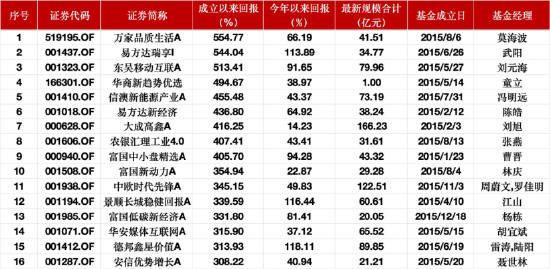
权益类基金“十年考”:万家品质生活A总回报555%领跑,太平灵活配置跌57%垫底
Xin Lang Ji Jin· 2025-10-28 08:59
Core Insights - The report highlights the performance of equity funds established in 2015, noting a significant disparity in their growth trajectories over the past decade [1] - The report emphasizes the dominance of technology sectors, particularly AI and coal, in the portfolios of top-performing funds [2][3] Fund Performance Overview - A total of 419 equity funds were established in 2015, with only 2 exceeding 10 billion yuan in size, and 14 funds above 5 billion yuan, representing less than 3.4% of the total [1] - The top-performing fund, Wan Jia Quality Life A, achieved a total return of 554.77% since inception, with a year-to-date return of 66.19% [2] - The second-best fund, Yi Fang Da Rui Xiang I, reported a total return of 544.04%, focusing heavily on the AI computing industry [3] - Dong Wu Mobile Internet A ranked third with a total return of 513.41%, showcasing a broad technology sector investment [4] Sector Analysis - The AI sector is highlighted as a critical area for growth, driven by the need for self-sufficiency amid US-China trade tensions [3] - The coal sector is experiencing a reversal in supply-demand dynamics, with expectations of rising coal prices in the fourth quarter due to potential cold weather [3] Underperforming Funds - The fund Tai Ping Flexible Allocation has the lowest total return at -56.70%, with a year-to-date return of only 1.17% [5][6] - Another underperformer, Yin He Transformation Growth A, has a total return of -51.90%, indicating a trend of long-term decline [8] Investment Strategies - Successful fund managers emphasize risk management and adaptability to market conditions, with a focus on technology and cyclical sectors [9] - The report suggests that investors should consider funds managed by experienced managers with stable investment philosophies to navigate market volatility [9]
开源证券:煤价正在经历惯性上穿 煤炭供需基本面有望持续改善
智通财经网· 2025-10-28 08:39
Core Viewpoint - The report from Kaiyuan Securities indicates a significant increase in thermal coal prices, driven by supply constraints and rising demand due to seasonal factors, with current prices still at historical lows, suggesting potential for further price recovery [1][2][3]. Thermal Coal Market Summary - As of October 24, the Qinhuangdao Q5500 thermal coal price reached 770 RMB/ton, an increase of 22 RMB/ton or 2.94% from the previous period, with other ports also reporting similar price levels [1][2]. - The recent price surge is attributed to a dual impact of supply reduction due to strict production checks post-National Day and increased demand driven by a cold wave in northern regions, leading to higher heating needs and accelerated port inventory replenishment [1][2]. Coking Coal Market Summary - The price of coking coal at Jingtang Port is reported at 1760 RMB/ton, rebounding from a low of 1230 RMB/ton in early July, while coking coal futures have increased from 719 RMB to 1248 RMB, marking a cumulative rise of 73.5% [2]. - The price of coking coal is closely linked to thermal coal prices, with a notable price ratio of 2.4 times, indicating potential target prices for coking coal based on thermal coal price movements [2][3]. Investment Logic - The upward movement in thermal coal prices is expected to follow a four-step process, including the restoration of long-term contracts and achieving a balanced profit margin for coal and power companies, with a target price of around 750 RMB by 2025 [3]. - The ideal target for thermal coal prices is projected to be between 800-860 RMB, with the upper limit being the breakeven point for power plants [3]. Investment Recommendations - The coal sector is positioned for a rebound due to historical low prices and improving supply-demand dynamics, with thermal and coking coal prices expected to rise [4]. - Companies in the coal sector are likely to benefit from both cyclical price recovery and stable dividend payouts, with several listed coal companies announcing interim dividend plans [4]. Selected Coal Stocks - Key stocks benefiting from the cyclical logic include Jinko Coal (601001.SH) and Yanzhou Coal (600188.SH) for thermal coal, and Pingmei Shenma (601666.SH) and Huabei Mining (600985.SH) for metallurgical coal [5][6]. - Dividend-focused stocks include China Shenhua (601088.SH) and Zhongmei Energy (601898.SH), while diversified and growth-oriented stocks include Shenhuo Co. (000933.SZ) and Xinji Energy (601015.SH) [5][6].
浙商证券:寒潮提升日耗 电厂采购推动煤炭第二轮行情
智通财经网· 2025-10-27 08:20
Core Viewpoint - The report from Zheshang Securities indicates that the "severe cold wave" has led to increased heating demand, resulting in a non-seasonal increase in daily coal consumption, with power plant inventories gradually depleting and insufficient time for replenishment. The report anticipates that coal prices could reach 800 yuan/ton due to supply constraints and safety regulations, with a potential supply-demand gap leading to localized coal shortages in certain periods. The outlook for the fourth quarter suggests a gradual balance in supply and demand, with coal prices expected to rise steadily, maintaining a "positive" rating for the industry [1]. Group 1: Coal Market Data - Key monitored enterprises reported an average daily coal sales volume of 7.34 million tons for the week of October 17-23, 2025, a week-on-week increase of 4.1% and a year-on-year increase of 2.8%. Among these, thermal coal sales increased by 4.9% week-on-week, while coking coal and anthracite sales rose by 2.8% and 0.2%, respectively [2]. - As of October 23, 2025, the average daily coal production from key monitored enterprises was 7.15 million tons, a week-on-week increase of 3.5% but a year-on-year decrease of 2%. The total coal inventory (including port stocks) was 23.04 million tons, a week-on-week decrease of 5.4% and a year-on-year decrease of 18.6% [2]. Group 2: Price Trends - As of October 24, 2025, the price index for thermal coal (Q5500K) in the Bohai Rim region was 684 yuan/ton, reflecting a week-on-week increase of 0.59%. The import price index for electric coal was 884 yuan/ton, up 5.11% week-on-week [3]. - For coking coal, the main coking coal price at Jingtang Port was 1,740 yuan/ton, a week-on-week increase of 3%. The price of coking coal futures settled at 1,251.5 yuan/ton, up 5.66% week-on-week [4]. Group 3: Chemical Coal Market - As of October 24, 2025, the price of anthracite coal in Yangquan was 880 yuan/ton, remaining stable week-on-week. The methanol market price in East China was 2,268.18 yuan/ton, down 23.86 yuan/ton week-on-week [5]. Group 4: Investment Recommendations - The report suggests focusing on flexible thermal coal companies and those in turnaround situations in the coking coal and coke sectors. Key companies to watch include China Shenhua (601088.SH), Shaanxi Coal and Chemical Industry (601225.SH), and Yanzhou Coal Mining (600188.SH) among others in the thermal coal sector [6][7].

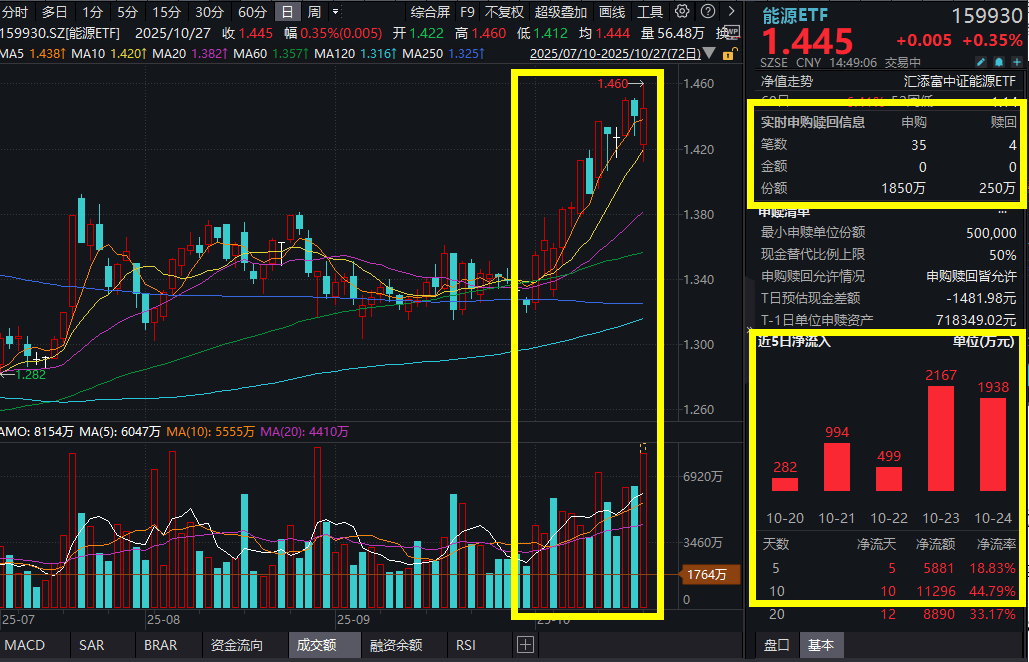
沪指冲击4000点!能源板块表现活跃,能源ETF(159930)爆量上涨,连续10日净流入超1.1亿元!煤炭底部确认?机构:蓄力反弹!
Sou Hu Cai Jing· 2025-10-27 07:27
Core Viewpoint - The coal sector is experiencing a reversal in supply-demand dynamics, with the bottom of the cycle confirmed in Q2 2025, leading to an upward trend in coal prices due to supply constraints and increasing demand [3][5]. Group 1: Market Performance - The energy ETF (159930) has seen significant inflows, with a net inflow of 113 million yuan over the past 10 days, indicating strong investor interest in the energy sector [4]. - The ETF's component stocks have shown mixed performance, with notable gains in coal companies like China Coal Energy, while others like Shanxi Coking Coal have experienced declines [4]. Group 2: Supply and Demand Dynamics - National coal production has declined for three consecutive months since July, influenced by policies aimed at curbing overproduction, which is expected to continue impacting supply [3][5]. - Electricity consumption growth has rebounded to 4.6% in August and September, suggesting a potential increase in demand as winter approaches [3]. Group 3: Policy Impact - The "anti-involution" policies have led to stricter enforcement against overproduction, which is a key factor supporting the recent rise in coal prices [3][5]. - Ongoing safety inspections and regulatory measures are expected to further constrain coal production, reinforcing the upward price trajectory [3]. Group 4: Investment Opportunities - The coal sector is characterized by high performance, cash flow, and dividends, making it an attractive investment option amid a recovering macroeconomic environment [5]. - The energy sector, particularly coal and oil, offers high dividend yields, with coal stocks showing a yield of approximately 4.69% [6].





民生证券:煤价持续上涨 短期或涨势暂缓、蓄力旺季涨价动能
智通财经网· 2025-10-27 07:01
Core Viewpoint - The recent increase in coal prices is primarily driven by supply contraction due to production inspections, leading to an unexpected rebound in electricity coal demand during the seasonal transition in October [1][2]. Supply Side - Since July 2025, the monthly year-on-year decline in national raw coal production has been 3.8%, 3.2%, and 1.8% respectively, with expectations of further supply contraction due to upcoming safety production assessments in November [1][2]. - The tightening of supply is exacerbated by stricter environmental inspections and production halts in various regions, including the Ulanqab area and Shanxi province [3]. Demand Side - With the drop in temperatures in southern regions, electricity consumption is expected to rise, particularly as northern areas begin heating earlier than usual, leading to increased demand for coal [2]. - The anticipated peak winter demand is expected to push coal prices back above 900 yuan per ton by the end of the year [2]. Investment Recommendations - Recommended investment targets include high spot price elasticity stocks such as Lu'an Environmental Energy and Yanzhou Coal Mining, as well as stable growth companies like Jinko Coal and Huayang Co., Ltd. [4]. - Companies benefiting from nuclear power growth, such as CGN Mining, are also highlighted as potential investment opportunities [4].
能源周报(20251020-20251026):欧美强化对俄制裁,本周油价上涨-20251027
Huachuang Securities· 2025-10-27 03:35
Investment Strategy - Crude oil supply growth is slowing due to declining global oil and gas capital expenditure, which has decreased significantly since the Paris Agreement in 2015. In 2021, global oil and gas capital expenditure was $351 billion, down nearly 22% from the 2014 peak. Major energy companies are cautious about capital spending due to long-term low oil prices and increasing decarbonization pressures [9][27][28] - The Brent crude oil spot price was $63.48 per barrel, up 1.25% week-on-week, while WTI crude oil was $59.31 per barrel, up 1.75% week-on-week. The outlook suggests that oil prices will remain volatile due to geopolitical risks and OPEC+ production cuts [10][32] Crude Oil - The report indicates that the overall supply of crude oil is limited, with demand remaining resilient. The OPEC+ production cuts are expected to continue, leading to limited supply growth in the coming year [9][27] - The report suggests focusing on companies that benefit from mid-to-high oil price fluctuations, such as China National Offshore Oil Corporation (CNOOC), China National Petroleum Corporation (CNPC), and Sinopec [10][49][50] Coal - The average market price for thermal coal at Qinhuangdao Port was 757.9 yuan per ton, up 4.84% week-on-week. The increase in demand due to falling temperatures and the tightening of supply due to safety inspections at coal mines are driving coal prices higher [11][12] - The report highlights companies with strong resource endowments and integrated operations, such as China Shenhua Energy and Shaanxi Coal and Chemical Industry, as potential investment opportunities [12][13] Coking Coal - Coking coal prices are experiencing slight increases due to ongoing demand from steel companies, despite some resistance to high-priced coal. The price of main coking coal at Jing Tang Port was 1,760 yuan per ton, up 2.92% week-on-week [14] - The report emphasizes the structural scarcity of high-quality coking coal resources in China and suggests focusing on companies like Huabei Mining and Pingmei Shenma Group that have strong resource acquisition capabilities [14] Natural Gas - The European Union is expected to ban Russian natural gas by the end of 2027, which has led to an increase in natural gas prices. The average price of natural gas in the U.S. was $3.41 per million British thermal units, up 13.0% week-on-week [15][16] - The report notes that the EU's price cap agreement on natural gas could exacerbate liquidity issues in the market, potentially leading to supply shortages [16] Oilfield Services - The oilfield services industry is expected to maintain its prosperity due to government policies supporting energy security. In 2023, the total capital expenditure of the three major oil companies was 583.3 billion yuan, with CNOOC showing a compound growth rate of 13.1% [17][18] - The report indicates that the number of active drilling rigs globally was 1,812, with a slight increase in the U.S. and Middle East regions, suggesting a stable demand for oilfield services [18]


9月二产用电持续修复原煤供给边际回升 | 投研报告
Zhong Guo Neng Yuan Wang· 2025-10-27 01:33
Core Insights - The overall electricity consumption in September increased by 4.5% year-on-year, with a total of 888.6 billion kilowatt-hours, but showed a decline in growth rate compared to previous months, primarily due to weather impacts [1][2] - The electricity consumption growth rates for the primary, secondary, and tertiary industries, as well as urban and rural residents, were +7.3%, +5.7%, +6.3%, and -2.6% respectively, indicating a notable decline in the tertiary sector and residential consumption [2][4] - The coal production in September was 41.15 million tons, a year-on-year decrease of 1.8%, but the price of coal has been rising significantly, indicating a persistent supply-demand gap [4][5] Electricity Sector - The electricity consumption growth rate in September was 4.5%, with a month-on-month and year-on-year decline of 0.5 and 4.0 percentage points respectively, mainly due to the drop in the tertiary sector and residential consumption [2][4] - The average temperature in September decreased by 0.4 and 3.9 degrees Celsius year-on-year and month-on-month, which likely contributed to the decline in electricity consumption in the tertiary sector and among residents [2] - Recommendations include focusing on dividend stocks with third-quarter performance catalysts and high-quality hydropower companies such as Yangtze Power and Guotou Power [2][3] Coal Sector - The coal supply showed a marginal recovery in September, but prices continued to rise, indicating a strong supply-demand gap that is expected to persist through the winter [4][5] - The average price of Qinhuangdao 5500 kcal thermal coal increased from 699 yuan/ton on September 30 to 770 yuan/ton by October 23, reflecting the significant supply gap [5] - The coal and lignite import volume in September was 46 million tons, a year-on-year decrease of 3.3%, but the decline rate has narrowed compared to previous months [5][6] - Recommendations for coal investments include stable leading thermal coal companies like China Shenhua and high-elasticity coal companies such as Yanzhou Coal Mining [6]
招商基金王平旗下招商中证红利ETF三季报最新持仓,重仓宁波华翔
Sou Hu Cai Jing· 2025-10-26 21:39
Core Viewpoint - The report from the招商中证红利交易型开放式指数基金 indicates a net value growth rate of 9.21% over the past year, with significant changes in the top ten holdings compared to the previous quarter [1]. Group 1: Fund Performance - The fund achieved a net value growth rate of 9.21% over the last year [1]. - The report highlights the addition of new stocks to the top ten holdings, including 潞安环能, 中谷物流, 农业银行, 南钢股份, and 建设银行 [1]. Group 2: Changes in Top Holdings - New entries in the top ten holdings include: - 潞安环能 (669709): 7.7764 million shares valued at 1.11 billion - 中谷物流 (603560): 10.0744 million shares valued at 1.1 billion - 农业银行 (601288): 161.424 million shares valued at 1.08 billion - 南钢股份 (600282): 199.957 million shares valued at 1.05 billion - 建设银行 (601939): 117.632 million shares valued at 1.01 billion [2]. - 宁波华翔 (002048) saw an increase in holdings by 56.7 thousand shares, making it the largest holding at 2.73 billion [1][2]. - Other stocks that exited the top ten holdings include 成都银行, 兴业银行, 大秦铁路, 江苏银行, and 交通银行 [1][2].





波动加大,如何看待煤炭板块后市机会?
Changjiang Securities· 2025-10-26 14:45
Investment Rating - The report maintains a "Positive" investment rating for the coal industry [9] Core Viewpoints - The coal price continues to rise, but the coal sector is experiencing increased volatility. Despite the nearing end of concentrated coal replenishment by power plants, extreme weather and tight supply conditions suggest that coal prices are likely to rise in Q4 2025 and may recover year-on-year by 2026. The report emphasizes the importance of focusing on the coal sector, which has shown signs of bottom reversal, supported by strong short-term fundamentals, a global interest rate cut cycle, and resilient long-term demand [2][7][9] Summary by Sections Weekly Tracking Summary - The coal index (Yangtze) increased by 1.49%, underperforming the CSI 300 index by 1.76 percentage points, ranking 22nd out of 32 industries. As of October 24, the market price for Qinhuangdao thermal coal was 770 CNY/ton, up 22 CNY/ton week-on-week. The report anticipates that coal prices will likely remain stable and fluctuate in the short term due to tight supply and seasonal demand [6][15][19] Supply and Demand Situation - As of October 23, the daily coal consumption in 25 provinces was 5.335 million tons, a week-on-week increase of 2.8%. The total coal inventory was 128.17 million tons, with a usable days count of 24.0 days, down 0.5 days from the previous week. The report indicates that coal supply remains tight due to production checks and seasonal demand [16][34][36] Investment Recommendations - The report recommends focusing on companies with strong defensive and offensive characteristics, such as Yanzhou Coal Mining Company (H+A), China Power Investment Corporation, and Xinji Energy. It also suggests considering companies with high elasticity and growth potential, such as Lu'an Environmental Energy and Jinkong Coal Industry, as well as stable leaders like China Shenhua Energy [7][27][30]

