
摩根士丹利

Search documents
机器人“赛”出圈,看科学竞技如何点燃资本热情
3 6 Ke· 2025-08-15 11:12
Group 1: Event Overview - The 2025 World Humanoid Robot Games opened on August 14 in Beijing, marking the first international sports event focused on humanoid robots, showcasing the integration of technology and sports [1][3] - The event features 26 competitions and 487 matches with participation from 280 teams across 16 countries, running from August 15 to 17 [3] Group 2: Industry Impact - The event is expected to attract more capital attention to the robotics industry, allowing investors to observe practical applications of technology and market potential [4] - The humanoid robot industry in China is experiencing a surge in capital enthusiasm and accelerated mass production, with a projected financing amount of 8.45 billion yuan in 2024, a 226% year-on-year increase [5] Group 3: Market Dynamics - The global humanoid robot market is anticipated to reach a sales volume of 12,400 units by 2025, with China accounting for 59% (7,300 units) [5] - The market size is expected to exceed 400 billion yuan by 2035, indicating rapid expansion [5] Group 4: Competitive Landscape - Notable companies in the humanoid robot sector include: - **Youbikex**: Leading with the highest number of effective patents globally and securing a 90.51 million yuan order for an automotive factory by 2025 [7] - **Yushutech**: Utilizing a consumer pricing strategy with a G1 robot priced at 9,900 yuan and achieving over 1,000 overseas orders [7] - **Sungyian Power**: Established in September 2023, focusing on advanced motion control and deep reinforcement learning algorithms [7] - **Zhiyuan Robotics**: Valued at 15 billion yuan by 2025, with a strong general-purpose intelligent model [7] Group 5: Technological Advancements - The competition assesses robots on various capabilities such as sensor recognition, motion control, and path planning, driving advancements across multiple disciplines including AI, materials, and optical technologies [3][6]



A股,又大涨了!还有更大空间?
Zheng Quan Zhi Xing· 2025-08-15 08:33
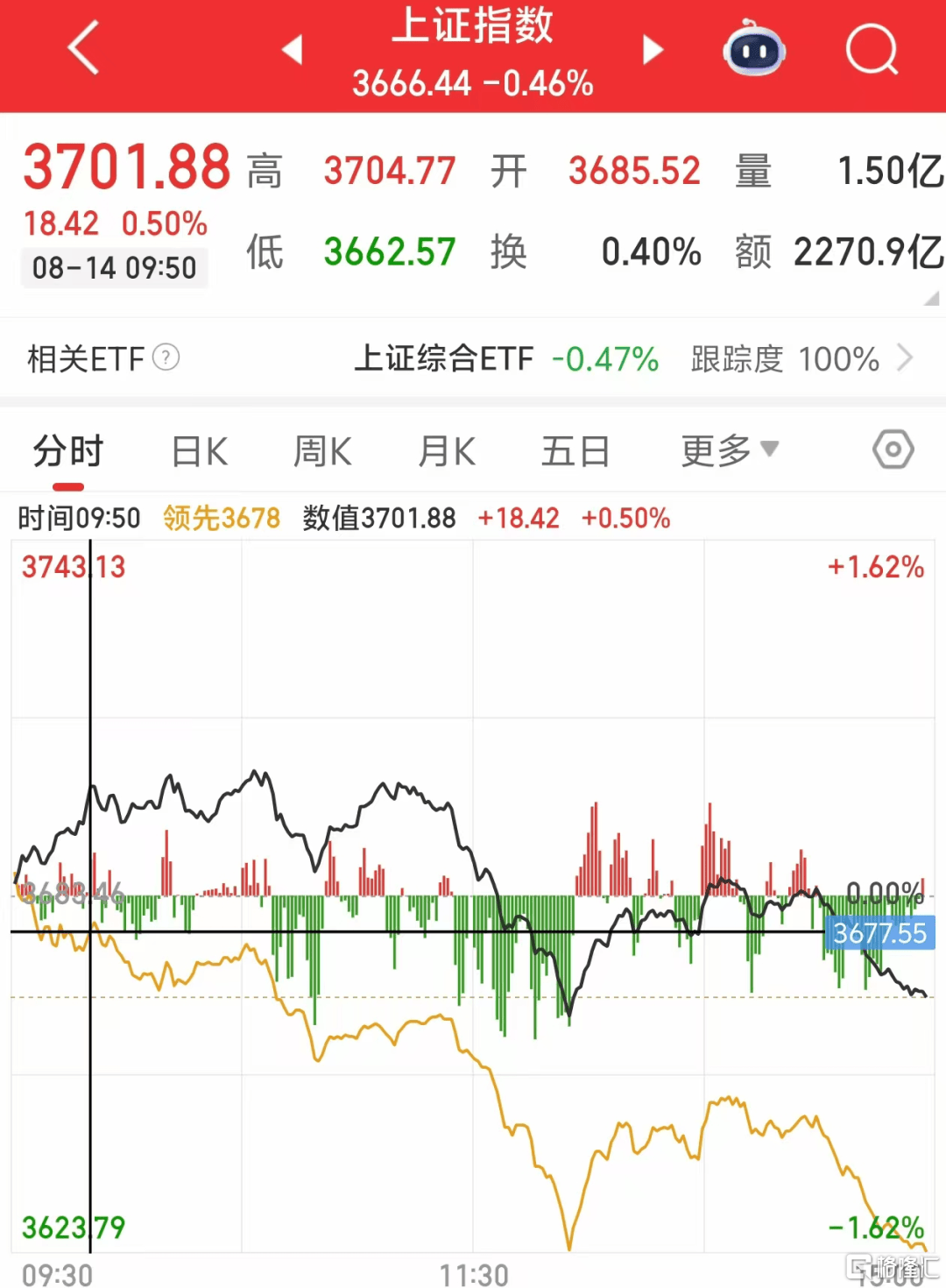
Market Overview - The A-share market experienced a strong rebound, with the ChiNext Index leading the gains, up 2.61% [1][2] - Major financial stocks, particularly in the brokerage and fintech sectors, saw significant increases, with stocks like Zhinan Compass and Tonghuashun reaching historical highs [1][2] - The overall market showed a mixed performance with over 4,600 stocks rising, while the total trading volume in the Shanghai and Shenzhen markets was 2.24 trillion yuan, a decrease of 34.6 billion yuan from the previous trading day [1] Financial Sector Performance - The non-bank financial sector, particularly brokerage stocks, experienced a notable surge, with a net buying of 8.917 billion yuan in the securities sector, marking it as the top sector for capital inflow [2] - Recent earnings reports from small and medium-sized brokerages indicated substantial profit growth, with Jianghai Securities reporting a 13-fold increase in net profit, driven primarily by proprietary trading [2] - Analysts from Western Securities expressed optimism about the growth potential of brokerage firms, citing improved risk appetite and ongoing capital inflows [2] Solar Energy Sector - The photovoltaic sector is witnessing a rebound, with reports of component shortages and price increases, as the price for first-tier components reached 0.7 yuan/W, up from 0.66 yuan/W in June [3] - The liquid cooling server and data center segments are also attracting significant investment, indicating a favorable outlook for technology stocks [3] Capital Inflows - Both domestic and foreign capital are increasingly flowing into the Chinese stock market, with domestic institutional participation reaching historical highs [4][5] - The number of new institutional accounts has surged, reflecting a strong interest in equity funds, particularly in sectors like electronics, pharmaceuticals, and military [5] - Foreign fund inflows have accelerated, with net inflows rising from 1.2 billion USD in June to 2.7 billion USD in July, driven by passive funds [6] Market Outlook - Analysts maintain a positive outlook for the A-share market, suggesting that the current bull market is not over and has room for further growth [7] - The average P/E ratios for the Shanghai Composite and ChiNext indices are at mid-levels compared to the past three years, indicating potential for medium to long-term investments [7] - The market is expected to benefit from a favorable liquidity environment and a potential weakening of the US dollar, which could attract more foreign investment [7] Investment Strategy - Investment strategies should focus on sectors showing upward trends due to industrial catalysts, particularly in technology growth areas and dividend-paying stocks with attractive yields [8] - As the market experiences a positive cycle of capital inflow and rising stock prices, attention should be given to the upcoming mid-year earnings reports for further market direction [8]
一波援军正在路上!
Sou Hu Cai Jing· 2025-08-14 09:01
Market Performance - The Shanghai Composite Index broke through the 3700-point mark, reaching a nearly four-year high since December 2021, shortly after opening yesterday [1][4] - The index has shown a strong upward trend since June 23, moving from 3500 to 3600 and now attempting to stabilize above 3700, indicating a potential for further gains [4] Foreign Investment - Foreign capital is accelerating its inflow into the Chinese stock market, with a reported injection of $2.7 billion (approximately 19.4 billion RMB) in July, a significant increase from $1.2 billion in June [4][6] - The International Financial Association reported a strong inflow of $55.5 billion into emerging market assets in July, with China accounting for a substantial portion of this [6] Bond Market - In July, China's bond market saw a net inflow of $30.8 billion, representing 78.6% of the total inflow into emerging market bonds [6][8] - Foreign investors have increased their holdings of domestic RMB bonds to over $600 billion, indicating a strong preference for Chinese debt [8] Retail Investment Trends - There has been a notable shift in household savings, with a decrease of 1.11 trillion RMB in household deposits in July, suggesting a migration of funds towards equity markets [12][13] - The number of new A-share accounts opened in July reached 1.96 million, a 71% increase year-on-year, reflecting growing retail investor interest [13][15] Economic Indicators - The M2 money supply growth rate increased to 8.8% in July, indicating higher liquidity in the market, while M1 growth rose to 5.6% [12] - The trend of increased non-bank deposits suggests a shift in risk appetite among residents, likely driven by positive stock market performance [12][16] Institutional Investment - Major investment firms like Bridgewater and JPMorgan have significantly increased their holdings in tech giants such as Nvidia and Microsoft, indicating confidence in the sector's growth potential [20][22] - BlackRock also reported substantial increases in its positions in major U.S. tech stocks, further highlighting the trend of institutional investment in high-growth sectors [23]
每日机构分析:8月13日
Xin Hua Cai Jing· 2025-08-13 13:57
星展银行:日本二季度经济增长温和,出口与消费仍显疲软 瑞士宝盛:需求放缓抑制美国通胀压力,为美联储降息提供空间 德意志银行:欧元计价信用利差压缩至年内最窄区间 贝莱德:市场加大押注美联储9月降息50基点 【机构分析】 星展银行分析指出,经过季节性调整后,日本第二季度的年化增长率预计仅温和上升0.2%,这一增长 幅度大致能够弥补第一季度经济收缩带来的影响。对于日本经济现状,由于对美出口下降和全球需求疲 软,第二季度出口增长势头减弱。同时,国内私人消费依旧低迷,主要原因是工资增长速度未能跟上通 胀步伐。日本央行短期内不太可能采取加息措施。尽管与美国的贸易协议有助于缓解关税不确定性,但 央行期待更强劲的工资增长和稳定的通胀水平以实现政策正常化。 野村证券策略师指出,美国7月CPI数据公布后,市场情绪明显缓和,乐观情绪有效传导至日本股市, 推动日经225指数进一步走高。美联储降息预期的升温是本轮上涨的重要驱动。 瑞士宝盛经济学家指出,美国通胀压力正受到需求放缓的有效抑制。尽管在服装、电子产品等领域已观 察到关税对价格的推动作用,但作为通胀最大构成部分的住房成本在6月份仅温和上涨,使得整体通胀 动能保持稳定。考虑到8月 ...
时报图说丨MSCI重要调整来袭,可能带来何种影响?
证券时报· 2025-08-13 13:47
Core Viewpoint - MSCI announced significant adjustments to its flagship index system, which will take effect after the market closes on August 26, 2023, including the addition of 42 new stocks and the removal of 56 existing constituents [2][15]. Group 1: MSCI Index Adjustments - The MSCI All Country World Index (ACWI) will see major changes, with a total of 42 new stocks being added and 56 stocks being removed [2]. - The MSCI China Index will include 14 new A-shares and 9 new Hong Kong stocks, indicating a notable increase in Hong Kong stock representation [3][5]. Group 2: New A-Share Constituents - New A-share stocks added to the MSCI China Index include: - Zhinan Zhen (指南针) with a market cap of 53.03 billion yuan and a year-to-date increase of 40.45% [7]. - CITIC Bank (中信银行) with a market cap of 443.77 billion yuan and a year-to-date increase of 21.94% [7]. - Giant Network (巨人网络) with a market cap of 57.68 billion yuan and a year-to-date increase of 126.86% [7]. - Others include Ailis (艾力斯), Jingwang Electronics (景旺电子) [4][7]. Group 3: New Hong Kong Stock Constituents - New Hong Kong stocks added to the MSCI China Index include: - Sanofi (三生制药) with a market cap of 74.18 billion HKD and a year-to-date increase of 405.68% [9]. - CITIC Financial Assets (中信金融资产) with a market cap of 93.09 billion HKD and a year-to-date increase of 78.46% [9]. - Horizon Robotics (地平线机器人-W) with a market cap of 100.78 billion HKD and a year-to-date increase of 101.67% [9]. - Others include Meitu (美图公司), NetEase Cloud Music (网易云音乐) [5][9]. Group 4: Market Impact and Performance - Following the announcement of index adjustments, stocks included in the MSCI indices typically experience increased trading volume and volatility, with historical data indicating excess returns in the 10 days following the announcement [10]. - Recent adjustments have led to positive performance for newly added stocks, with some showing significant gains post-inclusion [10][13]. Group 5: International Attention on Chinese Assets - International institutions are increasingly focused on Chinese assets, with S&P maintaining China's sovereign credit rating at "A+" and a stable outlook, reflecting confidence in China's economic resilience [16]. - Several foreign institutions have raised their ratings for the Chinese stock market, indicating a positive outlook for future performance [16].
美股屡创新高之际市场转向防御 迎接长牛途中的“回调插曲”
智通财经网· 2025-08-13 11:53
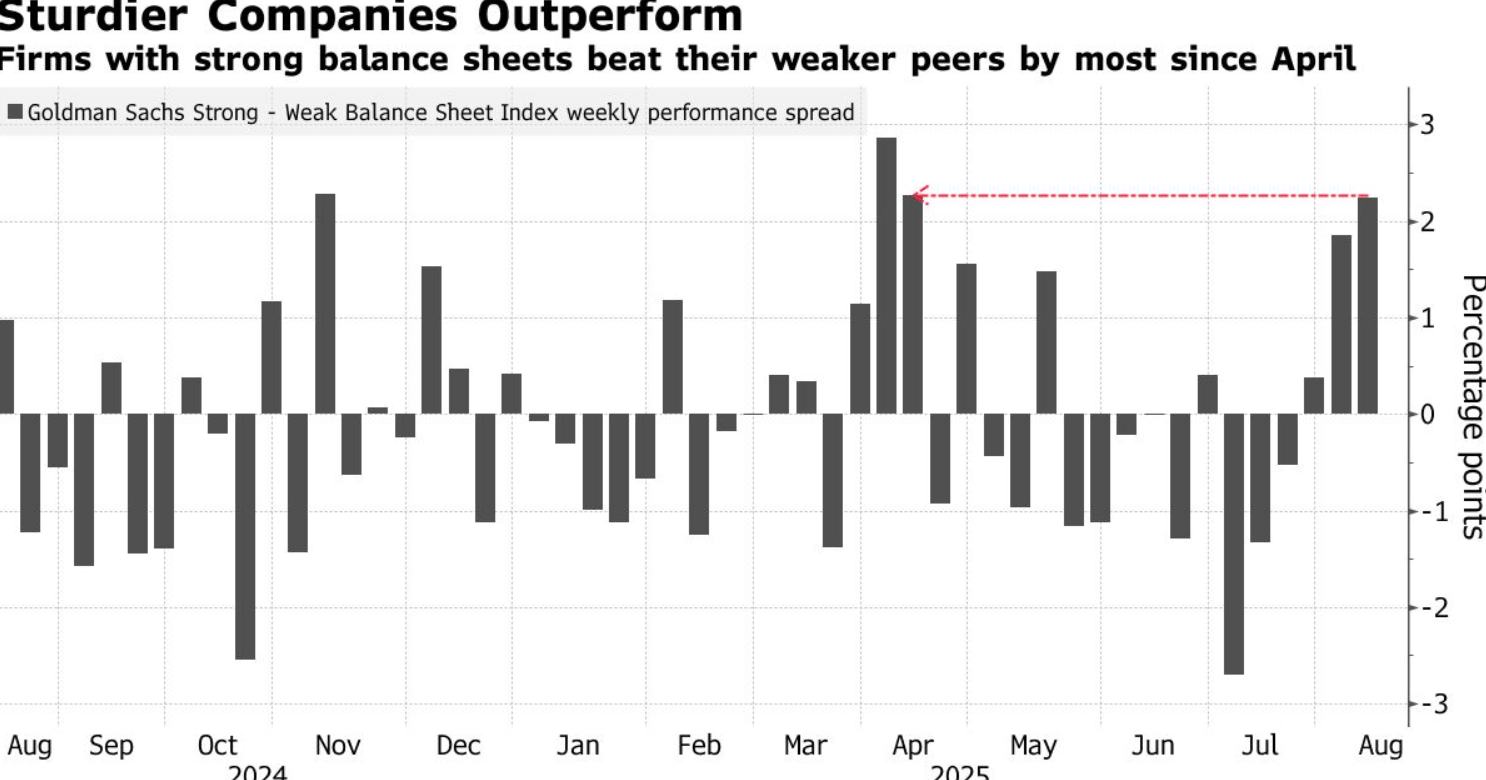
"我们一直感到,投资者们一边搭乘史无前例的涨势上行,一边也变得紧张起来,"来自Annex Wealth Management的首席经济学家Brian Jacobsen表示。他表 示,在当前市场中,"投资者们的适度谨慎操作是非常必要的"。 自4月8日的年内低点以来,美股大盘基准——标普500指数已飙升29%,并在周二再一次收于历史最高点位。很大一部分涨势归因于人工智能热潮驱动的狂 热涨势,这股史无前例的AI热潮将两大科技巨无霸——英伟达(NVDA.US)和微软(MSFT.US)推升至创纪录的4万亿美元市值。此外,标普500指数稳健的企业 盈利也支撑了这样一种乐观情绪:特朗普混乱的贸易政策并未造成此前市场预期的业绩损伤。 但需要注意的是,标普500指数成分公司的大多数利润增长集中在科技以及与科技相邻的行业——基本上都与人工智能息息相关,全面掩盖了消费品供应商 和工业设备制造商的疲弱利润。 因此,来自花旗集团的策略师们指出,从7月至8月初,价值因子出现"早期"回升迹象,因为投资者们在寻找那些股价相对于财务基本面而言被低估的公司。 这也意味着无利润的高风险科技公司及其他投机性的股票标的遭受损失。 数周以来,关于屡创历 ...
银行、科技双双反转,纳指、标指均超历史新高
Ge Long Hui· 2025-08-13 11:52
高开高走后全天震荡上行,截至收盘道指上涨1.1%,纳指上涨1.39%,标指上涨1.13%,其中纳指和标 指均创收盘新高。盘面上,银行、科技携手反转,中概股企稳走强,黄金止跌。 COMEX黄金弱势盘整后小幅收涨,截止收盘上涨0.17%报3399.6美元/盎司。盘中最低报3379.1美元/盎 司,最高报3410.8美元/盎司。 理财就是一场修行,有人修有人度,结果就是看谁踩准了点,把握住了机会。 银行高开高走强势爆发,截至收盘大涨3.6%。其中阿莱恩斯西部银行大涨6.78%,花旗集团上涨 3.72%,联合银行上涨3.34%,高盛上涨3.36%,美国银行、摩根士丹利、齐昂银行等多股涨幅均在2% 上方。 科技股反转,其中英特尔大涨5.62%,高通上涨3.89%,META上涨3.15%,苹果、微软、超威公司等多 股涨幅均在1%上方。 中概股小幅下探后反转企稳,截至收盘中国金龙上涨1.49%。其中腾讯音乐大涨11.85%,阿里巴巴上涨 3.19%,京东上涨3.01%,拼多多上涨3%,爱奇艺、百度等涨幅均超2%,小鹏汽车逆势大跌6.08%。 ...
AI芯片业务前景乐观 大摩上调博通(AVGO.US)目标价至338美元
智通财经网· 2025-08-13 03:41
Core Viewpoint - Morgan Stanley analyst Joseph Moore raised the target price for Broadcom (AVGO.US) from $270 to $338, maintaining an "overweight" rating based on the company's position in the artificial intelligence (AI) semiconductor market [1] Company Summary - Morgan Stanley believes that Broadcom's long-term strong performance validates the market's enthusiasm for AI semiconductors [1] - The firm considers Broadcom to be one of the most uncontroversial companies in the AI market [1] - Morgan Stanley also increased the target prices for other AI semiconductor companies it covers [1] Stock Performance - As of Tuesday's market close, Broadcom shares rose by 2.94%, closing at $312.83 [1] - The stock has seen a cumulative increase of 36% this year [1]

SKG母公司未来健康叫停北交所上市
Nan Fang Du Shi Bao· 2025-08-12 23:10
Core Viewpoint - Future Health, the parent company of SKG, has officially terminated its IPO plans on the Beijing Stock Exchange due to strategic development needs, following a series of challenges in its previous IPO attempts [2][4]. Group 1: Company Overview - Future Health was established in 2007 and has evolved into a high-tech enterprise providing smart wearable health products, with its main brand being SKG, focusing on products like neck and eye massagers, and health watches [2][3]. - As of September 2023, over 80% of the company's revenue comes from wearable health products, with neck and waist massagers being the most significant product lines [3]. Group 2: Financial Performance - Future Health's revenue from 2021 to 2024 was as follows: 1.054 billion, 904 million, 1.046 billion, and 1.048 billion yuan, while net profits were 131 million, 119 million, 127 million, and 135 million yuan respectively [3]. - The company has faced scrutiny regarding its high cash dividends, which were 155 million and 160 million yuan in 2020 and 2021, exceeding its net profits for those years [5]. Group 3: IPO Journey - Future Health's IPO journey has been tumultuous, with multiple attempts and rejections, including a failed application for the ChiNext board in 2022 and a subsequent withdrawal of its application in July 2023 [4][6]. - The company had initially aimed to raise 1.6 billion yuan but later reduced its target to 1.29 billion yuan [4]. Group 4: International Expansion - In recent years, Future Health has focused on expanding its international presence, particularly through its SKG brand, which has increased investments in cross-border e-commerce platforms [7]. - The company signed a strategic investment agreement with Morgan Stanley, securing a significant investment to accelerate its overseas expansion [7]. - Despite increased marketing expenditures, the company's overseas revenue saw a decline of 14.18% in the first half of 2024, amounting to approximately 28.54 million yuan [8].

《天才法案》点燃稳定币发行热潮 但实际用例扩张却难题重重
智通财经网· 2025-08-12 13:04
Core Insights - The new U.S. law, known as the GENIUS Act, establishes the first federal regulations for stablecoins, paving the way for their integration into mainstream finance [1][5] - Major financial institutions, including Bank of America and Citigroup, are preparing to launch their own dollar-backed stablecoins, indicating a shift towards "on-chain finance" [1][8] - The rise of stablecoins is linked to the increasing demand for efficient payment systems and cross-border transactions, with significant growth in their usage observed [2][3] Regulatory Framework - The GENIUS Act, signed into law by President Trump, aims to promote the use of digital assets and provides official guidelines for stablecoins, which are typically pegged to the U.S. dollar [1][5] - The act requires issuers to comply with anti-money laundering (AML) and Know Your Customer (KYC) regulations, adding compliance costs for non-bank financial institutions [7][8] Market Dynamics - Stablecoins are seen as "on-chain dollars," backed 1:1 by high-liquidity dollar assets, offering a new payment medium that combines stability and efficiency [2][3] - The monthly settlement volume of stablecoins has reached approximately $650 billion to $700 billion, demonstrating their growing role in financial transactions [3] Tokenization Trends - The concept of tokenization, particularly Real-World Assets (RWA), is gaining traction, with predictions that the market for tokenized assets could exceed $18 trillion by 2033, growing at a CAGR of 53% since 2025 [4] - Tokenization allows traditional assets to be represented as digital tokens on the blockchain, enhancing efficiency and reducing settlement risks [3][4] Challenges and Considerations - Experts caution that the new regulations will not immediately simplify the process for companies looking to adopt stablecoins, as they must navigate complex regulatory and technological challenges [5][6] - Companies must determine the specific use cases for stablecoins, which could influence their decision to create proprietary stablecoins or integrate existing ones [7][8] Institutional Interest - Major banks are actively considering the issuance of their own stablecoins, with executives from Bank of America and Citigroup expressing interest in this area [8] - The regulatory landscape will significantly impact how banks approach stablecoin issuance, particularly regarding capital requirements and liquidity management [8][9] Blockchain Considerations - The choice between public and private blockchains for stablecoin issuance is a critical decision for companies, with banks likely favoring private or permissioned blockchains for enhanced governance and control [9][10] - The ongoing interest in established blockchain networks highlights the importance of reliability and scalability in the stablecoin ecosystem [10][11]

