伊利股份

Search documents
2026-2032年中国婴幼儿奶粉市场全景调查与投资潜力分析报告
Sou Hu Cai Jing· 2026-01-07 06:10
Group 1 - The article discusses the importance of infant complementary foods, which include various types of food beyond breast milk, such as juices, purees, and solid foods, emphasizing the need for balanced nutrition during the critical growth period of infants [2] - The report titled "2026-2032 China Infant Formula Market Panorama Survey and Investment Potential Analysis" consists of eleven chapters, covering the market development environment, operational status, competitive landscape, key enterprise analysis, and future trends in the infant food industry [2] - The report serves as a crucial tool for understanding the infant food industry and for potential investors looking to enter this market [2] Group 2 - The research data is primarily sourced from national statistics, customs data, survey data, and various market monitoring databases, ensuring a comprehensive analysis of the infant formula industry [3] - The report includes an overview of the infant formula industry, its development environment, and the current operational status, along with a competitive analysis of the market [3][4] - The analysis covers the macroeconomic environment in China, including population birth rates and the implications for the infant formula market from 2021 to 2025 [4] Group 3 - The report highlights the competitive landscape of the infant formula market, noting the increasing competition from foreign brands and the strategies domestic brands must adopt to maintain market share [5][6] - It discusses the significance of product quality and brand value as key factors for success in the high-end infant formula market, which is expected to see significant growth [10][11] - The report predicts that the infant formula market will experience a shift towards high-quality, natural products, with an emphasis on organic options [11]




国盛证券:2026年白酒业有望迎来改善 大众品配置优选两条复苏与成长双主线
Zhi Tong Cai Jing· 2026-01-07 03:29
Group 1: Core Insights - The report from Guosheng Securities indicates that the liquor industry is expected to fully release risks by 2025, with improvements in supply and demand anticipated in 2026, characterized by a "supply-first, demand-gradual" recovery [1] - Current market conditions show a triple bottom in sales, pricing, and financial reports, with short-term improvements in sales expected during the Spring Festival, and mid-term recovery in sales, pricing, and financial reports anticipated [1] Group 2: Consumer Trends - The overall consumption landscape is stabilizing, but prices are under pressure, with structural growth changes continuing; the food and beverage sector saw a cumulative decline of 4% in 2025, with liquor significantly impacted, down 7% year-to-date [1] - High-end consumption is recovering first, with experiential consumption leading the way; product life cycles are shortening, and there is a clear trend towards health-oriented products and improved trust in channels [1] Group 3: Liquor Industry Analysis - The supply side is clearing, with leading companies like Kweichow Moutai and Wuliangye stabilizing prices and boosting channel confidence; the industry is expected to prioritize volume over price and focus on sales and market share in 2026 [2] - Demand is gradually recovering, with sales showing signs of improvement; the peak sales period around the Spring Festival is expected to see continued recovery, particularly for leading brands [2] Group 4: Beer and Beverage Sector - The beer sector is anticipated to benefit from restaurant recovery, with expectations for volume and price performance to exceed forecasts; key stocks include Beijing Beer and China Resources Beer [3] - The beverage industry is expanding steadily, with segments like sugar-free tea and energy drinks leading growth; companies with strong brand and channel capabilities are likely to stand out in a competitive landscape [3] Group 5: Food Sector Insights - The restaurant supply chain is seeing a recovery in demand, with price wars easing; leading companies like Anjijia are expected to navigate price pressures effectively [4] - The snack sector is focusing on retail transformation and product-driven growth, with opportunities for standout products; the dairy sector is expected to see a turning point in raw milk cycles in the second half of 2026 [4] - The health supplement market in China is still in a growth phase, with new ingredients and effects presenting explosive opportunities; companies like H&H International Holdings are highlighted for their resilience [4]



优然牧业涨超4% 牛肉原奶周期有望共振 牧业公司盈利改善有支撑
Zhi Tong Cai Jing· 2026-01-07 03:22
Group 1 - The core viewpoint of the article highlights the positive market response for YouRan Agriculture (09858), with a stock price increase of 4.56% to HKD 5.27 and a trading volume of HKD 62.75 million [1] - The Ministry of Commerce recently announced the results of the beef import ruling, implementing "country-specific quotas and additional tariffs," with a quota of 2.688 million tons for 2026 and a 55% tariff on excess imports [1] - CITIC Securities predicts a cumulative decline of over 10% in the cattle inventory for the meat industry in 2024 and the first half of 2025, which will impact beef output in the second half of 2025 to 2026, alongside a decrease in import volumes, leading to tighter supply and potential price increases for beef and live cattle [1] Group 2 - In terms of raw milk, the ongoing reduction in dairy cow inventory, coupled with increased demand from deep processing of dairy products and previous EU anti-subsidy rulings, is expected to support a rebound in milk prices, indicating a potential synchronization of the beef and raw milk cycles that could enhance profitability for livestock companies [1] - YouRan Agriculture is the largest raw milk supplier in China, operating 100 farms and raising approximately 620,000 dairy cows, with an expected raw milk production of about 3.74 million tons in 2024, accounting for 12.1% of the national total [1] - The company has a leading position in the upstream industry, being the largest supplier of ruminant feed in China, and its subsidiary, Saike Xing, is the largest dairy cow breeding enterprise in the country [1] - YouRan Agriculture benefits from its major shareholder, Yili Group, which is expected to contribute 95% of the company's raw milk revenue in 2024, with the company accounting for about 40% of Yili's overall raw milk procurement [1]
港股异动 | 优然牧业(09858)涨超4% 牛肉原奶周期有望共振 牧业公司盈利改善有支撑
智通财经网· 2026-01-07 03:18
Core Viewpoint - The recent announcement by the Ministry of Commerce regarding the import beef quota and additional tariffs is expected to tighten supply in the beef and dairy markets, potentially leading to price increases and improved profitability for companies in the livestock sector [1] Company Summary - YouRan Dairy (09858) has seen a stock price increase of over 4%, currently trading at 5.27 HKD with a transaction volume of 62.75 million HKD [1] - YouRan Dairy is the largest raw milk supplier in China, operating 100 farms and raising approximately 620,000 dairy cows, with an expected raw milk production of about 3.74 million tons in 2024, accounting for 12.1% of the national total [1] - The company is strategically positioned in the upstream industry, being the largest supplier of ruminant feed in China, and its subsidiary, Saike Xing, is the largest dairy cattle breeding company in the country [1] - YouRan Dairy is significantly supported by its major shareholder, Yili Group, which is expected to contribute 95% of the company's raw milk revenue in 2024, with YouRan accounting for about 40% of Yili's overall raw milk procurement [1] Industry Summary - The Ministry of Commerce has decided to implement a "country-specific quota and additional tariffs," with a total quota of 2.688 million tons for 2026, and a 55% tariff on any excess [1] - CITIC Securities predicts that the cattle inventory in the meat industry will decline by over 10% cumulatively in 2024 and the first half of 2025, impacting beef output in the second half of 2025 to 2026 [1] - The combination of decreasing import volumes and tightening supply is expected to drive up prices for beef and live cattle [1] - The ongoing reduction in dairy cow inventory, coupled with increased demand from deep processing of dairy products and previous EU anti-subsidy rulings, is expected to support a rebound in milk prices, indicating a potential positive cycle for both beef and raw milk markets [1]
雀巢中国婴配粉业务新架构:以谢国耀为中心
2 1 Shi Ji Jing Ji Bao Dao· 2026-01-07 02:54
Core Insights - Nestlé China has announced the merger of its Wyeth Nutrition and Nestlé Infant Nutrition businesses, effective January 1, 2026, to form a new Nestlé Nutrition business unit [1][2] - The restructuring aims to combine the strong brand influence of Wyeth's Enfa and S-26 with Nestlé's advantages in industry and channels for sustainable growth in a competitive market [2] Company Structure - The new leadership structure for the integrated infant nutrition business will be divided into three main functional areas: market development, sales and operations, and enabling functions [1] - Market development will have two independent teams responsible for the Enfa and Gerber brands from Nestlé and the Enfa and S-26 brands from Wyeth, led by Xu Zhen and Wang Ying respectively [1] Market Conditions - The infant formula market is facing challenges, with a growth rate of only 0.6% in Q2 2025, and a decline in marriage registrations in China by over 20% in 2024, indicating a decrease in newborns [3] - Market differentiation is intensifying, with leading companies like Yili, New Dihua, and FrieslandCampina expanding, while brands like Feihe are experiencing market share declines [4] Strategic Implications - The merger is expected to reduce internal redundancies and create synergies, which is crucial in a highly competitive market [5] - The infant nutrition business is seen as a cornerstone for Nestlé's performance in Greater China, especially as the region's organic growth rate was reported at -10.4% in Q3, continuing a downward trend from Q2 [5]

雀巢中国婴配粉业务新架构:以谢国耀为中心丨消费参考
2 1 Shi Ji Jing Ji Bao Dao· 2026-01-07 02:50
Company Restructuring - Nestlé China has announced the merger of its Wyeth Nutrition and Nestlé Infant Nutrition business units, effective January 1, 2026, forming a new Nestlé Nutrition business [1] - Joel Seah will lead the newly integrated Nestlé Nutrition team, which will be organized into three main functional areas: market development, sales and operations, and enabling functions [1] Market Dynamics - The infant formula market is facing challenges, with Nielsen IQ reporting a growth rate of only 0.6% in Q2 2025, and a decline in new births expected to weaken growth momentum [3] - The market is becoming increasingly fragmented, with leading companies like Yili, New Dairy Era, and FrieslandCampina expanding, while brands like Feihe are experiencing market share declines [4] Strategic Implications - The integration of the two business units is expected to reduce internal redundancies and create synergies, which is crucial in a highly competitive market [5] - The infant nutrition segment is seen as a cornerstone of Nestlé's performance in Greater China, especially as the region's organic growth rate fell by 10.4% in Q3 2025, continuing a downward trend [5]
【行业深度】一文洞察2026年中国秸秆行业发展前景及投资趋势研究报告
Sou Hu Cai Jing· 2026-01-07 02:34
Core Viewpoint - The straw industry in China is deeply integrated with agriculture, energy, chemicals, and building materials, forming various industrial chains that enhance rural employment and farmers' income while creating indirect economic value through the substitution of petrochemical and wood resources [2][10]. Market Policy - The Chinese government has implemented a series of policies to promote comprehensive utilization of straw, including subsidies, market construction, and incentive measures, providing a favorable policy environment for the development of the straw recycling and processing industry [2][10][12]. - Key policies include the "Air Quality Continuous Improvement Action Plan," which emphasizes the comprehensive utilization of straw and the prohibition of burning, aiming to stabilize the comprehensive utilization rate of straw above 86% [12][10]. Utilization Volume and Rate - The comprehensive utilization of straw in China is projected to increase from 555 million tons in 2024 to 647 million tons, with feed usage accounting for approximately 18.4%, raw material and substrate fields about 1.8%, edible fungus substrate around 2.3%, and fuel fields about 8.2% [2][10]. - The comprehensive utilization rate of straw is expected to rise from 77.7% in 2024 to 88.3%, with the market size growing from 147.63 billion yuan to 205.10 billion yuan [2][10]. Industry Chain - The straw industry chain in China consists of three levels: upstream resource supply and equipment manufacturing, midstream processing and technology conversion, and downstream diversified applications, moving towards scale, high value, and intelligence [13][14]. - The upstream includes straw resource sources, collection, storage, and machinery, while the midstream focuses on processing and technology conversion, leading to applications in agriculture, energy, building materials, and environmental protection [13][14]. Related Companies - Listed companies involved in the straw industry include Sierte (002538), Yili Group (600887), Huarui Agriculture (833462.NQ), Xuerong Biological (300511), Shouxiangu (603896), Disen Co. (300335), Changqing Group (002616), Sun Paper (002078), and Shengquan Group (605589) [2].


朝闻国盛:A股具备相对优势
GOLDEN SUN SECURITIES· 2026-01-07 00:06
Group 1: Core Insights - A-shares are recommended for investment due to their relative advantages, with a current win rate of 19% and a return to neutral levels in terms of odds [3] - The report highlights the performance of various industries, with defense and military showing a 55.9% increase over the past year, while banking and coal industries have underperformed [1] - The report emphasizes the potential growth in the semiconductor market driven by advancements in power supply technology and the demand for SiC devices, with a projected market size of approximately $1.15 billion by 2030 [8] Group 2: Sector Recommendations - Investment suggestions include focusing on growth-oriented real estate and energy companies, as well as internet firms benefiting from AI advancements [2] - In the food and beverage sector, the report recommends investing in both premium liquor brands and consumer staples, highlighting companies like Moutai and Yili for their recovery potential [5] - The report suggests that the advanced packaging and AR glasses markets could provide new growth opportunities for SiC devices, driven by increased power density in AI data centers [8]
霸王茶姬回应店员徒手操作;盒马发布2025年“盒区房”消费力报告
Sou Hu Cai Jing· 2026-01-06 20:13
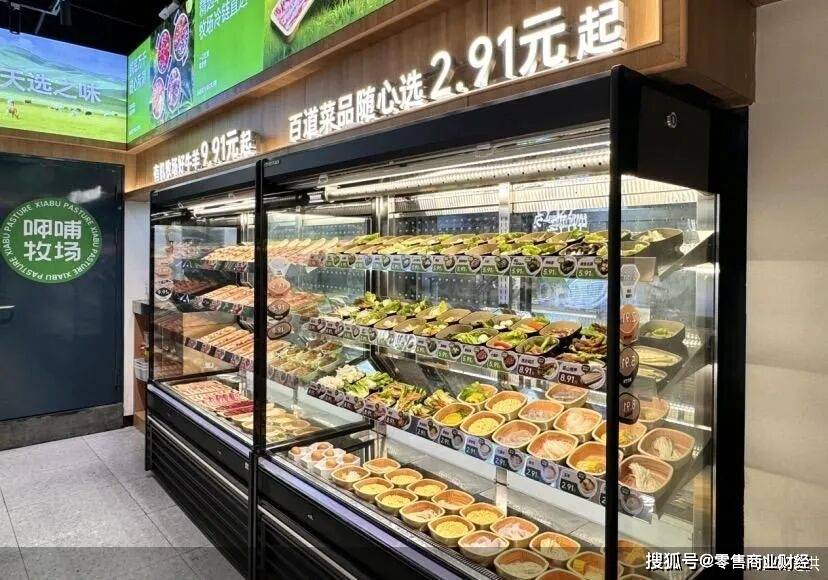
Group 1 - Bawang Chaji responded to a viral video of staff operating without gloves, confirming the incident occurred at their store in Fujian Zhangzhou. The store is now indefinitely closed for rectification, and the involved staff have been dismissed [1] - Lianhua Supermarket announced the resignation of Executive Director Zhu Dingping due to other work commitments, effective immediately. This change may raise market concerns regarding the company's strategic direction [2] - Yili Ice Cream launched a new product, "Nai Pi Zi Yogurt-flavored Ice Cream," featuring a yogurt filling and a butter-based shell, with a milk content of at least 45% [3] Group 2 - Beijing Civil Affairs Bureau signed a strategic cooperation agreement with Meituan to explore online elderly care services, aiming to address supply-demand mismatches. Meituan's elderly care services now cover over 300 cities and more than 30,000 institutions, with a 78% increase in user demand intentions and over 200% growth in transaction volume [4] - Xiaobai Xiaobai Group introduced a new self-service hot pot brand "Xiaobai Ranch" in Shanghai, targeting young consumers with affordable pricing starting at 29.82 yuan per person, including a variety of vegetables and drinks [5] - Huazhu Beverages' new production base in Wenzhou officially commenced operations, expected to produce 1.285 billion bottles of packaged drinking water annually, generating over 700 million yuan in annual output value [11] Group 3 - Grandpa's Farm International Holdings submitted a listing application to the Hong Kong Stock Exchange, reporting revenues of approximately 6.224 billion yuan for 2023 and projected revenues of 7.798 billion yuan for the first nine months of 2025 [13] - Yakult launched a new spring festival limited edition packaging featuring auspicious colors and messages, aimed at enhancing consumer engagement during the festive season [16] - Costa Coffee reported a projected loss of 13.5 million pounds (approximately 12.6 million yuan) for 2024, attributed to increased competition and rising operational costs [18]



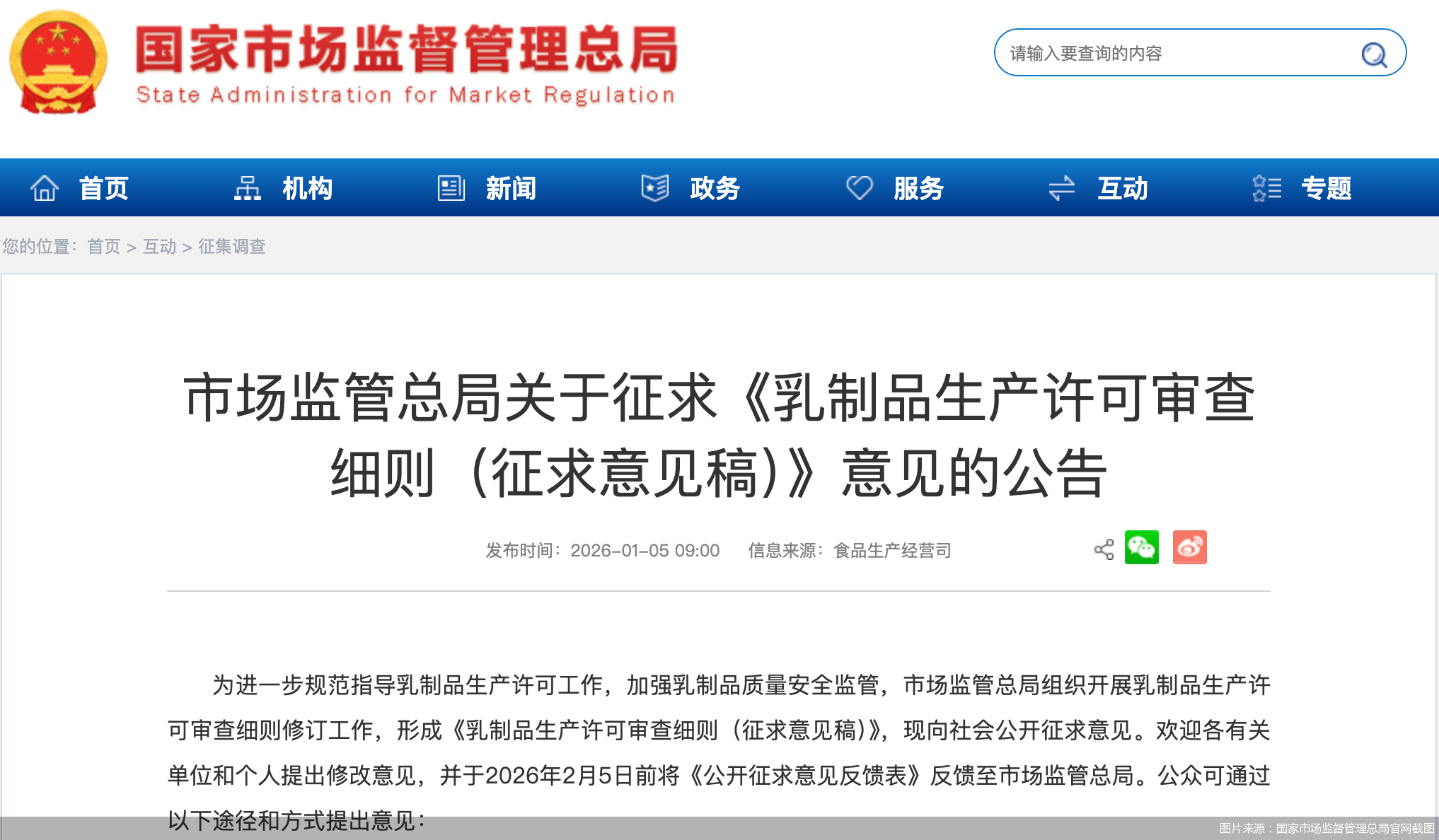
乳制品生产许可将迎新规
Bei Jing Shang Bao· 2026-01-06 13:51
Core Viewpoint - The National Market Supervision Administration has publicly solicited opinions on the "Draft Review Guidelines for Dairy Product Production Licenses," which aims to update the existing guidelines to better align with the evolving structure of the dairy product industry and facilitate technological breakthroughs and innovation among small enterprises [3]. Group 1: Product Category Expansion - The draft guidelines expand the product categories from three to eleven, including liquid milk, fermented milk, milk powder, concentrated dairy products, dairy fat products, cheese and its products, whey and its products, specialty livestock dairy products, local specialty dairy products, infant formula base powder, and other dairy products [4]. - This adjustment aims to enhance the operational feasibility of the guidelines by clearly defining and detailing the licensing categories and product specifics [4]. Group 2: Production Control Enhancements - The draft specifies requirements for factory site selection and environmental conditions, adjusting cleanliness standards based on product processing characteristics, and adding hygiene and access control requirements for clean work areas [5]. - It also revises equipment and process requirements, detailing standard equipment for dairy production and introducing specific technical requirements for water supply and drainage facilities [5]. Group 3: Personnel Management Improvements - The draft introduces requirements for food safety management personnel, including qualifications for the enterprise leader, food safety director, and food safety staff, mandating specialized education and relevant work experience [6]. - It also specifies educational qualifications for laboratory personnel and emphasizes regular training and assessment for staff [6]. Group 4: Support for Small and Medium Enterprises - The draft guidelines are seen as timely in response to the evolving dairy product structure in China, which is shifting from quantity to quality, with a growing focus on high-value and functional products [8]. - Analysts suggest that while the new standards may increase management costs for some companies, they also provide opportunities for small enterprises to accelerate technological innovation and gain a competitive edge in niche markets [8].