
陕西煤业

Search documents
2025年1-9月陕西省工业企业有8725个,同比增长4.92%
Chan Ye Xin Xi Wang· 2025-11-20 03:34
Group 1 - The core viewpoint of the article highlights the growth of industrial enterprises in Shaanxi Province, with a total of 8,725 enterprises reported as of January to September 2025, marking an increase of 409 enterprises compared to the same period last year, representing a year-on-year growth of 4.92% [1][1][1] - The report indicates that the number of industrial enterprises in Shaanxi Province accounts for 1.67% of the national total [1][1][1] - The data presented is sourced from the National Bureau of Statistics and organized by Zhiyan Consulting, a leading industry consulting firm in China [1][1][1] Group 2 - The article references a report by Zhiyan Consulting titled "2025-2031 China Industrial Cloud Industry Market Deep Assessment and Investment Opportunity Forecast Report" [1][1] - The report emphasizes the continuous growth and development of the industrial sector in Shaanxi, which has seen a significant increase in the number of large-scale industrial enterprises since 2011 [1][1][1] - Zhiyan Consulting has been dedicated to industry research for over a decade, providing comprehensive industry research reports, business plans, feasibility studies, and customized services [1][1][1]


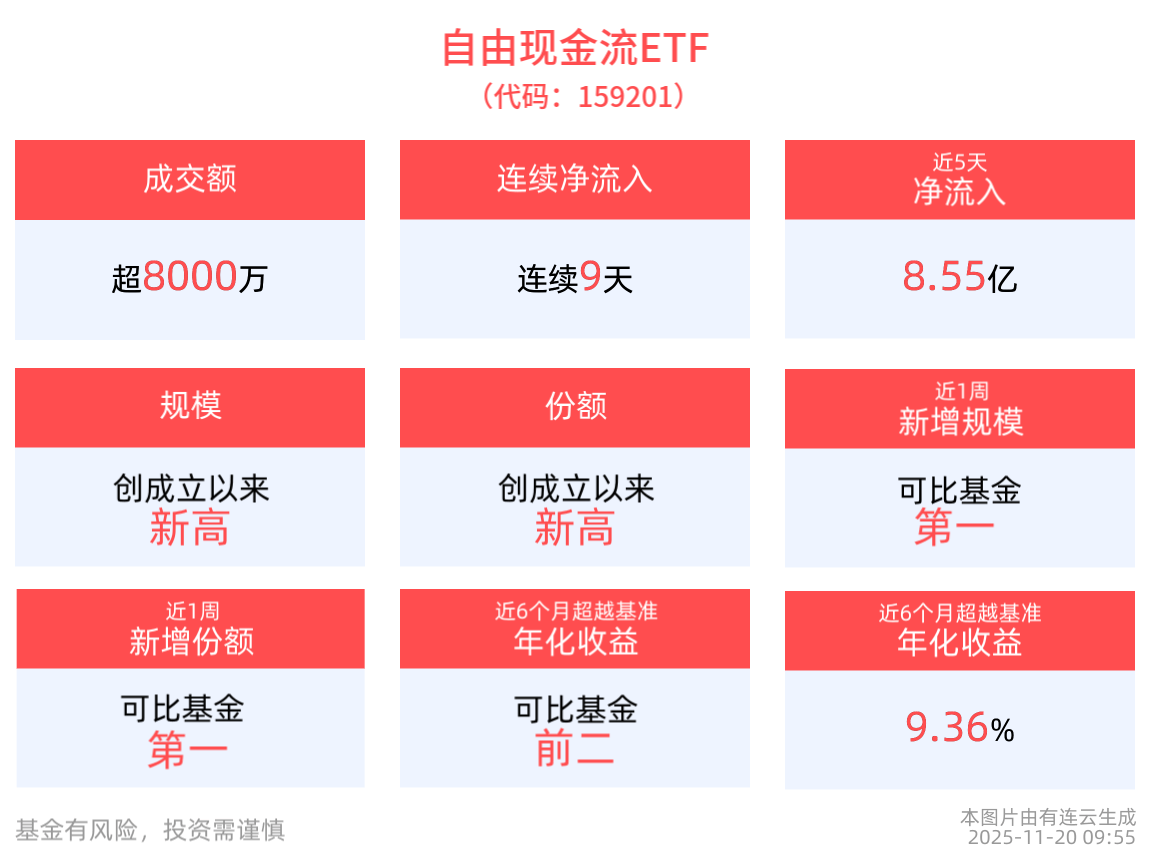
自由现金流ETF(159201)连续9天净流入,合计“吸金”14.95亿元,规模续创新高
Sou Hu Cai Jing· 2025-11-20 02:20
Core Insights - The Guozheng Free Cash Flow Index increased by 0.15% as of November 20, 2025, with leading stocks including Xiamen International Trade, Lianfa Shares, China Aluminum, Yun Aluminum, and Tailong Shares [1] - The Free Cash Flow ETF (159201) rose by 0.08%, with a latest price of 1.19 yuan [1] - The Free Cash Flow ETF has seen continuous net inflows over the past nine days, totaling 1.495 billion yuan, with a daily average net inflow of 166 million yuan [1] Performance Metrics - The Free Cash Flow ETF's net value increased by 20.89% over the past six months [4] - Since inception, the ETF's highest monthly return was 7.00%, with a maximum consecutive monthly gain of 22.69% and an average monthly return of 3.20% during the rising months [4] - The ETF has a historical six-month profitability rate of 100.00% [4] Fund Details - The management fee for the Free Cash Flow ETF is 0.15%, and the custody fee is 0.05% [5] - As of October 31, 2025, the top ten weighted stocks in the Guozheng Free Cash Flow Index accounted for 54.79% of the index, including China National Offshore Oil, SAIC Motor, Wuliangye, and Gree Electric [5] Stock Performance - The top ten stocks by weight in the index showed varied performance, with Xiamen International Trade leading with a 4.11% increase, while Mingguo Hai and SAIC Motor saw declines of -0.75% and -0.46%, respectively [7]
商品期货早班车-20251120
Zhao Shang Qi Huo· 2025-11-20 01:07
1. Report Industry Investment Rating No relevant content provided. 2. Core Viewpoints of the Report - The overall commodity futures market shows complex trends with different metals, agricultural products, and energy - chemical products having their own supply - demand situations, and corresponding trading strategies are recommended based on these situations [2][7][8]. 3. Summaries by Relevant Catalogs Precious Metals - **Gold**: Market strengthened on Wednesday, but London gold failed to hold above $4100. Fed's internal divergence on December rate - cut, employment report changes, and domestic gold ETF inflows are key factors. Suggest buying at support levels [2]. - **Silver**: Supply tightness is gradually easing. Recommend gradually reducing long positions [2]. Base Metals - **Copper**: Price stabilized yesterday. With improved risk appetite and low rate - cut expectations, and considering the supply - demand situation, it is recommended to buy on dips [2]. - **Aluminum**: Aluminum price may maintain oscillatory adjustment after a decline, with improved spot trading but continued reduction of long positions in the main contract [2]. - **Alumina**: Supply - demand surplus persists, and the price is expected to be weak and oscillatory [2]. - **Zinc**: Price declined yesterday. Due to supply shortages and demand - side factors, it is recommended to wait and see [3]. - **Industrial Silicon**: Price rebounded significantly. With planned production cuts and cost support, long positions can gradually take profits, and short positions should be entered with caution [3]. - **Lithium Carbonate**: Current demand is strong, but long - term demand may decline. It is recommended to try long positions at low levels and be cautious about chasing highs, or consider selling put options [3]. - **Polycrystalline Silicon**: Price rose. Near - month contracts are strong, but it is recommended to be cautious about chasing highs due to factors like slow progress of the storage platform [3]. - **Tin**: Price trended strongly. With improved risk appetite and supply - demand situation, it is recommended to buy on dips [4]. Black Industry - **Rebar**: Supply - demand is weak, and there is significant structural differentiation. Hold short positions in hot - rolled coil 2605, and the reference range for RB01 is 3030 - 3080 [5]. - **Iron Ore**: Supply - demand is weakening. Hold short positions in iron ore 2605, and the reference range for I01 is 760 - 795 [5]. - **Coking Coal**: Supply - demand is weakening. Hold short positions in coking coal 2605, and the reference range for JM01 is 1110 - 1150 [5]. Agricultural Products - **Soybean Meal**: US soybeans enter an oscillatory phase, and the domestic market is temporarily weak. The medium - term trend depends on tariff policies and production in the producing areas [7]. - **Corn**: As the supply in Northeast China is approaching, the futures price is expected to decline oscillatory. Hold short positions [7]. - **Oils and Fats**: Enter an oscillatory and slightly strong phase. Pay attention to future production and biodiesel policies [7]. - **Sugar**: International sugar price rebounds, and the domestic market will follow the international trend to decline. Short in the futures market and sell call options [7]. - **Cotton**: Temporarily wait and see, with a range - bound strategy of 13300 - 13600 yuan/ton [7]. - **Eggs**: The futures price is expected to be weak and oscillatory due to decreased supply pressure and weakening demand [7]. - **Pigs**: The supply is still abundant, and the futures price is expected to be weak and oscillatory [8]. - **Apples**: Wait and see due to low inventory and high - quality apple price increases [8]. Energy and Chemicals - **LLDPE**: Short - term oscillatory, and it is recommended to short at high levels or conduct spread trading in the long - term [8]. - **PVC**: Supply - demand is weak, and it is recommended to short or conduct spread trading [8]. - **PTA**: Take profits on long positions in PX, and short the processing margin of PTA in the long - term [8][9]. - **Glass**: Supply - demand is in a weak balance, and it is recommended to conduct spread trading [9]. - **PP**: Short - term oscillatory and weak, and it is recommended to short at high levels or conduct spread trading in the long - term [9]. - **MEG**: Supply - demand accumulates inventory, and it is recommended to short at high levels for the 01 contract [9]. - **Crude Oil**: Fundamentally bearish, but with high geopolitical uncertainty, it is expected to oscillate in the short - term. Short at high levels if Russian oil reduction is less than 500,000 barrels per day [9][10]. - **Styrene**: Short - term oscillatory, with the upside limited by the import window [10]. - **Soda Ash**: Supply - demand is balanced, and it is recommended to wait and see [10]. - **Urea**: The futures price is expected to oscillate in the short - term due to export news and supply - demand situation [10].
东吴证券晨会纪要-20251120
Soochow Securities· 2025-11-19 23:30
Macro Strategy - The report anticipates that the monetary policy in 2026 will continue to be supportive, with potential for 1-2 rate cuts and 1-2 reserve requirement ratio reductions [1][9][10] - The 10-year government bond yield is expected to fluctuate between 1.70%-2.0%, while the 30-year yield may range from 1.90%-2.30% [1][9] Fixed Income - The report outlines key valuation indicators for urban investment public REITs, including operational indicators like current revenue and distributable amount, valuation indicators such as expected REITs dividend rate and P/FFO multiples, liquidity indicators like daily turnover rate, and price indicators like daily price fluctuation [2][12] - Recommended REITs include Zhejiang Merchants Hu-Hang-Ning REIT and Zhongjin Anhui Traffic Control REIT in transportation infrastructure, Zhongjin Hubei Science and Technology REIT and E Fund Guangkai Industrial Park REIT in park infrastructure, and Guotai Junan City Investment Wide Court Rental Housing REIT in affordable rental housing [2][12] Industry - The 2025 Double Eleven sales totaled approximately 16,950 billion yuan, reflecting a year-on-year growth of 14.2%, with comprehensive e-commerce platforms achieving 16,191 billion yuan, up 12.3% [3][14] - Instant retail showed remarkable growth, with sales reaching 670 billion yuan during Double Eleven, marking a 138% increase year-on-year [3][14] - The report suggests that the extended sales period significantly contributed to the overall growth, and highlights the importance of focusing on fast-growing sectors like pet products [3][14] Coal Industry - The coal price is expected to fluctuate in a weak equilibrium state in 2026, with a reasonable price expectation around 770 yuan/ton [4][15] - The report emphasizes the importance of energy security and suggests focusing on companies like Guanghui Energy and Haohua Energy, which are expected to benefit from increased production and price elasticity [4][15] - High dividend logic is highlighted, with expectations that the dividend yield for China Shenhua and Shaanxi Coal will decrease from around 4.5% in 2025 to approximately 3.5% by mid-2026 [4][15] Company Analysis - Xiaomi Group reported a Q3 revenue of 1131.2 billion yuan, a year-on-year increase of 22.3%, with a net profit of 113.1 billion yuan, up 80.9% [6][18] - The automotive segment achieved profitability for the first time, with a revenue of 290.1 billion yuan, reflecting a 199.2% increase year-on-year [6][18] - Xpeng Motors reported a Q3 revenue of 203.8 billion yuan, a 101.8% increase year-on-year, with a net loss of 3.8 billion yuan, which is an improvement from the previous quarter [8][22] - Canadian Solar (CSIQ) expects Q4 sales between 13 billion to 15 billion USD, with a significant increase in storage shipments projected for 2026 [7][21]
以中长期稳健增值为目标 险资系私募基金接连启航
Zhong Guo Zheng Quan Bao· 2025-11-19 20:13
Core Insights - Sunshine Life Insurance, a subsidiary of Sunshine Insurance, has signed a fund contract with Sunshine Hengyi and China Merchants Bank Qingdao Branch, marking a significant step in launching a pilot fund project with an investment of 20 billion yuan [1] - Multiple insurance capital-backed private equity funds have been established this year, focusing on the secondary market and aiming for medium to long-term stable asset appreciation, thus facilitating the long-term investment reform of insurance funds [1][2] - The establishment of these funds is expected to enhance the interaction between insurance capital and the capital market, leveraging the advantages of insurance funds as long-term investors [1][4] Fund Establishment and Management - Sunshine Hengyi has completed its business registration and is in the process of signing contracts and filing for the pilot fund, which is expected to have a total scale of 20 billion yuan, fully subscribed by Sunshine Life Insurance [1][2] - As of now, seven insurance capital-backed private equity fund companies have been established, including those from Taikang Insurance, China Pacific Insurance, and China Life Insurance [2] - The funds are primarily focused on large-cap blue-chip stocks and high-dividend targets, with a strategy that emphasizes long-term capital attributes and stable returns [2][3] Investment Strategy and Focus - The investment scope of the proposed private equity fund includes equity assets, fixed income assets, and cash management tools, with a focus on stocks from the CSI 300 Index and related ETFs [3] - The investment philosophy of these funds includes a focus on high-dividend assets, stable operations, and sectors aligned with national development strategies, such as high-end manufacturing and artificial intelligence [3][4] - The insurance capital-backed private equity funds are expected to adopt a long-term holding strategy to optimize asset-liability matching and reduce market volatility impacts on profit statements [4][5] Regulatory and Market Context - The establishment of these funds aligns with the regulatory push for increasing long-term capital inflows into the market, as outlined in the implementation plan by several financial authorities [3][4] - The pilot fund initiative has already seen three batches of funds totaling 222 billion yuan, expanding the scope of participating institutions beyond large insurance companies [3][4] - The long-term investment strategy is aimed at supporting the healthy development of the capital market and enhancing the stability of insurance companies' investment capabilities [5]
煤炭行业第三季度盈利环比增长约20%
Xin Lang Cai Jing· 2025-11-19 14:06
Core Insights - The coal industry in China is experiencing a recovery in profitability despite a year-on-year decline in coal prices and corporate earnings [2][3][4]. Group 1: Industry Performance - The total electricity generation from coal-fired power plants in Q3 reached 1.76 trillion kWh, a year-on-year increase of 1% [2]. - Coal production and sales for 23 listed companies in the first three quarters were 940 million tons and 1.11 billion tons, respectively, with a slight quarter-on-quarter increase in Q3 [3]. - The average price of thermal coal at Huanghua Port rose from 641.7 yuan/ton to 679 yuan/ton, while the price of coking coal at Jingtang Port increased from 1315.3 yuan/ton to 1566.7 yuan/ton [2]. Group 2: Company Performance - The total profit for the coal industry in Q3 reached 75.5 billion yuan, a quarter-on-quarter increase of 9.7% [2]. - Among 37 listed coal companies, the net profit for Q3 was 29.942 billion yuan, up 22.83% from the previous quarter [3]. - Leading companies like China Shenhua reported a Q3 net profit of 14.7 billion yuan, a quarter-on-quarter increase of 13%, driven by strong performance in the power sector [4]. Group 3: Market Outlook - As of November 12, the spot price for 5500 kcal coal in the Bohai Rim region reached 828 yuan/ton, exceeding the price at the beginning of the year [5]. - The coal market sentiment is currently high, with coastal power plant inventories down 5%-6% year-on-year due to slow replenishment during the off-season [5].




东方财富证券:25Q3煤炭供给边际同比明显收缩 关注行业反内卷政策逻辑演绎
智通财经网· 2025-11-19 08:38
Core Viewpoint - The coal industry is expected to enter a long-term upward cycle due to a solidified price floor and limited growth in new coal production capacity, despite a decrease in coal production and imports in 2025 [1][2][4]. Group 1: Coal Supply - In the first nine months of 2025, domestic coal production increased by 2% year-on-year, but there was a significant decline in production following the release of the National Energy Administration's document No. 108 in July, with production in July, August, and September showing year-on-year decreases of -3.8%, -3.2%, and -1.8% respectively [1]. - In Q3 2025, coal production in Shanxi, Inner Mongolia, Shaanxi, and Xinjiang was 32.9 million tons, 30.9 million tons, 20.3 million tons, and 12.3 million tons respectively, with a quarter-on-quarter change of -1.6%, -0.3%, +0.1%, and -12.3% [1]. Group 2: Coal Imports - In the first nine months of 2025, coal imports totaled 34.6 million tons, a decrease of 11.1% year-on-year. Specifically, imports of Indonesian coal were 14.3 million tons, down by 2.525 million tons or 15% year-on-year [2]. - Imports of Mongolian coal reached 6.192 million tons, an increase of 130,000 tons or 2.1% year-on-year, but the proportion of imported coking coal decreased from 71.6% to 67.4% [2]. Group 3: Coal Demand - Short-term demand for coal is structurally weak due to a slowdown in electricity consumption growth and competition from renewable energy sources, with total thermal power generation in the first nine months of 2025 at 4,696.9 billion kWh, down 1.2% year-on-year [3]. - The steel sector shows resilience, with cumulative profits of key steel enterprises reaching 96 billion yuan, a year-on-year increase of 1.9 times [3]. - Chemical coal demand remains high but is slowing, with an average weekly coal consumption of 6.9 million tons in the first nine months of 2025, up 12.7% year-on-year [3]. - The building materials sector continues to be affected by real estate, with coal consumption of 18.6 million tons in the first nine months of 2025, down 4.6% year-on-year, but the decline is less severe than the 9.1% drop in the same period of 2024 [3]. Group 4: Industry Policy and Outlook - The "anti-involution" policy in the coal industry aims to control production release through capacity utilization rates, balancing supply and demand to support coal prices, with ongoing supply constraints expected [4]. - The central government's focus on regulating disorderly competition and promoting capacity governance is seen as crucial for the industry's recovery [4]. Group 5: Investment Recommendations - Companies to watch include China Shenhua (601088.SH), Shaanxi Coal (601225.SH), and China Coal Energy (601898.SH) for their long-term benefits from a solidified coal price floor [5]. - In the context of rising coal prices, companies like Yanzhou Coal (600188.SH), Jinkong Coal (601001.SH), and Shanxi Coal International (600546.SH) are recommended for their valuation recovery potential [5]. - Coking coal companies such as Lu'an Environmental Energy (601699.SH) and Pingmei Shenma (601666.SH) are expected to benefit from the steel industry's "anti-involution" [6].

A股冲高回落,1亿元盘中抢筹自由现金流ETF,四季度超280亿资金布局红利方向
Ge Long Hui· 2025-11-19 05:47
Core Insights - A-shares experienced a pullback after a high opening, with all three major indices turning negative in the afternoon. The Free Cash Flow ETF saw significant capital inflow, with a net subscription of 8.8 million units, amounting to an estimated net inflow of 104 million yuan [1] - As of November 18, the Free Cash Flow ETF has attracted capital for eight consecutive days, with a total net inflow of 2.242 billion yuan over 25 out of the last 26 trading days since October 14, making it the top ETF in the Free Cash Flow strategy [1] - With the year-end policy window approaching and increased reallocation demand, signs of style switching in A-shares are emerging. Since the fourth quarter, various dividend low-volatility ETFs, including the Free Cash Flow ETF, have collectively seen a net inflow of 28.167 billion yuan [1] - According to a report by Caitong Securities, the year-end policy window should focus on "low crowding + quality dividend layout," indicating that companies with abundant free cash flow can withstand volatility during style switching and seize opportunities in valuation recovery [1] - The Free Cash Flow ETF tracks the Guozheng Free Cash Flow Index, covering sectors such as non-ferrous metals, automotive, petrochemicals, and power equipment, which are characterized by low crowding and can benefit from policy-driven improvements in economic conditions [1] Related Products - The Free Cash Flow ETF (159201) has a current scale of 6.786 billion yuan, ranking first among similar products, with a weight in stocks including China National Offshore Oil Corporation, SAIC Motor, Shaanxi Coal and Chemical Industry, and Gree Electric Appliances. The product has the lowest comprehensive fee rate of 0.2% in the market [2]
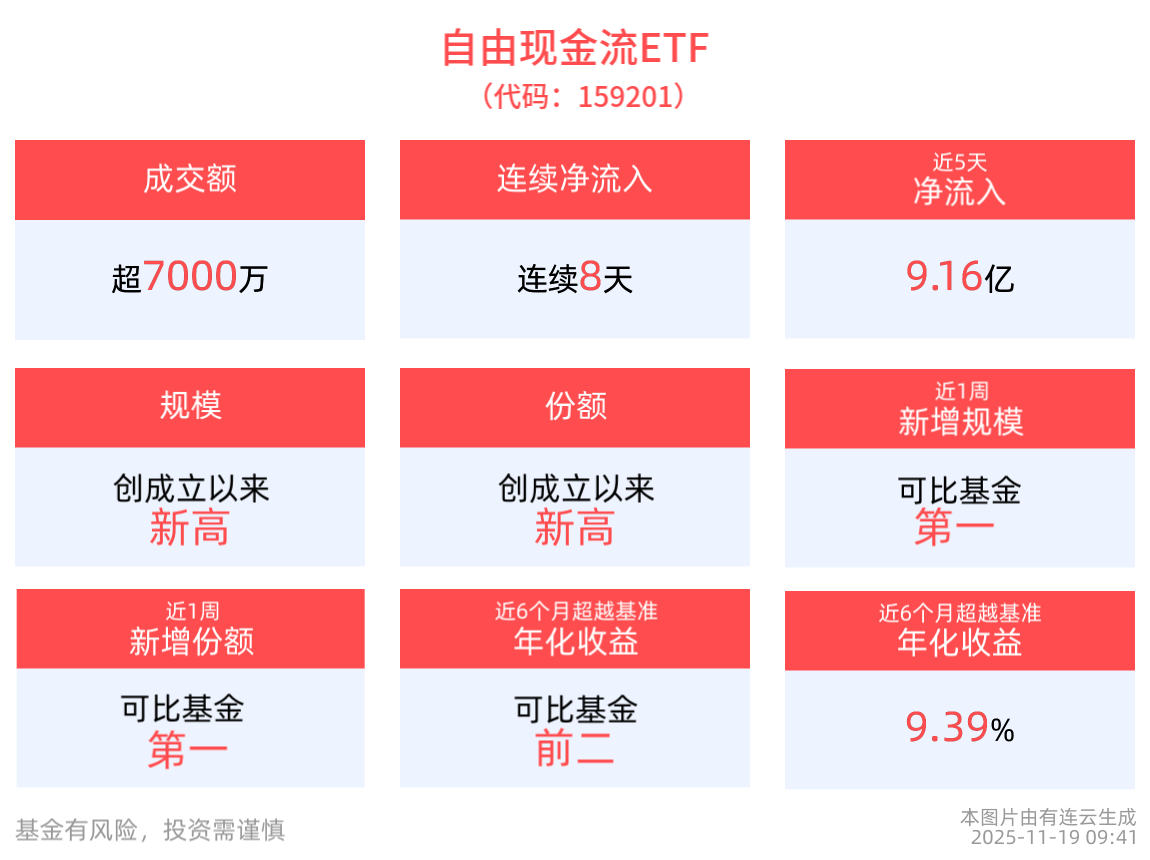
自由现金流ETF(159201)连续8天净流入,合计“吸金”13.16亿元,规模创成立以来新高
Sou Hu Cai Jing· 2025-11-19 02:15
Core Insights - The Guozheng Free Cash Flow Index has increased by 0.19%, with stocks such as Haili Heavy Industry reaching the daily limit, and other companies like Chuncheng Power, Dongfang Tower, Jianghe Group, and Hisense Visual also experiencing gains [1] - The Free Cash Flow ETF (159201) is experiencing a tug-of-war between bulls and bears, with the latest price at 1.19 yuan [1] - The Free Cash Flow ETF has seen continuous net inflows over the past eight days, totaling 1.316 billion yuan, with a daily average net inflow of 164 million yuan [1][3] Fund Performance - The Free Cash Flow ETF has achieved a net value increase of 21.02% over the past six months, with the highest monthly return reaching 7% and the longest consecutive monthly gain lasting six months [3] - The ETF has a historical monthly profit percentage of 87.5% and a monthly profit probability of 82.93%, with a 100% probability of profit for a six-month holding period [3] - As of November 18, 2025, the ETF's annualized return exceeded the benchmark by 9.39% over the last six months [3] Fund Details - The management fee for the Free Cash Flow ETF is 0.15%, and the custody fee is 0.05% [4] - The ETF closely tracks the Guozheng Free Cash Flow Index, with the top ten weighted stocks accounting for 54.79% of the index [4] - The top ten stocks include China National Offshore Oil Corporation, SAIC Motor, Wuliangye, Gree Electric Appliances, and others [4][6]
中国煤炭 - 煤炭专家电话会议核心要点-China Coal-Coal Expert Key Call Takeaways
2025-11-19 01:50
Key Takeaways from China Coal Industry Conference Industry Overview - The conference focused on the coal industry in China, particularly thermal and coking coal imports and prices for 2026 [1][2][6]. Core Insights 1. **Coal Import Projections**: - Total coal imports for 2026 are expected to decline to approximately 480 million tonnes (mnt), down from 493 mnt projected for 2025. This includes thermal coal at 373 mnt and coking coal at 107 mnt for 2026, compared to 383 mnt and 110 mnt in 2025 [2][9]. 2. **Price Forecasts**: - The average thermal coal price is forecasted to be Rmb 735 per tonne in 2026, an increase from Rmb 710-720 per tonne in 2025. Short-term price corrections are anticipated before winter heating demand potentially drives prices up to Rmb 850-900 per tonne [3][9]. 3. **Inventory Levels**: - Inventory levels across the supply chain are reported to be below seasonal averages, particularly at mines and ports. Slow stockpiling due to lower production and increased restocking by traders may lead to upward price pressure if inventory drawdowns continue [4][9]. 4. **Production Growth**: - A coal production increase of 1.1-1.5% is expected for 2026. Downstream demand from heating (+2%) and coal chemicals (+6%) is anticipated to offset declines in building materials (-0.3%) and steelmaking (-2%) [6][9]. 5. **Market Dynamics**: - The widening import price arbitrage between domestic and Indonesian coal since September is expected to increase import arrivals towards the end of the year, although logistics and the December rainy season may cause disruptions [2][4]. Additional Important Points - The production in November-December 2025 is expected to rebound slightly but will continue to show negative year-on-year growth due to ongoing overproduction inspection checks [9]. - Coking coal prices are projected to average Rmb 1,430-1,450 per tonne in 2026, up from Rmb 1,360 per tonne in 2025, while Mongolia coal prices are expected to be around Rmb 930 per tonne in 2026, compared to Rmb 900 per tonne in 2025 [9]. Conclusion - The coal industry in China is facing a complex landscape with declining imports, fluctuating prices, and tight inventory levels. The anticipated production growth and downstream demand may provide some stability, but external factors such as logistics and seasonal weather patterns could impact market dynamics significantly [1][6][9].