
宝马

Search documents
豪华信仰崩塌,BBA不再吸引年轻人
3 6 Ke· 2025-11-05 09:44
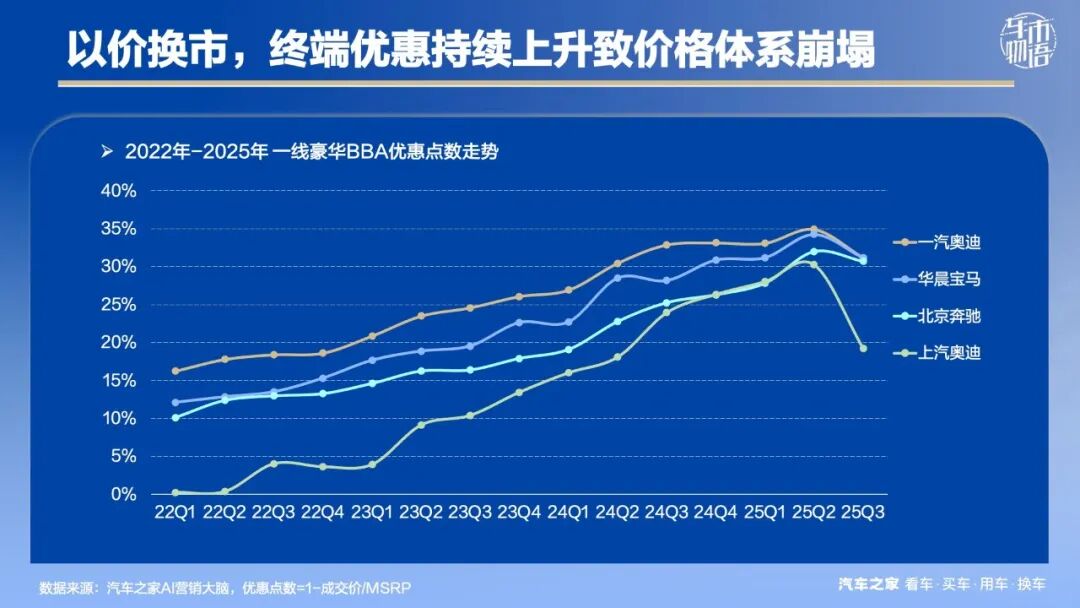
Core Insights - Mercedes-Benz is reportedly planning to lay off 30,000 employees, marking the largest layoff in the company's history, amid a significant decline in profits, with net profit dropping 50.3% year-on-year from €7.8 billion to €3.87 billion in the first nine months of 2025 [1] - The luxury automotive market is facing a transformation crisis, with traditional luxury brands struggling against rising Chinese brands and experiencing a collapse in their high-end pricing structure [1][2] - The market share of overseas luxury brands in the large vehicle segment has plummeted from 94% in 2016 to just 13% by 2025, indicating a significant loss of dominance [4] Group 1: Market Dynamics - Luxury vehicles are now being sold at discounts, with some models entering the price range of ¥250,000 to ¥300,000, and even below ¥200,000, which poses a threat to both foreign and domestic brands [2] - The high-end market share of luxury brands is rapidly declining, with a drop from 68% in 2016 to 22% by 2025 in the combined mid-large vehicle segment [4] - The shift in consumer preferences towards traditional fuel vehicles over luxury brands is evident, with only 41% of consumers with a budget over ¥300,000 considering overseas luxury brands [7] Group 2: Changing Consumer Preferences - In the new energy vehicle market, only 32% of potential buyers consider overseas luxury brands, highlighting a disconnect between luxury branding and consumer needs [9] - The perception of luxury is evolving, with 92% of high-budget new energy users recognizing at least one Chinese brand as a high-end brand, indicating a shift in the definition of luxury [13] - The importance of brand value is diminishing in the new energy sector, with only 25% of users considering brand as a key factor in their purchasing decision [9] Group 3: Technological Advancements - Chinese brands are increasingly recognized for their high-end features, with over 90% of new energy users acknowledging the high-end capabilities of Chinese brands [13][19] - The standardization of advanced features in Chinese high-end models is significantly higher than that of overseas luxury brands, particularly in areas like lane-keeping assistance and 360° panoramic imaging [19][21] - Collaborations between luxury brands and Chinese tech companies are expected to enhance their technological offerings, with several partnerships set to launch new models by 2025 [24][26]

浙江荣泰(603119):Q3增速恢复业绩亮眼,机器人业务加速推进
GOLDEN SUN SECURITIES· 2025-11-05 08:40
Investment Rating - The report maintains a "Buy" rating for the company [3][6]. Core Insights - The company reported a revenue of 390 million yuan in Q3 2025, representing a year-on-year increase of 25% and a quarter-on-quarter increase of 26%. The net profit attributable to the parent company was 80 million yuan, up 22% year-on-year and 25% quarter-on-quarter [1]. - The revenue growth in Q3 was primarily driven by overseas customers, with an estimated 50% of revenue coming from exports. The company has established partnerships with major global automotive manufacturers and battery leaders, indicating potential for further growth in overseas markets [1]. - The gross margin for Q3 2025 was 38.5%, an increase of 1.3 percentage points year-on-year and 2.8 percentage points quarter-on-quarter. The net profit margin was 20.83%, slightly down by 0.3 percentage points year-on-year [2]. - The company is strategically positioning itself in the robotics sector, with ongoing collaborations and a factory in Thailand expected to commence production by the end of 2025 [2]. Financial Summary - The company forecasts net profits of 310 million yuan, 420 million yuan, and 580 million yuan for 2025, 2026, and 2027 respectively, reflecting growth rates of 34%, 35%, and 39% [3]. - Projected revenues for the next few years are 1.518 billion yuan in 2025, 2.059 billion yuan in 2026, and 2.805 billion yuan in 2027, with year-on-year growth rates of 33.7%, 35.7%, and 36.2% respectively [5]. - The report indicates a stable expense ratio, with R&D expenses increasing by 67% quarter-on-quarter in Q3 2025, reflecting the company's commitment to innovation [2].

动储双轮驱动,锂电产业迎来新一轮爆发式增长,新能车ETF(515700)涨超2%
Xin Lang Cai Jing· 2025-11-05 05:40
Group 1 - The core viewpoint is that leading battery companies are benefiting from the dual drivers of power and energy storage, resulting in a supply-demand imbalance in the market [1] - In the first nine months of the year, China's new energy vehicle sales reached 11.196 million units, a year-on-year increase of 34.55%, which has driven rapid growth in power battery installations [1] - Power battery installations exceeded 500 GWh in the first nine months, reflecting a year-on-year growth of 43.5%, with the fourth quarter expected to maintain this growth trend due to seasonal demand [1] Group 2 - The global energy storage market is experiencing explosive growth, becoming a core engine for lithium battery demand, with Chinese companies expected to ship 252 GWh of energy storage batteries in the first half of 2025, a year-on-year increase of 109% [1] - The lithium battery industry is currently facing reduced inventory pressure, leading to a supply-demand situation, particularly in the energy storage sector, where a "chip shortage" persists [2] - By 2026, the demand growth for battery cells is expected to outpace the supply growth of battery materials, indicating potential shortages that could lead to a redistribution of value within the lithium battery supply chain [2] Group 3 - As of October 31, 2025, the top ten weighted stocks in the China Securities New Energy Vehicle Industry Index accounted for 53.56% of the index, with major companies including CATL, BYD, and Ganfeng Lithium [3] - The New Energy Vehicle ETF closely tracks the China Securities New Energy Vehicle Industry Index, which includes 50 listed companies involved in various aspects of the new energy vehicle industry [2][3]
12家外资车企登陆第八届进博会,9家八年“全勤”
Zhong Guo Jing Ji Wang· 2025-11-05 04:06
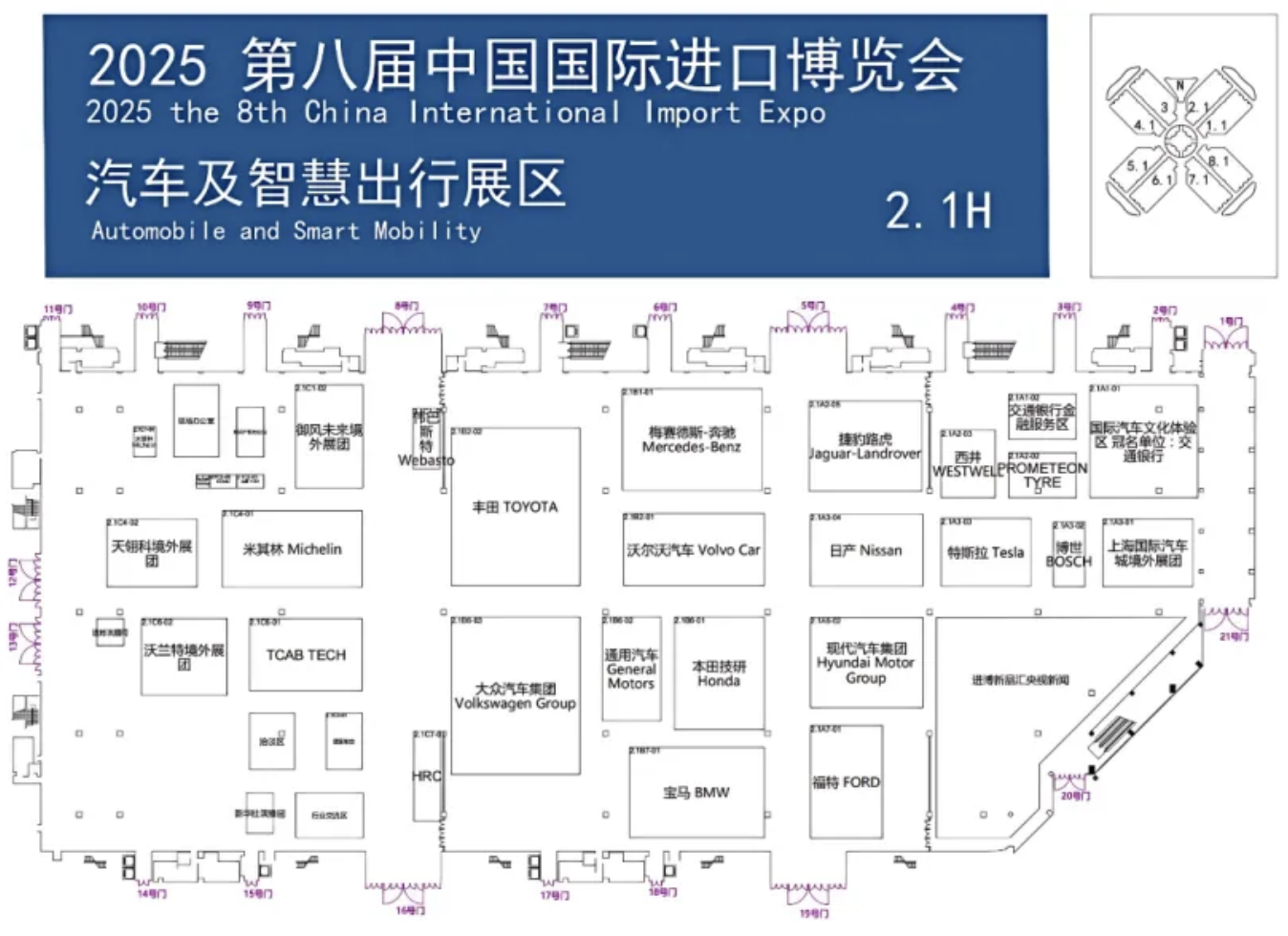
Core Insights - The 8th China International Import Expo (CIIE) will commence on November 5, showcasing the automotive sector as a key highlight, featuring major global brands like Jaguar Land Rover, Tesla, Nissan, and more [1][3] - The automotive exhibition has evolved to reflect industry trends, with a focus on electric vehicles, hydrogen energy, and autonomous driving technologies, marking a significant transformation in the automotive landscape [3] Group 1: Automotive Industry Trends - The import car market is contracting, yet it remains a platform for multinational brands to showcase cutting-edge technologies and diverse products [3] - The evolution from traditional fuel vehicles to electric and intelligent solutions is evident, with autonomous driving technology being the focal point of this year's expo [3] Group 2: Participating Brands and Innovations - Jaguar Land Rover will present the new Land Rover Defender OCTA and the Range Rover SV, along with rare royal vehicles, emphasizing its cultural heritage [5] - Hyundai will debut the world's first mass-produced hydrogen fuel cell heavy-duty truck, showcasing advancements in logistics efficiency and zero-emission operations [5] - Mercedes-Benz will display eight luxury models, catering to various market segments with different driving technologies [7] - Volvo will introduce the new XC70, a luxury hybrid SUV, highlighting safety and advanced technology [9] - Toyota will focus on localization, showcasing electric vehicles and new energy storage products developed in collaboration with China Minmetals [11] - Honda will present a diverse range of mobility solutions, including electric vehicles and motorcycles, emphasizing safety and outdoor experiences [14] - General Motors will highlight its commitment to safety and sustainability with new electric and intelligent driving solutions [15] - Volkswagen will showcase eight models, including electric and high-end smart vehicles, reflecting its commitment to rapid delivery in the Chinese market [17] - BMW will unveil several key models, including the new BMW M2CS and electric vehicles, targeting performance and exclusivity in the Chinese market [19]
泛亚微透20251104
2025-11-05 01:29
Summary of Pan-Asia Micro透 Conference Call Company Overview - **Company**: Pan-Asia Micro透 - **Industry**: Advanced materials and components, focusing on automotive and flexible circuit boards Key Financial Metrics - **Revenue**: - Micro透 products revenue: 127 million CNY, gross margin: 77%, YoY growth: 23.4% [2][3] - CMD and gas management business revenue: 1.105 billion CNY, gross margin: over 60%, YoY growth: 6.68% [2] - Aerogel business revenue: 54.4 million CNY, YoY growth: 25.8% [2] - Wiring harness and cable business revenue: 75.802 million CNY, growth rate over 2000% [2] - **Net Profit**: - For the first three quarters of 2025: 90 million CNY, YoY growth: 36.17% [3] Business Segments Performance - **Core Business Segments**: - Micro透 products: 127 million CNY revenue, gross margin: 77% [3] - CMD and gas management: 1.105 billion CNY revenue, gross margin: over 60% [7] - Aerogel: 54.4 million CNY revenue, slight decline in gross margin [7] - Wiring harness and cable: 75.802 million CNY revenue, significant growth due to high-margin aerospace cables [7] Strategic Developments - **R&D Investment**: - R&D expenditure accounts for approximately 5%-6% of revenue, increased due to platform characteristics and cross-industry projects [9] - Employee count increased from over 300 to around 700, significantly raising management costs [9] - **Future Revenue Projections**: - Expected revenue for 2026: over 1.2 billion CNY, driven by R&D and increased expenses [9] New Business Initiatives - **CMD Expansion**: - CMD production capacity currently at 20 million units, expected to reach 50 million units [16] - Anticipated orders for CMD products to exceed 30 million units in 2026 [11] - **FCLC Project**: - Completed four batches of certification for FCCL, first production line established, expected first orders of 100-150 million CNY [17][18] Market Position and Competitive Advantage - **Cost Efficiency**: - CMD solution costs 35 CNY, significantly lower than competitors' solutions [14] - **Strategic Partnerships**: - Collaborations with major automotive companies like H Company, Huayu Vision, and Xingyu for CMD solutions [11][12] Challenges and Risks - **Gross Margin Pressure**: - Decline in overall gross margin primarily due to underperformance of automotive wiring harness business [7][8] - **Market Competition**: - Increased competition in aerogel and flexible circuit board markets may impact margins [24] Future Growth Areas - **High-frequency and High-speed Cables**: - Expected to be a significant growth area, with ongoing testing and potential large revenue contributions in 2026 [26] - **Medical Devices**: - Targeting the medical device market, aiming to replicate successful models from companies like Gore [21][22] - **Acquisitions**: - Plans for strategic acquisitions to enhance technology and market share, targeting at least one to two acquisitions every three years [27] Conclusion - Pan-Asia Micro透 is positioned for significant growth with a focus on expanding its CMD and FCCL product lines, while also navigating challenges in gross margins and market competition. The company's strategic partnerships and R&D investments are expected to drive future revenue growth and enhance its competitive position in the advanced materials industry.

中美休战,荷兰成了炮灰!
Jin Tou Wang· 2025-11-04 13:25
Core Viewpoint - The article discusses the implications of the Dutch government's actions against the semiconductor company Nexperia, a subsidiary of Wingtech Technology, highlighting the unintended consequences for both the Netherlands and its European allies in the semiconductor supply chain [1][2]. Group 1: Dutch Government Actions - The Dutch government imposed dual restrictions on Nexperia, which aligns with U.S. export control measures, raising suspicions of coordinated efforts against Chinese assets [1][2]. - Following the restrictions, China retaliated with export controls, affecting major automotive manufacturers in Europe, including Honda, Volkswagen, BMW, and Mercedes, leading to potential production halts [2][3]. Group 2: Semiconductor Industry Dynamics - Nexperia's operational structure includes significant manufacturing capabilities in China, with 70%-80% of its production capacity located there, particularly in Dongguan, which handles 70% of global shipments [3][6]. - The article emphasizes that despite the Dutch restrictions, the short-term impact on Nexperia's operations may be mitigated by domestic Chinese semiconductor manufacturers like SMIC and Huahong, which can cover 80% of specifications [6]. Group 3: Geopolitical Context - The actions of the Dutch government are seen as part of a broader strategy by the U.S. and its allies to curb China's semiconductor industry, with the Netherlands acting as a key player in this geopolitical landscape [7][9]. - The article suggests that the long-standing global division of labor led by the U.S. and Europe is collapsing, with China beginning to reshape the rules of the semiconductor game [10][12]. Group 4: Future Implications - The ongoing geopolitical tensions are expected to continue affecting companies like Nexperia, with the potential for further restrictions and competitive dynamics in the semiconductor sector [12][13]. - The article concludes that the current situation serves as a warning to smaller nations about the shifting balance of power in the semiconductor industry and the need for strategic adjustments [13].


谁在追逐欧洲电池产业的新浪潮 | 海斌访谈
Di Yi Cai Jing· 2025-11-04 08:49
Core Insights - European economies like the UK and Germany are either restarting or planning to restart subsidies for electric vehicles (EVs) in early 2024, indicating a renewed focus on the EV market [6][7] - Local battery manufacturers in Europe, such as Northvolt and ACC, have faced significant challenges, including quality issues and investment halts, while Chinese and American companies are increasingly entering the European market [3][4][11] - The competitive landscape in the European battery market is shifting, with expectations that Chinese companies could capture up to 80% of the market share, while local firms struggle to keep pace [20][21] Industry Developments - Northvolt, once a leading battery manufacturer in Europe, is facing bankruptcy due to severe product delivery and quality issues, leading to a potential acquisition by the American startup Lyten [3][10] - ACC, a joint venture involving Stellantis, Mercedes-Benz, and TotalEnergies, has suspended its investment plans in Germany and Italy, highlighting the difficulties faced by European battery firms [3][4] - The European battery market is witnessing a resurgence, with a 34% year-on-year increase in EV sales in September 2025, driven by renewed subsidies and local production requirements [6][7] Investment Trends - Significant investments are flowing into the European battery sector from both Chinese and American companies, indicating a strategic shift in the competitive landscape [8][19] - Companies like CATL and Envision are expanding their production capabilities in Europe, with CATL's factory in Hungary set to have a capacity of 100GWh and an investment of €7.34 billion [16][22] - Gotion High-Tech has launched a €1.2 billion battery super factory in Slovakia, with an initial capacity of 20GWh, targeting orders from Skoda, a Volkswagen subsidiary [15][22] Competitive Landscape - The competition among battery manufacturers is intensifying, with a focus on who can effectively build and operate battery factories [19] - Chinese battery manufacturers are adapting their strategies in Europe, often opting for joint ventures to align with local regulations and market conditions [21][22] - The market share of South Korean companies like LG Energy Solution and SK On has decreased, while Chinese firms are gaining ground, with CATL and others becoming dominant players [19][20]




德国汽车业将迎20万个就业岗位流失 究竟做错了什么?
Feng Huang Wang· 2025-11-04 08:14
Core Insights - The German automotive industry is facing significant challenges, including a projected loss of over 200,000 jobs due to declining demand, high production costs, and difficulties in transitioning to electric vehicles [1][4] - Major automakers like Volkswagen, Mercedes-Benz, and BMW have reported substantial declines in net profits, with Volkswagen's profit dropping by 61.5% year-on-year in the first three quarters of the year [1][2] - The German government is attempting to address the crisis by potentially reversing the EU's ban on new internal combustion engine vehicles post-2035, but this move poses risks to the electric vehicle transition and may undermine consumer confidence [2][3] Job Losses and Economic Impact - Since 2019, Germany has lost approximately 245,000 manufacturing jobs, with the automotive sector accounting for 51,500 job losses in the past year, representing 6.7% of the industry's total workforce [1] - The automotive industry's struggles are threatening the overall economic stability of Germany, which relies heavily on this sector [1] Electric Vehicle Transition Challenges - The rise of electric vehicles has been a double-edged sword for German automakers, who have invested billions but are now facing high costs and competition from Chinese manufacturers [4][5] - Despite some achievements in electrification, German automakers are struggling to compete due to high costs and less appealing designs compared to emerging competitors [5] Policy and Political Factors - The political landscape in Germany has contributed to the automotive industry's decline, with fluctuating policies affecting investment and consumer demand [6][8] - The government's indecisiveness and lack of a coherent strategy have led to a negative feedback loop of reduced demand and cautious investment among automakers [6][9] Competitive Landscape - German automakers are at risk of losing their competitive edge as they face increasing pressure from both domestic and international competitors, particularly in the electric vehicle market [5][9] - The industry's historical reliance on brand reputation may not be sufficient to maintain market share against more innovative and cost-effective alternatives [5][9]
欧洲车企忙“扫货”,荷兰芯片却为何卖不动了?
Zhong Guo Qi Che Bao Wang· 2025-11-04 04:01
Core Points - The Dutch government's takeover of Nexperia, a semiconductor manufacturer, has created a new "chip shortage" risk for European automakers due to national security concerns [2][4] - Nexperia is a leading supplier of automotive-grade power semiconductors, crucial for electric vehicles, and its supply chain disruption could lead to significant shortages in the automotive industry [4][5] - The decision to halt wafer supply to the Dongguan factory has caused panic buying among European automakers, leading to a surge in chip prices and inventory issues in local wafer factories [5][6] Industry Impact - Nexperia holds approximately 18% of the European power semiconductor market, and a supply disruption lasting over four weeks could result in a loss of over 200 million chips [4] - The political intervention by the Dutch government is seen as a move to enhance "technological sovereignty," but it risks destabilizing the automotive chip supply chain and increasing production costs [4][6] - The ongoing situation reflects a shift in global semiconductor competition from market dynamics to control over supply chains, with potential long-term implications for both Europe and China [6][8] Market Reactions - European automakers, including Volkswagen and Renault, have increased their market purchases of Nexperia's automotive chips, with some orders tripling, resulting in a nearly 20% price increase for related chips [5][6] - The global automotive chip market is projected to reach $85 billion by 2027, with Asian supply chains expected to account for over 60% of the market share [7] - The 2021 chip shortage highlighted the critical role of semiconductors in the automotive industry, with significant production losses, emphasizing the need for supply chain resilience [8][9] Geopolitical Context - The U.S. has been a significant influence behind the Dutch government's actions, expressing concerns over Chinese control of Nexperia and its potential access to advanced technologies [6][9] - China's response includes export controls on specific components, aiming to strengthen its supply chain resilience and counteract the Dutch intervention [8][10] - The situation underscores the need for Europe to reassess its approach to "technological sovereignty," advocating for collaboration rather than isolation [11]

一场控制权争夺,撕裂全球半导体命脉
Tai Mei Ti A P P· 2025-11-04 02:25
Core Viewpoint - The control struggle over Nexperia, a semiconductor company, has led to a significant supply chain crisis affecting global automotive production, highlighting the geopolitical tensions between the Netherlands and China [1][10]. Group 1: Supply Chain Impact - Nexperia's production capacity has been severely disrupted, with a 30% reduction in parking space and one-third of packaging equipment idle due to wafer supply interruptions from its Dutch headquarters [1]. - Major automotive manufacturers, including Volkswagen and BMW, have halted production lines due to critical chip shortages, with the European automotive industry warning of a potential 15% reduction in production capacity if the crisis continues [7][11]. - The crisis has led to a tenfold increase in the price of basic chips, with costs exceeding 3 yuan per unit, directly impacting global automotive production plans [5][7]. Group 2: Historical Context and Acquisition - Nexperia's origins trace back to the 1920s, evolving through various ownerships, including a significant acquisition by a Chinese consortium in 2016 for $2.75 billion, which was seen as a strategic move to fill gaps in China's automotive semiconductor market [2][3]. - The acquisition by Wingtech Technology in 2019 for 34 billion yuan transformed Nexperia into a key player in the automotive semiconductor sector, significantly increasing its revenue and market share [3][4]. Group 3: Legal and Political Dynamics - The Dutch government invoked a 1952 law to freeze Nexperia's assets and remove its Chinese CEO, citing concerns over financial resource misuse and technology transfer risks [4][5]. - The legality of the Dutch court's decision has been questioned, with Wingtech asserting its rights as the 100% controlling shareholder, while the timing of the Dutch intervention aligns with U.S. pressures on Chinese management [5][6]. - The geopolitical context reveals that the Netherlands is aligning with U.S. semiconductor restrictions, reflecting broader strategic concerns about China's technological advancements [10][11]. Group 4: Future Implications and Lessons - The crisis underscores the vulnerabilities of global supply chains, particularly the reliance on a single region for critical components, prompting discussions about regional redundancy in production [13][14]. - The situation serves as a cautionary tale for Chinese companies regarding the importance of political risk assessment in overseas acquisitions, emphasizing the need for a more integrated operational approach to mitigate geopolitical risks [14][16]. - The ongoing conflict illustrates the potential for political actions to disrupt established business contracts, raising concerns about the future of international investments and the sanctity of contracts [14][15].