
赛力斯

Search documents
问界M9以唯一新能源汽车身份亮相国博 成中国制造成就展焦点
Quan Jing Wang· 2026-01-09 10:39
Core Insights - The AITO M9 has been selected as the only new energy vehicle to participate in the "Building a Strong Country Road - Achievements of Chinese Manufacturing during the 14th Five-Year Plan" exhibition, showcasing its status alongside significant national projects like the C919 aircraft and Fuxing high-speed trains [1] - The AITO brand aims to redefine luxury in the automotive sector with its "Five High" standards: high safety, high reliability, high quality, high performance, and high value, challenging the traditional dominance of European brands in the luxury car market [1] - The AITO M9 has achieved cumulative deliveries exceeding 260,000 units since its launch and has maintained the top position in the luxury car market priced above 500,000 yuan for 20 consecutive months [1] Industry Developments - The success of the AITO M9 in the high-end new energy market is attributed to Seres' breakthroughs in core technologies related to intelligence, electrification, and connectivity [2] - The AITO M9 features the new generation Seres Super Range Extender system, which boasts a maximum thermal efficiency of 44.8% and can generate over 3.65 kWh of electricity from one liter of fuel, setting a new industry benchmark for range extender technology [2] - The presence of the AITO M9 at the achievement exhibition signifies a broader success for Chinese automotive brands, marking their advancement into the global high-end manufacturing arena [2]


2025年汽车行业超40家企业IPO,电动智能成核心要素
经济观察报· 2026-01-09 10:28
Core Viewpoint - The automotive industry is entering a deep transformation phase towards electrification and intelligence by 2025, with a significant increase in IPO activities aimed at expanding into overseas markets [2][4]. Group 1: IPO Trends and Statistics - As of November 26, 2025, there were 97 companies listed on the A-share market, with expectations of over 100 listings and total financing exceeding 110 billion yuan for the year [2]. - Approximately 30% of these IPOs are from the automotive sector, including parts and electronic systems [2]. - More than 40 automotive companies from both A-shares and Hong Kong stocks are expected to be listed in 2025 [2]. Group 2: Major IPO Events - Three significant IPOs in 2025 include CATL, Chery Automobile, and Seres, which have set multiple market records and enhanced China's automotive global competitiveness [4]. - CATL's IPO raised approximately 35.3 billion HKD, with 90% of the funds allocated for projects in Hungary, aiming for a localized supply strategy in Europe [4]. - Chery Automobile raised about 9.145 billion HKD, with 35% of the funds dedicated to passenger vehicle R&D and 20% for overseas market expansion [5]. - Seres achieved the largest IPO in 2025, raising 14.016 billion HKD, with 70% of the funds focused on new energy vehicle technology R&D [5][6]. Group 3: Sector-Specific IPOs - The smart driving and lidar sectors saw significant IPO activity, with Pony.ai and WeRide both listing in Hong Kong, raising 7.7 billion HKD and becoming notable players in the autonomous driving field [10]. - Lidar companies like Hesai Technology and TuSimple also went public, contributing to the growth of smart driving technologies [11]. - The automotive parts sector is experiencing a surge in IPOs, with companies like Botai Carlink focusing on smart cockpit technology [11]. Group 4: Future Outlook - Several key companies have submitted IPO applications for 2026, indicating a continued trend of capital influx into the automotive sector [6][7]. - The overall IPO wave in 2025 reflects a deep collaboration between capital and industry, with a shift from reliance on imports to self-sufficiency in automotive components [12][13].


2025中国汽车行业十大年度品牌热点 | 精进2025——汽车行业10个十大年度盘点
Jing Ji Guan Cha Wang· 2026-01-09 09:33
Core Insights - The automotive industry in China experienced significant changes in 2025, characterized by a mix of opportunities and challenges, with a focus on innovation and collaboration among companies [2][4] - The report highlights the "Top Ten" annual reviews across various categories, reflecting the industry's evolving landscape [2] Group 1: Market Dynamics - The Chinese automotive market is undergoing accelerated differentiation and reshuffling, with leading companies expanding their ecosystems while some brands face pressure [4] - The competition has intensified, leading to a survival-of-the-fittest scenario, where some brands are on the brink of elimination [4][22] Group 2: Brand Influence - Chinese automotive brands are gaining global influence, with eight companies making it to the Fortune Global 500 list, marking a significant increase from previous years [5] - BYD, Geely, and Chery have notably improved their rankings, reflecting the rising global presence of Chinese brands [5] Group 3: Brand Strategy and Integration - Many automotive brands are restructuring their business architectures, with notable mergers and acquisitions, such as Geely's acquisition of Lynk & Co [7][8] - The trend of integrating brand operations is seen as a response to market pressures and a strategy to enhance competitiveness [9] Group 4: Technological Advancements - Companies are launching unique smart technology brands to keep pace with rapid advancements in intelligent technology, with several brands unveiling new systems and platforms [10] - The establishment of these technology brands is aimed at enhancing market perception and showcasing core competencies in smart mobility [11] Group 5: Foreign Brand Strategies - Foreign joint venture brands are initiating a "Localization 2.0" strategy, enhancing collaboration with local suppliers and adapting to the Chinese market [12] - This shift includes a focus on electric and intelligent vehicle development, indicating a more proactive approach to market integration [13] Group 6: Reputation Management - In response to negative online narratives, many automotive companies are taking legal action to protect their brand reputations, indicating a shift towards more aggressive reputation management strategies [19][20] - The industry is witnessing a rise in legal actions against misinformation, reflecting the importance of brand integrity in the digital age [21] Group 7: Market Exit and Brand Survival - Weaker automotive brands are facing significant challenges, with some declaring bankruptcy or undergoing restructuring to survive [22] - The industry is experiencing a natural selection process, where only the most adaptable brands are likely to thrive [23] Group 8: Sales Channel Evolution - The once-popular "supermarket store" model for car sales is losing traction, with many brands reassessing their sales strategies in favor of more traditional dealership models [24] - This shift indicates a move towards more sustainable and efficient sales practices in the automotive sector [25] Group 9: Luxury Brand Performance - The ultra-luxury automotive segment is facing declining sales in China, with several brands reporting significant drops in their sales figures [26] - The overall market conditions and changing consumer preferences are contributing to the challenges faced by these high-end brands [27]
汽车行业双周报(2025、12、26-2026、1、8):2026年汽车报废更新标准更新-20260109
Dongguan Securities· 2026-01-09 09:31
Investment Rating - The report maintains an "Overweight" rating for the automotive industry, indicating an expectation that the industry index will outperform the market index by more than 10% over the next six months [2][38]. Core Insights - The automotive sector has shown a recent upward trend, with the Shenwan Automotive Index rising by 3.52% over the past two weeks, outperforming the CSI 300 Index by 1.47 percentage points [4][11]. - The report highlights the implementation of a new vehicle scrappage and replacement policy for 2026, which includes subsidies for purchasing new energy vehicles and fuel-efficient cars, aimed at boosting consumer confidence and sales [33][34]. - The report notes a significant decline in retail sales of passenger vehicles in December 2025, with a year-on-year decrease of 13%, indicating a cautious market sentiment as consumers await new subsidy policies [21][34]. Summary by Sections Automotive Industry Trends and Valuation Review - As of January 8, 2026, the Shenwan Automotive Index has increased by 1.49% since the beginning of the year, ranking 23rd among 31 industries [11][12]. - The automotive sub-sectors have also experienced growth, with the automotive parts sector rising by 4.66% and the motorcycle and other sectors increasing by 2.44% [13][14]. Industry Data Tracking - Raw material prices have seen increases, with steel prices up by 0.70%, aluminum by 6.95%, and lithium carbonate by 16.88% as of January 8, 2026 [18][19]. Industry News - The Ministry of Industry and Information Technology has initiated testing and safety evaluations for smart connected vehicles equipped with autonomous driving features [20]. - The Ministry of Commerce projects that 17.67 million vehicles will be scrapped from 2024 to 2025, with an annual growth rate of 45.8% [22]. Corporate News - Xiaomi's new electric vehicle, the SU7, is expected to launch in April 2026 [26]. - Desay SV plans to issue H-shares and list on the Hong Kong Stock Exchange to enhance its international presence [28]. - Hesai Technology has been selected by NVIDIA as a lidar partner for its autonomous driving platform [30]. Investment Recommendations - The report suggests focusing on companies like BYD and Seres, which are expanding their overseas markets and benefiting from the increasing penetration of smart driving technologies [33][35].




依顿电子:公司已与赛力斯建立合作关系,且有部分产品处于送样验证阶段
Mei Ri Jing Ji Xin Wen· 2026-01-09 09:26
Group 1 - The company has established a partnership with Seres and is currently in the sample verification stage for some products [1] - The company is expected to disclose further announcements regarding collaborations with other clients in the future [1] - An investor inquired about the company's collaboration with Seres, indicating that it marks the company's role as a supplier for Huawei's vehicle system [3]

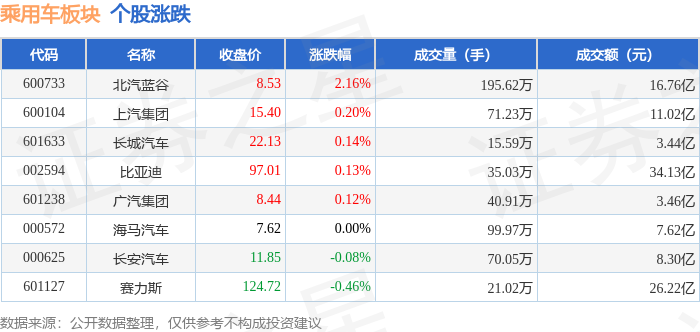
乘用车板块1月9日涨0.09%,北汽蓝谷领涨,主力资金净流出1.95亿元
Zheng Xing Xing Ye Ri Bao· 2026-01-09 08:54
Group 1 - The passenger car sector increased by 0.09% on January 9, with Beiqi Blue Valley leading the gains [1] - The Shanghai Composite Index closed at 4120.43, up 0.92%, while the Shenzhen Component Index closed at 14120.15, up 1.15% [1] - Beiqi Blue Valley's stock price rose by 2.16% to 8.53, with a trading volume of 1.9562 million shares and a transaction value of 1.676 billion yuan [1] Group 2 - The net outflow of main funds in the passenger car sector was 195 million yuan, while retail investors saw a net inflow of 341 million yuan [1] - Beiqi Blue Valley had a net inflow of 26 million yuan from main funds, while retail investors contributed 14.16 million yuan [2] - BYD experienced a net outflow of 21.18 million yuan from retail investors, despite a net inflow of 96.28 million yuan from main funds [2]





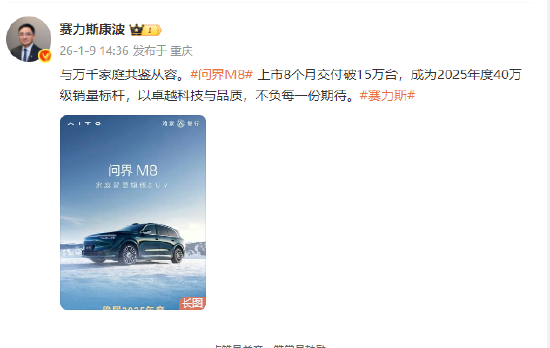
赛力斯康波:问界M8上市8个月交付破15万台
Xin Lang Cai Jing· 2026-01-09 06:48
Group 1 - The core message is that the AITO M8 has achieved significant sales, with over 150,000 units delivered within 8 months of its launch, positioning it as a benchmark for 400,000 units in sales for the year 2025 [1][3]
新势力“出海”步入爆发期 何小鹏预言行业“魔幻五年”开启新竞局
Xin Hua Cai Jing· 2026-01-09 06:01
Core Insights - Xiaopeng Motors is launching its 2026 P7+ model globally, marking its first simultaneous release in 36 countries, including production in Europe, indicating a significant milestone in its global expansion strategy [1] - The company aims to establish itself as a major player in the global automotive market, with a vision for the next five years described as "magical" by its founder, He Xiaopeng [3][4] Group 1: Global Expansion and Product Launch - Xiaopeng P7+ is part of a broader strategy that includes the simultaneous launch of four new models, emphasizing the importance of good products and technology reaching global markets [1] - By 2025, Xiaopeng's overseas deliveries are projected to reach 45,008 units, a 96% increase year-on-year, with expansion into 60 countries [1] - The company has already established a presence in several European markets, with the G6 and G9 models achieving significant sales milestones [1] Group 2: Local Production and R&D - Xiaopeng is advancing its localization strategy with the establishment of manufacturing bases in Indonesia, Austria, and Malaysia, creating a global manufacturing network [2] - The company has set up nine R&D centers worldwide, with a new center in Munich, Germany, aimed at localizing technology and product innovation [2] - Xiaopeng plans to build a self-operated fast-charging network across Europe, Asia, and America starting in 2026, enhancing its global charging infrastructure [2] Group 3: Autonomous Driving and Technology - The company is preparing for the potential easing of regulations on advanced driver-assistance systems (ADAS) in Europe by 2026, which could facilitate the global rollout of its autonomous driving technology [2][3] - Xiaopeng's intelligent cockpit technology, based on its second-generation VLM, supports seamless multilingual communication, catering to diverse markets [3] Group 4: Industry Trends and Competitor Movements - The year 2026 is viewed as a critical juncture for new energy vehicle brands as they seek to expand internationally amid increasing domestic competition [4] - Other Chinese automakers, such as NIO and Li Auto, are also ramping up their global strategies, with plans to enter multiple European markets and establish local production [5][6] - The overall trend indicates a shift from simple product exports to deeper localization strategies among Chinese automakers, enhancing their competitiveness in international markets [8] Group 5: Market Performance and Projections - In 2025, China's automotive exports reached 6.343 million units, with a notable increase in new energy vehicle exports, which doubled to 2.315 million units [7] - The market share of Chinese electric vehicles in overseas markets rose from 9.9% in 2024 to 15.4% in 2025, reflecting growing competitiveness [7] - Projections for 2026 suggest that overseas sales of Chinese passenger vehicles could reach between 641,000 to 656,000 units, with significant growth in new energy vehicle exports [8]

六大关键词回顾2025年一级市场:美元基金复苏、港股IPO火热 人工智能与半导体双线并进
Xin Lang Cai Jing· 2026-01-09 05:57
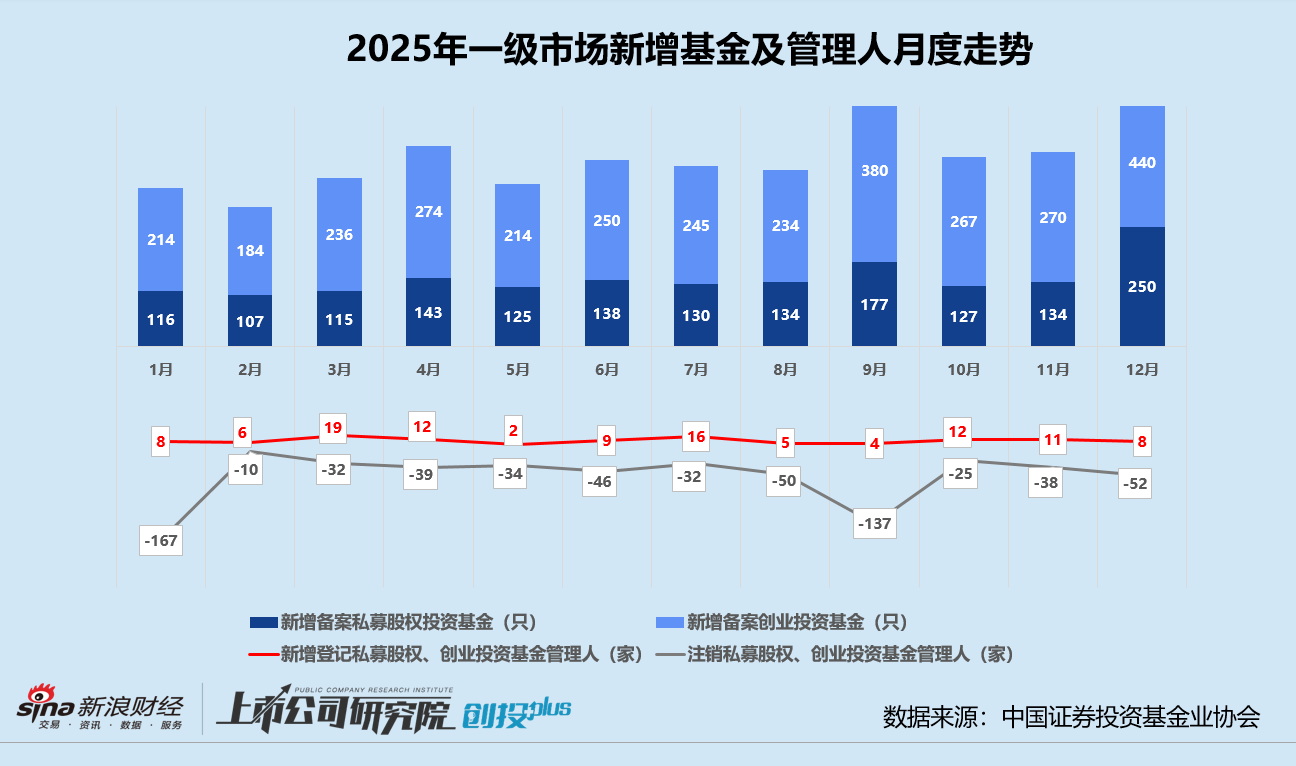
Group 1 - In 2025, the primary market is evolving amidst significant changes, driven by disruptive technologies led by artificial intelligence and reshaped capital flows due to geopolitical factors [1][50] - Global venture capital activity remained stable with 22,500 investment events and a total disclosed investment of approximately $348.1 billion, marking a 44.8% increase compared to 2024 [50] - The IPO and M&A markets rebounded strongly, with 1,372 companies successfully listing and raising approximately $170.6 billion, the best performance since 2022 [2][50] Group 2 - In China, the narrative differs, with government policies aimed at improving the efficiency of fiscal funds and supporting strategic sectors like AI and aerospace [51] - The establishment of a national venture capital fund with a registered scale exceeding 120 billion yuan aims to support seed and early-stage projects [51] - The banking sector's financial asset investment companies (AIC) have made significant progress, with 99 new funds established and a total scale of 198 billion yuan [3][51] Group 3 - The fundraising environment has shifted from quantity expansion to quality improvement, with a slight decrease in the number of private equity and venture capital managers [5][53] - The total scale of private equity funds reached 11.18 trillion yuan, showing a modest increase of 2.3% year-on-year [53] - Notably, the fundraising situation for dollar funds has improved, with several funds successfully closing significant amounts [7][55] Group 4 - Artificial intelligence remains the dominant investment theme in 2025, with 788 AI companies receiving 1,015 investments totaling 65.6 billion yuan, a significant increase from 2024 [18][60] - The robotics sector, particularly embodied intelligence, saw substantial growth, with 530 investments totaling 34.5 billion yuan, reflecting a 116.3% increase in investment events [19][60] - The competition in the foundational model space has stabilized, with a noticeable decline in investment activity as resources concentrate among leading firms [20][60] Group 5 - The trend of early-stage investments continues, with A-round investments being the most frequent, comprising 34.5% of total investment events [25][26] - Seed and angel round investments have seen significant increases, with seed round investments growing by 59.5% in number and 179.4% in amount compared to 2024 [27][25] - Noteworthy large investment events include significant funding rounds for various companies across sectors, indicating a robust interest in early-stage ventures [26][27] Group 6 - The Yangtze River Delta region remains the most active investment area, accounting for nearly 50% of total investment events in China [31][30] - Jiangsu province alone had 1,256 investment events, representing 19.8% of the national total, with significant investments in advanced manufacturing and AI [33][30] - Beijing reported the highest disclosed investment amount at 95.9 billion yuan, highlighting its prominence in the investment landscape [36][30] Group 7 - The M&A market in China is characterized by a trend of private equity firms acquiring foreign brands, with notable transactions involving major global companies [38][39] - Investment institutions are increasingly engaging in mergers and acquisitions of listed companies, marking a shift towards deeper involvement in operational aspects [39][40] - The trend indicates a growing preference for controlling stakes in companies to enhance operational synergies and market positioning [40][39] Group 8 - The Hong Kong stock market has regained its position as a leading venue for IPOs, with 247 Chinese companies listed in 2025, a 26.7% increase year-on-year [44][43] - The total fundraising amount for Chinese companies in Hong Kong reached approximately 326.6 billion yuan, reflecting a significant recovery in the IPO market [44][43] - The A-share market also saw a notable increase in listings and fundraising, with 116 companies raising around 128.7 billion yuan [45][43]
广发证券:“定比例”补贴对乘用车行业利润拉动几何?
Zhi Tong Cai Jing· 2026-01-09 03:29
Core Viewpoint - The adjustment of the vehicle trade-in policy to a "proportional subsidy" will significantly benefit mid-to-high-end vehicles, with an expected profit increase of 15.9 billion yuan for the passenger car industry in 2026 [1][2][3]. Group 1: Policy Changes and Impacts - The new policy, effective from December 30, 2025, includes a scrapping subsidy of 12% for new energy vehicles and 10% for fuel vehicles, with maximum subsidies of 20,000 yuan and 15,000 yuan respectively [1]. - The trade-in subsidy will provide 8% for new energy vehicles and 6% for fuel vehicles, with maximum subsidies of 15,000 yuan and 13,000 yuan respectively [1]. Group 2: Profit Projections - Based on data from Chongqing, the proportional subsidy is expected to increase the profit of the passenger car industry by 15.9 billion yuan in 2026, with profit growth in different price segments projected as follows: 0 yuan for under 100,000 yuan, 300 million yuan for 100,000-150,000 yuan, 2.9 billion yuan for 150,000-200,000 yuan, and 12.8 billion yuan for above 200,000 yuan [2][3]. - The total amount of trade-in subsidies is projected to decline by approximately 30 billion yuan in 2026, but the subsidy amount for vehicles priced above 150,000 yuan is expected to increase by about 14 billion yuan [3]. Group 3: Investment Recommendations - The report suggests focusing on various companies within the passenger vehicle supply chain, including Geely, BYD, Chery, and others as potential investment opportunities [4]. - Companies positioned for growth include SAIC Motor, while others like Great Wall Motors and Changan Automobile are identified as left-side targets [4].
