
古茗

Search documents
2025年中盘点:中国消费市场的五大惊喜
Sou Hu Cai Jing· 2025-09-07 13:15
Group 1: Overview of China's Consumer Market in 2025 - The Chinese consumer market in the first half of 2025 shows a unique trend of "macro caution, micro activity," with consumer confidence at historical lows while core consumption categories are steadily recovering [12][14] - The total retail sales of consumer goods increased by 5.0% year-on-year in the first half of 2025, with May's growth rate reaching a two-year high [16][19] - The food category led the growth with a 12.3% year-on-year increase, driven by the rapid expansion of new channels like snack specialty stores and membership discount supermarkets [16][19] Group 2: Tourism Recovery - The tourism industry has seen a strong recovery, with international flight passenger volumes in the first and second quarters of 2025 increasing by 9% and 13% compared to the same periods in 2019 [20][36] - Domestic travel also surged, with 329 million trips taken in the first half of 2025, an 18% increase from 2019 [20][36] - The number of inbound tourists reached over 35 million in the first quarter of 2025, a year-on-year increase of 19.6%, marking a historical high for a single quarter [29][36] Group 3: New Energy Vehicles (NEVs) - China has become the world's largest automobile exporter, with nearly 5.5 million vehicles exported in 2024, an eightfold increase from 2019 [24][28] - NEVs accounted for nearly half of passenger car exports in the first half of 2025, with domestic brands holding a market share close to 90% in the NEV segment [28][21] - BYD surpassed Tesla to become the world's largest electric vehicle manufacturer in 2024, with sales reaching 4.27 million units and revenue of $108 billion [28] Group 4: Cultural Export and Trends - The cultural export sector, particularly in video games and trendy toys, has gained momentum, with the game "Black Myth: Wukong" selling 28 million copies and generating revenue of 9 billion yuan [42][43] - The toy brand Pop Mart's Labubu character has gained global popularity, with revenue from the "Monster Series" increasing by 726% year-on-year, reaching over 3 billion yuan [43][46] - The overseas market contribution to Pop Mart's revenue rose from 4% in 2021 to 39% in 2024, indicating a significant expansion [43] Group 5: Capital Market Dynamics - The capital market in Hong Kong saw a significant rebound in the first half of 2025, with total financing reaching 107.1 billion HKD, a substantial increase from the previous year [37][41] - Consumer-related companies have become a major force in the capital market, with four out of the top ten IPOs in Hong Kong coming from the consumer sector [37][41] - Private equity and venture capital activities also surged, with transaction volumes in the second quarter reaching 2.28 trillion yuan, doubling from the previous quarter [41] Group 6: Foreign Brands in China - Foreign brands are experiencing a resurgence in China, particularly in the outdoor sportswear segment, which has seen sales double over the past five years [47] - Several new or expanding brands have achieved annual revenues exceeding $500 million, reflecting the growing consumer interest in health and outdoor activities [47] - This trend indicates a robust market opportunity for international brands to adapt to local demands and capitalize on China's consumption upgrade [47]







霸王茶姬掉队了吗
Hu Xiu· 2025-09-07 13:13
Core Viewpoint - The article discusses the competitive landscape of the milk tea industry, highlighting the significant growth of certain brands while pointing out the struggles of BaWang Tea Ji amidst a fierce price war in the delivery market [1][2]. Group 1: Industry Overview - The milk tea industry has seen a surge in sales due to the ongoing delivery wars, benefiting brands that operate on a franchise model [2][5]. - Major players like Mixue Ice City and Gu Ming have reported impressive financial results, with Mixue's revenue growing by 39% and profit by 44% year-on-year [3][4]. - The delivery war has led to increased consumer spending on milk tea, with franchise stores experiencing a significant rise in order volumes [8]. Group 2: BaWang Tea Ji's Performance - BaWang Tea Ji, once a leading brand, has faced challenges despite opening over a thousand new stores, with revenue growth of only 10% and nearly stagnant profit [11][12][13]. - The brand's same-store sales have declined by 23% over three consecutive quarters, indicating significant operational pressure [15][16]. - BaWang Tea Ji's refusal to participate in the price war has resulted in a drop in active consumer membership from 44.1 million to 38.6 million year-on-year [20]. Group 3: Pricing Strategy and Brand Positioning - BaWang Tea Ji maintains a high-end pricing strategy, with its signature drink priced at 16 yuan, and has resisted deep discounts, which has alienated some consumers [17][18]. - The brand's decision to avoid participating in the delivery price war is a strategic choice to protect its premium image, but it risks losing customers who are price-sensitive [22][25]. - The article draws parallels between BaWang Tea Ji's current situation and that of Heytea, which had to lower prices to adapt to market conditions [43][46]. Group 4: Global Expansion Opportunities - Despite domestic challenges, BaWang Tea Ji has seen a 70% year-on-year increase in overseas GMV, reaching 230 million yuan, indicating potential for international growth [49]. - The brand is expanding into Southeast Asia and the U.S., positioning itself as a premium tea brand with higher pricing than local competitors [51][53]. - The competitive landscape in overseas markets is less intense, allowing BaWang Tea Ji to maintain higher price points compared to the domestic market [55].
新消费行业周报:体育产业支持政策落地,国内折叠自行车龙头新股上市-20250907
Hua Yuan Zheng Quan· 2025-09-07 12:32
Investment Rating - The investment rating for the industry is "Positive" (maintained) [4] Core Insights - The report highlights the strong brand power of the leading company in the folding bicycle sector, which holds a market share of 26.3% in retail volume and 36.5% in retail value as of 2024 [4] - The company has established a robust distribution network with 38 dealers across 30 provincial-level regions in China, covering 680 retail points, with domestic dealer revenue constituting 68% of total revenue in 2024 [4] - The product lineup includes five major series tailored for specific customer segments and usage scenarios, showcasing diverse performance features [4] - Recent government policies are expected to stimulate the growth of the sports industry in China, with a projected total scale exceeding 7 trillion yuan by 2030 [5] Summary by Sections Industry Performance - The new consumption sector has shown varied performance, with the textile and apparel index increasing by 1.37% and the retail index decreasing by 0.59% during the week of September 1 to September 5, 2025 [9] Key Industry Data - Retail sales in July for various categories showed growth, with jewelry sales increasing by 8.2% year-on-year [17] Investment Analysis - The report suggests focusing on high-quality domestic brands in emerging consumer goods, particularly in beauty, jewelry, and tea beverage sectors, which resonate well with younger consumers [22]
餐饮巨头们止跌回血:一边关店砍成本,一边加码做外卖
虎嗅APP· 2025-09-07 09:00
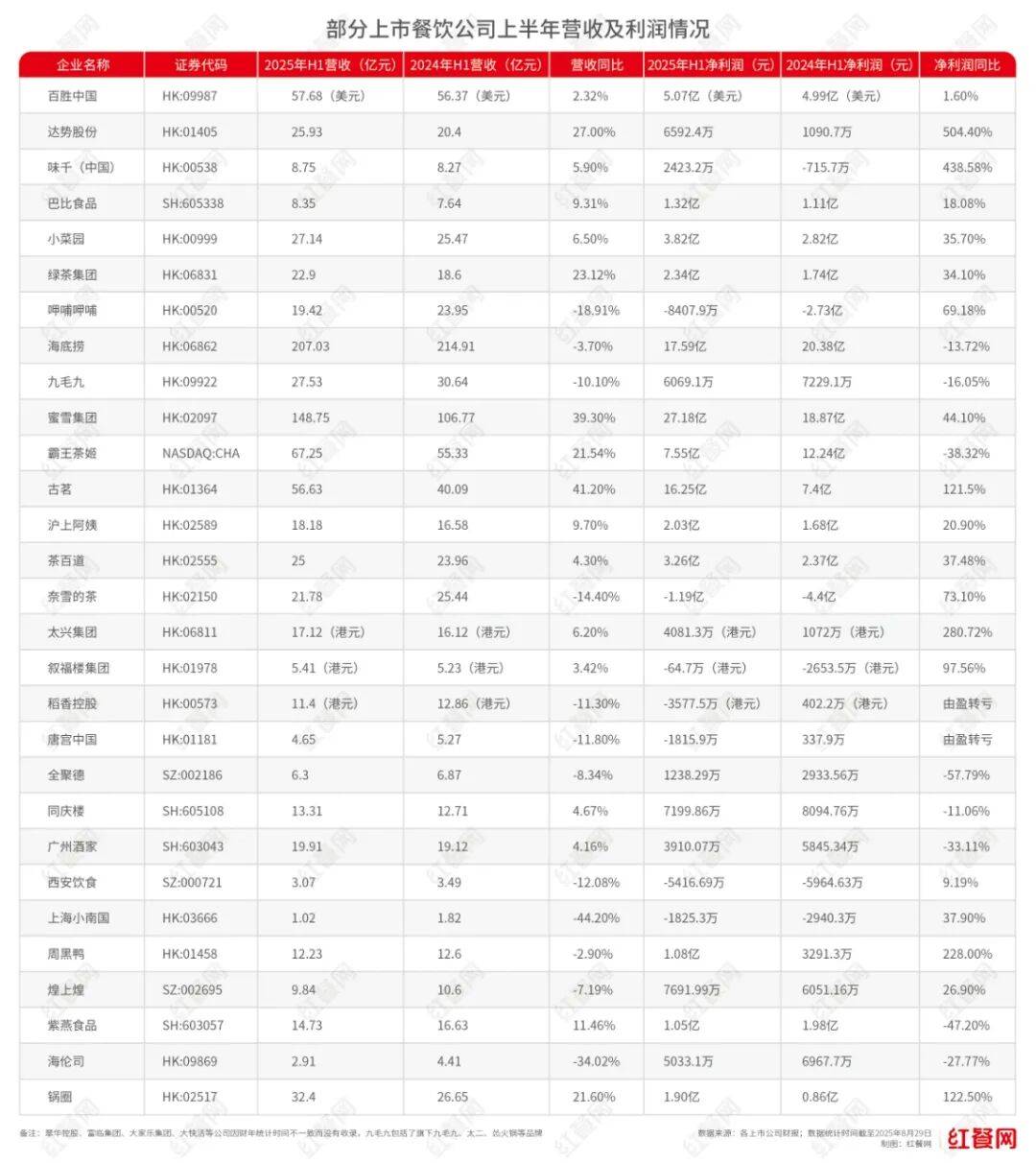
Core Viewpoint - The restaurant industry in China is experiencing a mixed recovery, with some leading companies showing signs of revenue and profit growth, while others continue to face challenges due to external factors and market competition [4][5]. Group 1: Overall Performance - Among 29 listed restaurant companies, 17 reported year-on-year revenue growth, with Gu Ming leading at 41.26% [6]. - 15 companies saw an increase in net profit, while 7 remained in a state of net loss, including Dao Xiang Holdings and Tang Palace, which shifted from profit to loss [6][9]. - Notable profit growth was observed in companies like Da Shi and Wei Qian (China), with net profits increasing over 100% [9]. Group 2: Market Dynamics - The restaurant sector is characterized by uneven performance across different segments, with high-end dining facing significant pressure due to reduced consumer spending and government policies [11]. - In Hong Kong, over 20 local chain restaurants have closed in recent months, highlighting the tough market conditions [11]. - Traditional high-end restaurants are struggling, while casual dining and fast-food brands are performing better, with companies like Da Shi and Wei Qian (China) showing revenue and profit increases [11]. Group 3: Cost Management and Store Closures - Many companies are focusing on cost-cutting measures, including closing underperforming stores to improve operational efficiency [14][19]. - For instance, Huang Shang Huang closed 762 stores in the first half of the year, contributing to improved efficiency [12]. - Companies like Xiao Cai Yuan and Hai Di Lao are also reducing store numbers while optimizing their operational models [21][22]. Group 4: New Strategies and Innovations - The entry of major players like JD and Taobao into the food delivery market has intensified competition, prompting restaurants to adapt their strategies [26]. - Many companies are increasing their focus on delivery services, with significant revenue contributions from this channel [29]. - New product lines and sub-brands are being launched to capture additional market segments, as seen with Hai Di Lao's expansion into new restaurant concepts [31][34].

外卖战火下:巨头博弈 新茶饮“捞鱼”
3 6 Ke· 2025-09-06 00:31
Group 1 - The core viewpoint of the article highlights that despite concerns about the long-term impact of the "takeout war" on the restaurant industry, most new tea beverage brands have reported revenue and net profit growth in their recent semi-annual reports [1] - Most listed new tea beverage brands, except for Bawang Tea Ji and Nayuki, achieved both revenue and net profit growth in the first half of the year [1] - Bawang Tea Ji attributed its profit decline to investments in new product development and overseas markets, while Nayuki cited store optimization and intensified market competition as reasons for its performance drop [1] Group 2 - Many new tea beverage brands reported improved same-store performance, with Gu Ming stating that "takeout subsidies and coffee business drove same-store improvement" [1] - Mixue Ice City mentioned that during the takeout war, it collaborated with franchisees to seize opportunities, significantly enhancing store profitability through increased order volume [1] - Even Bawang Tea Ji, which did not actively participate in the takeout war, saw an increase in second-quarter takeout GMV due to higher customer repurchase rates [1] Group 3 - Industry concerns regarding the takeout war include the impact of low prices on consumer perception, overburdening of store staff, and a decline in dine-in business [1] - The takeout war is not only a competition among internet giants but also tests the operational capabilities of businesses during this period [1] - Once subsidies cease, the performance growth driven by them is expected to end, and the industry will still face intensified competition and slowing growth in the domestic market [1]

餐饮巨头们止跌回血:一边关店砍成本,一边加码做外卖
Hu Xiu· 2025-09-05 12:38
Group 1 - The core viewpoint indicates that despite the ongoing adjustment period in the industry, leading restaurant companies are showing signs of recovery in revenue and net profit [1][3][5] - Among 29 listed restaurant companies, 17 reported year-on-year revenue growth, with Gu Ming leading at a growth rate of 41.26% [3][5] - The overall trend shows an increase in profitable companies, with notable improvements in profitability for several firms [5][6][7] Group 2 - The challenges include a weak consumer environment, policies like alcohol bans, and competition from food delivery services, which necessitate exploration of new growth avenues [2][10][11] - Companies like Da Shi and Wei Qian have shown significant profit increases, with Da Shi's net profit growing by 504.4% year-on-year [6][7] - Some companies, such as Dao Xiang Holdings and Tang Gong China, have transitioned from profit to loss due to various market pressures [10][11] Group 3 - The restaurant industry is experiencing uneven recovery, with some segments like casual dining performing better than traditional high-end dining [11][12] - Fast food brands are generally faring well, with companies like Da Shi and Ba Bi Food achieving revenue and profit growth [12][13] - The trend of closing underperforming stores is evident, as companies aim to enhance operational efficiency [13][22] Group 4 - The shift towards delivery services is becoming increasingly important, with companies like Nai Xue's Tea reporting that nearly half of their revenue comes from delivery [32][36] - Traditional dining establishments are also adapting by exploring delivery options and new business models to remain competitive [39][40] - Many companies are diversifying their offerings by launching sub-brands and entering new markets, such as coffee and light meals [41][44][46]

被麦肯锡的年中盘点报告刷屏,我从中总结了20条高价值洞察
3 6 Ke· 2025-09-05 12:07
Core Insights - The report from McKinsey highlights five major surprises in the Chinese consumer market, emphasizing the need for positive news to boost confidence among entrepreneurs, investors, and consumers [1] Macro Confidence and Consumer Sentiment - "Sleeping funds" represent the largest growth engine for future consumption, with total household deposits in China reaching 163 trillion yuan, indicating a potential for significant consumer spending once confidence is restored [2] - Consumer sentiment is shifting from a downgrade to a more "prudent" approach, with retail sales still growing at 5.0%, suggesting consumers are spending smarter and are willing to pay for quality and emotional value [2][3] - High-value categories like automobiles (+11.2%) and home appliances (+30.7%) are experiencing strong growth, indicating that consumers are willing to pay for quality products rather than engaging in price wars [2] Industry Opportunities and Market New Frontiers - The domestic brand share in the new energy vehicle market is close to 90%, showcasing a significant opportunity for brands to leverage technological changes and consumer trends for competitive advantage [4] - China's automobile export volume has increased eightfold since 2019, marking a shift from merely selling products to selling brands, with a notable increase in average export prices [4] - Cultural exports, exemplified by successful IPs like "Black Myth: Wukong," indicate a growing potential for Chinese cultural products to become global trends, opening new avenues for various industries [4][5] Capital Trends and Corporate Strategies - The capital market is favoring consumer brands, with four out of the top ten IPOs in Hong Kong coming from the consumer sector, reflecting long-term investor confidence in the Chinese consumer market [6] - The success of tea brands like Mixue Ice City and Gu Ming highlights the effectiveness of supply chain management and product innovation in the retail sector [6] - Private equity is increasingly investing in "new retail," indicating a reassessment of the value of physical retail spaces and the potential for growth through digitalization and innovative business models [6] Insights for Business Leaders - Global social media can be a powerful tool for brand promotion, as seen with Labubu's success linked to K-pop influencer Lisa [7] - Strong cultural products can drive local economies, suggesting that businesses should consider how their offerings can create new economic opportunities [7] - Expanding visa-free policies in China presents a chance for businesses to attract international customers, particularly in the tourism sector [7] - Focusing on existing customer bases may yield better results than acquiring new customers, as successful companies demonstrate the importance of deep user engagement [7] - Micro-level positive changes can signal macro-level opportunities, encouraging businesses to look beyond pessimistic macro data [7]
蜜雪冰城:万店狂奔下的甜蜜与隐忧
Guan Cha Zhe Wang· 2025-09-05 11:46
Core Insights - The article highlights the dominance of Mixue Ice Cream and Tea in the Chinese beverage market, showcasing its impressive financial performance and market expansion [1][2][3] - Despite its success, the company faces challenges such as declining single-store profitability, food safety concerns, and market saturation [1][10][11] Financial Performance - In the first half of 2025, Mixue reported revenue of 14.87 billion yuan, a year-on-year increase of 39.3%, with a gross profit of 4.71 billion yuan and a net profit of 2.72 billion yuan, reflecting a growth of 38.3% and 44.1% respectively [2][4] - The company operates 53,014 stores globally, having opened 9,796 new stores in the past year, averaging 27 new stores per day [2][3] Business Model - Mixue's revenue primarily comes from selling ingredients, packaging, and equipment to franchisees, accounting for approximately 97% of total revenue [4][5] - The franchise model allows for significant scale effects, with the company leveraging its purchasing power to control costs and enhance profitability [6] Market Strategy - The company has a strong presence in lower-tier cities, with 57.6% of its stores located in third-tier and below cities, while only 4.9% are in first-tier cities [7] - As competition intensifies in lower-tier markets, the company faces challenges in maintaining growth and profitability [7][10] Marketing and Brand Positioning - Mixue employs innovative marketing strategies, including viral songs and social media campaigns, to enhance brand visibility and consumer engagement [8][9] - However, the company must continue to evolve its marketing approach to sustain consumer loyalty beyond initial trends [9] Challenges Ahead - The increasing density of stores has led to a decline in single-store revenue, with franchisees reporting significant pressure on profitability [10] - Food safety issues pose a risk to the brand's reputation, as incidents can quickly escalate through social media [11]


新开近9000家店,五大新茶饮半年净赚62亿
3 6 Ke· 2025-09-05 10:52
Core Insights - The current state of the ready-to-drink tea industry shows significant revenue growth among major players, with Mixue Group leading the market with a revenue of 14.87 billion yuan, a year-on-year increase of 39.3% [3][6] - The competitive landscape is intensifying due to aggressive subsidy wars initiated by delivery platforms, impacting various brands differently [7][9] - The overall performance of the industry is mixed, with some brands like Nayuki experiencing a decline in revenue, while others like Mixue and Gu Ming continue to grow [4][6] Revenue and Growth - Mixue Group reported a revenue of 14.87 billion yuan, up 39.3%, with a net profit of 2.72 billion yuan, reflecting a 44.1% increase [6] - Gu Ming achieved a revenue of 5.66 billion yuan, a 41.2% increase, with a net profit of 1.63 billion yuan, up 119.8% [6] - Bawang Tea Ji generated 6.725 billion yuan in revenue, a 21.61% increase, with a net profit of 1.307 billion yuan, up 6.8% [6] Market Dynamics - The industry is witnessing a surge in store openings, with the top five brands adding nearly 9,000 new stores in the first half of the year [3] - Nayuki is the only major brand to report a revenue decline, with a revenue of 2.178 billion yuan, down 14.4% [4][6] - The competitive environment is characterized by a price war, with some brands opting out of aggressive discounting strategies [7][10] Strategic Responses - Brands are diversifying their offerings, with many entering the ready-to-drink coffee market as a new growth avenue [16][18] - Mixue's coffee brand, Lucky Coffee, aims to expand to over 10,000 stores, with significant investments in the coffee supply chain [16] - Gu Ming has equipped over 8,000 stores with coffee machines to enhance its coffee product offerings [17] International Expansion - The overseas expansion of brands is accelerating, with Bawang Tea Ji opening 39 new stores abroad in the second quarter [19] - The Southeast Asian market is becoming crowded, prompting brands like Mixue to optimize existing stores [20] - North America is emerging as a new battleground for Chinese tea brands, with Bawang Tea Ji and others making significant inroads [21]
观察:新茶饮企业业绩分化加剧 有重新洗牌的机会吗?
Zheng Quan Shi Bao Wang· 2025-09-05 10:09
Core Insights - The new tea beverage industry is experiencing significant differentiation among listed companies, with varying revenue and profit growth rates [1][2] - Companies like Mixue Group and Gu Ming are showing strong growth, while others like Nayuki's Tea are facing declines [1] Group 1: Revenue and Profit Trends - Gu Ming reported a revenue growth rate of 41.2% and a profit growth rate of 121.5% for the first half of 2025 [1] - Mixue Group's revenue growth rate was 39.3%, with a profit increase of 44.1% during the same period [1] - Nayuki's Tea experienced a revenue decline of 14.4% year-on-year for the first half of 2025 [1] Group 2: Revenue Scale Disparities - Mixue Group's revenue for the first half of 2025 was approximately 14.875 billion yuan, nearly seven times that of Nayuki's Tea, which reported 2.178 billion yuan [1] - The revenue gap between these companies has widened compared to previous years [1] Group 3: Market Capitalization Differences - Mixue Group's market capitalization exceeds 150 billion HKD, while Gu Ming's is around 50 billion HKD [1] - Nayuki's Tea has a market capitalization of approximately 2.3 billion HKD, making Mixue Group's valuation over 60 times larger [1] Group 4: Strategic Approaches and Consumer Behavior - Differentiation among new tea beverage companies is influenced by economic conditions, corporate strategies, and consumer habits [2] - Some companies are expanding aggressively into lower-tier cities, while others are optimizing their store layouts by reducing the number of outlets [2] - Nayuki's Tea has improved its average daily sales per store to approximately 7,600 yuan, with an increase in daily order volume compared to the previous year [2] Group 5: Future Industry Outlook - The new tea beverage industry is expected to continue evolving, with potential for market reshuffling as companies adapt to consumer needs and economic changes [2] - Companies that can innovate in product offerings, marketing, and operational models while ensuring health and safety may thrive in the future [2]