比亚迪股份

Search documents
小米车主遭特斯拉车主恶意别车、持续辱骂,「母亲吓得脸色发白」,小米发声;曝字节拟年产10万颗自研AI芯片;曝魅族手机业务即将解散
雷峰网· 2026-02-12 00:35
Group 1 - Xiaomi's legal department supports a car owner's rights after a road rage incident involving a Tesla driver, emphasizing the importance of protecting brand reputation and user rights [5][6][7] - ByteDance plans to produce 100,000 self-developed AI chips this year, with ambitions to increase production to 350,000, and is negotiating with Samsung for manufacturing [10][11] - Meizu's mobile phone business is reportedly facing dissolution, with indications of project halts and employee layoffs, although no large-scale layoffs have been confirmed yet [12][13] - Alibaba is increasing investments in Taobao's flash sales, with a focus on instant retail and a commitment to not worry about losses for the next three years [13][14] - TSMC reported a net profit of approximately 378.2 billion yuan for 2025, with plans for a capital budget of about 44.9 billion USD to expand production capacity [15][16] - Domestic AI models are rapidly evolving, with new releases from DeepSeek and Zhiyuan, indicating a competitive landscape in AI development [18][19] Group 2 - xAI, founded by Elon Musk, is experiencing significant personnel changes, with two co-founders leaving within 48 hours, raising concerns about the company's stability [40][41][42] - Amazon has received approval to deploy 4,500 satellites as part of its plan to compete with SpaceX, aiming to provide satellite internet services [42][43][44] - New regulations in the U.S. require that electric vehicle charging stations funded by federal money be 100% manufactured in the U.S., which may hinder the development of the charging network [45][46] - OpenAI is collaborating with Samsung and SK Hynix to establish data centers in South Korea, reflecting the growing demand for AI infrastructure [47] - BYD has surpassed Ford in global sales, achieving 4.6 million units sold, marking a significant milestone in the automotive industry [48]






海豹05:新款纯电续航210km,大哥说买完车就准备去辞职
车fans· 2026-02-12 00:29
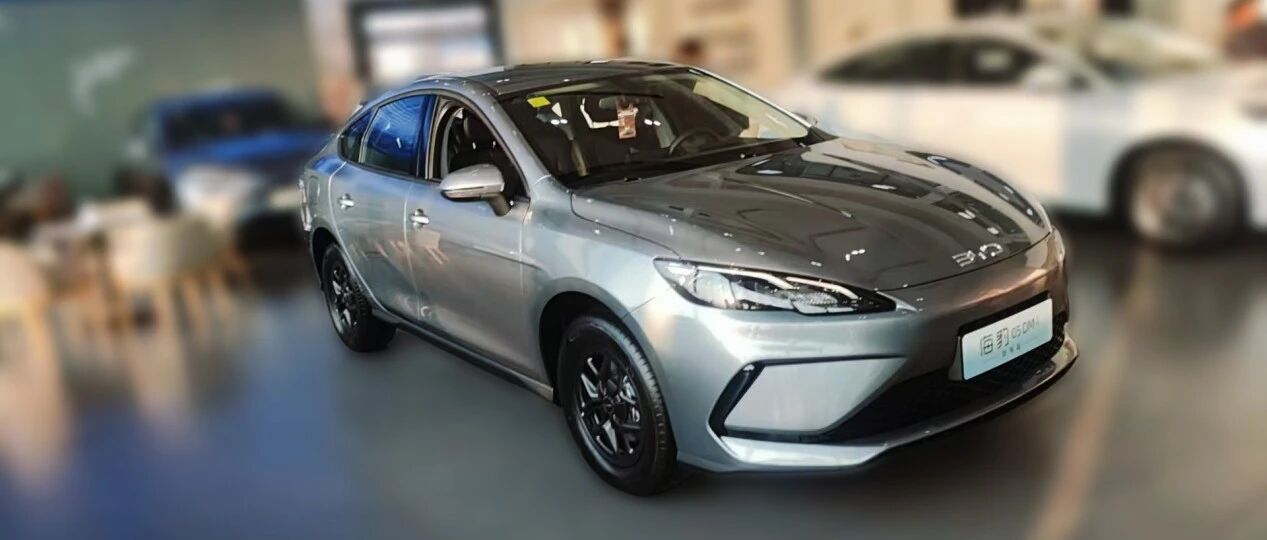
Core Viewpoint - The article discusses the launch and market positioning of the BYD Sea Lion 05, highlighting its competitive pricing and features, particularly the 210 km range version, while also addressing market challenges and customer perceptions [1][4][20]. Group 1: Product Launch and Pricing - The Sea Lion 05 was launched on January 18, with two models priced at 89,800 yuan and 99,800 yuan, respectively, and no current discounts available [2][4]. - The new model primarily features an extended range of 210 km, with no significant changes to other specifications, and lacks a formal launch event [8][15]. - The sales strategy is closely tied to the popularity of the Qin model, with customers expressing concerns about potential price drops in the future [10][19]. Group 2: Customer Insights and Market Competition - Customers often compare the Sea Lion 05 with the Qin and models from Geely, with Geely being a significant competitor due to its quality and design [10][12]. - There is a perception among customers that the current economic climate may lead to further price reductions, impacting their purchasing decisions [8][10]. - A customer shared that using the Sea Lion 05 for ride-hailing could provide a better work-life balance, indicating a shift in consumer behavior towards flexibility in work [12][13]. Group 3: Financing and Purchase Timing - Financing options include a two-year interest-free loan from Agricultural Bank, which is appealing to customers given the vehicle's lower price point [17][18]. - The article suggests that now is a good time for customers in need of a vehicle to make a purchase, especially considering the current market conditions [19]. - The sales team believes that the Sea Lion 05 offers strong value for daily commuting and ride-hailing, despite challenges in the broader market [20].
美股三大指数小幅收跌,谷歌、微软跌超2%,中概指数跌0.65%
Ge Long Hui· 2026-02-11 23:22
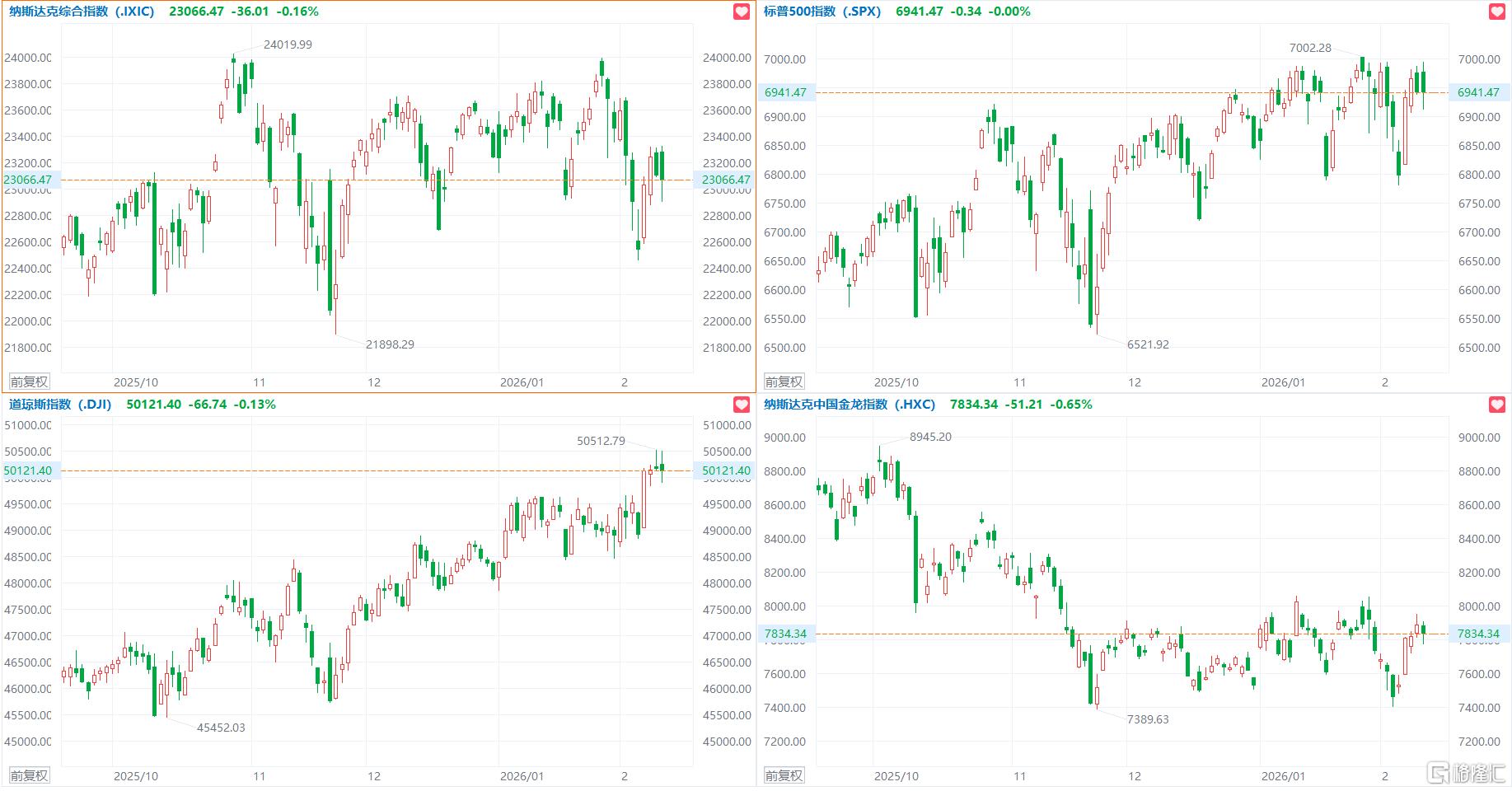
Group 1 - The U.S. non-farm payroll data for January exceeded expectations, leading to slight declines in the three major U.S. stock indices: Dow Jones down 0.13%, Nasdaq down 0.16%, and S&P 500 down 0.01% [1] - Popular tech stocks showed mixed performance, with Google and Microsoft both falling over 2%, while Intel rose over 2%, and Nvidia, Apple, and Tesla had gains of less than 1% [1] - Storage concept stocks and the metals and mining sector saw significant gains, with SanDisk up over 10%, Micron Technology up over 9%, and companies like American Vanguard and Western Digital rising over 4% [1] Group 2 - Cryptocurrency-related stocks experienced substantial declines, with Robinhood down over 8%, Coinbase and Strategy down over 5%, and Circle down over 3% [1] - The Nasdaq China Golden Dragon Index fell by 0.65%, with notable declines in popular Chinese concept stocks such as WeRide down 5.5%, NetEase down 4%, and others like Yum China, Baidu, Tencent, Alibaba, and Meituan down over 1% [1] - However, some Chinese electric vehicle manufacturers saw gains, with XPeng up 1.6%, Li Auto up 1.8%, NIO up 2.1%, BYD up 2.8%, and Xiaomi up 3.9% [1]
智通ADR统计 | 2月12日
智通财经网· 2026-02-11 22:31
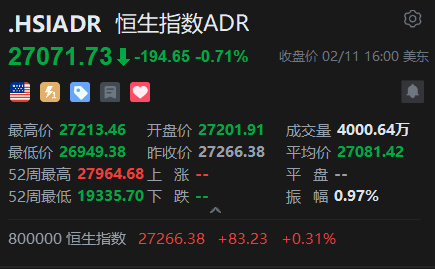
Core Viewpoint - The Hang Seng Index (HSI) closed at 27,071.73, down 194.65 points or 0.71% from the previous close, indicating a decline in market performance [1]. Group 1: Market Performance - The HSI reached a high of 27,213.46 and a low of 26,949.38 during the trading session, with a trading volume of 40 million shares [1]. - The average price for the HSI was 27,081.42, while the 52-week high and low were 27,964.68 and 19,335.70, respectively [1]. Group 2: Major Blue-Chip Stocks - HSBC Holdings closed at HKD 139.794, unchanged from the Hong Kong close, while Tencent Holdings closed at HKD 543.262, down 0.86% [2]. - Among the major stocks, Alibaba (HKD 160.100, down 0.25%), and Xiaomi (HKD 37.100, up 4.27%) showed varied performance [3]. - Notable gainers included BYD Company, which rose by 3.50% to HKD 99.150, while Pop Mart International fell by 5.49% to HKD 255.000 [3].





中资企业全球化布局落子新加坡
Jing Ji Ri Bao· 2026-02-11 21:59
Core Insights - Singapore attracted 14.2 billion SGD in fixed asset investments in 2025, marking a 5.2% year-on-year increase despite global geopolitical and economic challenges [1] - Chinese investments surged, increasing from 2.5% in 2024 to 20.6% in 2025, surpassing the US to become Singapore's second-largest investment source after Europe [1] Investment Structure - Of the 14.2 billion SGD in fixed asset investment commitments, approximately 12.1 billion SGD came from manufacturing-related projects, accounting for 85% [2] - Semiconductor manufacturing led the investments, contributing 33% of the fixed asset investments, driven by the explosive growth in global AI demand [2] - Investments in biopharmaceutical manufacturing, specialty chemicals, sustainable materials, and aerospace maintenance also saw significant interest from Chinese enterprises [2] Strategic Shifts in Operations - 55% of surveyed Chinese enterprises rated Singapore's business environment as "excellent," with public services and financial systems being key attractions [3] - The strategic positioning of Chinese enterprises in Singapore has evolved from a "springboard" to a "regional headquarters hub," with over 70% viewing the Johor-Singapore Economic Zone as vital for capacity expansion and cost management [3] Full Industry Chain Ecosystem - Chinese companies are establishing a comprehensive industry chain ecosystem in Singapore, with firms like ByteDance and Ant Group setting up regional headquarters [4] - This integrated model of "R&D + manufacturing + sales + financial management" signifies a shift from simple market expansion to global value chain restructuring [4] - Singapore's role as an international financial center facilitates comprehensive financial services for Chinese enterprises, reducing reliance on the US dollar system [4] Regional Economic Integration - The influx of Chinese investments in Singapore reflects the accelerating economic integration between China and Southeast Asia [5] - The model of "Singapore base + ASEAN manufacturing + global sales" is being replicated in countries like Vietnam and Malaysia, reshaping the global supply chain geography [5] Future Outlook - The investment trend from Chinese enterprises in Singapore is expected to continue, driven by factors such as the advancement of the China-Singapore Free Trade Agreement and Singapore's role in digital currency trials [6] - Despite potential challenges, the Singapore model remains a preferred strategy for Chinese enterprises to navigate trade barriers and expand into global markets [6]
汽车数据出境有章可循更便利
Jing Ji Ri Bao· 2026-02-11 21:56
Core Viewpoint - The article discusses the release of the "Automotive Data Export Security Guidelines (2026 Edition)" by multiple Chinese government departments, aiming to establish a safe and efficient mechanism for the cross-border flow of automotive data, enhancing the convenience of data export and promoting high-quality development in the automotive industry [1]. Group 1: Data Export Challenges - The automotive industry generates significant data throughout its lifecycle, with a high-level autonomous driving test vehicle producing up to 10TB of data daily [2]. - Companies face common challenges in data export, including selecting appropriate export methods, defining data for security assessments, and building a protective system tailored to the automotive sector [2]. - The guidelines systematically define important data categories and clarify data export paths for six major scenarios, addressing long-standing operational pain points for enterprises [2]. Group 2: Regulatory Framework - The guidelines require all organizations and individuals within China, including domestic and foreign enterprises, to conduct data export activities in a regulated manner [3]. - The guidelines respond to urgent concerns in the automotive industry, facilitating global collaboration and service provision through clear data identification rules and exemptions [3]. - A transparent and efficient management framework for automotive data export is expected to align with international governance trends and enhance global cooperation in automotive data management [3]. Group 3: Promoting Data Utilization - The guidelines encourage the integration of security technologies such as data desensitization and encryption into the automotive production process, enhancing the industry's technological framework [4]. - Data is viewed as a critical resource for innovation in areas like autonomous driving and service upgrades, driving the digital transformation of the automotive sector [5]. - Companies are advised to embrace the guidelines to optimize their global operations and enhance their market competitiveness by effectively utilizing data [5]. Group 4: Industry Development Benefits - The guidelines are seen as a "stabilizing pill" for the automotive industry, providing clear rules that enhance confidence in global market expansion [6]. - They act as an "accelerator" for industry upgrades, prompting companies to better understand their data assets and improve their data governance systems [6]. - The guidelines serve as a "new benchmark" for safety management, offering a practical manual for the industry to navigate data export regulations [7]. Group 5: Implementation Support - The Ministry of Industry and Information Technology plans to assist companies in identifying important data and establishing safety protection goals [7]. - Companies are encouraged to develop comprehensive management systems covering the entire data lifecycle, employing technologies to ensure data security [7]. - The industry is urged to foster cross-sector data security sharing mechanisms to promote safe and efficient data flow, unlocking data value for innovation [7].
腾讯、阿里、京东,再次下跌
Di Yi Cai Jing Zi Xun· 2026-02-11 18:31
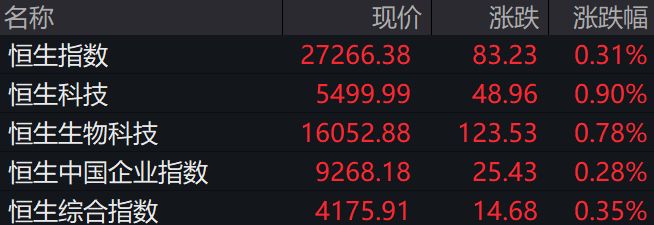
贵金属板块再次大涨,万国黄金集团、紫金黄金国际涨超9%,灵宝黄金涨超7%,赤峰黄金涨近6%。 | 名称 | 涨跌幅 ▼ | 现价 | | --- | --- | --- | | 月国黄金集团 | 9.33% | 17.460c | | 紫金黄金国际 | 9.06% | 228.800c | | 灵宝黄金 | 7.75% | 25.300c | | 赤峰黄金 | 5.95% | 37.760c | | 山东黄金 | 4.42% | 40.180c | | 龙资源 | 4.24% | 10.820c | | 中国黄金国际 | | 3.40% 201.000c | | 中国白银集团 | 3.17% | 0.650c | | 紫金矿业 | 2.84% | 43.520c | | 梦会同 | 2.56% | 16.000c | | 漳关黄金 | 2.20% | 3.250c | | 周大福 | 1.24% | 14.650c | | 招金矿业 | 0.86% | 32.880c | 编辑丨瑜见 | 名称 | 现价 | 涨跌 涨跌幅 | | --- | --- | --- | | 恒生指数 | 27266.38 | 83 ...
美国再加25%关税,特朗普提前开香槟庆贺,中国:抛售5000亿美债
Sou Hu Cai Jing· 2026-02-11 17:50
Group 1 - The Trump administration has implemented a 25% import tariff on specific high-performance AI chips, including Nvidia's H200 and AMD's MI325X, requiring all related products to clear customs in the U.S. before being sold to the Chinese market [1][3] - The policy is expected to generate significant revenue for the U.S. government, with an estimated annual increase of $264 billion in fiscal income, although market reactions indicate a decrease in orders from Chinese companies, putting pressure on Nvidia's revenue expectations [3][4] - The tariff is seen as a tool to reshape the manufacturing landscape, encouraging companies to bring testing and certification processes back to the U.S., but it has led to increased costs for U.S. importers and extended logistics cycles for Silicon Valley AI startups [3][6] Group 2 - China has strategically reduced its holdings of U.S. Treasury bonds, with a decrease of approximately $70 billion in 2025, reflecting a systematic operation to diversify foreign exchange reserves and reduce risk concentration in dollar assets [4][6] - The reduction in U.S. debt holdings has been partially redirected into increasing gold reserves, with China's gold holdings reaching 7.415 million ounces by the end of 2025, indicating concerns over the long-term safety of dollar assets [6] - The tariff policy has unexpectedly spurred rapid growth in China's domestic AI chip industry, with significant revenue increases for companies like Huawei and Baidu, as well as a shift in procurement strategies by firms like ByteDance towards domestic suppliers [6][13] Group 3 - China has decided to continue imposing anti-dumping duties of 53.3% to 57% on U.S. solar-grade polysilicon, blocking U.S. manufacturers from accessing the largest photovoltaic application market [7] - The U.S. semiconductor industry faces increased uncertainty due to internal conflicts and policy changes, with significant losses reported by companies reliant on imports, while the fiscal revenue from tariffs has not offset the broader economic impacts [9][11] - The Chinese semiconductor industry is experiencing a technological breakthrough, with companies like Ruisi Chip and Zhuhai Silicon Chip making significant advancements in chip design and manufacturing, driven by the need to adapt to changing market conditions [13][15] Group 4 - The U.S. has adjusted its export licensing model for AI chips, moving from presumed denial to case-by-case reviews, which complicates the export process despite appearing to relax restrictions [9][15] - China's semiconductor equipment imports have increased significantly, with a 40% year-on-year growth in Q3 2025, highlighting the efficiency of its customs system compared to the U.S. [15] - The ongoing geopolitical tensions and tariff policies are leading multinational tech companies to reassess their investment priorities, with some shifting planned production lines from the U.S. to regions like ASEAN or the EU [13][15]
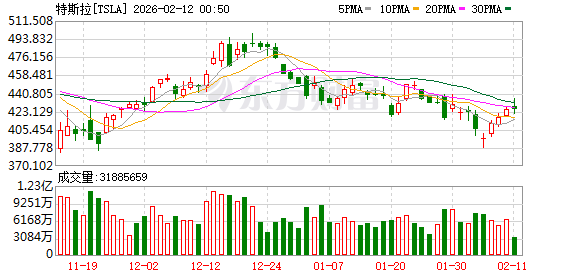
特斯拉副总裁等多名骨干离职、xAI核心专家吴宇怀也走了 “霸总”马斯克遭遇人才流失!员工:对他过度的工作要求感到疲惫
Mei Ri Jing Ji Xin Wen· 2026-02-11 16:49
当地时间2月9日,特斯拉副总裁拉吉·杰加纳坦在LinkedIn上宣布离职,结束了13年的特斯拉生涯。这是 马斯克麾下公司近期高管离职潮中的最新一例。在此之前,特斯拉和xAI公司已有多名核心高管、联合 创始人先后离开。 特斯拉副总裁 及多个要害部门负责人离职 杰加纳坦在社交媒体上写道:"在一篇帖子里概括13年并不容易。我在特斯拉的旅程就像一个不断进化 的过程。当我离开时,我怀着感恩的心和对未来的兴奋。" 去年秋天,由于特斯拉前北美销售主管特洛伊·琼斯和马斯克的高级副手奥米德·阿夫沙尔相继离职,毫 无销售经验的杰加纳坦被硬生生推到销售领域,接管了整个销售和服务部门。离职前,他的职位是负责 信息技术、AI基础设施、业务应用程序和信息安全的副总裁。 杰加纳坦试图将之前由人工处理的客户服务环节自动化。然而,特斯拉的销售持续暴跌,公司难以适应 不断变化的客户需求和日益激烈的竞争。 在杰加纳坦之前,特斯拉已有多名核心高管离开,包括负责北美和欧洲生产运营的副总裁奥米德·阿夫 沙尔、北美人力资源主管詹娜·佩鲁亚、AI战略负责人米兰·科瓦奇、电池部门负责人维尼特·梅塔以及软 件部门负责人大卫·劳。 xAI多名联合创始人离职 吴宇 ...
美股跳水翻绿 超3500只个股下跌 多只中概龙头股下挫!加密货币大跌 12万人爆仓,金银短线跳水丨美股开盘
Mei Ri Jing Ji Xin Wen· 2026-02-11 16:22
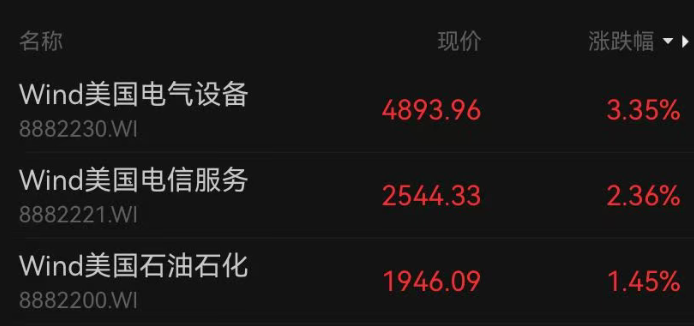
Market Overview - The US stock market experienced a collective decline after initially opening higher, with the Nasdaq down 0.84%, the Dow Jones down 0.45%, and the S&P 500 down 0.41% [1] - A total of 3,575 stocks fell while 1,609 stocks rose [1] Sector Performance - The electric equipment, telecommunications, and petrochemical sectors led the gains, while the real estate and software sectors saw significant declines [1] - Specific sector performance includes: - Electric Equipment: +3.35% [2] - Telecommunications: +2.36% [2] - Petrochemical: +1.45% [2] - Real Estate: -4.57% [2] - Software Services: -3.00% [2] Major Companies - Among the tech giants, Nvidia rose over 1%, while Microsoft fell over 2% [2] - Notable stock performances include: - Apple: +0.97% [3] - Nvidia: +1.01% [3] - Tesla: -0.32% [3] - Amazon: -0.73% [3] - Meta: -1.03% [3] - Alphabet: -1.33% [3] - Microsoft: -2.13% [3] Chinese Stocks - The Nasdaq Golden Dragon China Index declined, with notable movements in individual stocks: - Kingsoft Cloud surged 10% [4] - Xiaomi ADR rose over 3% [4] - Alibaba fell 2% [4] - Tencent Holdings ADR dropped 1.39% [4] - NetEase fell over 2% [4] Cryptocurrency Market - The cryptocurrency market saw a significant drop, with over 120,000 liquidations totaling $191 million within 24 hours [6] - Liquidation amounts included $85.36 million in one hour and $154 million in four hours [8] Employment Data - The US labor market showed unexpected strength with non-farm payrolls increasing by 130,000, significantly above the expected 65,000, marking the largest increase since April 2025 [6] - The unemployment rate unexpectedly decreased to 4.3%, while the previous and expected rates were 4.4% [6] Federal Reserve Expectations - Following the employment data, traders adjusted their expectations for the Federal Reserve's interest rate cuts, pushing the anticipated timing from June to July [9] - The probability of a 25 basis point rate cut in March dropped from 19.6% to 6%, while the probability of maintaining current rates rose to 94% [9] Commodity Prices - Gold and silver prices experienced volatility, with gold peaking at a 1.8% increase before settling at a 0.69% rise, priced at $5062.5 per ounce [9] - Brent crude oil prices rose above $70, currently at $70.7 [9]