
五粮液

Search documents
酒价内参1月22日价格发布 市场延续下跌五创两月价格新低
Xin Lang Cai Jing· 2026-01-22 00:59
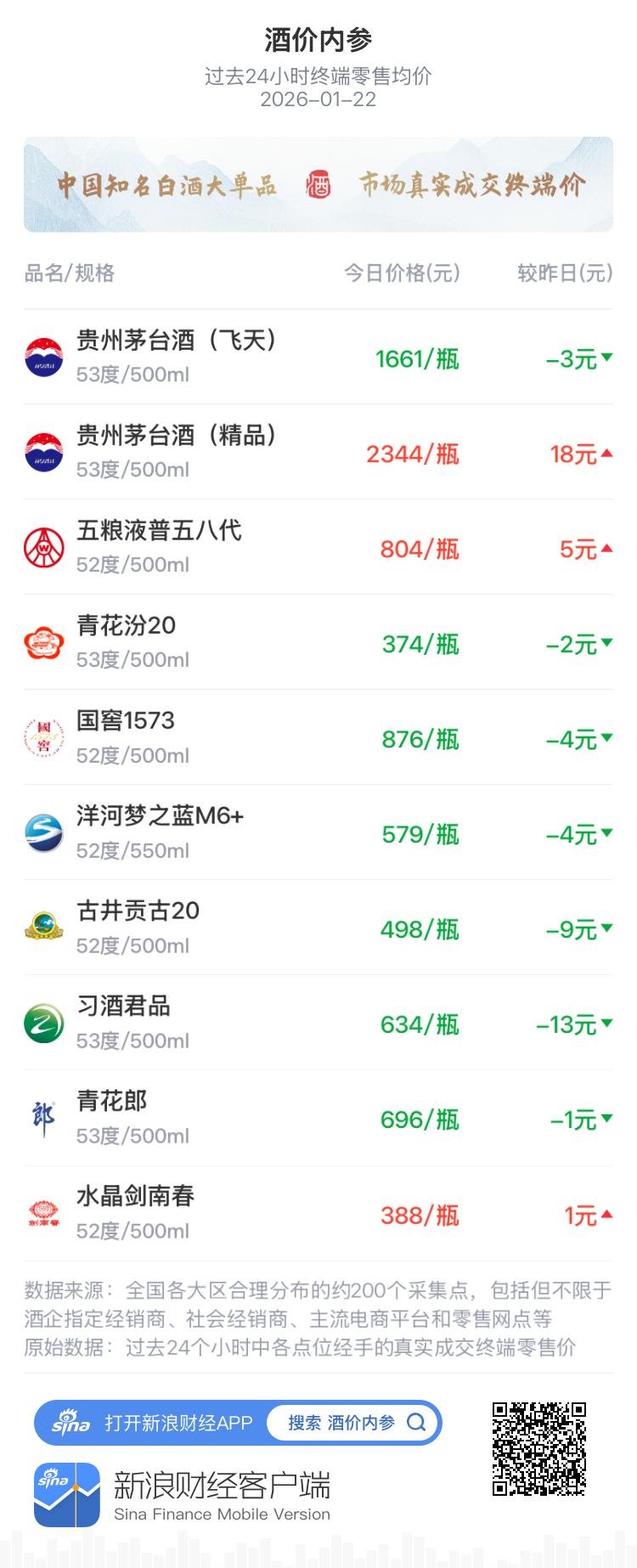
新浪财经"酒价内参"过去24小时收集的数据显示,中国白酒市场十大单品的终端零售均价在1月22日迎来 普遍下跌。如果十大单品各取一瓶整体打包售卖,今日总售价为8854元,较昨日下跌12元。市场价格第五 次创下近两个月的新低,高端酒价格中枢持续下移,行业短期调整态势未改。今日市场普跌特征凸显,十 大单品七跌三涨,头部酒品走势分化,仅少数单品显露止跌回暖迹象。下跌产品中,习酒君品领跌,环比 降低13元/瓶;古井贡古紧随其后,环比下跌9元/瓶;国窖1573与洋河梦之蓝M6+均环比下跌4元/瓶;飞天 茅台环比下跌3元/瓶,i茅台平价货源持续投放,终端价格支撑进一步弱化;青花汾20与青花郎跌幅较小, 分别下跌2元/瓶与1元/瓶。上涨产品中,精品茅台领涨,环比大幅上涨18元/瓶,渠道货源阶段性收紧,叠 加部分终端补货需求释放;五粮液普五八代上涨5元/瓶;水晶剑南春微涨1元/瓶。 数据来源:全国各大区合理分布的约200个采集点,包括但不限于 酒企指定经销商、社会经销商、主流电商平台和零售网点等 原始数据: 过去24个小时中各点位经手的真实成交终端零售价 sma 打开新浪财经APP 搜索 酒价内参 Q 新浪财经客户端 Sina ...







张坤4100点上首“发声”:消费、房价、AI和国运,究竟该怎么看?
Xin Lang Cai Jing· 2026-01-22 00:56
来源:资事堂 当市场在交易当下的热点时,张坤在思考和下注未来的"国运"。 2025年1月22日凌晨,张坤的四季报准时上网,一如既往、不差分毫,恰如他始终如一的投资风格。 但本季度的观点有了更多的"新"内容。 其一、这是近十年来,张坤管理的产品首次在上证指数4100点以上"发声",面对过去两年间1000点的涨 幅和高度分化的行情表现,张坤的看法和应对颇引人关注。 其二、这是外界印象中,张坤首次提及AI和AI泡沫论,他不仅坦率的讲出了自己的看法,而且也藉由 价值投资的逻辑推演,并点评了部分中国企业在AI大潮中的表现。 其三、这也是张坤罕见的从增量和存量角度分析了未来我们所在国家的经济、消费、房地产等关键要素 的走向,很多判断和论述也颇有新意。 总之,张坤这一季的季报,不容错过。 中期经济增速不会低 经历了市场的回暖后,场内机构观点在2016年初明显趋暖,这也是张坤在过去几个季度里始终坚持、相 信并重申的。 但他看的更加长远,张坤在本季报里展示了他对中国未来增速和增长空间的"大级别趋势的预判"。 换言之,他认为,从增量角度看,未来几年的经济增速不会低,而由此带动的内需、消费等因素也值得 比市场共识更积极的看待。 主 ...
贵州茅台价格市场化改革专题研究报告从外溢依赖到独立生态,构建消费者导向的价格形成机制
Guoxin Securities· 2026-01-22 00:30
Investment Rating - The report maintains an "Outperform" rating for Guizhou Moutai [6][43] Core Insights - The report emphasizes the transformation of Guizhou Moutai's pricing mechanism, which aims to create a consumer-oriented pricing structure that reflects real market demand and enhances channel profitability [1][3][29] - The white liquor industry is expected to shift from dependence on Moutai's demand to a more independent ecosystem, leading to differentiated development among companies [4][25] - The pricing reform is compared to the 1988 market liberalization, indicating a significant shift in the competitive landscape and pricing formation mechanisms in the industry [9][10][25] Summary by Sections Industry Investment Rating - Guizhou Moutai is rated as "Outperform" with projected revenues of 1833.0 billion, 1842.9 billion, and 1861.4 billion yuan for 2025-2027, reflecting growth rates of +5.3%, +0.5%, and +1.0% respectively [5][43] Pricing Mechanism Reform - The 2026 pricing reform focuses on breaking the rigid factory price model, allowing for a more market-driven pricing strategy that adapts to supply and demand dynamics [35][43] - The new pricing structure includes a multi-price system that aligns with consumer expectations and ensures channel profitability [35][43] Consumer-Centric Strategy - Guizhou Moutai is restructuring its product offerings to focus on two main products: the "Flying Heaven" and premium offerings, enhancing its core product strength [3][30] - The company is implementing a multi-channel sales strategy that includes self-sale, distribution, consignment, and direct sales to improve consumer access and service quality [34][43] Market Dynamics - The report highlights a shift in the white liquor industry from a "follow-the-leader" growth model to a "differentiated competition" model, driven by changing consumer preferences and market conditions [4][25] - The anticipated changes in consumer behavior and market structure are expected to reshape the competitive landscape, with a focus on quality and service [25][29]
茅台联名冰淇淋卖不动了?
Sou Hu Cai Jing· 2026-01-21 13:38
Group 1 - The core issue in the liquor industry is that young consumers are not rejecting traditional brands for nostalgia but are instead rejecting poorly executed commercial collaborations [1] - The collaboration between Luzhou Laojiao and the sci-fi series "The Three-Body Problem" sold out in 10 minutes, highlighting the effectiveness of culturally relevant marketing [3] - Moutai's ice cream product is struggling in convenience stores, while Luzhou Laojiao's innovative marketing approach resonates with younger audiences [4] Group 2 - The beverage market is shifting towards low-sugar options, as evidenced by the success of Wuliangye's low-alcohol series, which has a 37% repurchase rate in convenience stores [6] - Moutai is advised to focus on developing lighter versions of its products rather than investing heavily in collaborations, as seen with the success of Japan's Dassai sake [7] - The pricing structure of Moutai is under pressure, with reports of significant losses for resellers and the impact of e-commerce platforms driving prices below factory levels [9]
贵州茅台价格市场化改革专题研究报告:从外溢依赖到独立生态,构建消费者导向的价格形成机制
Guoxin Securities· 2026-01-21 12:48
Investment Rating - The report maintains an "Outperform" rating for Kweichow Moutai [5][6] Core Insights - Kweichow Moutai is undergoing a market-oriented transformation with a focus on a consumer-driven pricing mechanism, which is expected to reshape the competitive landscape and pricing formation in the industry [1][3][4] - The 2026 pricing system reform aims to create a "multi-price coexistence" ecosystem that aligns with consumer needs and enhances channel profitability through improved service [3][35] - The white liquor industry is transitioning from dependence on Moutai's demand to establishing independent ecosystems, leading to differentiated development among companies [4][29] Summary by Sections Investment Outlook - Short-term expectations indicate stable pricing for the flagship product, with anticipated sales growth during the Spring Festival [5] - Medium-term recovery in demand and product structure upgrades are expected to enhance profitability [5] - Long-term prospects remain positive as the company focuses on consumer-centric strategies and service capabilities, with potential for price increases and brand premium [5] Market Dynamics - The white liquor industry is shifting from a "follow-the-leader" growth model to a "differentiated competition" structure, driven by Moutai's market reforms [4][29] - The report highlights the importance of adapting to changing consumer preferences and market conditions, emphasizing the need for companies to build independent customer bases and market scenarios [4][29] Pricing Mechanism - The new pricing strategy breaks away from rigid factory prices, allowing for dynamic adjustments based on market conditions and consumer expectations [35] - The pricing reform is seen as a significant step towards marketization, ensuring channel profitability while stimulating sales [35] Company Performance Forecast - Revenue projections for Kweichow Moutai are set at CNY 183.3 billion, CNY 184.3 billion, and CNY 186.1 billion for 2025-2027, reflecting year-on-year growth of 5.3%, 0.5%, and 1.0% respectively [5] - Expected net profit for the same period is CNY 90.45 billion, CNY 90.50 billion, and CNY 91.79 billion, with growth rates of 4.9%, 0.0%, and 1.4% respectively [5]
吃喝板块突遭寒流,白酒股领跌!食品饮料ETF华宝(515710)重挫1.71%,机构激辩:布局时刻到了吗?
Xin Lang Cai Jing· 2026-01-21 11:23
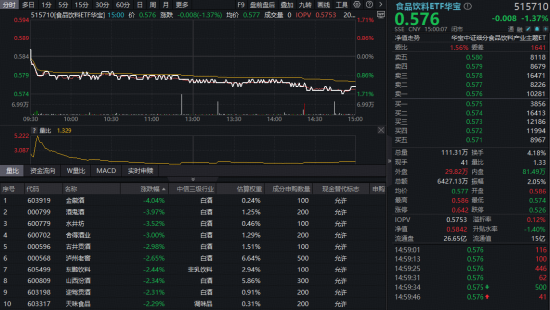
Core Viewpoint - The food and beverage sector continues to experience a downturn, with the Huabao Food and Beverage ETF (515710) showing a significant decline, particularly in the liquor stocks, which have collectively dropped, impacting the overall sector performance [1][10]. Group 1: Market Performance - On January 21, the Huabao Food and Beverage ETF (515710) experienced a maximum intraday decline of 1.71%, closing down 1.37% [1][10]. - Major liquor stocks such as Jinhui Liquor fell by 4.04%, while others like Guizhou Moutai and Wuliangye also saw significant declines, contributing to the sector's downturn [1][10]. Group 2: Company Insights - Guizhou Moutai, the largest holding in the Huabao Food and Beverage ETF, had a holding ratio of 14.89% as of the third quarter of 2025 [3][12]. - The brand value of Guizhou Moutai increased by 2.2% to reach $59.63 billion, ranking first in the global liquor industry according to the Brand Finance report [1][12]. Group 3: Valuation and Investment Strategy - The current valuation of the food and beverage sector is at a historical low, with the price-to-earnings ratio of the ETF's underlying index at 19.83, placing it in the bottom 3.33% of the last decade [4][12]. - Analysts suggest that the food and beverage sector may present a good opportunity for left-side positioning due to its low valuation and strong cash dividend capabilities [4][14]. Group 4: Future Outlook - The market is expected to show a "growth first, liquor accumulation" characteristic as the Spring Festival approaches, with increasing demand for liquor as inventory levels decrease [14][15]. - The food and beverage ETF is positioned to capture core assets in the sector, with approximately 60% of its holdings in high-end and mid-range liquor stocks, and 40% in other beverage and dairy segments [15][16].

贵州茅台价格市场化改革专题研究报告:海外溢依赖到独立生态,构建消费者导向的价格形成机制
Guoxin Securities· 2026-01-21 11:12
Investment Rating - The report maintains an "Outperform" rating for Kweichow Moutai [5][6] Core Insights - Kweichow Moutai is undergoing a market-oriented transformation with a focus on a consumer-driven pricing mechanism, which is expected to reshape the competitive landscape and pricing dynamics in the industry [1][3][4] - The 2026 pricing system reform aims to create a "multi-price coexistence" ecosystem that aligns with consumer needs and enhances channel profitability [3][35] - The white liquor industry is transitioning from dependence on Moutai's demand to establishing independent ecosystems, leading to differentiated development among companies [4][25] Summary by Sections Investment Outlook - Short-term expectations indicate stable pricing for the flagship product, with anticipated sales growth during the Spring Festival [5] - Medium-term recovery in demand and product structure upgrades are expected to enhance profitability [5] - Long-term prospects remain positive as the company focuses on consumer-centric strategies and service capabilities, with continued potential for price increases [5] Market Dynamics - The report highlights a shift in the white liquor industry towards a "product + service" economy, driven by changes in consumer preferences and market conditions [3][25] - The competitive landscape is evolving, with companies moving away from following Moutai's lead to developing their own customer bases and market strategies [4][25] Pricing Strategy - The new pricing mechanism breaks away from rigid factory prices, allowing for dynamic adjustments based on market conditions and consumer expectations [35] - The introduction of a multi-channel sales approach, including self-sale, agency sale, and consignment, aims to improve channel profitability and consumer access [34][35] Company Performance Forecast - Revenue projections for Kweichow Moutai are set at CNY 183.3 billion, CNY 184.3 billion, and CNY 186.1 billion for 2025-2027, reflecting growth rates of +5.3%, +0.5%, and +1.0% respectively [5] - Expected net profit for the same period is CNY 90.45 billion, CNY 90.50 billion, and CNY 91.79 billion, with growth rates of +4.9%, 0.0%, and +1.4% respectively [5]
“顶流”调仓,傅鹏博、李晓星,加仓这些股票
Zhong Guo Zheng Quan Bao· 2026-01-21 11:04
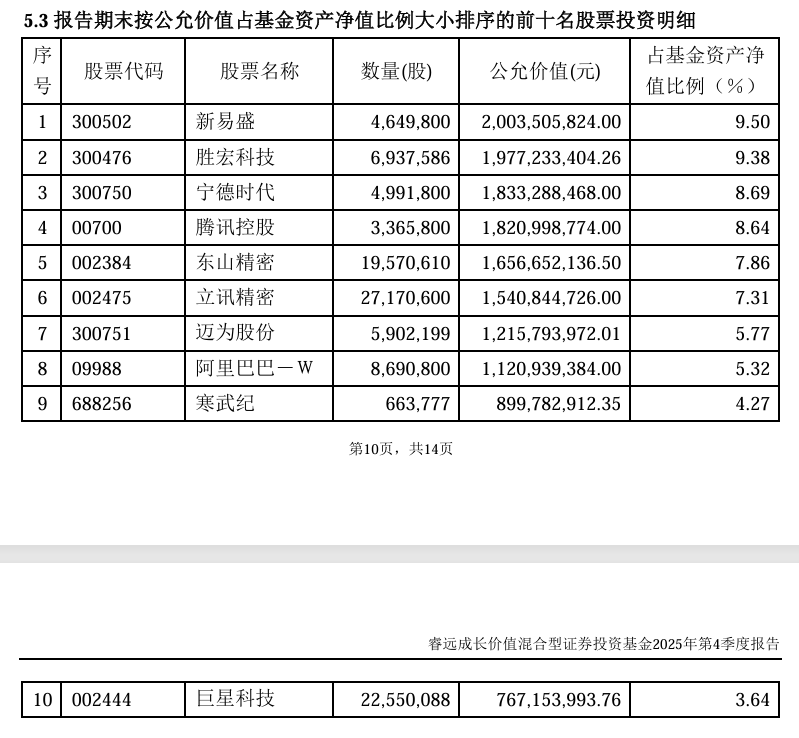
1月21日,睿远基金、银华基金等基金公司披露旗下基金的2025年四季报,傅鹏博、李晓星等知名基金经理2025 年四季度调仓情况随之曝光。 傅鹏博减持了基本面趋势偏弱的公司,增持数据中心液冷、存力和算力的相关公司;李晓星则加仓了港股互联网 和消费股,减持了部分港股金融股。 傅鹏博表示,上市公司2025年年报预披露将于2026年1月底完成,景气度高的AI、有色金属、锂电材料等板块预 计会有较高增长,市场对此已有定价。 李晓星认为,2026年权益市场总体机会大于风险,AI仍是全球科技创新的主线,预计国内互联网大厂的业绩将保 持稳定的增长,港股科技巨头可能是产业趋势和基本面趋势共振的方向。 傅鹏博增持 数据中心液冷、存力和算力相关公司 1月21日,知名基金经理傅鹏博、朱璘管理的睿远成长价值披露2025年四季报。 2025年四季报显示,该基金的前十大重仓股变动较小,迈为股份代替中国移动新进入其前十大重仓股。此外,该 基金增持了寒武纪,减持了新易盛、胜宏科技、宁德时代、腾讯控股、东山精密、立讯精密、阿里巴巴、巨星科 技。 | 序 | 股票代码 | 股票名称 | 数量(股) | 公允价值(元) | 占基金资产净 | | - ...


超200股已跌破“924”!千亿市值权重占一成,这些板块临近行情起点
Xin Lang Cai Jing· 2026-01-21 09:28
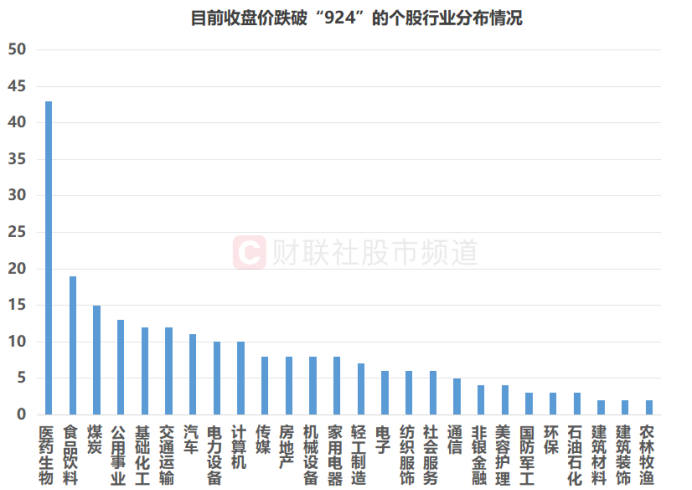
Core Viewpoint - The A-share market has shown overall stability, but nearly 230 stocks have seen their closing prices fall below the level recorded on September 24, 2024, accounting for approximately 4.3% of the total market [1]. Industry Analysis - The pharmaceutical sector has the highest number of stocks below the September 24 closing price, making up 18.7% of the total. Other sectors with significant representation include food and beverage, coal, public utilities, basic chemicals, and transportation, each exceeding 10% [2]. - Among the sub-sectors, stocks in the liquor, traditional Chinese medicine, thermal coal, coking coal, and residential development categories are the most affected, with a notable presence of chemical preparations, in vitro diagnostics, and medical consumables [2]. Market Capitalization Insights - The average total market capitalization of the over 200 stocks currently below the September 24 closing price is approximately 43.6 billion, with a median market capitalization of 10.8 billion. Stocks with a market capitalization below 5 billion account for nearly 30%, while those above 100 billion represent close to 10% [5]. - Notably, China Mobile, the only stock with a market capitalization exceeding 1 trillion, has seen a decline of about 3.7% from its September 24 closing price, currently fluctuating around 96 yuan [5]. Performance of Major Stocks - Key large-cap stocks that have fallen below the September 24 closing price include China Petroleum, Yangtze Power, China Telecom, Wuliangye, and others. Six stocks, including Pizaihuang and Daqin Railway, have experienced declines exceeding 10% [7]. - The performance of the dividend index has lagged behind the broader market, with a cumulative increase of only 5.9% since September 24, while other indices have shown more substantial gains [8]. Index Performance Overview - As of January 21, all 31 first-level industry indices are above their September 24 levels, with an average increase of approximately 58.12% and a median increase of 53.42%. The communication, non-ferrous metals, electronics, and comprehensive sectors have seen increases exceeding 130% [10]. - Conversely, sectors such as coal, food and beverage, public utilities, banking, and transportation have shown relatively lower growth, with the coal sector only increasing by 0.6% [10].





食品饮料行业今日跌1.53%,主力资金净流出24.16亿元
Zheng Quan Shi Bao Wang· 2026-01-21 09:20
Market Overview - The Shanghai Composite Index rose by 0.08% on January 21, with 18 out of the 28 sectors experiencing gains. The top-performing sectors were non-ferrous metals and electronics, with increases of 2.79% and 2.62% respectively [1] - The banking and coal sectors saw the largest declines, with drops of 1.58% and 1.57% respectively [1] Capital Flow Analysis - The net inflow of capital in the two markets was 11.983 billion yuan, with 14 sectors receiving net inflows. The electronics sector led with a net inflow of 16.369 billion yuan, while the non-ferrous metals sector followed with a net inflow of 7.289 billion yuan [1] - Conversely, 17 sectors experienced net outflows, with the power equipment sector seeing the largest outflow of 6.688 billion yuan, followed by the defense and military sector with an outflow of 2.906 billion yuan [1] Food and Beverage Sector Performance - The food and beverage sector declined by 1.53%, with a net outflow of 2.416 billion yuan. Out of 124 stocks in this sector, 23 rose while 97 fell, including one stock that hit the daily limit down [2] - The top three stocks with the highest net inflows in the food and beverage sector were "Hao Xiang Ni" with 61.106 million yuan, "*ST Chun Tian" with 12.8997 million yuan, and "Wei Zhi Xiang" with 12.7381 million yuan [2] - Major stocks with significant net outflows included Kweichow Moutai with 9.52 billion yuan, Wuliangye with 3.66 billion yuan, and Shanxi Fenjiu with 1.33 billion yuan [2][4] Food and Beverage Sector Capital Inflow and Outflow - The capital inflow leaderboard in the food and beverage sector included "Hao Xiang Ni" (+8.11%), "*ST Chun Tian" (+4.85%), and "Wei Zhi Xiang" (+1.43%) [2] - The capital outflow leaderboard featured Kweichow Moutai (-1.64%), Wuliangye (-1.77%), and Shanxi Fenjiu (-2.34%) [4]

