
小米

Search documents
东吴证券晨会纪要-20251204
Soochow Securities· 2025-12-04 02:33
Macro Strategy - The macro environment is influenced by both domestic and overseas factors, leading to a decline in market confidence due to a drop in manufacturing PMI and uncertainty in macroeconomic data [1][15] - Domestic liquidity support through fiscal issuance and monetary policy is stabilizing the valuation environment, while industry policies in sectors like renewable energy and satellite IoT provide long-term support for related sectors [1][15] - The consumer technology sector shows structural differentiation in earnings reports, with companies like Meituan, JD, and Alibaba facing profit declines due to intense competition, while Tencent and Xiaomi achieve profit growth through international expansion and premiumization [1][15] Industry Analysis - The Nasdaq 100 index experienced volatility driven by concerns over AI bubbles and mixed macroeconomic data, with strong non-farm employment data coexisting with rising unemployment rates, complicating the Federal Reserve's assessment of economic health [2][4][16] - The semiconductor sector's performance is shaped by the earnings of companies like Broadcom and Micron, which validate demand trends [4][17] - The gold market is influenced by interest rate expectations, geopolitical tensions, and the performance of other precious metals, with a significant focus on the upcoming Federal Reserve meetings and inflation data [5][18][19] Index Outlook - The Hang Seng Technology Index is expected to maintain a bottoming and slightly upward trend in December 2025, influenced by macroeconomic conditions and policy expectations [1][15] - The Nasdaq 100 index is projected to experience a volatile upward trend, supported by the AI industry revolution and commercial validation, despite potential pullbacks if key economic data underperform [4][17] - The gold price is anticipated to remain strong in the short term, with a bullish medium-term outlook, contingent on the Federal Reserve's policy direction and macroeconomic data releases [5][18][19] ETF Products - The Huaxia Hang Seng Technology ETF (513180) closely tracks the Hang Seng Technology Index, with a total market value of 47.745 billion yuan as of November 28, 2025 [1][15] - The GF Nasdaq 100 ETF (159941.SZ) also closely follows the Nasdaq 100 Index, with a circulating scale of 29.915 billion yuan as of November 28, 2025 [4][17] - The Huaan Gold ETF (518880.SH) tracks domestic gold spot price returns, with a total market value of 90.631 billion yuan as of November 28, 2025 [5][18][19]
消费新视野丨新供给创造新需求 智能穿戴产品打开千亿市场空间
Xin Hua Wang· 2025-12-04 02:13
Core Insights - The Ministry of Industry and Information Technology and five other departments have issued a plan to enhance the adaptability of supply and demand for consumer goods, aiming for a significant optimization of the supply structure by 2027, with three trillion-level consumption fields and ten hundred-billion-level consumption hotspots identified [1] Group 1: Market Trends - Smart wearable products are becoming a new essential for consumers, integrating technology and practicality, and are recognized as one of the hundred-billion-level consumption hotspots [1] - The market for smart wearables has diversified, extending from wristbands and watches to headphones, glasses, and rings, with each segment developing distinctively [2] - The deployment of AI models at the edge is driving the evolution of smart wearable product scenarios, enhancing functionalities such as real-time translation and voice control [2] Group 2: Industry Advantages - China possesses five core advantages in the supply of smart wearable products, including a complete industrial chain, strong manufacturing capabilities, flexible supply chains, leading brand ecosystems, and supportive policies and funds [3] - Major companies are leading innovation in the industry, with products like Huawei's smart watch featuring advanced communication technologies and Alibaba's Quark glasses integrating AI capabilities [3] Group 3: Future Outlook - The competition in the smart wearable market is shifting from device-to-device to ecosystem-to-ecosystem, emphasizing a comprehensive user experience that integrates hardware, systems, services, and content [4] - Experts predict that the future growth of the smart wearable market will be driven by three key areas: health management, young consumer markets, and industrial applications [5]
我国汽车转向新国标发布:支持线控转向 删除机械连接强制要求
Xin Lang Cai Jing· 2025-12-04 02:05
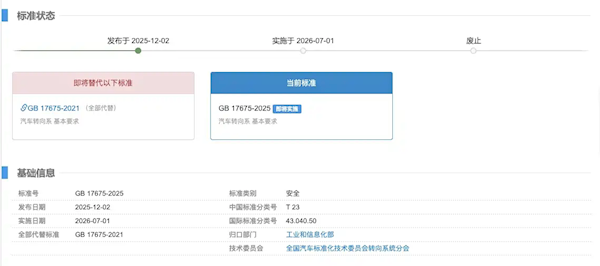
Core Points - The new national standard GB 17675-2025 for automotive steering systems has been officially released and will replace the previous standard GB 17675-2021 starting from July 1, 2026 [1][6] - The primary revision of the new standard addresses new technologies such as steer-by-wire (SBW) and electric power steering (EPS), removing mandatory mechanical connection requirements [1][6] Summary by Category Standard Information - The new standard was published on December 2, 2025, and will be implemented on July 1, 2026 [2] - It is classified under safety standards and is overseen by the Ministry of Industry and Information Technology [2][7] - The standard was drafted by multiple automotive companies, including NIO, Li Auto, Xpeng, BYD, Geely, Xiaomi, Huawei, Toyota, and Mercedes-Benz [2][7] Safety Requirements - The new standard emphasizes enhanced safety requirements, particularly for the redundancy capabilities of steering systems in case of failure [3][7] - It introduces functional safety terminology and verification methods, requiring electronic control systems to meet ISO 26262 functional safety levels [3][7] - Specific requirements for fully powered steering systems include vehicle safety status, degradation requirements, and energy management systems [3][7] Technological Changes - The fully powered steering system eliminates mechanical connections and relies on energy for steering operations, necessitating new alarm methods for battery aging and performance issues [3][7] - Current models utilizing steer-by-wire technology include Infiniti Q50, Zhiji L6, NIO ET9, and Tesla Cybertruck, with NIO ET9 being the first mass-produced model in China to implement full steer-by-wire without mechanical redundancy [3][7]

极氪订单闲鱼转手躺赚5万,饥饿营销的风终于还是刮到车圈了?
3 6 Ke· 2025-12-04 01:44
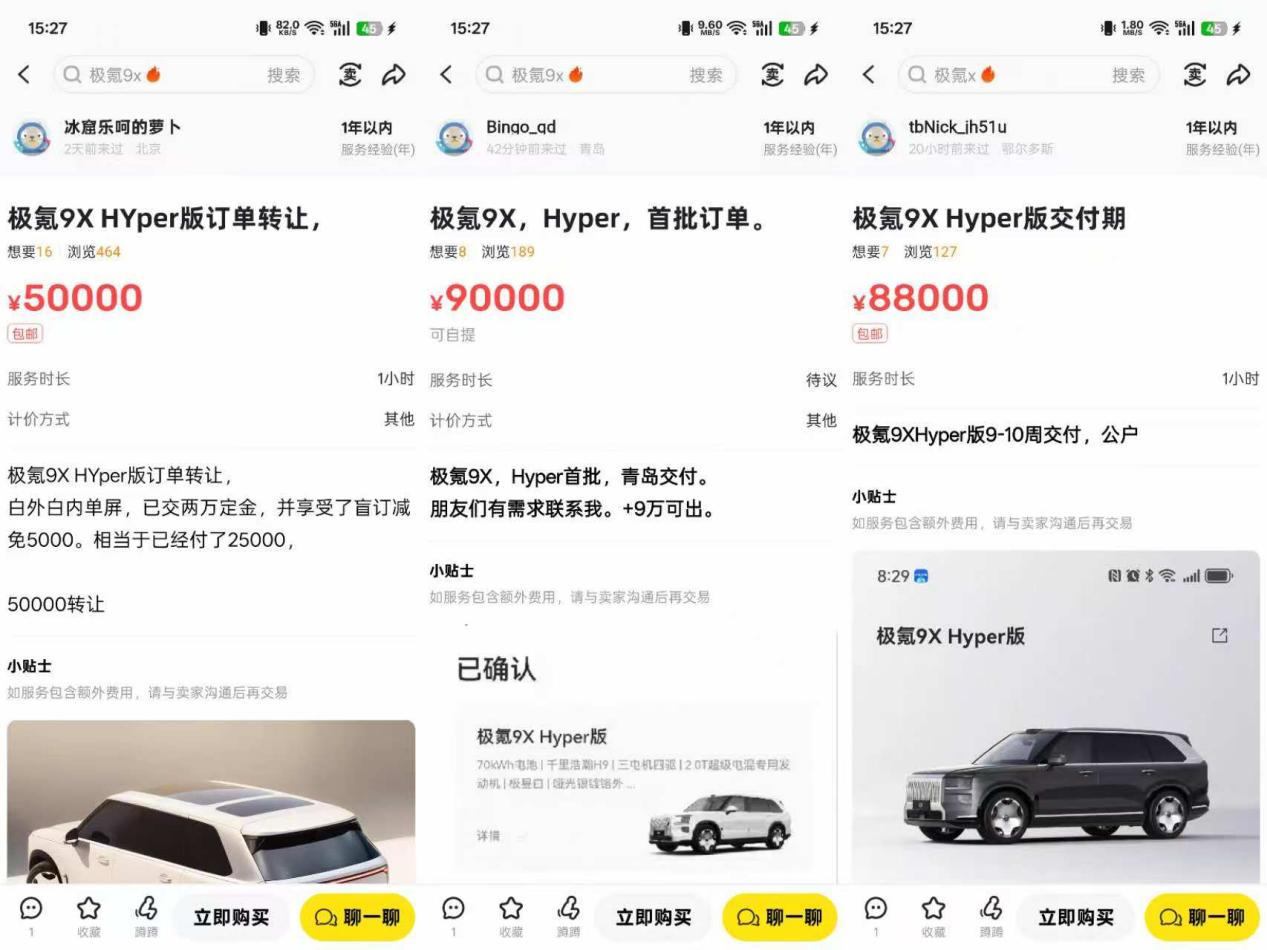
Core Viewpoint - The phenomenon of order transfer and price markup in the new energy vehicle market is creating a new wealth generation opportunity, with significant premiums being charged for vehicle orders, reflecting a speculative market dynamic [1][3][15]. Group 1: Market Dynamics - High-end new energy vehicle orders are being resold at significant premiums, with examples showing markups ranging from 50,000 to 90,000 yuan, indicating a more than 20% increase over the original price of 465,900 yuan for the Zeekr 9X [1][3]. - The practice of order transfer has become a new trend in the new energy vehicle sector, likened to a "hunger marketing" strategy that was previously seen in consumer electronics [4][20]. - The transfer of orders is characterized by a price gradient based on delivery timelines, with shorter wait times commanding higher prices, similar to futures markets [6][20]. Group 2: Consumer Behavior - Consumers are willing to pay premiums for quicker delivery, viewing the additional cost as a reasonable trade-off for time saved, reflecting a shift in consumer psychology towards valuing time over money [12][14]. - The acceptance of price markups is rooted in a historical context where such practices were common in traditional car sales, leading to a perception of transparency and efficiency in the current market [13][19]. Group 3: Corporate Strategy - Automakers benefit from the order transfer market as it creates a perception of high demand and allows them to segment customers based on their willingness to pay, without directly raising prices [16][19]. - The existence of a gray market for order transfers allows car manufacturers to maintain a favorable public image while indirectly profiting from the speculative activities of resellers [15][20]. Group 4: Future Outlook - The current market conditions that support order markups, such as production capacity constraints and sustained demand, are expected to change, potentially leading to a decline in this practice as production ramps up and competition increases [20][22]. - Price wars among manufacturers could disrupt the order transfer market by reducing delivery times and lowering prices, making the speculative nature of order transfers less viable [20][22].
全球大公司要闻2025年12月4日星期四
Wind万得· 2025-12-04 00:14
Group 1: Key Developments in Technology and AI - Maiwell Technology announced the acquisition of Celestial AI for $3.25 billion to enhance its technology layout and market competitiveness in the AI computing sector, which will help expand its AI chip business applications and customer base [2] - Tesla showcased a running segment of its humanoid robot Optimus, indicating significant breakthroughs in motion control technology, which may accelerate the commercialization of robots [2] - Amazon's AWS launched the 3nm AI chip Trainium3, achieving three times the computing speed of its predecessor and reducing AI model training and operational costs by 50% compared to equivalent GPU systems [7] Group 2: Developments in the Greater China Region - Xiaomi Auto has delivered over 500,000 units since April 3, 2024, marking a significant improvement in its competitiveness in the new energy vehicle market [4] - JD Group's industrial supply chain service provider, JD Industrial, has officially launched its IPO, aiming to raise up to HKD 3.27 billion by issuing 210 million shares priced between HKD 12.7 and HKD 15.5 [4] - Taiwan's Tigerair plans to lease 11 new A321neo aircraft and purchase 4, with a total investment of nearly NT$40 billion, aimed at enhancing fleet fuel efficiency and reducing operating costs per seat [5] Group 3: Semiconductor and Chip Industry Updates - TSMC is facing a lawsuit due to the leakage of its 2nm technology, which may impact its technology confidentiality and market competition landscape [5] - Samsung Electronics has surpassed SK Hynix in HBM production, becoming the global leader, while NAND Flash and DRAM shortages are intensifying [10] - SK Hynix's Dalian company increased its investment to $3.1 billion, but its market share in HBM has fallen to second place behind Samsung [10] Group 4: Automotive Industry Insights - Toyota's revenue forecasts for fiscal years 2025-2028 are projected at ¥50.25 trillion, ¥51.51 trillion, and ¥51.71 trillion, with net profits of ¥3.36 trillion, ¥4.09 trillion, and ¥4.27 trillion respectively [10] - Mercedes-Benz launched its pure electric CLA, featuring an 89 kWh battery with a range of 866 kilometers, priced between ¥249,000 and ¥299,900 [13]




小米汽车又出事?车轮脱落事故,雷军紧急辟谣!
Sou Hu Cai Jing· 2025-12-03 23:16
该现象引发网友对小米汽车制造质量的担忧,甚至有人质疑轮毂结构是否不够牢固。 可能从未有一家车企像小米汽车这样,汇聚了如洪流般的滔天流量。无论是正面还是负面,只要发生在小米汽车身上,再小的事都会变成大事。 连续两起小米SU7碰撞事故,将小米汽车轮毂安全问题推至舆论中心。对此,雷军亲自出面,在微博上做紧急辟谣。 1. 小米汽车轮毂风波 安徽高速碰撞和成都天府事故,这两起交通事故,让小米汽车的安全问题,被推向了风口浪尖,深陷舆论风暴之中。 在这期间,小米和雷军均承受了巨大的压力。一波不平一波又起,日前小米轮毂安全问题,成为网友热议的话题。 9月24日,安徽亳州一辆小米SU7 Ultra,因避让行人而撞上马路牙子。 事故中车辆右前侧出现受损情况,且右侧前轮脱离车身,滚至路边人行道,且有明显损坏痕迹。 无独有偶,10月17日湖北武汉车谷大道,小米SU7汽车失控后,撞倒路中间护栏,冲入对向车道,与一辆货拉拉面包车发生碰撞。 结果左前轮车轴断裂,车轮脱落在10米开外,早高峰车流被迫停滞长达两小时。 上述两起事故,所幸没有造成人员伤亡,但它们均出现同一现象:车轮在碰撞后脱离车身,飞出数米之外。 | 安全景草础和前提 小学生 ...

伦铜涨破纪录!小非农超预期降温;特朗普:美特使与普京会面“相当不错”;用户微信被强制下线?豆包、微信回应;王健林买回一座万达广场丨每经早参
Mei Ri Jing Ji Xin Wen· 2025-12-03 22:08
Group 1 - US stock markets saw collective gains, with the Dow Jones up 0.86%, Nasdaq up 0.17%, and S&P 500 up 0.3%. Notable movements included Tesla rising over 4% and Microsoft dropping over 2% [4] - The ADP employment report indicated a decrease of 32,000 jobs in November, the largest drop since March 2023, contrasting with an expected increase of 5,000 jobs [5] - Copper prices on the London Metal Exchange reached a historical high, closing nearly 3% higher at $11,488 per ton, with significant increases in delivery orders [5] Group 2 - International oil prices rose, with WTI crude oil up 0.89% to $59.16 per barrel and Brent crude oil up 0.59% to $62.82 per barrel [7] - The European stock indices showed mixed results, with Germany's DAX down 0.07%, France's CAC40 up 0.16%, and the UK's FTSE 100 down 0.1% [8] - The Chinese Nasdaq Golden Dragon Index fell by 1.38%, with most Chinese concept stocks declining, including NIO and XPeng Motors dropping over 4% [4] Group 3 - France's President Macron arrived in Beijing for a three-day state visit, marking his fourth visit to China, aimed at enhancing the comprehensive strategic partnership [9] - The Chinese Foreign Ministry reiterated its firm opposition to any official exchanges between the US and Taiwan, emphasizing the Taiwan issue as a core interest of China [10] - A fire in Hong Kong resulted in 159 fatalities, with ongoing search and rescue operations [10] Group 4 - China Huaneng Group appointed Zhong Guodong as the new General Manager, a significant leadership change in the energy sector [16][17] - The China Foreign Languages Publishing Administration signed a cooperation agreement with Huawei, focusing on innovation and talent development [18][19] - Xiaomi opened sales for its cars, allowing users to purchase existing stock without waiting for delivery, indicating a shift in its sales strategy [20] Group 5 - Li Auto officially launched its AI glasses, priced from 1,999 yuan, showcasing advancements in AI technology and smart hardware [26][27] - New financing rounds in the semiconductor industry, including Wuxi Shangji Semiconductor's over 300 million yuan Pre-IPO financing, reflect strong investor confidence in domestic chip development [31][32] - The GPU leader Muxi Co. announced an IPO price of 104.66 yuan per share, aiming to raise approximately 4.197 billion yuan for its projects [29][30]

理想入局,AI眼镜赛道竞逐白热化
Zhong Guo Zheng Quan Bao· 2025-12-03 14:37
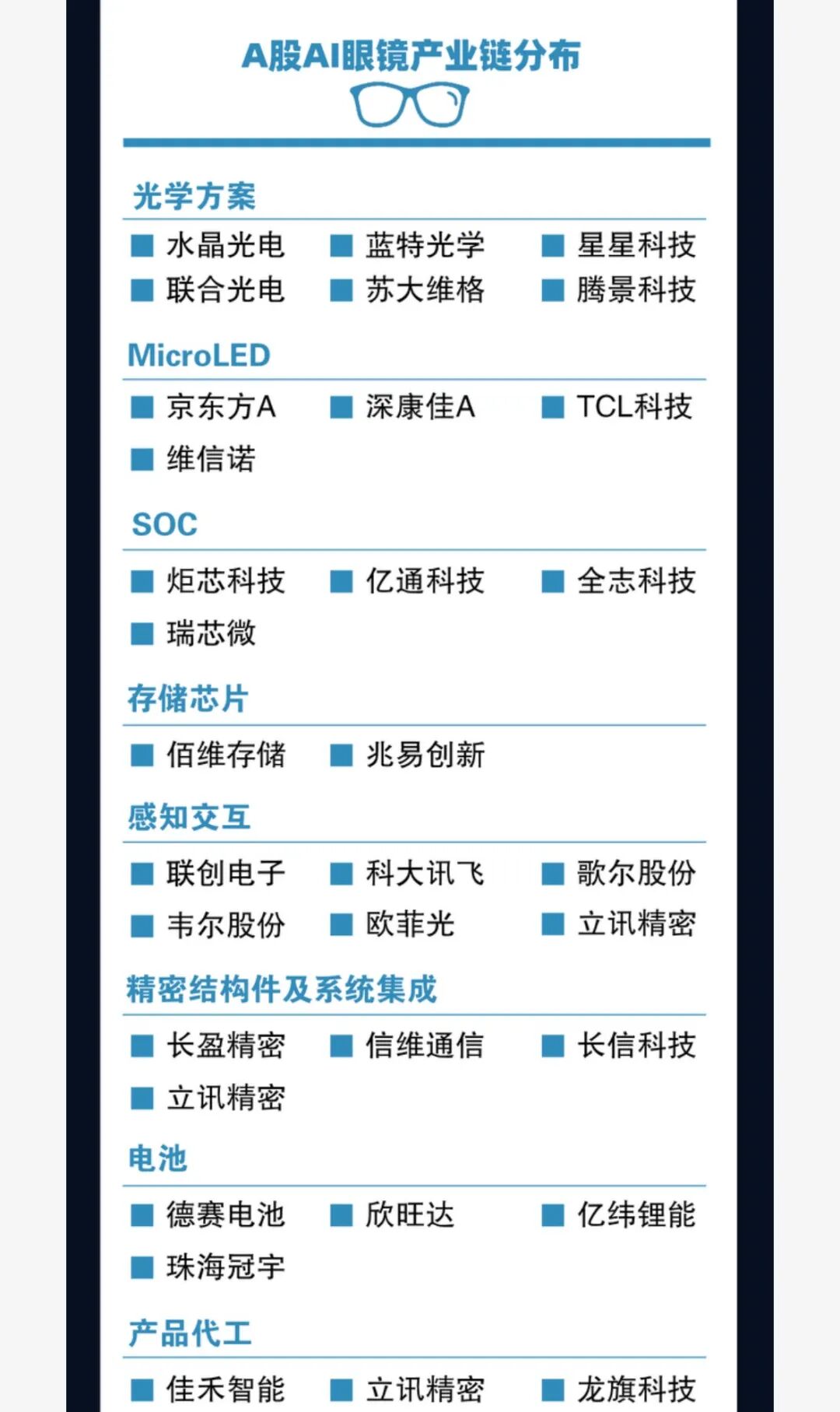
Core Viewpoint - Li Auto has launched the Livis AI glasses, marking its entry into the smart wearable device sector, with a price range of 1999 to 2559 yuan, and a promotional starting price of 1699 yuan, aiming to extend in-car intelligence to the outside world [1] Group 1: Product Features - The Livis AI glasses are equipped with Zeiss lenses and come in various types, including prescription, photochromic, and sunglasses [1] - The glasses enable remote vehicle control, such as opening electric sliding doors and pre-conditioning the car's interior, enhancing user experience while driving [2][3] - Livis features a 12-megapixel camera with ultra-wide-angle capabilities, electronic stabilization, and automatic horizon correction, allowing for photo and video recording, as well as voice interaction [3][4] Group 2: Market Context - The AI glasses market is becoming increasingly competitive, with major tech companies like Xiaomi, Baidu, and Alibaba launching their own AI glasses this year, indicating a potential new consumer electronics category [1][5] - The AI glasses are seen as an evolution of traditional eyewear, integrating functionalities such as audio, photography, and wireless communication, alongside AI capabilities like voice assistance and real-time translation [5] - Analysts predict that the AI glasses market is still in its early stages, with a penetration rate of less than 1% in traditional eyewear by 2024, but expect significant growth, with an estimated shipment of 8.83 million units by 2025, representing a year-on-year increase of 225.6% [9]

阿里千问App全球增速榜第一,AI眼镜赛道开始爆发丨AI产品榜·应用榜2025年11月榜单
36氪· 2025-12-03 13:41
Core Insights - The article discusses the latest AI product rankings for November 2025, highlighting significant growth in user engagement and market presence of various AI applications, particularly focusing on the performance of Alibaba's Qwen model and its associated app, Qianwen [5][9]. Global Rankings - The global monthly active users (MAU) for the top AI applications are led by ChatGPT with 775.57 million users, followed by Doubao and Quark with 167.91 million and 151.93 million users respectively [13]. - Qianwen app achieved a remarkable MAU growth rate of 149.03%, ranking first in the global growth chart [8][21]. Domestic Rankings - In the domestic market, Doubao leads with 167.91 million MAU, followed by Quark and Baidu Wangpan with 151.93 million and 142.61 million MAU respectively [22]. - Qianwen app, positioned as a personal AI assistant, is still in the public testing phase but has already shown explosive growth, indicating strong market potential [9][22]. Global Growth Rankings - The global growth rankings show that Qianwen app leads with a 149.03% increase in MAU, followed by Open Chat with a 53.48% increase and Meta View with a 44.42% increase [21]. - The article emphasizes that the strongest AI products emerge from teams with the most advanced models, as evidenced by Qwen's performance [9]. Download Rankings - The global download rankings indicate that ChatGPT leads with 8.91 million new downloads, followed by Gemini with 5.85 million and Doubao with 2.99 million [24]. - Qianwen app also shows significant download growth, reflecting its rising popularity in the market [25]. Subscription Revenue Rankings - The subscription revenue rankings highlight ChatGPT as the top earner with an annualized revenue of $191.1 million, followed by Gemini and other notable AI applications [26]. - The revenue growth of these applications underscores the increasing monetization potential within the AI sector [26].


新势力系列点评二十五:11月新能源渗透率提速,新势力销量向上
Guolian Minsheng Securities· 2025-12-03 13:22
Investment Rating - The report maintains a "Recommended" rating for the industry, indicating a potential upside of over 15% relative to the benchmark index [7]. Core Insights - The penetration rate of new energy vehicles (NEVs) is accelerating, with a projected retail market size of approximately 2.25 million units in November, reflecting a year-on-year decline of 8.7% but a significant increase in NEV sales, expected to reach 1.35 million units, achieving a penetration rate of 60% for the first time [4][3]. - The report highlights the resilience of new energy vehicle sales, with key players showing varied performance. Leap Motor leads with a 75.1% year-on-year increase, while Li Auto experienced a decline of 31.9% [3][5][9]. Summary by Company Leap Motor - In November, Leap Motor delivered 70,327 vehicles, a year-on-year increase of 75.1% and a slight month-on-month increase of 0.1%. The growth is attributed to strong sales of models C10 and B01, with the company expected to continue its upward trajectory as new models are launched [5][14]. Xpeng Motors - Xpeng Motors reported 36,728 deliveries in November, marking an 18.9% increase year-on-year but a 12.6% decrease month-on-month. The company has expanded its charging network significantly, with over 2,840 self-operated stations and approximately 16,000 charging piles [6][14]. NIO - NIO delivered 36,275 vehicles in November, reflecting a 76.3% year-on-year increase but a 10.2% month-on-month decline. The report notes the strong performance of models ES8 and ET5T [6][14]. Li Auto - Li Auto's November deliveries totaled 33,181 units, down 31.9% year-on-year but up 4.5% month-on-month. The company is expanding its charging network, which is expected to enhance competitiveness as new electric models are introduced [9][14]. Zeekr - Zeekr delivered 28,843 vehicles in November, a 6.8% year-on-year increase and a significant month-on-month increase of 34.6%. The report highlights the successful launch of new models, contributing to sales growth [10][14]. Xiaomi - Xiaomi reported over 40,000 vehicle deliveries in November. The new SUV YU7 has been well-received, with significant pre-order numbers indicating strong market interest [11][14]. Industry Trends - The report emphasizes the ongoing shift towards intelligent driving technologies, with companies like Xpeng and Huawei leading the charge. The expectation is that advancements in smart driving will lower hardware costs and expand market access, particularly in the sub-200,000 yuan segment [11][12]. - The report suggests that the new energy vehicle supply chain and smart electric growth are expected to strengthen, with a focus on intelligent driving and new energy vehicle components [12].