
华西证券

Search documents
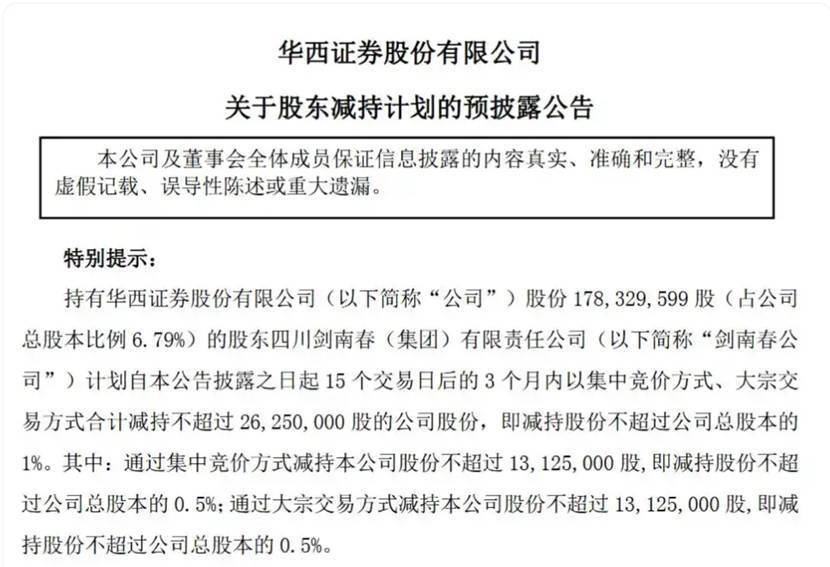
剑南春减持华西证券背后:水晶剑“失锋”,营收增速不足4%
Sou Hu Cai Jing· 2025-10-13 04:01
Core Viewpoint - Jian Nan Chun's recent capital action, involving a plan to reduce its stake in Huaxi Securities, signals potential financial strain amid a backdrop of cash flow pressures and ambitious expansion plans [1][4][5]. Financial Actions - Jian Nan Chun plans to reduce its holdings by up to 26.25 million shares, translating to approximately 255 million yuan at a closing price of 9.71 yuan per share, decreasing its stake from 6.79% to 5.79% [1][5]. - The reduction comes at a time when Huaxi Securities is experiencing a significant profit increase, with a net profit growth of 1195.02% expected in the first half of 2025 [5]. Historical Context - Jian Nan Chun has held its stake in Huaxi Securities since 2000 without any reductions, even during financial crises, making this recent move particularly noteworthy [5]. - The company’s financial challenges are compounded by a recent legal issue involving its former chairman, who was sentenced to prison and fined 400 million yuan, which may impact cash flow [7]. Expansion and Investment - Jian Nan Chun is investing heavily in capacity expansion, with a 1.667 billion yuan project set to begin production in July 2025, requiring approximately 1 billion yuan in self-funding [7][8]. - The company has also increased its distribution network by adding 217 new dealers since 2024, incurring significant marketing and advertising costs [8]. Market Position and Challenges - Jian Nan Chun's revenue growth has slowed, with a projected 3.74% increase in 2024, significantly below the industry average of 5.3% [9][10]. - The company's reliance on its core product, "Crystal Sword," which contributes over 80% of its revenue, is problematic as it faces pricing challenges, with market prices falling below the factory price [9][10]. Strategic Moves - The introduction of state-owned capital into Jian Nan Chun, with a recent investment of 137 million yuan for a 14.51% stake, is seen as a strategic move to enhance governance and restore brand credibility [8]. - Analysts suggest that while the reduction in financial assets addresses short-term liquidity needs, the involvement of state capital is crucial for long-term strategic positioning [10].


特朗普又变了?万斯紧急“灭火”,港A股巨震,黄金飙涨!
Ge Long Hui· 2025-10-13 03:54
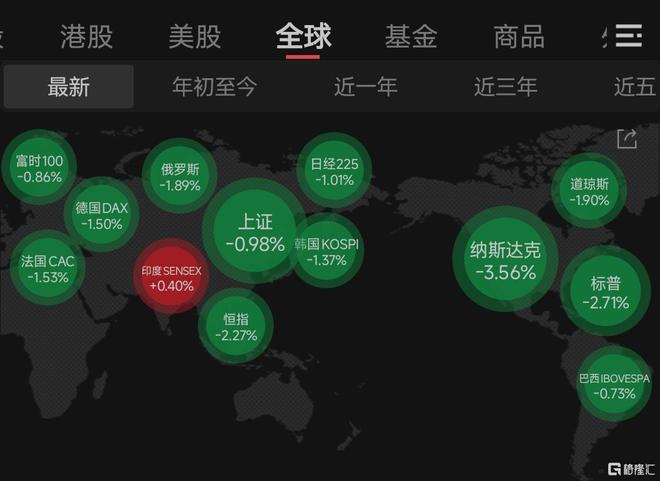
Market Overview - A-shares opened significantly lower, with the Shanghai Composite Index narrowing its decline to 1% and the ChiNext Index down 2.14%, having previously dropped over 4% at the open. The Sci-Tech 50 Index turned positive, with a strong performance in self-controlled industrial chains, particularly in lithography machines, EDA, operating systems, and rare earths [1] - The Hang Seng Index fell over 2.27%, while the Hang Seng Tech Index dropped 2.71% [2] - The volatility index for the Hang Seng surged by 20%, reaching its highest level since May 2025 [5] Global Economic Sentiment - Following Trump's claim of imposing "100% tariffs," there was a subsequent report of "tariff easing," causing significant global market fluctuations [3] - The FTSE China A50 Index futures opened higher but were down 1.22% after a previous night session decline of 4.26% [7] Commodity Market - Risk assets saw a broad increase, with gold and silver reaching new highs. Spot gold peaked at $4,060 per ounce before retreating to $4,048 per ounce, while spot silver rose over 1% to $50.81 per ounce [9] Cryptocurrency Market - The cryptocurrency market rebounded strongly, with Bitcoin recovering from a low of $101,500 to $115,275, marking a 4.29% increase. Ethereum and other cryptocurrencies also saw significant gains [11][12] Trade Policy and Market Reactions - U.S. Vice President Vance indicated a willingness for rational negotiations with China, suggesting that Trump's tariff threats may not materialize as expected [13][14] - Analysts from Huaxi Securities believe the likelihood of the 100% tariff being implemented is low, citing past experiences that indicate high tariffs could disrupt U.S.-China trade, especially during the holiday season [15][16] - The "TACO" (Trump Always Chickens Out) trading strategy has been identified, highlighting a pattern of Trump threatening tariffs followed by market volatility and subsequent easing signals [18]
芯片股逆市走高 大国科技领域博弈升级 半导体行业近期迎来多重催化
Zhi Tong Cai Jing· 2025-10-13 03:05
芯片股逆市走高,截至发稿,华虹半导体(01347)涨2.2%,报83.55港元;中芯国际(00981)涨1.61%,报 78.8港元。 消息面上,大国科技领域博弈升级。10月8日,美众议院"特别委员会"发布涉华半导体出口管制重要报 告;10月10日,中国市场监管总局对高通立案调查,因其收购Autotalks涉嫌违反反垄断法;10 月10 日 特朗普发文表示将对中国加征100%关税,并对关键软件产品实施新的出口管制;10月15日-17日,2025 湾区半导体产业生态博览会将在深圳举办,深圳市发改委主任表示,新凯来将带来惊喜。 浙商证券(601878)指出,算力已成为推动新一轮科技革命和产业变革的新引擎,半导体自主可控刻不 容缓,我国本土制造、半导体设备、算力芯片等有望借此窗口期加速成长。华西证券(002926)则指 出,稀土管制政策首次覆盖半导体,或对海外芯片制程有所影响。 ...
一周流动性观察 | 节后买断式逆回购操作释放积极信号 资金利率或低位运行
Xin Hua Cai Jing· 2025-10-13 02:33
Core Viewpoint - The People's Bank of China (PBOC) is maintaining a stable monetary policy with significant liquidity injections through reverse repos, despite upcoming large-scale maturities and external disturbances in the financial market [1][2][4]. Group 1: Monetary Policy Actions - On October 13, the PBOC conducted a 1.378 trillion yuan (approximately 137.8 billion) 7-day reverse repo operation at an interest rate of 1.40%, resulting in a net injection of 1.378 trillion yuan [1]. - From September 28 to October 11, the PBOC had a net withdrawal of 1.3304 trillion yuan through reverse repos, but subsequently announced a 1.1 trillion yuan 3-month buyout reverse repo operation [1]. - The upcoming week (October 13-17) will see a decrease in reverse repo maturities to 1.021 trillion yuan, with significant amounts maturing on Thursday and Friday [2]. Group 2: Market Liquidity Outlook - Despite the pressure from upcoming reverse repo maturities, the liquidity environment is expected to remain stable due to limited government bond net payments and delayed tax periods [2][3]. - The liquidity test in October is anticipated to be concentrated at the end of the month, with tax reporting deadlines pushed to October 27, coinciding with the month-end [3]. - Analysts suggest that the PBOC's continued use of longer-term tools like MLF and buyout repos indicates a commitment to maintaining liquidity, with expectations that funding rates will remain low [4]. Group 3: Future Expectations - The liquidity gap in October is expected to be weaker than seasonal trends, with the PBOC's monetary policy remaining accommodative, thus limiting risks of liquidity tightening [3]. - If the PBOC continues to provide support through reverse repos and potentially reintroduces other measures, the funding environment could become more favorable, leading to lower volatility [4].
力勤资源涨超8% 刚果(金)钴出口企业配额细节落地
Zhi Tong Cai Jing· 2025-10-13 01:44
Core Viewpoint - The lifting of the cobalt export ban in the Democratic Republic of Congo (DRC) is expected to significantly impact global cobalt supply and prices, with the country being the largest producer globally, accounting for 75.86% of the world's production in 2024 [1] Group 1: Cobalt Market Impact - The DRC will lift its cobalt export ban on October 16, implementing an annual export quota management system, with a cap of 18,125 tons for the remainder of 2025 [1] - The export quota policy is projected to lead to a global cobalt supply shortage from 2025 to 2027, with shortfalls of 122,000 tons, 88,000 tons, and 97,000 tons respectively [1] - Analysts anticipate that cobalt prices are likely to rise significantly due to the expected supply constraints [1] Group 2: Nickel Market Dynamics - Indonesia's newly released RKAB regulations for 2026 are expected to boost nickel ore demand, supporting nickel prices [1] - Minsheng Securities noted that nickel prices are currently at a cyclical low, with clear cost support [1] Group 3: Company Growth Potential - The company has wet nickel production capacity located in Indonesia, which is not affected by the DRC's export restrictions, allowing it to fully benefit from rising cobalt prices [1] - The combination of new capacity release and cost advantages indicates significant growth potential for the company [1]
A股再受关税冲击,业内乐观:情况好于4月7日|市场观察
Di Yi Cai Jing· 2025-10-13 01:31
Core Viewpoint - The market is expected to maintain a slow bull trend despite potential escalations in trade tensions and the U.S. government shutdown crisis, with recent signals indicating a willingness for rational negotiations between the U.S. and China [1][2] Group 1: Market Reactions - Following President Trump's threat of significant tariff increases, U.S. stocks faced a sharp decline, and Chinese concept stocks also experienced substantial drops on October 10 [1] - On October 10, the Shanghai Composite Index fell by 0.94%, the ChiNext Index dropped by 4.55%, and the Sci-Tech Innovation 50 Index decreased by 5.61%, with total trading volume across Shanghai, Shenzhen, and Beijing reaching 2.53 trillion yuan [2] Group 2: Analyst Insights - Analysts believe that the impact of the current tariff situation will be less severe than the previous April 7 incident due to market learning effects and enhanced market stabilization mechanisms in China [2] - Long-term perspectives suggest that the A-share market will continue its slow bull trend, driven by structural profit recovery and ongoing credit repair, while short-term adjustments present opportunities for strategic investments [2] Group 3: Investment Strategies - Investors are advised to be cautious of stocks with high financing balances and consider "high-low switching" strategies, as some companies are expected to outperform following the release of third-quarter reports [2] - The financing balance on October 10 was reported at 24.257 billion yuan, accounting for 2.52% of the circulating market value, indicating a slight decrease from the previous day's balance of 24.292 billion yuan [2]
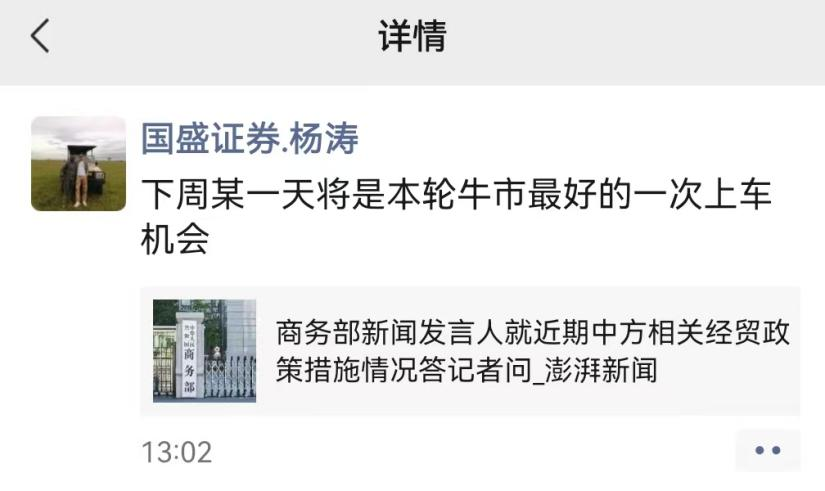
关税再袭,A股是否会重复“4.7”行情?十大券商最新研判来了
Ge Long Hui· 2025-10-13 01:11
Core Viewpoint - The A-share market shows divergence in the first two trading days after the holiday, with the Shanghai Composite Index rising by 0.37%, while the Shenzhen Component Index fell by 1.26%, and the ChiNext Index dropped by 3.86% [1] Group 1: Market Outlook - Citic Securities suggests that opportunities in traditional manufacturing are emerging due to recent export controls, which may benefit compliant and globally experienced leading companies [1] - Guojin Securities indicates that the market may not experience a significant downturn despite recent volatility, as current valuations are higher than in April, and the market is not in a state of panic [2] - Everbright Securities predicts a wide fluctuation phase for the market in the short term, influenced by high valuations and uncertainties in Sino-U.S. relations, but expects policy expectations to rise [2] Group 2: Policy and External Factors - Huajin Securities emphasizes that policies and external events are key factors affecting the A-share market in October, with potential for upward movement if conditions are favorable [3] - Minsheng Securities compares the current situation to May rather than April, suggesting that the market is stabilizing and avoiding drastic measures [4] - Zheshang Securities notes that the Shanghai Composite Index has broken through 3900 points but is facing volatility, maintaining a "slow bull" outlook [5] Group 3: Investment Strategies - Industrial and agricultural sectors are highlighted as potential investment opportunities, with a focus on domestic demand and sectors benefiting from the "15th Five-Year Plan" [9] - Guotai Junan Securities suggests that external shocks may present buying opportunities in the Chinese market, emphasizing the importance of focusing on stable value and industry development [10] - Huaxi Securities anticipates that the impact of trade tensions will be less severe than in April, with a focus on sectors like agriculture, military, and rare earths [8]
不惧关税冲击:多位券商首席看好加仓机会,砸坑即买点
Feng Huang Wang· 2025-10-12 22:23
Core Viewpoint - The consensus among brokerages is that the impact of the current trade tensions will be significantly less than that experienced in April, with many viewing the situation as an opportunity rather than a cause for panic [1][4][5][10]. Group 1: Market Reactions and Strategies - Multiple brokerages emphasize the "TACO" trading strategy, suggesting that short-term market declines due to tariff threats often present buying opportunities [1][7][11]. - Analysts from various firms, including Guangfa Securities and Huaxi Securities, predict that the current market environment is different from April, with a more robust monetary and fiscal policy backdrop supporting the market [7][10]. - The potential for a minor risk-reward rebalancing is noted, with expectations of a short-term reduction in leveraged funds against the backdrop of strong market fundamentals [4]. Group 2: Economic and Policy Insights - The ongoing trade tensions are viewed as a tactical maneuver by the U.S. to gain leverage in negotiations, with the likelihood of a resolution being high [6][11]. - Analysts highlight that the long-term trend for A-shares remains bullish, supported by structural improvements in earnings and credit recovery [13]. - The upcoming APEC summit is identified as a critical event that may influence future negotiations and market sentiment [6]. Group 3: Investment Opportunities - Specific sectors such as technology, AI, and semiconductor industries are recommended for investment, particularly in the context of potential market volatility [7][10]. - The focus on domestic policies aimed at stabilizing growth and addressing internal demand is seen as a key driver for future market performance [9][13]. - Analysts suggest that the current market conditions may provide favorable entry points for investors, particularly in light of historical patterns observed during similar market conditions [7][8].




A股中期向好逻辑未改变对外部扰动无须过度悲观
Shang Hai Zheng Quan Bao· 2025-10-12 17:12
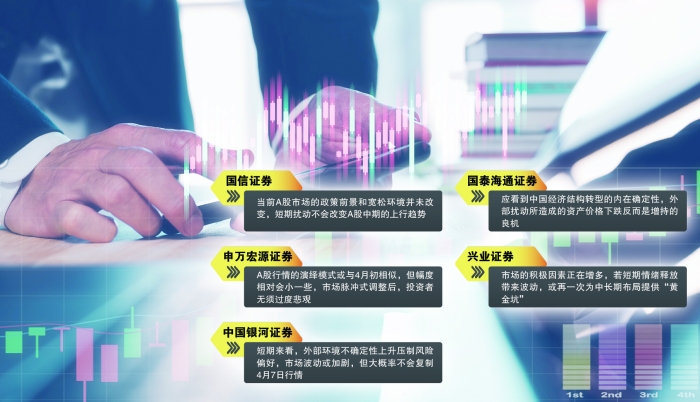
Core Viewpoint - The mid-term positive outlook for the A-share market remains unchanged despite recent external disturbances, and investors should not be overly pessimistic [2][3][4] Market Performance - A-share market experienced significant volatility, with the Shanghai Composite Index returning to the 3900-point mark for the first time in ten years, followed by a high-level adjustment [2] - External factors, including a notable decline in U.S. stock indices, have impacted market sentiment, but historical patterns suggest that the market may recover [3][4] Institutional Insights - Institutions agree that while short-term emotional impacts may lead to increased volatility, the long-term upward trend of the A-share market is intact due to the "learning effect" and improved market stabilization mechanisms [3][4] - The consensus is that the core drivers of the current market rally remain unchanged, and the market is unlikely to replicate the severe downturn seen in April [4] Investment Opportunities - Some institutions view short-term market fluctuations as potential opportunities for long-term investment, suggesting that unexpected market movements can signal new trends [5] - The ongoing structural transformation of the Chinese economy and continuous capital market reforms are seen as positive indicators for investment [5] Sector Focus - The technology sector is expected to remain the main focus for mid-term investments, with specific attention on advanced manufacturing areas such as computing power, semiconductors, and robotics [6] - Stable assets may perform well in the short term, but the technology industry's growth trajectory is anticipated to lead the market in the long run [6][7]
中美关税阴云再起!专家、机构解读:A股不会重演4月行情
Nan Fang Du Shi Bao· 2025-10-12 13:57
Core Viewpoint - The recent announcement by President Trump regarding a 100% tariff on all products from China has reignited concerns over US-China trade relations, with the new tariffs set to take effect on November 1. This has led to market adjustments, with significant declines in both A-shares and US stocks [1][2]. Group 1: Market Reactions - Following Trump's announcement, A-shares experienced a pullback, with the Shanghai Composite Index adjusting from a previous high of 3900 points to 3897.03 points. In the US, major indices also fell, with the Nasdaq dropping by 3.56% and the Nasdaq Golden Dragon China Index declining by 6.10% [1]. - Experts believe that the market is better prepared for this round of tariff discussions compared to previous instances, indicating that the short-term emotional impact on A-shares will be less severe than in April [4][5]. Group 2: Expert Opinions - Analysts from Huaxi Securities and other firms suggest that the likelihood of the 100% tariff being implemented is low, and the current trade tensions are expected to serve as leverage for future negotiations rather than lead to significant market disruptions [2][3]. - The sentiment among analysts indicates a shift in mindset, with increased confidence in handling external uncertainties. This is attributed to prior experiences with tariff announcements, which have led to better psychological preparedness in the market [3][4]. Group 3: Long-term Outlook - The long-term trajectory of the market will largely depend on the progress of tariff negotiations, particularly leading up to the APEC meeting and the November 1 deadline. The focus remains on internal economic and policy developments within China rather than solely on external pressures [3][6]. - The current market environment is characterized by a supportive policy framework aimed at stabilizing capital markets, which is expected to mitigate the impact of any potential downturns [6][7].