
江淮汽车

Search documents
L3自动驾驶量产元年,离L4的梦想又近了一步
3 6 Ke· 2025-12-17 08:43
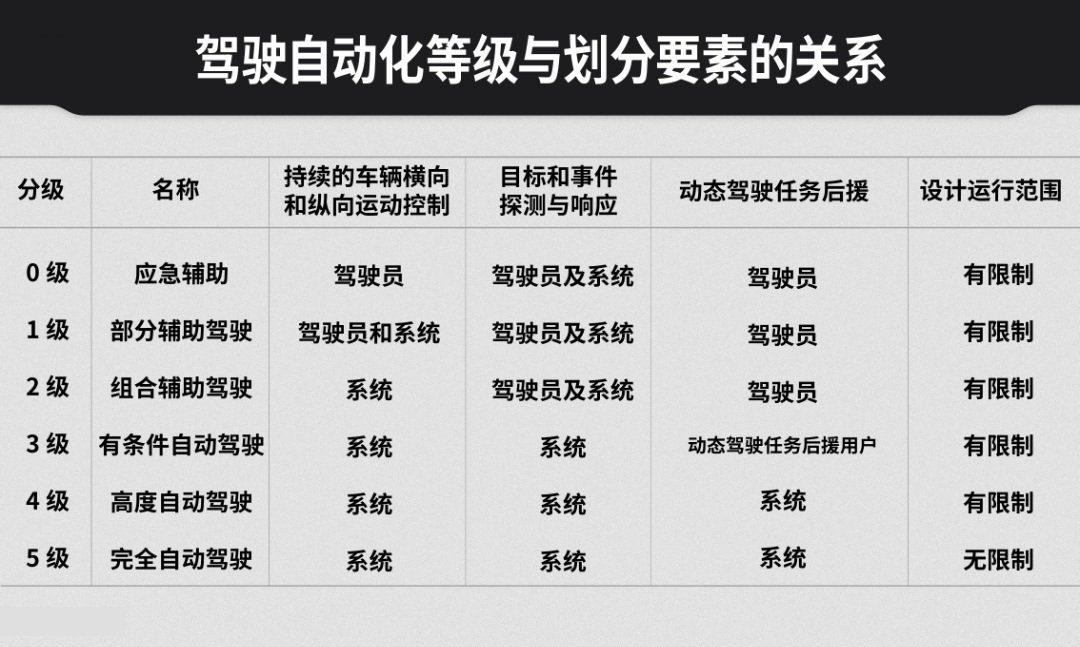
Core Insights - The Ministry of Industry and Information Technology has approved the commercial operation of L3 autonomous driving for the first time in China, allowing vehicles to operate under specific conditions with the system taking over driving tasks [1] - The approval includes two models: Changan Deep Blue SL03 and Arcfox Alpha S6, marking a significant step towards the mass production of L3 autonomous vehicles by 2026 [1] - The responsibility for accidents occurring while the system is activated will primarily fall on the car manufacturers, emphasizing the importance of accountability in this new phase of autonomous driving [1] Industry Developments - Major automotive companies in China, including Huawei, Chery, and GAC Group, are targeting the implementation of L3 conditional autonomous driving by 2025, with several already obtaining testing licenses [4][5] - Companies like XPeng Motors and Chery have announced plans to launch L3 autonomous vehicles, with XPeng aiming for L4 capabilities by 2026 [4] - The L3 level is seen as a crucial transition from "assisted driving" to "fully autonomous driving," with L4 expected to allow vehicles to operate without human intervention in designated areas [1][4] Technological Advancements - The automotive industry is experiencing a shift towards integrating AI and advanced technologies into autonomous driving systems, with companies developing models that enhance perception, planning, and control [9][12] - The introduction of VLA (Visual Language Action) models is expected to significantly improve the capabilities of autonomous driving systems, providing better scene understanding and decision-making [9][15] - The competition among automakers is intensifying, with a focus on developing proprietary technologies that enhance vehicle performance and safety, particularly in complex driving scenarios [17][18] Future Outlook - The approval of L3 autonomous driving is viewed as a pivotal moment in the evolution of transportation, setting the stage for ongoing exploration and innovation in the field [19] - The industry is expected to continue evolving, with a focus on balancing self-research and collaboration to maintain technological leadership while managing costs [18][19] - As the market for autonomous vehicles grows, the emphasis will shift from merely achieving autonomous capabilities to ensuring the safety and reliability of these systems in real-world conditions [17][19]


【周度分析】车市扫描(2025年12月8日-12月14日)
乘联分会· 2025-12-17 08:38
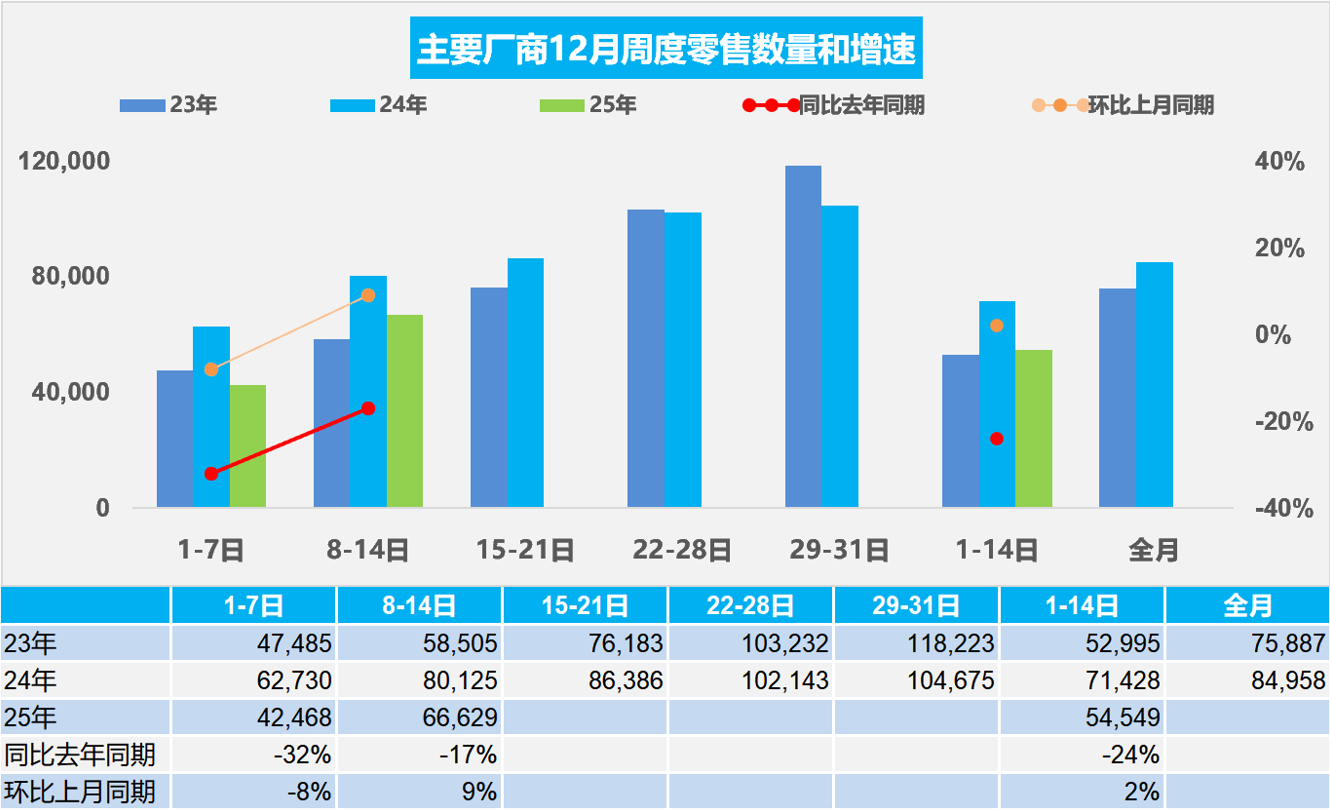
Group 1: Market Overview - From December 1 to 14, the national retail sales of passenger cars reached 764,000 units, a year-on-year decrease of 24%, but a month-on-month increase of 2%. Cumulative retail sales for the year reached 22.247 million units, a year-on-year increase of 5% [2][5] - During the same period, wholesale sales of passenger cars were 734,000 units, down 31% year-on-year and down 15% month-on-month. Cumulative wholesale sales for the year reached 27.499 million units, a year-on-year increase of 9% [2][9] - The retail penetration rate of new energy vehicles (NEVs) in the passenger car market reached 62.3% in the first two weeks of December, with retail sales of NEVs at 476,000 units, a year-on-year decrease of 4% [2][6] Group 2: Production and Sales Trends - In the first two weeks of December, production of pure fuel light vehicles was 457,000 units, down 24% year-on-year, while production of hybrid and plug-in hybrid vehicles was 275,000 units, down 14% year-on-year [3] - The average daily retail sales in the first week of December were 42,000 units, down 32% year-on-year, while in the second week, it increased to 67,000 units, down 17% year-on-year [5][6] - The production of passenger cars in November was 3.52 million units, a year-on-year increase of 2%, with NEVs accounting for 1.84 million units, a year-on-year increase of 17% [11] Group 3: Economic and Policy Impact - The macroeconomic environment remains stable, but the tightening of trade-in and scrapping subsidy policies has led to a decline in retail sales in November [6][10] - The expectation of a strong year-end sales push is influenced by the expiration of tax exemptions for NEVs, prompting consumers to purchase vehicles before the end of the year [6][10] - The government is expected to announce new trade-in policies for 2026, which could stimulate demand and support sales in early 2026 [7] Group 4: Industry Challenges and Compliance - The automotive industry faces intensified competition and price disorder, with 52.6% of dealers reporting losses and 74.4% experiencing price discrepancies [12] - The introduction of the "Automotive Industry Price Behavior Compliance Guidelines" aims to stabilize the market and protect the interests of dealers and suppliers [12][13] - The industry is encouraged to adopt measures to reduce price wars and ensure fair competition, which is crucial for the sustainability of dealerships [12][13] Group 5: Pickup Truck Market Analysis - In November 2025, the pickup truck market saw sales of 56,000 units, a year-on-year increase of 18.8%, with a cumulative sales of 537,000 units for the year, up 12.1% [14][15] - The export of pickups reached 32,000 units in November, a year-on-year increase of 54%, with exports accounting for 57% of total sales in November [14][15] - The market for new energy pickups is growing rapidly, with sales increasing by 152% year-on-year in November [15]

乘联分会:12月前两周全国乘用车新能源市场零售47.6万辆 同比下降4%
智通财经网· 2025-12-17 08:15
Group 1: New Energy Vehicle Market Performance - From December 1 to December 14, the retail sales of new energy vehicles in the passenger car market reached 476,000 units, a year-on-year decrease of 4%, but a month-on-month increase of 1% [1] - Cumulative retail sales for the year reached 11.948 million units, representing an 18% year-on-year growth, with a penetration rate of 62.3% in the new energy segment [1] - Wholesale figures for new energy vehicles during the same period were 457,000 units, down 15% year-on-year and 14% month-on-month, with a cumulative wholesale of 14.213 million units for the year, up 26% [1] Group 2: Overall Passenger Car Market Trends - Total retail sales of passenger cars from December 1 to December 14 were 764,000 units, down 24% year-on-year but up 2% month-on-month, with cumulative retail sales for the year at 22.247 million units, a 5% increase [4][5] - Wholesale sales for the same period were 734,000 units, a 31% year-on-year decline and a 15% month-on-month decrease, with cumulative wholesale for the year at 27.499 million units, up 9% [9] Group 3: Market Dynamics and Consumer Behavior - The market is experiencing a cautious sentiment among dealers due to tightened trade-in and scrapping subsidy policies, leading to a negative growth in retail sales in November [5] - The end of the year is marked by a strong urgency among consumers to purchase vehicles due to the impending expiration of tax exemptions for new energy vehicles [5] - The expectation of a new trade-in policy for 2026 could stimulate demand, but the current retail growth is considered weak compared to the previous year [4][5] Group 4: Production and Export Trends - In the first two weeks of December, production of pure fuel light vehicles was 457,000 units, down 24% year-on-year, while production of hybrid and plug-in hybrid vehicles was 275,000 units, down 14% year-on-year [1] - The export market for Chinese vehicles has shown positive trends, particularly in the new energy segment, with significant growth in overseas markets [10] - The overall production of vehicles in November was 3.52 million units, with new energy vehicle production at 1.84 million units, reflecting a 17% year-on-year increase [11]

份额第一!玉柴混合动力领跑这一市场
第一商用车网· 2025-12-17 07:00
Core Viewpoint - The article highlights the delivery of 70 hybrid mining trucks equipped with Yuchai YCK16-400kW hybrid power systems, emphasizing the company's leadership in intelligent and low-carbon technology for the transformation and upgrading of large mining equipment [1][3]. Group 1 - The Yuchai YCK16-400kW hybrid power system is specifically designed for the complex working conditions of mining areas, offering strong power, energy efficiency, and excellent economic performance [3]. - The advanced hybrid technology significantly reduces energy consumption and emissions while ensuring efficient heavy-load transportation, aligning with the smart operation needs of mining areas and supporting their green transformation [3]. - Customer representatives highly praised the performance of the trucks during the delivery event, indicating strong market acceptance and satisfaction [5]. Group 2 - Yuchai and Tongli plan to deepen their collaboration in the field of green high-end mining equipment, aiming to inject new vitality into efficient transportation in mining areas and create a mutually beneficial situation [5]. - The article also mentions significant contracts and sales achievements in the commercial vehicle sector, including a nearly 4.6 billion yuan contract won by CRRC and a nearly 6 billion yuan contract by BYD for commercial vehicles, indicating a robust market environment [10].


三一超4000辆夺冠 徐工/解放破3000辆角逐前二!11月充电重卡销2万辆涨疯了 | 头条
第一商用车网· 2025-12-17 07:00
Core Insights - The sales of electric heavy-duty trucks have reached new heights, with November 2025 recording a total of 28,000 units sold, marking a 178% year-on-year increase and a 39% month-on-month increase [3][32] - Charging heavy-duty trucks have been the main contributor to this growth, achieving a record sales figure of 19,900 units in November, which represents a 207% year-on-year increase and a 42% month-on-month increase [3][32] - The market share of charging heavy-duty trucks within the electric heavy-duty truck segment has consistently exceeded 60% since June 2024, reaching 73.01% in November 2025 [4][6] Sales Performance - In November 2025, the sales of pure electric heavy-duty trucks (including charging and battery swap types) reached 27,200 units, accounting for 97.46% of total sales [3] - Charging heavy-duty trucks have maintained a monthly sales average exceeding 10,000 units since April 2025, with the last six months averaging 14,200 units per month [32] - Cumulatively, from January to November 2025, charging heavy-duty trucks sold 125,600 units, representing a 219% increase compared to the same period last year [18][24] Market Dynamics - The market for charging heavy-duty trucks has seen participation from 31 companies by November 2025, up from 27 in 2024 [18] - The top three companies in charging heavy-duty truck sales for January to November 2025 are SANY, XCMG, and FAW Jiefang, with sales of 25,700, 20,300, and 19,200 units respectively [19][21] - The market share of the leading companies has shown significant growth, with SANY holding 20.47%, XCMG at 16.16%, and FAW Jiefang at 15.29% [21] Segment Analysis - The sales of charging tractors and dump trucks have been particularly strong, with tractors seeing a 278% increase and dump trucks a 133% increase year-on-year [24][29] - Charging tractors accounted for 71.57% of total sales, while dump trucks made up 12.36% [24] - The competition among the top three charging tractor manufacturers is intense, with SANY, FAW Jiefang, and XCMG all exceeding 15,000 units sold [26] Conclusion - The charging heavy-duty truck market has demonstrated remarkable growth, with consistent month-on-month increases and a strong performance across various segments [32] - The trend of doubling sales year-on-year has been maintained for 23 consecutive months, indicating a robust market outlook for the future [32]




L3自动驾驶量产元年,离L4的梦想又近了一步?
Xin Lang Cai Jing· 2025-12-17 06:30
Group 1 - The Ministry of Industry and Information Technology has approved the commercial operation of L3 autonomous driving for the first time in China, allowing vehicles to operate under specific conditions with the system taking over driving tasks [1] - The two models approved for L3 autonomous driving are Changan Deep Blue SL03 and Arcfox Alpha S6, marking a significant step towards the commercialization of L3 technology [1] - The year 2026 is anticipated to be the "mass production year" for L3 autonomous driving, with several companies aiming to launch L3 vehicles by then [3][4] Group 2 - The approval clarifies the responsibility division for L3 autonomous driving, indicating that if an accident occurs while the system is activated, the car manufacturer may bear primary responsibility [1] - The L3 level is seen as a crucial transition from "assisted driving" to "fully autonomous driving," with L4 expected to achieve greater breakthroughs [1][4] - Major automotive companies, including XPeng, Chery, and GAC, have set timelines for the mass production of L3 vehicles, with GAC planning to launch its first L3 model in Q4 of this year [3][4] Group 3 - The automotive industry is experiencing intensified competition in intelligent driving technologies, with companies like BYD, Geely, and Chery developing their own autonomous driving systems [9] - The integration of AI and data-driven technologies is becoming essential for enhancing autonomous driving capabilities, moving beyond traditional rule-based systems [9][12] - The VLA model is emerging as a key technology in the transition from L2 to L4 autonomous driving, offering improved scene reasoning and generalization capabilities [9][14] Group 4 - The shift towards L3 autonomous driving represents a new beginning for human-machine coexistence, with ongoing exploration in technology iteration and regulatory improvement [17] - Companies are increasingly focusing on in-house development of core technologies, such as battery technology and autonomous driving algorithms, to enhance brand competitiveness [16] - The balance between self-research and collaboration is crucial for companies to maintain technological leadership while managing costs [16][17]
江铃域虎:超级商用大皮卡,面子里子全拿捏!| 头条
第一商用车网· 2025-12-17 03:46
Core Viewpoint - The article emphasizes that the Jiangling Yuhu pickup truck is a benchmark for "super commercial large pickups," excelling in aesthetics, functionality, and driving experience, making it suitable for various scenarios including construction, emergency response, and family outings [1][24][25] Design and Aesthetics - The Yuhu features a design that combines practicality and aesthetics, with a robust front grille and sleek lines that enhance its visual appeal while maintaining functionality [4][5] - The vehicle's dimensions and design elements, such as the 245/70 R17 tires, ensure stability and adaptability across different terrains, from construction sites to urban environments [5][7] Functionality and Versatility - The Yuhu's cargo box has a volume of 1.6m³, allowing for efficient loading and transportation of heavy materials, which significantly boosts construction efficiency [7] - The vehicle's body is constructed with 68% high-strength steel, providing durability and safety even on rough roads [8] - The 180° opening tailgate facilitates easy loading and unloading, reducing labor costs [9] - Compared to competitors, the Yuhu's cargo capacity is 23% larger, and it boasts a fuel efficiency of 7.1L per 100km, enhancing profitability for agricultural transport [11] Urban and Family Use - The Yuhu is designed for urban delivery with a compact size that allows for easy maneuverability in tight spaces, making it suitable for city logistics [13] - The interior features a dual-screen setup for enhanced technology and comfort, making it appealing for both business and family use [14] - The spacious rear seating and storage options cater to family outings, ensuring comfort and convenience [16][17] Performance and Handling - The Yuhu is powered by a 2.5T engine, delivering a maximum power of 123kW and a torque of 430N·m, allowing for quick acceleration even when fully loaded [20] - The vehicle's transmission system is designed for smooth operation, making it user-friendly for both novice and experienced drivers [21] - The robust chassis and braking system ensure stability and safety across various driving conditions [19][24]


业内专家:汽车软件正朝底层自主化、架构全栈化、应用智能化等方向发展
Xin Hua Cai Jing· 2025-12-17 03:42
Group 1 - The automotive software is becoming a key driver for the restructuring of the automotive industry and the reshaping of its ecosystem, focusing on bottom-level autonomy, full-stack architecture, and intelligent applications [1] - The Shanghai Municipal Economic and Information Commission emphasizes three areas for collaboration: strengthening foundational technology, integrating AI with new information technologies, and promoting an open-source ecosystem for automotive software [1] - The China Association of Automobile Manufacturers advocates for a dual-driven approach of "learning + innovation," establishing a controllable technological foundation, leading with standardization, and fostering an open and shared development framework [1] Group 2 - Shanghai Jiading has gained a competitive edge as the first national pilot demonstration zone for intelligent connected vehicles and electric vehicles, focusing on automotive software as a key development area [2] - The Shanghai International Automobile City collaborates with leading companies to launch the "Meta-Ecosystem" platform, providing comprehensive support for the embodied intelligence industry driven by AI [2] - A high-quality incubation center for embodied intelligence is being established to support companies with affordable computing power and diverse training scenarios, significantly reducing R&D costs [2] Group 3 - The China Association of Automobile Manufacturers, in collaboration with key industry partners, has released a white paper on "Software-Defined Automotive Service Development," outlining how software can drive profound changes through service-oriented approaches [3] - The white paper presents a comprehensive methodology, toolchain requirements, and middleware solutions for the industry, serving as a practical development guide [3]
L3商用加速落地,有望推动智能底盘批量应用 | 投研报告
Zhong Guo Neng Yuan Wang· 2025-12-17 02:04
Core Viewpoint - The recent approval of L3-level conditional autonomous driving vehicles by the Ministry of Industry and Information Technology (MIIT) marks a significant step towards the commercialization of advanced autonomous driving technology in China [2][5]. Group 1: L3 Autonomous Driving Approval - Changan Automobile and BAIC BluePark Magna Automotive have submitted applications for L3-level conditional autonomous driving vehicles, which have been approved by MIIT in the 401st batch of announcements [2][3]. - L3 autonomous driving allows for conditional self-driving within a limited operational range, differing fundamentally from L2 assistance systems [2][3]. Group 2: Impact on Intelligent Chassis - The approved vehicles include Changan's Deep Blue product and BAIC's Arcfox Alpha S (L3 version), which features a high-performance redundant sensor system with 34 sensors, including three LiDARs [3][4]. - The commercialization of L3 is expected to accelerate the application of intelligent chassis technologies, such as active suspension, electronic brake-by-wire (EMB), and steer-by-wire (SBW) systems [3][4]. Group 3: Investment Strategy - The approval of L3 vehicles provides policy support for the popularization of high-level autonomous driving, benefiting companies actively engaged in this sector [5]. - Key investment areas include vehicle application, where leading companies are establishing advantages in training data and smart driving ecosystems, and the intelligent chassis sector, which is expected to see rapid mass application by 2026 [5].





“制造强国”实干系列周报(12、14期)-20251217
Shenwan Hongyuan Securities· 2025-12-17 01:46
Group 1: Aluminum vs. Copper in Air Conditioning - The shift from copper to aluminum in air conditioning systems is driven by the copper-aluminum price gap, energy efficiency standards upgrades, and refrigerant replacements, with microchannel technology becoming increasingly prevalent[3] - The competitive landscape for microchannel heat exchangers is dominated by three players: Sanhua, Mahler/Delphi, and Danfoss[3] - Sanhua's revenue growth has slowed, indicating a need for innovation and adaptation in the market[14] Group 2: Nuclear Fusion Developments - The nuclear fusion sector is expected to accelerate due to continuous technological breakthroughs and policy support, with significant project milestones achieved in 2025[19] - The global nuclear fusion market is projected to reach approximately $479.5 billion by 2029, with a total of 196 fusion devices expected by 2035[40][42] - Key investment opportunities in nuclear fusion include core supporting entities and high-value segments within the supply chain, such as superconducting magnets and power systems[46] Group 3: Commercial Aerospace - The commercial aerospace sector is witnessing stable or potentially increasing core players due to cost reduction trends, with a focus on satellite manufacturing and launch services[3] - The domestic satellite constellation projects, such as G60 and GW, are set to significantly increase satellite launches, with G60 planning to deploy 1,296 satellites by the end of 2027 and 15,000 by 2030[60] - The market for satellite services and ground equipment is expected to dominate, accounting for over 90% of the commercial aerospace value chain[52]