
中国石油

Search documents
机构详解2026年化工四大方向,石化ETF(159731)成布局利器,规模份额创历史新高
Sou Hu Cai Jing· 2026-01-19 02:56
Group 1 - The Petrochemical ETF (159731) has seen a rise of 1.79% as of January 19, with significant gains from holdings such as Yara International, Haohua Technology, and Hualu Hengsheng [1] - The Petrochemical ETF has experienced net inflows for eight consecutive trading days, totaling 269 million yuan, with its latest share count reaching 549 million and total scale hitting 522 million yuan, both marking new highs since inception [1] - Dongwu Securities highlights four major investment directions for the chemical industry by 2026, including dividend strategies focusing on China National Offshore Oil Corporation, China Petroleum, and Sinopec [1] Group 2 - The Petrochemical ETF and its linked funds closely track the CSI Petrochemical Industry Index, with the basic chemical industry accounting for 59.23% and the oil and petrochemical industry for 32.60% of the index [2] - The chemical industry cycle is expected to accelerate its reversal as supply-side measures continue to reduce capacity and promote domestic demand in the context of the "14th Five-Year Plan" [2]
涨超2.0%,石化ETF(159731)连续8天净流入
Sou Hu Cai Jing· 2026-01-19 02:41
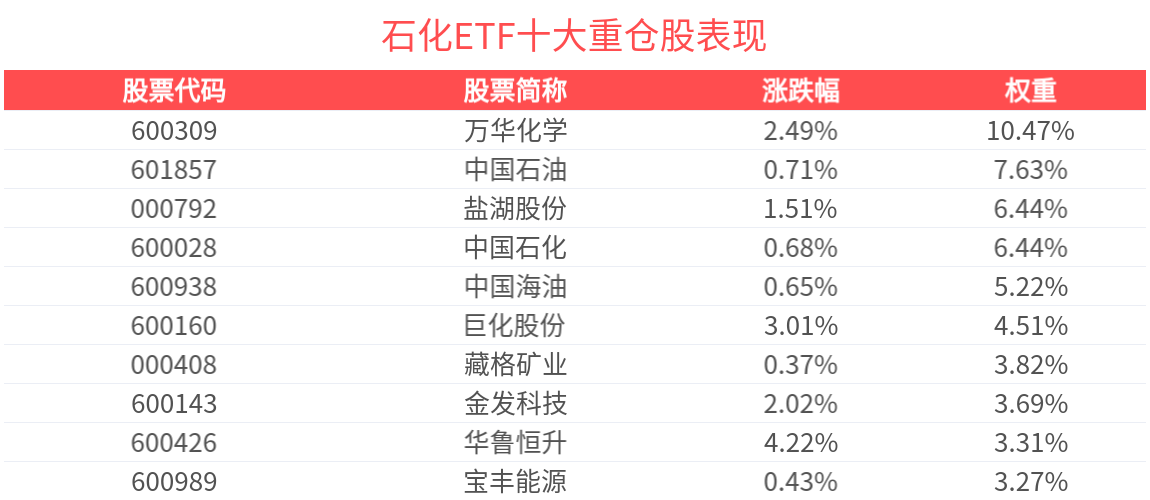
Core Insights - The petrochemical industry index has shown a strong increase of 1.88%, with significant gains in constituent stocks such as Yara International (up 4.93%) and Haohua Technology (up 4.58%) [1] - The Petrochemical ETF (159731) has experienced continuous net inflows over the past 8 days, totaling 269 million yuan, reaching a record high in both shares and scale [2] - The Petrochemical ETF has achieved a net value increase of 53.13% over the past two years, with a maximum single-month return of 15.86% since its inception [2] Fund Performance - The Petrochemical ETF's latest share count is 549 million, with a total scale of 522 million yuan [2] - The ETF has recorded an average monthly return of 5.25% during its rising months, with the longest consecutive rising streak lasting 8 months and a total increase of 41.60% [2] - The top ten weighted stocks in the index account for 56.73% of the total, including major companies like Wanhua Chemical and China Petroleum [2] Stock Performance - Notable stock performances include Wanhua Chemical (up 2.49%, weight 10.47%), China Petroleum (up 0.71%, weight 7.63%), and Salt Lake Potash (up 1.51%, weight 6.44%) [4] - Other significant stocks include China Petrochemical (up 0.68%, weight 6.44%) and Haohua Technology (up 4.22%, weight 3.31%) [4]

机构称区域冲突支撑油价,"三桶油"凸显周期韧性,石油ETF鹏华(159697)涨超1.3%
Xin Lang Cai Jing· 2026-01-19 02:13
Group 1 - The core viewpoint of the news is that geopolitical risks are driving up oil prices, with Brent and WTI crude oil futures prices increasing by 1.9% and 0.7% respectively as of January 16, 2026 [1] - The Iranian situation may lead to significant impacts on oil production and exports if tensions escalate, with Iran's average monthly oil production projected at 3.26 million barrels per day for 2025 [1] - OPEC forecasts an increase in global oil demand by 1.38 million barrels per day in 2026 and 1.34 million barrels per day in 2027, while OPEC+ is expected to increase production by 2.21 million barrels per day in 2025 [1] Group 2 - The "Big Three" oil companies in China, namely China National Petroleum Corporation, China National Offshore Oil Corporation, and Sinopec, are expected to maintain high capital expenditures and strengthen their natural gas market expansion, showing resilience during oil price downturns [2] - As of January 19, 2026, the National Petroleum and Natural Gas Index rose by 1.31%, with significant gains in stocks such as Jiufeng Energy and China Merchants Energy [2] - The top ten weighted stocks in the National Petroleum and Natural Gas Index account for 67.11% of the index, including major players like China National Petroleum Corporation and Sinopec [2]



国际油价小幅上涨,丁二烯、环氧丙烷价格上涨 | 投研报告
Sou Hu Cai Jing· 2026-01-19 01:41
Core Viewpoint - The report highlights the current trends in the chemical industry, focusing on price movements, supply-demand dynamics, and investment opportunities in undervalued leading companies amid a backdrop of strong downstream demand and geopolitical tensions [1][3][7]. Industry Dynamics - In the week of January 12-18, 49 out of 100 tracked chemical products saw price increases, while 20 experienced declines, and 31 remained stable. The average price of 49% of products rose month-on-month, while 39% fell [2]. - The average price of WTI crude oil futures increased by 0.54% to $59.44 per barrel, and Brent crude oil futures rose by 0.66% to $63.76 per barrel during the same week [3]. - As of January 9, U.S. crude oil production averaged 13.753 million barrels per day, a decrease of 58,000 barrels from the previous week but an increase of 2.72 million barrels compared to the same period last year [3]. Price Movements - The price of butadiene rose to 9,663 yuan per ton, up 4.04% week-on-week and 25.98% month-on-month, although it is down 20.8% year-on-year [4]. - Epoxy propane prices increased to 8,620 yuan per ton, reflecting an 8.84% rise week-on-week and a 9.88% increase year-on-year [5][6]. Investment Recommendations - As of January 18, the price-to-earnings (P/E) ratio for the basic chemical sector is 14.68, while the oil and petrochemical sector stands at 13.44, indicating potential investment opportunities in undervalued leading companies [7]. - The report suggests focusing on sectors benefiting from strong downstream demand, including electronic materials and certain new energy materials companies, as well as companies that are well-positioned amid supply-side reforms [7]. - Recommended stocks include Wanhua Chemical, Hualu Hengsheng, and others, with a focus on companies in emerging fields such as semiconductor materials and OLED materials [7][8].
伊朗风险仍是左右油价的重要因素 | 投研报告
Sou Hu Cai Jing· 2026-01-19 01:25
Group 1 - The core viewpoint of the report indicates that geopolitical disturbances, particularly the ongoing situation in Iran, are significantly influencing oil prices, with Brent and WTI prices recorded at $64.13 and $59.34 per barrel respectively as of January 16, 2026 [1][2] - In the first half of the week, oil prices rose due to concerns over potential supply disruptions from Iran, while in the latter half, prices fell as plans for military action by the U.S. were temporarily shelved [1][2] - The report highlights that Brent crude futures settled at $64.13 per barrel, up by $0.79 (+1.25%) from the previous week, while WTI crude futures increased by $0.22 (+0.37%) to $59.34 per barrel [2] Group 2 - As of January 12, 2026, the global number of offshore self-elevating drilling rigs increased to 377, with notable additions in Southeast Asia, Europe, and the Middle East [3] - U.S. crude oil production decreased to 13.753 million barrels per day as of January 9, 2026, while the number of active drilling rigs rose to 410 as of January 16, 2026 [3] - U.S. refinery crude processing increased to 16.958 million barrels per day with a utilization rate of 95.30% as of January 9, 2026, reflecting a slight increase from the previous week [3] Group 3 - U.S. total crude oil inventories rose to 836 million barrels as of January 9, 2026, marking an increase of 3.605 million barrels (+0.43%) from the previous week [4] - The report details that gasoline inventories increased by 8.977 million barrels (+3.71%), while diesel and jet fuel inventories saw slight decreases [4] Group 4 - As of January 16, 2026, the FOB price for ester-based biodiesel remained stable at $1,150 per ton, while hydrocarbon-based biodiesel also held steady at $1,875 per ton [5] - The report notes that the price of waste cooking oil in China increased slightly, with prices recorded at $876.68 and $961.81 per ton for waste cooking oil and waste oil respectively [5] Group 5 - Relevant companies in the sector include China National Offshore Oil Corporation (CNOOC), China Petroleum & Chemical Corporation (Sinopec), and China Petroleum Corporation (PetroChina), among others [6]
【基础化工】“AI+”赋能化工研发制造,26年小核酸药物迎快速增长期——行业周报(20260112-20260116)(赵乃迪/周家诺/蔡嘉豪/王礼沫)
光大证券研究· 2026-01-18 23:04
Core Viewpoint - The article emphasizes the ongoing integration of artificial intelligence (AI) in various industries, particularly in manufacturing and pharmaceuticals, driven by government policies and technological advancements [4][5][6]. Group 1: AI Integration in Manufacturing - The Chinese government has issued policies to promote the integration of AI in manufacturing, focusing on quality improvement and efficiency through technologies like large models and digital twins [4]. - Key players in the chemical industry, such as China National Petroleum, China Petroleum & Chemical, and China National Offshore Oil Corporation, are developing industry-specific AI models to enhance core business operations [5]. - Companies like Wanhua Chemical are leveraging third-party AI platforms to achieve cost reduction and efficiency in production management and material research [5]. Group 2: Growth of Small Nucleic Acid Drugs - The global market for small nucleic acid drugs has seen significant growth, with a compound annual growth rate (CAGR) of 217.8%, increasing from $0.1 billion in 2016 to $3.25 billion in 2021 [6]. - Projections indicate that the market for oligonucleotide drugs will exceed $15 billion by 2026, with a CAGR of 35% from 2020 to 2025 [6]. - The industry is expected to transition from technological breakthroughs to large-scale commercialization, indicating a promising future for the small nucleic acid drug sector [6]. Group 3: Key Players in Small Nucleic Acid Development - Bluestar Technology has established a comprehensive technology platform for small nucleic acids and peptide drugs, being one of only two global suppliers capable of providing integrated solutions for complex oligonucleotide synthesis [7]. - Lonza Technology is expanding its CDMO services globally, achieving significant progress in partnerships with leading pharmaceutical companies and enhancing its domestic collaborations [7].


湾财周报 | 大事记 “广货行天下”开门红;央行发大礼包;携程被立案调查
Nan Fang Du Shi Bao· 2026-01-18 15:11
Group 1 - The "Guanghuo Hang Tianxia" spring campaign launched in Guangdong, with over 1,300 local appliance companies participating, aiming to boost sales through online and offline promotions [5] - The campaign will feature 12 synchronized promotional events throughout the first quarter, targeting over 6,000 enterprises to enhance online sales of quality products [5] Group 2 - The People's Bank of China announced eight major policy measures to support economic transformation, including a 0.25 percentage point reduction in various structural monetary policy tool rates and a special relending quota of 1 trillion yuan for private enterprises [6] - The measures also include increasing relending quotas for technological innovation to 1.2 trillion yuan and lowering the minimum down payment for commercial housing to 30% [6] Group 3 - In 2025, the national real estate market continued to adjust, with new residential sales area declining by 4.9% year-on-year to approximately 390 million square meters, and sales value dropping by 10% to around 5.4 trillion yuan [7] - The total transaction volume of new and second-hand residential properties reached 839 million square meters, indicating stable demand from residents [7] Group 4 - Zeekr Automotive clarified its cross-year vehicle purchase tax subsidy policy, stating that it has covered the tax subsidy for 8,125 users who placed orders in 2025 and received their vehicles in January 2026 [9] - The confusion arose from the overlap of two policies, leading to misinterpretations regarding payment and vehicle delivery [10] Group 5 - The State-owned Assets Supervision and Administration Commission disclosed the 2024 salary information for over 80 central enterprise leaders, showing a stable salary range without extreme high salaries [11] - The top earners are primarily from telecommunications and energy sectors, with China Mobile's former chairman leading at a pre-tax salary of 1.2582 million yuan [11] Group 6 - The State Administration for Market Regulation has initiated an antitrust investigation into Trip.com Group for suspected monopolistic behavior [12] - Trip.com has committed to cooperating with the investigation and ensuring normal business operations [12] Group 7 - IKEA announced the closure of its Guangzhou Panyu store, raising questions about the future of its 40,000 square meters of self-owned property [13] - IKEA is currently evaluating arrangements for the asset and will comply with relevant laws and regulations [13] Group 8 - CHALI Tea clarified rumors regarding a 200 million yuan salary debt, admitting to cash flow pressures due to strategic missteps in bottled tea, while assuring that its core bagged tea business remains operational [16] - The company is addressing salary issues for departing employees in batches, although some employees have expressed ongoing concerns about unpaid wages [16] Group 9 - The white wine market is experiencing a price decline, influenced by the price adjustments of flagship products like Moutai, leading to a broader price reduction across various brands [15] - The industry is facing inventory pressures, prompting some distributors to lower prices to stimulate sales, indicating a shift towards a "price for volume" strategy [15]

原油周报:伊朗风险仍是左右油价的重要因素-20260118
Xinda Securities· 2026-01-18 13:01
Investment Rating - The industry investment rating is "Positive" [1] Core Insights - The report highlights that geopolitical tensions, particularly regarding Iran, are significant factors influencing oil prices. The Brent and WTI oil prices were reported at $64.13 and $59.34 per barrel, respectively, as of January 16, 2026 [2][9]. Oil Price Overview - As of January 16, 2026, Brent crude futures settled at $64.13 per barrel, up $0.79 (+1.25%) from the previous week. WTI crude futures settled at $59.34 per barrel, up $0.22 (+0.37%). The Urals crude price remained stable at $65.49 per barrel, while ESPO crude rose by $0.49 (+0.98%) to $50.39 per barrel [2][26]. Offshore Drilling Services - As of January 12, 2026, the global number of offshore self-elevating drilling platforms was 377, an increase of 1 from the previous week. The number of floating drilling platforms was 130, also up by 1 [2][35]. U.S. Oil Supply - As of January 9, 2026, U.S. crude oil production was reported at 13.753 million barrels per day, a decrease of 58,000 barrels from the previous week. The number of active drilling rigs in the U.S. was 410, with an increase of 1 rig [2][49]. U.S. Oil Demand - U.S. refinery crude processing was 16.958 million barrels per day as of January 9, 2026, an increase of 49,000 barrels from the previous week. The refinery utilization rate was 95.30%, up 0.6 percentage points [2][57]. U.S. Oil Inventory - As of January 9, 2026, total U.S. crude oil inventories were 836 million barrels, an increase of 3.605 million barrels (+0.43%) from the previous week. Strategic oil inventories were 414 million barrels, up 214,000 barrels (+0.05%) [2][67]. Related Companies - Key companies mentioned include China National Offshore Oil Corporation (CNOOC), China Petroleum & Chemical Corporation (Sinopec), and PetroChina [2][3].
中国-委内瑞拉经贸规模演变、风险与突围
Di Yi Cai Jing· 2026-01-18 12:54
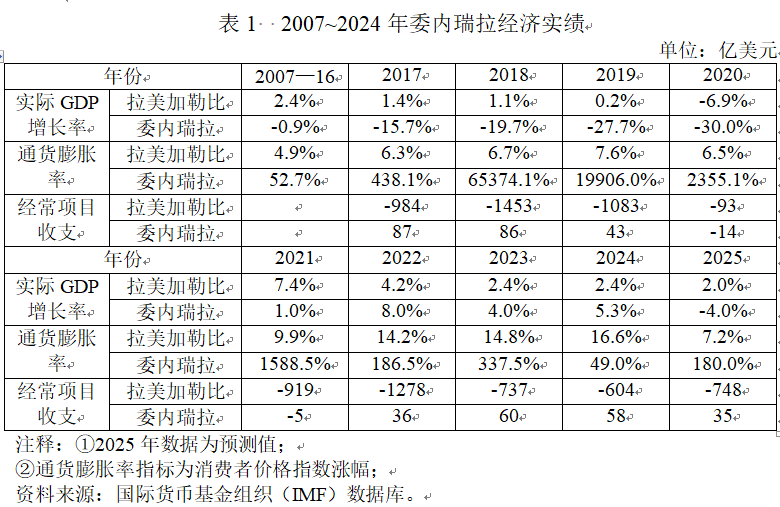
Core Viewpoint - The economic and social structural flaws in Venezuela, along with policy mistakes, severely limit the potential scale of bilateral trade between China and Venezuela, leading to significant fluctuations in trade volume [1]. Group 1: Economic and Trade Relations - Venezuela possesses vast land and rich resources, including the world's largest oil reserves, while China is a comprehensive manufacturing powerhouse and a major importer of primary products, making them highly complementary in terms of resource endowment and industrial structure [2]. - The political relationship established during the Chávez-Maduro era has created a favorable environment for bilateral trade, with Venezuela recognizing China's market economy status in 2004 and joining the Belt and Road Initiative in 2018 [3]. - Despite the political goodwill, Venezuela suffers from the "resource curse," where fluctuations in international primary product prices, especially oil prices, dictate the economic health and trade volume with China [4]. Group 2: Economic Indicators - Venezuela's nominal GDP peaked at $372.6 billion in 2012 but fell to $42.8 billion and $56.6 billion in 2020-2021, lower than its GDP in 1980, with a projected recovery to $119.8 billion in 2024 [6]. - The per capita GDP has drastically declined from a peak of $12,688 in 2012 to an estimated $4,510 in 2024, reflecting a significant economic downturn [6]. - Inflation has been rampant, with consumer price index (CPI) increases exceeding 65,000% in 2020-2021, indicating severe economic instability [7]. Group 3: Trade Volume Fluctuations - The trade volume between China and Venezuela has experienced significant ups and downs, with imports from Venezuela to China peaking at $14.5 billion in 2012 but dropping to $5.3 billion in 2020 [10][11]. - In 2024, imports from Venezuela to China rebounded to $1.6 billion, but this still represents only 0.09% of China's total imports [11]. - Chinese exports to Venezuela reached a peak of $9.3 billion in 2012, but have fluctuated between $2-3 billion in recent years, with a recovery to $4.8 billion projected for 2024 [12]. Group 4: Investment and Engineering Cooperation - Claims of $60 billion Chinese investment in Venezuela are exaggerated; actual direct investment peaked at $3.5 billion in 2018 but has since declined significantly [13]. - Engineering contracts have also seen volatility, with a peak of $5.97 billion in 2013, but dropping to just over $1 billion in recent years [14].
化工行业周报20260118:国际油价小幅上涨,丁二烯、环氧丙烷价格上涨-20260118
Bank of China Securities· 2026-01-18 12:22
Investment Rating - The report rates the chemical industry as "Outperform" [2] Core Views - The report highlights the recent slight increase in international oil prices and the rise in prices of butadiene and propylene oxide, suggesting a focus on undervalued leading companies in the industry and the impact of "anti-involution" on supply in related sub-industries [2][9] - It emphasizes the strong downstream demand and the increasing importance of self-sufficiency in electronic materials and certain new energy materials companies amid a backdrop of price increases [2][9] - The report recommends a mid-to-long-term investment strategy focusing on policy support for demand recovery, continuous supply-side optimization, and the growth potential of emerging sectors such as semiconductor materials, OLED materials, and new energy materials [2][9] Industry Dynamics - As of January 18, the TTM price-to-earnings ratio for the SW basic chemical sector is 14.68, at the 59.64 percentile historically, while the price-to-book ratio is 1.54, at the 40.20 percentile historically [2][13] - The SW oil and petrochemical sector has a TTM price-to-earnings ratio of 13.44, at the 39.81 percentile historically, and a price-to-book ratio of 1.30, at the 41.38 percentile historically [2][13] - The report notes that since 2025, the industry has been significantly affected by tariff-related policies and fluctuations in oil prices [2][13] Price Trends - In the week of January 12-18, 49 out of 100 tracked chemical products saw price increases, while 20 experienced declines, and 31 remained stable [9][32] - The average price of butadiene increased to 9,663 CNY/ton, up 4.04% week-on-week and 25.98% month-on-month [34] - The average price of propylene oxide rose to 8,620 CNY/ton, up 8.84% week-on-week and 9.88% year-on-year [35] Recommendations - The report recommends investing in leading companies such as Wanhua Chemical, Hualu Hengsheng, and Yake Technology, among others, while suggesting to pay attention to companies like Yangnong Chemical and Tongcheng New Materials [2][13]