三星

Search documents
美光科技:别被 “英伟达时刻”冲昏头脑
美股研究社· 2026-01-22 11:11
Core Viewpoint - Micron Technology (MU) has become a highly sought-after stock in the AI sector, with its recent earnings report being described as a "NVIDIA-style highlight," attracting significant investor interest. However, analysts caution that the impressive performance may not be sustainable, leading to a downgrade of the stock rating to "Sell" [2][30]. Financial Performance - Micron reported a remarkable revenue increase of 57% year-over-year, reaching $13.64 billion, marking the second consecutive quarter of accelerating revenue growth [2][6]. - The company's non-GAAP operating margin surged to 47%, while the GAAP operating margin reached 45%, the highest since 2018 [8][9]. - Free cash flow for the quarter was $3 billion, with $300 million allocated for stock buybacks [10]. Future Outlook - Management provided an aggressive revenue guidance for the year, projecting a maximum revenue of $22.7 billion, representing a year-over-year increase of 180% [10]. - The company plans to invest approximately $20 billion in capital expenditures throughout the year [11]. - Management expects business performance to continue strengthening throughout the year, with demand outpacing supply significantly [12][13]. Market Dynamics - Analysts express concerns that investors may be overestimating the actual returns from the company's performance growth, given the cyclical nature of the semiconductor industry [16]. - Micron's current price-to-earnings ratio is approximately 12, with a forward P/E ratio around 9.4, suggesting a conservative valuation compared to its explosive growth [17][18]. - Despite the impressive growth, analysts highlight that Micron's valuation is significantly above historical levels, particularly from a price-to-sales perspective [20]. Industry Competition - The semiconductor market, particularly high-bandwidth memory (HBM), remains highly competitive, with Micron, SK Hynix, and Samsung as the main players [22]. - Analysts argue that the current profit margins and demand growth are likely short-term phenomena, not driven by structural changes in the market [25]. - There is a concern that as competitors expand capacity to meet demand, product prices may normalize, leading to potential declines in Micron's profitability [27][28]. Conclusion - Given the cyclical nature of the industry and the current market dynamics, analysts have downgraded Micron Technology's rating to "Sell," indicating that the stock may be overvalued based on future earnings expectations [30].



1.22犀牛财经晚报:算力市场供需失衡 “假内存”乱象滋生
Xi Niu Cai Jing· 2026-01-22 10:28
Group 1: Consumer Lending and Interest Rates - Personal consumption loan rates are currently in the range of 3%-6%, with some banks offering rates around 3% after a 1% subsidy, potentially lowering effective rates to around 2% [1] - This effective rate of 2% is lower than the current rates for newly issued housing loans [1] Group 2: Copper Market - A notice has been issued prohibiting the production and sale of copper bars in the Shui Bei market, indicating a regulatory response to market practices [1] - No copper bars were found for sale during a recent market visit, suggesting compliance with the ban [1] Group 3: Sulfur Prices - The price of solid sulfur at Zhenjiang Port has surged to 4358 yuan/ton, an increase of nearly 180% from under 1600 yuan/ton at the end of 2024 [1] - China's reliance on imported sulfur remains around 50%, with increased demand driven by new industries like Indonesian nickel wet-process smelting [1] Group 4: Semiconductor and Memory Market - The domestic computing power market is experiencing severe supply-demand imbalance, with high-end GPU chips becoming scarce and mid-range GPU prices rising significantly due to raw material costs [2] - DDR5 memory prices have seen increases exceeding 300% for some large-capacity models, while there are reports of counterfeit memory products emerging in the market [2] Group 5: Industrial Display Panel Market - Global industrial display panel manufacturers are projected to achieve revenues of $3.4 billion in 2025, reflecting a 24% year-on-year growth [3] - Despite a slight decline in shipment volume due to regulatory changes in Europe, revenue growth remains a key performance indicator for this niche market [3] Group 6: Battery and Solar Market - Prices for Topcon183N solar cells are currently between 0.4-0.42 yuan/W, with market activity indicating a potential price increase to 0.45 yuan/W [4] - The reduction in upstream inventory of solar cells is attributed to increased overseas demand, which is also boosting domestic sales [4] Group 7: Energy Storage Market - The China Energy Storage Alliance (CNESA) forecasts that by 2030, cumulative installed capacity for new energy storage could reach over 370 million kilowatts under conservative scenarios [4] - The expected annual growth rates from 2026 to 2030 are projected at 20.7% in conservative scenarios and 25.5% in ideal scenarios [4] Group 8: Corporate Developments - Alibaba's chip subsidiary, Pingtouge, is reportedly planning to go public, marking a significant move for the company since its establishment in 2018 [5] - Various companies, including Huachang Electronics and Hualing Steel, are announcing significant investments in new projects, indicating ongoing growth and expansion in their respective sectors [9][10]
AI不抢工作反而抢人?黄仁勋首次亮相达沃斯:它掀起了人类最大规模基建潮
AI前线· 2026-01-22 10:23
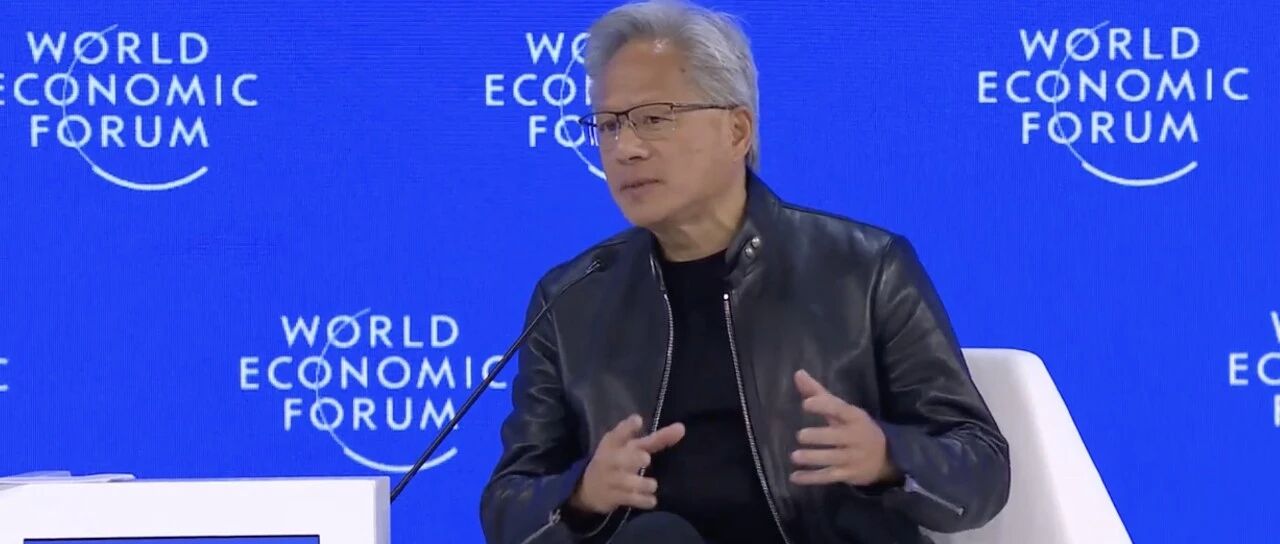
Core Insights - The core perspective presented by Jensen Huang, CEO of NVIDIA, emphasizes that the application layer is crucial for AI to become a productive force and contribute to economic growth, highlighting that the rapid advancements in AI models have led to an explosion in applications [3][14]. Group 1: AI Industry Structure - The AI industry can be categorized into five layers: energy, chip and computing infrastructure, cloud infrastructure and services, AI model layer, and the application layer, with the application layer being the most significant for generating economic returns [12][18]. - The current investment in AI infrastructure is only in the hundreds of billions, while the actual requirement is in the trillions, indicating a massive infrastructure build-out is underway [16][15]. Group 2: AI Model Developments - In 2025, three significant developments occurred in the AI model layer: the emergence of Agentic AI, breakthroughs in open-source models, and substantial progress in physical AI, which allows AI to understand and interact with the physical world [22][24][26]. - The rise of open-source models has democratized access to AI technology, enabling various sectors to develop specialized models tailored to their needs [24]. Group 3: Job Market Implications - Contrary to fears of AI leading to job losses, Huang argues that AI will create a labor shortage, necessitating skilled workers in various trades, with many positions offering salaries nearing or exceeding six figures [5][29]. - Historical examples, such as the impact of AI in radiology, demonstrate that AI can enhance job roles rather than eliminate them, leading to increased hiring in healthcare sectors [30][32]. Group 4: Global Economic Impact - AI is viewed as a transformative infrastructure that can help bridge gaps in developing economies, with the potential for widespread adoption due to the availability of open-source models [36][40]. - The rapid adoption of AI is lowering technical barriers, allowing individuals without formal programming backgrounds to engage in digital economies [39][40]. Group 5: European Opportunities - Europe has a unique opportunity to integrate AI into its strong industrial base, particularly in manufacturing and robotics, which could lead to significant advancements in the physical AI sector [44]. - The success of AI in Europe hinges on increased energy supply, infrastructure investment, and early engagement in AI ecosystem development [45].

存储太火!铠侠今年产能已全部售罄
Hua Er Jie Jian Wen· 2026-01-22 10:21
人工智能热潮带来的强劲需求正在重塑全球存储市场格局,廉价固态硬盘(SSD)时代宣告终结。据媒 体1月22日报道,日本存储芯片巨头铠侠证实,受"极度渴望"的AI需求驱动,公司今年的产能已全部售 罄,且供应紧张局面预计将持续至2027年。 Shunsuke Nakato认为,这种价格上涨趋势将贯穿2026年,并可能延续至2027年。这意味着对于计划进 行系统构建或存储升级的用户而言,低成本窗口期已经关闭。 基于信任的配给策略 作为NAND制造商,铠侠并未选择简单的"价高者得"策略来应对此次短缺。Shunsuke Nakato透露,公司 采取了一种基于信任和长期合作关系的"君子协定"模式来分配产能。 据Tom's Hardware援引韩国媒体Digital Daily报道,铠侠存储业务部门董事总经理Shunsuke Nakato在首尔 举行的会议上明确表示,1TB SSD售价在7000日元(约45美元)左右的日子已经一去不复返。自2023年 底至2024年初以来,市场上已难觅低于50美元的1TB SSD产品,这一结构性转变标志着低价存储周期的 结束。 供应端的短缺已迅速传导至终端价格,导致消费级和企业级存储产品价格 ...
黄仁勋最新对话:几千亿只是开胃菜,AI基建还得再砸几万亿
创业邦· 2026-01-22 10:19
Core Viewpoint - The discussion emphasizes that the current investment in AI is not a bubble but rather the beginning of a massive infrastructure build-up, likening it to historical infrastructure projects like railroads and power grids [5][10][34]. Group 1: AI Infrastructure Investment - Nvidia's CEO Jensen Huang stated that the investment in AI infrastructure has only just begun, with estimates suggesting that global spending could reach $3 trillion to $4 trillion by 2030 [13][30]. - The AI infrastructure is conceptualized as a "five-layer cake," with energy at the base, followed by chips, cloud services, AI models, and finally, applications across various industries [13][41]. - Major tech companies have committed to investing over $500 billion in data centers, indicating a significant shift in R&D budgets towards AI [15][31]. Group 2: Job Creation and Economic Impact - Contrary to fears that AI will lead to job losses, Huang argues that AI is creating high-paying blue-collar jobs, with salaries for electricians and plumbers in the U.S. exceeding $100,000 [7][19]. - The healthcare sector has seen an increase in the number of radiologists, as AI takes over repetitive tasks, allowing doctors to focus on patient care [8][21]. - Huang emphasizes the importance of understanding the distinction between the "purpose" and "task" of jobs, suggesting that AI will automate tasks while enhancing the overall purpose of jobs [24][49]. Group 3: AI Sovereignty and Global Development - Huang advocates for every country to develop its own AI capabilities, viewing AI as a fundamental infrastructure akin to electricity and roads [25][28]. - He believes that developing countries can leverage AI to bridge technological gaps, using local languages and cultural data to create tailored AI solutions [28][52]. - For Europe, Huang suggests that the region should capitalize on its strong industrial base and scientific expertise to embrace "physical AI" and robotics [28][54]. Group 4: Current Market Dynamics - Nvidia's GPUs are in high demand, with rental prices increasing, indicating a robust market for AI infrastructure [30][55]. - The shift in R&D budgets towards AI is exemplified by companies like Eli Lilly, which are reallocating funds from traditional labs to AI supercomputing [31][55]. - The current investment climate is characterized by record levels of venture capital flowing into AI-native companies, with over $100 billion expected in 2025 [15][56].

苹果官宣限时促销,官网最高降价1000元
Xin Lang Cai Jing· 2026-01-22 09:57
Group 1 - Apple has launched a limited-time Spring Festival promotion on its Chinese website, allowing users to save up to 1,000 yuan on selected products from January 24 to January 27, 2026 [1] - The iPhone 16 series models enjoy various discounts, with the iPhone 16 and iPhone 16 Plus saving 300 yuan, and the iPhone 16e saving 200 yuan. The MacBook Pro has a maximum discount of 1,000 yuan, while the MacBook Air discounts range from 700 to 800 yuan. The iPhone 17 series is not included in the promotion [3] - Apple has consistently launched limited-time promotions around the Lunar New Year in recent years, becoming a regular marketing strategy [3] Group 2 - According to Omdia, the smartphone shipment in mainland China for 2025 is approximately 282.3 million units, a slight decrease of 1% year-on-year. Huawei leads the market with 46.8 million units shipped, holding a 17% market share, followed by Vivo with 46 million units. Apple ranks third with 45.9 million units shipped [3] - In Q4 2025, driven by year-end promotions and continued "national subsidies," the Chinese market's year-on-year decline narrowed to 1%, with quarterly shipments reaching 76.4 million units. Apple shipped 16.5 million units in this quarter, increasing its market share to 22%, ranking first in the domestic market [4] - Globally, smartphone shipments grew by 4% year-on-year in Q4 2025, with Apple achieving a record high in shipments due to strong demand for the iPhone 17 series, leading with a 25% global market share and maintaining its position as the top smartphone manufacturer for three consecutive years, slightly ahead of Samsung [4] Group 3 - Several Wall Street firms have expressed optimism about Apple's prospects for 2026. Morgan Stanley raised its target price for Apple to $315 in December 2025, citing benefits from an extended replacement cycle, feature upgrades, and optimized carrier subsidies for the iPhone 17 series. Goldman Sachs also raised its target price to $320 in November 2025, providing a positive outlook for Apple's future performance [4]


爱施德:与苹果、荣耀、三星等主流手机品牌保持深度合作,APR渠道规模居全国第一
2 1 Shi Ji Jing Ji Bao Dao· 2026-01-22 09:54
Core Viewpoint - The company, Aishide, is a leading distributor for major smartphone brands such as Apple, Honor, and Samsung, highlighting its significant market presence in the mobile device sector [1] Group 1: Company Overview - Aishide serves over 2,000 Apple authorized stores/outlets, more than 7,000 Honor customers, and over 4,300 Samsung stores in the first half of 2025 [1] - The company's Coodoo brand operates 236 self-owned Apple Premium Reseller (APR) stores in key commercial areas across the country, maintaining the largest physical channel scale in the nation [1]

爱施德(002416) - 2026年1月8日—22日 投资者关系活动记录表
2026-01-22 09:42
Group 1: Company Overview - Aishide Co., Ltd. was established in June 1998 and listed on the Shenzhen Stock Exchange in May 2010 [2] - The company is a leading digital smart distribution and retail service provider, focusing on mobile smart terminals, digital products, communication and value-added services, and fast-moving consumer goods [2][3] Group 2: Business Partnerships - Aishide is a national一级 distributor for major smartphone brands including Apple, Honor, and Samsung, serving over 2,000 Apple authorized stores, 7,000 Honor clients, and more than 4,300 Samsung stores [3] - The company operates 236 self-owned Apple Premium Reseller (APR) stores, maintaining the largest APR channel scale in the country [3] Group 3: Financial Performance and Investments - The company has a 5 billion RMB fund focusing on investments in smart terminals, artificial intelligence, and low-altitude economy, with current projects including Yunshen Technology and Saigan Technology [4] - Aishide has consistently paid dividends for several years, with plans to distribute 4 RMB and 5 RMB per 10 shares for the years 2023 and 2024 respectively [5] Group 4: International Expansion - Aishide's overseas business channels are expanding, targeting markets in Australia, Southeast Asia, the Middle East, and Africa, with a 30% year-on-year increase in overseas sales revenue in the first half of 2025 [5] - The company collaborates closely with Honor in various international markets, supporting its global expansion [4]
华为折叠屏国内份额超70%,坐等苹果入局
Guan Cha Zhe Wang· 2026-01-22 09:16
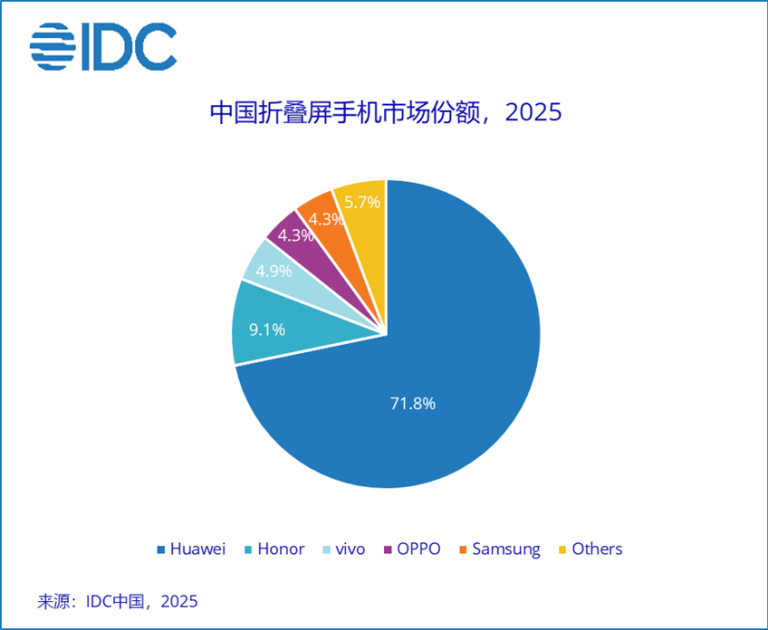
Core Insights - The Chinese foldable smartphone market is projected to see a shipment of approximately 10.01 million units in 2025, reflecting a year-on-year growth of 9.2%, contrasting with a slight decline of 0.6% in the overall smartphone market [1] - Huawei leads the market with a significant share of 71.8%, while other brands like Honor, Vivo, and OPPO have much smaller shares, indicating Huawei's dominant position [1][3] - Despite the emergence of competitive products from other manufacturers, Huawei's comprehensive product lineup and brand strength have solidified its market leadership [4][6] Market Dynamics - The foldable smartphone segment has reached a bottleneck since 2019, with manufacturers struggling to drive sales through hardware improvements alone, leading to a decline in the overall market in Q4 of the previous year [3][4] - Brand strength is increasingly influencing consumer preferences in the high-end market, with Huawei's focus on balanced capabilities and innovative designs contributing to its market share growth of over 20 percentage points in 2025 [4] - The foldable smartphone market still represents only 3.5% of total smartphone shipments in China, prompting some manufacturers to reconsider their strategies in this niche segment [4][6] Technological Innovations - Manufacturers are exploring soft-hard collaboration as a breakthrough direction, with Huawei's MateX7 focusing on AI integration rather than just hardware enhancements [6] - Other brands like OPPO and Vivo are also attempting to bridge compatibility with Apple ecosystems, indicating a trend towards cross-platform functionality [6] Future Outlook - The anticipated entry of Apple's foldable smartphone, expected to be released in the fall of 2026, is generating significant market interest, particularly regarding its potential to enhance hardware and software integration [7][8] - The overall smartphone market in China may face challenges in 2026 due to rising storage costs, which could lead to a noticeable decline in shipments [8]

华为折叠屏国内份额超70%,苹果今年能带来惊喜吗?
Guan Cha Zhe Wang· 2026-01-22 09:12
Core Insights - The Chinese foldable smartphone market is projected to see a shipment of approximately 10.01 million units in 2025, marking a year-on-year growth of 9.2%, contrasting with a slight decline of 0.6% in the overall smartphone market [1] - Huawei leads the market with a significant share of 71.8%, while other brands like Honor, Vivo, and OPPO have much smaller shares, with Xiaomi dropping out of the top five [1][3] - The foldable smartphone segment is experiencing a bottleneck phase, with hardware improvements no longer sufficient to drive significant sales growth, leading to a decline in market performance [3][4] Market Dynamics - Huawei's dominance is attributed to its comprehensive product lineup, including various foldable designs and a focus on balanced capabilities rather than just lightweight models [4] - Other manufacturers have introduced innovative products, such as OPPO's Find N5 and Vivo's lightweight foldable, but these have not significantly challenged Huawei's market position [3][4] - The foldable smartphone market only accounts for 3.5% of total smartphone shipments in China, leading some companies like Xiaomi to reconsider their strategies in this niche [4][6] Technological Innovations - Manufacturers are focusing on soft-hard collaboration to enhance user experience, with Huawei's MateX7 introducing AI capabilities to improve functionality [6] - Competitors like OPPO and Vivo are also exploring compatibility with Apple ecosystems to attract users [6] - The anticipated entry of Apple's foldable phone, expected in 2026, is generating significant market interest, with expectations for superior hardware and software integration [7][9] Future Outlook - The smartphone market is expected to face cost pressures due to rising storage prices, potentially leading to a noticeable decline in shipments in 2026 [9] - The success of Apple's foldable device and its impact on the market remains a key point of interest for industry stakeholders [9]