
收益率曲线控制(YCC)

Search documents
“做多底特律”!美银Hartnett:以史为鉴,接棒黄金的最佳策略
Hua Er Jie Jian Wen· 2026-01-26 08:51
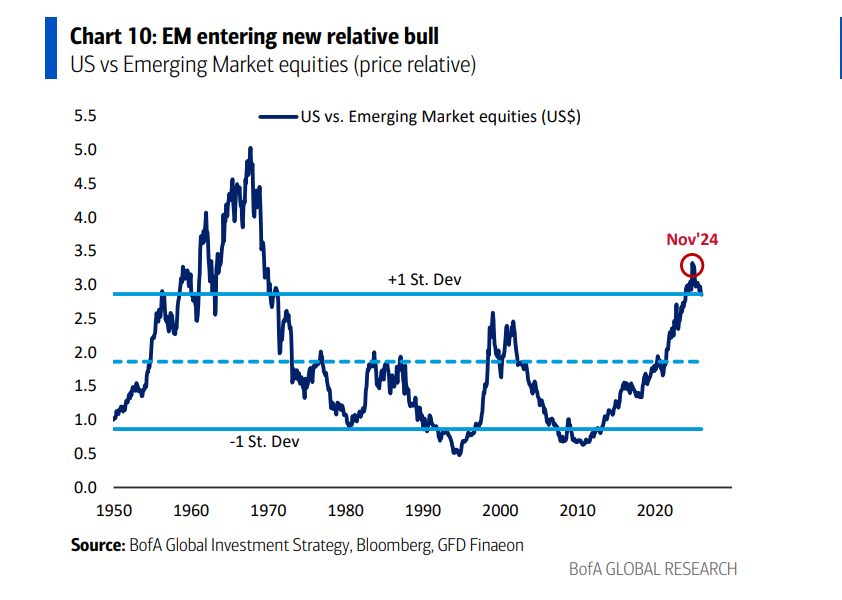
Core Viewpoint - Bank of America signals a tactical sell signal despite the "bull-bear indicator" being in an extremely bullish zone (9.2), suggesting investors should rotate rather than retreat, focusing on small-cap stocks and real economy sectors over large-cap and tech stocks [1][14]. Group 1: Market Trends - The current market sentiment indicates that while the selection of the new Federal Reserve Chair typically leads to yield fluctuations, it is believed that the new chair in 2026 will not allow the 30-year Treasury yield to exceed the 5% "safe haven" level due to interventions like quantitative easing (QE) and yield curve control (YCC) [2]. - The bond market is experiencing a severe bear market, with the price of 30-year U.S. Treasuries dropping by 50% and Japanese government bonds (JGB) falling by 45% since the beginning of the 2020s [3]. Group 2: Fund Flows - Despite rising yields, the bond market recorded an inflow of $15.4 billion, while gold saw inflows of $4.9 billion. Conversely, U.S. equities experienced an outflow of $16.8 billion, marking the first outflow in two weeks [4]. - The bear market in bonds has led to a bull market for U.S. tech stocks, European/Japanese bank stocks, and gold in the first half of the decade, while emerging markets (EM) and small-cap stocks are expected to benefit in the latter half [4]. Group 3: Investment Strategy - The core strategy of "buying Detroit and shorting Davos" emphasizes a bullish outlook on U.S. small-cap stocks until 2027, supported by four pillars: global macro trends, extreme capital outflows from Japan, undervaluation of small-cap stocks, and government interventions to control costs [10][11]. - Historical comparisons suggest that the current situation resembles the 1970s, where initially gold thrived, followed by small-cap stocks becoming the best-performing assets [7]. Group 4: Emerging Markets and Capital Flows - Capital is flowing from weak Asian currencies to U.S. and European assets, with South Korean retail investors having invested nearly $100 billion in U.S. stocks since 2019 [16]. - The long-term bull market for international stocks is entering its second year, driven by strong commodity prices and a strengthening of emerging market currencies, which is expected to lower emerging market bond yields and propel emerging market stocks into a new relative bull market [16].

日美联合干预汇市要来了?
Hua Er Jie Jian Wen· 2026-01-24 00:05
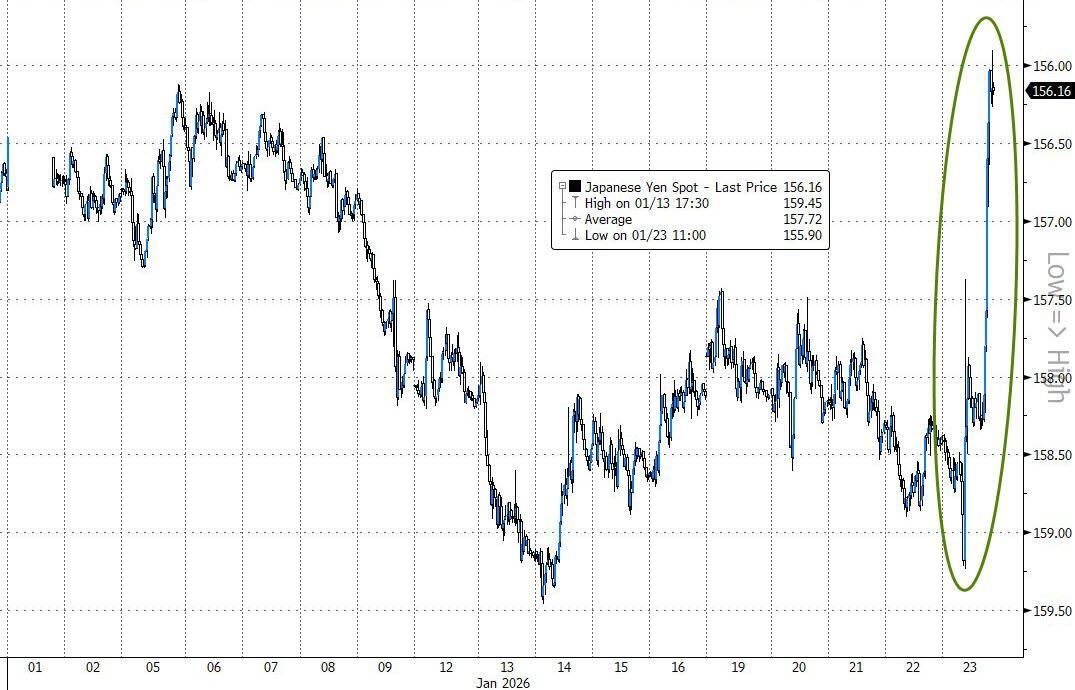
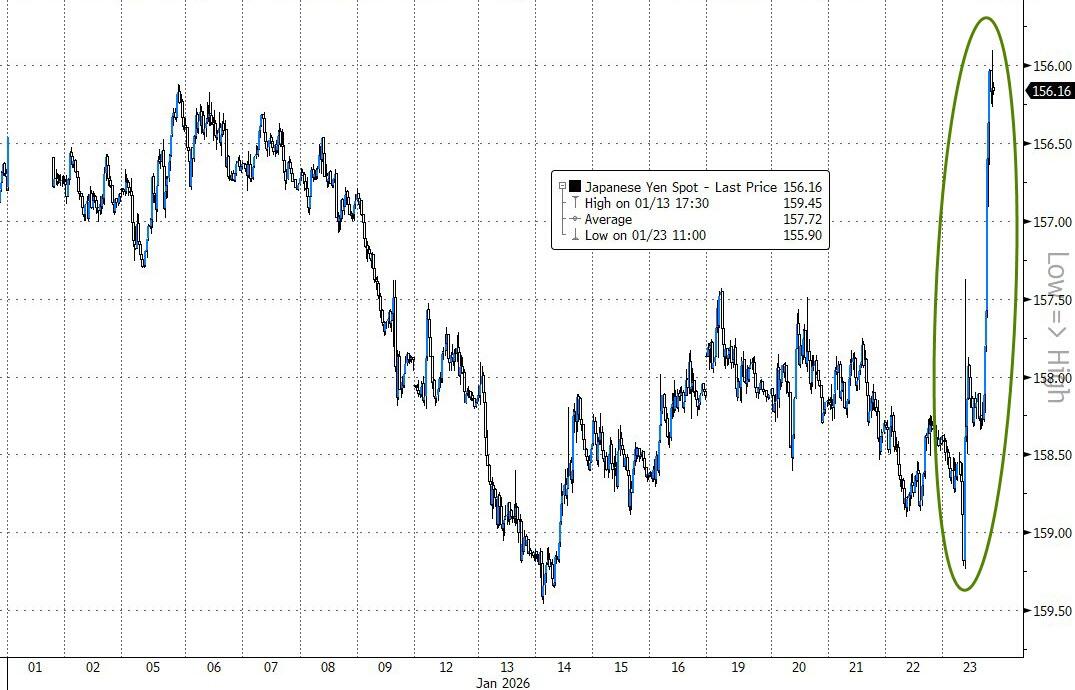
Group 1 - The Japanese yen experienced significant fluctuations, with a notable rebound after three consecutive declines, leading to a maximum intraday drop of approximately 1.75% against the US dollar, marking the largest increase since August of the previous year [4] - Speculation arose regarding potential intervention by the Japanese government in the currency market, possibly in coordination with the US government, due to the sudden rise in the yen [4][6] - The Japanese government has not confirmed any intervention, but officials expressed heightened vigilance regarding currency market dynamics, contributing to market uncertainty [5][6] Group 2 - The New York Federal Reserve's inquiries about the yen's exchange rate sparked discussions about possible intervention, with traders interpreting this as a sign of potential support for the yen [6][10] - Analysts noted that the yen's recent movements were closely monitored due to its proximity to critical intervention levels, with the 160 yen per dollar mark being a significant threshold for past interventions [8][9] - The Japanese government had previously intervened in the currency market when the yen fell below the 160 mark, spending nearly $100 billion to support the currency [9] Group 3 - The Bank of Japan indicated a willingness to maintain low borrowing costs while expressing confidence in a moderate economic recovery, which could influence future monetary policy decisions [12][13] - There are concerns that a stronger yen could lead to sell-offs in US equities, as historical correlations suggest that fluctuations in the yen may impact market volatility [13]
去年8月以来最大涨幅!日元一天两波拉涨,日美联合干预汇市要来了?
Hua Er Jie Jian Wen· 2026-01-23 23:32
Core Viewpoint - The recent fluctuations in the Japanese yen have sparked widespread speculation about potential intervention by the Japanese government, possibly in coordination with the U.S. government [1][7]. Group 1: Yen Movements - The yen experienced a significant rebound after three consecutive declines, with the dollar-yen pair showing a maximum intraday drop of approximately 1.75%, marking the largest increase for the yen since August of the previous year [5]. - The first wave of yen appreciation occurred during the European market's early session, where the dollar-yen rate fell to 155.63, the lowest since December 24 of the previous year [2][5]. - The yen's recent surge coincides with political instability in Japan, as the House of Representatives was dissolved for the first time on the opening day of a parliamentary session in 60 years, with elections scheduled for February 8 [6]. Group 2: Speculation on Intervention - Market speculation about potential intervention was fueled by reports that the New York Federal Reserve contacted financial institutions regarding the yen's exchange rate, which traders interpreted as a sign of possible U.S. support for Japanese intervention [7]. - The notion of a "red line" for intervention is associated with the yen approaching the 160 mark against the dollar, a level at which Japan has previously intervened, spending nearly $100 billion to support the yen [8][9]. - Analysts noted that the recent inquiries by the New York Fed could indicate that any potential intervention would not be unilateral, suggesting a coordinated approach [8][9]. Group 3: Economic Context - The Japanese government has been under pressure due to fiscal uncertainties and rising yields, with the yen depreciating over 4% since October, raising concerns about the currency's stability [9]. - The Bank of Japan has indicated a willingness to maintain low borrowing costs while also signaling potential future rate hikes, which could impact the yen's value [11]. - There is a noted correlation between the yen's strength and volatility in U.S. equity markets, suggesting that a stronger yen could trigger broader market sell-offs [12].
日本央行“鹰派按兵不动”,不想要债市崩,那就只能牺牲日元了?
Sou Hu Cai Jing· 2026-01-23 16:47
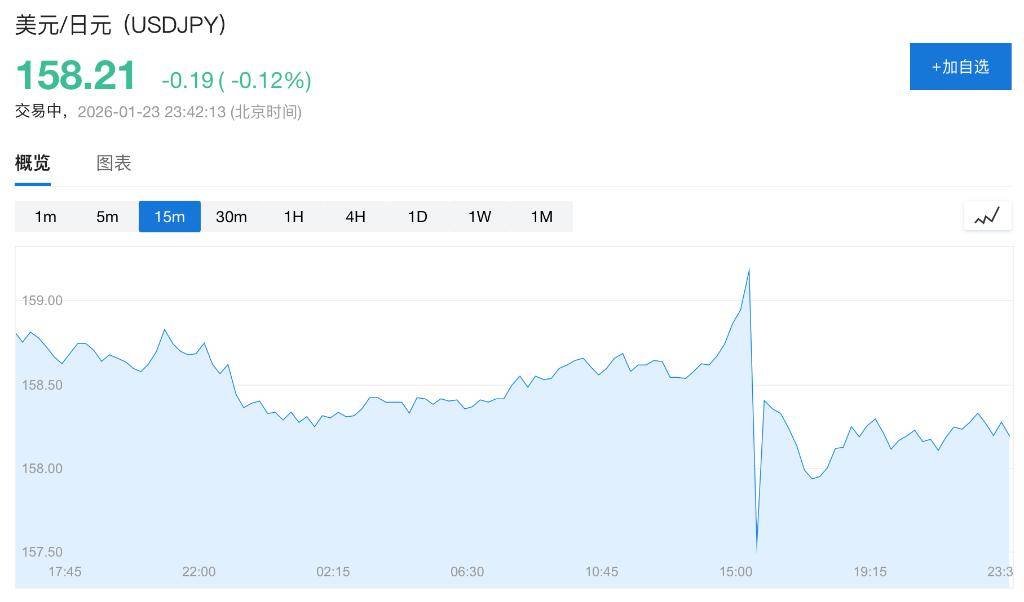
Core Viewpoint - The Bank of Japan is caught in a policy dilemma, needing to stabilize the bond market, curb excessive yen depreciation, and support economic growth simultaneously, leading to the yen acting as a "pressure valve" for policy contradictions [1][8]. Group 1: Policy Signals and Market Reactions - Goldman Sachs' Rich Privorotsky notes that the Bank of Japan's decision can be seen as a "hawkish hold," with an upward revision of growth expectations and a commitment to maintain bond market stability, yet this has not supported the yen and has intensified its depreciation pressure [1][4]. - On January 23, the Bank of Japan maintained its policy interest rate but signaled potential future rate hikes, which did not prevent the yen from weakening, with the USD/JPY nearing the psychological level of 160 [1][4]. - Following the Bank of Japan's announcement, the yen continued to weaken, prompting speculation about possible official intervention, as indicated by the sudden rebound in the exchange rate [1][5]. Group 2: Market Dynamics and Intervention Expectations - The 160 level for USD/JPY has become a warning line, as Japan intervened in the currency market four times in 2024 when the exchange rate approached this level, making investors alert to potential interventions [5][6]. - Market sentiment has shifted, with traders noting that if the exchange rate approaches 160 again, it could significantly impact market expectations [6]. - The liquidity in the foreign exchange market has narrowed, meaning that relatively small capital flows could lead to significant changes in exchange rates [6]. Group 3: Structural Challenges and Future Outlook - The Bank of Japan faces a deep structural dilemma, as avoiding a clear strategic choice between "supporting the bond market" and "stabilizing the exchange rate" may lead to a loss of policy credibility and a vicious cycle of market volatility [7][8]. - Goldman Sachs analysts suggest that if the market perceives a return of yield curve control (YCC), the yen may face further depreciation, highlighting the difficulty of achieving strong growth, high inflation, stable rates, and stable exchange rates simultaneously [8].
怎么救日债?日本财长“嘴炮”无用,只有央行“印钞”
Hua Er Jie Jian Wen· 2026-01-21 02:05
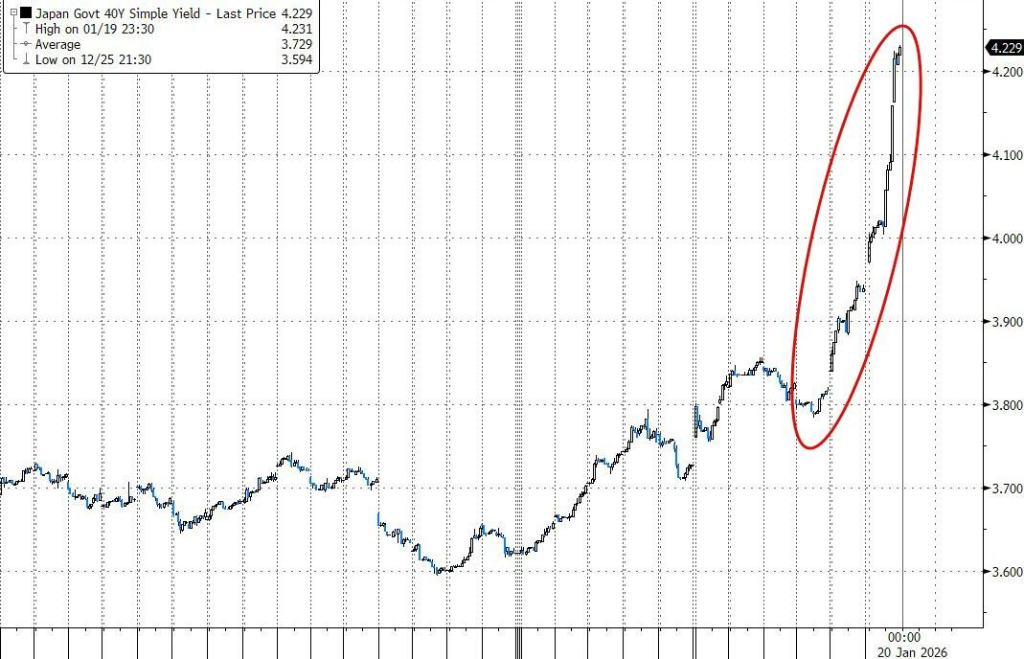
Core Viewpoint - The Japanese government bond market is experiencing a significant crisis, characterized by a historic surge in long-term bond yields, leading to a loss of confidence in Japan's fiscal discipline and prompting concerns about potential intervention by the Bank of Japan [1][3][5]. Group 1: Market Dynamics - The market is witnessing a "collapse" with traders describing a scenario where "everyone is selling at all maturities simultaneously," resulting in a daily increase of over 25 basis points in 30-year and 40-year yields, with the latter briefly surpassing 4% [3][5]. - Analysts indicate that the current turmoil is not merely a reaction to external shocks but rather a manifestation of a long-standing structural issue of "lack of natural demand" in the Japanese bond market [3][10]. - The recent volatility has been exacerbated by political uncertainties, particularly Prime Minister Kishi's campaign promise to lower the food consumption tax without a clear funding source [3][5]. Group 2: Policy Implications - Japan faces a dilemma: either significantly cut spending, which is politically unpalatable, or have the central bank intervene, likely through unlimited bond purchases, which could have adverse effects on the yen [5][7]. - The potential for the Bank of Japan to return to yield curve control (YCC) is seen as a "logical endgame," but it poses risks to the currency, especially if aggressive interventions lead to a depreciation of the yen beyond the critical 160 level [5][7]. Group 3: Investor Sentiment - The market's reaction to the finance minister's calls for calm has been limited, as investors are increasingly unwilling to buy long-term Japanese bonds unconditionally, reflecting a broader loss of confidence in fiscal policy [10][11]. - Concerns are growing that Japan may face a situation similar to the "Truss moment" in the UK, where fiscal expansion could lead to a crisis of credibility in policy [10][11]. - The lack of natural demand for ultra-long Japanese bonds raises fears that without official intervention, selling pressure may not subside on its own, necessitating some form of policy "circuit breaker" [13].
鲍威尔遭刑事调查 美联储独立性风暴升级 美国市场再现“股汇债三杀”
2 1 Shi Ji Jing Ji Bao Dao· 2026-01-12 23:47
Core Viewpoint - The independence of the Federal Reserve is under severe scrutiny as Chairman Jerome Powell faces a criminal investigation related to a renovation project, raising concerns about the influence of political pressure on monetary policy [1][2][3] Group 1: Investigation and Political Pressure - The U.S. federal prosecutors have initiated a criminal investigation into Jerome Powell, focusing on potential false statements made to Congress regarding the scale of a renovation project [1][2] - Powell has publicly stated that the investigation undermines the Federal Reserve's independence in setting interest rates, suggesting that monetary policy could be swayed by political pressures [1][3] - The investigation was approved in November of the previous year, indicating a long-standing concern regarding Powell's actions [1] Group 2: Trump's Influence and Intentions - President Trump has been critical of Powell for not accommodating his requests for significant interest rate cuts, despite having nominated him as Chairman in 2017 [2][3] - Analysts suggest that the investigation serves as a strategic move by Trump to force Powell's resignation without direct legal confrontation, thereby altering the Federal Reserve's leadership and potentially its policies [2][3] - The timing of the investigation is crucial, as it coincides with significant upcoming debt refinancing needs for the U.S. government, which may require lower interest rates [2] Group 3: Market Reactions and Implications - Following the news of the investigation, gold and silver prices surged, with gold surpassing $4600 per ounce, while the U.S. markets experienced a "triple whammy" of declines in stocks, bonds, and the dollar [1][3] - The investigation has led to a reassessment of the risk premium associated with U.S. Treasury bonds, as the market begins to factor in potential "institutional default risk" due to the Federal Reserve's compromised independence [7][17] - Analysts predict that if the Federal Reserve's independence is undermined, it could lead to a fundamental restructuring of global asset pricing, with significant implications for the U.S. dollar and Treasury yields [7][17] Group 4: Future Outlook for the Federal Reserve - The potential for a new Federal Reserve chair appointed under Trump's influence raises concerns about the erosion of the central bank's independence, with implications for monetary policy and financial stability [6][16] - There is a risk that the Federal Reserve may become more aligned with fiscal policy, potentially leading to a scenario where it acts as a "printing machine" for the White House [16] - The ongoing political uncertainty and the investigation's impact on the Federal Reserve's credibility could lead to a prolonged period of volatility in financial markets, particularly affecting high-valuation stocks and the bond market [7][19]
鲍威尔遭刑调美联储独立性风暴升级,美国市场再现“股汇债三杀”
2 1 Shi Ji Jing Ji Bao Dao· 2026-01-12 13:12
Core Viewpoint - The independence of the Federal Reserve is under severe scrutiny as a criminal investigation into Chairman Jerome Powell has been initiated, raising concerns about the influence of political pressure on monetary policy [1][2][3] Group 1: Investigation and Political Pressure - The U.S. federal prosecutors are investigating Powell regarding potential false statements made to Congress about a renovation project, which has been interpreted as a tactic to undermine the Fed's independence in setting interest rates [1][2] - Powell has publicly stated that the investigation is a pretext to challenge the Fed's ability to make decisions based on economic evidence rather than political pressure [1][5] - Trump's ongoing attacks on Powell, including threats of dismissal, highlight a broader strategy to exert control over the Fed, particularly as the 2026 debt rollover approaches [2][3] Group 2: Implications for Monetary Policy - Analysts suggest that the investigation aims to pressure Powell into lowering interest rates, thereby weakening his decision-making autonomy and damaging his reputation [3][6] - The potential replacement of Powell could lead to a shift in the Fed's structure, with Trump having already nominated several members aligned with his economic views [6][7] - The investigation sets a precedent for using legal means to challenge policy disagreements, which could threaten the independence of future Fed chairs [6][7] Group 3: Market Reactions - The uncertainty surrounding the Fed's independence has led to significant market volatility, with a notable increase in gold prices and a decline in U.S. equities and bonds [1][7] - Analysts predict that if the Fed's independence is compromised, it could lead to a fundamental restructuring of global asset pricing, with the U.S. dollar losing its status as a safe-haven asset [7][8] - Gold is increasingly viewed as a hedge against the weakening dollar and potential inflation, with forecasts suggesting prices could reach between $5000 and $5200 per ounce [8][9]
兴业证券全球首席策略分析师张忆东:2026年美联储降息幅度可能超当前市场预期
Sou Hu Cai Jing· 2025-12-17 12:22
Group 1 - The core viewpoint of the report is that the Federal Reserve's interest rate cuts in 2026 may exceed current market expectations, influenced by the federal government's debt pressure, which is a key variable affecting long-term interest rates [1] - The report anticipates the possibility of unconventional operations such as restarting asset purchases (QE) or similar yield curve control (YCC) [1] - The US dollar is expected to continue its weak trend in 2026, which will support a loose global liquidity environment [1] Group 2 - China's nominal GDP improvement in 2026 is projected to attract more foreign capital back to Chinese assets [3] - Under a low inflation and low interest rate environment, the cost-effectiveness of A-shares and Hong Kong stocks is significantly higher than that of the bond and real estate markets [3] - The report highlights that the approximately 160 trillion yuan of household deposits in China still has potential for increased allocation to the stock market [3] - Historically, the ratio of household deposits to total stock market value has fluctuated between 1-2, currently standing at a historically high level of 1.53 [3] - With the improvement in the stock market's profitability, household deposits are expected to accelerate their allocation to equity assets [3]


日本股债汇三杀,急推21万亿日元经济刺激计划
21世纪经济报道· 2025-11-21 13:43
Core Viewpoint - Japan is facing significant economic challenges due to a combination of expansive fiscal policies and a weak economy, leading to a sell-off in stocks, bonds, and the yen [1][3][10]. Group 1: Economic Stimulus and Market Reaction - The Japanese government is formulating an economic stimulus plan exceeding 20 trillion yen (approximately 1354 billion USD), which has caused market volatility [1][11]. - The Nikkei 225 index has dropped by 2.4%, closing at 48,625.88 points, while the yen has depreciated against the dollar, trading at 156.79 yen per dollar [3][11]. - The yield on Japan's 10-year government bonds fell by 1.98% to 1.780%, indicating market reactions to the government's fiscal measures [5][8]. Group 2: Monetary Policy and Currency Concerns - The Bank of Japan is hesitant about raising interest rates, which, combined with expansive fiscal policies, has led to concerns about the yen's depreciation and the stability of Japanese government bonds [10][12]. - Analysts express fears that the ongoing sell-off of Japanese assets may just be beginning, with potential implications for global liquidity and risk assets [3][10][15]. - The current fiscal and monetary policy mix is raising concerns about Japan's financial stability, with the debt burden reaching 250% of GDP and interest payments consuming about 23% of annual tax revenue [11][12]. Group 3: Economic Performance and External Factors - Japan's economy contracted by 0.4% in the third quarter, marking the first negative growth since early 2024, primarily due to weak domestic and external demand [16][17]. - The impact of U.S. tariffs on Japanese exports, particularly in the automotive sector, has exacerbated economic challenges, leading to a cautious consumer sentiment amid high inflation [17][18]. - Experts predict that the Bank of Japan may not raise interest rates until 2026, as current economic conditions do not necessitate immediate tightening [16][18].

大摩闭门会:邢自强、Laura Wang:2026经济与市场展望 _ 纪要
2025-11-18 01:15
Summary of Key Points from Conference Call Records Industry or Company Involved - The conference call primarily discusses the macroeconomic outlook for the United States and China, along with insights into the Asian technology sector and investment opportunities. Core Insights and Arguments U.S. Economic Outlook - The U.S. economy may experience a slight slowdown in the first half of 2026, but AI investments are expected to provide support, leading to gradual recovery in the second half of the year [1][3][5] - The Federal Reserve is likely to adopt a dovish stance, with interest rates expected to be lowered to 3%-3.25% before entering a wait-and-see phase [1][3] - The U.S. government is implementing a high-growth, high-inflation strategy to address rising debt, similar to post-World War II approaches [1][5] - The S&P 500 index is projected to reach 7,800 points by the end of 2026, with an annualized earnings growth of 15% [1][9] Chinese Economic Outlook - China is expected to transition from deflation to low inflation between 2026 and 2027, with fiscal policies likely to be strengthened in response to real estate challenges [1][4][6] - The introduction of a "Chinese version" of mortgage rates through fiscal subsidies is anticipated to stimulate consumption and maintain financial stability [1][8] - The nominal GDP growth for China is projected to remain just above 4% for the third consecutive year, with a real growth rate of 4.8% in 2026 [1][4] Asian Technology Sector - The outlook for Asian technology exports remains optimistic, with growth expected to extend beyond the tech sector into investment and consumption [2][23] - Countries such as India, Japan, Malaysia, Singapore, and South Korea are highlighted as having strong growth potential due to non-tech export recovery [2][26] Investment Recommendations - Investors are advised to favor U.S. equities, followed by Japanese and European stocks, while maintaining a lower allocation to emerging markets [1][9] - The Chinese stock market is expected to maintain a price-to-earnings ratio of around 13, with a projected earnings growth of 6% for the Minsheng China Index in 2026 [1][10][12] Other Important but Possibly Overlooked Content - The potential for a significant wealth effect from the stock market recovery is noted, but the overall impact on consumer spending is limited due to the high proportion of wealth tied to real estate [1][18] - The challenges facing local government finances are highlighted as a key factor affecting overall investment levels in China [1][20] - The anticipated recovery in the Asian economy is expected to be gradual, with GDP growth projected to rise from 4.3% in Q4 2025 to 4.7% in Q4 2026 [2][25] This summary encapsulates the key points discussed in the conference call, providing a comprehensive overview of the economic outlook and investment strategies for the U.S., China, and the broader Asian region.