
期货市场交易

Search documents
期货市场交易指引-20260318
Chang Jiang Qi Huo· 2026-03-18 03:24
Report Industry Investment Ratings - Macro-finance: Index futures are bullish in the medium to long term and recommend buying on dips; Treasury bonds are expected to move in a range [1] - Black building materials: Coking coal recommends short-term trading; rebar suggests range trading; glass advises selling out-of-the-money call options [1] - Non-ferrous metals: Copper recommends moderately shorting at high prices or staying on the sidelines; aluminum suggests strengthening observation; nickel advises staying on the sidelines; tin recommends range trading; gold and silver are expected to move in a range; lithium carbonate is expected to trade in a range [1] - Energy and chemicals: PVC, caustic soda, styrene, and polyolefins are expected to be moderately bullish; soda ash recommends shorting at high prices; rubber recommends buying on dips without chasing highs; urea and methanol recommend range trading [1] - Cotton textile industry chain: Cotton and cotton yarn are expected to be moderately bullish; apples and jujubes are expected to move in a range [1] - Agricultural and livestock: For live pigs, adopt a bearish approach on rebounds for contracts 05 and 07, and treat contract 09 with a range-bound view; eggs are expected to trade in a range; corn is expected to trade in a short-term range; for soybean meal, be cautious about chasing long positions in contract 05 due to capital disturbances; for oils and fats, recommend rolling long positions and gradually reducing previous long positions [1] Core Views - The global geopolitical situation, especially the ongoing conflict between the US and Iran, has a significant impact on the futures market, affecting factors such as inflation expectations, interest rate expectations, and supply and demand of various commodities [5][6][14][20][21] - Different commodities show different trends and investment opportunities due to their own supply and demand fundamentals, cost factors, and market sentiment [8][9][11][16][17] Summary by Directory Macro-finance - Index futures: In the medium to long term, they are bullish. Due to factors such as the significant downward revision of the US Q4 GDP growth rate, the decline in consumer confidence, and geopolitical events, the index futures may move in a range in the short term, and it is recommended to buy on dips [1][5] - Treasury bonds: They are expected to move in a range. Influenced by factors such as China's new social financing and credit data, Sino-US economic and trade consultations, and geopolitical situations, the bond market sentiment is cautious, and the overall bond market shows a differentiated trend [1][6] Black building materials - Coking coal: It is expected to move in a range, and short-term trading is recommended. After the Spring Festival, the coking coal market is generally weak and stable. The resumption of production in coal mines and the slow recovery of terminal steel demand have led to a weak trading atmosphere [1][8] - Rebar: It is expected to move in a range. The rebar futures price is currently below the electric furnace valley electricity cost, with a low static valuation. The inventory is expected to peak and decline, and the price is expected to be moderately bullish in the short term [1][9] - Glass: It is expected to move in a range, and selling out-of-the-money call options is recommended. The downstream replenishment is basically completed, the supply and demand situation is complex, and the price is expected to be in a high-level range [1][10][11] Non-ferrous metals - Copper: It is in a high-level range and is under pressure. It is recommended to moderately short at high prices or stay on the sidelines. Pay close attention to the duration and intensity of the war, the global economic recession expectations, and the inventory depletion progress [1][13][14] - Aluminum: It is in a high-level range. It is recommended to strengthen observation. The supply and demand situation is affected by factors such as the price of bauxite, the production capacity of alumina and electrolytic aluminum, and the geopolitical situation. The overall situation is complex, and it is recommended to be long with position control [1][16] - Nickel: It is expected to move in a range, and it is recommended to stay on the sidelines. The supply and demand of nickel ore are tight, the supply of refined nickel is increasing, and the demand is general. The price is expected to be moderately bullish, but there is a lack of obvious upward drivers [1][17] - Tin: It is expected to move in a range, and range trading is recommended. The supply of tin ore is tight, the downstream consumption is in a rigid demand state, and the price is expected to be in a wide and moderately bullish range [1][18][19] - Gold and silver: They are expected to move in a range. Affected by the conflict between the US and Iran, inflation expectations, and interest rate expectations, the prices are in a callback state, and the mid-term price centers are moving up. It is recommended to stay on the sidelines and trade cautiously [1][20][21] - Lithium carbonate: It is expected to trade in a range. The supply and demand are both increasing, and the price is expected to continue to fluctuate. Pay attention to the progress of the export ban in Zimbabwe and the disturbances in the Yichun mining area [1][22] Energy and chemicals - PVC: It is expected to be moderately bullish. The cost is at a low level, the supply is high, the domestic demand is weak, and the export is expected to maintain a high growth rate. It is recommended to operate within the range of the upward channel [1][23][24] - Caustic soda: It is expected to be moderately bullish. The demand from the alumina industry provides marginal support, and the export is expected to increase. The price is expected to rebound strongly at a low valuation, but be cautious about chasing highs [1][25] - Styrene: It is expected to be moderately bullish. Supported by the cost and with a low inventory pressure, it is recommended to buy on dips without chasing highs [1][26][27] - Polyolefins: They are expected to be moderately bullish. Supported by the cost and with an improvement in supply and demand, the price has upward momentum [1][28] - Rubber: It is expected to be moderately bullish. Affected by factors such as synthetic rubber and inventory pressure, it is recommended to buy on dips without chasing highs [1][29][30] - Urea: It is expected to be moderately bullish and trade in a range. The supply is at a high level, the demand from the agricultural and compound fertilizer industries is increasing, and the inventory is decreasing. The price is expected to be moderately bullish [1][31] - Methanol: It is expected to be moderately bullish and trade in a range. Affected by the conflict in Iran, the supply may be in a shortfall, and the price is expected to be pushed up in the short term [1][33] - Soda ash: It is recommended to short at high prices. The supply is expected to remain high, the inventory pressure is increasing, and the price is expected to be under pressure [1][34] Cotton textile industry chain - Cotton and cotton yarn: They are expected to be moderately bullish. The global cotton supply is increasing, the consumption is slightly decreasing, the domestic spot market is active, and the price is expected to be moderately bullish [1][36][37] - Apples: They are expected to move in a range. The market is in a state of polarization, and the prices in different regions vary [1][38] - Jujubes: They are expected to move in a range. The raw material acquisition in the production area is based on quality, and the trading is relatively light [1][39][40] Agricultural and livestock - Live pigs: For contracts 05 and 07, adopt a bearish approach on rebounds; for contract 09, treat it with a range-bound view. The current supply is greater than demand, and the price is in a bottoming-out stage. Pay attention to factors such as policies, second-round fattening, and frozen product storage [1][42] - Eggs: They are expected to trade in a range. The supply and demand are in a state of balance, and the price is close to the cost line. Pay attention to factors such as the rhythm of chicken culling, inventory depletion, and holiday备货 [1][43][44] - Corn: It is expected to trade in a short-term range. The supply and demand are in a state of balance, and the price is in a narrow range. Pay attention to factors such as the circulation of high-quality grain in the Northeast, the replenishment rhythm in North China, and the substitution of wheat [1][45] - Soybean meal: In the case of capital disturbances, be cautious about chasing long positions in contract 05. Affected by factors such as the progress of US soybean exports, Brazilian shipping, and Argentine production, the price is expected to be moderately bullish [1][46][47] - Oils and fats: They are expected to be in a high-level range. It is recommended to roll long positions and gradually reduce previous long positions. Affected by factors such as the conflict between the US and Iran, the supply and demand of palm oil, soybean oil, and rapeseed oil are different, and the price trends vary [1][47][53]
期货市场交易指引-20260317
Chang Jiang Qi Huo· 2026-03-17 02:15
Report Industry Investment Ratings - **Macro Finance**: Bullish on stock indices in the medium to long term, suggesting buying on dips; government bonds expected to trade in a range [1] - **Black Building Materials**: Short - term trading for coking coal; range trading for rebar; buying out - of - the - money call options for glass [1] - **Non - ferrous Metals**: Holding short positions or staying on the sidelines for copper at high prices; strengthening observation for aluminum; staying on the sidelines for nickel; range trading for tin; gold and silver expected to trade in a range; lithium carbonate expected to trade in a range [1] - **Energy and Chemicals**: PVC, caustic soda, styrene, rubber, polyolefins expected to be bullish with oscillations; shorting soda ash at high prices; range trading for urea and methanol [1] - **Cotton Textile Industry Chain**: Cotton and cotton yarn expected to be bullish with oscillations; apples and jujubes expected to trade in a range [1] - **Agricultural and Livestock**: For live pigs, bearish on 05 and 07 contracts on rebounds, neutral on 09 contract; eggs expected to trade in a range; being cautious about chasing high for corn at high levels; being cautious about chasing long for soybean meal 05 contract; suggesting rolling long on oils and gradually reducing previous long positions [1] Core Views The report provides trading suggestions for various futures products based on their market conditions, including macro - economic factors, supply - demand relationships, and geopolitical events. It also analyzes the price trends and investment opportunities of different industries, taking into account factors such as production, consumption, inventory, and cost. Summary by Industry Macro Finance - **Stock Indices**: Medium - to long - term bullish, suggesting buying on dips. Due to factors such as the significant downward revision of US Q4 GDP growth, low consumer confidence, and geopolitical events, stock indices may trade in a range [1][5] - **Government Bonds**: Expected to trade in a range. Influenced by factors such as China's new social financing and loan data, Sino - US trade negotiations, and geopolitical situations, the bond market shows a differentiated trend [1][6] Black Building Materials - **Coking Coal**: Short - term trading. After the Spring Festival, the coking coal market is weak and stable, with slow recovery of downstream demand [1][8] - **Rebar**: Range trading. The rebar futures price is expected to be bullish with oscillations in the short term, considering factors such as cost, inventory, and demand [1][9] - **Glass**: Buying out - of - the - money call options. The glass market is affected by factors such as production cost, inventory, and demand, and is expected to trade at a high level with oscillations [1][10][11] Non - ferrous Metals - **Copper**: Holding short positions or staying on the sidelines at high prices. The copper price is affected by macro factors and supply - demand relationships, and there are both upward and downward risks [1][13][14][15] - **Aluminum**: Strengthening observation. The aluminum market is affected by factors such as raw material prices, production capacity, and geopolitical situations, with both positive and negative impacts on prices [1][16][17] - **Nickel**: Staying on the sidelines. The nickel market is affected by factors such as supply - demand relationships and cost, and the nickel price is expected to be bullish with oscillations [1][18] - **Tin**: Range trading. The tin market is affected by factors such as production, consumption, and inventory, and the tin price is expected to be bullish with wide - range oscillations [1][19][20] - **Gold and Silver**: Expected to trade in a range. Affected by geopolitical events and interest rate expectations, the prices of gold and silver are expected to adjust with oscillations [1][21][23] - **Lithium Carbonate**: Expected to trade in a range. The lithium carbonate market is affected by factors such as supply - demand relationships and policy risks, and the price is expected to continue to oscillate [1][24] Energy and Chemicals - **PVC**: Bullish with oscillations. The PVC market is affected by factors such as cost, supply, demand, and export policies, and is expected to be bullish in the short term [1][25][27] - **Caustic Soda**: Bullish with oscillations. The caustic soda market is affected by factors such as demand, supply, and geopolitical situations, and is expected to rebound strongly in the short term [1][28][29] - **Styrene**: Bullish with oscillations. The styrene market is affected by factors such as cost, inventory, and export, and is expected to be bullish with oscillations [1][30] - **Polyolefins**: Bullish with oscillations. The polyolefin market is affected by factors such as cost, supply, and demand, and is expected to be bullish [1][31] - **Rubber**: Buying on dips without chasing highs. The rubber market is affected by factors such as cost, supply, and demand, and is expected to be bullish with oscillations [1][32] - **Urea**: Range trading. The urea market is affected by factors such as supply, demand, and inventory, and is expected to be bullish with oscillations [1][33][34] - **Methanol**: Bullish with oscillations. The methanol market is affected by factors such as supply, demand, and geopolitical events, and the price is expected to be pushed up in the short term [1][35] - **Soda Ash**: Shorting at high prices. The soda ash market is affected by factors such as supply, inventory, and cost, and the price is expected to be under pressure [1][36] Cotton Textile Industry Chain - **Cotton and Cotton Yarn**: Bullish with oscillations. Affected by factors such as global cotton supply - demand and consumption expectations, the price is expected to be bullish with oscillations [1][37] - **Apples**: Expected to trade in a range. The apple market shows a polarized trading situation, and the price is relatively stable [1][38] - **Jujubes**: Expected to trade in a range. The jujube market has a slow trading atmosphere after the Spring Festival, and the price is relatively stable [1][40] Agricultural and Livestock - **Live Pigs**: For 05 and 07 contracts, bearish on rebounds; neutral on 09 contract. The pig market is affected by factors such as supply, demand, and policies, and the price is expected to bottom out with oscillations [1][41] - **Eggs**: Expected to trade in a range. The egg market is affected by factors such as supply, demand, and inventory, and the price is expected to trade in a range [1][43] - **Corn**: Bullish with oscillations, being cautious about chasing high at high levels. The corn market shows a differentiated pattern, and the price is expected to trade in a range in the short term [1][44][45] - **Soybean Meal**: Bullish on 05 contract, buying on dips. The soybean meal market is affected by factors such as US soybean prices, Brazilian harvest, and domestic supply - demand, and the price is expected to be bullish [1][46] - **Oils**: Bullish with oscillations at high levels, suggesting rolling long and gradually reducing previous long positions. The oil market is affected by factors such as geopolitical events, supply - demand relationships, and inventory, and the price is expected to trade at a high level with oscillations [1][47][51]
原油、燃料油、集运欧线连续三天涨停!交易所公布新措施!
券商中国· 2026-03-04 15:42
Core Viewpoint - The article discusses the significant impact of the tense situation in the Middle East on domestic futures markets, particularly highlighting the surge in prices for crude oil, fuel oil, and the shipping index, which have experienced consecutive limit-up trading days due to geopolitical tensions [1][2]. Group 1: Market Performance - The shipping index (European line) futures main contract EC2604 closed at 1909.5 points, hitting the limit-up with a 20% increase, leading the domestic futures market [2]. - Crude oil futures main contract SC2604 closed at 641.1 yuan per barrel, with a 13.99% increase, while fuel oil futures main contract FU2605 closed at 3888 yuan per ton, with a 13.98% increase, marking a rare three-day limit-up trend for these commodities [2][3]. Group 2: Analysis of Shipping Index - The shipping index (European line) continues to show strong bullish sentiment, with the main contract EC2604 experiencing high volatility and multiple limit-up touches during the trading session [4]. - The analysis indicates that the current shipping routes are limited to bypassing the Cape of Good Hope, as plans to return to the Suez Canal have been shelved due to geopolitical tensions [4][5]. Group 3: Crude Oil Market Dynamics - The crude oil market faces complex challenges, with domestic prices rising more than international prices due to the significant impact of the ongoing conflict in the Middle East on Asian oil supplies [5][6]. - Major international banks have raised their oil price forecasts, with predictions suggesting that if the conflict lasts over four weeks, prices could reach between 100 to 150 dollars per barrel [5][6]. Group 4: Regulatory Adjustments - The Shanghai Futures Exchange and the Shanghai International Energy Exchange announced new measures to adjust the price limits and margin requirements for crude oil, fuel oil, and shipping index contracts, reflecting the heightened volatility in the market [7][10]. - Specific adjustments include a 12% price limit for various crude oil contracts and a 20% limit for the shipping index contracts, with increased margin requirements to manage trading risks [8][12].


【早知道】沪深北交易所宣布优化再融资一揽子措施
Sou Hu Cai Jing· 2026-02-10 00:05
Group 1 - The Shanghai and Shenzhen Stock Exchanges announced a package of measures to optimize refinancing [1] - The Ministry of Commerce held a seminar with automotive companies to discuss issues related to automotive circulation and consumption [1] - The inter-ministerial joint meeting office for new transportation formats interviewed Didi Chuxing regarding its ride-hailing services [1] Group 2 - Seven departments, including the Ministry of Human Resources and Social Security, provided administrative guidance on labor practices to leading platform companies and express delivery firms [1] - The Ministry of Agriculture and Rural Affairs emphasized the cultivation of leading agricultural technology enterprises and accelerated the implementation of the "Hundred, Thousand, and Ten Thousand" agricultural technology enterprise cultivation project [1] - The Shanghai Futures Exchange adjusted the margin requirements and price limits for newly listed futures contracts, including copper [1] Group 3 - In January, the national futures market saw a year-on-year increase in trading volume of over 105% [1] - Shanghai is intensifying efforts to promote the renovation of urban villages and the comprehensive renovation of old housing [1]
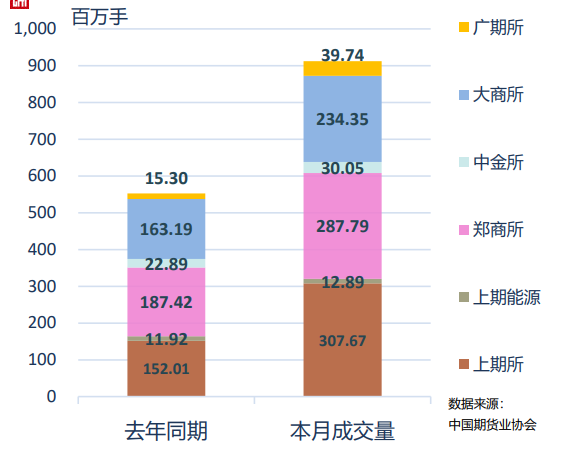
中期协:1月全国期货市场成交量为912.49百万手 同比增长65.09%
智通财经网· 2026-02-09 07:12
Group 1: Market Overview - In January, the national futures market transaction volume reached 912.49 million contracts, representing a year-on-year increase of 65.09% [1] - The total transaction value for January was 100.26 trillion yuan, showing a year-on-year growth of 105.14% [3] - The open interest in the national futures market increased by 14.65% compared to the previous month [4] Group 2: Exchange Performance - The Shanghai Futures Exchange (SHFE) had a transaction volume of 307.67 million contracts, accounting for 33.72% of the national market, with a year-on-year increase of 102.40% [1] - The Zhengzhou Commodity Exchange (ZCE) recorded a transaction volume of 287.79 million contracts, representing 31.54% of the national market, with a year-on-year growth of 53.56% [1] - The Dalian Commodity Exchange (DCE) had a transaction volume of 234.35 million contracts, making up 25.68% of the national market, with a year-on-year increase of 43.61% [1] - The China Financial Futures Exchange (CFFEX) reported a transaction volume of 30.05 million contracts, accounting for 3.29% of the national market, with a year-on-year growth of 31.30% [1] - The Guangxi Futures Exchange (GFE) had a transaction volume of 39.74 million contracts, representing 4.35% of the national market, with a year-on-year increase of 159.76% [1] Group 3: Transaction Value by Exchange - The transaction value for SHFE was 51.96 trillion yuan, making up 51.82% of the national market, with a year-on-year increase of 278.92% [3] - The transaction value for ZCE was 7.75 trillion yuan, accounting for 7.73% of the national market, with a year-on-year growth of 14.73% [3] - The transaction value for CFFEX was 26.35 trillion yuan, representing 26.28% of the national market, with a year-on-year increase of 42.02% [3] - The transaction value for DCE was 8.76 trillion yuan, making up 8.74% of the national market, with a year-on-year growth of 35.32% [3] - The transaction value for GFE was 3.37 trillion yuan, accounting for 3.36% of the national market, with a year-on-year increase of 332.19% [3] Group 4: Open Interest by Exchange - The open interest for SHFE was 11.68 million contracts, representing 22.51% of the national market, with a month-on-month increase of 10.46% [4] - The open interest for ZCE was 16.76 million contracts, accounting for 32.32% of the national market, with a month-on-month growth of 18.64% [4] - The open interest for CFFEX was 2.59 million contracts, making up 5.00% of the national market, with a month-on-month increase of 19.38% [4] - The open interest for DCE was 18.49 million contracts, representing 35.66% of the national market, with a month-on-month growth of 17.56% [4] - The open interest for GFE was 1.78 million contracts, accounting for 3.43% of the national market, with a month-on-month decrease of 17.94% [4] Group 5: Leading Products by Transaction Value - In January, the top five products by transaction value on SHFE were silver (30.70%), gold (18.47%), copper (11.93%), tin (8.96%), and nickel (8.10%) [6] - The leading products on ZCE were PTA (12.78%), cotton (10.80%), caustic soda (10.38%), methanol (9.74%), and glass (9.50%) [8] - The top products on DCE included coking coal (19.08%), palm oil (11.05%), PVC (8.87%), soybean meal (7.93%), and styrene (7.84%) [10] - The leading products on CFFEX were CSI 1000 index futures (29.57%), CSI 500 index futures (23.75%), CSI 300 index futures (15.72%), 30-year treasury futures (9.47%), and 10-year treasury futures (6.22%) [12] - The top products on GFE were lithium carbonate futures (64.79%), platinum futures (14.21%), industrial silicon futures (11.12%), palladium futures (5.96%), and polysilicon futures (2.54%) [14]
广期所碳酸锂主力合约大涨6%,重新站上15万元关口
Jin Rong Jie· 2026-02-03 02:08
Core Viewpoint - The main contract for lithium carbonate on the Shanghai Futures Exchange surged by 6%, surpassing the 150,000 yuan per ton mark, closing at 150,100 yuan per ton [1] Group 1 - The significant increase in the price of lithium carbonate indicates strong market demand and potential bullish sentiment in the lithium sector [1] - The price movement reflects ongoing trends in the electric vehicle and battery manufacturing industries, which are heavily reliant on lithium carbonate [1]
2026年01月13日:期货市场交易指引-20260113
Chang Jiang Qi Huo· 2026-01-13 01:21
Report Industry Investment Ratings - **Macro Finance**: Index futures are bullish in the medium - long term, recommended to buy on dips; Treasury bonds are expected to trade sideways [1][5] - **Black Building Materials**: Coking coal for short - term trading; Rebar for range trading; Glass recommended to sell on rallies [1][7] - **Non - ferrous Metals**: Copper recommended to hold long positions cautiously at low levels and conduct rolling operations; Aluminum advised to strengthen observation; Nickel advised to observe or sell on rallies; Tin for range trading; Gold for range trading; Silver is expected to be strong; Lithium carbonate to trade in a range [1][11] - **Energy Chemicals**: PVC with a low - buying strategy; Caustic soda and soda ash to wait and see temporarily; Styrene for range trading; Rubber for range trading; Urea for range trading; Methanol for range trading; Polyolefins to be weak and volatile [1][19] - **Cotton Textile Industry Chain**: Cotton and cotton yarn are expected to be strong with fluctuations; Apples are expected to be strong with fluctuations; Jujubes are expected to rebound from the bottom [1][26] - **Agricultural and Animal Husbandry**: Pigs: Near - term contracts to sell on rallies and roll short, far - term contracts to be bullish cautiously; Eggs: Current 02 contract for farmers to wait and sell on rallies for hedging; Corn: Short - term to be cautious of chasing high, grain - holding entities to sell on rallies for hedging; Soybean meal: Near - term contracts to be treated strongly on dips, far - term contracts to be treated weakly; Oils: Soybean and palm oil rallies are limited, be cautious of chasing up, rapeseed oil is weak [1][30] Core Viewpoints The report provides trading guidance for various futures products in different industries, analyzing the market conditions, supply - demand relationships, and influencing factors of each product, and giving corresponding trading strategies based on these analyses. Summary by Directory 1. Macro Finance - **Index Futures**: Although the US December non - farm payrolls were disappointing, the unemployment rate dropped, reducing January rate - cut bets. The January consumer confidence index reached a four - month high. Geopolitical and precious - metal risks increased. Considering the December PMI returning to expansion and strong expectations of early - year policy support, the market may develop further, but the index may trade sideways. It is recommended to be bullish in the medium - long term and buy on dips [5] - **Treasury Bonds**: The decline momentum of the bond market has attenuated in the short term, but it still faces supply pressure and rising inflation expectations in the medium term. Whether the bond - market pressure has been fully released remains to be seen. Treasury bonds are expected to trade sideways [5] 2. Black Building Materials - **Coking Coal**: The number of coal - hauling vehicles has decreased, the inventory at ports has accumulated, and market demand has not improved significantly. It is recommended for short - term trading [7] - **Rebar**: The futures price is slightly higher than the electric - furnace off - peak electricity cost and slightly lower than the flat - rate electricity cost. The supply - demand pattern has weakened seasonally. The rebound space is limited, and it is recommended for range trading [7] - **Glass**: The short - term price rise is due to factors such as production line shutdowns and inventory reduction, but the fundamental pattern has not changed. It is expected to be weak, and it is recommended to sell on rallies [7][9] 3. Non - ferrous Metals - **Copper**: The market is in a "strong expectation, weak reality" stage. The short - term upward momentum is exhausted, but the long - term shortage expectation and supporting factors still exist. It is expected to trade in a high - level range with a possible downward shift, and it is recommended to hold long positions cautiously at low levels and conduct rolling operations [11] - **Aluminum**: The weak reality of alumina surplus will continue, and the policy expectation is uncertain. The aluminum price is mainly driven by expectations and capital, and it faces great pressure in January. It is recommended to strengthen observation [13] - **Nickel**: The nickel ore quota is expected to be cut, but the overall nickel market remains in surplus. It is recommended to observe or sell on rallies [14] - **Tin**: The supply of tin ore is tight, and the downstream demand is recovering. It is expected to be strong with fluctuations, and it is recommended for range trading [15] - **Silver**: Due to factors such as the disappointing US non - farm payrolls and interest - rate cut expectations, the price is expected to be strong. It is recommended to hold long positions and be cautious of opening new positions [17] - **Gold**: Similar to silver, the price is expected to move up in the medium term. It is recommended for range trading and be cautious of chasing high [17] - **Lithium Carbonate**: The supply is expected to increase, and the demand is strong but may decline slightly. It is expected to trade in a range [18] 4. Energy Chemicals - **PVC**: The cost is at a low level, the supply is high, the domestic demand is weak, and the export is expected to maintain a high growth rate. Although the current supply - demand situation is weak, considering valuation and policies, it is recommended to buy at low levels [19] - **Caustic Soda**: The short - term has delivery pressure, and the medium - term may be supported by the market atmosphere of related commodities. However, the rebound space is limited without production cuts. It is recommended to wait and see [21] - **Styrene**: The current valuation is high, and the overseas gap has been filled. It is recommended to be cautiously bearish in the short term and focus on the improvement of cost and supply - demand in the long term [21] - **Rubber**: The supply is increasing during the high - yielding season, but the inventory accumulation may slow down. The downstream demand is weak. It is expected to trade in a range [22] - **Urea**: The supply is increasing, the agricultural and industrial demand has some support, and the inventory is at a low level. It is expected to trade in a range [23] - **Methanol**: The supply in the inland area is recovering, the demand for methanol - to - olefins is stable, and the traditional downstream demand is weak. Affected by geopolitical and port - arrival factors, the price is expected to trade in a range [24] - **Polyolefins**: The supply is still abundant, the demand has entered the off - season, and the price is expected to be weak and volatile [24] - **Soda Ash**: The supply is in surplus, but the cost support is strong. It is recommended to wait and see [26] 5. Cotton Textile Industry Chain - **Cotton and Cotton Yarn**: The global cotton supply and demand are adjusted, and the price has shown high - level fluctuations after a continuous rise. It is recommended to be cautious in the short term and optimistic in the long term [28] - **Apples**: The market of late - Fuji apples in the warehouse is stable, with different trading situations in different regions. The price is expected to be strong with fluctuations [28] - **Jujubes**: The acquisition in Xinjiang is almost finished, and the market trading atmosphere is different in different regions. It is expected to rebound from the bottom [29] 6. Agricultural and Animal Husbandry - **Pigs**: The short - term supply - demand relationship may turn loose, and the price may decline. In the medium - long term, the supply in the first quarter will increase, and the price after the Spring Festival will be under pressure. It is recommended to sell on rallies for near - term contracts and be cautiously bullish for far - term contracts [30][31] - **Eggs**: The short - term price may rise seasonally, but the supply is sufficient, limiting the increase. In the medium - long term, the new - laying pressure is not large, but the supply pressure still exists. It is recommended to wait for the opportunity to sell on rallies for hedging [33][34] - **Corn**: The short - term price is under selling pressure, and the long - term demand will gradually recover, but the supply - demand pattern is relatively loose year - on - year. It is recommended to be cautious of chasing high in the short term and sell on rallies for hedging [35][36][37] - **Soybean Meal**: The short - term price is expected to be strong with fluctuations, and the long - term price is expected to be weak. It is recommended to be long on dips for the near - term contract and pay attention to the pressure levels [38][39] - **Oils**: The short - term rallies of soybean and palm oil are limited, and rapeseed oil is weak. In the medium - long term, soybean and palm oil may rebound, and rapeseed oil will continue to be weak. It is recommended to be cautious of chasing up for soybean and palm oil and gradually exit long positions for rapeseed oil [39][43][44]
2025年12月18日:期货市场交易指引-20251218
Chang Jiang Qi Huo· 2025-12-18 03:06
Report Industry Investment Ratings - Macro-finance: Index futures are bullish in the medium to long term and recommended to buy on dips; Treasury bonds are expected to move in a range [1][5]. - Black building materials: Coking coal is recommended for short - term trading; rebar for range trading; glass is advised to short on rallies [1][7][8]. - Non - ferrous metals: Copper is recommended to reduce positions on rallies and replenish after stabilizing at low levels; aluminum is suggested to strengthen observation; nickel is advised to observe or short on rallies; tin is for range trading; gold is for range trading; silver is recommended to hold long positions and be cautious about new positions; lithium carbonate is expected to oscillate strongly [1][10][12]. - Energy and chemicals: PVC, caustic soda, soda ash, styrene, rubber, urea, and methanol are for range trading; polyolefins are expected to oscillate weakly [1][19][21]. - Cotton and textile industry chain: Cotton and cotton yarn are expected to oscillate strongly; PTA is expected to rise in an oscillating manner; apples and jujubes are expected to oscillate weakly [1][27][29]. - Agricultural and livestock: Pigs are recommended to short on rallies for near - month contracts and be cautiously bullish for far - month contracts; eggs' price increase is limited; corn is recommended to be cautious about chasing highs in the short term and hedging on rallies for grain - holding entities; soybean meal is for range trading, with near - month contracts treated strongly on dips and far - month contracts treated weakly; oils are advised to be cautious about short - chasing [1][31][36]. Core Views The report provides trading suggestions for various futures products based on their market fundamentals, supply - demand relationships, and macro - economic factors. It analyzes the influencing factors of each product, such as policy, inventory, production, and consumption, and gives corresponding investment strategies [1][5][7]. Summaries by Catalog Macro - finance - **Index futures**: In the medium to long term, they are bullish. With the U.S. employment and retail sales data fluctuating, and the market's main line rotating quickly, the index futures may oscillate. It is recommended to buy on dips [5]. - **Treasury bonds**: They are expected to oscillate. If the ultra - long - term yield does not reach a new high and the capital interest rate remains stable and low, the medium - and short - term interest rates may ease. Attention should be paid to the possible large fluctuations in the liability side of broad - based funds at the end of the year [5]. Black building materials - **Coking coal**: The market is in a game between strong bearish reality and weak marginal support. The short - term operation is mainly range trading on the right side [7]. - **Rebar**: It has low valuation and weak driving force. After the important meetings, the boost to the market is limited. With the decline in steel production and demand and the smooth inventory reduction, the steel price may oscillate weakly [7]. - **Glass**: The end - of - year inventory is high, the demand is weak, and the supply is increasing. The price is expected to be weak before the Spring Festival. It is recommended to short on rallies [8][9]. Non - ferrous metals - **Copper**: The price has reached a new high but faces a callback risk. The macro - loose expectation and long - term shortage of ore support the price center, but the short - term over - rise suppresses consumption. It is recommended to reduce positions on rallies and replenish after stabilizing at low levels [10]. - **Aluminum**: The price fluctuates greatly at a high level. The demand is in the off - season, and the inventory is decreasing. It is recommended to strengthen observation or reduce long positions [12]. - **Nickel**: The supply is expected to be loose in the long term, and the market is in an oversupply situation. It is recommended to observe or short on rallies [16]. - **Tin**: The supply of tin ore is tight, and the downstream consumption is weak. It is recommended for range trading, and attention should be paid to the supply resumption and downstream demand [16]. - **Silver and gold**: After the Fed's interest - rate cut and balance - sheet expansion, the prices are expected to be strong. It is recommended to hold long positions for silver and conduct range trading for gold [17]. - **Lithium carbonate**: The supply is affected by mine production, and the demand is strong. The price is expected to oscillate strongly. Attention should be paid to the progress of mine certificates and the resumption of lithium mines [19]. Energy and chemicals - **PVC**: The cost is low, the supply is high, and the demand is weak. The inventory is high, and the export growth is uncertain. It is expected to oscillate at a low level [19]. - **Caustic soda**: The inventory is high, and the profit of the main downstream is compressed. The supply is high in winter. It is recommended to observe temporarily [21]. - **Styrene**: The overseas market is weak, and the port inventory is decreasing. The factory's profit recovery limits the rebound space. It is expected to oscillate [21]. - **Rubber**: The overseas raw material price is high, but the domestic inventory is large. The tire production capacity utilization rate is expected to be weak. It is expected to oscillate strongly in the short term [22]. - **Urea**: The supply is sufficient, the agricultural demand is weak, and the industrial demand is supported. The inventory is relatively stable. It is recommended for range trading [23]. - **Methanol**: The supply recovers, the demand of methanol - to - olefins is high, and the traditional demand is weak. The inventory is decreasing. The price is expected to repair upwards [25]. - **Polyolefins**: The supply is strong, and the demand is weak. The inventory is decreasing, but the upward pressure is large. PE is expected to oscillate in a range, and PP is expected to oscillate weakly [25][26]. - **Soda ash**: The supply is in excess, and the cost rises. The supply contraction eases the contradiction. It is recommended to observe temporarily [27]. Cotton and textile industry chain - **Cotton and cotton yarn**: Although the global supply - demand data is loose, the domestic cotton sales are fast, and the yarn price is strong. They are expected to oscillate strongly [29]. - **PTA**: Affected by geopolitics and the Fed's interest - rate cut expectation, the crude oil price rises, and the PTA supply - demand is in a de - stocking state. It is expected to rise in an oscillating manner [29][30]. - **Apples and jujubes**: The apple inventory sales are general, and the jujube acquisition is coming to an end. Both are expected to oscillate weakly [30][31]. Agricultural and livestock - **Pigs**: In the short term, the supply pressure is large, and the price oscillates narrowly. In the long term, the capacity is being reduced, but it is still above the equilibrium level. It is recommended to short on rallies for near - month contracts and be cautiously bullish for far - month contracts [31][33]. - **Eggs**: The short - term supply and demand are balanced, and the price lacks driving force. In the long term, the supply pressure still exists. It is recommended to hedge on rallies for short - term, and pay attention to the elimination and external variables [33][34]. - **Corn**: In the short term, there is selling pressure, and it is recommended to be cautious about chasing highs and hedge on rallies. In the long term, the demand recovers, but the supply - demand pattern is relatively loose, and the increase is limited [35]. - **Soybean meal**: The external market is weak, and the domestic near - month contracts are strong. It is recommended for range trading, with near - month contracts treated strongly on dips and far - month contracts treated weakly [36]. - **Oils**: The short - term market is affected by multiple negative factors and is expected to oscillate weakly. It is recommended to be cautious about short - chasing [36][43].
顺势交易也会死?揭秘K线背后那场精心设计的“人性围猎”
Sou Hu Cai Jing· 2025-11-24 14:48
Core Viewpoint - The trading market serves as a reflection of human nature, exposing the deep-seated emotions of greed, fear, and desire that drive trading decisions [1][2]. Group 1: Human Nature in Trading - The market reveals the complexities of human emotions, where every trade reflects an internal struggle between desire and rationality [1]. - Historical figures, including Newton and Churchill, have faced failures in trading, highlighting the unpredictability of human behavior in financial markets [1]. Group 2: Challenges in Trading Psychology - Success in trading often requires overcoming inherent human instincts, such as fear and greed, which can lead to poor decision-making [3][4]. - The transformation of mindset is essential for success, as it influences attitudes, habits, and ultimately character [4]. Group 3: The Reality of Trend Trading - Recognizing market trends is necessary but not sufficient for success; many traders still incur losses despite following trends [5][6]. - Entry points in trading are critical; poor timing can lead to unfavorable risk-reward ratios, diminishing the chances of success [7]. Group 4: Risk Management - Effective stop-loss strategies are vital; traders often fail by using tight stop-losses that do not accommodate market fluctuations [8]. - A rigid mindset can hinder adaptability to changing market conditions, leading to potential losses [9]. Group 5: The Illusion of Control - Many traders enter the market with overconfidence, believing their knowledge or resources can guarantee success, which often leads to failure [10][11]. - True understanding of the market requires humility and the ability to let go of personal biases and predictions [12][13]. Group 6: Conclusion on Trading Wisdom - Trading is a complex profession that demands a combination of strategic thinking, patience, courage, and emotional resilience [14][16]. - Mastery in trading involves both technical skills and a deep understanding of one's own mindset and emotions [17].
2025年11月13日:期货市场交易指引-20251113
Chang Jiang Qi Huo· 2025-11-13 02:03
Report Industry Investment Ratings - **Macro Finance**: Index futures are long - term bullish with a strategy of buying on dips; Treasury bonds are expected to trade in a range [1][5] - **Black Building Materials**: Coking coal and rebar are for range trading; Glass is recommended for selling call options [1][7][8] - **Non - ferrous Metals**: Copper is for taking profits on long positions at high levels or range short - term trading; Aluminum is suggested to buy on dips; Nickel is for waiting and watching or shorting on rallies; Tin, gold, and silver are for range trading [1][10][11][18] - **Energy and Chemicals**: PVC, caustic soda, styrene, rubber, urea, methanol, and polyolefins are expected to trade in a range; Soda ash 01 contract is for a short - selling strategy [1][21][23][24][30][32] - **Cotton Textile Industry Chain**: Cotton and cotton yarn are expected to trade in a range; PTA is in low - level oscillation; Apples are expected to be slightly bullish; Jujubes are expected to be slightly bearish [1][33][34][35] - **Agricultural and Livestock**: Pigs are facing resistance in rebound; Eggs have limited upside; Corn is in a bottom - building phase; Soybean meal is in range oscillation; Oils are in a bottom - building and rebounding phase [1][37][39][41][43][45] Core Views - The overall market shows a complex situation with different trends in various sectors. Some sectors are affected by policy, supply - demand, and international factors. For example, the macro - financial sector is influenced by domestic policies and global risk preferences; the non - ferrous metals sector is affected by international trade and supply - demand fundamentals; the agricultural and livestock sector is related to production capacity, consumption seasons, and policies [5][10][37] Summary by Directory Macro Finance - **Index Futures**: A - share market is in oscillation. Global risk preference and domestic policies fail to boost market sentiment. The market lacks a clear main line, so index futures may oscillate. Long - term bullish with a strategy of buying on dips [5] - **Treasury Bonds**: The third - quarter monetary policy report maintains a moderately loose tone. The possibility of using total - volume monetary policy tools this year is limited. The bond market is in a range - trading phase, waiting for policy signals from the December Central Economic Work Conference [5] Black Building Materials - **Double - Coking**: The coal market has tight supply - demand and rising prices. Supply is restricted by mine shutdowns, and demand is improving. It is expected to trade in a range [7] - **Rebar**: The futures price is in narrow - range oscillation. The market is affected by macro - policies and supply - demand fundamentals. The price has limited downside due to low valuation [7] - **Glass**: Production cuts are implemented. Supply is reduced, but demand is weak. The inventory is relatively high, and there is delivery pressure. It is recommended to sell call options [8] Non - ferrous Metals - **Copper**: The price hits a record high and then falls. It is affected by trade, supply, and interest - rate policies. The supply is tightening, but the demand is suppressed by high prices. It is expected to trade in a high - level range [10][11] - **Aluminum**: The bauxite supply is expected to improve. The production capacity and inventory are changing. The market is over - trading some expectations. It is recommended to strengthen observation [10][11] - **Nickel**: The new RKAB policy brings uncertainty. The supply is expected to be loose in the long - term. It is recommended to wait and watch or short on rallies [16] - **Tin**: The production is changing, and the supply is expected to improve. The downstream consumption is weak. It is recommended for range trading [18] - **Silver and Gold**: Affected by the US government shutdown, employment, and interest - rate policies, they are in oscillation. They are supported by interest - rate cut expectations and risk - aversion demand. It is recommended for range trading [18][20] Energy and Chemicals - **PVC**: The cost is under pressure, supply is high, and demand is weak. The export growth sustainability is questionable. It is expected to be slightly bearish in oscillation [22] - **Caustic Soda**: Affected by alumina production and inventory, the valuation is under pressure. It is expected to be slightly bearish in oscillation [24] - **Styrene**: The cost and supply - demand fundamentals are weak. It is expected to be slightly bearish in oscillation [25][26] - **Rubber**: The market lacks a clear driving force. The inventory and production capacity utilization are changing. It is expected to trade in a range [26] - **Urea**: The supply is increasing, and the demand is spreading. The price is expected to oscillate, and the rebound sustainability needs attention [27][28] - **Methanol**: The supply is recovering, and the demand is weak. The inventory is increasing. It is expected to trade in a range [28] - **Polyolefins**: The supply pressure is increasing, and the demand improvement is limited. It is expected to be bearish in oscillation [30] - **Soda Ash**: The supply is in surplus, and the demand is weak. The 01 contract is for a short - selling strategy [32] Cotton Textile Industry Chain - **Cotton and Cotton Yarn**: The global cotton supply - demand situation is changing. The seed - cotton price is high, and trade negotiations are progressing. It is expected to trade in a range [33] - **PTA**: The oil price is affecting, and the supply - demand is in a state of inventory accumulation. It is in low - level oscillation [34] - **Apples**: The ground trading is ending, and the出库 is starting. The production and quality are declining. It is expected to be slightly bullish [34] - **Jujubes**: The acquisition price is changing, and the market sentiment is weak. It is expected to be slightly bearish [36] Agricultural and Livestock - **Pigs**: The short - term price is in narrow - range oscillation. The long - term supply is high, and the price is under pressure. It is recommended to hold short positions and pay attention to arbitrage [37][38][39] - **Eggs**: The supply is sufficient, and the demand is stable. The price increase is limited. It is recommended to short on rallies for the 12 - contract and trade in a range for the 01 - contract [39][40] - **Corn**: The short - term supply is sufficient, and the demand is weak. The long - term cost has support. It is in a bottom - building phase [41][42] - **Soybean Meal**: Affected by US policies and Brazilian planting, it is in range oscillation. It is recommended to pay attention to the 3000 - yuan support level [43][44] - **Oils**: Different oils have different supply - demand situations. They are expected to bottom - build and rebound in the short - term and trade in a wide range in the long - term [45][49]