
算力革命

Search documents
春晚含“AI”量拉满 绩优科基前瞻布局拥抱新周期
Jiang Nan Shi Bao· 2026-02-26 03:28
虽然科技主线仍有望延续,但从盘面表现看,板块和热点轮动加速,普通投资者若想跟上行情却并未易 事。同时科技板块高波动性和高不确定性并存,且行业内部细分领域众多,不同领域的发展节奏和盈利 能力差异较大,进一步增加了投资难度。而公募基金公司拥有专业的投研团队,具备更为丰富的行业知 识和投资经验,能够深入研究科技行业趋势,筛选优质标的,降低投资者的信息不对称风险。从2025年 度表现看,多只科技方向的基金把握结构性行情实现收益翻倍。其中汇安基金旗下的汇安成长优选混合 A(005550)聚焦科技成长链条,该基金以139.91%的年度收益(同期业绩比较基准10.98%)在同期可 比的2272只灵活配置型基金中高居第4名。 立足当下,汇安成长优选混合基金经理单柏霖强调:"产业浪潮依旧汹涌,我们正处于一轮巨大的科技 大周期之中,AI 推理带来的算力革命才刚刚开始"。回顾2025年四季度,单柏霖及其团队基于第一性原 理——"AI推理时代的算力重心将从 连接转移至存储",对汇安成长优选混合基金进行了前瞻性的结构 性调整。一方面对前期涨幅较大、交易拥挤度较高的海外算力(光模块、PCB等)仓位进行了局部仓位 战术性获利了结。单柏霖分 ...
算力“电力化”革命来袭,AI时代新基建暗战升级
Sou Hu Cai Jing· 2026-02-23 09:03
数据显示,当前多模态模型的算力消耗是纯文本时代的十倍以上,国内科技巨头正加速布局算力基建:阿里、腾讯加 码液冷服务器与智算中心,华为深耕绿色数据中心技术,试图破解算力增长与能源约束的矛盾。与此同时,AI模型正 从"黑箱"走向"白盒",阿里安全部提出的"内生安全"理念,让AI在金融、医疗等领域的落地少了"信任壁垒"。 当AI算力褪去"技术外衣",化身像水、电、煤一样的基础资源,一场关乎未来的"算力电站"建设暗战已在国内悄然打 响。近期,字节跳动发布Seedance 2.0视频生成模型,60秒即可产出带原生音频的多镜头视频,将多模态AI的应用推 向新高度,也让算力消耗的指数级增长成为行业焦点。 资本市场上,算力产业链迎来价值重估,中芯国际、中科飞测等企业凭借技术突破获得资本青睐,光模块、芯片制造 等环节成为投资热点。这场算力革命不再是单一企业的技术比拼,而是关乎数字经济发展根基的全面竞争,未来谁能 掌握"算力发电站",谁就有望抢占AI时代的话语权。 ...


英伟达统治AI时代:下游产业的算力革命与万亿机会
QYResearch· 2026-02-19 02:03
过去三年, 英伟达(NVIDIA)已成为全球科技产业的核心驱动力 。2025财年,公司全年营收突破约 1300 亿美元 ,数据中心业务占比接近 90% ,毛利率维持在 70%–75% 区间。Blackwell GPU 和相关平台成为推动这轮 AI 基础设施升级的主要引擎。 这意味着下游行业——从云服务到企业 IT、从软件平台到终端应用——正在围绕这股算力浪潮重新定义其架构、投资与商业模式。 一、英伟达营收与算力扩张的下游拉动机制 数据中心业务的爆发式增长 英伟达数据中心业务是其增长核心: 2025 财年数据中心营收约 115.2 亿美元 ,同比增长 142% 。 Blackwell 架构单季曾贡献约 110 亿美元营收 ,是公司历史上最快的产品销售增长纪录。 在多个季度中,数据中心收入占比一度超过 88%~90% 。 Blackwell GPU 贡献了数据中心业务约 70% 的计算收入 。 这些数字说明,英伟达的增长几乎完全由 AI 计算需求驱动,而这种需求本质上来自下游企业对大规模模型训练、实时推理、AI 工厂和智能应用的投 入。 下游需求爆发背后的三大趋势 1. 算力成为生产力基础设施 下游企业不再把 A ...


电力设备行业2026年投资策略:国内电改与海外需求共振,风电电网迎来高质量发展
Hua Yuan Zheng Quan· 2026-02-08 13:35
Group 1 - The power industry is expected to achieve high-quality development as it enters a year of comprehensive marketization, driven by the "dual carbon" strategy and accelerated reforms in the electricity system [3][7][8] - The electricity market reform is set to fully unfold in the 15th Five-Year Plan, with significant policies introduced in the final year of the 14th Five-Year Plan that will have far-reaching impacts [3][11][12] - The core idea of the electricity reform is to reflect the different values of power sources (energy value, capacity value, adjustment value, and clean value) in market pricing, which has been historically dominated by energy value due to the predominance of coal power [8][10] Group 2 - The reform is expected to accelerate the construction of ultra-high voltage (UHV) and distribution networks, with UHV construction likely to speed up again as green electricity demand rises [3][16][24] - The investment in distribution networks has been low, with a continuous decline in the investment ratio, but this is expected to change as the demand for reliable power supply increases [28][34][41] - The introduction of capacity pricing for UHV and distribution networks is anticipated to stabilize project returns and promote the development of related projects [26][41] Group 3 - The surge in AI investments is projected to significantly increase electricity demand in the U.S., with OpenAI planning to deploy over 250GW of computing power by 2033, which could lead to a substantial electricity shortfall [45][49] - The U.S. electricity demand has been stagnant, but projections indicate that by 2030, peak load could approach 1000GW, driven largely by data centers [49][51] - The anticipated increase in electricity demand from AI investments presents a significant opportunity for companies involved in power generation and distribution [45][49] Group 4 - The profitability of wind turbine manufacturers is expected to improve, with domestic companies accelerating their international expansion as domestic bidding volumes remain high and prices trend upward [3][4] - Companies such as Goldwind Technology, Yunda Co., Mingyang Smart Energy, and Sany Heavy Industry are recommended for investment due to their competitive advantages in cost and market position [3][4]



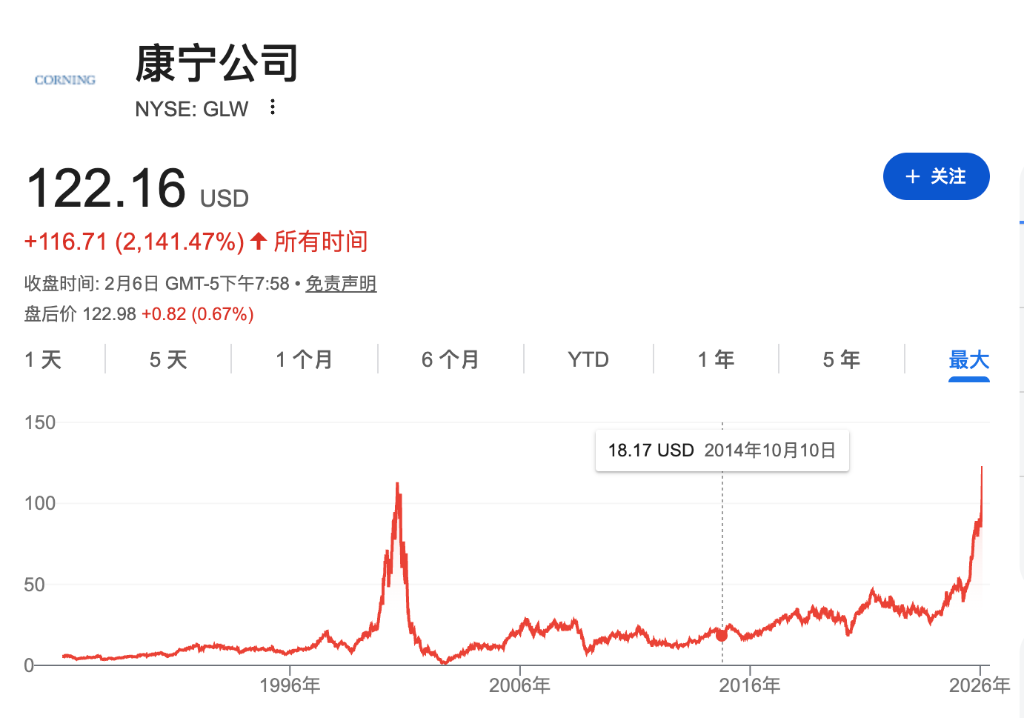
百年康宁华丽转身:光纤终结二十年亏损,抱上Meta大腿成AI新贵!
Hua Er Jie Jian Wen· 2026-02-07 09:53
Core Insights - Corning's fiber optics business is emerging as a key beneficiary of the AI data center construction wave after nearly two decades of losses, highlighted by a recent $6 billion supply agreement with Meta [1] - The efficiency of photonic data transmission is three times that of electronic transmission over short distances and up to twenty times over long distances, making fiber optics the preferred choice as global computing infrastructure accelerates [1] - Corning's technology has expanded into Co-Packaged Optics (CPO), which enhances data transmission efficiency by embedding directly into servers, further solidifying its strategic position in AI infrastructure [1] Historical Context - Founded in 1851, Corning initially produced glass for incandescent bulbs and has since innovated in various materials technologies, including low-loss fiber optics developed in 1970, which became foundational for modern communication networks [4] - Despite achieving a technological breakthrough in low-loss fiber optics in 1970, the business struggled for nearly two decades, facing continuous losses and pressure from investors to divest [4] Strategic Turning Point - A pivotal insight in 2018 during a visit to Meta's data center led to the development of a new, thinner, and more flexible fiber optic cable to address significant interconnection challenges within data centers [5] - This strategic bet on technology has proven valuable following the surge in AI-driven demand for data centers, positioning Corning as a key supplier to major players like Meta [5] Long-term Investment Philosophy - Corning's core competitiveness stems from its unique vertical integration model and long-term talent strategy, maintaining control over critical industry chain segments and avoiding outsourcing of core operations [6] - During challenging periods, such as the pandemic, Corning prioritized retaining capacity and workforce, allowing for the accumulation of unique cross-domain experience among its engineers [7] Supply and Demand Dynamics - As North America's largest fiber optic manufacturer, Corning's data center fiber business has become its fastest-growing revenue engine, but future success is contingent on the actual investment pace of large tech companies in data center construction [8] - Current stock prices reflect optimistic expectations, yet the industry faces two major bottlenecks: maximum capacity and a shortage of skilled installation labor [8] - Corning is exploring technologies like Co-Packaged Optics (CPO) to support the next growth phase, with the cumulative delivery of fiber optics accelerating significantly [8]

重塑全球计算格局 马斯克筹划整合资产推进太空算力
Sou Hu Cai Jing· 2026-02-02 00:54
Core Viewpoint - SpaceX is seeking to launch and operate up to one million satellites to serve as orbital data centers, providing computational power for large-scale artificial intelligence reasoning and training [1] Group 1: Satellite Operations - The satellites will operate at altitudes ranging from 500 kilometers to 2000 kilometers in multiple orbital layers to meet global demand [1] - The system will rely on solar energy, which is expected to lower operational costs and reduce environmental impact compared to ground data centers [1] Group 2: Strategic Considerations - Elon Musk is considering integrating assets to advance the space computing layout, indicating a strategic choice to expand computational capabilities beyond Earth [1] - The ongoing development of projects like China's "Trinity Computing Constellation" and "Star Computing Plan," along with breakthroughs in reusable rockets and radiation-resistant materials, suggests a significant shift in the global computing landscape [1] - This space computing revolution is anticipated to provide critical support for the future digital and intelligent processes of society [1]
指数微红,个股普跌,近4600家绿盘!现在的A股到底该怎么玩?
Sou Hu Cai Jing· 2026-01-27 05:35
今天的市场,用一个词形容就是"割裂"。指数看着还行,但手里的个股却可能绿油油一片,这种滋味确 实不好受。 截至午盘,上证指数微涨0.03%,收在4134.03点;创业板指和科创50分别上涨0.44%和0.57%。然而,指 数表面的平静之下,是超过4600只个股下跌的惨淡现实。市场呈现出典型的"指数稳、个股冷"格局,赚 钱效应非常集中,大多数投资者可能只赚了指数,没赚到钱。 相比之下,港股今天表现得更强势一些,恒生指数大涨1.08%。这背后有政策暖风的支持,央行宣布支 持香港人民币业务的资金安排翻倍至2000亿元,提升了离岸市场的流动性,给了外资和南向资金更多信 心。 那么,今天A股里,为数不多的"火"烧在哪里呢?答案非常清晰:科技主线。通信板块大涨2.13%,电 子板块上涨1.50%,成为两市最亮眼的风景线。此外,银行板块也上涨了1.03%,起到了稳定大盘的作 用。 通信和电子的强势,核心驱动力来自AI(人工智能)产业的重大进展。昨天,阿里发布了千问Qwen3- Max-Thinking大模型,性能达到国际顶尖水平。同时,AI领域另一家公司阶跃星辰完成了超50亿元的巨 额融资。这两大事件叠加,彻底点燃了市场对 ...
【研报行业】无光不AI!硅光产业投资全梳理:从Fab厂到光模块,这些公司卡位算力新基建
第一财经· 2026-01-05 11:27
Group 1 - The article emphasizes the significance of AI and the new computing power revolution, highlighting a potential 10x market expansion with profits concentrating in specific segments of the supply chain [1] - A forecast suggests that 2026 may mark the year for China's commercial rocket reusable launch, urging attention to core "shovel stocks" and new 3D printing technology routes in commercial aerospace investments [1] - The low-altitude economy in Shanghai is undergoing an upgrade, indicating that the eVTOL (electric Vertical Take-Off and Landing) industry chain is at a critical juncture [1] - Elon Musk has accelerated production in the brain-computer interface industry, signaling a pivotal turning point for this sector [1]

华源晨会精粹20251224-20251224
Hua Yuan Zheng Quan· 2025-12-24 09:41
Group 1: Power and Environmental Industry - The core viewpoint highlights the significant power supply shortage in the U.S. due to increased computing power investments, with OpenAI raising its investment scale to 250GW by 2033 and peak electricity demand expected to exceed 1000GW by 2030, up from approximately 820GW currently [2][5] - The report suggests that the power generation side will rely on gas power, nuclear power, energy storage, and SOFC as emergency measures, with a projected electricity gap of 182GW or 89GW depending on whether existing units are retired by 2030 [6] - It is anticipated that U.S. grid investments will increase significantly, with projections of reaching $30 billion in 2024 and $43.4 billion by 2027, creating export opportunities for domestic companies [7] Group 2: Home Appliance Industry - The report on Tabo (06110.HK) indicates a high single-digit decline in retail sales for Q3 FY25/26, aligning with expectations, and a reduction in store closures is anticipated for FY26 compared to FY25 [11][12] - Nike's revenue in the Greater China region has decreased by 16% year-on-year, prompting the company to collaborate closely with distributors like Tabo to address inventory issues and enhance brand image through targeted strategies [11][12] - The introduction of new brands such as Soar and NORRONA is expected to diversify Tabo's offerings and expand its customer base, potentially driving new revenue growth [12]

华源证券:算力革命与能源革命共振 关注美国缺电背景下电力投资机遇
Zhi Tong Cai Jing· 2025-12-24 05:57
Core Viewpoint - OpenAI has raised its computing power investment target to 250GW by 2033, while the peak electricity load in the U.S. is expected to exceed 1000GW by 2030, leading to potential electricity shortages in the U.S. due to significantly increased demand [1] Group 1: Power Supply and Demand - OpenAI's computing power investment has been significantly increased, indicating a notable shortfall in U.S. electricity supply and demand [1] - The projected electricity gap in the U.S. by 2030 is estimated to be 182GW or 89GW, depending on whether existing units are retired [2] - Gas and nuclear power are expected to be the main sources of electricity, with gas power being a stable and cost-effective option, while nuclear power's capacity is set to increase from approximately 100GW to 400GW by 2050 [2] Group 2: Grid Investment and Export Opportunities - U.S. grid investment is projected to rise significantly, with expectations of surpassing $30 billion in 2024, driven by the need to maintain grid reliability [3] - China is expected to see a substantial increase in transformer exports to non-U.S. regions, with growth rates of 41% in Q1-Q3 of 2025, indicating a potential opportunity for Chinese exports due to U.S. electricity investment growth [3] Group 3: Power Equipment Trends - The trend towards 800VDC power architecture is emerging, with NVIDIA proposing this as a solution to increasing power demands from GPUs, which could enhance power efficiency by approximately 157% compared to 415V AC [4] - Solid-state transformers (SST) are anticipated to become a long-term solution for converting medium-voltage AC to 800V DC [4] Group 4: Domestic Implications - The competition between China and the U.S. in technology may lead to increased computing power investments in China, potentially resulting in a tighter domestic electricity supply-demand balance [5] - If China's AIDC investment aligns with that of the U.S., it could drive a compound growth rate of approximately 1.1% to 1.5% in electricity consumption during the 14th Five-Year Plan [5]