贸易政策不确定性

Search documents
每日机构分析:2月27日
Xin Hua Cai Jing· 2026-02-27 16:54
Group 1: US Housing Market - The average interest rate for a 30-year fixed mortgage in the US fell to 5.98% as of February 26, down from 6.01% the previous week and significantly lower than 6.76% a year ago. This decline is primarily attributed to the drop in the 10-year Treasury yield. However, economists believe this decrease is insufficient to materially stimulate housing demand [1] - The current decline in mortgage rates is seen as a result of market volatility rather than strong economic fundamentals, raising questions about its sustainability. Analysts emphasize that the shortage of housing inventory remains a core constraint on market recovery, indicating that merely lowering rates will not drive demand unless supply improves [1] - Despite the lower rates, there has been a noticeable increase in mortgage refinancing activity [1] Group 2: UK Government Bonds - UK government bond prices have risen due to market expectations that the Office for Budget Responsibility will announce a reduction in bond issuance for the current fiscal year and further cuts in the 2027 fiscal year. Analysts suggest that strong tax revenues early in the year may lead to a downward revision of bond issuance expectations [2] Group 3: Japan Inflation - In February, Tokyo's core consumer prices, excluding fresh food, rose by 1.8% year-on-year, slightly above economists' median forecast of 1.7%. The inflation rate is cooling as the impact of government measures to lower utility bills becomes evident and food cost increases slow down [2] Group 4: South Korea Exports - South Korea's exports are expected to grow for the ninth consecutive month in February, driven by a surge in chip demand amid a global AI investment boom. Analysts predict a 24.0% year-on-year increase in exports, with semiconductor prices rising faster than expected and low inventory levels supporting strong export momentum [2] - There is a high likelihood that semiconductor export growth will exceed 100% in the first half of the year [2] Group 5: Singapore Trade Performance - Singapore's manufacturing and trade performance may be adversely affected by uncertainties in US trade policy by 2026. Potential trade tensions and geopolitical conflicts among major economies could raise production costs and exacerbate global economic policy uncertainty, ultimately dampening global investment flows and trade activities [2]
“中国得利最大”,东南亚挠头…
Xin Lang Cai Jing· 2026-02-27 15:21
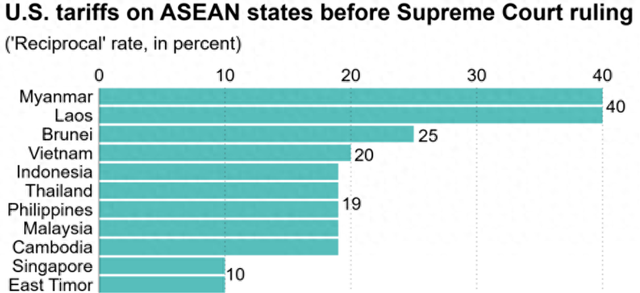
【文/观察者网 阮佳琪】 上周最高法院裁定所谓"解放日"对等关税越权违法后,美国总统特朗普最初设定的全球商品加税10%已 于本周二(24日)生效,为期150天。美国贸易代表贾米森·格里尔次日还称,白宫将"在适当情况下"继 续上调关税至15%。 美国关税政策剧烈摇摆,令东南亚出口商普遍陷入观望与被动调整,地区贸易前景被不确定性笼罩。 《日经亚洲》27日报道指出,特朗普政府用短期关税替代被法院否决的"对等关税",再度加剧全球贸易 波动,东南亚企业至今仍无法确定是否、以及如何调整供应链、定价策略与出货计划。 当地企业普遍反映,当前正身处贸易政策"灰色地带",无论是与美国采购商的合作,还是美最高法院裁 决对竞争对手,尤其是中国的影响,都难以预判,"几乎一切都偏离了计划"。 报道援引悉尼智库洛伊研究所首席经济学家罗兰·拉贾(Roland Rajah)的观点称,美最高法院的裁决, 让中国成为了所谓"最大的直接受益者之一",进一步复杂化了东南亚国家的竞争环境。 拉贾声称,东南亚地区正处于一个利益悖论中:该地区本有望从中国的贸易转移与供应链外迁中获益, 但那些已与美国签署双边贸易协定国家,如柬埔寨、马来西亚、印度尼西亚等国, ...

三大核心变量主导金价:关税、地缘与美联储政策
Sou Hu Cai Jing· 2026-02-27 07:14
Core Viewpoint - Recent international gold prices have shown a significant rebound, breaking through key resistance levels and reflecting strong performance driven by geopolitical tensions, adjustments in U.S. tariff policies, and Federal Reserve monetary policy statements [1] Group 1: U.S. Tariff Policy Adjustments - The U.S. Supreme Court ruled on February 20 that the large-scale tariff policy implemented by the Trump administration was illegal, leading to the cessation of these tariffs starting February 24, 2026 [2] - In response, Trump announced an executive order to impose an additional 10% tariff on all goods imported into the U.S. for 150 days, later increasing it to 15%, maintaining existing tariffs amid rising trade policy uncertainty [2] Group 2: Geopolitical Risks - The ongoing negotiations between the U.S. and Iran have become a key variable affecting gold prices, with recent talks showing mixed progress and leading to fluctuations in market sentiment [2] - Following a significant drop in gold prices below $4,900 per ounce, renewed tensions and military deployments by the U.S. in the Middle East have driven gold prices back above $5,000 per ounce, with further escalation possible depending on the outcome of negotiations [2] Group 3: Federal Reserve Monetary Policy - Recent statements from Federal Reserve officials have been hawkish, indicating that interest rates may remain unchanged for an extended period due to improving labor market data and persistent inflation risks [3] - The Fed's stance has supported a rebound in the U.S. dollar, indirectly influencing precious metal prices [3] Group 4: Market Impact and Future Focus - Gold and silver have recently strengthened due to uncertainties surrounding tariffs and risks of U.S. military action against Iran, recovering approximately half and one-third of their declines from late January, respectively [4] - The market is expected to maintain a volatile but less intense trading range, with ongoing geopolitical tensions providing long-term support for precious metals [4] - Future attention should be on the progress of U.S.-Iran negotiations, as a successful agreement could lead to a sudden market shift, while failure could push gold prices towards historical highs [4]
RBC raises provisions again amid renewed tariff uncertainty
American Banker· 2026-02-26 22:14
Key Insight: Canada's largest bank is once again bracing for pressure on the Canadian economy from U.S. tariffs.Supporting Data: In the quarter ending Jan. 31, RBC raised provisions for credit losses by 4% year over year.Expert Quote: "While we believe the Canadian economy has demonstrated resilience, factors such as U.S. trade policy … add ongoing uncertainty to our outlook," said RBC Chief Risk Officer Graeme Hepworth.Processing Content The Royal Bank of Canada is back where it was a year ago — bracing f ...

【环球财经】削弱规则、增加变数——多国专家批评美关税政策冲击全球贸易环境
Xin Hua She· 2026-02-26 16:31
新华财经伦敦2月26日电(记者赵小娜)美国最高法院日前公布裁决,认定美国《国际紧急经济权力 法》未授权总统大规模征收关税。此后,特朗普政府宣布对来自所有国家和地区的商品加征15%的关 税。多国学者表示,美国关税政策在法律依据与实施方式上的频繁变动,令全球贸易环境陷入更深层次 的不确定性。 政策反复削弱规则稳定性 他分析说,前一轮关税虽为美国政府带来超过千亿美元收入,但这些收入的代价实则由美国消费者和企 业承担。随着美国最高法院裁决可能引发的关税退税诉求,美国政府将面临双重压力:一是关税征收与 退税流程本身产生的行政成本,二是随之而来的法律纠纷和财政压力,这一局面或将演变为财政、司法 和商业合同领域的系统性摩擦。 澳大利亚昆士兰理工大学国际贸易法专家费利西蒂·迪恩表示,企业若要申请退还此前缴纳的关税,往 往要走复杂的法律程序,还得提供完整的相关记录。政策频繁调整,意味着企业必须不断调整合规安 排,这些额外增加的成本最终都会通过提高商品价格等方式,转嫁给终端市场。 《日本经济新闻》网站报道,大量预计特朗普政府会败诉的企业此前已向美国国际贸易法院提起诉讼, 要求退还税款。包括川崎重工、丰田通商等在内,至少有10家日 ...
国际观察|削弱规则 、增加变数——多国专家批评美关税政策冲击全球贸易环境
Xin Hua She· 2026-02-26 13:21
新华社伦敦2月26日电 题:削弱规则、增加变数——多国专家批评美关税政策冲击全球贸易环境 新华社记者赵小娜 美国最高法院日前公布裁决,认定美国《国际紧急经济权力法》未授权总统大规模征收关税。此后,特 朗普政府宣布对来自所有国家和地区的商品加征15%的关税。多国学者表示,美国关税政策在法律依据 与实施方式上的频繁变动,令全球贸易环境陷入更深层次的不确定性。 政策反复削弱规则稳定性 一些专家认为,此轮关税争议的核心,不在于税率高低,而在于全球贸易规则可预期性的持续下降。政 策的反复调整,正在不断侵蚀市场对规则的信任。 英国伯明翰大学国际经济地理学教授约翰·布赖森表示,企业发展最需要稳定的政策环境,但在特朗普 政府的关税政策下,"唯一能确定的就是不确定性"。这种不确定性会直接抑制企业投资意愿、减少就业 岗位,迫使企业把大量资源花在应对政策变动上,而非扩大生产、加大技术研发。 他分析说,前一轮关税虽为美国政府带来超过千亿美元收入,但这些收入的代价实则由美国消费者和企 业承担。随着美国最高法院裁决可能引发的关税退税诉求,美国政府将面临双重压力:一是关税征收与 退税流程本身产生的行政成本,二是随之而来的法律纠纷和财政压力 ...
IMF警告:贸易不确定性正在侵蚀美国增长基础
Jin Shi Shu Ju· 2026-02-26 04:13
Group 1 - The International Monetary Fund (IMF) warns that uncertainty surrounding extensive tariffs in the U.S. may weaken an otherwise "strong" economy [1] - The IMF indicates that the uncertainty in trade policy could lead to a more significant drag on economic activity than anticipated [1] - The recent tariffs implemented by President Trump, which are the highest in nearly a century, are intended to encourage domestic investment [1] Group 2 - IMF President Kristalina Georgieva noted that the U.S. current account deficit is "too large," but it is not an immediate or urgent issue [2] - The IMF's research highlights that the declining net investment position of the U.S. poses a potential significant vulnerability [2] Group 3 - The IMF calls for measures to control the historically high budget deficit in the U.S., citing rising public debt as a growing stability risk [3] - The report mentions that stricter immigration policies may pressure labor supply and suppress economic growth, potentially reducing economic activity by about 0.4% by 2027 [3] - The IMF has lowered its medium-term potential growth forecast by 0.25 percentage points due to expected labor growth slowdown offsetting productivity gains [3]
The Supreme Court's Tariff Ruling and the New Risk Regime
Etftrends· 2026-02-25 17:32
The Supreme Court's Tariff Ruling and the New Risk RegimeOn Friday, the Supreme Court ruled that the International Emergency Economic Powers Act (IEEPA) does not grant the president authority to impose tariffs, striking down the reciprocal, fentanyl, and immigrationrelated regimes enacted under the law. President Trump responded with a new blanket tariff — first 10%, then 15% — reviving trade policy uncertainty with implications for both markets and economic activity.The Trade Policy Uncertainty Index, whic ...
贵金属专题报告:贵金属马年强势开局结构,牛市警惕高位波动
Guo Xin Qi Huo· 2026-02-25 11:07
贵金属 贵金属马年强势开局 结构牛市警惕高位波动 2026 年 2 月 25 日 主要结论 / 国信期货研究 Page 1 国信期货贵金属专题报告 2022 年 12 月 25 日 2026 年春节长假期间,海外市场正常交易,风险事件密集落地,贵金属走 出先抑后扬、波动加剧的行情,整体强势格局清晰。假期初期,美伊谈判释放阶 段性积极信号,避险情绪降温带动贵金属小幅回调。随着谈判陷入僵局、美国关 税政策遭遇司法裁决后快速重构,地缘风险与贸易摩擦担忧同步升温,避险买盘 大规模回流,推动金银快速拉升,铂钯同步跟随板块波动。长假结束后,国内市 场迎来节后首个交易日,内外盘联动效应强化,国内贵金属大幅补涨,全线收高。 截至 2 月 24 日收盘,沪金主力合约大幅上涨 3.52%,报 1150.50 元/克;沪银主 力合约暴涨 12.84%,报 22327 元/千克。铂族金属市场跟随贵金属板块同步走强。 广期所铂金主力合约上涨 5.54%,报 551.85 元/克;钯金主力合约上涨 4.57%, 报 438.45 元/克。 综合地缘局势、贸易政策、美联储动向与资金面判断,贵金属市场或呈现高 位偏强震荡格局,短期波动加剧但 ...
金荣中国:现货黄金延续隔夜反弹空间,重新尝试挑战5200关口
Sou Hu Cai Jing· 2026-02-25 08:07
周三(2月25日)亚盘时段,现货黄金延续隔夜反弹空间重新尝试挑战5200关口及以上,目前暂交投于5185美元附近。周二(2月24日)现货黄金价格出现显 著回调,一度下跌近2.5%至接近5094美元,收报5141.43美元/盎司,跌幅约1.65%,从而中断了此前连续四个交易日的上涨行情。这一轮调整主要源于市场 获利了结行为叠加美元指数的明显走强,导致以美元计价的贵金属承压下行。尽管价格出现回落,但仍有逢低买盘提供支撑。 基本面: 技术面: 日线级别,金价昨日录得阴线收盘回吐近期部分涨幅,但仍守住本周上破后空间展开争夺,短期表现仍暗示乐观预期或有望挑战5230及以上更多空间。1--4 小时级别,短线走势自4840低点展开多头攻势后本周迎来5100上破打破僵局,隔夜盘中自5250附近回吐涨幅后再度企稳5100关口并迎来反击,至当前亚盘时 段,价格已再度逼近5200附近蓄势待发。日内交易者或留意5150上方支撑测试情况尝试多单为主,上方压力5220/5280附近。 操作思路: 多单: 黄金在触及多周高点后,部分持仓者选择锁定前期涨幅,导致卖压逐步显现。这种典型的获利了结现象在价格快速拉升后较为常见,直接削弱了黄金的短 ...