
资源重估

Search documents
钨价狂飙 1个月上涨近50%|经济周刊·理财
Guang Zhou Ri Bao· 2026-02-13 03:10
Group 1 - Tungsten prices have surged nearly 50% over the past month, leading to a systematic revaluation of tungsten and related industries due to rigid supply and explosive demand [1][2] - The recent spike in tungsten prices has driven the non-ferrous metal sector's stock prices, with the China Securities Rare Metals Theme Index rising 3.51% as of February 11, 2026, and key stocks like Zhangyuan Tungsten and Dongfang Tantalum hitting their daily limits [2] - The price increases are attributed to stricter safety and environmental regulations in mining, resulting in temporary supply tightness, alongside stable demand from downstream sectors such as PCB tools [2] Group 2 - The current market is evolving from a simple commodity bull market to a "resource revaluation" super cycle driven by multiple long-term logic factors [3] - Tungsten's strategic value is highlighted as a countermeasure metal with highly concentrated global resources and slow new capacity release, alongside rising demand from high-end manufacturing sectors like AI and semiconductors [3] - As of January 30, 2026, the top ten stocks in the China Securities Rare Metals Theme Index accounted for 59.71% of the index, suggesting significant investment opportunities in the sector through rare metal ETFs and related funds [3]
钨价突破历史新高,“元素周期表”行情持续演绎
Mei Ri Jing Ji Xin Wen· 2026-02-11 02:13
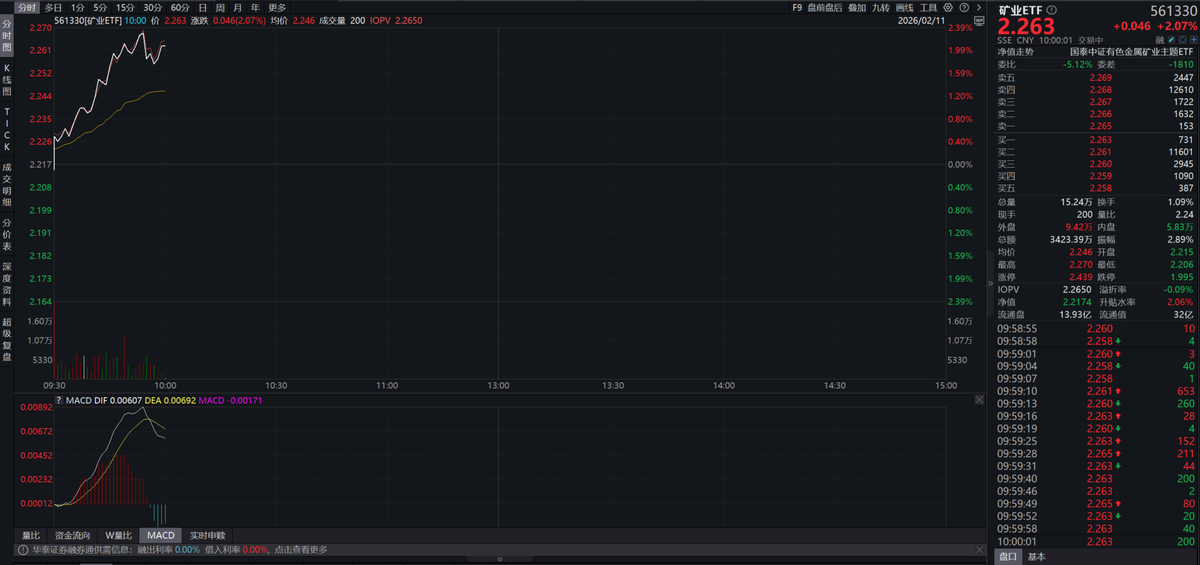
Core Viewpoint - Tungsten prices have recently reached historical highs, driven by geopolitical factors and commodity market dynamics, making the non-ferrous metals sector a focal point for global capital markets [1][3]. Group 1: Tungsten Price Surge - Tungsten prices have surged significantly, with black tungsten concentrate and ammonium paratungstate prices increasing over 24% in two weeks, both reaching historical highs [4]. - The price increase is attributed to stricter safety and environmental regulations leading to supply tightness, alongside stable demand from downstream sectors like PCB tools [4][5]. - The current price dynamics reflect a broader trend of resource revaluation, with tungsten's strategic importance highlighted amid rising resource nationalism [4][6]. Group 2: Supply and Demand Dynamics - Short-term price increases are primarily driven by supply constraints, as domestic mines face stricter regulations, leading to reduced operational rates and tighter market circulation [5]. - Despite being in a traditional off-season, demand from sectors such as PCB and hard alloys remains stable, supporting prices [5]. - The price increase is beginning to transmit from raw materials to midstream products, indicating a potential upward shift in the overall price structure of the industry [5]. Group 3: Strategic Value of Tungsten - Tungsten's role as a critical strategic resource is becoming more pronounced in the context of globalization and resource nationalism, with its supply highly concentrated and irreplaceable in high-end manufacturing and energy sectors [6]. - The demand for high-performance tungsten materials is expected to grow in emerging fields such as renewable energy and aerospace, further supporting long-term price resilience [6]. Group 4: Investment Strategies - Investors are encouraged to focus on upstream resources and consider mining ETFs as a means to capitalize on the historical "resource revaluation" super cycle [10]. - Mining ETFs have shown superior performance compared to other non-ferrous ETFs, with the index tracking the non-ferrous metal mining theme achieving a cumulative increase of 296.64% since its inception [10][18]. - The mining ETF's concentration on leading resource companies offers higher profit elasticity and valuation potential during price increases [15].

A股今天定格在4151点,做好准备了,不出意外,明天很可能这样走
Sou Hu Cai Jing· 2026-01-29 06:31
Group 1 - The A-share market closed at 4151.24 points, with three major indices in the green, but over 3600 stocks fell, indicating a disconnect between index performance and individual stock performance [1][3] - The resource and cyclical sectors dominated the market, with significant gains in precious metals, jewelry, non-ferrous metals, coal, and oil and gas extraction, driven by rising global commodity prices [3][4] - The price of gold surged past $5200 per ounce, up over $400 from early January, prompting a bullish sentiment in related A-share stocks [3][11] Group 2 - The semiconductor sector saw a brief rally, attributed to increased demand for storage chips driven by AI hardware needs, although the overall tech sector remained weak [6][11] - Mid-cap stocks, particularly those in the CSI 500 index, showed stronger performance compared to large-cap stocks, indicating a shift in investor preference [7][11] - The market is experiencing a structural adjustment, with record trading volumes in ETFs, suggesting a significant reallocation of funds among different sectors [6][11] Group 3 - The market is characterized by a widening gap between high-performing large-cap stocks and underperforming small-cap stocks, with many previously popular speculative stocks continuing to decline [4][12] - Investor sentiment is polarized, with those holding resource stocks celebrating gains while others express frustration over stagnant portfolios [12]
现货黄金加速冲上5500,黄金强周期来袭!
Sou Hu Cai Jing· 2026-01-29 05:25
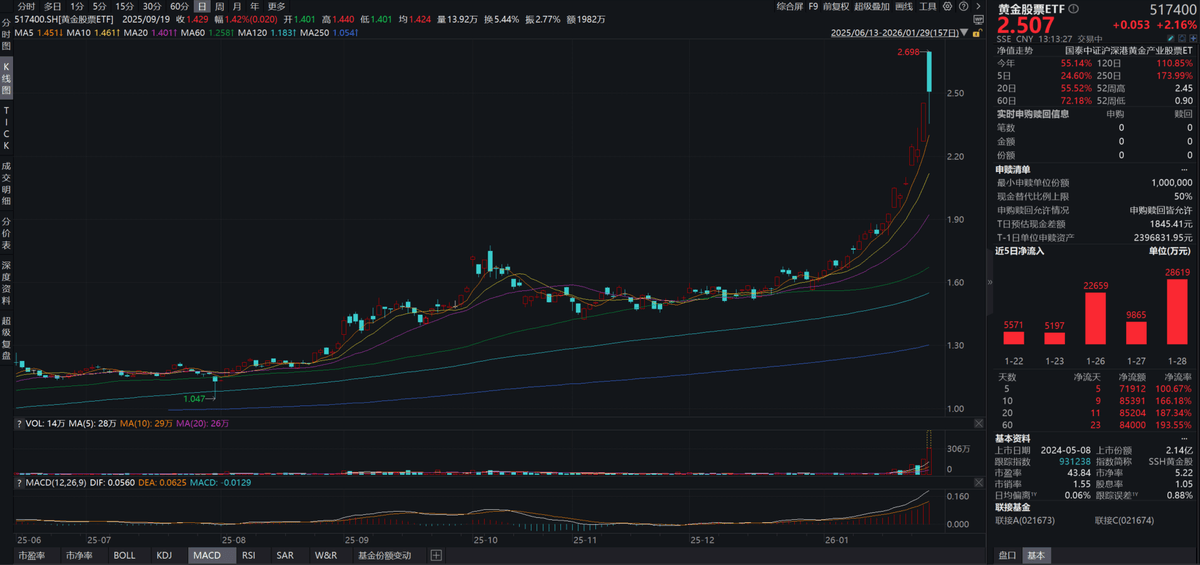
Core Viewpoint - The recent surge in gold prices, surpassing $5,500 per ounce, signifies a profound shift in the global macroeconomic landscape, reflecting a transition in industrial demand paradigms and a reassessment of resource strategic value [3][4]. Group 1: Market Dynamics - Gold prices have recently broken the $5,500 mark, driven by a shift from traditional inflation hedging to a focus on hedging against changes in the global monetary credit system [4][5]. - The recent increase in gold ETF inflows, with over 5% gains and net inflows exceeding 5.8 billion yuan in the last 20 trading days, indicates strong market interest [1][4]. - The total open interest in gold futures has accelerated, reflecting a robust buying force from central banks and institutional asset reallocations [4][5]. Group 2: Macro Environment - The current macro environment is characterized by "de-globalization" and "resource nationalism," leading to strategic control over key mineral resources and creating supply constraints that elevate the strategic premium of all resources [6][7]. - Political factors are increasingly influencing the supply side of mineral resources, with countries implementing policies to strengthen control over domestic resources [7][8]. Group 3: Investment Strategies - The financial environment, marked by the Federal Reserve entering a rate-cutting cycle, reduces the opportunity cost of holding non-yielding assets like gold, providing a favorable liquidity backdrop for gold price increases [5][6]. - The demand for gold is being driven by geopolitical uncertainties and the traditional role of gold as a safe-haven asset, with increasing interest from central banks as long-term buyers [5][9]. - Investment banks, including Goldman Sachs, have raised gold price forecasts, predicting a potential rise to $6,000 per ounce in the spring of 2026, driven by structural changes in central bank gold purchasing behavior [8][9].
资源重估周期下,如何在资源板块里做结构性投资?
Xin Lang Cai Jing· 2026-01-15 07:53
Core Viewpoint - Resource commodities are emerging as a core investment direction due to macroeconomic changes and asset price revaluation, driven by U.S. fiscal expansion and a shift towards looser monetary policy, alongside domestic demand for key metals like copper, aluminum, and lithium [1][3][4] Global Macro Perspective - The combination of U.S. fiscal expansion and low interest rates is expected to drive global funds to reprice major assets, with a renewed focus on precious metals like gold due to increased demand from central banks and institutional investors [3] - The restructuring of global manufacturing, including the return of manufacturing to the U.S. and increased focus on energy security in Europe, is enhancing the underlying demand for resource commodities [3][4] Domestic Demand Dynamics - The new productive forces in China are creating a new demand structure for resource commodities, particularly in sectors like electric vehicles and energy storage, where lithium shows strong demand elasticity [4] - The inventory cycle is shifting from passive destocking to active restocking, indicating a structural change in demand for raw materials and midstream products [4] Investment Framework - The resource commodities are categorized into defensive assets like gold and certain energy resources, and offensive assets like industrial metals (copper, aluminum) and rare resources, emphasizing a balanced "attack and defense" strategy [5][6] - Gold is highlighted as a defensive asset, gaining strategic value amid global conflicts and serving as a hedge against uncertainty [5] - Energy companies with resource control and cost advantages are positioned to provide sustainable cash returns and risk mitigation [6] Rare Metals and Strategic Assets - Rare metals like tungsten and antimony are gaining attention due to their high demand in AI infrastructure, aerospace, and defense sectors, with their scarcity providing pricing power amid supply chain disruptions [7] - The investment logic for these rare resources aligns with a "strategic asset" approach, suggesting potential for price revaluation in the medium to long term [7] Investment Strategy and Performance - The investment strategy emphasizes a high equity position in resource-related companies, focusing on mining and manufacturing sectors, with a significant allocation to upstream resources [8] - The performance of the fund, achieving a total return of 83.05% within less than a year, demonstrates the effectiveness of a forward-looking investment approach [9] Research and Risk Management - The investment discipline emphasizes long-term performance and compliance, integrating macroeconomic analysis with industry trends and individual stock fundamentals [11][12] - A systematic research framework is employed to assess macroeconomic conditions, industry phases, and individual stock evaluations, enhancing the sustainability of investment strategies [11][12]
国海富兰克林基金2026年度展望:慢牛延续,结构分化下的机遇与挑战
Zhong Guo Ji Jin Bao· 2026-01-12 07:21
Core Viewpoint - The report from Guohai Franklin Fund presents a positive outlook for the A-share market in 2026, highlighting a "slow bull" market characterized by structural differentiation, with significant performance from the technology sector and resource revaluation driven by external and internal demand dynamics [1][9]. Group 1: Technology Growth - Artificial Intelligence (AI) is identified as the core driver of the fourth industrial revolution, with its impact expected to surpass that of the internet and mobile internet eras [2]. - The past year has seen exponential growth in computing power driven by companies like OpenAI and Nvidia, alongside advancements in algorithms, leading to a clearer understanding of the path to General Artificial Intelligence (AGI) [2][3]. - The focus for investment in the AI sector should be on commercial opportunities in application development and the technological iteration of computing power, with a strong belief that 2026 will be a breakthrough year for domestic AI industries in China [3]. Group 2: Resource Revaluation - The report notes a significant increase in the prices of non-ferrous metals, driven by geopolitical tensions, de-globalization trends, and the rising demand for strategic resources due to the AI revolution [4]. - The U.S. is implementing tariffs and localization policies to build strategic reserves of critical minerals, while China is enhancing its control over supply in areas like rare earths and tungsten [4]. - The potential for this revaluation trend to extend to oil and agricultural products is highlighted, with oil prices being a key factor influencing global inflation and economic policies [5]. Group 3: Domestic Demand Stabilization - The decline in real estate prices since 2021 has led to a contraction in local government and household balance sheets, contributing to weak domestic demand [6]. - Short-term stabilization of core asset prices and proactive debt management are seen as effective measures to restore balance sheets, while long-term recovery will depend on structural reforms in consumption and income distribution [6][7]. - The direction of real estate policy will be crucial for the performance of the domestic demand sector in 2026, with a shift from a "supportive" to a "stimulative" approach potentially leading to significant valuation recovery across the domestic industry chain [7]. Group 4: National Competition - The report suggests that a stable external economic environment is essential for the continued performance of externally driven sectors, with a shift in U.S. foreign policy expected to lead to a more pragmatic approach [8]. - Improved relations between China and Europe are anticipated, although potential trade disputes in Southeast Asia and other regions remain a concern [8]. - Overall, the external environment in 2026 is expected to be more stable than in 2025, benefiting the outlook for externally driven industries [8]. Conclusion - Guohai Franklin Fund maintains an optimistic view for the A-share market in 2026, with a continued focus on technology growth, resource revaluation, and the potential stabilization of domestic demand [9].
国海富兰克林基金2026年度展望:慢牛延续,结构分化下的机遇与挑战
中国基金报· 2026-01-12 07:16
Core Viewpoint - The report from Guohai Franklin Fund indicates that the A-share market in 2026 is expected to be influenced by a "slow bull" market characterized by structural differentiation, with significant performance from the technology sector and resource revaluation [1][15]. Group 1: Technology Growth - Artificial intelligence (AI) is identified as the core driver of the fourth industrial revolution, with its impact expected to surpass that of the internet and mobile internet eras [3][4]. - The AI sector is anticipated to experience substantial growth in 2026, driven by advancements in domestic manufacturing technology and the mass production of GPUs, alongside established advantages in large model development in China [5]. - The focus for investment in the AI industry should be on commercial opportunities in application and the technological iteration path in computing power, with a recognition of potential short-term disruptions in stock selection due to hardware technology changes [4][5]. Group 2: Resource Revaluation - The report notes a significant increase in the prices of non-ferrous metals, driven by geopolitical tensions, de-globalization trends, and the rising demand for strategic resources due to the AI revolution [7][8]. - The supply-side dynamics are influenced by the U.S. implementing tariffs and localization policies, while China continues to manage its advantages in rare earths and other strategic materials [7]. - The potential for value revaluation trends to extend into oil and agricultural products is highlighted, with oil prices being a critical factor affecting global inflation and economic policies [8]. Group 3: Domestic Demand Stabilization - The decline in real estate prices since 2021 has led to a contraction in local government and household balance sheets, contributing to weak domestic demand [10][11]. - Short-term stabilization of domestic demand relies on balancing the asset-liability sheets of households, governments, and enterprises, while long-term recovery will depend on fundamental changes in economic driving models [10]. - The direction of real estate policy will be crucial for the market structure in 2026, determining whether it will adopt a conservative "support" strategy or a more aggressive "stimulus" approach [11]. Group 4: National Competition - The report suggests that a stable external trade environment is essential for the continuation of strong performance in foreign demand-driven sectors [13]. - The U.S. is expected to adopt a more pragmatic foreign policy, which may lead to a phase of stability in U.S.-China relations and improved ties with Europe [13]. - Despite potential trade disputes in Southeast Asia, China's ability to manage these challenges has significantly improved compared to the past [13]. Conclusion - Overall, Guohai Franklin Fund maintains an optimistic outlook for the A-share market in 2026, expecting a better environment than in 2025, with a continued focus on technology growth and resource revaluation [15].

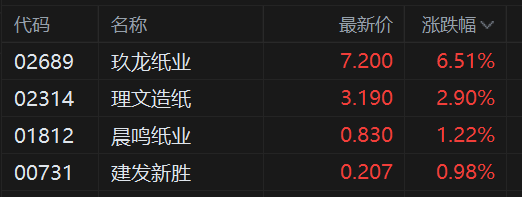
纸业股再度活跃,玖龙纸业涨6.5%续刷阶段新高,月内累计升幅达22%
Ge Long Hui· 2026-01-12 03:50
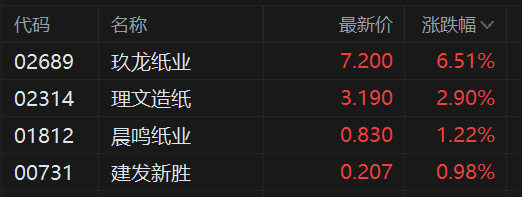
Group 1 - The core viewpoint of the article highlights the recent surge in Hong Kong paper stocks, particularly Nine Dragons Paper, which rose by 6.5%, marking a cumulative increase of 22% for the month [1] - Major packaging paper companies, including Nine Dragons, Shanying, Lee & Man, and Rongcheng, have initiated large-scale maintenance shutdowns to proactively reduce production capacity [1] - Several manufacturers of white card and cultural paper, such as Bohui, APP, and Asia Pulp & Paper, have collectively announced price increases [1] Group 2 - According to CICC, a short-term supply-demand gap for wood chips is expected to emerge by 2026, with a positive outlook for the recovery of wood chip and pulp price levels [1] - Despite recent large-scale domestic production of self-made pulp, the construction cycle for high-quality wood chip resources is lagging behind equipment production, leading to a projected supply gap in the domestic wood chip market by 2026 [1] - The tightening of raw material supply is anticipated to elevate cost pressures, while marginal improvements in demand could lead to a recovery in pulp price levels by 2026, benefiting leading companies with full supply chain capabilities [1]
港股异动丨纸业股再度活跃,玖龙纸业涨6.5%续刷阶段新高,月内累计升幅达22%
Ge Long Hui· 2026-01-12 03:19
Group 1 - The core viewpoint of the articles highlights the recent surge in the Hong Kong paper industry stocks, particularly with Nine Dragons Paper experiencing a 6.5% increase, reaching a new high, and a cumulative rise of 22% within the month [1] - Major packaging paper companies, including Nine Dragons, Shanying, Lee & Man, and Rongcheng, have undertaken large-scale maintenance shutdowns, actively reducing production capacity [1] - Several manufacturers of white card paper and cultural paper, such as Bohui, APP, and Asia Pulp & Paper, have collectively announced price increases [1] Group 2 - According to CICC, a short-term supply-demand gap for wood chips is expected to emerge by 2026, with a positive outlook on the recovery of wood chip and pulp price levels [1] - Despite recent large-scale domestic production of self-made pulp, the construction cycle for quality wood chip resources is lagging behind equipment production, leading to a projected supply gap in the domestic wood chip market by 2026 [1] - The tightening of raw material supply is anticipated to elevate cost levels, while marginal improvements in demand could lead to a recovery in pulp price levels by 2026, benefiting leading companies with full supply chain capabilities [1]
中金:2026年短期木片供需缺口将现,看好木片、浆价中枢修复
Zheng Quan Shi Bao Wang· 2026-01-09 00:19
Core Viewpoint - The short-term supply-demand gap for wood chips is expected to emerge in 2026, with a positive outlook for the recovery of wood chip and pulp prices [1] Group 1: Supply and Demand Dynamics - Domestic production of self-made pulp has increased significantly in recent years, but the construction cycle for high-quality wood chip resources is lagging behind equipment production [1] - A phase of supply shortage in the domestic wood chip market is anticipated in 2026 due to the mismatch between production capacity and resource availability [1] Group 2: Price Recovery and Industry Opportunities - The tightening of raw material supply is expected to elevate cost pressures, while marginal improvements in demand could lead to a recovery in the central price of pulp in 2026 [1] - Leading companies with full industry chain self-sufficiency are likely to experience premium opportunities as they transition from "processing and manufacturing" to "resource revaluation" [1]