
风险管理式降息

Search documents
美联储“鸽派暂停”意味着什么?大摩:未来降息路径将更多由通胀驱动
Hua Er Jie Jian Wen· 2026-01-29 13:55
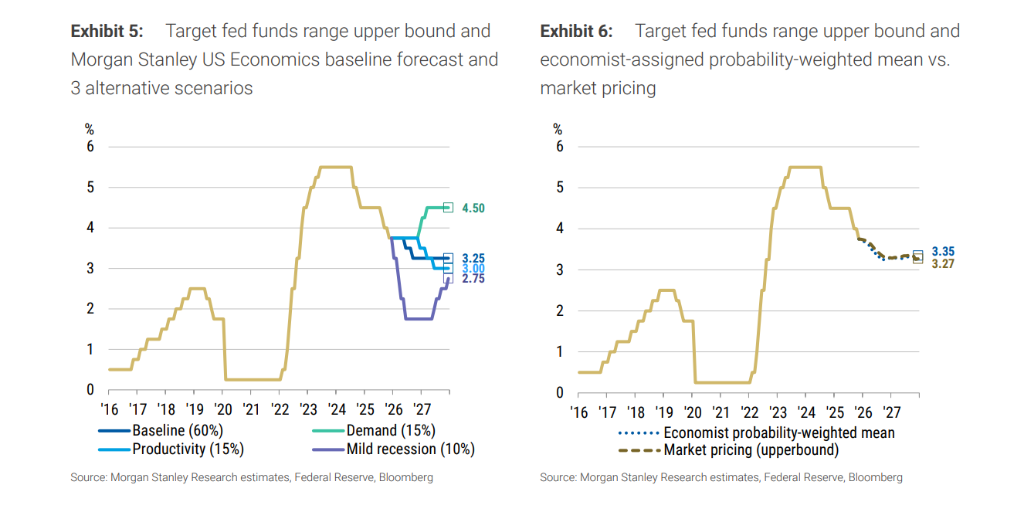
Core Viewpoint - The Federal Reserve implemented a "dovish pause" during the January FOMC meeting, signaling a shift in the future rate cut path, which will now depend more on inflation data rather than solely on labor market weakness [1][5] Economic Outlook - FOMC members showed greater consensus on the economic outlook, with Powell noting stronger economic performance compared to December, supported by resilient consumer spending, expanding business investment, fiscal support expectations, favorable financial conditions, and ongoing AI-related capital expenditures [5] - The only weak area identified was the housing market [5] Rate Cut Logic - The logic for future rate cuts has fundamentally changed, with a shift towards being "inflation-based" rather than "employment-based" as the risk of job losses diminishes [5][6] - Morgan Stanley expects the Fed to maintain patience until clearer signs of inflation deceleration appear, likely later in the year, before considering rate cuts [5][6] Market Strategy - Morgan Stanley's rate strategists recommend maintaining a neutral position on U.S. Treasury durations and curves, while continuing to favor 2-year UST SOFR swap spreads [8][9] - In the foreign exchange market, the firm predicts a weaker dollar, but notes that the Fed's policy is unlikely to be the main driver of dollar depreciation, with more focus shifting to international monetary policies and related intervention risks [9] MBS Strategy - For agency MBS, Morgan Stanley maintains a neutral stance, citing low volatility as favorable but noting that the option-adjusted spread (OAS) is near its narrowest levels in recent years, with ongoing uncertainty in housing policy [9]

美国通胀三维六体分析框架(上篇):美国2026年通胀展望:前高后低,整体可控
NORTHEAST SECURITIES· 2026-01-12 04:14
Group 1: Report Industry Investment Rating No relevant content provided. Group 2: Report's Core View - The report constructs a multi - dimensional analysis framework based on long - term expectations, medium - term cycles, and short - term shocks to systematically sort out the core driving forces and future trends of US inflation [3]. - The Fed's "risk - management style" rate cuts will not restructure the inflation pattern as this round of cuts occurs in a non - recession environment and is more about maintaining economic resilience rather than causing a significant rebound in inflation [3]. - Long - term inflation expectations are anchored, and the Fed's independence remains a key stabilizer, with limited risk of long - term inflation getting out of control [3]. - Endogenous inflation momentum is slowing, and most structural sub - items show downward pressure, except for possible mild rebounds in durables and core services (excluding rent) inflation [3]. Group 3: Summary According to Related Catalogs 1. Inflation Analysis's Three - Dimensional Framework: Long - term Expectations, Core Dynamics, and Short - term Shocks - The Fed assesses inflation trends through a three - dimensional framework: long - term inflation expectations, core inflation, and short - term price shocks [11]. - Long - term inflation is anchored by monetary policy through expectations, core inflation's mid - term fluctuations are driven by the economic cycle, and external factors cause short - term disturbances [12]. - Long - term inflation expectations are the core pillar of the Fed's inflation management, core inflation reflects the domestic demand and labor market, and short - term shocks are usually temporary and exogenous [13]. - "Risk - management style" rate cuts generally do not lead to a significant inflation rebound based on historical experience and logical reasons [20][21]. 2. Is the Fed's Long - term Inflation Anchor Failing? - Although inflation has been persistently above the Fed's 2% target, the 5 - year/5 - year forward break - even inflation rate shows that the market's long - term inflation expectations remain stable [33]. - A quantitative model shows that the Fed's 2% inflation target has played a decisive role in guiding and stabilizing market expectations, and currently, the market may overestimate Trump's short - term impact on the Fed's independence [36][40]. 3. Reconstructing US Inflation Analysis: A Six - Sub - item Analysis Framework 3.1 Food and Beverage: Obvious Dual - Factor Drive of Commodity and Labor Costs - The cost of US food mainly concentrates on the middle and lower reaches of processing and circulation. The CRB food index and salary growth indicators are in a downward trend, so the food sub - item's upward momentum for overall inflation will weaken [3][51]. 3.2 Energy: Inflation Thrust Easing under Changing Supply - Demand Patterns - Energy has a significant impact on overall inflation. In 2025 - 2026, the global crude oil market's supply growth is expected to exceed demand, reducing the risk of a significant upward movement in US inflation [3][56][58]. 3.3 Rent: Lags US Housing Prices by about 15 Months - Rent is a key driver of CPI. In 2026, the year - on - year growth rate of rent is expected to slow to about 2.88%, leading to a 0.3% decline in overall inflation [3][71]. 3.4 Durables: May Face Some Upward Pressure in 2026 - Durables inflation may face upward pressure in 2026, but the pulling effect on inflation is expected to be mild due to the slowdown in the job market and consumer pressure [3][88]. 3.5 Non - durables: Obvious Cost - Driven Characteristics - Non - durables demand is rigid, and prices are mainly cost - driven. Based on the prediction of a decline in the crude oil price center in 2026, non - durables inflation is expected to cool down or fluctuate narrowly [91]. 3.6 Core Services: The Labor Market is the Core Driver - Core services inflation (excluding rent) is mainly driven by the labor market's tightness. Currently, the labor market is demand - driven, and there is no sustainable upward momentum for this type of inflation [3][111].
中信证券:日本良性通胀循环已较稳固,日本央行即将再次加息
Xin Lang Cai Jing· 2025-12-19 00:12
Core Viewpoint - The report from CITIC Securities suggests that Japan's benign inflation cycle is becoming more stable, and the Bank of Japan is likely to raise interest rates again soon [1] Group 1: Economic Context - The global market turmoil following Japan's interest rate hike last summer was primarily driven by rising recession expectations and shifts in the AI narrative in the U.S., rather than the reversal of carry trades, which only exacerbated risk aversion [1] - The "Black Monday" experienced last year is unlikely to be repeated this year due to the different economic conditions [1] Group 2: Market Dynamics - In the context of the policy divergence between the U.S. and Japan, U.S. factors are currently the main narrative influencing global liquidity and the pricing of U.S. dollar assets [1] - Market skepticism regarding the AI narrative is mainly focused on a few companies with aggressive business models, while most financially stable AI leaders are expected to maintain market confidence [1] Group 3: Investment Insights - The ongoing trend of industrial intelligence is anticipated to continue supporting the performance of leading U.S. stocks in the medium to short term [1] - Long-term U.S. Treasury bonds are considered to have a low cost-performance ratio in the current risk management-driven rate cut cycle, while short-term U.S. Treasury bonds may benefit from technical improvements in liquidity due to reserve management purchasing operations [1]

12月FOMC会议简评:眼下的鸽与未来的鹰
GUOTAI HAITONG SECURITIES· 2025-12-12 05:21
1. Report Industry Investment Rating No relevant content provided. 2. Core Viewpoints of the Report - The 12 - month FOMC meeting cut the interest rate by 25bp as expected, but the forward - looking guidance was hawkish, compressing the future easing space. The interest rate path shifted from "continuous rate cuts" to "data - dependent slow - paced easing", and the market repriced the hawkish forward - looking information [5]. - The Fed unexpectedly restarted short - term balance - sheet expansion in advance, with a monthly purchase of about $40 billion in short - term Treasury bonds, and a total bond - buying scale of about $60 billion including MBS reinvestment. This move improved short - term liquidity but did not change the long - and medium - term downward trend of overall interest rates [5]. - After the 12 - month rate cut, the long - end U.S. Treasury yields did not decline significantly. The "profit - taking" effect and the rebalancing of global liquidity and carry - trade structure led to a sell - off of long - end U.S. Treasuries [5]. - The policy structure of this meeting was typically "dovish now, hawkish in the future". The short - term interest rates and risk assets benefited, but the long - end interest rates needed to re - incorporate a higher risk premium. The main logic of the interest - rate market shifted from "trading rate cuts" to "waiting for data and the new chairman's policy inclination" [5]. 3. Summary by Relevant Catalogs 3.1 Policy Itself: A Hawkish Neutral Rate Cut - The overall tone of this rate cut was hawkish. The dot - plot showed only one rate cut in 2026, less than the market's expectation, compressing the future easing space. The statement hinted at a possible slowdown or pause in the rate - cut rhythm. Future rate cuts would depend highly on employment and inflation data [8]. - This rate cut was a "risk - management rate cut" rather than the start of a new strong rate - cut cycle. Based on the hawkish guidance, the long - end interest rates might rebound. The policy choice was between "maintaining the status quo" and "how much to cut", and the 2026 interest - rate path would depend on data [9]. 3.2 The Fed's Early Restart of Balance - Sheet Expansion - Starting from December 12, the Fed began to buy about $40 billion in short - term Treasury bonds monthly, with a total bond - buying scale of about $60 billion including MBS reinvestment. This short - term balance - sheet expansion aimed to maintain the bank - system reserves at an "abundant level" and improve money - market liquidity, which was earlier than expected [10]. 3.3 Interest - Rate Market: The Landing of Rate - Cut Benefits vs. Liquidity Spillover Effects 3.3.1 "Profit - Taking" Logic - After the rate cut, the long - end U.S. Treasuries did not rally significantly because the market had already priced in continuous rate - cut expectations since the second half of 2025. The new dot - plot was hawkish, restricting the downward space of long - end interest rates, which were likely to enter a range - bound pattern [13]. 3.3.2 Changes in Global Liquidity and Carry - Trade Structure: Rising Japanese Bond Yields and U.S. Dollar Fund Repatriation Pressure - The rapid rise in Japanese bond yields narrowed the U.S. - Japan interest - rate spread, weakening the "sell Japanese bonds, buy U.S. bonds" carry - trade strategy. Funds flowed back to Japan, leading to the liquidation of carry - trade positions and putting pressure on long - end U.S. Treasuries. The U.S. reserve shortage amplified this impact, which also explained the Fed's early balance - sheet expansion [14].
机构:美联储实施了“风险管理式降息”
Sou Hu Cai Jing· 2025-12-11 06:26
Core Viewpoint - The recent interest rate cut by the Federal Reserve is characterized as a "risk management cut" due to a slowing job market and limited inflation concerns [1] Group 1: Economic Impact - The interest rate cut and its lagging effects will significantly impact a large portion of U.S. businesses, particularly small and medium-sized enterprises (SMEs) [1] - SMEs are notably affected due to their size, scope, and reliance on short-term financing [1]
资产配置快评:美联储继续降息,同时重启扩表——12月美联储议息会议点评2025年第8期
Huachuang Securities· 2025-12-11 02:21
Monetary Policy Changes - The Federal Reserve announced a rate cut of 25 basis points in December, lowering the federal funds rate range from 4%-3.75% to 3.75%-3.5%[1] - The Fed raised its economic growth forecast for the U.S. next year while lowering inflation expectations, with the 2026 GDP growth forecast increased by 0.5% to 2.3% and the core PCE forecast reduced by 0.1% to 2.5%[1][4] Future Rate Projections - The latest dot plot indicates the Fed may cut rates once in both 2026 and 2027, with no cuts expected in 2028, maintaining a neutral rate at 3%[1][4] - The median forecast for the federal funds rate at the end of 2026 is not expected to be lower than 3.25%, with a similar outlook for 2027[4] Economic Outlook - The Fed's decision to purchase short-term U.S. Treasury securities aims to maintain ample reserve levels, unrelated to monetary policy stance[1][5] - The Fed's actions support a positive outlook for the U.S. economy, with potential upward pressure on the dollar and long-term Treasury yields[1][7] Risks and Market Reactions - Risks include a potential price war in the oil market and systemic financial risks in emerging markets[2] - Following the Fed's rate cuts from April to September, U.S. equities, the dollar, and long-term Treasury yields have shown upward trends, indicating a shift in market sentiment[7]
伦敦金维持震荡 野村转变降息立场
Jin Tou Wang· 2025-12-09 02:22
Group 1 - The core viewpoint of the news indicates that Nomura Securities has revised its expectations for the Federal Reserve's interest rate decision in December, now anticipating a 25 basis point cut instead of maintaining rates [2] - The revision is based on sufficient dovish signals for the Fed's moderates, suggesting that a "risk management-style rate cut" is reasonable [2] - The report also highlights that the U.S. personal consumption expenditures (PCE) price index data aligns with market expectations, not significantly altering the outlook for the Fed's policy easing [2] Group 2 - In the London gold market, the current trading price is above $4207, with a reported price of $4210.49 per ounce, reflecting a 0.33% increase [1] - The technical analysis indicates an overall upward trend for London gold, with key support levels at $4168 and $4110 [3] - The intraday trading analysis suggests a range-bound market, with support seen between $4195 and $4190, and resistance at $4230 [3]

12月8日白银晚评:本周将迎来降息决议 白银今晚或继续上涨
Jin Tou Wang· 2025-12-08 09:53
Core Viewpoint - The article discusses the current state of silver prices and the expectations surrounding the Federal Reserve's interest rate decisions, highlighting a potential rate cut in December and its implications for the silver market. Group 1: Silver Price Analysis - As of December 8, the spot silver price is trading at $58.50 per ounce, with a daily range between $57.52 and $58.61 [1] - The silver trading strategies indicate that the price remains above the 200-hour EMA, which is positioned at $56.30, providing bullish support [4] - The MACD has turned negative, suggesting a buildup of downward momentum, while the RSI is at 50.82, indicating a neutral stance [4] Group 2: Federal Reserve Expectations - Nomura Securities has revised its expectation for the Federal Reserve to cut rates by 25 basis points in December, citing sufficient dovish signals for a "risk management-style rate cut" [3] - The probability of a 25 basis point rate cut in December is estimated at 86.2%, with a 13.8% chance of maintaining the current rate [3] - Key upcoming data to watch includes consumer inflation expectations and weekly jobless claims, which may influence the Fed's decision [3]
消息面平静但黄金跌破4200美元 市场预期美联储将“鹰式”降息?
Sou Hu Cai Jing· 2025-12-02 13:03
Group 1 - The core point of the articles is that gold prices unexpectedly fell below $4200 due to traders betting on a "hawkish rate cut" by the Federal Reserve in December, which involves lowering rates while signaling caution about future policy uncertainty [1][2] - The internal division within the Federal Reserve has intensified, with members expressing differing opinions on whether to pause rate cuts or implement a 50 basis point cut, leading to increased market uncertainty regarding future monetary policy [1] - Market reactions include a stabilization of the dollar index after a sharp decline and a steepening of the U.S. Treasury yield curve, indicating expectations for short-term rate cuts while maintaining caution about long-term economic prospects [1] Group 2 - The concept of "hawkish rate cut" implies that the Federal Reserve aims to stabilize the market through rate cuts without encouraging excessive risk-taking, as Chairman Powell may issue warnings about future policy uncertainty and ongoing inflation concerns [2] - The recent decline in gold prices is viewed as a measure to cool the market and prevent overly optimistic sentiment that could lead to inflationary pressures [2]
美联储10月货币政策会议纪要出炉:未来宽松取向明确 降息节奏充满变数
Qi Huo Ri Bao· 2025-11-21 03:53
Group 1 - The Federal Reserve's October meeting minutes reveal significant internal divisions regarding the decision to lower interest rates and the potential for further cuts in December [1][2] - Nearly all participants agreed that ending the balance sheet reduction plan on December 1 is appropriate, but there were differing opinions on the October rate cut, indicating a split within the Fed [2][3] - The market's expectation for a December rate cut has decreased from 83% at the end of October to around 30%, reflecting the uncertainty in the Fed's future monetary policy direction [3][4] Group 2 - The labor market in the U.S. is showing signs of weakness, with initial jobless claims and continuing claims both higher than previous values, which may support the Fed's decision to maintain a loose monetary policy [4][5] - The uncertainty surrounding inflation targets is a significant factor that could constrain the Fed's ability to lower rates further, especially if inflation rises unexpectedly [4][6] - The political pressure from President Trump on the Fed could influence future rate cut expectations, as his control over Fed appointments may increase significantly next year [5][6]