
GDP目标

Search documents
——利率债市场周度复盘:权益走强叠加美伊冲突爆发,债市收益率先上后下-20260301
Huachuang Securities· 2026-03-01 13:26
1. Report Industry Investment Rating - Not provided in the content 2. Core View of the Report - In the first week after the Spring Festival, strong equity performance, tariff progress, and the "Shanghai Seven Measures" boosted equity risk appetite, leading to a callback in the bond market driven by profit - taking of trading desks. On Friday, the central bank lowered the foreign exchange risk reserve ratio for forward foreign exchange sales, and on Saturday, the Iran - US conflict intensified the risk - aversion sentiment, causing bond yields to decline. Overall for the week, the yield of the 1 - year Treasury active bond rose 1.92BP to 1.30%, the yield of the 10 - year Treasury active bond rose 1.19BP to 1.79%, and the 30 - year Treasury yield rose 1.05BP to 1.235% [4][7]. 3. Summary According to the Directory 3.1 Interest Rate Bond Market Review - **Overall Situation**: In the first week after the Spring Festival, factors such as good holiday high - frequency data, tariff progress, and the "Shanghai Seven Measures" improved equity risk appetite. Profit - taking by trading desks led to a bond market callback. Policy adjustments and the Iran - US conflict later drove bond yields down. The yields of 1 - year, 10 - year, and 30 - year Treasury bonds all increased slightly for the week [4][7]. - **Daily Analysis**: - **Tuesday (February 24)**: The central bank net - withdrew 9264 billion yuan. The capital market was balanced, risk appetite improved, and the equity market was strong. The bond market was lightly traded, with most maturities fluctuating within 0.5BP of the ChinaBond valuation [1][8][13]. - **Wednesday (February 25)**: The central bank net - injected 3095 billion yuan. The capital market changed from tight to loose, and the Shanghai real - estate policy was optimized. The equity market was strong, and due to the stock - bond seesaw effect and institutional profit - taking, bond yields oscillated and adjusted, with the 10 - year Treasury yield rising above 1.8% [1][8][14]. - **Thursday (February 26)**: The central bank net - withdrew 795 billion yuan. The equity market had a high - level correction. Due to the "Shanghai Seven Measures" and pre - Two Sessions policy games, profit - taking sentiment increased, and the bond market sentiment was weak, with the 10 - year Treasury yield rising to a maximum of 1.8140% [1][8][15]. - **Friday (February 27)**: The central bank net - injected 2690 billion yuan and lowered the foreign exchange risk reserve ratio for forward foreign exchange sales. The Politburo meeting's communiqué had little new content. Bond market sentiment recovered, and the yields of most bonds declined, with the 10 - year Treasury active bond yield returning to around 1.8% [2][8][16]. - **Saturday (February 28)**: The central bank continued net - injection. The capital market was stable and loose. In the afternoon, the Iran - US situation escalated, and risk - aversion sentiment drove bond yields down rapidly, with the 10 - year Treasury active bond yield dropping 1.2bp to 1.79% [2][8][18]. - **Next Week's Focus**: - **Fundamentals**: Due to the Spring Festival holiday in February affecting production, the PMI is expected to remain below the boom - bust line. In 2026, local economic targets have been mostly lowered, and it is expected that the policy intensity during the Two Sessions will remain the same, with the GDP target maintained at around 5% [2][9]. - **Funds**: At the beginning of the month, there are few capital disturbances, and the capital market is likely to remain stable. 1 trillion yuan of 3 - month repurchase agreements are due, and attention should be paid to the central bank's renewal [2][9]. - **Overseas**: After the breakdown of the Geneva negotiations, the risk of the Iran - US conflict over the weekend continued to rise, the Middle East situation became more tense, and global risk - aversion sentiment increased significantly. Attention should be paid to the volatility risks of global stocks, crude oil, gold and other assets [2][9]. 3.2 Capital Market - The central bank's open - market operations (OMO) had a net withdrawal, and the capital market was balanced and loose. The 1 - year national - share bank certificate of deposit issuance rate dropped to 1.59%, and the capital sentiment index was basically around 50 [1][8][21]. 3.3 Primary Issuance - The net financing of Treasury bonds and local bonds increased, while the net financing of policy - financial bonds and inter - bank certificates of deposit decreased [25]. 3.4 Benchmark Changes - The term spread of Treasury bonds narrowed, while the term spread of China Development Bank bonds widened. Specifically, the short - end yields of Treasury bonds rose 0.23BP, and the long - end yields fell 1.46BP. The short - end yields of China Development Bank bonds rose 0.47BP, and the long - end yields rose 1.60BP. The 10Y - 1Y spread of Treasury bonds narrowed 1.69BP to 45.58BP, and the 10Y - 1Y spread of China Development Bank bonds widened 1.13BP to 39.31BP [20][30].
2026年地方两会收官——图观地方两会第8期
一瑜中的· 2026-02-09 15:23
Core Viewpoint - The article discusses the GDP target adjustments of 31 provinces in China for the year 2026, highlighting a trend of downward adjustments and the implications for economic growth [4][6]. Summary by Sections GDP Target Adjustments - 16 provinces have lowered their GDP targets by 0.5 percentage points, while 12 provinces have kept their targets largely unchanged [6]. - The weighted average GDP target for 2026 across the 31 provinces is set at 5.27%, which is 0.27 percentage points higher than the national target of 5.0% for this year [6]. Specific Provincial Targets - Guangdong and Zhejiang are among 7 provinces that have set range targets, with Guangdong's target set between 4.5% and 5.5% [6]. - Historical context shows that only in 2016 and 2019 did major provinces set range targets, coinciding with significant economic events [6]. Economic Performance Indicators - In 2025, the GDP growth was reported at 5.5%, with fixed asset investment declining by 9.2%, and retail sales increasing by 4.2% [11]. - The expected GDP growth for 2026 is projected to be between 5% and 5.5%, with a focus on achieving better results in practice [12]. Investment and Consumption Goals - The investment target for 2026 includes starting over 2000 key projects, while the retail sales target is set to grow by approximately 4% [12][14]. - The focus on consumption includes expanding cultural industries and enhancing the quality of goods and services available [17]. Employment and Income - The target for urban employment in 2026 is to create around 680,000 new jobs, with an urban unemployment rate aimed at approximately 5.5% [12][18]. - The plan includes measures to increase disposable income for both urban and rural residents, aiming for growth rates above the national average [12][18]. Technological and Industrial Development - The emphasis on technological innovation includes establishing influential centers for smart automotive technology and quantum information [17]. - The strategy involves enhancing the capabilities of emerging industries and fostering a conducive environment for innovation [17].


GDP设定区间目标的历史经验——图观地方两会第6期
一瑜中的· 2026-02-02 07:13
Core Viewpoint - The article discusses the GDP targets set by various provinces for 2026, highlighting a trend of downward adjustments in targets by several major provinces, indicating a cautious economic outlook for the upcoming year [2][3]. Summary by Sections GDP Targets - As of January 31, 2024, 22 provinces have set GDP targets, accounting for 67% of the national GDP. Notably, 12 provinces, including Guangdong and Zhejiang, have lowered their GDP targets by 0.5 percentage points, with a weighted average target of 5% for these provinces compared to 5.3% the previous year [3][4]. - The historical data shows that when two or more major economic provinces set a range target, the national target tends to follow suit, as seen in 2016 and 2019 [3][4]. Provincial Adjustments - Specific provinces have set their GDP targets as follows: - Guangdong: 4.5%-5.5% - Zhejiang: 5%-5.5% - Henan: 5% - Hubei: 5.5% - Other provinces have also adjusted their targets, with some showing increases while others have decreased their expectations [6][7]. Economic Performance Indicators - The article provides insights into the economic performance of specific regions, such as Tibet, which aims for a GDP growth of over 7% in 2026, and Heilongjiang, which targets a GDP growth of 4.5%-5% [8][15]. - The expected growth rates for fixed asset investment and retail sales are also outlined, with Tibet aiming for a 15% increase in fixed asset investment and a 7% increase in retail sales [8][11][13]. Investment and Consumption Goals - Investment goals for 2026 include significant infrastructure projects and initiatives to boost consumption, with Heilongjiang planning to implement over 2,000 promotional activities to stimulate consumer spending [15][19]. - The focus on clean energy and agricultural productivity is emphasized, with specific targets for investment in these sectors [8][15].
宏观点评:1月PMI超季节性回落的背后-20260201
GOLDEN SUN SECURITIES· 2026-02-01 06:20
Economic Indicators - January manufacturing PMI fell to 49.3%, down 0.8 percentage points from the previous month, indicating a return to contraction territory[3] - January non-manufacturing PMI decreased to 49.4%, also down 0.8 percentage points, reflecting a similar trend[3] - Composite PMI dropped to 49.8%, a decline of 0.9 percentage points, suggesting overall economic activity is contracting[3] Demand and Supply Dynamics - New orders index fell by 1.6 percentage points to 49.2%, indicating a return to contraction in demand[3] - The production index for January was 50.6%, down 1.1 percentage points, showing a slowdown in manufacturing activity[4] - New export orders index decreased by 1.2 percentage points to 47.8%, signaling weakened external demand[4] Sector Performance - Service sector PMI fell to 49.5%, down 0.2 percentage points, weaker than seasonal trends[6] - Construction PMI dropped significantly by 4.0 percentage points to 48.8%, attributed to adverse weather and the upcoming Spring Festival[6] - Employment indices for manufacturing, services, and construction showed minimal changes, indicating persistent employment pressure[5] Future Economic Outlook - The GDP target for 2026 is projected to be between 4.5% and 5%, suggesting a need for proactive and expansionary policies[7] - Local government meetings are focusing on GDP targets, with a weighted average of 5% across 20 regions, reflecting a downward adjustment of 0.5 percentage points in major provinces[8] - Key areas of focus include fiscal policy acceleration, potential interest rate cuts by the central bank, and early commencement of major projects[7]
开年以来二手房销售改善、新房仍弱【国盛宏观|高频半月观】
Xin Lang Cai Jing· 2026-01-25 16:12
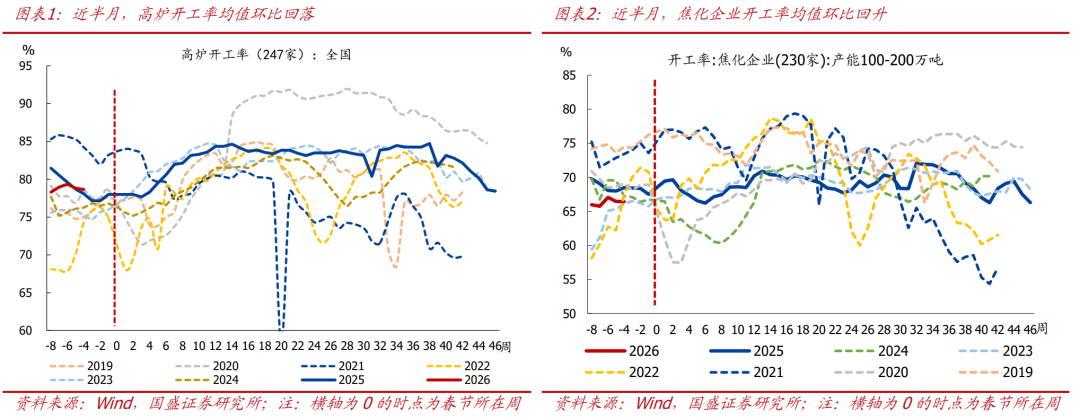
Core Conclusion - The recent high-frequency changes indicate three main trends: improvement in second-hand housing sales, continued weakness in new housing sales, and rising prices of major commodities [1][2]. Group 1: Supply - Upstream operating rates show divergence, with a slight recovery in coking and asphalt, while high furnace and cement dispatch rates have declined. The average operating rate of high furnaces decreased by 0.4 percentage points to 78.7% [3][18]. - In the downstream sector, the operating rate of automotive semi-steel tires increased by 6.9 percentage points to 74.0%, while the operating rate of polyester filament saw a seasonal decline [21]. Group 2: Demand - Second-hand housing sales continued to improve, while new housing sales remained weak. From January 1 to 23, the average transaction area of new homes in 30 major cities decreased by 55.1% month-on-month, with a year-on-year decline of 38.6% [5][34]. - In contrast, second-hand housing sales in 18 key cities remained stable, with a month-on-month increase of 22.5%, indicating a potential recovery [34]. Group 3: Prices - Most upstream commodity prices have risen, with Brent crude oil prices increasing by 5.4% month-on-month, while LME copper prices rose by 2.1% [7][38]. - The average price of rebar increased by 0.2% month-on-month, while cement prices fell by 1.7% [8][46]. Group 4: Inventory - Industrial metal inventories have increased, with steel and electrolytic aluminum inventories rising by 0.3% and 5.8%, respectively [10][54]. - The average coal inventory in coastal power plants decreased by 3.7% month-on-month, while U.S. crude oil and petroleum product inventories increased by 14.76 million barrels [10][52]. Group 5: Transportation and Logistics - Chinese export freight rates have rebounded, with the CCFI index rising by 1.2% month-on-month [13][61]. - The number of commercial flights increased by 2.6% month-on-month, while subway ridership in 10 key cities saw a slight decline [58]. Group 6: Liquidity - The central bank implemented a net liquidity injection of 10,423 billion yuan through OMO, with a focus on easing monetary conditions [15][65]. - The yield on 10-year government bonds decreased by 2.1 basis points, reflecting a broader trend of declining interest rates [67].
地方两会的“信息点”
一瑜中的· 2026-01-12 16:04
Group 1 - The provincial two sessions are typically held before the Lunar New Year, with 17 provinces confirming meetings in January, representing 57.3% of the national GDP for 2024 [1] - Among the six major economic provinces, four will hold their sessions in January, which collectively account for 44.4% of the national GDP [1] - Zhejiang will kick off the sessions on January 14, followed by Henan, Shandong, and Guangdong on January 26, while Jiangsu is scheduled for early February [1] Group 2 - The focus of the provincial two sessions includes setting GDP targets for the next five years, with Changsha establishing a range of 5%-5.5% annual growth, down from the previous target of around 7% [2] - Historical data shows that the weighted GDP targets of the 31 provinces are consistently higher than the national target by 0.3-0.6 percentage points from 2022 to 2025 [2] - The CPI targets are generally aligned with the national target, with Wuhan maintaining a target around 2% and Changsha lowering its target from around 3% to around 2% [3] Group 3 - Employment targets are assessed by comparing the total across the 31 provinces to the previous year, with Wuhan's new employment target remaining consistent with last year [3] - The growth rate of major projects in economic provinces is a key observation point, with previous years showing limited project increases, indicating potential investment momentum issues [3] - Other areas of interest include real estate investment, service consumption statements from provinces, and local consensus on industrial policies [3]

【宏观快评】:地方两会的信息点
Huachuang Securities· 2026-01-12 13:44
Group 1: Provincial Meetings Timing - Provincial meetings are typically held before the Lunar New Year, with 17 provinces confirming meetings in January, representing 57.3% of the national GDP for 2024[2] - Among the six major economic provinces, four will hold meetings in January, accounting for 44.4% of the national GDP[2] - Zhejiang will kick off the meetings on January 14, followed by Henan, Shandong, and Guangdong on January 26, with Jiangsu scheduled for early February[2] Group 2: Economic Goals and Targets - The future five-year GDP target for Changsha is set as a range of 5%-5.5%, down from the previous target of around 7%[3] - Historical data shows that the weighted GDP targets of 31 provinces are consistently 0.3-0.6 percentage points higher than the national target from 2022 to 2025[3] - CPI targets for provinces are generally aligned with the national target; Wuhan maintains a target of around 2%, while Changsha has lowered its target from around 3% to 2%[3] Group 3: Employment and Investment Insights - The employment target for Wuhan remains consistent with the previous year, indicating stability in national employment goals[4] - There is uncertainty regarding the growth rate of major projects in economic provinces for 2026, with mixed expectations on infrastructure investment[4] - Key areas of focus include urban village renovations in real estate and new statements on service consumption from provinces[4]
中国经济 - 中央经济工作会议前瞻:托底而非拉升-China Economics-CEWC Preview Cushion, Not Lift
2025-12-09 01:39
Summary of the Conference Call Transcript Industry Overview - **Industry**: Chinese Economy and Policy Outlook - **Company**: Morgan Stanley Asia Limited Key Points and Arguments 1. **2026 Economic Stance**: The policy for 2026 is expected to maintain a small, reactive approach rather than a significant pivot. The GDP target is set at 5% to ensure a solid start for the 15th Five-Year Plan. The fiscal package is likely to remain flat compared to 2025, with a potential mid-year top-up of approximately 0.5 percentage points of GDP if necessary [4][4][4]. 2. **Policy Mix**: The tone remains supply-centric, with an emphasis on rebalancing. The strategy includes expanding domestic demand while optimizing supply, indicating a focus on better composition rather than size [4][4][4]. 3. **Missing Elements**: The meeting did not address specific actions regarding service consumption, property stabilization, or social-welfare support, which may indicate a lack of immediate plans in these areas [4][4][4]. 4. **Macro Economic Outlook**: The forecast for 2026 includes less deflation rather than reflation, with a base case of 4.8% real GDP growth and approximately 4.1% nominal GDP growth. The GDP deflator is expected to improve but remain below zero [4][4][4]. 5. **Support Tools**: Infrastructure support will be front-loaded through Local Government Special Bonds (LGSB) and policy banks. There will be guardrails for the housing market, including optional mortgage-interest subsidies if stress broadens. Support for service consumption is anticipated to be more likely in the second half of the year once regulations are established [4][4][4]. 6. **Policy Style**: The approach will involve small, reactive steps, with increased coordination language and a push against anti-involution and for market-oriented policies [4][4][4]. Additional Important Content - The report emphasizes the continuity of existing policies and the cautious approach towards new initiatives, reflecting a careful balancing act in the current economic climate [4][4][4]. - The lack of mention of specific sectors such as services and real estate may suggest potential risks or areas of concern that investors should monitor closely [4][4][4].
李迅雷:对当前经济热点的一点思考 | 立方大家谈
Sou Hu Cai Jing· 2025-11-25 14:11
Group 1: Real Estate Cycle - The long-term upward cycle of real estate from 2000 to 2020 led to a widespread belief that housing prices would not decline, despite contrary predictions from analysts like Professor Zhu Ning [2][3] - The average rental yield in core cities of China is estimated to be around 2%, indicating a high price-to-earnings ratio of 50 times, suggesting that a rental yield of 3% is necessary for a price bottom [3][6] - Real estate development investment in China decreased by 14.7% year-on-year in the first ten months of the year, indicating a potential acceleration in the downward trend [3][6] Group 2: Economic Impact - The decline in the real estate sector is expected to continue affecting China's economy through 2026, with significant impacts on related industries and financial sectors [3][6] - The slowdown in urbanization, aging population, and declining total population are identified as pressures on the real estate market post-2021 [6] - The contribution of real estate to GDP and employment is significant, and its decline could hinder overall economic growth [6][12] Group 3: Export Trends - China's exports grew by 5.3% in the first ten months of the year, contrary to initial fears of negative growth, with a notable increase in capital and technology-intensive products [7][8] - However, the growth in exports is expected to slow down in the coming year due to the diminishing "import grabbing" effect from the U.S. and high base effects from previous years [11][12] - The ongoing trade tensions and tariff wars between major economies are likely to impact future export performance negatively [11][12] Group 4: Consumer Spending - Consumer spending is projected to become a more significant contributor to GDP growth, especially as export growth declines [12][16] - The consumption growth has shown a pattern of being higher in the first half of the year, with expectations of a slowdown in the latter half due to high base effects from previous years [15][16] - Long-term improvements in consumption will depend on rising household incomes and increased marginal propensity to consume, which are currently challenged by the real estate downturn [16][19] Group 5: Fiscal and Monetary Policy - The fiscal policy for 2026 is expected to be more aggressive, with a projected increase in the general deficit from approximately 11.9 trillion yuan to 13.2 trillion yuan [28][31] - Interest rates may be lowered by 10-20 basis points in 2026 to stimulate demand, although this poses challenges for banks' net interest margins [35][36] - Coordination between fiscal and monetary policies is deemed essential to address the economic challenges and support growth [40][41] Group 6: Stock Market Outlook - The stock market has faced resistance around the 4000-point mark, with the need for corporate profit growth to outpace GDP growth for a sustained bull market [41][43] - The current economic environment suggests that corporate profitability must improve significantly to support stock market performance [41][43] - Structural bull markets are anticipated, particularly in the context of the AI revolution, which may provide new growth opportunities for companies [47][48]
“十五五”,GDP目标怎么定?
和讯· 2025-10-24 10:12
Core Viewpoint - The article discusses the key outcomes of the Fourth Plenary Session of the 20th Central Committee, focusing on the economic goals set for the 14th and 15th Five-Year Plans, particularly the target of achieving a per capita GDP at the level of moderately developed countries by 2035 [2][3][6]. Economic Growth Targets - The average economic growth rate during the 14th Five-Year Plan (2020-2024) is projected to be 5.5%, with per capita GDP increasing from $10,632 in 2020 to $13,445 in 2024, surpassing $13,000 for two consecutive years [3]. - For the 15th Five-Year Plan, a GDP annual growth rate of at least 4.5% is suggested, with potential targets set around 5% [3][4]. - The potential economic growth rate for the 15th Five-Year Plan is estimated to be between 4.5% and 5.3% under baseline conditions, and could rise to 5.1% to 5.8% in optimistic scenarios [3]. Strategic Environment - The development environment for the 15th Five-Year Plan is characterized by both strategic opportunities and risks, with increasing uncertainties in international relations and domestic economic pressures [5][6]. - The emphasis on high-quality development and technological self-reliance is highlighted as a key focus for the upcoming period, indicating a shift towards prioritizing quality over quantity in economic growth [6]. Policy Implications - The upcoming full text of the 15th Five-Year Plan is expected to be released by the end of October, with the final version to be approved in March 2026 [4]. - The document underscores the importance of balancing development with national security, particularly in the context of global geopolitical shifts [6].
