
财政扩张

Search documents
财政扩张令加息存疑 日元结构性压力强化
Jin Tou Wang· 2025-11-19 03:19
Core Viewpoint - The USD/JPY exchange rate is experiencing a strong upward trend, maintaining above 155.30, with a recent peak at 155.73, marking a 9-month high, indicating a bullish sentiment in the market [1] Group 1: Market Dynamics - The Japanese yen remains weak, hovering near its lowest point since February, due to unclear guidance on future Bank of Japan policies and the government's preference for fiscal expansion and low interest rates, which adds structural pressure on the yen [1] - The ruling party's budget committee proposed an additional fiscal budget exceeding 25 trillion yen to support the Prime Minister's stimulus plan, raising concerns about increased government bond supply and pushing 40-year bond yields to historical highs [1] - The Prime Minister emphasized the risk of deflation and reiterated the desire for inflation driven by wage growth rather than external factors, urging the central bank to continue supporting economic stimulus efforts and expressing resistance to interest rate hikes [1] Group 2: Technical Analysis - Despite the accelerated rise in the USD/JPY pair, the Relative Strength Index (RSI) indicates that it has not yet entered the overbought territory, suggesting potential for further gains if employment data is strong, possibly pushing the exchange rate above 156.00 [3] - Conversely, if the employment data falls short of expectations, it could lead to a bearish reversal, with potential declines towards the 152.00 level and the 50-day moving average at 151.87 [3] Group 3: Risk Sentiment - Global risk sentiment has weakened, leading to a slight increase in safe-haven demand, which provides some support for the yen [2]
日债危机重现?财政刺激担忧加剧,日本“股债汇”三杀,长债收益率再创新高
Hua Er Jie Jian Wen· 2025-11-18 07:55
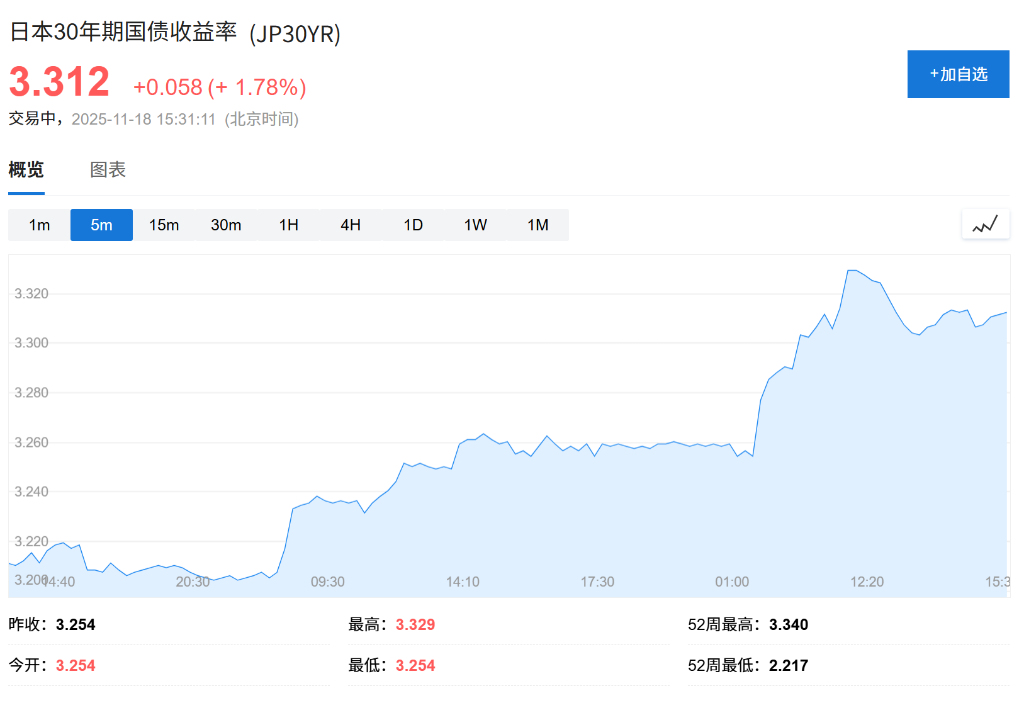
Core Viewpoint - Concerns over a new large-scale economic stimulus plan in Japan are causing turmoil in the bond market, leading to a surge in long-term government bond yields and downward pressure on the yen, impacting the stock and currency markets simultaneously [1][2][5]. Group 1: Bond Market Reaction - The price of Japanese long-term government bonds has plummeted, with the 40-year bond yield rising by 8 basis points to 3.68%, the highest since its issuance in 2007 [1]. - The 20-year and 30-year bond yields have also increased by at least 4 basis points, with the 30-year yield nearing historical highs [1]. Group 2: Yen Exchange Rate - The yen has weakened significantly, with the exchange rate against the US dollar falling below the critical psychological level of 155 and reaching a historical low of 180 against the euro [2]. Group 3: Economic Stimulus Plan Speculation - Market speculation centers on the anticipated scale of the economic stimulus plan, which is expected to exceed last year's 13.9 trillion yen (approximately 89.8 billion USD) [7][8]. - Finance Minister Satsuki Katayama indicated that the plan has "expanded significantly" so far, heightening investor anxiety over potential new debt issuance [8]. Group 4: Internal Political Pressure - Pressure from within the ruling Liberal Democratic Party may lead to more aggressive fiscal measures, with a proposal for a supplementary budget of approximately 25 trillion yen (about 161 billion USD) being submitted [10]. - This figure significantly exceeds previous media reports of a supplementary budget around 14 trillion yen and a total plan scale of 17 trillion yen [10]. Group 5: Market Sentiment and Upcoming Auctions - Market sentiment is extremely pessimistic ahead of the upcoming 20-year bond auction, with expectations of weak demand for the 800 billion yen (approximately 51.6 million USD) bonds [11]. - Analysts predict that if demand is weak, yields may rise further, reflecting concerns over the expanding stimulus plan and delayed interest rate hikes by the central bank [11][14]. Group 6: Yield Curve Dynamics - The steepening of the yield curve indicates that long-term yields are rising faster than short-term yields, reflecting market expectations of increased long-term risk premiums due to government borrowing [14]. - The 10-year benchmark bond yield rose by 1.5 basis points to 1.745%, reaching its highest level since June 2008 [11][14].

11月18日热门路演速递 | 华泰、中金、瑞银把脉投资主线,小米、拼多多业绩会揭晓答案
Wind万得· 2025-11-18 05:48
Group 1 - The core viewpoint of the article emphasizes the potential validation of the AI investment boom and the impact of global fiscal expansion combined with monetary policy on the market, as well as the transition of domestic economic drivers and the possibility of substantial improvement in corporate profits next year [2] Group 2 - The article discusses the increasing divergence between new and old economies in China and the US, highlighting that the bull markets in stocks and bonds are not mutually exclusive. It notes that with continued global fiscal policy easing, monetary policy is expected to follow suit, and China's trade surplus and fiscal deficit are at record highs, providing support for the economy and stock market [4] Group 3 - The focus is on three core drivers for China's power equipment sector: increased exports, accelerated capital expenditure in nuclear power, and technological upgrades, along with the transformation of electricity consumption structures driven by AI data centers [6] Group 4 - The article raises questions about whether Xiaomi's automotive segment will be the highlight of its financial report, the impact of the SU7's sales on profit margins, and how the mobile business will maintain growth amidst intense price competition, as well as the new directions for its automotive and AIoT strategies for the coming year [8] Group 5 - The article highlights Pinduoduo's strategy for "high-quality development" and questions whether its domestic e-commerce growth can continue to outpace the industry, the financial pressure from Temu's rapid expansion, and how the company will navigate the increasingly complex international environment [10]


美联储降息分歧加剧,金价延续走低,黄金ETF华夏(518850)跌0.74%
2 1 Shi Ji Jing Ji Bao Dao· 2025-11-18 03:17
Core Viewpoint - The divergence in interest rate decisions among Federal Reserve officials is impacting gold prices, leading to a decline in COMEX gold futures and related ETFs [1] Group 1: Gold Market Performance - COMEX gold futures opened lower and are currently trading around $4028 per ounce, reflecting a downward trend [1] - Gold ETF 华夏 (518850) has seen a net inflow of 686 million yuan over the past 13 trading days, despite a 0.74% drop today [1] - Other related ETFs, such as 黄金股 ETF (159562) and 有色金属 ETF 基金 (516650), have also experienced declines of 1.2% and 1.56% respectively [1] Group 2: Federal Reserve Insights - There is increasing disagreement among Federal Reserve officials regarding interest rate decisions, with at least three officials expected to oppose maintaining the current rates in the upcoming December meeting [1] - If the Federal Reserve were to cut rates by 25 basis points, the opposition could also reach at least three votes [1] Group 3: Market Analysis and Future Outlook - Longcheng Futures indicates that the recent pullback in gold prices follows a period of strong performance, driven by signals of a weak U.S. economy and expectations of Federal Reserve easing [1] - Following the end of the U.S. government shutdown, market expectations for rate cuts have decreased, contributing to the recent decline in gold prices [1] - In the short term, gold prices may continue to fluctuate within a range, while medium to long-term support remains from risks of economic recession, fiscal expansion, and weakening dollar credibility [1]

内外需不振 日本经济再现负增长
Bei Jing Shang Bao· 2025-11-17 15:17
内外需同时"哑火",日本经济在年末拉响警报。受美国关税政策的影响逐步显现,今年第三季度日本国内生产总值(GDP)实际按年率计算下降1.8%,这是 日本经济在六个季度中首次呈现负增长态势。外需急剧收缩是此轮负增长的核心推手,但还面临着内需疲软局面,叠加近期新任首相高市早苗表态引起政治 波动,本就步履维艰的日本经济陷入三重困局。 外需收缩、内需疲软 日本内阁府17日发布的初步统计结果显示,日本三季度实际国内生产总值(GDP),剔除物价变动因素后的实际GDP较上季度减少0.4%,按年率计算下降 1.8%。这是自2024年第一季度以来,日本季度GDP增速首次呈现负增长。 具体数据显示,三季度,日本个人消费环比增幅仅为0.1%;在进出口方面,三季度日本出口增速下降1.2%,进口增速下降0.1%。此外住房投资继续疲软, 与二季度相比下降9.4%。 旅游经济冲击 日本内需不振的态势已趋于长期化。日本内阁府近期将2025财年经济增长预期从1.2%下调至0.7%,显示出对经济前景的深度忧虑。而高市早苗近期的言 论,更令日本经济雪上加霜。 高市早苗7日在国会答辩时就"台湾有事"表示,如果伴随出动军舰和使用武力,可能会构成"存亡危 ...
财政扩张担忧引发日本长债猛烈抛售,20年期收益率飙升至1999年来新高
Hua Er Jie Jian Wen· 2025-11-17 07:59
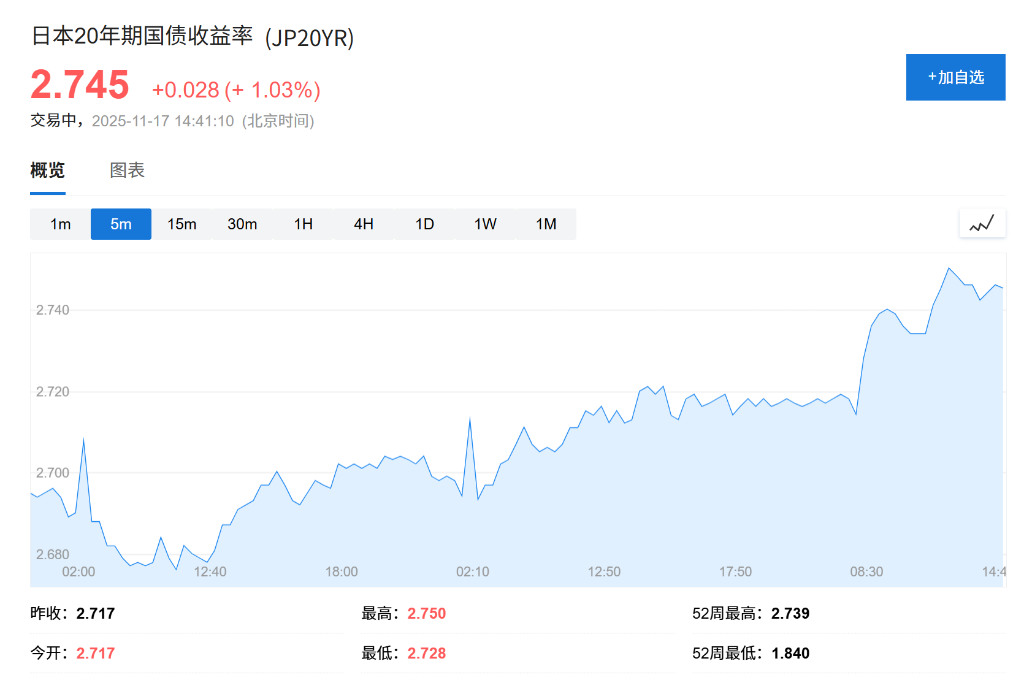
Core Viewpoint - Concerns over Japan's fiscal situation have intensified, leading to a significant sell-off of long-term government bonds, with the 20-year bond yield reaching its highest level in 25 years [1] Group 1: Market Reactions - The 30-year bond yield increased by 5 basis points to 3.26%, while the 40-year bond yield rose by 5.5 basis points to 3.6%, reflecting a global sensitivity among investors towards government fiscal discipline [1] - The sell-off in Japanese bonds mirrors a recent downturn in U.S. and U.K. bond markets, indicating a broader trend of investor caution regarding government fiscal policies [1] Group 2: Economic Stimulus Focus - Traders are closely monitoring the actual spending scale of Prime Minister Kishida's economic plan, especially after GDP data indicated economic contraction, which provides justification for stimulus measures [3] - The upcoming economic stimulus plan's specifics are a central uncertainty driving the current bond sell-off, with reports suggesting the government may consider a supplementary budget exceeding last year's 13.9 trillion yen [4] Group 3: Investor Sentiment - Investors are cautious about the scale of the government's economic stimulus plan, as uncertainties regarding its impact on government bond issuance are exerting pressure on long-term bonds [5] - Goldman Sachs noted that rising concerns over a potentially larger-than-expected stimulus plan are causing Japan's fiscal risk premium to increase, putting pressure on long-term sovereign bonds and the yen [5] - The current political context and market sentiment have heightened concerns ahead of the upcoming 20-year bond auction, with participants keenly observing the auction results to gauge demand for Japanese long-term bonds following the yield surge [5]
美元兑日元自2月以来首次涨至155,或引发东京口头干预
Sou Hu Cai Jing· 2025-11-12 15:45
Core Points - The Japanese yen has depreciated to 155 against the US dollar, marking the lowest level since February of this year, which is expected to prompt verbal intervention from Tokyo officials to curb the decline [1] - On Wednesday morning in New York, the yen fell by 0.6% to 155.04 yen per dollar before slightly recovering [1] - Concerns are rising that if this trend continues, it may lead to government intervention by Japan [1] - In October, the yen has depreciated approximately 4% against the dollar, making it the weakest performer among G10 currencies [1] - The market is betting on Prime Minister Fumio Kishida's inclination towards a combination of loose monetary policy and fiscal expansion [1]
停摆结束3大利好 黄金大涨
Sou Hu Cai Jing· 2025-11-11 04:33
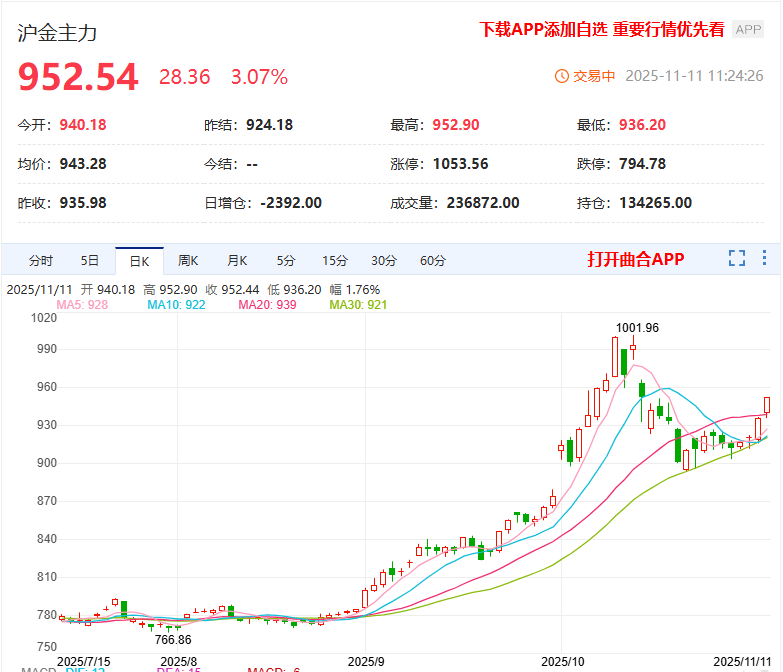
Group 1 - Precious metal prices generally rose, with COMEX gold futures up 2.83% at $4123.40 per ounce and COMEX silver futures up 4.70% at $50.41 per ounce [1] - The U.S. Senate passed a procedural vote on a temporary funding bill aimed at ending the government shutdown, although a final vote in the Senate and a vote in the House of Representatives are still pending [1] Group 2 - Federal Reserve Governor Milan stated that the government shutdown will not affect his view on the U.S. economy, predicting a 50 basis point rate cut in December [2] - Inflation for durable and personal goods in the U.S. showed its first slowdown in three months in October, indicating increased discounting by retailers [2] - The reopening of the U.S. government is expected to positively impact precious metals due to three main reasons: 1) Fiscal expansion is anticipated to resume; 2) Following data releases, the Fed may consider a rate cut in December; 3) The TGA account may release liquidity again [2] Group 3 - In early trading, both Shanghai gold and silver rose by more than 3% [3]
贵属策略报:财政与经济担忧犹存,???强
Zhong Xin Qi Huo· 2025-11-11 02:22
Group 1: Report Industry Investment Rating - No relevant content provided Group 2: Core Viewpoints of the Report - Gold prices have risen above $4,070 per ounce. Weakening US consumer confidence and employment indicators have strengthened expectations of interest rate cuts, partially offsetting the negative impact of the end of the government shutdown. The market's trading logic has returned to expectations of loose liquidity [1]. - The current gold price is driven by the resonance of "economic weakness" and "fiscal expansion". The silver price follows the rhythm of gold, with an expected monthly oscillation. In the long - term, gold is the anchor for silver pricing, and a contraction in the US dollar's credit is beneficial to physical currencies, with gold benefiting first and silver enjoying spill - over effects [3]. - The weekly price of London gold is expected to be in the range of $3,800 - $4,200 per ounce, and that of London silver in the range of $46 - $52 per ounce [6]. Group 3: Summary by Related Catalogs Key Information - The US Senate passed a temporary appropriation bill, ending a 40 - day government shutdown. Federal employees have returned to work, and lagging data will be released gradually [2]. - The US consumer confidence index dropped to a three - and - a - half - year low (50.3), and Challenger job cuts soared by 183% compared to the previous month, indicating a continuous cooling of the labor market [2]. - Sino - US trade flow has been weak, shipping capacity has dropped to the lowest level this year, and the WCI freight index has fallen from its mid - year high, showing a slowdown in foreign trade demand, which supports the expectation of a decline in US inflation and strengthens the Fed's logic of loosening [2]. - San Francisco Fed President Mary Daly said the US economy is experiencing a "downward demand shock", wage growth has slowed, inflation is still under control, and the impact of tariffs is mainly limited to the commodity sector. She hinted that the December meeting will maintain a loose stance [2]. - The People's Bank of China increased its gold reserves for the 12th consecutive month in October, and global gold ETFs recorded net inflows in the past two days [2]. Price Logic Gold - The economic aspect: The decline in consumption and employment caused by the shutdown is gradually emerging. Alternative indicators show a slowdown in economic momentum. Sino - US shipping and trade flow declines support the Fed's decision to continue cutting interest rates in December. Mary Daly's statement further consolidates market bets on interest rate cuts [3]. - The fiscal aspect: The government's resumption of work brings one - time expenditure replenishment and the continuation of medical insurance subsidies. Short - term fiscal investment may push up long - term interest rates and cause short - term fluctuations, but in the medium - term, US debt expansion and deficit pressure will extend the loose cycle, which is beneficial to the reserve and hedging demand for gold [3]. Silver - The silver price follows the rhythm of gold, with an expected monthly oscillation. Focus on the trading window around the December FOMC meeting. In the long - term, gold is the anchor for silver pricing, and a contraction in the US dollar's credit benefits physical currencies, with gold benefiting first and silver enjoying spill - over effects. Interest rate cuts will drive the repair of the US fundamentals, and with global fiscal resonance expansion, the world may shift from a soft landing to a moderate recovery in 2026, which is conducive to the release of silver's long - term elasticity [3][6]. Commodity Index - On November 10, 2025, the comprehensive index, the commodity 20 index, and the industrial products index of the CITICS Futures Commodity Index increased by 0.65%, 0.71%, and 0.48% respectively [43]. Precious Metals Index - As of November 10, 2025, the precious metals index had a daily increase of 1.73%, a 5 - day increase of 2.85%, a 1 - month increase of 1.15%, and a year - to - date increase of 49.57% [45].
欧洲央行维持利率不变 政策前景趋于谨慎
Jin Tou Wang· 2025-11-04 09:21
Group 1 - The core viewpoint of the articles indicates that the Euro is experiencing a downward trend against the Yen, influenced by the Bank of Japan's potential interest rate hike and the new Japanese Prime Minister's fiscal expansion plans [1][2] - The Bank of Japan's Governor Ueda hinted at a possible interest rate increase in December or January 2026, which has led the market to reassess the outlook for the Yen [1] - The new Japanese Prime Minister, Suga, is expected to implement more aggressive fiscal spending, which may conflict with monetary tightening goals, potentially delaying the Bank of Japan's rate hike [1] Group 2 - The new Finance Minister, Katayama, clarified that she no longer adheres to the previous view of the Yen's fair value being in the 120-130 range, indicating a possible government intervention in the currency market to stabilize exchange rate fluctuations [1] - The European Central Bank (ECB) maintained interest rates during its October meeting for the third consecutive time, citing stable inflation prospects and ongoing economic growth, but acknowledged external uncertainties [1] - The technical analysis shows that the Euro to Yen exchange rate has fallen below short-term support levels, indicating a continued weak trend, with potential further declines if it breaks below 177.00 [2]