
避险需求

Search documents
市场综述:标普500指数期货下跌 0.2%,黄金突破 3700 美元
Sou Hu Cai Jing· 2025-09-22 09:59
Market Overview - US stock market may retreat from historical highs as traders reduce risk exposure amid a relatively quiet event calendar [1] - S&P 500 index futures fell by 0.2% after reaching a new high due to expectations of interest rate cuts [1] - European stock markets remained mostly flat, while Asian markets rebounded as concerns over the Bank of Japan's ETF reduction eased [1] Economic Indicators - Key data point this week will be the core inflation indicator preferred by policymakers, set to be released on Friday [1] - The upcoming non-farm payroll report and the start of the earnings season next month are expected to be significant catalysts [1] Gold and Silver Market - Gold prices surpassed $3,700 per ounce, with ETF inflows reaching a three-year high [1] - Silver prices also rose to their highest level since 2011 [1] - Gold has accumulated over a 40% increase in price since 2025, driven by low interest rates and geopolitical risks [1] Corporate News - BBVA SA raised its acquisition offer for Banco Sabadell by approximately 10% to persuade investors [1] - Pfizer is nearing a deal to acquire obesity treatment startup Metsera Inc. for about $7.3 billion [1] - Samsung Electronics' stock rose over 5% after receiving approval from Nvidia for advanced storage chip usage [1] - Apple’s latest iPhone launch led to a consumer buying frenzy, boosting the stock prices of its suppliers in Asia [1]
贵金属有色金属产业日报-20250922
Dong Ya Qi Huo· 2025-09-22 09:58
1. Report Industry Investment Rating No relevant content provided. 2. Core Views of the Report - **Precious Metals**: The Fed cut interest rates by 25 basis points in September and sent a dovish signal. Economic recession risks have boosted safe - haven demand, and long - term factors such as central bank gold purchases and de - dollarization support gold prices [3]. - **Copper**: In the next week, copper may continue to fluctuate strongly around 80,000 yuan per ton. Supply is tight in the short term, and demand remains stable [18]. - **Aluminum**: After the September interest rate cut, the macro - drive has paused. The Shanghai aluminum market may focus on fundamentals, and the price may fluctuate strongly. Alumina may be weak in the short term due to supply surplus, and cast aluminum alloy may fluctuate strongly [37][38]. - **Zinc**: The supply is in an excess state, and the market's expectation for the "Golden September and Silver October" is average. Zinc prices may fluctuate in the short term [68]. - **Nickel Industry Chain**: Nickel ore prices are affected by nickel price movements and supply concerns. The new energy sector provides some support, nickel iron prices are firm, and stainless steel has limited downside space [83]. - **Tin**: The decline in tin prices last week was due to Powell's hawkish speech. The short - term supply is tight, and prices may fluctuate around 274,000 yuan per ton [98]. - **Lithium Carbonate**: Before the National Day holiday, lithium carbonate futures prices are expected to fluctuate. Downstream demand may support prices in the future [109]. - **Silicon Industry Chain**: Industrial silicon prices may rise slightly with the arrival of the dry season, but the increase is limited by inventory. The trading of polysilicon futures is complex, and the risk is relatively high [118]. 3. Summaries by Related Catalogs Precious Metals - **Price Influencing Factors**: Fed's interest rate cut, economic data, central bank gold purchases, and de - dollarization affect gold prices [3]. - **Price Charts**: Include SHFE and COMEX gold and silver prices, gold - silver ratio, gold and US Treasury real interest rates, and gold and US dollar index [4][8][15]. Copper - **Price Outlook**: May fluctuate strongly around 80,000 yuan per ton in the next week [18]. - **Supply - Demand Situation**: Supply is tight as the Indonesian Grasberg copper mine needs 1 - 2 weeks to resume production, and demand remains stable [18]. - **Market Data**: Provide copper futures and spot prices, import and export data, and inventory data [19][24][34]. Aluminum - **Aluminum Price Analysis**: Interest rate cut expectations and fundamentals affect prices. After the interest rate cut, the focus is on inventory, and prices may fluctuate strongly [37]. - **Alumina Situation**: Supply surplus leads to a weak price outlook in the short term [38]. - **Cast Aluminum Alloy**: Rises due to tight scrap aluminum supply and may fluctuate strongly [38]. - **Market Data**: Include aluminum and alumina futures and spot prices, spreads, and inventory data [39][54][64]. Zinc - **Supply - Demand Analysis**: Supply is in excess, and the market's expectation for the peak season is average. LME inventory is decreasing, showing an external - strong and internal - weak pattern [68]. - **Market Data**: Provide zinc futures and spot prices, spreads, and inventory data [69][74][79]. Nickel Industry Chain - **Nickel Ore**: The benchmark price has increased, and supply concerns exist due to government intervention in Indonesia [83]. - **New Energy**: Supports nickel - related product prices [83]. - **Nickel Iron**: Prices are firm, but high - price transactions have declined [83]. - **Stainless Steel**: Has limited downside space due to cost support and de - stocking [83]. - **Market Data**: Include nickel and stainless steel futures prices, trading volume, and inventory data [84]. Tin - **Price Analysis**: The decline last week was due to Powell's hawkish speech. Supply is tight in the short term, and prices may fluctuate around 274,000 yuan per ton [98]. - **Market Data**: Provide tin futures and spot prices, inventory data, and related indexes [99][103][105]. Lithium Carbonate - **Price Outlook**: May fluctuate before the National Day holiday, and downstream demand may support prices [109]. - **Market Data**: Include lithium carbonate futures and spot prices, inventory data [110][112][116]. Silicon Industry Chain - **Industrial Silicon**: Prices may rise slightly with the dry season but are limited by inventory [118]. - **Polysilicon**: The trading focus is on the establishment of the September procurement platform and the November warehouse receipt cancellation. The risk is relatively high [118]. - **Market Data**: Provide industrial silicon and polysilicon spot and futures prices, production, and inventory data [119][120][141].
黄金,继续向上冲击!
Sou Hu Cai Jing· 2025-09-22 09:02
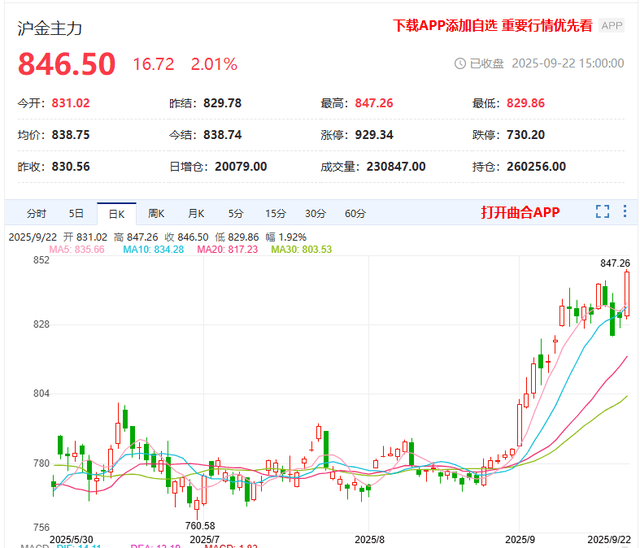
Group 1 - Wall Street analysts have returned to a neutral outlook on gold prices following the Federal Reserve's interest rate cut, with 40% expecting prices to rise in the coming week, 20% predicting a decline, and 40% anticipating a sideways movement [1] - Retail investors have cooled their enthusiasm, with 58% optimistic about price increases, 24% forecasting declines, and 18% expecting consolidation, indicating a retreat from previous bullish sentiment [1] - The Shanghai gold price surged to a historic high, increasing by 2.01% to close at 846.5 yuan per gram [1] Group 2 - According to GF Futures, the market's interpretation of the Federal Reserve's interest rate decision is neutral, with the dollar index rebounding after a decline [3] - Technical indicators suggest that the precious metals market has entered an overbought condition, leading to a potential pullback as funds may exit due to the "buy the rumor, sell the news" logic [3] - The outlook for the future indicates that with increasing risks in the U.S. labor market, the dual characteristics of "strengthened expectations - compromised independence" in the Federal Reserve's policy path will continue to suppress the dollar index and U.S. Treasury yields, while geopolitical tensions in Europe and the U.S. will increase institutional demand for precious metals as a safe haven [3]

趋势不改震荡上行,沪银突破前高打开空间
Jin Shi Shu Ju· 2025-09-22 05:29
Group 1 - Precious metals market rebounds strongly after a brief correction, with silver reaching a 14-year high and leading the gains in the gold and silver sector [1] - As of 11:00 AM, New York silver rose by 1.50% to $43.58 per ounce, while Shanghai silver surged by 3.07% to ¥10,243 per kilogram [1] - Gold also experienced upward movement, with New York gold futures increasing by 0.43% to $3,721.8 per ounce, and Shanghai gold rising by 1.25% to ¥840.16 per gram [1] Group 2 - Silver's price increase is driven by speculative sentiment and growing industrial demand in sectors such as photovoltaics, electric vehicles, and semiconductors, maintaining a supply-demand imbalance [1] - The gold-silver ratio in the domestic market is around 83, while the international market is approximately 85, indicating potential for silver price correction as it remains above the historical range of 60-80 [1] - Multiple factors, including speculative sentiment, industrial fundamentals, interest rate cuts, and geopolitical uncertainties, are expected to enhance silver's price elasticity compared to gold [1] Group 3 - The Federal Reserve's dovish stance, as indicated by officials, reinforces market expectations for continued monetary easing, supporting precious metal prices [2] - Geopolitical tensions in the Middle East are escalating, significantly boosting global market risk aversion and providing strong support for gold and silver prices [2] - The ongoing restructuring of military alliances in the region and the anticipated long-term conflicts are likely to sustain demand for gold and silver as traditional safe-haven assets [2] Group 4 - Overall, expectations of monetary policy easing, political and geopolitical uncertainties, along with bullish sentiment from institutions, are driving upward momentum in gold and silver prices [3] - Technically, key support for New York gold has risen to around $3,600, with potential to reach $3,800, while silver, benefiting from both financial and industrial demand, aims for a target of $45 after breaking through $43 [3] - Market corrections are viewed as opportunities for positioning, with gold and silver expected to remain in a long-term bullish trend [3]
港股黄金股大涨!盘整结束了?
Xin Lang Cai Jing· 2025-09-22 04:59
来源:市场资讯 (来源:同小泰话基金) 国际金价再次逼近3700美元关口,港股黄金板块全线走强,背后是全球央行持续购金与地缘政治风险的 双重支撑。 今日板块行情 今日亚洲早盘时段,现货黄金价格小幅走高,上涨0.1%,报每盎司3687.84美元。市场在美联储降息后 弥漫观望情绪,等待更多关于利率路径的线索。 与此同时,港股黄金概念股表现强劲,黄金股的强劲表现吸引了市场目光,资金涌入黄金相关资产明 显。 黄金卷土重来? 黄金市场在经过短暂盘整后再次展现强势。今年以来,金价已经上涨40%,市场密切关注在美联储启动 降息循环过程中,黄金是否仍能保持上涨动能。 美联储9月FOMC会议如期降息25个基点,点阵图显示年内还将降息50个基点,符合市场预期。降息落 地后,黄金可能面临"卖事实"的回调压力。 然而,全球央行购金热潮成为金价的重要支撑。自2022年中期以来,各央行的黄金购买量增加了两倍, 达到每季度约1千万盎司。 高盛在近期发布的报告中指出:"我们证明了自2022年中期以来,央行推动了黄金需求的增长,而新的 地缘政治或金融冲击可能会大幅推高金价。" 后市展望 多家机构对黄金后市保持乐观态度。渣打银行分析认为,技术支 ...

降息+避险双重助力,黄金或迎来加速上涨
Sou Hu Cai Jing· 2025-09-22 02:54
Core Viewpoint - Gold prices remain strong following the Federal Reserve's first rate cut of 25 basis points, which has increased the appeal of non-yielding assets [1][3] Group 1: Market Analysis - Despite a slowdown in the pace of rate cuts, the overall upward trend in gold prices is expected to continue due to strong market expectations for further easing [3] - The upcoming U.S. Personal Consumption Expenditures (PCE) price index is a key focus, as a slowdown in inflation could reinforce expectations for additional rate cuts this year [3] - Current market surveys indicate traders anticipate nearly two more rate cuts within the year [3] Group 2: Gold Price Dynamics - Year-to-date, gold has seen an increase of nearly 40%, supported by factors such as geopolitical risks, U.S. tariff policies creating global economic uncertainty, and central banks increasing gold purchases and ETF holdings [3] - Technical analysis shows strong support for gold around $3,650, with resistance concentrated at the $3,700 level; a breakthrough could lead to a challenge of historical highs between $3,710 and $3,720 [3] - The moving average system remains bullish, with MACD in a positive momentum zone, although momentum is narrowing, indicating a potential slowdown in the upward trend [3] Group 3: Editor's Perspective - Gold prices are currently driven by both Federal Reserve policy expectations and safe-haven demand; if PCE inflation data shows a slowdown, prices may approach or exceed historical highs [5] - Conversely, stronger-than-expected data could trigger market adjustments [5] - In the medium to long term, the trend of central bank gold purchases, global economic uncertainty, and ongoing geopolitical risks will continue to provide solid support for gold [5]
美盘黄金延续涨势 德商银行提示短期暂歇、长期看涨
Ge Long Hui· 2025-09-19 14:28
Core Viewpoint - Gold prices continue to rise, supported by expectations of U.S. interest rate cuts, safe-haven demand, and central bank purchases, with a cumulative increase of nearly 10% this month [1] Group 1 - Despite investors perceiving the Federal Reserve's future policy statements as less dovish than expected, gold prices are still on an upward trend [1] - Barbara Lambrecht from Commerzbank suggests that the current momentum in gold prices may have paused, but Asian buyers are gradually adapting to the high price levels [1] - The expectation is that the Federal Reserve will cut rates more than the market anticipates next year, indicating a long-term bullish outlook for gold prices [1]

KVB官网:地缘政治风险抵消美元反弹,金价守住3660美元附近涨幅
Sou Hu Cai Jing· 2025-09-19 10:34
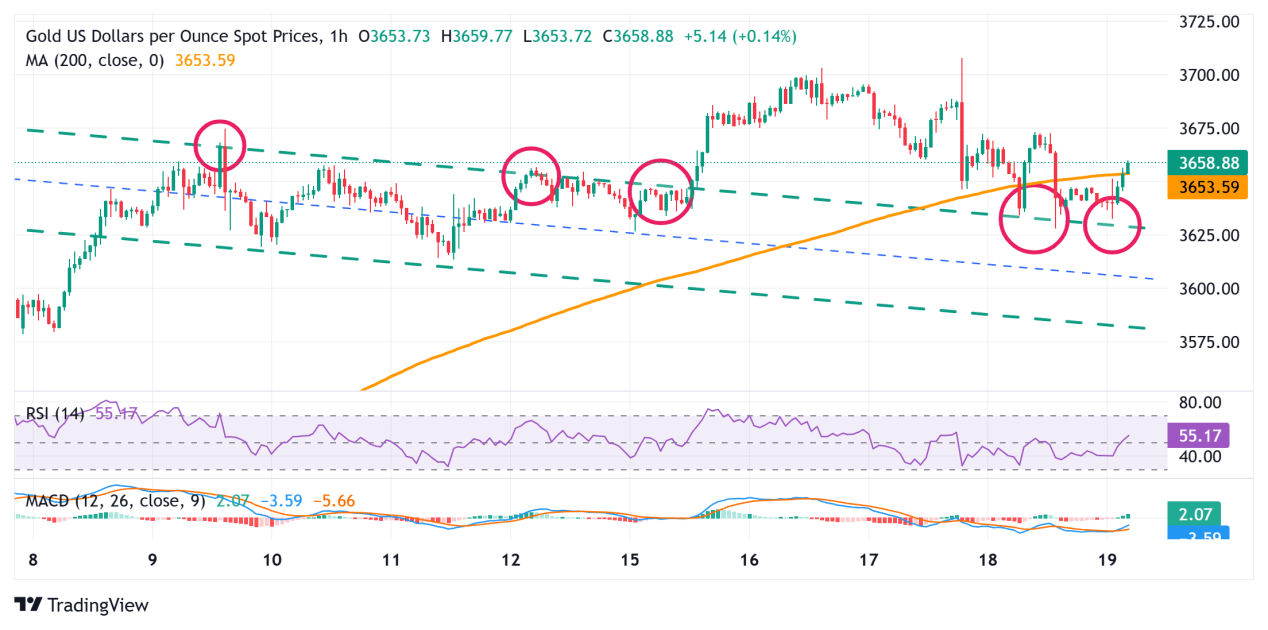
Core Viewpoint - Gold has attracted some buyers and halted a two-day pullback from historical highs, driven by renewed geopolitical risks that have increased demand for the safe-haven asset, although upside potential appears limited [1][3]. Group 1: Geopolitical Risks and Market Dynamics - Geopolitical tensions, particularly the escalation of the Russia-Ukraine conflict and Middle East tensions, have provided some support for gold prices [3][4]. - U.S. President Donald Trump expressed disappointment in Russian President Vladimir Putin, urging allies to stop purchasing oil from Russia to end the ongoing war with Ukraine [4]. - The European Commission President Ursula von der Leyen announced proposals to accelerate the EU's phase-out of fossil fuel imports from Russia [4]. Group 2: Federal Reserve and Dollar Impact - Federal Reserve Chairman Jerome Powell's dovish stance has supported the dollar, limiting the upward movement of gold, which is a non-yielding asset [2][5]. - The Fed announced its first rate cut since December 2024, indicating further cuts may occur by the end of the year amid a weak labor market [4]. - The dollar is expected to rebound from its lowest level since February 2022 following Powell's hawkish assessment, which has suppressed gold prices [3][5]. Group 3: Technical Analysis of Gold Prices - Gold (XAU/USD) maintained slight gains but failed to break the $3,660 mark, with resistance expected around $3,673-$3,675 if it breaks above [3][8]. - A significant drop below the $3,628-$3,626 support level could lead to further declines towards $3,563-$3,562, with $3,511-$3,510 acting as strong support [8]. - Caution is advised before making aggressive directional bets, as the market awaits strong follow-up buying to confirm the end of the recent pullback from historical highs [5][6].
短线获利回吐,中期维持多头思路
Zhong Xin Qi Huo· 2025-09-19 05:17
Report Summary 1. Report Industry Investment Rating - No specific industry investment rating is provided in the report. 2. Core View of the Report - Gold experienced short - term profit - taking after the Fed's September rate cut, but maintains a long - term bullish outlook. The Fed's dot - plot shows a further 50bp rate cut this year and continued easing in 2025, which, along with other factors, supports the mid - term upward momentum of gold prices [1][3]. 3. Summary by Related Catalogs 3.1 Key Information - The Fed cut interest rates by 25 basis points on Wednesday and hinted at further rate cuts for the rest of the year in response to concerns about the weakening job market [2]. - US President Trump paid a second state visit to the UK and praised the special relationship between the two countries [2]. - US Congressman John Moolenaar expressed concerns about the TikTok framework agreement between China and the US [2]. 3.2 Price Logic - Gold has been oscillating in the range of 3,660 - 3,700 after the Fed's September rate cut. It has risen about 39% since the beginning of the year, and although there is short - term profit - taking, mid - term upward momentum remains [3]. - Driving factors include the Fed's expected 50bp rate cut this year and continued easing in 2025, global central banks' continuous gold purchases, Trump's pressure on the Fed's independence, and escalating geopolitical conflicts [3]. - The global ETF gold holdings are still about 3,000 tons, with room to recover to the 2020 high of 3,500 tons [3]. - In the short term, focus on the 3500 - 3800 oscillation range, and maintain a long - term bullish view [3]. 3.3 Outlook - Weekly London gold spot is expected to be in the range of [3500, 3800], and weekly London silver spot in the range of [39, 45] [3]. 3.4 Commodity Index - The comprehensive index of commodities on September 18, 2025: the commodity 20 index was 2489.53, down 1.04%; the industrial products index was 2246.67, down 1.06% [42]. 3.5 Precious Metals Index - On September 18, 2025, the precious metals index was 2878.86, with a daily decline of 1.22%, a 5 - day decline of 1.53%, a 1 - month increase of 6.56%, and a year - to - date increase of 30.12% [44].
短期事件、中期趋势与长期结构性变化共同作用—— 多因素推动金价维持高位
Jing Ji Ri Bao· 2025-09-18 21:58
Core Viewpoint - Recent expectations of interest rate cuts by the Federal Reserve have significantly boosted international gold prices, with the price surpassing $3,700 per ounce for the first time, reaching a historical high of $3,703.13 per ounce on September 16 [1] Group 1: Federal Reserve's Impact on Gold Prices - The Federal Reserve announced a 25 basis point cut in the federal funds rate to a target range of 4.00% to 4.25%, marking its first rate cut of the year and the fourth since last year [1][2] - Analysts indicate that the Fed's interest rate policy is a crucial factor influencing gold prices, with expectations of further rate cuts supporting the recent price increases [2][3] Group 2: Market Reactions and Predictions - Following the Fed's announcement, gold prices experienced volatility, retreating to around $3,650 per ounce [1] - Market analysts suggest that while short-term pressures may exist due to profit-taking, the long-term outlook for gold remains positive due to ongoing geopolitical tensions and central bank gold purchases [3][4] Group 3: Underlying Factors Supporting Gold Prices - Key drivers for the recent rise in gold prices include concerns over the independence of the Federal Reserve due to political pressures and signs of a slowing U.S. labor market [1][2] - The global economic landscape, characterized by loose monetary policies and increasing gold purchases by central banks, is expected to provide a supportive environment for gold prices in the medium term [4]