人民币国际化

Search documents
特朗普:美国太强中国不敢惹,话音刚落,中方官宣人民币重大消息
Sou Hu Cai Jing· 2025-11-14 20:07
特朗普在高调宣扬美国实力逼中国让步之际,人民币国际化正悄然迈出关键一步,而西芒杜铁矿的投产正在静悄悄改变着中美实力对比的底层逻辑。 "我们和中国关系很好,但那是因为他们知道我强硬。 "特朗普在最近接受美媒采访时,再次展现了他标志性的自信。 他骄傲地认为,中国之所以愿意在贸 易谈判中达成协议,完全是因为美国实力太强,中国不敢招惹美国。 就在特朗普吹嘘美国实力的同一天,国际航空运输协会宣布正式将人民币纳入其清算所结算货币体系。 这一决定看似与经济无关,却深刻影响着中美实力 对比的底层逻辑。 特朗普的自信言论很快遭到了事实的打脸。 就在他夸耀"中国怕美国"的同时,美国政府却悄悄撤销了多项对华限制措施。 特朗普在福克斯新闻的采访中详细阐述了他的逻辑:美国的强大实力体现在两个方面,一是关税手段,二是军事实力。 他声称,正是这两大支柱让中国不 得不妥协。 但现实情况却大相径庭。 截至11月9日,美国政府已经停摆40多天,公共服务陷入瘫痪,甚至驻外军人的工资都需要盟友垫付。 这种国内困境迫使特朗普急 需一个"外交突破口"来转移视线。 与特朗普的"口头强国"形成鲜明对比的是,中国正在扎实推进人民币国际化进程。 11月5日,国 ...


中国央行副行长:深化金融改革有五个重点方向
Zhong Guo Xin Wen Wang· 2025-11-14 13:57
Core Points - The Vice Governor of the People's Bank of China, Tao Ling, outlined five key directions for deepening financial reform [1][2] - Emphasis on developing a scientific and robust monetary policy system alongside a comprehensive macro-prudential policy framework [1] - The importance of enhancing the adaptability of financial institutions, products, and services to meet diverse investment and financing needs [1] Group 1 - The five key directions for financial reform include: 1. Accelerating the improvement of the central bank system 2. Enhancing the adaptability of financial institutions, products, and services 3. Establishing a well-functioning financial market 4. Building a higher-level open financial system 5. Creating a sustainable financial ecosystem [1] Group 2 - The need to balance development and security while promoting trade and investment facilitation, expanding the openness of China's financial market, and advancing the internationalization of the Renminbi [2] - The goal of constructing the Shanghai International Financial Center and consolidating Hong Kong's status as an international financial center [2] - The call to regulate "involutionary" competition in the financial industry to maintain reasonable profit margins and to encourage a healthy economic-financial cycle [2]
野村陆挺:中国新兴产业的实力被低估了
Hua Er Jie Jian Wen· 2025-11-14 13:04
Core Insights - The Chinese economy is undergoing a significant structural transformation, transitioning from an export-driven model to a more balanced focus on domestic demand [1] - The future of high-quality development should not solely rely on replacing old industries but rather on the collaboration of new and old driving forces [1] - A fundamental reform of the social security system is essential to unlock true domestic consumption potential [3] Group 1: Economic Transition - The transition period is characterized by a notable rise in China's position within the value chain, providing strong support for the economy [1] - Emerging industries, particularly in artificial intelligence and automotive sectors, are showing unexpected performance, with China becoming the largest producer and exporter of vehicles [1][2] - The shipbuilding industry secured 75% of global orders last year, and over 50% of robots globally are now produced in China [2] Group 2: Importance of Traditional Industries - There is a need to avoid the misconception that only new economies matter, as traditional sectors remain crucial for economic stability [2] - Real estate plays a vital role in household wealth, accounting for over 50% of many families' assets, which is significantly higher than the stock market [2] - The urbanization rate in China is approximately 68%, indicating substantial unmet demand in housing and transportation [2] Group 3: Consumer Spending and Policy - Consumer spending is seen as a key variable in the "14th Five-Year Plan," with the government implementing substantial consumption policies [3] - Long-term reforms in the social security system are deemed more effective than short-term cash incentives for stimulating consumer spending [3] Group 4: Capital Market Development - The capital market is expected to play a more significant role in the national economy, with a focus on enhancing the financial weight of Chinese assets [4] - Key directions include promoting the internationalization of the RMB, nurturing truly global enterprises, and protecting investors to ensure healthy industrial development [4] - Achieving these goals will require patience and sustained efforts in the right direction [4]
人均持有现金增至约1万!扫码支付无处不在,为何现金M0持续高增?
Xin Lang Cai Jing· 2025-11-14 10:56
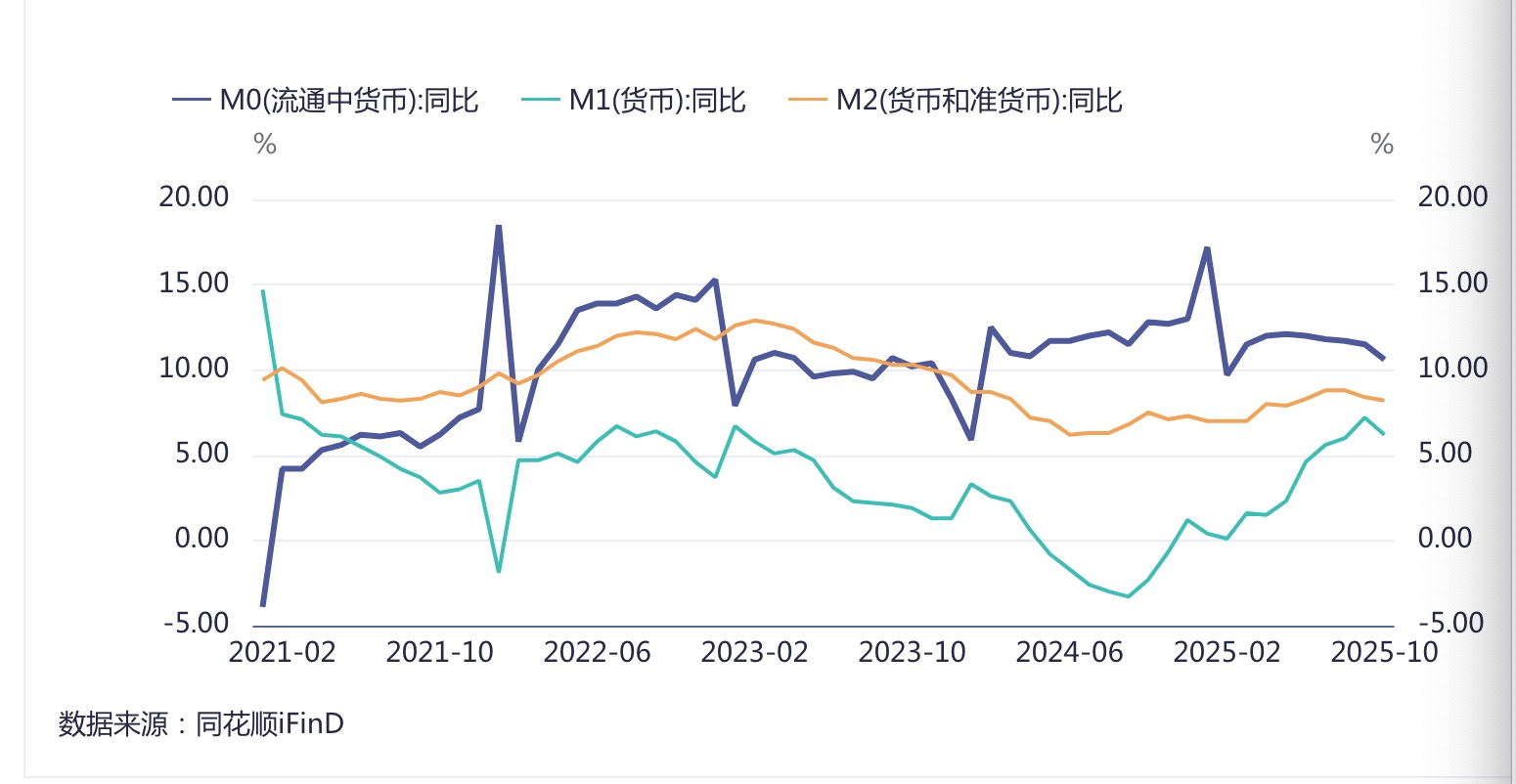
智通财经记者 | 杨志锦 智通财经编辑 | 王姝 中国人民银行11月13日公布的金融统计数据显示,10月末流通中货币(M0)余额13.55万亿元,同比增长10.6%。 官方数据还显示,自从2022年以来,M0增速几乎一直保持10%以上,大多数时间也高于广义货币M2增速,而同期狭义货币M1增速非常低,一度出现负增 长。 智通财经记者根据同花顺 ifind、央行数据制图 M0代表流通中的现金,M0同比持续高增,说明社会上的现金越来越多,这跟很多人的直觉是相反的——在扫码支付非常普遍的中国,很多人可能一年到头 几乎不用现金进行支付,"现金消失论"一度甚嚣尘上。 按照10月末13.55万亿元的M0余额、14亿人口计算,意味着当前人均持有现金约1万元,而在2012年末M0余额为5.5万亿,人均持有现金仅仅0.4万元。换言 之,随着移动支付渗透率越来越高,人们持有的现金反而增加了。 智通财经记者采访了解到,近年来M0持续高增的原因可能有:持有现金成本下降、防御性储备需求增加、人民币国际化带来的境外现金需求增长、一些非 法活动的现金需求增长等。值得注意的是,过去10年中国积极发展数字人民币,数字人民币也定位于M0,但数字人 ...
伦敦金属交易所封杀非美元交易,打压人民币,还是自断生路?
Sou Hu Cai Jing· 2025-11-14 10:50
Core Viewpoint - The London Metal Exchange (LME) has decided to stop all non-USD settled futures trading, effectively sidelining currencies like the RMB and Euro, which reflects a deeper political maneuver to maintain USD dominance in global markets [3][5][9]. Group 1: Impact on Currencies - The LME's decision primarily affects non-USD currencies, particularly the RMB and Euro, reinforcing the USD's position in international trade [5][9]. - This move is seen as a defense of USD hegemony amid a global trend towards "de-dollarization," with China pushing for greater international pricing power for the RMB [7][13]. Group 2: Market Dynamics - By excluding non-USD transactions, the LME risks driving trading volume away to other markets, such as the Shanghai Futures Exchange, which allows RMB pricing [11][19]. - The LME's actions may inadvertently accelerate the RMB's push towards financial autonomy and increase its presence in global commodity pricing [13][21]. Group 3: Future Outlook - In the short term, the RMB may face challenges in international metal trading, but this could stimulate a shift towards platforms that are more accommodating to RMB transactions [17][19]. - The LME's authority and relevance in the global market may decline as the trend of de-dollarization continues, potentially leading to a loss of market share to Asian exchanges [19][21].
特朗普没想到:压垮美元霸权的最后一根稻草,会从自己手中落下
Sou Hu Cai Jing· 2025-11-14 10:04
Group 1 - The foundation of US dollar hegemony is crumbling, with over 90% of transactions between China and Russia now conducted in local currencies, signaling a shift towards de-dollarization that has become a market reality [1][3] - The CIPS system, connecting nearly 5,000 financial institutions across 185 countries, is emerging as a significant financial infrastructure, often referred to as the "financial Silk Road" [1] - The financial sanctions imposed by the US on Russia following the Ukraine conflict have led many countries to reconsider their reliance on the dollar, realizing that their assets are not fully under their control [3] Group 2 - The Trump administration's tariff policies have significantly impacted the dollar's dominance, driving the dollar index to its lowest level in nearly 50 years, with a more than 10% drop in the first half of the year [5] - The US national debt has surged past $34 trillion, resulting in an average debt burden of $100,000 per citizen, which undermines the credibility of the dollar [7] - The internationalization of the renminbi is accelerating, supported by initiatives like the Belt and Road, which enhance the currency's appeal and encourage countries to bypass the dollar for trade [9][11] Group 3 - Countries are increasingly recognizing the strength of the Chinese economy, leading to a growing acceptance of the renminbi in international trade and foreign exchange reserves [11]
固定收益点评:“南向通”扩容下的境外债券投资机会
GOLDEN SUN SECURITIES· 2025-11-14 09:17
Report Industry Investment Rating No industry investment rating is provided in the report. Core Viewpoints The report explores investment opportunities in the Hong Kong bond market under the expansion of the "Southbound Connect." It analyzes the market conditions of Chinese dollar-denominated bonds and Dim Sum bonds, and points out potential investment opportunities based on factors such as interest rates, exchange rates, and credit risks [2]. Summary by Directory I. Bond "Southbound Connect" Introduction - Launched on September 24, 2021, it allows domestic investors to invest in bonds traded in the Hong Kong bond market through a connected mechanism [9]. - Initially, it only supported spot bond trading and later gradually introduced repo trading. In 2025, measures were announced to expand trading currencies and extend trading hours [10]. - Regulatory authorities have defined the current participants and trading counterparties. The scope of participants is expected to expand to include non-bank institutions such as securities firms, insurance companies, and asset management companies [11]. II. "Southbound Connect" Investment Target Situation Hong Kong Bond Market Situation - The Hong Kong bond market consists of three main segments: Hong Kong dollar, offshore RMB, and G3 currency markets. As of the end of 2024, the outstanding amounts of Hong Kong dollar bonds, offshore RMB bonds, and G3 currency bonds were 195.5 billion, 173.2 billion, and 565.6 billion US dollars respectively, with G3 currency bonds dominating the market [24]. - From 2015 to 2024, the total size of the Hong Kong bond market showed a significant upward trend, reaching HK$2.83 trillion in 2024. The Exchange Fund and the Hong Kong Special Administrative Region Government are the cornerstones of the market, and overseas issuers and local statutory bodies have also contributed to its growth [26]. Hong Kong Chinese Dollar-Denominated Bond Market Status - Affected by factors such as the US dollar interest rate hike, rising overseas financing costs, and changes in the credit environment, the issuance volume of Chinese dollar-denominated bonds in Hong Kong has declined significantly since 2022, with negative net financing in the past three years [32]. - As of October 30, 2025, the outstanding amount of Chinese dollar-denominated bonds traded on the Hong Kong Stock Exchange and CMU was 361.5 billion US dollars, with 1,180 bonds. They are mainly concentrated in industries such as finance and energy, with coupon rates mostly between 3% - 5% and maturities mostly over 3 years [37][40]. Dim Sum Bond Market Status - The issuance volume and net financing of Dim Sum bonds have increased significantly since 2022, reflecting the promotion of RMB internationalization and the expansion of the "Southbound Connect" [43]. - As of October 29, 2025, the outstanding amount of Dim Sum bonds traded on the Hong Kong Stock Exchange and CMU was 1.5666 trillion RMB, with 1,266 bonds. They are mainly concentrated in industries such as finance, real estate, and consumption, with coupon rates mostly between 3% - 5% and maturities mostly between 1 - 3 years [48][50]. III. Investment Opportunities in Chinese Dollar-Denominated Bonds - The benchmark interest rate for Chinese dollar-denominated bonds is US Treasury bonds. In the first three quarters of 2025, US Treasury bond yields fluctuated and declined in the third quarter. It is expected to remain volatile at a low level in the future [55]. - Investment-grade Chinese dollar-denominated bonds have declined with US Treasury bonds this year, and the spread has narrowed to a low level since 2024. High-yield bonds have fluctuated, and the spread is at a high percentile [57]. - Due to the continuous advancement of debt resolution policies, the spread of overseas Chinese dollar-denominated urban investment bonds has significantly compressed since mid-2024 [59]. - The spread of real estate Chinese dollar-denominated bonds has shown significant differentiation. The spread of investment-grade bonds has continued to compress, while that of non-investment-grade bonds has fluctuated at a high level [63]. - In terms of exchange rates, the US dollar has depreciated against the RMB in 2025, and the narrowing of the discount has reduced the exchange rate hedging cost, increasing the allocation value of Chinese dollar-denominated bonds [66]. - From a credit perspective, the number of defaults or extensions of local state-owned enterprises and central enterprises has decreased, and the investment strategy can focus on bonds of central and state-owned enterprises with large onshore-offshore spreads [67]. IV. Investment Opportunities in Dim Sum Bonds - The benchmark interest rate for Dim Sum bonds is offshore RMB sovereign bonds. This year, Dim Sum bonds have outperformed onshore bonds, and the spread has narrowed to about 50bp [69]. - On the supply side, due to the financing cost advantage and policy support, the issuance of Dim Sum bonds has increased in recent years, and the product structure is expected to become more diverse [71]. - On the demand side, the expansion of the "Southbound Connect" has broadened cross-border investment channels, and the strong demand of domestic institutions for overseas investment is beneficial to the secondary market performance of Dim Sum bonds. Some Dim Sum bonds still have relatively high spreads compared to onshore bonds, offering good value [71].
【专访】刘劲:建设金融强国,应聚焦国际化与市场化两大方向 | 前瞻十五五⑰
Sou Hu Cai Jing· 2025-11-14 02:38
Core Viewpoint - The article emphasizes the urgent need for China to accelerate the construction of a financial powerhouse, highlighting the importance of financial reform and innovation in the context of international geopolitical challenges and the necessity for technological advancement [1][6]. Group 1: Financial Development Strategies - The main development focus for a financial powerhouse should be on internationalization and marketization [2]. - Marketization involves gradually replacing indirect financing with direct financing, creating a multi-layered financial system to support high-tech and strategic emerging industries [2][10]. - Internationalization aims to promote the international use of the Renminbi and establish an independent payment system [3][10]. Group 2: Achievements in Financial Reform - Significant progress has been made in the past five years, including the internationalization of the Renminbi and the establishment of a multi-layered financial system [8]. - The introduction of new market rules has adapted to the needs of a multi-layered financial system, allowing for different requirements for technology companies compared to traditional markets [8][12]. - High-quality opening-up has been achieved by relaxing restrictions on foreign financial institutions [9]. Group 3: Challenges and Future Directions - The current financial resource allocation primarily relies on the banking system, which needs to evolve to include stock markets, bond markets, and derivatives markets [10]. - Establishing an independent payment system is crucial for enhancing the international acceptance of the Renminbi, which requires creating a favorable market environment [10][11]. - The development of a robust derivatives market is essential for risk management, but it must be accompanied by strong regulatory frameworks to mitigate systemic risks [14][15]. Group 4: Balancing Traditional and Emerging Industries - The shift in focus from merely promoting high-tech industries to also enhancing traditional industries reflects a deep understanding of current economic realities, particularly regarding employment [16][17]. - Traditional industries play a vital role in job creation and economic stability, which is crucial for maintaining consumer spending and overall economic health [17].

港股IPO冷热博弈:6天6家申请上市,“明星”药企缘何临门停步?
2 1 Shi Ji Jing Ji Bao Dao· 2025-11-14 00:20
Core Viewpoint - The Hong Kong stock market is experiencing a surge in IPO applications from biotech companies, but the recent delay in the IPO of Baile Tianheng highlights potential risks and challenges in the market [1][7][11]. Group 1: IPO Activity - Six biotech companies, including Mindray Medical and Insilico Medicine, submitted IPO applications to the Hong Kong Stock Exchange within six days, marking a record high for the year [1][2]. - The Hong Kong Stock Exchange's support for the biotech sector, particularly the 18A listing rule allowing unprofitable biotech firms to go public, has attracted these companies [2][3]. Group 2: Company Profiles - Mindray Medical, a leading medical device company, aims to enhance its international strategy and brand influence through its IPO, with a projected international revenue share exceeding 50% by Q3 2025 [3]. - Other companies like Kexing Pharmaceutical and Real Bio are also seeking to expand their international presence and fund R&D through their IPOs [4]. Group 3: Market Environment - The influx of southbound capital into the Hong Kong market has reached a historic high, with net inflows exceeding HKD 5 trillion, boosting investor confidence [5][6]. - Despite the positive fundraising environment, there is a shift in investment strategies towards high-dividend stocks, which may impact the biotech sector's attractiveness [5][11]. Group 4: Challenges and Risks - Baile Tianheng's delayed IPO raises concerns about high entry barriers and insufficient valuation discounts, which may deter retail investors [8][9]. - The company's volatile financial performance and reliance on a significant one-time transaction for revenue have led to skepticism about its long-term profitability [9][10]. - The market's increasing focus on stable cash flows and product commercialization capabilities may pose challenges for companies lacking clear market positioning [11].
继续实施适度宽松的货币政策
Nan Fang Du Shi Bao· 2025-11-13 23:08
Core Insights - The People's Bank of China (PBOC) emphasizes the continuation of a moderately accommodative monetary policy while introducing "maintaining relatively loose social financing conditions" as a new focus in its latest report [2][3] - The report highlights the importance of balancing short-term and long-term economic goals, as well as internal and external equilibria, while reinforcing the need for both counter-cyclical and cross-cyclical adjustments in monetary policy [3] Monetary Policy Strategy - The PBOC aims to create a suitable monetary and financial environment by closely monitoring changes in overseas central bank policies and analyzing liquidity supply and demand within the banking system [3] - The report reiterates the commitment to a supportive monetary policy stance, with no immediate plans for reserve requirement ratio (RRR) cuts or interest rate reductions, indicating that further economic data will be needed to trigger any significant policy changes [4] Credit Policy Initiatives - The report introduces measures to support personal credit repair, addressing the impact of past debt defaults on individuals' credit records, particularly those affected by the COVID-19 pandemic [5][6] - The PBOC plans to implement a one-time personal credit relief policy, which will not display certain default information in credit systems for individuals who have repaid loans below a specified amount [5][6] Financial Market Development - The report outlines plans to enhance the bond market, particularly through the development of a "technology board" for bonds, aimed at supporting private technology enterprises and investment institutions [6] - The PBOC's approach to promoting the internationalization of the Renminbi has shifted from a cautious expansion to a more proactive stance, focusing on increasing the use of the currency in cross-border trade and investment [6]