
绿色转型

Search documents
中国石化驻晋企业发布“十四五”成果报告
Zhong Guo Hua Gong Bao· 2025-11-25 02:51
Core Viewpoint - China Petroleum & Chemical Corporation (Sinopec) has showcased its achievements in energy security, green transformation, and improving people's livelihoods in Shanxi Province over the past five years through the "14th Five-Year Plan" high-quality development report [1][2]. Group 1: Energy Security - Sinopec's enterprises in Shanxi have integrated into the province's energy structure optimization, establishing a diversified supply system including oil, gas, hydrogen, electricity, and geothermal energy [1]. - Shanxi Petroleum has completed the upgrade to National VI standards for oil products and is responsible for 40% of the province's refined oil supply, with an annual average growth rate of 95% in natural gas retail volume, making it the largest natural gas retailer in the province [1]. - Sinopec (Shanxi) Coalbed Methane Company has developed key technologies for deep coalbed methane extraction, promoting the conversion and utilization of local clean energy resources [1]. - New Star Double Cool Geothermal Energy Company has built a geothermal heating capacity of 13 million square meters, serving nearly 120,000 households, becoming the largest geothermal heating enterprise in the province [1]. Group 2: Green Development - Sinopec's enterprises in Shanxi have contributed to the continuous improvement of ecological environment quality by investing over 20 million yuan annually in environmental protection projects such as oil and gas recovery and wastewater treatment [2]. - Shanxi Petroleum has established 24 "carbon-neutral" stations, providing experience for low-carbon transformation for enterprises across the province [2]. - Sinopec (Shanxi) Coalbed Methane Company has pioneered a "full gas power generation + full electric drive reservoir transformation" technology model, achieving zero carbon emissions in coalbed methane development [2]. - New Star Double Cool Geothermal Energy Company has replaced 300,000 tons of standard coal with geothermal energy annually, reducing carbon dioxide emissions by 780,000 tons, equivalent to planting 1.15 million trees [2]. Group 3: High-Quality Development - Sinopec's enterprises in Shanxi have created a new development pattern of "enterprise-local interaction and mutual benefit" through strategic alignment, industrial co-construction, and public service [2]. - Shanxi Petroleum has signed cooperation agreements with local governments and organized production and sales matching events to promote Shanxi specialties nationwide [2]. - In support of rural revitalization, Sinopec's enterprises have invested in assistance funds and actively conducted agricultural support activities, reducing fuel costs for farmers [2]. - Sinopec has established 255 love stations and 88 driver homes, providing convenience services for over 500,000 freight drivers [2]. - The company has collaborated with the China Health Express Foundation to provide free cataract surgeries for over 4,000 impoverished patients in Changzhi and other areas [2].

绿色转型 钱从何来?
Jin Rong Shi Bao· 2025-11-25 01:09
Core Insights - The COP30 conference in Brazil focuses on financing for climate action, particularly for developing countries facing significant funding gaps for emission reduction projects [1][2] - Developed countries have historically fallen short of their climate financing commitments, with only about $116 billion provided by 2022, far below the promised $100 billion annually [1][2] - The new collective quantified goal (NCQG) aims to increase annual climate financing from developed countries to at least $300 billion by 2035, with a total target of $1.3 trillion for climate financing [2][3] Funding Gaps and Challenges - Developing countries need to achieve at least 8% emission reductions by 2030, but face substantial funding shortages for large-scale projects and adaptation infrastructure [1] - The current annual funding gap is estimated to be in the hundreds of billions, necessitating a multi-faceted approach to fill this gap [3][4] Diversification of Funding Sources - Public funding remains a critical support, with bilateral public climate financing expected to grow from $43.4 billion in 2022 to $50 billion by 2025 [4] - To meet the $90 billion public funding target by 2035, a 6% annual growth rate is required, alongside an increase in private financing [4] Activation of Private Capital - Engaging private capital is seen as essential for addressing funding gaps, particularly for small and medium-sized emission reduction projects [5][6] - Recommendations include establishing demand aggregation platforms and standardizing data to overcome investment barriers [5] Focus on Vulnerable Regions - Special attention is needed for climate-vulnerable regions, such as parts of Africa and small island nations, which face severe climate risks [6] - Funding should prioritize urgent projects like agricultural improvements and protective infrastructure to enhance climate resilience [6] Recommendations for Funding Mechanisms - Experts suggest increasing the proportion of grants and reducing loans to avoid exacerbating debt burdens in developing countries [6] - Establishing dedicated international institutions for fund allocation and management is recommended to ensure efficient and compliant use of resources [6]
“穿”上“氢”装再出发
Zhong Guo Jing Ji Wang· 2025-11-25 00:52
Core Insights - The city of Daye is transitioning from a historical mining hub to a green energy center, focusing on hydrogen energy as a key component of its economic transformation [1][2]. Hydrogen Production and Infrastructure - The Jiangqiao hydrogen production plant has a design capacity of 3,200 standard cubic meters per hour, with an annual output of 1,500 tons of green hydrogen, sufficient to meet the hydrogen needs of 200 buses or 100 mining vehicles [2]. - The plant employs a dual process of alkaline electrolysis and PEM (Proton Exchange Membrane) electrolysis, reducing energy consumption by 15% and achieving zero alkaline liquid discharge and zero wastewater pollution [2][4]. - A new photovoltaic power station, built on a repurposed abandoned mine, has a total installed capacity of 20 megawatts, expected to generate 20 million kilowatt-hours annually, significantly lowering electricity costs for the hydrogen production facility [3]. Hydrogen Storage Innovations - The first underground hydrogen storage project in China is being developed in Daye, utilizing a cylindrical cavern capable of withstanding pressures of 10 MPa, which is three times the capacity of conventional high-pressure tanks [5]. - This project aims to address the challenges of hydrogen storage, particularly the issue of "hydrogen embrittlement," by using a newly developed high-strength hydrogen-resistant metal composite material [5][6]. Policy Support and Industry Development - Daye has introduced 16 supportive measures for the hydrogen industry, covering the entire hydrogen value chain from production to storage and usage, including financial incentives for companies producing over 500 tons of green hydrogen annually [8]. - The city plans to deploy 300 hydrogen vehicles by June next year, with current operations including 12 hydrogen buses and various commercial vehicles, consuming approximately 16 tons of green hydrogen monthly [7][8]. - The establishment of a hydrogen innovation technology park aims to attract upstream and downstream enterprises in the hydrogen industry, facilitating a comprehensive hydrogen management platform for efficient energy use and carbon reduction [8].
视频丨产业链升级+制度护航 绿色贸易成我国外贸发展新动能
Yang Shi Xin Wen· 2025-11-24 23:28
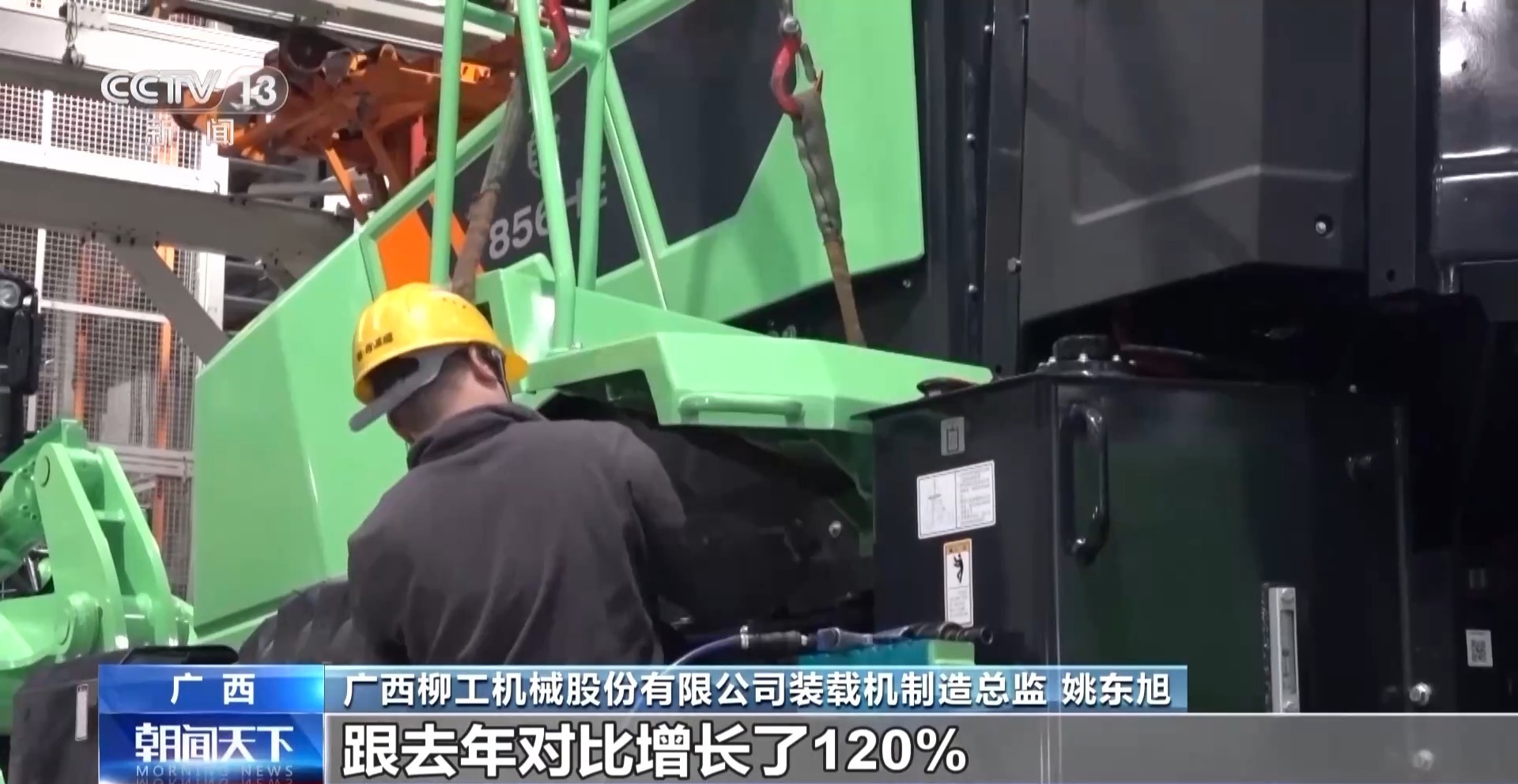
Core Viewpoint - China is actively expanding green trade to support its "dual carbon" goals, with green trade becoming a new driving force for foreign trade development as more green low-carbon products and services enter the international market [1][10]. Group 1: Green Product Export Growth - The export volume of electric loaders from Guangxi Liugong Machinery Co., Ltd. has increased by 120% compared to last year, with production capacity expanded from one to three production lines [3]. - In Zhejiang, a company is producing eco-friendly trademark belts made from recycled plastic bottles, showcasing the shift towards sustainable materials [5][8]. - In the first three quarters of this year, exports of wind turbine units and parts from China grew by over 30%, while photovoltaic products have maintained an export value exceeding 200 billion yuan for four consecutive years [10]. Group 2: Comprehensive Green Transformation - China's green product appeal in international markets stems from a comprehensive green transformation across the entire industrial chain, covering design, manufacturing, operation, and recycling [12]. - A refrigerator factory in Qingdao is producing energy-efficient refrigerators for the European market, with over 80% of its buildings equipped with solar panels, generating over 50 million kWh of green electricity annually [16][18]. - The factory expects to produce over 2 million refrigerators this year, saving approximately 10,000 tons of standard coal and reducing carbon dioxide emissions by over 26,000 tons [18]. Group 3: Institutional Support for Green Trade - The establishment of a green trade public service platform in Hubei aims to help export companies understand international carbon rules, addressing challenges in green transformation [28][31]. - China has accelerated the development of its green trade system, issuing 49 national standards for greenhouse gas emission accounting and 13 standards for carbon footprints [33]. - The Ministry of Commerce plans to promote high-quality development of green trade and enhance the green low-carbon development capabilities of enterprises [35].

西班牙媒体:欧洲应汲取中国能源转型经验
Huan Qiu Shi Bao· 2025-11-24 12:57
当美国犹豫不决、欧洲举棋不定时,中国正凭借太阳能发电场、电池和电动汽车,全速迈向绿色未 来。贝伦气候峰会证明了:没有中国的硬件产品,世界将无法实现其气候目标。 如今,超过60%的电动汽车产自中国,超过70%的电池也在中国生产。曾经被嘲笑的比亚迪超越了 特斯拉,电池巨头宁德时代展示了"充电5分钟,续航520公里"的电池。中国电动汽车价格实惠,不仅得 益于技术优势,还归功于高效的组织结构:激烈的市场竞争、自动化生产以及从原材料到产品交付的垂 直整合模式,降低了生产成本。 那么,中国是如何成为全球绿色领导者的?中国在能源转型方面的飞跃并非偶然,而是过去数十年 经济快速增长的结果。中国将社会投资、灵活开放、严格规划与市场激励相结合,打造出一个兼具规 模、速度和方向的经济体。 先说说社会基础。从一开始,中国就投入大量资金用于教育、医疗和社会保障,培养出健康且受过 良好教育的大量劳动者。重要的是,工资水平与生产率同步增长,这既维护了社会稳定,又培育出庞大 而充满活力的国内市场。 在此基础上,基础设施和技术成为"加速器"。中国快速建成了铁路、公路、港口和能源网络。同 时,大规模投资研发,在科学出版物和专利数量上跃居世界前列 ...
全球经济展望及投资策略
工银国际· 2025-11-24 12:04
Global Economic Outlook - The global economy is at a critical inflection point with the Federal Reserve restarting its interest rate cut cycle[10] - Geopolitical tensions, tech rivalries, and tightening U.S. fiscal conditions are significant challenges[10] - Risk assets are experiencing increased volatility due to stretched valuations[10] China Economic Insights - China's economy is navigating through complex environments, achieving steady growth under the "14th Five-Year Plan"[10] - The "15th Five-Year Plan" will further unleash China's economic potential through industrial upgrades and technological innovation[11] - Hong Kong's capital market has shown robust recovery, with the Hang Seng Index leading global performance and IPO fundraising reclaiming the top position[10] Investment Strategy - Hong Kong is positioned as a key gateway for global capital allocation into Chinese assets, enhancing its role as a "super-connector" and "super value-adder"[11] - The convergence of internal and external forces will spotlight China's strategic advantage in value investing[11] - The ongoing capital market reforms and expansion of interconnection programs will bolster Hong Kong's financial market status[11]
德国连续四年衰退,彻底被中国击败?英媒:都是特朗普关税的错
Sou Hu Cai Jing· 2025-11-24 10:18
Core Insights - The article discusses the significant economic decline of Germany, attributing it to a combination of long-term structural issues and external pressures, particularly from the trade policies initiated during Trump's administration [1][3][20] - Germany's industrial output has reverted to levels not seen in 20 years, indicating a severe downturn in its manufacturing sector [3][19] - The shift from trade surplus to trade deficit with China by 2025 raises concerns about Germany's economic standing globally [5][19] Economic Decline - Germany's GDP has been in decline since 2022, marking four consecutive years of negative growth, which is indicative of deeper economic issues rather than short-term fluctuations [3][20] - The industrial production level has fallen back to 2005 standards, highlighting a significant regression in Germany's manufacturing capabilities [3][19] Trade Dynamics - Germany has transitioned from a trade surplus with China to a trade deficit by 2025, which poses challenges to its economic stability and raises questions about its global economic position [5][19] - The rising costs of logistics and energy have further exacerbated the situation, leading to increased industrial costs and reduced profits for German companies [10][19] Competitive Pressures - The slow pace of industrial upgrades in Germany has allowed Chinese manufacturing to catch up rapidly, with significant price advantages and improving product quality [6][15] - German companies are facing increased competition from Chinese firms, which have demonstrated faster innovation cycles and adaptability in emerging sectors like renewable energy and smart manufacturing [11][13][15] Policy Impact - Trump's tariffs have disrupted global supply chains, particularly affecting German manufacturers who rely heavily on international sourcing for materials and components [8][10] - The combination of external trade barriers and internal policy pressures has constrained the operational space for German businesses, especially small and medium-sized enterprises [11][13] Future Outlook - The article suggests that Germany must adapt its industrial and policy strategies to regain its competitive edge, as the global economic focus shifts eastward [22] - Without significant changes in approach, Germany risks falling further behind in the next industrial revolution, highlighting the urgency for transformation in its economic model [22]

有色金属及新材料行业年度策略:铜铝筑基,金银涌动
Zhongyuan Securities· 2025-11-24 08:25
Core Viewpoints - The report maintains a "stronger than market" rating for the non-ferrous metals and new materials industry, highlighting the sector's robust performance relative to the CSI 300 index [1][4]. Group 1: Performance and Market Review - In 2025, the non-ferrous metals sector has seen a significant increase, with a year-to-date rise of 77.88%, outperforming the CSI 300's 16.01% increase [21]. - The sub-sectors within non-ferrous metals have shown varied performance, with nickel, cobalt, tin, and antimony leading with a rise of 106.62%, followed by lithium at 102.88% and tungsten at 97.82% [21][23]. - The upstream mining sector reported revenues of CNY 306.97 billion, a 14.20% year-on-year increase, and profits of CNY 93.28 billion, up 33.30% [27][28]. Group 2: Industrial Metals - Copper supply is constrained due to declining ore grades and insufficient capital expenditure, while demand is bolstered by investments in energy and electric vehicles, leading to an upward price trend [6][8]. - The aluminum sector is experiencing tight supply with limited new capacity, and the average price of electrolytic aluminum is expected to be around CNY 22,000 per ton in 2026 [6][8]. - The copper segment's revenue for Q3 2025 reached CNY 1,443.86 billion, a 5.05% increase year-on-year, with net profit rising 44.60% to CNY 69.91 billion [32]. Group 3: Precious Metals - The gold sector is benefiting from central bank purchases and geopolitical uncertainties, with revenues for Q3 2025 reaching CNY 291.17 billion, a 34.35% increase year-on-year, and net profits rising 63.03% to CNY 14.49 billion [37]. - Silver, with both industrial and monetary attributes, is expected to show greater price elasticity, supported by a slight increase in global demand [6][8]. Group 4: Rare Metals - The rare metals sector has shown significant profit growth, with revenues for Q3 2025 reaching CNY 79.93 billion, a 12.47% increase, and net profits soaring 200.11% to CNY 4.99 billion [41]. - The nickel, cobalt, tin, and antimony segment reported revenues of CNY 130.87 billion, a 23.79% increase, with net profits rising 25.45% to CNY 9.31 billion [41]. Group 5: Investment Recommendations - The report suggests focusing on leading companies in copper, aluminum, gold, and superhard materials, emphasizing the strategic value of these resources in the current market environment [6][7].
宏观经济展望:全球经济慢复苏,十五五引领新方向
Xiangcai Securities· 2025-11-24 06:41
Group 1: Global Economic Outlook - The IMF has slightly raised the global economic growth forecast for 2025 to 3.2%, with developed economies expected to grow at approximately 1.5% and emerging markets at over 4%[14] - The UAE's economic growth forecast for 2025 is adjusted to 4.8%, up from earlier predictions[14] - The US economy is projected to grow by 2.0% in 2025, slightly above the average for developed countries[14] Group 2: Domestic Economic Trends - China's GDP growth for 2025 is expected to be around 4.8%, a decrease of 0.2 percentage points from 2024, with further decline to 4.2% in 2026[14] - Fixed asset investment in China turned negative in September 2025, dropping from a positive 0.5% in August to -1.7% in October[49] - Real estate development investment in China has decreased by 14.7% year-on-year as of October 2025[49] Group 3: Inflation and Monetary Policy - Global inflation is expected to ease, but the US still faces inflation risks above target levels, while other regions maintain moderate inflation[15] - The Federal Reserve has initiated a rate cut cycle, reducing the federal funds rate to a range of 3.75% to 4.00%[30] - The probability of the Fed not lowering rates in December 2025 has risen to 51.4%, indicating market uncertainty[32] Group 4: Investment Recommendations - The report suggests that the Hong Kong stock market may benefit from the Fed's rate cuts, as liquidity improves and capital flows to higher-yield emerging markets[7] - Long-term investment in gold is recommended, with prices expected to rise further during the global rate cut cycle, currently above $4000 per ounce[8]
行业解决方案:针对不同行业客户需求,发布定制化解决方案,展现公司专业服务能力
QYResearch· 2025-11-24 05:01
Core Insights - The article emphasizes the complexity of challenges and opportunities faced by enterprises in a rapidly evolving global industrial landscape, driven by digital transformation, supply chain restructuring, policy changes, and upgraded market demands [3]. Group 1: Industry Focus - The electronic and semiconductor industry is characterized by rapid technological updates and is influenced by global digital economy growth and geopolitical factors. The research team provides insights into wafer manufacturing, packaging testing, and equipment materials to help clients maintain technological leadership [4]. - The mechanical equipment industry is undergoing a deep transformation towards digital systems driven by smart manufacturing and automation trends. Research focuses on production models, supply chain structures, and overseas market expansion to identify digital transformation opportunities [5]. - The chemical and new materials industry faces higher demands for green transformation and sustainable development. The research team explores innovations in production processes and downstream market changes to help companies find breakthroughs under policy and market pressures [5]. - The automotive and rail transit industry is being redefined by the rise of electric vehicles and smart transportation. Research covers battery supply chains, autonomous driving, and smart cockpit technologies to assist manufacturers in strategic planning [5]. - The renewable energy sector is becoming a core growth driver amid the "dual carbon" strategy and global energy transition. Research focuses on breakthroughs in materials and equipment, battery technology, and smart grid systems to help companies seize opportunities in the low-carbon economy [5]. - The pharmaceutical and medical industry is rapidly growing due to aging populations and increased health demands. Research spans from raw materials to high-end formulations, providing market data and insights for pharmaceutical companies and healthcare institutions [5]. - The consumer goods industry is experiencing rapid iteration driven by consumption upgrades and digital retail. Research analyzes market size, consumer behavior, and supply chain management to support sustainable growth strategies [5]. - The software and services industry has evolved into a key driver of economic and social development, with a focus on cloud computing, big data, and AI. Research helps clients understand the transition from "tool software" to "platform ecosystems" [5]. Group 2: Customized Solutions - The company offers three core service models to meet diverse client needs: standardized research reports, customized research solutions, and strategic consulting with deep collaboration [6][8][9]. - Standardized research reports provide comprehensive industry data, market size forecasts, competitive landscape analysis, and policy environment interpretations to help clients quickly understand the industry [7]. - Customized research solutions are tailored to specific client needs, such as entering new markets or evaluating new technologies, ensuring alignment with strategic goals [8]. - Strategic consulting involves long-term collaboration, where the company acts as a strategic advisor, participating in the strategy formulation process and continuously updating market information [9]. Group 3: Professional Service Capabilities - The company's professional service capabilities include in-depth research across the entire industry chain, from raw materials to end-user applications, and from technological trends to market models [10]. - The company maintains an international perspective, tracking global market dynamics to assist clients in developing globalization strategies [10]. - Emphasis is placed on the practical application of research, ensuring that solutions are feasible and actionable, enabling clients to find breakthroughs in complex environments [10].
