
通胀

Search documents
美联储理事鲍曼呼吁美联储准备降息,美国就业市场仍然脆弱
Sou Hu Cai Jing· 2026-01-16 19:57
Core Viewpoint - Federal Reserve Governor Bowman advocates for readiness to lower interest rates due to a weakening labor market, emphasizing the need for the Fed to remain responsive to employment conditions [1][3]. Group 1: Labor Market Concerns - The labor market is showing signs of increasing vulnerability, with potential deterioration expected in the coming months, despite a slight decrease in the unemployment rate to 4.4% [3]. - December's job growth fell short of expectations, indicating cautious hiring and limited layoffs, which may signal a slowdown in the labor market for the year [3]. Group 2: Monetary Policy Stance - Bowman describes the current monetary policy as "moderately restrictive," indicating ongoing efforts to combat inflation and support economic growth [1]. - There is a divergence among Federal Reserve officials regarding interest rate policies, with some believing that current rates are insufficient to effectively curb inflation, leading to a cautious stance on further rate cuts [5]. Group 3: Inflation Outlook - Bowman expresses a relatively optimistic view on inflation, noting that inflationary pressures are easing, partly due to reduced tariff impacts, with underlying inflation nearing the Fed's 2% target [1]. - The Fed's dual mandate of managing inflation and employment presents uneven risks, necessitating a flexible approach to policy decisions [4]. Group 4: Financial Market Vulnerabilities - Concerns are raised about potential vulnerabilities in financial markets, particularly regarding high stock prices and the risk of disappointing returns from AI investments, which could lead to sharp corrections in stock prices [1]. Group 5: Regulatory Focus - In terms of banking regulation, Bowman emphasizes the need to improve merger review processes, assess capital requirements across the banking system, and enhance examiner training and development [2].
美联储前票委:当前阶段并不合适大幅降息
2 1 Shi Ji Jing Ji Bao Dao· 2026-01-16 14:08
Core Viewpoint - The independence of the Federal Reserve is crucial for effective policy and economic stability, and external pressures, particularly from political figures, pose significant risks to this independence [1][3]. Group 1: Federal Reserve Independence - The U.S. Department of Justice has initiated a criminal investigation into Federal Reserve Chairman Jerome Powell, raising concerns about the Fed's independence [1]. - Patrick Harker emphasizes that any external pressure on the Federal Reserve is dangerous and could undermine its decision-making effectiveness, impacting both the U.S. economy and the global financial system [1][3]. - Harker notes that the Federal Reserve's structure allows it to maintain a degree of political independence, which is essential for making unpopular decisions, such as raising interest rates during high inflation [3]. Group 2: Current Economic Challenges - The U.S. economy is facing multiple challenges, including persistent inflation around 3%, high housing costs, and stagnant labor markets [1][4]. - Harker warns that pursuing short-term economic stimulus through significant interest rate cuts could exacerbate structural issues rather than resolve them [2][5]. - The inflation rate remains stubbornly high, influenced by factors such as tariffs and rising housing and healthcare costs, which are expected to persist [4][7]. Group 3: Policy Outlook and Employment - Harker indicates that the labor market is showing signs of stagnation, with job growth concentrated in healthcare and government services, while manufacturing jobs are declining [8]. - The uncertainty surrounding tariff policies and housing costs will significantly influence inflation trends moving forward [9][10]. - Harker suggests that the Federal Reserve may consider one interest rate cut this year, but the decision will depend on the evolving economic landscape [11]. Group 4: Global Economic Perspective - Harker believes that the U.S. economy will perform reasonably well, supported by investments in artificial intelligence and data centers, but overall growth remains modest [13]. - The potential for global growth is seen in Asia, although risks persist due to the changing nature of U.S. policies [14]. - Harker stresses the importance of trust and cooperation among nations to avoid stagnation in global affairs, highlighting that excessive distrust could hinder progress [16].
美联储前票委:当前阶段并不合适大幅降息
21世纪经济报道· 2026-01-16 13:56
记者丨 施诗 李依农 《全球财经连线》: 我们看到司法部已发起刑事调查,针对美联储以及美联储主席鲍 威尔。你如何看待这件事? 面对这种政治与政策交织的复杂局面, 美联储前票委、费城联邦储备银行前行长Patrick Harker在接受南方财经记者独家专访时指出,美联储的独立性是保障政策有效性和经济稳定 的关键。 他强调,任何针对美联储的外部施压都是危险的行为,可能削弱央行独立性、影响 其决策效果,甚至在全球经济层面产生连锁影响。在他看来,保持独立性不仅关乎美联储自身 的政策执行,也对美国经济及全球金融体系的稳定至关重要。 Harker还提醒,当前美国经济面临多重挑战: 通胀长期停留在3%左右,住房成本和医疗保健 支出仍居高不下,劳动市场整体呈现停滞。在这样的环境下,盲目追求短期刺激,尤其是通过 大幅降息,不仅无法解决结构性问题,反而可能埋下更大风险。 当前阶段并不合适大幅降息 《全球财经连线》: 特朗普呼吁大幅降息,如何看待这一主张? Patrick Harker: 在当前阶段,这并不是一项合适的政策。这样做只会进一步刺激通胀,而我 们需要的是采取相反方向的措施,即推动通胀回落、加以抑制。 挑战美联储独立性是一 ...


国投期货贵金属日报-20260116
Guo Tou Qi Huo· 2026-01-16 13:07
Report Industry Investment Rating - Gold and silver are rated ★☆☆, indicating a bullish bias but with limited operability on the trading floor [1] Core View - The US economy remains resilient with the weekly initial jobless claims at a new low since December, and multiple Fed officials oppose short - term interest rate cuts. Short - term risk - aversion sentiment has cooled due to Trump's delay in deciding on a military strike against Iran. However, gold shows resistance to decline. Given the US challenges to the global order, precious metals are expected to stay strong in the medium term, and a long - position strategy remains unchanged [1] Summary by Related Topics South American Situation - The US military has seized the sixth oil tanker related to Venezuela. The US is pressuring Mexico to allow cross - border anti - drug operations. Trump plans to visit Venezuela, and the Venezuelan opposition leader met with Trump, who refused to back his bid for power [2] Federal Reserve - Goolsbee believes the central bank should focus on reducing inflation due to a stable job market. Bostic thinks inflation is too high and tight policies are needed. Paulson supports keeping interest rates unchanged at the next meeting. Schmid sees little reason for a rate cut as monetary policy is not very tight. Daly thinks the policy is in a "good position" and adjustments should be cautious [2] International Monetary Fund (IMF) - IMF President Kristalina Georgieva emphasized the importance of central bank independence and supported Fed Chairman Powell, who is under investigation by the Trump administration [2]
古尔斯比力挺鲍威尔:破坏央行独立性将致通胀“卷土重来”!
美股研究社· 2026-01-16 12:34
Core Viewpoint - Concerns regarding attacks on the Federal Reserve's independence could negatively impact inflation, as stated by Chicago Fed President Goolsbee [2]. Group 1: Federal Reserve Independence - Goolsbee emphasized that any infringement on the independence of the central bank is problematic, warning that it could lead to a resurgence of inflation [2]. - He supported Powell's statement that inquiries into construction projects could be seen as political pressure from President Trump regarding interest rates [3][5]. Group 2: Powell's Tenure and Future - Powell's term as chair will end in May, but he can remain as a governor until 2028 [4]. - Goolsbee praised Powell as a "first-ballot Hall of Fame member" for managing to lower inflation without triggering a recession [6]. Group 3: Monetary Policy Outlook - Goolsbee indicated that the Fed should focus on reducing inflation, given the strong employment market, and suggested that there is room for interest rate cuts later this year if inflation trends back to 2% [6].

美最高法院再推迟裁决关税是否合法 美国经济将面临什么?
Sou Hu Cai Jing· 2026-01-16 12:06
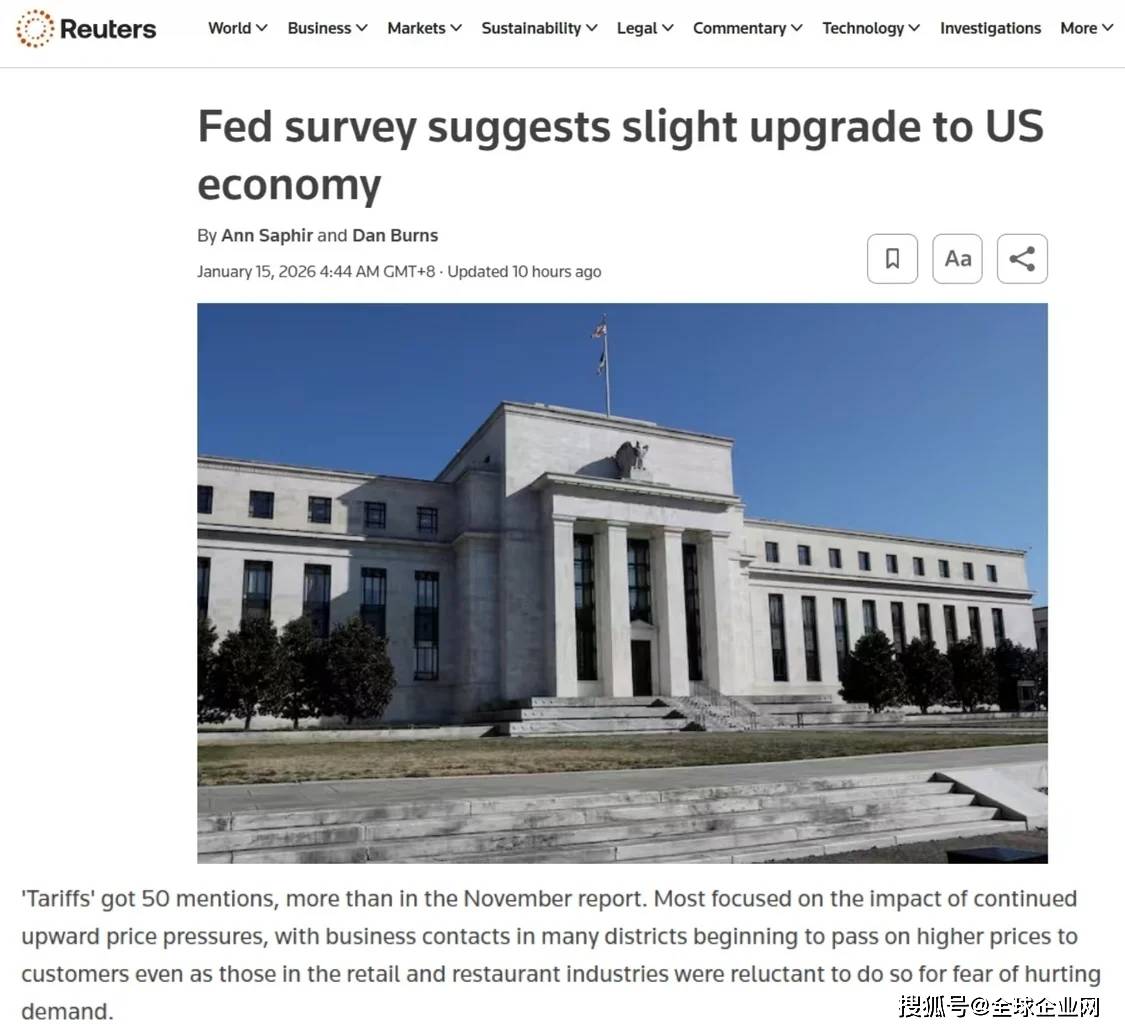
Group 1 - The Federal Reserve's Beige Book indicates that economic activity has improved across most districts, but cost pressures from tariffs persist [1] - Companies are beginning to pass on tariff costs to consumers due to depleted inventories and increased pressure to maintain profit margins [1] - Concerns are rising about inflationary pressures if companies continue to transfer costs to consumers, which could impact overall economic conditions in the U.S. [4] Group 2 - The uncertainty surrounding tariffs is causing companies to be cautious in long-term production planning, potentially disrupting manufacturing investment [4] - The Federal Reserve may face a dilemma in its monetary policy, as rising inflation from tariffs could prevent it from lowering interest rates to stimulate economic growth [4] - The U.S. Supreme Court has not yet ruled on the legality of the Trump administration's tariff policies, which has led to ongoing legal challenges [7] Group 3 - The legal basis for the tariffs is under scrutiny, particularly whether the invocation of the International Emergency Economic Powers Act violates U.S. tariff laws [7] - If the Supreme Court rules against the tariffs, the government could face significant financial repercussions, including potential refunds amounting to hundreds of billions [8] - A balanced or compromise solution may be sought by judges to avoid exacerbating economic and fiscal impacts while addressing potential executive overreach [9] Group 4 - The U.S. government has announced new tariffs on certain imported semiconductors and related products, indicating that tariffs will remain a core tool in domestic and foreign policy [9] - A ruling that supports the government's tariff measures could strengthen its global tariff strategy, potentially undermining the multilateral trading system established post-World War II [10] - Consideration may be given to establishing broader tariff exemptions for essential goods to mitigate domestic inflation and public discontent [10]
分析:澳大利亚央行加息可能性或大于预期
Xin Lang Cai Jing· 2026-01-16 11:58
Core Viewpoint - The Reserve Bank of Australia (RBA) is facing pressure to potentially raise interest rates amid strong economic indicators, contrasting with the Federal Reserve's inclination to lower rates, which could impact global forex and fixed income markets [1][4]. Group 1: Economic Indicators - The RBA's upcoming meeting in February is set against a backdrop of concerning indicators for investors accustomed to loose monetary policy, including persistent price pressures, strong private sector demand, and a booming real estate market [1][5]. - Upcoming inflation data for the three months ending in December is crucial; if it shows trimmed mean inflation above the RBA's 2%-3% target, the RBA may have no choice but to act [1][5]. - Current household spending is robust, economic growth is steady, core and overall inflation are above targets, and unit labor costs have risen, although productivity growth remains weak [1][5]. Group 2: Interest Rate Predictions - RBA Governor Michele Bullock's recommendations may focus on actions to mitigate inflation risks, with expectations that the RBA will raise rates in February and again in May, reflecting a historical pattern of consecutive rate changes [2][6]. - Some economists predict that if CPI momentum slows, the RBA may pause after a February hike but could raise rates again later in the year [2][6]. - There is a consensus that Australia is not on the verge of an aggressive tightening cycle, as the RBA has been cautious in its rate adjustments compared to other central banks [2][6]. Group 3: Currency and Market Reactions - The potential for the RBA to maintain or raise rates while the Federal Reserve lowers them could widen the interest rate differential favoring Australia, potentially leading to an appreciation of the Australian dollar [3][7]. - The Australian dollar is nearing its highest level since October 2024, trading at 0.6705 USD [3][7].
大摩2026全球展望:美国强经济推迟降息,日央行全年按兵不动,中国出口持续扩大……
Sou Hu Cai Jing· 2026-01-16 11:28
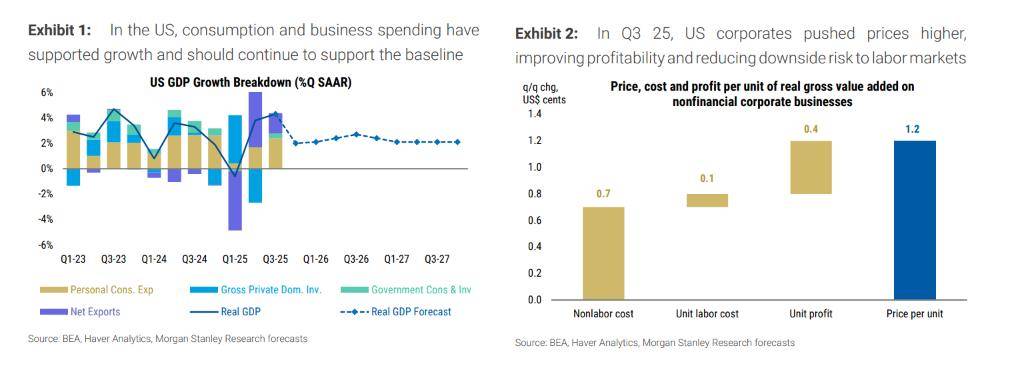
Group 1: Global Economic Outlook - Morgan Stanley indicates that the global economy is at a highly differentiated crossroads, with market expectations for liquidity easing potentially misaligned with reality [1] - The expectation for the Federal Reserve to cut rates early in the year has largely evaporated due to strong U.S. consumer data, pushing the first rate cut expectation to mid-year [1][5] - The first half of 2024 is expected to operate under a "high interest rate, strong dollar" monetary environment, leading to increased asset price volatility [1] Group 2: U.S. Economic Conditions - The U.S. economy shows a confusing yet resilient divergence, with consumer spending growing at a strong annualized rate of 3.5% despite signs of labor market weakness [2][5] - Inflation, particularly driven by tariff costs, is becoming a more pressing threat than recession, with a significant portion of tariff cost pass-through to consumers still pending [5] Group 3: Eurozone and UK Economic Challenges - The Eurozone is experiencing stagnation, with the composite PMI dropping from 52.8 to 51.9, indicating a loss of growth momentum [6] - Core inflation in the Eurozone has decreased to 2.3%, supporting the case for potential rate cuts by the European Central Bank in June and September [8] - The UK economy remains weak, with labor demand softening and inflation expected to return to target levels by April 2026, increasing the likelihood of a rate cut in February [8] Group 4: Japan's Monetary Policy Outlook - Morgan Stanley predicts that the Bank of Japan will maintain its interest rates throughout 2026, contrary to market expectations for rate hikes, due to anticipated declines in core CPI [9][12] - Political uncertainty in Japan, including potential early elections, adds to the challenges for monetary policy tightening [12] Group 5: China's Economic Strategy - China is expected to increase its share of the global export market from 15% to 16.5% by 2030, reflecting a strong export outlook [13] - The recent PMI data indicates the effectiveness of prior fiscal expansion, with continued fiscal support expected in 2026 [14] Group 6: Emerging Markets Dynamics - India is projected to be a growth engine in emerging markets, with a growth forecast of 7.4% for the fiscal year 2026, driven by policy easing and strong demand [17] - Latin America is poised for a policy shift towards more market-friendly approaches, with Brazil expected to cut rates significantly while facing moderate economic slowdown [17]

金属价格暴涨,美国CPI的下一个上行风险?
Hua Er Jie Jian Wen· 2026-01-16 10:57
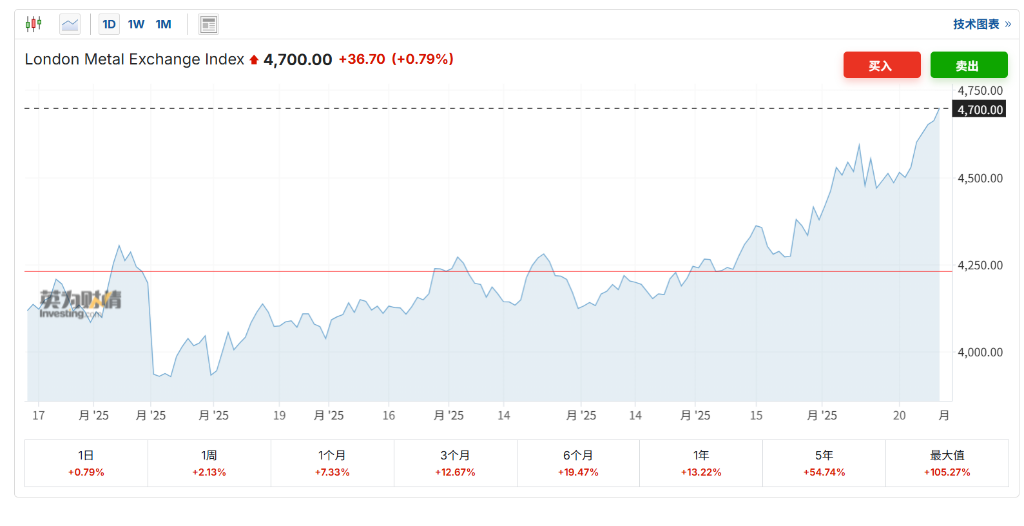
工业金属价格的持续上涨正成为美国通胀前景的潜在威胁。随着油价近期反弹、关税成本传导以及经济增长保持韧性,多重因素叠加可能推动 CPI在未来数月出现上行压力,最高法院即将就关税问题作出的裁决也为短期通胀走势增添了不确定性。 据追风交易台消息,德银分析师Markus Heider在15日公布的报告中表示,金属市场正经历一轮强劲涨势。LMEX工业金属指数自去年12月以来已 上涨近20%,自9月以来累计涨幅达到30%。这一始于去年秋季的上涨行情在最近几周明显提速。 通胀风险正在累积。本周公布的11月生产者价格指数(PPI)报告已显示核心消费品通胀出现加速迹象。与此同时,此前一直作为重要抵消因素的 能源价格近期止跌回升,过去一周油价出现反弹,削弱了成本端的缓冲空间。 对于美国市场而言,这一风险尤为突出。近几个月来关税政策已为成本端增添压力。如果油价维持在当前水平且经济增长保持强劲,金属价格上 涨将更明显地构成美国CPI的上行风险。 金属价格与通胀市场估值之间存在显著的正相关关系,这种关联建立在两个基础之上。首先,基础金属是生产成本的重要驱动因素,价格上涨会 直接传导至制造业成本,进而影响终端消费价格。其次,金属价格与通 ...

费城联储主席声援鲍威尔
Sou Hu Cai Jing· 2026-01-16 10:42
Core Viewpoint - Anna Paulson, President of the Philadelphia Federal Reserve Bank, publicly supports Jerome Powell's leadership amid ongoing political pressure and controversy surrounding the Federal Reserve [1][4]. Group 1: Support for Powell - Paulson emphasizes the importance of strong leadership at the Federal Reserve, stating that it benefits the American public [5]. - She aligns with other Federal Reserve officials who have also endorsed Powell's integrity and leadership [5]. - Powell is currently facing a criminal investigation related to a renovation project at the Federal Reserve's Washington headquarters, which Paulson supports him on [3][4]. Group 2: Monetary Policy and Interest Rates - Paulson indicates a cautious but clear stance on monetary policy, supporting recent interest rate cuts while suggesting that further cuts are not urgent [6]. - She believes the current interest rate level is "sufficiently high" and slightly above the neutral rate, which does not stimulate or suppress economic growth [6]. - Paulson anticipates significant progress in reducing inflation towards the Federal Reserve's 2% target by the end of the year, but is open to supporting small rate cuts later if inflation data continues to show easing [6][7]. Group 3: Labor Market Insights - Paulson expresses concern about the risks in the labor market, noting that 95% of private sector job growth last year was concentrated in healthcare and social assistance, which is not indicative of a healthy economy [8]. - She warns that signs of a rapid deterioration in the labor market would be closely monitored, as historical trends suggest labor market signals often dominate economic indicators [8]. - Paulson observes that companies are now more cautious in their pricing strategies, focusing on maintaining market share rather than aggressively raising prices [8].