智能化

Search documents
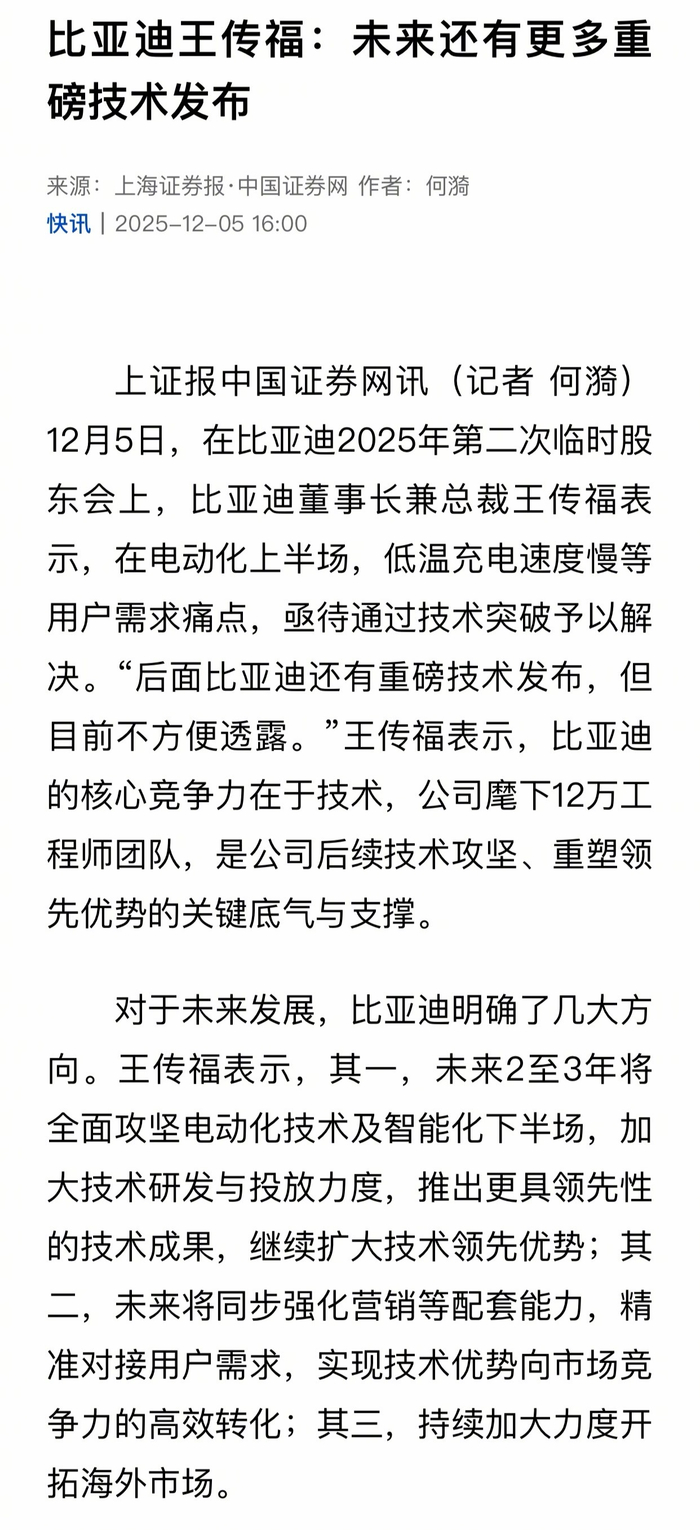
王传福:比亚迪要带头做好榜样,用技术创新赢得尊重
Guan Cha Zhe Wang· 2025-12-06 03:25
Core Viewpoint - BYD's chairman Wang Chuanfu emphasizes the company's commitment to not undermine competitors and to lead by example in the industry, focusing on technological advancements to impress consumers [1][3]. Group 1: Company Principles and Performance - Wang reiterates BYD's principle of long-termism and not disparaging peers, stating that the company will only promote its own strengths [3]. - In November, BYD's sales reached 480,200 units, a year-on-year decline of 5.25%, while cumulative sales from January to November totaled 4.182 million units, reflecting a year-on-year growth of 11.3% [3]. - The decline in market appeal of BYD's technological achievements and the increasing homogeneity in the industry are noted as factors affecting performance, which aligns with the cyclical nature of product and technology development [3]. Group 2: Future Directions - BYD plans to focus on electric and intelligent technology advancements over the next 2-3 years, increasing R&D efforts to launch more leading-edge technologies [4]. - The company aims to enhance marketing capabilities to better align with user needs, while avoiding excessive marketing that could backfire [4]. - BYD is committed to expanding its overseas market presence, with November overseas sales reaching 131,900 units, marking a significant milestone, and cumulative overseas sales for the year reaching 917,000 units, doubling from the previous year [4].


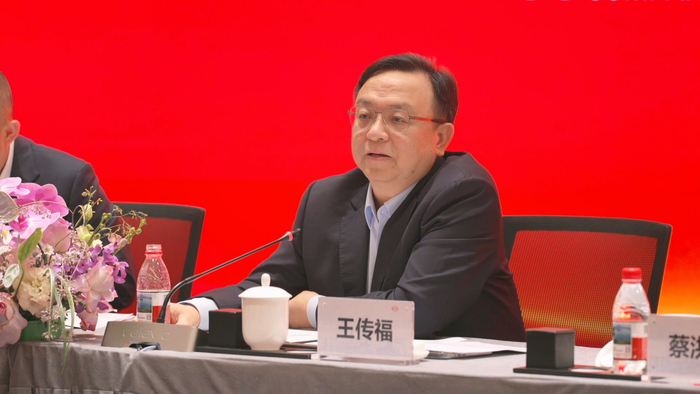
聚焦巨型机组“智”“绿”新趋势 未来巨型水轮发电机组论坛举办
Zhong Guo Xin Wen Wang· 2025-12-05 17:50
Core Insights - The forum titled "Intelligent Driving of Giant Turbine Generator Sets for a Green Dual-Carbon Future" opened in Beijing, focusing on advanced technologies and development trends of giant turbine generator sets, aiming to provide research directions for their intelligent, green, and low-carbon future [1][2] Group 1: Industry Position and Achievements - China holds the world's largest installed capacity and annual power generation in hydropower, with the key factor being the emergence of million-kilowatt turbine generator sets [1] - China Water Resources and Hydropower Fourth Engineering Bureau has participated in over 200 leading hydropower projects, witnessing China's transition from a hydropower major to a hydropower powerhouse, with a total installed capacity exceeding 50 million kilowatts [1] Group 2: Key Technologies and Innovations - Academician Shu Yinbiao emphasized the need for breakthroughs in technologies such as cascade scheduling, cross-basin compensation, wind-solar integration, pumped storage, and digital smart hydropower to advance China's hydropower development [2] - Academician Zhang Zongliang discussed the history and achievements of China's hydropower development, analyzing the functional positioning of hydropower in the new historical context and proposing suggestions for future development [2] - Professor Wang Zhengwei highlighted the demand for predictive technology development for future giant turbine generator sets, calling for collaboration across the industry to unlock the modern potential of traditional hydropower [2] Group 3: Future Directions and Forum Highlights - The forum, lasting three days, includes various sessions such as opening ceremonies, keynote speeches, panel discussions, and technical exchanges, marking it as the highest-level and most influential event focused on giant turbine generator sets in China [1][4] - The future installation and commissioning technology for giant turbine generator sets will focus on "intelligent, digital, standardized, lean, systematic, and safe" approaches, integrating cutting-edge technologies like intelligent robots and digital twins [4]
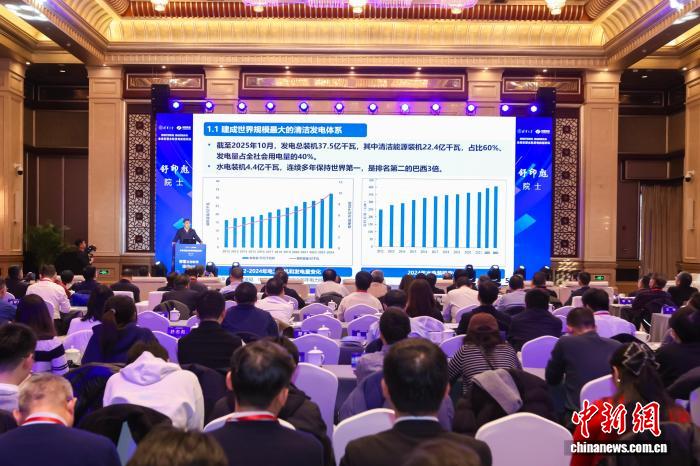
王传福:将有重磅技术发布 目前不方便透露
Shang Hai Zheng Quan Bao· 2025-12-05 13:33
Core Viewpoint - BYD is focusing on technological innovation and AI application to maintain its competitive edge in the electric vehicle market, despite facing challenges in the domestic market due to increased competition and a slowdown in product technology cycles [4][5][6][7]. Group 1: Sales Performance - In the first 11 months of 2025, BYD sold a total of 4.182 million new energy vehicles, representing a year-on-year increase of 11.3% [5]. - In November 2025, BYD exported 131,900 new energy vehicles, a significant increase of 369.4% compared to 28,100 units in the same month last year [5]. - Domestic sales of passenger new energy vehicles in November 2025 were 474,900 units, a decrease of 5.77% from the same month last year [5]. Group 2: Technological Development - BYD's chairman, Wang Chuanfu, emphasized the company's commitment to technological innovation, stating that the company has a team of 120,000 engineers to support its technological advancements [5][7]. - The company is preparing to release significant new technologies, although specific details are not yet disclosed [5]. - BYD aims to enhance its electric and intelligent technology capabilities over the next 2 to 3 years, focusing on addressing challenges such as slow charging and low-temperature charging [5]. Group 3: Market Strategy - Wang Chuanfu highlighted the importance of maintaining a fair competitive environment in the industry, indicating that BYD is willing to sacrifice short-term performance for long-term sustainable growth [6]. - The company is committed to leveraging its strong manufacturing base, vertical integration capabilities, and extensive user data to rapidly implement AI technologies [5][6].
奇瑞集团前11月销量256万辆 新能源突破80万辆增69.4%
Xin Lang Cai Jing· 2025-12-05 12:49
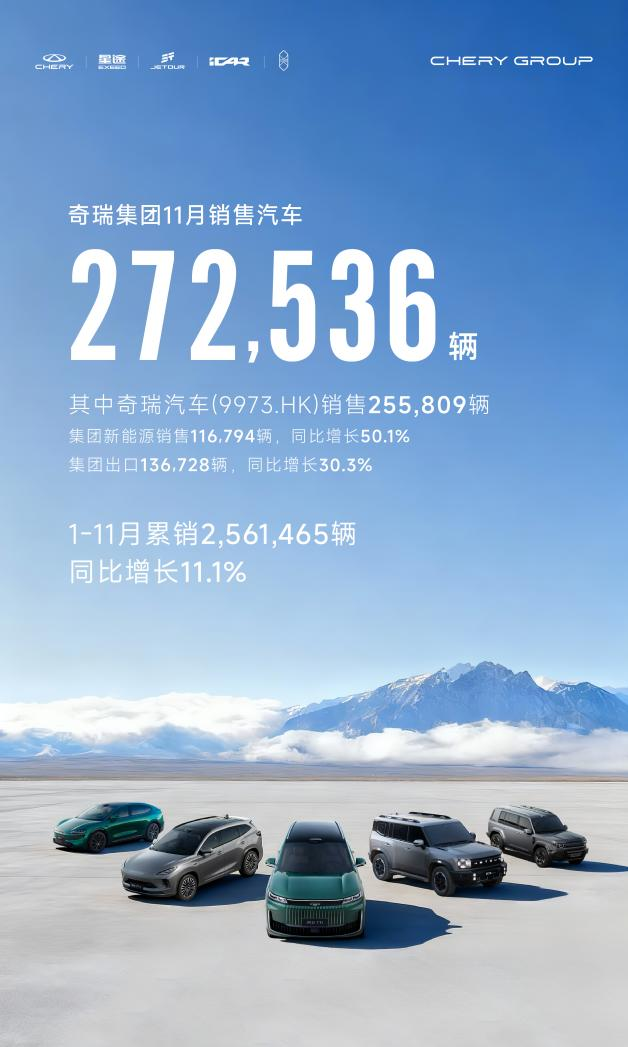
Core Insights - Chery Group reported a total vehicle sales of 272,536 units in November, with new energy vehicles (NEVs) sales reaching 116,794 units, marking a year-on-year growth of 50.1% and setting a new historical record [1][13] - Cumulative sales from January to November reached 2,561,465 units, representing an 11.1% year-on-year increase, while NEV sales totaled 814,685 units, up 69.4% year-on-year [1][13] - Chery continues to lead in exports, with 136,728 units exported in November, a 30.3% increase, maintaining its position as the top exporter of Chinese automobiles [1][13] Sales Performance - Chery brand sold 165,511 units in November, with a cumulative total of 1,543,069 units for the year [3][15] - The Exeed brand sold 12,021 units in November, totaling 109,466 units year-to-date [3][15] - The Jetour brand achieved sales of 55,088 units in November, with a cumulative total of 573,739 units [3][15] - The iCAR brand sold 11,428 units in November, accumulating 90,451 units for the year [3][15] - The Zhijie brand sold 11,761 units in November, with a total of 82,348 units year-to-date [3][16] Product Strategy - Chery Group is focusing on a dual-track strategy of "new energy + new fuel," launching the fifth-generation Tiggo 8 and various new energy models to meet global market demands [5][18] - At the 2025 Guangzhou Auto Show, Chery showcased 34 key models across its five brands, covering mainstream segments such as sedans, SUVs, and off-road vehicles [5][18] Technological Advancements - Chery is advancing its smart technology integration across its vehicles, with significant developments in intelligent driving, AI models, and smart cockpits [7][20] - The Exeed ET5 was awarded the "World's Top Ten Smart Cars" title, highlighting Chery's commitment to innovation in the automotive sector [9][21] User-Centric Approach - Chery is enhancing its "people, car, home" ecosystem by incorporating user feedback into product development, with over 500,000 users participating in the Wind Cloud A9L project [8][22] - The company is fostering community engagement through various brand activities, transforming users from participants to co-creators [8][22] Global Strategy - Chery is transitioning from "product export" to "brand export," with a focus on establishing a strong global presence [10][25] - The launch of the Zongheng G700 in Dubai signifies Chery's entry into the luxury off-road market, receiving positive feedback from local consumers [10][25] Future Outlook - As 2025 approaches, Chery aims to accelerate its transformation into a globally trusted high-tech ecological group, emphasizing long-term strategies in new energy, smart technology, and global innovation [13][27]
比亚迪王传福,最新发声!
Zhong Guo Zheng Quan Bao· 2025-12-05 12:16
Core Insights - BYD is focusing on three core directions for future development: enhancing electric and intelligent technology, improving marketing capabilities, and expanding overseas markets [1][3]. Group 1: Technology and Innovation - The company emphasizes "technology as king," highlighting the increasing homogeneity in industry technology and the need for continuous innovation to maintain a competitive edge [2]. - BYD has a strong engineering team of 120,000, which is crucial for ongoing technological advancements and maintaining leadership in the market [2]. - The company plans to invest significantly in AI technology, focusing on manufacturing scenarios to drive its application in automotive and component manufacturing [4]. Group 2: Market Performance - In November, BYD's sales reached 480,200 units, a year-on-year decrease of 5.25%, while cumulative sales for the first 11 months of the year were 4.182 million units, reflecting a year-on-year increase of 11.3% [2]. - The company has successfully expanded its overseas market presence, with November overseas sales surpassing 100,000 units for the first time, reaching 131,900 units compared to 28,100 units in the same month last year [2]. Group 3: Marketing and Brand Strategy - The company acknowledges past marketing weaknesses and plans to enhance brand strength and competitiveness in high-end products while avoiding aggressive marketing tactics [3]. - BYD aims to build long-term brand recognition and consumer trust, even if it means sacrificing short-term market share [3].
以高端化重塑竞争规则 赛力斯如何打造产业变革新范式?
Zheng Quan Ri Bao· 2025-12-05 12:09
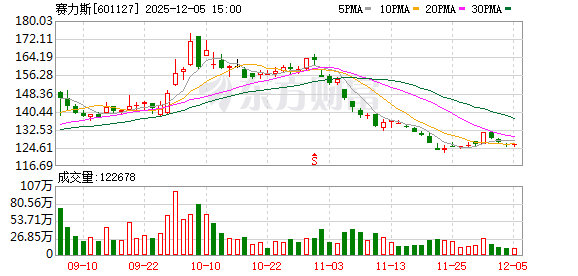
Core Viewpoint - The company, Seres, is rapidly achieving new records in the new energy vehicle sector, with significant sales growth and successful market entry, indicating strong potential for future growth and profitability [2][8]. Sales Performance - In November, Seres sold 55,203 electric vehicles, marking a year-on-year increase of 49.84%, setting a new historical high [2]. - Cumulatively, the sales of new energy vehicles reached 411,288 units in the first 11 months of the year [2]. - The Aito series has become the main sales driver for the company, showcasing strong market demand [2]. Product Development - The Aito series includes four models: Aito M9, M8, M7, and M5, with continuous product iterations throughout the year [3]. - As of November 21, the cumulative delivery of Aito series vehicles surpassed 900,000 units [3]. - The Aito M9 and M8 lead their respective price segments, with cumulative deliveries of over 260,000 and 130,000 units, respectively [4]. Financial Performance - For the first three quarters of 2025, Seres reported revenue of 110.53 billion yuan, a year-on-year increase of 3.67%, and a net profit of 5.31 billion yuan, up 31.56% [4]. - The gross profit margin has increased compared to the same period last year, indicating enhanced profitability [4]. Technological Advancements - The Aito M9 benefits from a robust technological foundation established through collaboration with Huawei, enhancing its market appeal [5]. - Seres has invested nearly 30 billion yuan in R&D for high-end smart electric vehicles, creating a positive cycle of technology breakthroughs, sales growth, and profit enhancement [6]. Global Expansion - Seres is actively pursuing a global strategy, with products now available in over 70 countries and regions [7]. - The company aims to transition from product export to brand establishment in international markets, marking a significant shift in its growth strategy [7]. - The recent successful listing on the Hong Kong stock market represents a new phase in Seres' globalization efforts, enhancing its international presence and resources [8].

广汽集团11月汽车销量17.97万辆 环比增长5.2%
Zheng Quan Shi Bao Wang· 2025-12-05 11:15
Group 1 - GAC Group reported November 2025 production and sales figures, with total vehicle sales reaching 179,700 units, a month-on-month increase of 5.2% [1] - From January to November, GAC's self-owned brand overseas sales increased by 39% year-on-year [1][3] - GAC's new management team, including General Manager He Xianqing, has been fully appointed, focusing on key business areas such as product management, R&D, manufacturing, marketing, internationalization, strategic development, and human resources [3] Group 2 - In November, GAC continued to enhance its smart and high-end positioning, with several key models showing sales recovery [2] - GAC Trumpchi's new energy vehicle sales exceeded 150,000 units by November, while the MPV family sold over 830,000 units, leading the luxury MPV market in China [2] - GAC Aion's first dual-power model, Aion i60, was launched just before the Guangzhou Auto Show, achieving over 10,000 orders within two weeks [2] - GAC Toyota's pure electric model, Platinum 3X, achieved a monthly sales figure of 10,010 units, surpassing 62,000 units in total sales [2] - GAC Honda's flagship model, Accord, sold 21,653 units in November, a year-on-year increase of 63.3% [2]

创新为核,全球布局!浙江鼎力“智能平台+机器人”系列产品惊艳海事展
Zheng Quan Shi Bao Wang· 2025-12-05 10:12
Core Insights - The 2025 China International Maritime Exhibition showcased over 2,200 exhibitors from more than 40 countries, highlighting the industry's shift towards "green" and "smart" transformation [1] - Zhejiang Dingli presented its "Intelligent Platform + Robot" series, focusing on revolutionary solutions for ship rust removal and spraying, which became a focal point of the exhibition [1][2] Company Innovations - Zhejiang Dingli's integrated intelligent operating system addresses long-standing issues in shipbuilding, such as low efficiency, high costs, and safety risks associated with manual rust removal and spraying [2] - The company's robots offer superior quality, efficiency, cost-effectiveness, safety, and environmental impact compared to traditional manual operations, achieving a spraying rate of at least 450 square meters per hour, which is approximately ten times more efficient [3] Market Applications - The series of ship rust removal and spraying robots has been successfully implemented in various shipyards, including Wanbang Heavy Industry and Changhong International, indicating potential for new revenue growth for Zhejiang Dingli [4] R&D and Future Strategy - Innovation is central to Zhejiang Dingli's strategy, focusing on differentiated products in niche markets, with a commitment to exploring electric, green, digital, and unmanned technologies [5] - The company plans to continue developing modular and differentiated high-altitude work platforms, expanding into new application scenarios and fields [5] Global Market Position - Zhejiang Dingli maintains a robust production and operational performance, with a steady production rhythm and increasing capacity utilization, reflecting strong market demand [6] - The company has developed a comprehensive risk management system to navigate complex overseas market conditions, enhancing its resilience and global market expansion efforts [6] Industry Trends - The shift towards "green" and "smart" solutions in the shipbuilding industry presents significant growth opportunities for Zhejiang Dingli, as it aligns with global demands for sustainable practices [7] - The company aims to drive innovation and provide intelligent solutions to enhance safety, efficiency, and environmental sustainability across various industries [7]


英威腾(002334) - 2025年11月25日至12月3日投资者关系活动记录表
2025-12-05 10:08
Group 1: Company Overview - The company focuses on industrial automation and energy power sectors, with four main business segments: industrial automation, network energy, new energy power, and photovoltaic energy storage [2][3] - The industrial automation segment provides core components and integrated solutions, widely applied in various industries including compressors, lifting machinery, and semiconductor equipment [3] - The network energy segment offers products like micro-module data centers and intelligent monitoring solutions, serving industries such as cloud computing and finance [3] Group 2: Industry Outlook - The industrial automation industry is expected to grow due to policy support, technological innovation, and market demand, with a shift towards intelligent, green, and service-oriented solutions [3][4] - The domestic replacement process is deepening, creating opportunities for local companies to fill gaps in high-end automation equipment [3] Group 3: Business Growth Strategies - Future growth points for industrial automation include consolidating low-voltage inverter advantages, enhancing servo and PLC products, and transitioning to integrated scenario-based solutions [4] - The company aims to deepen operations in strategic industries and expand overseas market presence to leverage global growth potential [4][5] Group 4: Network Energy Business - The network energy business primarily consists of UPS products, which account for approximately 70% of sales, with precision air conditioning becoming the second-largest product [5] - The company is focusing on data centers and intelligent computing centers, with plans for product innovation and market expansion [5] Group 5: New Energy Vehicle Business - The new energy vehicle segment has seen significant revenue growth, particularly in commercial vehicles, leading to improved profit margins [6] - The management is confident in the profitability potential of this segment, emphasizing product competitiveness and market share expansion [6] Group 6: Overseas Market Strategy - The company has been active in overseas markets for nearly 20 years, with industrial automation and network energy as the main revenue sources [7][8] - Future plans include strengthening global operations through local subsidiaries and enhancing service capabilities to increase market share [8]

王传福称比亚迪将加大技术研发力度,未来2至3年攻坚电动化智能化
Cai Jing Wang· 2025-12-05 10:01
Core Viewpoint - BYD is committed to enhancing its technological research and development efforts, with significant technology releases expected in the future [1] Group 1: Technological Development - BYD's chairman Wang Chuanfu emphasized the need to address user pain points such as slow low-temperature charging speeds through technological breakthroughs [1] - The company has a team of 120,000 engineers, which is crucial for overcoming technical challenges and maintaining its competitive edge [1][2] Group 2: Future Directions - Over the next 2 to 3 years, BYD plans to focus on advancing electric vehicle technology and smart technology, increasing R&D investment, and launching more leading-edge technological achievements [1][2] - The company aims to strengthen its marketing capabilities to better align with user needs, effectively converting technological advantages into market competitiveness [1][2] - BYD will continue to expand its efforts in overseas markets [1][2]