铝代铜

Search documents
以后的空调制冷都不行了?铝代铜到底是升级还是减配
虎嗅APP· 2026-01-04 14:15
Core Viewpoint - The article discusses the ongoing debate in the air conditioning industry regarding the shift from copper to aluminum in key components, particularly heat exchangers, and the implications for product performance and cost [5][8][25]. Group 1: Industry Trends - Major air conditioning brands, including Haier, Midea, and TCL, have formed an alliance to promote the use of aluminum instead of copper, while Gree has opted out, citing concerns over quality and reliability [5][6][25]. - The shift to aluminum is driven by rising copper prices, which have surged to over $12,000 per ton, making copper a significant cost component in air conditioning units, accounting for approximately 30% to 40% of total costs [30][29][28]. Group 2: Technical Considerations - The transition involves replacing copper pipes in heat exchangers with aluminum pipes, which could potentially affect cooling efficiency due to aluminum's lower thermal conductivity (about 60% of copper's) and other performance metrics [12][10][8]. - Advances in technology, such as microchannel technology and specialized coatings, are being developed to mitigate the disadvantages of aluminum, including its thermal conductivity and corrosion resistance [14][16][18]. Group 3: Market Dynamics - The global demand for copper is increasing, driven by sectors like AI and electric vehicles, which require significant amounts of copper for infrastructure and manufacturing [38][42]. - Geopolitical risks and supply chain vulnerabilities related to copper mining are prompting manufacturers to consider aluminum as a more stable alternative, given its abundance and lower cost [50][49]. Group 4: Consumer Implications - Consumers are concerned that the switch to aluminum may compromise the performance of air conditioning units, leading to calls for manufacturers to ensure quality and possibly lower prices to reflect the cost savings from using aluminum [51][52]. - The article suggests that if manufacturers can demonstrate that aluminum-based systems perform comparably to copper systems, they should consider passing on cost savings to consumers through lower prices or extended warranties [52].



2025家电收官:空调价格战白热化,港股上市潮涌
Bei Ke Cai Jing· 2025-12-31 13:41
谈及家电行业"内卷",格力电器董事长董明珠向记者表示,家电行业竞争非常激烈,大家不再追求技术 突破,简单地偷工减料,以价格忽悠用户。如果图便宜买1000元的空调,面临的维修成本远远大于购买 一台质量好的产品,劣质产品耗电量也是正常产品耗电量的翻倍。 市场"价格战"悄然改变行业格局。小米集团合伙人、总裁卢伟冰在2025年年初提到,"小米空调2024年 是中国市场第四名,今年目标坐稳第三名,最近提出2030年目标,在中国市场空调要做到数一数二。虽 然目标蛮难,但我认为小米机会很大。" 2025年收官,家电行业经历了市场竞争与资本布局的双重变革。空调赛道成为最热门领域,政策引导下 的多重补贴引发激烈价格战,"千元机"频现,行业均价结构性下探,不仅导致头部品牌市场份额收缩, 也让小米等新势力借机崛起,行业格局悄然生变。 资本市场方面,A股家电及消费电子企业赴港上市热潮涌动,奥克斯电气成功登陆港股,石头科技、极 米科技、视源股份等纷纷推进"H股上市"计划,以"A股+H股"双平台布局拓展融资渠道、加速全球化进 程,为行业发展注入新的资本动力,2026年行业竞争与布局或将更趋激烈。 价格战下,空调头部企业份额收缩 2025 ...

铝价存趋势格局,氧化铝寻底路漫漫
Yin He Qi Huo· 2025-12-31 08:17
Report Industry Investment Rating No relevant content provided. Core Viewpoints of the Report - The aluminum price is expected to show a trending pattern, while alumina is on a long - term downward path. The financial attribute of aluminum will continue to strongly drive the price in 2026, and the global supply - demand shortage of aluminum will support the price. Alumina will maintain a cost - based pricing logic due to an oversupply situation [6][86]. - The consumption of aluminum will grow at a low rate but still have bright spots, such as in energy transformation, lightweight applications, and the export of aluminum - processed products. However, traditional industries like real estate and home appliances may still perform weakly [34][54]. - The supply of recycled cast aluminum alloy will be affected by raw material shortages and policy uncertainties, and its price will generally follow the trend of the aluminum price [89]. Summary by Directory Part One: Preface Summary 1. Market Review - **Electrolytic Aluminum**: Overseas tariffs, monetary policies, and the "de - dollarization" trend have affected the aluminum price. The supply - demand contradiction and low inventory have supported the price, and the cost has decreased while the profit has increased [5]. - **Aluminum Alloy**: The casting aluminum alloy futures were successfully launched this year. The price of aluminum alloy is highly correlated with the aluminum price, but the spot price of casting aluminum alloy has difficulty following the increase in the aluminum price [5]. - **Alumina**: The supply - demand situation at home and abroad has turned to oversupply, and the price has declined. The industry is shifting profits to the ore end, and there are basis trading opportunities [5]. 2. Market Outlook - **Electrolytic Aluminum**: The financial attribute will continue to strongly drive the aluminum price. The supply - demand shortage and low inventory will give the price greater elasticity [6]. - **Aluminum Alloy**: The supply - demand pattern will remain slightly oversupplied, and the price will generally follow the metal sector and the aluminum price. There are risks in basis and cross - variety spreads [6]. - **Alumina**: The oversupply situation will continue, and the price will maintain a downward - selling strategy. There are policy risks, and basis trading opportunities still exist [6]. 3. Strategy Recommendation - **Unilateral**: Be bullish on the aluminum price on dips; the absolute price of casting aluminum alloy will follow the aluminum price, and pay attention to basis and variety spread opportunities before the expiration of warehouse receipts; maintain a downward - selling strategy for alumina, and pay attention to price elasticity risks driven by policy expectations [7]. - **Arbitrage**: Pay attention to the expansion of the monthly spread of aluminum at low inventory levels, the convergence of the basis at the end of the off - season, and the repeated arbitrage opportunities in the internal - external price difference; for aluminum alloy, pay attention to the arbitrage opportunities in the range of a discount of 100 - 1400 yuan to the aluminum price and the spot - futures arbitrage opportunities; there are basis trading opportunities for alumina when the warehouse receipts are low and before expiration [7]. Part Two: Supply Rigidity and Global Shortage, Aluminum Price in a Trending Pattern 1. 2025 Aluminum Market Review - The aluminum price showed a volatile upward pattern in 2025, with the Shanghai Aluminum main contract price ranging from a minimum of 19,000 yuan to a maximum of 22,980 yuan, an annual increase of 13.8% [11]. - The price increase in the first and fourth quarters was mainly driven by LME aluminum, while in the second and third quarters, the price rebounded steadily after a decline [12][13]. 2. 2026 - 2030 Global Electrolytic Aluminum Supply Outlook - **Domestic**: The supply - side constraints on domestic electrolytic aluminum capacity still exist. The capacity will reach the theoretical ceiling in 2026, and the supply elasticity will decrease significantly. The production in 2026 and 2027 will have limited growth [20][21][22]. - **Overseas**: The overseas electrolytic aluminum capacity is expected to increase by 820,000 tons in 2026 and 1.65 million tons in 2027. The new - investment capacity is mainly concentrated in Indonesia [24][25]. - **Imports**: China will still rely on imported aluminum ingots in 2026, and the net import volume is expected to increase to 2.5 million tons [33]. 3. Aluminum Consumption with Low Growth but Bright Spots - **Export of Aluminum - processed Products**: The export volume of aluminum - processed products in 2025 is expected to be about 10.2 million tons, a year - on - year decrease of 2.55%. It is expected to turn positive in 2026, with an increase of about 400,000 tons [34]. - **Domestic Aluminum Demand**: The proportion of domestic aluminum demand in the total apparent demand increased in 2025. The growth of domestic demand was mainly in the first half of the year, and the demand in the energy transformation and lightweight application fields will be a stable growth source [41][54]. - **Difference between Apparent Demand and Actual Output**: The apparent demand of aluminum is significantly higher than the actual output of aluminum - processed materials, mainly due to the inventory in the intermediate links of the industry [45]. - **Traditional Industries**: The demand for aluminum in the real estate industry will still be weak, and the home appliance industry is expected to have a mild growth in air - conditioner production. The "aluminum - for - copper" substitution is ongoing [59][65]. 4. Certainties and Uncertainties of Aluminum - The global aluminum supply - demand gap may continue in the next five years, which will increase the price elasticity of aluminum. Tariffs and trade barriers mainly affect the price difference between regions, and the EU's CBAM policy may increase the trading cost [69][70]. - The aluminum market has a weak tolerance for supply - side uncertainties. Overseas electrolytic aluminum plants face risks such as accidents, carbon tariffs, and energy supply, and the climate phenomenon may also affect production and demand [71]. 5. Supply - Demand Balance and Inventory Expectations - **Balance Sheet**: The global economic growth is expected to be slow from 2025 to 2030. The domestic aluminum demand in 2026 is expected to increase by 2.54%. The global aluminum supply - demand gap is expected to be 570,000 tons in 2026 and 330,000 tons in 2027 [72]. - **Inventory**: Overseas, the LME aluminum spot basis has been in a premium state, and the new regulatory rules may make the price increase more stable. Domestically, the overall inventory is expected to remain stable, but attention should be paid to the changes in the monthly spread and basis during peak seasons [79][84]. 6. Macroeconomic and Fundamental Factors Affecting Aluminum Price The price of aluminum is affected by both financial and commodity attributes. In 2026, the resonance of these two attributes may push the aluminum price to break through previous highs, and the smelting profit is expected to be considerable [86]. Part Three: Recycled Cast Aluminum Alloy Expected to Follow the Aluminum Price 1. Supply - Demand of Recycled Aluminum Alloy - **Supply**: In 2025, the total built - in capacity of recycled aluminum alloy reached 18.67 million tons, with a low production rate due to raw material shortages, price inversion, and policy disturbances. In 2026, about 1 million tons of new capacity are expected to be put into operation, but the supply growth is still restricted [89]. - **Demand**: The demand for recycled aluminum alloy is mainly from the transportation industry, especially in the automotive sector. The demand growth rate is expected to slow down in 2026 [94][95]. - **Supply - Demand Balance**: The industry is expected to face a shortage in 2025 and 2026. The futures market may drive demand, but the expiration of warehouse receipts may widen the basis [102]. 2. Scrap Aluminum Raw Materials - The global scrap aluminum trade has been growing steadily. China's scrap aluminum is in short supply and relies on imports. The application of scrap aluminum in non - alloy products is increasing, which will keep the scrap aluminum in short supply and narrow the refined - scrap price difference [105][108]. 3. Price and Spread of Recycled Aluminum Alloy The price of recycled aluminum alloy is highly correlated with the aluminum price. In 2026, it is expected to follow the aluminum price, but the seasonal performance of the spread may be weaker than in previous years [113][114]. Part Four: Alumina in an Oversupply Situation with a Long - term Downward Path 1. 2025 Alumina Market Review The alumina price showed a downward trend in 2025, mainly due to the improvement of the supply - demand situation. The price rebounded in May and July but then continued to decline. The domestic production capacity and output increased significantly [120][121][124]. 2. Alumina Supply Outlook - **Domestic**: The domestic alumina production capacity is expected to increase in 2026, with a theoretical maximum output of 103.68 - 104.68 million tons. After considering dynamic balance, the output is expected to be about 99.45 million tons, a year - on - year increase of 4.8% [127][128]. - **Overseas**: The overseas alumina production is expected to increase by about 7% to 61.73 million tons in 2026 [133]. 3. Alumina Supply - Demand Balance Expectation The growth rate of electrolytic aluminum production is not significant, and there will be an oversupply of about 4 million tons at home and abroad in 2026. The alumina price will mainly follow the cost - based pricing logic, but the price may rebound if the supply - demand surplus narrows [141]. 4. Bauxite with Significant Increment and Expected Price Decline In 2025, the domestic bauxite production increased slightly, and the import volume increased significantly. The supply of bauxite is expected to be in surplus in 2026, and the price is expected to continue to decline, which will drive the alumina price down [145][153][154].
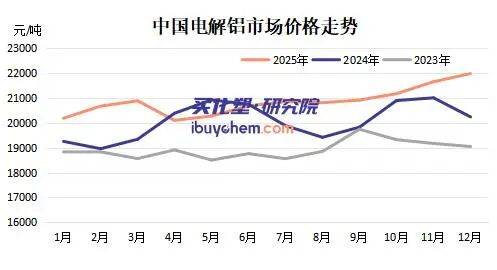
价格突破2.2万元/吨!电解铝价格创3年新高
Sou Hu Cai Jing· 2025-12-31 05:49
Core Viewpoint - The electrolytic aluminum market has entered a strong upward trend since 2025, driven by tight supply-demand dynamics, with domestic and international prices reaching new highs [1][3]. Supply Side Summary - The domestic electrolytic aluminum industry has entered a "stock replacement" era, with a production capacity ceiling set at approximately 45 million tons due to dual constraints from industry consensus on "anti-involution" and "carbon peak" policies [3]. - It is estimated that net new production capacity in China will only increase by 200,000 tons by 2025, with a total foreseeable increase of only 560,000 tons, making it difficult to effectively supplement market supply [3]. - Although countries like India and Indonesia are advancing new capacity construction, factors such as unstable power supply will hinder full production capacity by 2026, exacerbating the tight supply situation in the domestic market [3]. Demand Side Summary - Structural upgrades in demand are providing sustained upward momentum for electrolytic aluminum prices, with traditional construction sector demand stabilizing while the new energy sector becomes the core growth engine [5]. - The demand from the new energy vehicle industry continues to grow, with increased aluminum usage per vehicle due to lightweight trends; the acceleration of ultra-high voltage construction is significantly boosting demand for aluminum cables [5]. - The "aluminum replacing copper" trend in the power and electronics sectors is further expanding the application space for electrolytic aluminum, with projected demand growth rates of 2.1% in 2025 and 2026, outpacing supply growth of 1.6% [5]. Cost Side Summary - The release of cost dividends is a significant driver of profit expansion in the electrolytic aluminum industry, with key raw material prices, such as alumina, experiencing a decline due to ample supply [6]. - For instance, the domestic alumina futures price fell below 2,500 yuan/ton, nearly halving from its peak a year ago, contributing to an expanding profit margin for the industry [6]. - Major companies are showing stable profitability and improved cash flow, with China Aluminum leading the industry with a net profit of 10.872 billion yuan, a historical high for the same period, reflecting a year-on-year growth of 20.65% [6]. Industry Outlook - The tight supply-demand balance in the electrolytic aluminum industry is expected to persist, with demand growth in the new energy sector being a core driver for long-term industry development [6]. - Leading companies are likely to benefit from their production capacity advantages, industry chain layout, and cost control capabilities during this high-profit cycle [6]. - The acceleration of the "aluminum replacing copper" process and gradual recovery in overseas markets will further open up growth space for the electrolytic aluminum industry, with increasing industry concentration expected during the stock replacement phase [6].



建信期货铝日报-20251231
Jian Xin Qi Huo· 2025-12-31 01:45
Group 1: Report Information - Report Name: Aluminum Daily Report [1] - Date: December 31, 2025 [2] - Research Team: Non-ferrous Metals Research Team [3] - Researchers: Yu Feifei, Zhang Ping, Peng Jinglin [3] Group 2: Market Review and Operation Suggestions - Aluminum Price: On the 30th, Shanghai aluminum fluctuated at a high level. The main contract 2602 closed at 22,565, a slight increase of 0.13% from the previous day. The total position decreased by more than 22,000 lots to 655,000 lots [7]. - Spot Premium: Affected by the year - end settlement of enterprises, the trading sentiment in East China weakened, and the market liquidity was generally low. The spot premium was still under pressure. The discount in East China was - 310, in Central China was - 330, and in South China was - 320 [7]. - Supply: The domestic aluminum industry maintained a high - profit level, and the domestic operating capacity increased steadily but slightly under the stimulation of high profits. The supply pressure was generally limited due to the production capacity ceiling. Overseas, attention should be paid to the production reduction risk of Mozambique aluminum plants and the progress of Indonesia's capacity expansion [7]. - Demand: The operating rate of aluminum processing enterprises was further weakened by environmental protection restrictions and high aluminum prices, and the inventory showed an inflection point of accumulation [7]. - Price Outlook: In the medium term, aluminum prices are likely to rise due to loose liquidity and the strong performance of the gold and copper sectors. In the short term, the probability of high - level adjustment increases due to the fluctuating macro - atmosphere and limited fundamental drivers. It is advisable to control risks with light positions during the holiday [7]. Group 3: Industry News - Aluminum Substitution for Copper: 19 air - conditioning enterprises and research institutions, including Midea, Haier, and Xiaomi, jointly launched the implementation of the "aluminum substitution for copper" series of standards. Some brands plan to launch aluminum - made household air - conditioning products as early as 2026, while others have no such plan [10]. - Company Capacity Expansion: Lizhong Group's second - phase project of 1.8 million ultra - lightweight aluminum alloy wheels in its Mexican factory has been initially put into production. The third factory in Thailand with an annual production capacity of 3 million cast - spun aluminum alloy wheels is expected to be put into production next year. New high - performance aluminum alloy material projects in Chongqing, Huaian, Changchun, and Thailand will be put into production from the fourth quarter of this year to next year [10][11]. - Mining Plan: India's state - owned National Aluminium Company (Nalco) plans to start mining the Pottangi bauxite mine in Odisha in June 2026. It is expanding the fifth production line at its Damanjodi alumina refinery, increasing the annual production capacity by 1 million tons to 3.275 million tons [11]. - Automobile Industry: In the first 11 months, China's automobile production and sales exceeded 31 million, with a year - on - year increase of over 10%. The production and sales of new energy vehicles were close to 15 million, with a year - on - year increase of over 30%. New energy vehicle exports reached 2.315 million, doubling year - on - year [11]
白银具备阶段性更高的弹性
Mei Ri Jing Ji Xin Wen· 2025-12-31 00:39
Group 1 - Guojin Securities indicates that silver possesses higher elasticity in the short term, especially as it relates to AI narratives and its dual role as a precious metal and an asset linked to AI electricity [1] - Huaxi Securities notes that short-term volatility in precious metals is expected to persist, with silver, platinum, and palladium facing significant adjustments due to liquidity and market capacity constraints [2] - Tianfeng Securities highlights that while copper prices have risen significantly since 2025 due to overseas policies and supply-demand mismatches, the transition to alternative materials in the home appliance industry will not happen overnight [3] Group 2 - Guojin Securities suggests that gold has become a valuable insurance asset amid the AI bubble, while silver's narrative may revert to rationality once AI narratives become clearer [1] - Huaxi Securities anticipates that gold and non-ferrous metals will be less affected by emotional resonance, with expected declines being relatively controllable [2] - Tianfeng Securities recommends maintaining observation on the "aluminum replacing copper" trend, which may be catalyzed by policies and cost factors in the long term [3]


天风证券:铜价上涨,家电行业材料替代并非一蹴而就
Mei Ri Jing Ji Xin Wen· 2025-12-31 00:16
Core Viewpoint - Copper prices are expected to rise significantly due to overseas policy influences and supply-demand mismatches starting from 2025, while the white goods sector is likely to recover quickly in profitability due to a favorable competitive landscape and price adjustments by leading appliance manufacturers [1] Group 1: Copper Market - Copper prices are projected to increase significantly from 2025 due to external policy drivers and supply-demand imbalances [1] - Historical trends indicate that the white goods sector has a strong competitive structure that allows for rapid recovery in profitability [1] Group 2: White Goods Sector - Leading appliance manufacturers are effectively passing on cost pressures through price increases and new product launches [1] - The sector's ability to recover profitability quickly is attributed to its competitive advantages [1] Group 3: Long-term Considerations - Short-term observation is recommended as material substitution is not an immediate process [1] - Long-term focus should be on the practical implementation of "aluminum replacing copper" under the influence of policies and cost catalysts [1]
天风证券:铜价上涨 家电行业材料替代并非一蹴而就
Di Yi Cai Jing· 2025-12-31 00:12
Core Viewpoint - Copper prices are expected to rise significantly from 2025 onwards due to overseas policy influences and supply-demand mismatches, while the white goods sector is likely to see a quick recovery in profitability due to a favorable competitive landscape and price adjustments by leading appliance manufacturers [1] Group 1: Copper Market - Copper prices are anticipated to increase significantly starting in 2025, driven by overseas policies and supply-demand imbalances [1] - Historical trends indicate that the white goods sector has a strong competitive structure, which aids in rapid profitability recovery [1] Group 2: White Goods Sector - Leading appliance manufacturers are implementing price increases and introducing new products to pass on cost pressures, contributing to the swift recovery of profitability in the white goods sector [1] - The transition to material substitution, specifically "aluminum replacing copper," is not expected to happen overnight, indicating a need for ongoing observation [1]
AI供应链博弈与库存“堰塞湖”隐忧——2026年铜价真的高枕无忧吗?
Xin Hua Cai Jing· 2025-12-30 13:42
Core Viewpoint - Copper prices have surged to historical highs due to supply constraints and increasing demand from emerging sectors like AI and renewable energy, while concerns about potential tariffs and inventory levels in the U.S. add complexity to the market dynamics [1][2][10]. Supply Dynamics - On December 3, 2023, copper prices reached $11,448.50 per ton, marking a new high since May 2021, driven by supply tightness exacerbated by the cancellation of warehouse receipts by major commodity traders like Mercuria [1]. - The global copper supply has been disrupted, with mining pressures affecting smelting operations, leading to a forecasted reduction in copper production capacity by over 10% for 2026 [1][2]. - U.S. copper inventories account for nearly 50% of global stocks, while the remaining regions hold less than half, indicating a potential depletion of copper outside the U.S. [2]. Demand Drivers - Structural growth in demand for copper is being fueled by sectors such as electric vehicles, renewable energy, and AI, with significant investments in AI infrastructure expected to drive copper consumption [2][4]. - The AI sector alone is projected to increase copper demand by 47,500 tons by 2026, significantly impacting the supply-demand balance in a market that typically has a shortfall of only 10-20 thousand tons annually [4]. Market Sentiment and Price Projections - Despite recent price fluctuations, the market remains optimistic about copper's long-term prospects, with forecasts suggesting prices could stabilize around $11,400 per ton in 2026 [5][12]. - Analysts warn that U.S. inventory levels may create a "dam" effect, potentially flooding the market if tariffs are lifted or delayed, which could lead to significant price volatility [10][11]. Infrastructure and Regulatory Challenges - The construction of AI data centers is facing delays due to bottlenecks in electrical grid access and supply chain issues for critical power equipment, which may slow down the anticipated demand growth for copper [6][7]. - In Europe, regulatory measures are being implemented to limit the expansion of data centers, further complicating the supply landscape for copper [8][9]. Alternative Materials and Recycling - High copper prices may accelerate the adoption of aluminum as a substitute, particularly in non-AI sectors, while advancements in recycling technology could increase the supply of recycled copper [12].

有色板块延续升势 中国铝业(02600)升7.25%
Xin Lang Cai Jing· 2025-12-30 11:04
Group 1: Copper Market Insights - The copper supply is currently constrained due to resource nationalism and supply chain disruptions, leading to an uneven global copper inventory distribution [1][3] - As major economies stabilize, the mismatch between supply and demand is expected to transition from anticipation to reality, with strong market sentiment driving copper prices upward [1][3] - The US economy shows positive performance and optimism, while domestic copper demand is expected to remain resilient through 2026, contributing to the bullish market outlook [1][3] Group 2: Aluminum Market Dynamics - Aluminum has transitioned from a traditional bulk raw material to a core carrier of energy value, which supports the long-term bullish trend and upward price movement of aluminum [2][4] - Current aluminum price increases are partially driven by rising copper prices, but future growth may be supported by the mean reversion of the copper-aluminum ratio and increased demand for aluminum as a substitute for copper [2][4] - The lithium market is projected to experience simultaneous supply and demand growth by 2026, although potential mismatches in the release timing of supply and demand should be monitored [2][4]