
避险需求

Search documents
贵金属月报:联储降息东风助金价向上突破-20250901
Jian Xin Qi Huo· 2025-09-01 03:33
Report Information - Report Type: Precious Metals Monthly Report - Date: September 1, 2025 - Research Team: Macro Financial Research Team - Researchers: He Zhuoqiao, Huang Wenxin, Nie Jiayi [2] Report Industry Investment Rating - Not provided in the report Core Viewpoints - The long - term bull market of gold is supported by the hedging demand and reserve diversification demand due to the restructuring of the international trade and monetary system. The medium - term bull market is supported by economic growth weakness and central bank interest - rate cut expectations caused by Trump's reforms. In the short term, gold is expected to break through the $3,500/ounce mark and start a new upward trend. Silver, with strong industrial attributes, will also rise and may outperform gold. Investors are advised to maintain a bullish trading approach, and short - hedgers can reduce the hedging ratio [5]. Section Summaries 1. 2025 January - August Precious Metals Trend Review - Gold started a new upward trend in late December 2024 due to factors such as festival consumption expectations in China and India,避险需求, and US economic stagflation risks. In early April, the release of Trump's tariff details caused gold to fall to $2,956/ounce, but then it soared to $3,500/ounce due to multiple hedging demands. After that, gold traded in the range of $3,120 - $3,500/ounce. In August, gold rebounded and reached a new closing - price high on August 29. In 2025, London gold and silver rose 29.4% and 33.5% respectively, and Shanghai gold and silver futures indices rose 26.4% and 24.4% respectively [7][10]. - In June, funds flocked to silver, platinum, and palladium. Silver reached a 15 - year high of $39.52/ounce on July 23. The correlations between gold and the US dollar index, US Treasury real - interest rates, crude oil, and silver have all changed [9][10]. 2. Influence Factor Analysis 2.1 US Employment Market Weakens and Inflation is Moderate - In July 2025, US non - farm payrolls increased by 73,000, significantly lower than the expected 104,000. The unemployment rate rose, but the Sahm indicator was far below the recession threshold. Overall, the employment market deteriorated, giving the Fed a reason to restart interest - rate cuts without causing market panic about a recession. In July, the overall CPI remained at 2.7%, the core CPI rose to 3%, and the PPI increased by 0.9% month - on - month [11][14][15]. - Tariff threats pushed up inflation expectations and depressed consumer confidence. In May, 1 - year and 5 - year inflation expectations reached their highest levels since 1982, and the consumer confidence index hit a three - year low. After June - July, inflation expectations eased, but they rebounded in August [17][18]. 2.2 The Fed Hints at Restarting Interest - Rate Cuts - Fed Chairman Powell's speech at the Jackson - Hole meeting in August was seen as opening the door for a September interest - rate cut. The market expects an 81.9% probability of a 25 - basis - point cut on September 17, a 43.5% probability of another 25 - basis - point cut on October 29, and 80.2% and 33.3% probabilities of 50 - basis - point and 75 - basis - point cuts this year respectively [19]. - Trump has been attacking the Fed. He has made personnel changes at the Fed, increasing his influence. The market expects the Fed to cut interest rates by 75 basis points from January to July 2026, with the federal funds rate dropping to 3 - 3.25% by July 30 [20][21][22]. 2.3 Trade Policy Developments - The high - tariff suspension period between China and the US was extended to November 9. Trump imposed new tariffs on India and threatened to impose tariffs on imported furniture, but the impact of new tariff measures on the market is small [24]. - The US and the EU reached a trade agreement, including tariff adjustments, energy and chip purchases, and investment cooperation [25][26]. 2.4 US Dollar Exchange Rate and US Treasury Yields - US Treasury 10 - year yields have fluctuated. It is expected that the 10 - year Treasury yield will continue to steepen in the second half of 2025, with a core fluctuation range of 4 - 5%. The US dollar index is expected to first decline and then rise, with a core range of 95 - 105. The RMB - US dollar exchange rate is expected to first rise and then fall, with a core range of 7.1 - 7.4 [27][30][31]. 2.5 Gold Supply, Demand, and Market Structure - Gold and silver ETF holdings have rebounded since 2025. As of August 27, SPDR Gold ETF holdings were 962.5 tons, and SLV Silver ETF holdings were 15,275 tons. In the week of August 19, non - commercial institutions adjusted their positions in gold and silver futures and options, with the gold fund net - long ratio dropping to 31.3% and the silver fund net - long ratio rising to 223.4% [32][34]. 3. Precious Metals Price Outlook - In the long term, geopolitical risks and the restructuring of the trade and monetary system support the upward movement of the gold price center. In the medium term, economic growth weakness and interest - rate cut expectations keep the gold price strong. In the short term, gold is expected to break through $3,500/ounce and start a new upward trend [35][39].
2011年来首次,白银涨破40美元!
Hua Er Jie Jian Wen· 2025-09-01 03:26
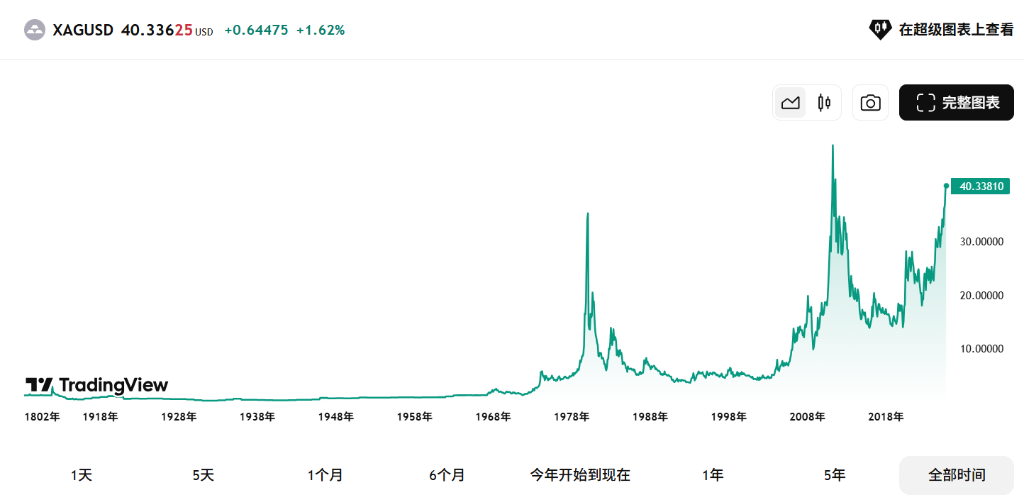
Core Viewpoint - The silver market is experiencing a significant surge, with prices surpassing $40 per ounce for the first time since 2011, driven by expectations of interest rate cuts by the Federal Reserve and strong demand fundamentals [1][4]. Group 1: Price Movement and Market Dynamics - On September 1, silver prices broke the $40 per ounce mark, with a year-to-date increase of over 40% [1]. - Current spot silver is reported at $40.33 per ounce, reflecting a daily increase of over 1.6% [1]. - The rise in silver prices is in line with other precious metals, including gold, which also reached new highs [1]. Group 2: Economic and Geopolitical Influences - Market speculation regarding the Federal Reserve's potential interest rate cuts is a primary driver of the recent surge in precious metals [1]. - Geopolitical tensions and an uncertain financial environment have increased investor demand for safe-haven assets [1]. Group 3: Supply and Demand Fundamentals - The silver market is heading towards its fifth consecutive year of supply shortages, driven by rising demand for clean energy technologies like solar panels [4]. - There has been a continuous inflow of funds into silver exchange-traded funds (ETFs), marking the longest streak of inflows since 2020 [4]. Group 4: Policy Implications - The U.S. Geological Survey's proposal to include silver in the 2025 critical minerals list could lead to significant policy changes, including potential high import tariffs [5][6]. - The proposal aims to reduce U.S. dependence on imports and expand domestic production [5]. Group 5: Tariff Risks and Market Reactions - Analysts suggest that the inclusion of silver in the critical minerals list may set the stage for the U.S. to impose tariffs under Section 232, potentially reaching rates as high as 50% [6]. - The U.S. currently relies on imports for 64% of its silver needs, indicating that tariff risks may be underestimated by the market [6]. - Citigroup maintains a bullish outlook for silver prices, projecting them to reach $43 per ounce within the next 6-12 months [6].

美元走软避险资金涌入 金价狂飙创五周新高
Jin Tou Wang· 2025-08-29 03:08
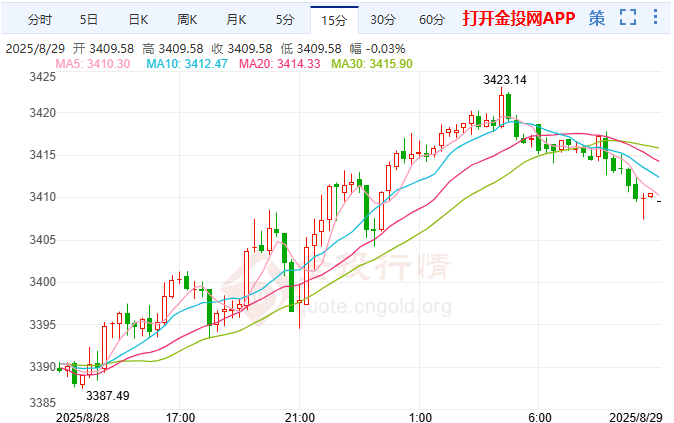
Core Viewpoint - The ongoing concerns regarding the independence of the Federal Reserve have increased demand for safe-haven assets like gold, leading to a rise in gold prices, which reached a five-week high [3]. Group 1: Market Performance - On August 29, gold prices fluctuated and were trading around $3,410, following a three-day increase, with a closing price of $3,417.07 per ounce, marking a 0.60% rise [1]. - Gold prices surpassed $3,400 per ounce on August 28, driven by declining U.S. dollar and Treasury yields, and reached a five-week high [3]. Group 2: Influencing Factors - President Trump's actions to influence monetary policy, including attempts to remove Federal Reserve Governor Cook, have raised concerns about the Fed's independence, contributing to the rise in gold prices [3]. - Cook has filed a lawsuit against Trump, claiming he lacks the authority to dismiss her, which has sparked a significant debate about the independence of the Federal Reserve [3]. Group 3: Market Predictions - Market strategist Daniel Pavilonis predicts that gold could rise to approximately $3,700 per ounce by the end of the year due to the current pressures on the Federal Reserve [3]. Group 4: Technical Analysis - The daily chart indicates that gold is maintaining a wide range of fluctuations, with K-line patterns showing a stable upward trend along short-term moving averages [3]. - On the hourly chart, there is a slight downward pressure on gold prices, suggesting potential adjustments in the short term [4]. - The four-hour chart shows that gold is currently in a high-level consolidation phase, with short-term moving averages indicating a slightly strong upward trend [5].
新世纪期货交易提示(2025-8-29)-20250829
Xin Shi Ji Qi Huo· 2025-08-29 01:33
1. Report Industry Investment Ratings - Iron ore: Oscillation [2] - Coal and coke: Oscillation [2] - Rebar (Rolled steel): Oscillation with a weak bias [2] - Glass: Oscillation with a weak bias [2] - Shanghai Stock Exchange 50 Index: Upward [2] - CSI 300 Index: Oscillation [2] - CSI 500 Index: Oscillation [2] - CSI 1000 Index: Upward [4] - 2 - year Treasury bond: Oscillation [4] - 5 - year Treasury bond: Oscillation [4] - 10 - year Treasury bond: Decline [4] - Gold: Oscillation with a strong bias [4] - Silver: Oscillation with a strong bias [4] - Pulp: Weak operation [5] - Logs: Range oscillation [5] - Soybean oil: Oscillation [5] - Palm oil: Oscillation [5] - Rapeseed oil: Oscillation [5] - Soybean meal: Oscillation with a bearish bias [5] - Rapeseed meal: Oscillation with a bearish bias [5] - Soybean No. 2: Oscillation with a bearish bias [5] - Soybean No. 1: Oscillation with a bearish bias [5] - Live pigs: Oscillation with a weak bias [8] - Rubber: Oscillation [10] - PX: Wait - and - see [10] - PTA: Oscillation [10] - MEG: Reverse spread [10] - PR: Wait - and - see [10] - PF: Wait - and - see [10] 2. Core Views of the Report - The overall market shows a complex trend, with different products having different outlooks based on their specific supply - demand fundamentals, policy factors, and geopolitical situations. For example, the black industry is affected by production restrictions and demand trends; the financial market is influenced by policies and market sentiment; precious metals are driven by central bank purchases, geopolitical risks, and inflation data; and agricultural products are affected by weather, planting area, and consumption demand [2][4][5]. 3. Summary by Related Catalogs Black Industry - **Iron ore**: The fundamental contradiction is not prominent. The probability of an interest rate cut in September is high, supporting commodities. The expectation of domestic blast furnace production restrictions has been temporarily disproven, and the impact on demand is small. Global iron ore shipments have decreased slightly, and there is no obvious inventory accumulation pressure. Terminal demand is weak, and short - term prices are expected to oscillate [2]. - **Coal and coke**: Coal supply accidents are frequent, and production reduction expectations may cause supply fluctuations. Coal mine inventories are at a low level, and downstream demand is high. Short - term price adjustments are limited, and it is recommended to buy on dips after the market sentiment is released [2]. - **Rolled steel (Rebar)**: The production restriction policy in Tangshan is clear, but the reduction is less than expected. Overall demand is difficult to show a counter - seasonal performance, and there will be a pattern of high in the front and low in the back. Spot demand for rebar is weak, and futures prices are looking for support after a significant adjustment [2]. - **Glass**: Market sentiment has cooled, and the supply - demand pattern has not improved significantly in the short term. The key for the 01 contract is the cold - repair path. The long - term demand is difficult to recover significantly due to the adjustment of the real estate industry [2]. Financial Market - **Stock index futures/options**: The market has rebounded, and it is recommended to increase risk preference and long - position holdings. The release of relevant policies and international trade exchanges may have an impact on the market [2][4]. - **Treasury bonds**: Market interest rates are fluctuating, and the trend of Treasury bonds is weak. It is recommended that long - position holders hold lightly [4]. Precious Metals - **Gold and silver**: The pricing mechanism of gold is shifting from being centered on real interest rates to central bank gold purchases. Factors such as the US debt problem, geopolitical risks, and central bank gold - buying behavior support the prices of gold and silver. Although some factors may cause short - term fluctuations, the upward - driving logic has not completely reversed [4]. Light Industry - **Pulp**: The cost support for pulp prices is weak, and the paper - making industry has low profitability and high inventory pressure. The supply - demand pattern is weak, and prices are expected to decline [5]. - **Logs**: The daily shipment volume of logs is relatively stable, and the supply pressure is not large. The cost support is increasing, and prices are expected to oscillate within a range [5]. Oils and Fats - **Soybean oil, palm oil, and rapeseed oil**: The demand for soybean oil is promising due to strong export sales and relevant policies. The production and inventory of palm oil are in a certain state, and the demand growth provides long - term support. The inventory of domestic oils shows different trends, and prices are expected to oscillate after a previous sharp rise [5]. Oilseeds and Meals - **Soybean meal, rapeseed meal, soybean No. 1, and soybean No. 2**: The US soybean planting area has been significantly reduced, but the single - yield is expected to increase. The domestic soybean supply is abundant, and prices are expected to oscillate with a bearish bias, with weather and import volume being key factors [5]. Agricultural Products - **Live pigs**: The average trading weight of live pigs is decreasing, and the supply is increasing. The demand is restricted by high temperatures, and prices are expected to oscillate with a weak bias in the future [8]. Soft Commodities - **Rubber**: The supply of natural rubber is affected by weather and geopolitical factors, and the demand is relatively stable. The inventory is decreasing, and prices are expected to be strong in the short term [10]. Polyester - **PX, PTA, MEG, PR, and PF**: These products are affected by factors such as the geopolitical situation, oil prices, supply - demand fundamentals, and cost. Different products have different outlooks, including oscillation, wait - and - see, and reverse spread [10].
山金期货贵金属策略报告-20250828
Shan Jin Qi Huo· 2025-08-28 10:41
投资咨询系列报告 山金期货贵金属策略报告 更新时间:2025年08月28日16时49分 一、黄金 报告导读: 今日贵金属震荡偏强,沪金主力收涨0.21%,沪银主力收涨0.56%。①核心逻辑,短期贸易协议分批达成,避险需求回落;美国经 济滞涨风险增加,就业走弱通胀温和,联储降息预期反弹。②避险属性方面,特朗普试图解雇美联储理事库克,引发外界担忧美联 储的独立性。白宫官员称特朗普已签署行政令,美中关税休战期再延90天。③货币属性方面,鲍威尔暗示美联储可能需要降息, 但将谨慎行事。鲍威尔宣布美联储最新政策框架,回归灵活通胀目标。美国最新企业设备支出彰显韧性,但消费者对劳动力市场的 信心不断恶化。目前市场预期美联储9月降息概率从非农前40%左右快速飙升至80%以上,且年内降息次数预期从1次涨至2到3次 。美元指数和美债收益率承压回落;④商品属性方面,CRB商品指数反弹承压,人民币偏强压制国内价格。⑤预计贵金属短期震荡 偏强,中期高位震荡,长期阶梯上行。 | 数据类别 | 指标 | 单位 | 最新 | 较上日 | | 较上周/前值 | | | --- | --- | --- | --- | --- | --- | -- ...
美联储独立性面临严峻挑战 贵金属市场表现亮眼
Jin Tou Wang· 2025-08-28 07:26
Core Insights - The US dollar index showed a typical inverted V-shape pattern, closing slightly down by 0.06% at 98.147 points [2][3] - Precious metals, particularly gold and silver, experienced upward momentum due to challenges to the independence of the Federal Reserve, with gold rising by 0.11% to $3397.46 per ounce and silver increasing by 0.12% to $38.61 per ounce [2][3] Market Overview - The dollar index displayed a stable trend, influenced by uncertainties surrounding the frequent changes in the Federal Reserve's leadership and a data-dependent monetary policy stance, leading to doubts about the independence of monetary policy and future interest rate cuts [3] - Progress in tariff agreements between the US and Europe, along with positive negotiations regarding auto tariffs with Japan, may alleviate current trade tensions [3] - However, US pressure on India to cease oil transactions with Russia in exchange for tariff relief poses a potential risk of reigniting trade conflicts, which could lead to significant volatility in the precious metals market [3] Economic Context - The global economic landscape is delicately balanced, with varying policy adjustments from central banks and intertwined geopolitical risks and trade disputes [3] - Investors are advised to remain vigilant and closely monitor changes in policy indicators and international trade dynamics, as minor policy adjustments or unexpected events could disrupt market equilibrium and lead to substantial asset price fluctuations [3] Trading Strategy - The demand for precious metals as a safe haven is supported by policy uncertainty and geopolitical trade risks, but specific trends will depend on forthcoming US economic data and policy signals [4] - In the short term, precious metals are expected to maintain a strong oscillating trend, with gold anticipated to outperform silver [4] - Key technical levels to watch include the $3450 per ounce resistance for gold and the $39 per ounce resistance for silver, with potential upward momentum if these levels are effectively breached [4]
新世纪期货交易提示(2025-8-28)-20250828
Xin Shi Ji Qi Huo· 2025-08-28 03:12
Report Industry Investment Ratings - Iron Ore: Volatile [2] - Coking Coal and Coke: Volatile [2] - Rebar and Coiled Steel: Volatile and Weakening [2] - Glass: Volatile and Weakening [2] - Shanghai Stock Exchange 50 Index: Declining [2] - CSI 300 Index: Volatile [2] - CSI 500 Index: Volatile [4] - CSI 1000 Index: Declining [4] - 2 - Year Treasury Bond: Volatile [4] - 5 - Year Treasury Bond: Volatile [4] - 10 - Year Treasury Bond: Declining [4] - Gold: Volatile and Strengthening [4] - Silver: Volatile and Strengthening [4] - Pulp: Weakening [6] - Logs: Range - bound Volatility [6] - Soybean Oil: Volatile [6] - Palm Oil: Volatile [6] - Rapeseed Oil: Volatile [6] - Soybean Meal: Volatile and Bearish [6] - Rapeseed Meal: Volatile and Bearish [6] - Soybean No. 2: Volatile and Bearish [6][7] - Soybean No. 1: Volatile and Bearish [6] - Live Pigs: Volatile and Weakening [7] - Natural Rubber: Volatile [9] - PX: Hold for Observation [9] - PTA: Volatile [9] - MEG: Reverse Spread [9] - PR: Hold for Observation [9] - PF: Hold for Observation [9] Core Viewpoints of the Report - The fundamentals of the black industry have different characteristics, with some products having limited fundamental contradictions and expected to be volatile, while others face supply - demand imbalances and are expected to be volatile and weakening [2] - The stock index futures/options market has overall declined, and it is recommended to reduce risk appetite and long positions in stock indices. The bond market has a weakening trend, and it is advisable to hold long positions in bonds lightly. The precious metals market is expected to be volatile and strengthening, mainly influenced by factors such as central bank gold purchases and geopolitical risks [2][4] - The pulp market shows a pattern of weak supply and demand and is expected to decline. The log market has limited supply pressure and is expected to be range - bound volatile [6] - The oil and fat market is expected to be volatile, mainly affected by factors such as export sales and production. The meal market is expected to be volatile and bearish, affected by factors such as production and imports [6] - The agricultural product market, represented by live pigs, is expected to be volatile and weakening due to factors such as supply increases and consumption restrictions [7] - The soft commodity market, represented by natural rubber, is expected to be volatile and strengthen in the short term due to factors such as supply tightening and inventory reduction [9] - The polyester market has different trends for different products, and short - term prices are mainly affected by factors such as cost and supply - demand [9] Summary by Related Catalogs Black Industry - **Iron Ore**: The fundamentals have limited contradictions. The probability of an interest rate cut in September is increasing, and the demand is affected little by the refutation of the domestic blast furnace production restriction expectation. The global iron ore shipment has a slight decline, and there is no obvious inventory accumulation pressure under high port clearance. The terminal demand is weak, but the blast furnace hot metal output is slightly rising, and steel mills have little motivation to actively reduce production. It is expected to be volatile [2] - **Coking Coal and Coke**: There have been frequent accidents in the coal supply side, and the supply may fluctuate. The inventory of clean coal in coal mines has reached the lowest level since March 2024. The downstream coking and steel enterprises have high operating rates, and some coal mines have saturated pre - sold orders. The overall coking production restriction in Hebei and Shandong has a long time, and the short - term adjustment range is limited. It is recommended to buy on dips after the market sentiment is released [2] - **Rebar and Coiled Steel**: The production restriction policy of Tangshan steel mills is clear, but the production reduction is less than expected. The building material demand has a month - on - month decline, the external demand export has been overdrawn in advance, and the real estate investment continues to decline. The total demand is difficult to have an anti - seasonal performance, showing a pattern of high in the front and low in the back. The profits of the five major steel products are okay, the output has a slight increase, the apparent demand has recovered, and the steel mill inventory and social inventory are both increasing. During the military parade in mid - August, there is an expectation of supply contraction, but it is limited. The overall supply - demand contradiction in the steel market is intensifying. The spot demand for rebar is still weak in the traditional peak season, and the futures price is expected to find support after a significant adjustment [2] - **Glass**: The market sentiment has cooled significantly, and the middle and lower reaches are in the stage of digesting previous inventories, with a significant weakening of restocking demand. The glass production line has no water release or ignition, the operating rate is basically stable, the weekly output is stable month - on - month, and the manufacturer's inventory continues to accumulate. It is unlikely for glass factories to stop production during the military parade, and they can only choose cold repair. The market sentiment is highly volatile, and the middle and lower reaches of the glass market have room for restocking, but the rigid demand has not recovered. In the long term, the real estate industry is still in the adjustment cycle, and the glass demand is difficult to increase significantly. The short - term spot price is weak, and attention should be paid to the support of the 60 - day moving average on the disk [2] Financial Products - **Stock Index Futures/Options**: The previous trading day saw declines in the CSI 300, SSE 50, CSI 500, and CSI 1000 indices. The communication equipment and Internet sectors had capital inflows, while the daily chemical and education sectors had capital outflows. The Ministry of Commerce will introduce policies to expand service consumption next month and promote service exports. In July, the profits of industrial enterprises above designated size decreased year - on - year, but the decline narrowed for two consecutive months, with high - tech manufacturing leading the way. The market has overall declined, and it is recommended to reduce risk appetite and long positions in stock indices [2][4] - **Treasury Bonds**: The yield of the 10 - year Treasury bond has increased by 3 basis points, and the market interest rate has fluctuated. The central bank conducted a 7 - day reverse repurchase operation of 379.9 billion yuan on August 27, with a net withdrawal of 236.1 billion yuan on the same day. The bond market has a weakening trend, and it is advisable to hold long positions in bonds lightly [4] - **Precious Metals**: The pricing mechanism of gold is shifting from being centered on real interest rates to central bank gold purchases. The US debt problem may intensify, and the de - dollarization attribute of gold is prominent. The substitution effect of gold for bonds has weakened, and the geopolitical risk has marginally decreased, but the market's risk - aversion demand still exists. China's physical gold demand has increased significantly, and the central bank has been increasing its gold holdings for eight consecutive months. The logic driving the rise in gold prices has not completely reversed, and the Fed's interest rate and tariff policies may be short - term disturbing factors. The silver market is also expected to be volatile and strengthen [4] Light Industry - **Pulp**: The spot market price is showing a differentiated trend, with the cost support for pulp prices weakening. The papermaking industry has a low profitability level, and paper mills have high inventory pressure and low acceptance of high - priced pulp. The demand is in the off - season, and raw materials are purchased on a rigid - demand basis, which is negative for pulp prices. The pulp market shows a pattern of weak supply and demand and is expected to decline [6] - **Logs**: The daily average shipment volume of log ports has increased, and the supply pressure is limited. The inventory has decreased month - on - month, and the spot market price is stable. The cost support has strengthened, and the delivery willingness is affected by the price range. The market is expected to be range - bound volatile [6] Oil and Fat and Meal - **Oil and Fat**: The demand for soybean oil is promising due to strong export sales and relevant policies. The palm oil production in Malaysia has increased and inventory has accumulated in July, but the end - of - period inventory is lower than expected. The export demand for palm oil has been strong since August, mainly driven by Indian festival purchases. The Indonesian biodiesel policy has uncertain implementation time but provides long - term support for palm oil prices. The domestic soybean imports in August are high, and the oil mills have high operating rates. The soybean oil inventory has pressure, the palm oil inventory has rebounded, and the rapeseed oil inventory has continued to decline. The double - festival restocking demand has recovered, and the oil and fat market is expected to be volatile after a previous significant increase [6] - **Meal**: The USDA has significantly reduced the soybean planting area. Although the yield per unit has increased significantly, the initial inventory, output, and end - of - period inventory of US soybeans have all decreased. The US soybean production area is conducive to soybean growth, and the market expects a bumper harvest of US soybeans and Canadian rapeseed, but the weather in the next month is still a key factor. Before the US soybean exports improve substantially, the high premium pattern of Brazilian soybeans is difficult to change. The domestic soybean imports from August to September are high, the oil mills have high operating rates, and the soybean meal inventory is high. After the downstream concentrated restocking, the purchasing sentiment has become cautious. The Sino - US negotiation expectation continues to disturb the market sentiment, and the meal market is expected to be volatile and bearish [6] Agricultural Products - **Live Pigs**: On the supply side, the average trading weight of live pigs across the country has continued to decline. The temperature increase has slowed down the weight gain of pigs, and slaughter enterprises have increased the purchase of low - priced standard pigs, resulting in a decline in the overall purchase weight. It is expected that the average trading weight of live pigs in most areas will continue to decline. On the demand side, the settlement price of live pigs by key slaughter enterprises has shown a downward trend due to factors such as the accelerated slaughter by farmers and the impact of high - temperature weather on terminal consumption. The average operating rate of key slaughter enterprises has increased month - on - month. The price difference between fat and standard pigs has fluctuated, and the weekly average price of live pigs is expected to remain volatile in the future [7] Soft Commodities - **Natural Rubber**: The weather factors in the main natural rubber producing areas have less interference, and the raw material supply in Yunnan is tight, supporting high purchase prices. The glue production in Hainan is lower than expected, and the raw material purchase prices have increased due to the futures market. The cup - lump price in Thailand has continued to rise, but the profit has continued to narrow, and the geopolitical conflict in some areas has restricted the tapping progress. The raw material prices in Vietnam have also increased. The capacity utilization rate of semi - steel radial tire enterprises has been affected by individual factory shutdowns and production cuts, while that of all - steel radial tire enterprises has increased due to the resumption of work by some maintenance enterprises. The inventory in Qingdao ports has decreased, with lower inbound rates and higher outbound rates. The natural rubber market still has an oversupply situation, but the gap has narrowed. With the expected increase in rainfall in the main producing areas at home and abroad in the next cycle, the expected tightening of raw material supply will drive up rubber prices, and the domestic spot inventory is expected to continue to decline. It is expected that the natural rubber price will remain strong in the short term [9] - **PX**: The decline in US commercial crude oil inventory has exceeded expectations, leading to an increase in oil prices. The PTA load has weakened, while the PX load has fluctuated and recovered. The short - term supply - demand has weakened, but the pressure is not high, and the PXN spread is relatively stable. The PX price fluctuates with oil prices [9] - **PTA**: The oil price has large fluctuations, and the cost support is average despite the stable PXN spread. The PTA supply has decreased, and the downstream polyester factory load has started to rebound, improving the PTA supply - demand situation. The short - term price mainly fluctuates with the cost [9] - **MEG**: The port inventory decreased last week, and the subsequent arrival volume is lower than expected. The terminal demand has slightly improved, domestic production has increased, and the import volume has fluctuated. The supply pressure has increased, and the medium - term supply - demand is expected to be in a wide - balance state. The short - term cost fluctuates greatly, and the low inventory supports the MEG disk price [9] - **PR**: The supply of polyester bottle chips has become more abundant, weakening the supply support. Downstream purchases are mainly for rigid - demand restocking at low prices, and the polyester bottle chip market is expected to decline weakly in a volatile manner [9] - **PF**: The polyester staple fiber has no positive factors in its own supply - demand, but the overnight increase in oil prices may be positive for the cost. The price of the polyester staple fiber market is expected to fluctuate within a narrow range [9]
美联储鸽派表态,金价延续强势!黄金ETF基金(159937)高开高走,连续6日获资金净流入
Sou Hu Cai Jing· 2025-08-28 02:25
Core Viewpoint - The recent developments surrounding the U.S. Federal Reserve and rising geopolitical tensions have increased demand for gold as a safe-haven asset, leading to a notable performance of the Gold ETF fund. Group 1: Fund Performance - As of August 28, 2025, the Gold ETF fund (159937) has risen by 0.17%, with a latest price of 7.45 yuan. Over the past week, the fund has accumulated a rise of 1.09% [1] - The Gold ETF fund has seen a significant net inflow of capital, totaling 164 million yuan over the past six days, with a peak single-day net inflow of 99.54 million yuan [1] - The fund's net asset value has increased by 81.14% over the past five years, ranking it among the top two comparable funds [2] Group 2: Trading and Liquidity - The Gold ETF fund has a trading volume of 50.23 million yuan, with a turnover rate of 0.18% [1] - The average daily trading volume over the past month is 609 million yuan, placing it in the top two among comparable funds [1] Group 3: Risk and Return Metrics - The fund has a Sharpe ratio of 2.32 over the past year, indicating strong risk-adjusted returns [3] - Year-to-date, the fund has a relative drawdown of 0.49% compared to its benchmark [4] - The fund's historical performance shows a 100% probability of profit over a three-year holding period, with an average monthly return of 3.23% [2] Group 4: Fees and Tracking Accuracy - The management fee for the Gold ETF fund is 0.50%, and the custody fee is 0.10% [5] - The fund has a tracking error of 0.002% over the past month, indicating high tracking precision among comparable funds [5]
多空拉锯金价逼近3400关口,关注初请和GDP修正数据
Sou Hu Cai Jing· 2025-08-28 02:14
Core Viewpoint - Gold prices are experiencing relative stability amid uncertainties surrounding Federal Reserve policies and geopolitical risks, with potential volatility lurking beneath the surface [1][2][4] Federal Reserve Policy Uncertainty - President Trump’s attempt to dismiss Federal Reserve Governor Cook has raised concerns about the independence of the Fed, impacting market confidence and increasing gold's short-term appeal [1][3] - The market anticipates an 87% probability of a 25 basis point rate cut at the Fed's September meeting, which supports gold's resilience [5] - Fed officials emphasize that any rate cut will depend on upcoming economic data, adding to the uncertainty surrounding gold prices [5][6] Inflation Data Impact - The upcoming Personal Consumption Expenditures (PCE) data is crucial, with expectations of a 2.6% increase for July, which could influence rate cut expectations and gold prices [2][6] - If PCE data shows stronger inflation, it may challenge the Fed's rate cut path, enhancing gold's appeal as a safe-haven asset [2][6][10] Market Dynamics: Dollar and Bond Market - The dollar's fluctuations and bond market dynamics are closely linked to gold prices, with recent movements indicating cautious investor sentiment [7][8] - The yield curve has steepened, suggesting economic recovery expectations, but also hints at potential for more accommodative policies, indirectly benefiting gold [7][8] Summary - The gold market is at a crossroads influenced by multiple factors, including Fed internal conflicts, inflation data, and market dynamics, with the PCE data being a decisive variable for short-term price movements [9][10]
分析师警告:政治干预美联储是在“玩火” 避险需求助推金价连续上涨
智通财经网· 2025-08-27 23:25
Core Viewpoint - Gold futures experienced a slight increase, reversing earlier losses, driven by concerns over the independence of the Federal Reserve following President Trump's attempt to dismiss a Fed governor [1] Group 1: Market Reactions - Gold futures for August delivery rose by 0.5%, closing at $3,404.60 per ounce, marking the highest closing price since August 8 [2] - Silver futures for August delivery increased by 0.3%, closing at $38.689 per ounce [2] Group 2: Influencing Factors - Two main factors driving the recent rise in gold prices include signals from Fed Chair Jerome Powell regarding a potential rate cut in September and Trump's actions raising concerns about the Fed's independence [1] - Ongoing geopolitical risks, such as increased attacks on Russian energy infrastructure by Ukraine, and unresolved trade tensions are expected to maintain a solid risk premium in gold prices [1] Group 3: Investment Products - Related exchange-traded funds (ETFs) include SPDR Gold ETF (GLD.US), VanEck Gold Miners ETF (GDX.US), VanEck Junior Gold Miners ETF (GDXJ), iShares Silver ETF (SLV), and GlobalX Silver Miners ETF (SIVR) [2]