财政政策

Search documents
深度 | 财政的“后手”——财税重塑系列之四【财通宏观•陈兴团队】
陈兴宏观研究· 2025-06-17 08:28
Group 1 - The effectiveness of fiscal policy is beginning to show, but revenue is still below budget targets. The general public budget revenue for the first four months was 8.1 trillion yuan, with a year-on-year growth rate of -0.4%, which is lower than the previous year's growth of 1.3% and the initial budget target of 0.1% [4][5][26] - Monthly improvements in revenue are observed, with April's revenue growth turning positive at 1.9%. The revenue completion rate for the first four months was 36.7%, slightly below the average of the past five years [4][6] - Government expenditure has exceeded targets, with a year-on-year growth of 4.6% for the first four months, surpassing the budget target of 4.4%. The expenditure completion rate reached 31.5%, the highest since 2020 [6][9] Group 2 - The narrow fiscal deficit for the first four months reached 1.3 trillion yuan, marking a historical high for the same period, with a usage rate of 16.8%, significantly above the average of 12% over the past five years [13][14] - The issuance of government bonds has been accelerated, contributing to a rapid usage of the narrow deficit. The net financing of ordinary government bonds reached 1.9 trillion yuan, accounting for 39.4% of the annual central deficit target [14][18] - Special bonds have seen a slower issuance pace, with a completion rate of 37.1% for the first five months, which is higher than the previous year but lower than the levels seen in 2022 and 2023 [18][19] Group 3 - There is a potential need for incremental support, with a projected revenue gap of approximately 550 billion yuan for 2025. If revenue performance does not improve, there may be a possibility of increasing government debt quotas [3][26] - Special bonds are expected to be a focus for fiscal efforts in the second half of the year, with an anticipated increase in funds for land reserves, which could alleviate liquidity pressures for real estate companies [27][31] - New policy financial tools are expected to be implemented in the second half of the year, aimed at supporting investment in urban renewal and various infrastructure projects [33]


财政发力进度跟踪(20250616)
LIANCHU SECURITIES· 2025-06-16 12:34
Fiscal Policy Progress - The general public budget expenditure target for 2025 is set at 29.7 trillion yuan, with 9.358 trillion yuan spent by April, achieving 31.5% of the annual target[1] - The deficit target for 2025 is 5.66 trillion yuan, with 1.2965 trillion yuan utilized by April, resulting in a usage progress of 22.9%[1] - Considering fund transfers and budget carryovers, the deficit usage progress stands at 16.8%[1] National Debt Issuance - The national debt balance for 2024 is 34.572 trillion yuan, with a limit of 35.2008 trillion yuan, leaving a remaining quota of 628.473 billion yuan[2] - As of June 15, the net financing amount for national debt reached 2.2001 trillion yuan, achieving 40.1% of the limit[2] - The issuance of special national bonds for 2025 is complete at 500 billion yuan, with a completion rate of 100%[2] Local Government Bonds - The balance of local government general bonds for 2024 is 16.7013 trillion yuan, with a limit of 17.2689 trillion yuan, leaving a remaining quota of 567.645 billion yuan[3] - By June 15, the net financing for local government general bonds reached 392.16 billion yuan, achieving 28.7% of the limit[3] - The completion rate for local government special bonds is 37.5%, with a remaining quota of 27.52065 trillion yuan[4]
2025年第二季度即将走完,我国GDP增速能达到多少呢?
Sou Hu Cai Jing· 2025-06-16 10:57
2025年第二季度的最后一个月已走完一半的路程,该出预测文章了——根据当前的多项经济数据分析、解读及展望,南生认为:4至6月的我国GDP实际提 升力度将在4.7%至4.9%区间,取个中位数,4.8%吧。 增速预计维持在4.8%左右,主要依赖三大动能 一是企业对非美市场的拓展获得了巨大的成绩,不仅对冲对美贸易的损失,而得到了更多的收益——以5月份为例:中国对印度尼西亚出口上涨16.8%、对 越南出口上涨18.8%、对泰国出口大涨20.9%,对整个东盟的商品出口金额大涨了12.2%。 2025年5月份,我国对法国出口上涨5.9%,对德国出口金额提升了12.3%,对整个欧盟的出口增长了6.4%;对英国出口上涨7.4%,对加拿大出口上涨8.7%, 对拉美各国的商品出口上涨9.4%…… 对一带一路沿线国家的商品出口金额在今年5月份上涨了9.2%,对非洲各国的商品出口金额大涨了18.9%,并推动:我国5月份的外贸顺差金额暴涨至1032.2 亿美元,同比居然激增了40.3%,创新高。 是不是感到很惊讶啊?特朗普的本意是围剿中国,降低我国的外贸顺差,但结果却是:中国的对外贸易继续高歌猛进,单月顺差金额突破了1000亿美元。若 ...
坚持民生导向 强化财力保障
Jing Ji Ri Bao· 2025-06-15 22:03
Group 1 - The core viewpoint emphasizes the necessity of strengthening fiscal support to translate policy measures into tangible benefits for the public [1][2] - The recent policy document outlines various measures aimed at addressing the most pressing livelihood issues faced by the populace, including employment, pension, education, and basic living security [1][2] - The government aims to ensure sustainable fiscal support for people's livelihoods while maintaining a balance between economic development and financial capacity [4][5] Group 2 - The fiscal policy is directed towards optimizing expenditure structures and enhancing financial guarantees for basic livelihood sectors such as education, health, and social security [3][4] - Significant increases in budget allocations for education, social security, and employment are projected, with nearly 4.5 trillion yuan allocated for these sectors by 2025, reflecting a growth of 6.1% and 5.9% respectively [2] - The government is committed to improving the minimum standards for pensions and public health funding, which will enhance the public's sense of well-being and security [4][5]
当前为何要重视建筑央企港股投资机会?
GOLDEN SUN SECURITIES· 2025-06-15 07:29
证券研究报告 | 行业周报 gszqdatemark 2025 06 15 年 月 日 当前为何要重视建筑央企港股投资机会? 央企港股估值极低,A/H 价差大,股息率具备较强吸引力 。截至 2024/6/13,中国中铁、中国铁建、中国交通建设的 H 股 PE( TTM)均小 于 4 倍;中国中铁、中国铁建、中国交通建设、中国中冶、中国能源建设 PB( MRQ)均小于 0.4 倍,建筑央企港股估值处于极低位置。从 A 股与 H 股的价差看,两地上市的中国中铁、中国铁建、中国交通建设、中国中冶、 中国能源建设 5 家公司 A/H 价差平均为 86% 所有两地上市公司 A/H 价 差平均为 73%),其中中国中冶、中国能源建设 A/H 价差超过 100%。从 股息率看,我们统计的 7 家建筑央企 见表 1)H 股的平均股息率 TTM) 为 5.16%,其中中国中铁、中国铁建、中国交通建设、中石化炼化工程 H 股股息率 TTM)均高于 5%,具备较强吸引力。 对保险等长周期资金来说,建筑央企港股配置性价比凸显。监管政策积极 引导中长期资金入市,证监会等六部委印发《关于推动中长期资金入市工 作的实施方案》,预计增量中长 ...
社融由财政支撑——2025年5月金融数据解读【陈兴团队•财通宏观】
陈兴宏观研究· 2025-06-13 14:47
信贷同比延续少增。 5月份新增人民币贷款6200亿元,同比少增额收窄至3300亿元。其中,居民部门贷款新增540亿元,同比由多减转为少增217亿元,短期贷款减 少208亿元、中长期贷款增加746亿元,从同比变化来看,居民短贷同比多减额略降至451亿元,中长贷同多增额收窄至232亿元。企业部门贷款增加5300亿元,主要 由中长贷和短贷贡献,票据融资较弱,同比少增额降至2100亿元,从分项来看,企业短贷增加1100亿元,同比由多减转为多增2300亿元,企业中长贷增加3300亿 元,同比少增额继续扩大至1700亿元,票据融资规模增加746亿元,同比少增2826亿元 。 报 告 正 文 有效融资需求暂显不足。 5月社融同比保持多增,除了政府债融资保持较高规模以外,低利率带动企业债券融资好转。不过,5月信贷依然偏弱,一方面化债对于企 业贷款的替代效应仍然存在,关税政策也继续影响着企业的融资意愿,反映在企业短期贷款和票据融资整体走弱;另一方面,实体部门融资需求仍然偏弱,降息后 居民的加杠杆意愿尚未有明显增强,财政政策有待加力提效 。 财政资金拨付提振M1。 5月M1增速反弹,一是主要受到去年同期整顿存款"手工补息"带来的 ...

央行发布重要数据
新华网财经· 2025-06-13 09:48
Core Viewpoint - The financial data for May indicates a reasonable match with the real economy, with significant growth in social financing scale, M2, and RMB loan growth outpacing nominal GDP growth, suggesting continued support for the real economy [1][2]. Financial Data Overview - As of the end of May, the broad money supply (M2) stood at 325.78 trillion yuan, reflecting a year-on-year growth of 7.9% [2]. - The narrow money supply (M1) reached 108.91 trillion yuan, with a year-on-year increase of 2.3% [2]. - The total social financing stock was 426.16 trillion yuan, showing a year-on-year growth of 8.7% [2]. - In the first five months, the increment in social financing was 1.863 trillion yuan, which is 383 billion yuan more than the same period last year [2]. - RMB loans increased by 1.068 trillion yuan in the first five months [2]. Social Financing Growth - In May, the increment in social financing was 229 billion yuan, which is 224.7 billion yuan more than the previous year, primarily driven by government bonds and corporate bonds [3]. - Government bonds were identified as the main factor for the rapid growth in social financing, with special refinancing bonds and local special bonds contributing significantly [3]. - Corporate bond financing also saw an increase, with the average yield on 5-year AAA corporate bonds dropping to 1.97% in May, encouraging companies to issue bonds [3]. M1 Growth and Economic Activity - M1 growth accelerated, with a year-on-year increase of 2.3%, up 0.8 percentage points from the previous month [3]. - The increase in "active money" reflects the effectiveness of recent financial support measures, indicating a recovery in investment and consumption activities [4]. Loan Growth and Structure - RMB loans increased by 1.068 trillion yuan in the first five months, with a total loan balance of 266.32 trillion yuan, showing a year-on-year growth of 7.1% [6]. - The structure of loans shows positive trends, with inclusive small and micro loans growing by 11.6% and medium to long-term loans for manufacturing increasing by 8.8% [7]. - The recent interest rate cuts have supported loan demand, with banks reporting increased willingness to borrow due to lower rates [8]. Financial Stability Outlook - Financial growth is expected to remain stable, supported by resilient economic development and effective fiscal policies [11]. - The central bank's recent financial support measures, including rate cuts and liquidity provisions, are anticipated to enhance market confidence and support economic recovery [11].
中信证券:新型政策性金融工具将带动财政加速发力
news flash· 2025-06-12 00:18
Core Viewpoint - The new policy financial tools have been reintroduced after three years, with a scale of 500 billion yuan, aimed at supplementing project capital and accelerating the implementation of investment projects [1] Group 1: Investment Focus - The new policy financial tools will target traditional infrastructure sectors such as urban infrastructure, water conservancy, and transportation, as well as emerging technology industries like digital economy, artificial intelligence, and low-altitude economy [1] - The traditional role of policy financial tools is to leverage investments, and their effectiveness in the current debt environment will depend on corporate loan issuance [1] Group 2: Economic Impact - The overall fiscal policy indicates a strong commitment to stabilizing growth, with the new policy financial tools expected to have a significant impact on the economy in the second half of the year [1] - The time lag from the introduction of the new policy financial tools to their implementation is estimated to be about 1-2 months, suggesting that local government bond issuance and the acceleration of projects supported by special government bonds will increase [1]

天风固收|暖风再起,静待下行
2025-06-10 15:26
Summary of Conference Call Notes Industry Overview - The focus is on the bond market and its dynamics in 2024, particularly regarding deposit certificates and the movement of deposits due to seasonal pressures on bank liabilities [1][3] - The bond market has been influenced by two main themes: funding and liability shortages, and fundamental factors, especially the impact of overseas markets [2] Key Points and Arguments - **Monetary Policy and Market Stability**: The central bank's unexpected measures, such as a 1 trillion yuan reverse repurchase operation, have helped stabilize the funding environment, although ongoing observation of future measures is necessary [3][4] - **Fiscal Policy Impact**: The issuance of government bonds has accelerated, but the overall economic impact remains limited due to stricter self-auditing and economic conditions [5] - **Short-term and Long-term Interest Rates**: Short-term rates are stable, with deposit certificates maintaining rates below 1.7%. Long-term rates are expected to fluctuate based on fundamental expectations and market sentiment, with potential downward pressure if monetary policy is further eased [6][11] - **Future Economic Indicators**: Key factors to monitor include domestic economic recovery, upcoming political meetings, and the results of US-China negotiations, which will influence long-term interest rates [7][8] Additional Important Insights - **Credit Market Dynamics**: The credit bond market in 2025 shows unique characteristics, with short-term bonds sometimes outperforming deposit certificates, while the supply of credit bonds remains constrained [9] - **Liquidity Premiums**: There has been a rebound in credit spreads, with high-grade, pledgeable securities experiencing compressed liquidity premiums. The stable attitude of the central bank has contributed to a smoother market logic [10] - **Investment Recommendations**: There is a recommendation to focus on long-term interest rate compression opportunities and to consider slightly flawed but yield-potential securities in the three to four-year category [11][12] - **Market Performance of Financial Products**: The performance of financial products and public funds has been less favorable compared to last year, with limited space for interest rate declines leading to lower volatility in certain securities [12]
巴克莱、小摩齐发声:美股涨势如虹,“聪明钱”或成后市新引擎
智通财经网· 2025-06-10 11:21
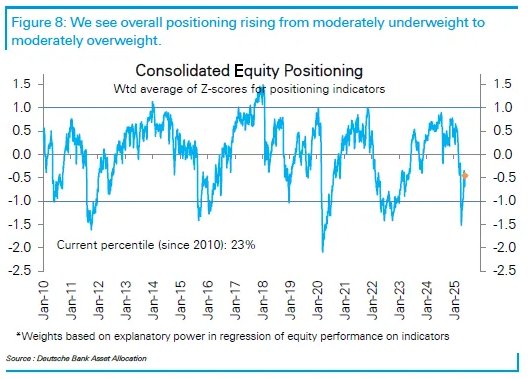
大型基金经理的持仓仍偏低 尽管看涨的散户投资者推动标普500指数重回历史高位,但美国总统唐纳德·特朗普不断变化的贸易政策 迫使这些机构投资者保持克制。这种仓位配置反映了机构资产管理者的谨慎情绪,但也给他们提供了增 加配置的空间,以跟上市场的步伐。 巴克莱银行全球股票战术策略主管Alexander Altmann表示,他的团队将在未来几周保持对美股的看多立 场,并称仓位和情绪都"过低"。 以Dubravko Lakos-Bujas为首的摩根大通策略师上周表示,随着特朗普政府的重点似乎从关税转向减 税,"阻力最小的道路就是创下新高"。"即使在全球股市出现V型反弹之后,投资者的仓位仍然处于轻 度至中等水平,市场情绪也较为低迷。" 智通财经APP获悉,巴克莱和摩根大通等公司的分析师认为美国股市还有进一步上涨的空间,部分原因 是他们预计机构投资者将放弃谨慎的立场并增加对股票的投资。 尽管美国股市已从4月份关税引发的下跌中强势反弹,但大型基金经理的持仓仍明显偏低:德意志银行 的数据显示,自2010年以来,其整体股票仓位之低仅在23%的时间里出现过。 Truist Advisory Services联席首席投资官Keith ...