
地缘政治

Search documents
全球瞭望丨荷兰国际集团:美国冒险主义对美元和石油意味着什么
Xin Hua She· 2026-01-05 14:47
Core Viewpoint - The analysis report from ING highlights the market's focus on the recent U.S. attack on Venezuela and its potential short-term, medium-term, and long-term impacts on regional and international relations [1] Group 1: Immediate Market Reactions - The initial market reaction to the January 3rd event in Venezuela was a mild "risk-off" sentiment, with gold and Swiss franc gaining traction, while the dollar received some support [1] - Stock index futures did not show excessive reaction to the current situation, while the oil market remained volatile as it assessed the short-term and medium-term impacts on Venezuela's oil production [1] Group 2: Currency and Commodity Implications - Investors may prefer the liquidity of the dollar in the face of uncertainty in the coming days, which could put pressure on Latin American currencies, particularly the Colombian peso and potentially the Mexican peso [1] - The oil market is expected to face increased uncertainty regarding supply, with short-term impacts largely dependent on the nature of the power transition in Venezuela [1] Group 3: Long-term Projections - The long-term market impact will depend on how much Venezuela can increase its oil production, which may take 5 to 10 years to reach levels of 2.5 to 3 million barrels per day [2] - The euro to dollar exchange rate has faced pressure after briefly exceeding 1.18 in late December 2025, with future developments in Venezuela potentially influencing further declines in the euro [2] Group 4: Geopolitical Considerations - Geopolitical factors are significant, as U.S. President Trump has not ruled out the possibility of deploying ground troops to Venezuela, which could lead to a complex military situation in multiple Latin American countries [2] - If the U.S. becomes embroiled in such conflicts, investors may adopt a more pessimistic outlook on U.S. fiscal health and the dollar's future [2]

油气行业2025年12月月报:受俄乌、委内瑞拉地缘政治博弈影响,12月油价震荡下跌-20260105
Guoxin Securities· 2026-01-05 13:56
Investment Rating - The oil and gas industry is rated as "Outperform" [4] Core Views - The report indicates that oil prices experienced fluctuations and a downward trend in December 2025, influenced by geopolitical tensions and supply concerns [1][12] - OPEC+ has decided to pause production increases in the first quarter of 2026, despite previous plans to increase output [1][16] - Demand for crude oil is expected to grow in 2025 and 2026, with estimates ranging from 83,000 to 130,000 barrels per day for 2025 and 86,000 to 138,000 barrels per day for 2026 [2][17] Summary by Sections Oil Price Review - In December 2025, the average price of Brent crude oil futures was $61.6 per barrel, down $2.0 from the previous month, while WTI averaged $57.9 per barrel, down $1.6 [1][12] - The fluctuations in oil prices were attributed to various geopolitical events, including the attack on the Russian Friendship Pipeline and sanctions on Venezuela [1][12] Supply Side Analysis - OPEC+ announced a pause in production increases for the first quarter of 2026, following a period of planned increases in late 2025 [1][16] - The report highlights that OPEC+ aims to maintain a balance in oil prices, with Brent crude expected to stabilize between $55 and $65 per barrel in 2026 [3][36] Demand Side Analysis - Major energy agencies project an increase in crude oil demand for 2025 and 2026, with specific figures provided by OPEC, IEA, and EIA [2][17] - The report notes that the refining industry in China is facing overcapacity issues, leading to stricter controls on new refining projects [3][18] Company Recommendations - The report recommends several companies, including China National Offshore Oil Corporation (CNOOC), China Petroleum & Chemical Corporation (Sinopec), Satellite Chemical, and CNOOC Development, as key investment opportunities [4]




全球瞭望|荷兰国际集团:美国冒险主义对美元和石油意味着什么
Sou Hu Cai Jing· 2026-01-05 13:47
Group 1 - The core focus of the financial market is on the recent U.S. attack on Venezuela, with investors assessing its short-term, medium-term, and long-term impacts on regional and international relations [1] - Initial market reactions included a mild "risk-off" sentiment, with gold and Swiss franc gaining traction, while the dollar received some support [1] - Oil market remains uncertain as investors evaluate the short-term and medium-term impacts on Venezuela's oil production, with current supply at approximately 500,000 barrels per day due to sanctions [1] Group 2 - The long-term market impact will depend on Venezuela's ability to increase oil production, which could take 5 to 10 years to reach levels of 2.5 to 3 million barrels per day [2] - The euro to dollar exchange rate has faced pressure, with geopolitical factors influencing its future trajectory [2] - U.S. President Trump's potential military involvement in Venezuela could lead to a more pessimistic outlook on U.S. fiscal health and the dollar, prompting investors to reconsider U.S. asset holdings [2]
荷兰国际集团:美国冒险主义对美元和石油意味着什么
Xin Lang Cai Jing· 2026-01-05 13:47
Group 1 - The core viewpoint of the report by ING is that the recent U.S. attack on Venezuela has significant implications for the financial markets, particularly concerning the dollar and oil prices, with investors assessing short-term, medium-term, and long-term impacts [1][2] - The initial market reaction to the event on January 3 was a mild "risk-off" sentiment, with gold and the Swiss franc gaining traction, while the dollar received some support [1][2] - The oil market is experiencing uncertainty regarding the short-term impact on Venezuela's oil production, which is currently assessed to be around 500,000 barrels per day due to sanctions [3][4] Group 2 - The future of the oil market will depend on how much Venezuela can increase its oil production, with estimates suggesting it could take 5 to 10 years to reach a level of 2.5 to 3 million barrels per day [4] - The euro to dollar exchange rate briefly surpassed 1.18 in late December 2025 but is now under pressure, with the future development of the Venezuelan situation likely to influence further declines [4] - Geopolitical factors are critical, as U.S. President Trump has not ruled out the possibility of deploying ground troops to Venezuela, which could lead to a more pessimistic outlook on U.S. fiscal health and the dollar's future [4]
光大期货:1月5日能源化工日报
Xin Lang Cai Jing· 2026-01-05 12:50
Group 1: Oil Market Overview - Recent oil prices have shown low volatility, with Brent crude closing at $60.8 per barrel and WTI at $57.33 per barrel as of January 2 [1] - A significant geopolitical event occurred on January 3, with the U.S. launching an operation against Venezuela, resulting in the capture of President Maduro, which is expected to lead to a spike in oil prices due to supply concerns [1][2] - Venezuela's current oil production is approximately 1 million barrels per day, with major production areas including the Orinoco heavy oil belt and the Maracaibo basin [2] Group 2: Geopolitical Impact - The change in Venezuela's political regime introduces high uncertainty regarding its oil production and trade flows, potentially shifting exports from west to east [2] - Colombia has called for an emergency meeting of the UN Security Council to address the regional stability concerns arising from the situation in Venezuela [2] - The geopolitical tensions are likely to increase risk premiums in the oil market, pushing prices higher in the short term [4] Group 3: OPEC+ and Inventory Data - OPEC+ is set to hold a meeting on January 4 to discuss production policies, with expectations of maintaining current output levels in the first quarter of 2026 [3] - U.S. oil inventories have shown a decrease, with total crude oil stocks at 836.107 million barrels, down by 1.686 million barrels from the previous week [3] - Gasoline and distillate inventories have increased, indicating mixed signals in the oil supply-demand balance [3] Group 4: Short-term Price Projections - The short-term outlook for oil prices suggests a potential for a pulse-like increase due to geopolitical tensions and supply disruption fears [4] - In the medium to long term, if U.S. companies regain access to Venezuelan oil, production could increase significantly, alleviating some structural issues in the oil market [4] Group 5: Fuel Oil Market Dynamics - High-sulfur fuel oil supply is expected to remain stable, with December shipments from the Middle East at approximately 4.6 million tons, despite a decrease from the previous month [6] - Demand for high-sulfur fuel oil is showing marginal improvement, with imports to China expected to be around 1 million tons in December [6] - The market remains focused on geopolitical developments, particularly the ongoing tensions between the U.S. and Venezuela, which could impact supply chains [7] Group 6: Asphalt Supply and Demand - The geopolitical situation between the U.S. and Venezuela is causing uncertainty in the supply of diluted asphalt, although current supply remains stable [9] - China's asphalt production is projected to be around 2.1 million tons in January, reflecting a slight decrease from December [9] - The market is currently experiencing a weak demand environment, particularly in northern regions, as construction activities slow down [9]
发生了什么?国际油价不涨反跌,地缘冲突难改供需格局
Xin Lang Cai Jing· 2026-01-05 11:45
Group 1: Oil Price Movement - International oil prices initially rose due to the capture of Venezuelan President Maduro, with U.S. crude reaching $57.73 per barrel and Brent crude hitting $61.24 per barrel [2][12] - However, prices later declined, with Brent crude falling 0.69% to $60.32 per barrel and U.S. crude down 0.82% to $56.85 per barrel [2][12] - The market's rational assessment indicated that while the Venezuelan situation might reduce oil supply, the overall impact on global supply was limited due to existing oversupply conditions [2][12] Group 2: Venezuelan Oil Production and Global Impact - Venezuela holds the largest proven oil reserves globally, accounting for approximately 17% of the total, but its current production is less than 1% of global output due to political and economic issues [4][14] - The limited impact of Venezuela's production on global oil prices is attributed to its small export volume and concentrated export destinations [14] - Analysts suggest that any potential recovery in Venezuelan oil production could alter the global supply structure, but current production challenges remain significant [5][15] Group 3: Geopolitical Factors and Market Dynamics - The geopolitical situation in Venezuela, including U.S. military actions and sanctions, has been factored into oil market pricing for some time, leading to limited immediate effects on oil prices [3][14] - The U.S. has a vested interest in Venezuelan heavy crude oil due to its compatibility with U.S. refining capabilities, which are designed for processing heavy crude [17] - The ongoing geopolitical tensions, including the situation in Iran and the Russia-Ukraine conflict, continue to influence market sentiment and risk premiums [18][19] Group 4: Supply and Demand Outlook - The oil market is expected to remain oversupplied in the first quarter of the year, with increasing production from non-OPEC countries like the U.S. and Brazil [19][20] - Demand forecasts for 2026 are not optimistic, suggesting that the oversupply situation may persist [19] - OPEC's decision to pause production increases indicates a proactive management approach to supply, providing some support to the market [20]


原油期货:供应充足、地缘持续发酵
Ning Zheng Qi Huo· 2026-01-05 11:42
期货研究报告 2026年01月05日 周报 原油期货:供应充足、地缘持续发酵 师秀明 投资咨询从业资格号:F0255552 shixiuming@nzfco.com 报告导读: 1、市场回顾与展望:一方面,当地时间1月3日,美国总统特朗普称,美方已成功对委内瑞拉实施打击, 抓获委内瑞拉总统马杜罗及其夫人,并带离委内瑞拉,目前委内瑞拉原油产量在100万桶/日附近,仅为全球原 油产量的0.8%,当前,委内瑞拉的原油出口量约为60万桶/日,对全球供应总量的直接影响相对有限。伊朗由于 里亚尔贬值,通胀极高以及国际制裁问题导致全国性抗议活动;同时12月乌克兰打击俄罗斯能源基础设施次数 创俄乌冲突以来新高。受地缘密集利多影响,上周布伦特原油微涨0.47美元/桶或0.78%。 2、对于后市。虽然OPEC+在一季度暂停增产,但巴西、加拿大等非减产联盟国家产量预计进一步提升,供 应仍充足。后续重点关注:1)OPEC+在1月是否按计划暂停增产;2、伊朗问题走向;3、马杜罗被带走后,委内 瑞拉重油政策、产量和出口变化情况。 3、关注因素:1.地缘政治;2.原油周度数据。 | 原油 | 单位 | 最新一周 | 上一期 | 周度环比变 ...
马杜罗,或将面临终身监禁
中国能源报· 2026-01-05 10:53
以下文章来源于中国新闻网 ,作者管娜 中国新闻网 . 看中国新闻,就上中国新闻网 美国纽约南区联邦地区法院网站说, 马杜罗将于美国东部时间1月5日1 2时(北京时间6日1时)出庭。 "无限制权力的表达,没有什么比在深夜从首都绑架一位在任总统更直白了。"美国有线电视新闻网(CNN)当地时间1月3日感叹道。 美军当天凌晨突袭委内瑞拉首都加拉加斯等地,强行控制委内瑞拉总统马杜罗夫妇,震惊世界。 当天晚上,马杜罗抵达纽约一处拘留中心。美国纽约南区联邦地区法院网站4日发布的通知说,马杜罗将于美国东部时间5日1 2时(北 京时间6日1时)出庭。 ▲ 据路透社报道,当地时间1月3日,委内瑞拉总统尼古拉斯·马杜罗及其妻子弗洛雷斯乘坐的飞机抵达位于美国纽约的斯图尔特空军国民警卫 队基地。 接下来,马杜罗将面临什么? 美国司法部3日公布了针对马杜罗夫妇及其儿子的起诉书。CNN3日称,预计马杜罗将于下周在纽约曼哈顿联邦法院面临毒品和武器走 私指控。 根据美国司法部长邦迪的说法,马杜罗被指控犯有"毒品恐怖主义阴谋罪、可卡因走私阴谋罪、持有机枪及破坏性装置罪,以及针对美 国的持有机枪及破坏性装置阴谋罪"。 《印度斯坦时报》称,美国针对 ...

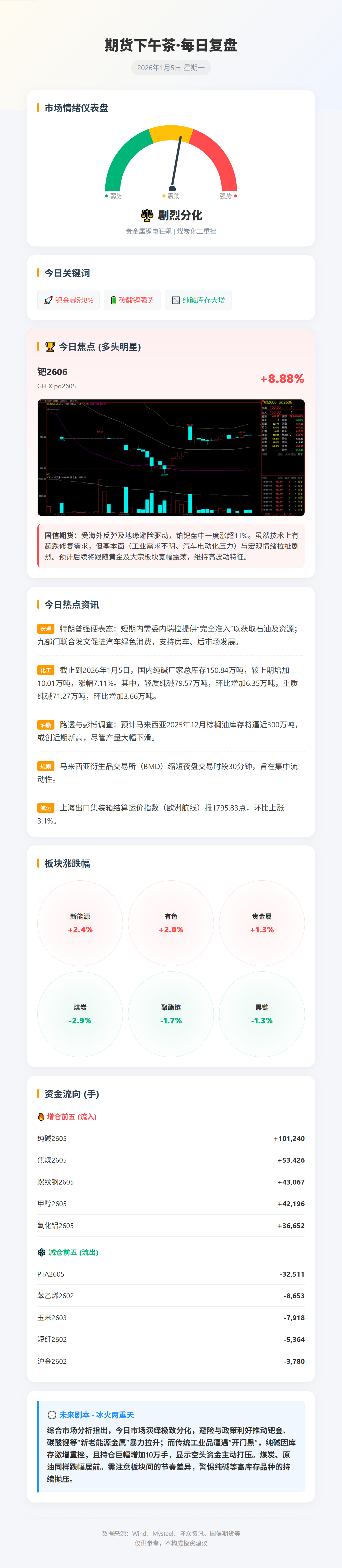
每日期货全景复盘1.5:铂、钯期货预计仍将维持高波动特征
Xin Lang Cai Jing· 2026-01-05 10:33
Market Sentiment - The market sentiment is currently weak, with significant divergence observed across sectors, particularly in precious metals and lithium, which are experiencing strong gains, while coal and chemical sectors are facing sharp declines [1]. Key Highlights - Lithium carbonate prices surged by 8.88%, with the main contract reaching 129,980 yuan/ton, driven by strong supply-demand dynamics [10][25]. - Domestic soda ash inventory increased to 1.5084 million tons, up by 10,010 tons or 7.11% from the previous period [4][19]. - The price of platinum and palladium saw significant fluctuations, with platinum rising by 6.48% and palladium by 8.88% after an initial spike of over 11% [10][26]. Sector Performance - The new energy sector showed a positive performance with a 2.4% increase, while coal and polyester chains declined by 2.9% and 1.7% respectively [5][21]. Fund Flows - The top five positions with increased holdings included soda ash (2605) with +101.2,焦煤 (焦煤2605) with +53.4, and rebar (螺纹钢2605) with +43.0 [6][22]. Commodity Insights - The supply of lithium is expected to tighten due to regulatory issues affecting domestic mining operations, with a projected monthly reduction of 0.8-1 million tons from key suppliers [10][25]. - The oil market is under pressure due to concerns over oversupply, with SC crude oil prices dropping to 421.7 yuan/barrel, marking a 3.39% decline [12][27].
智通决策参考︱地缘政治再次扰动市场 大国博弈在航天领域展开较量
Zhi Tong Cai Jing· 2026-01-05 09:59
精品VIP投研内容 当前内容仅限订阅用户查看 【免责声明】本文仅代表作者本人观点,与和讯网无关。和讯网站对文中陈述、观点判断保持中立,不对所包含内容 的准确性、可靠性或完整性提供任何明示或暗示的保证。请读者仅作参考,并请自行承担全部责任。邮箱: news_center@staff.hexun.com VIP (责任编辑:刘畅 ) 立即订阅 ...